Get in touch with Kitech Company

Plastic Film Pelletizing Machine
Plastic Film Pelletizing Machine — PE PP Film Recycling & Granulation | KITECH
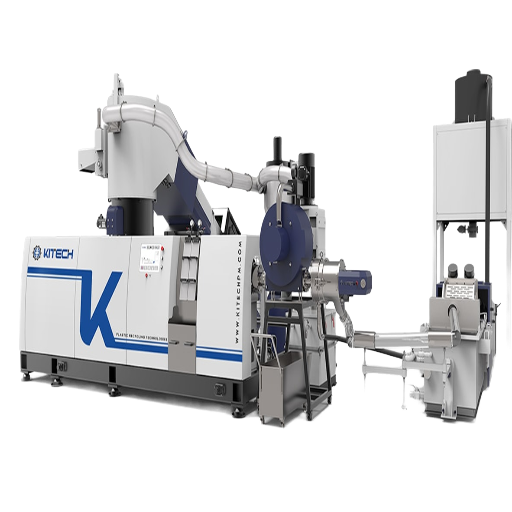
Turn waste PE, PP, LDPE, HDPE film into market-ready recycled pellets. KITECH KCP series pelletizing lines provide 200-1500kg/h throughput with Siemens PLC control, double vacuum degassing, water ring pelletizing – designed for nonstop operation in film recycling facilities around the world.
200–1500
kg/h Capacity
25+
Years Experience
6
Film Types Processed
Siemens
PLC + HMI Control
What Is a Plastic Film Pelletizing Machine?
A pelletizing machine is recycling machinery that melts waste plastic film and recycles it into small, regular plastic pellets. Sometimes called regranulate, these recycled pellets are the starting point for downstream film blowing, injection molding, pipe extrusion, and sheet manufacturing; the equipment takes film waste and transforms it into a usable pellet feedstock.
The KCP Series Application
As a plastic recycling machine, the KCP series is often installed as the final recycling machine in a larger plastic recycling line. Some customers also use the same plastic recycling pelletizing platform after bottle recycling cap-and-label streams or film scrap have already been washed and dried.
Overcoming Film Challenges
Recycling film is very different from recycling rigid objects like bottles or boxes. Film has low bulk density, it wants to bridge and wrap around mechanical parts, and the weight makes it awkward to move; the optimal pelletizer for film addresses these issues – densifies the material before it enters the extruder barrel – so it processes smoothly without stalling.
Industry Leader
25 Years of Engineering Excellence
KITECH has been making plastic pelletizers for 25 years. Its pelletizer series is uniquely designed for the high-heat, low-melt-strength nature of polyethylene; the KCP machines use high-efficiency alloy screws and a single screw extruder for high throughput and a reliable melt process.
This results in a high-quality, dependable product that commands a premium price above flake or regrind because it can be metered accurately in gravimetric feeders and melt predictably. Moving into pellet form is the critical step that allows film waste streams to be sold as refined commodities.
How Film Pelletizing Machine Works: From Waste to Pellets
Converting loosely bundled film waste into densified pellets requires four key processes: densification, extrusion and melting, degassing and filtering, and pelletizing and cooling. Each stage necessitates particular design considerations.
Stage 1 — Feeding and Compaction
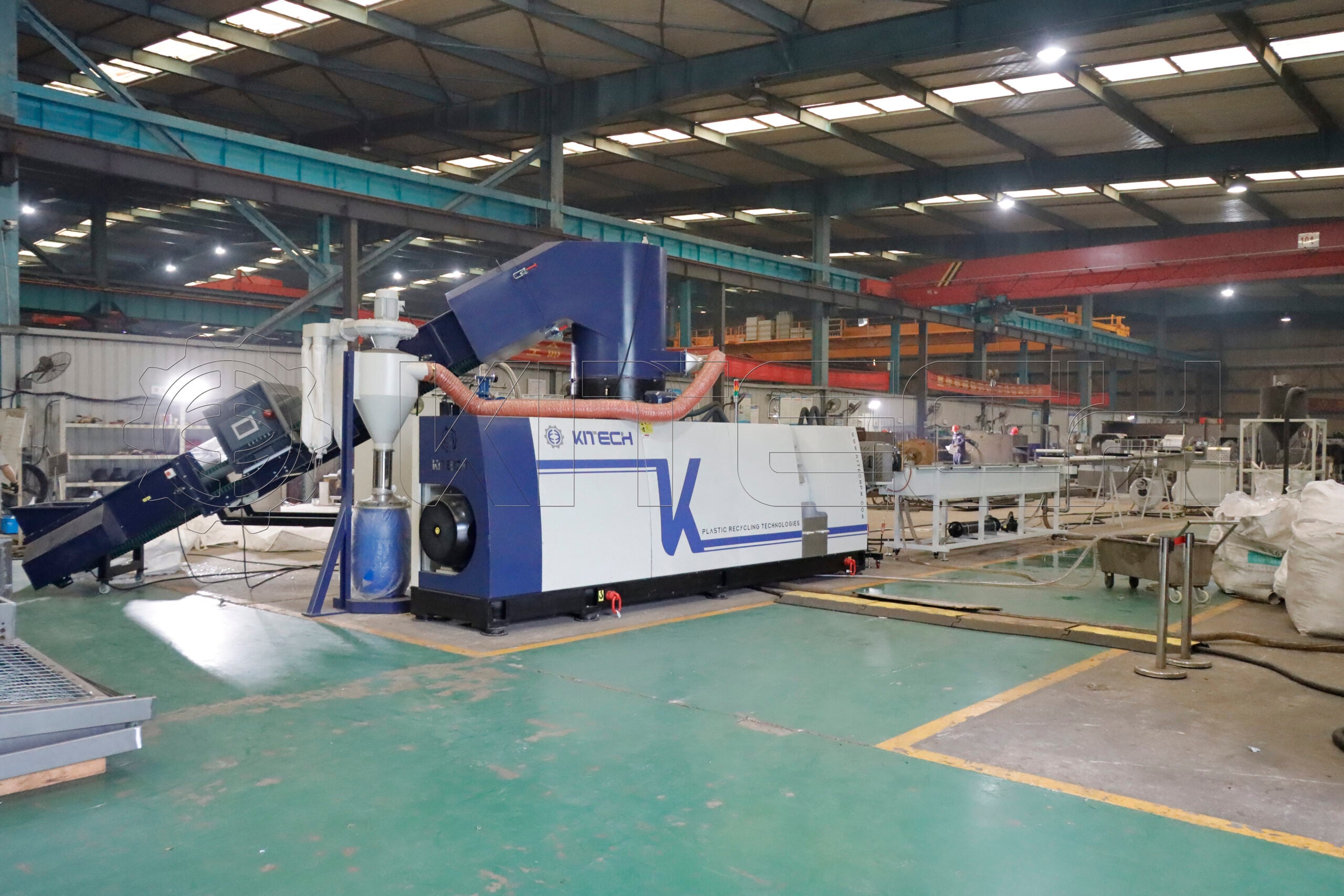
A conveyor or conveyor-belt delivers the bulky film to a cutter-compactor, or agglomerator, where high-speed blades cut, friction-heat, and compact the film into a dense particle. Densification allows consistent feed into the extruder, raising bulk density from ~30-50 kg/m³ to 200-300 kg/m³. This step is necessary unless you’re processing treated cut trim with a consistent profile.
Stage 2 — Extrusion and Melting
Compacted flake is gravity fed into a single screw extruder – on KITECH KCP machines, using a bimetallic alloy for 1.5 times longer wear; the screw heats the molten mass by compression, friction, and barrel band heaters – set to 160-190°C for LDPE, 190-220°C for polypropylene. Specific screw geometry is necessary to achieve a uniform melt.
Stage 3 — Degassing and Filtration
The moisture, printing ink volatiles, and any entrained air must be vented from the melt prior to pelletization. At KITECH, this is achieved with double vacuum venting; this is two extended vent zones along the barrel of the extruder connected to vacuum pumps of the type used in instrument refrigerators. Molecules of moisture and ink volatiles are brought to the surface and expelled through the first vent zone into the vacuum trap; the second zone allows the volatiles that migrate to the top of the melt to be removed. Finally, the air is vented from the melt and it is passed through a screen changer with hydraulic slide plates that remove contaminants from the melt (paper labels, dirt, unmelted particles). Continuous screen changers eliminate the need for the line to stop and allow for easy filter change.
Stage 4 — Pelletizing and Cooling
The melt then passes through a die plate with multiple holes. In a typical water ring pelletizing system (the common system used for PE and PP film), the water ring cools the pellets while cutter blades cut the strands at the die face. A column of circulating water forms a film around the strands, cooling and transporting them to the centrifugal dryer; the dry pellets are transported to a bin or baggable container. Die hole diameter (normally 3-5mm) and cutter speed are used to control pellet diameter.
Types of Pelletizing Systems for Plastic Film
Not all pelletizing systems will yield the same results for film; the type system that is correct for your film is a function of the polymer type, the throughput level needed, the level of contamination, and your pellet shape requirement. Here are the three primary types of pelletizing equipment used in plastic recycling, with real-world practicality considerations:
Water Ring Pelletizing
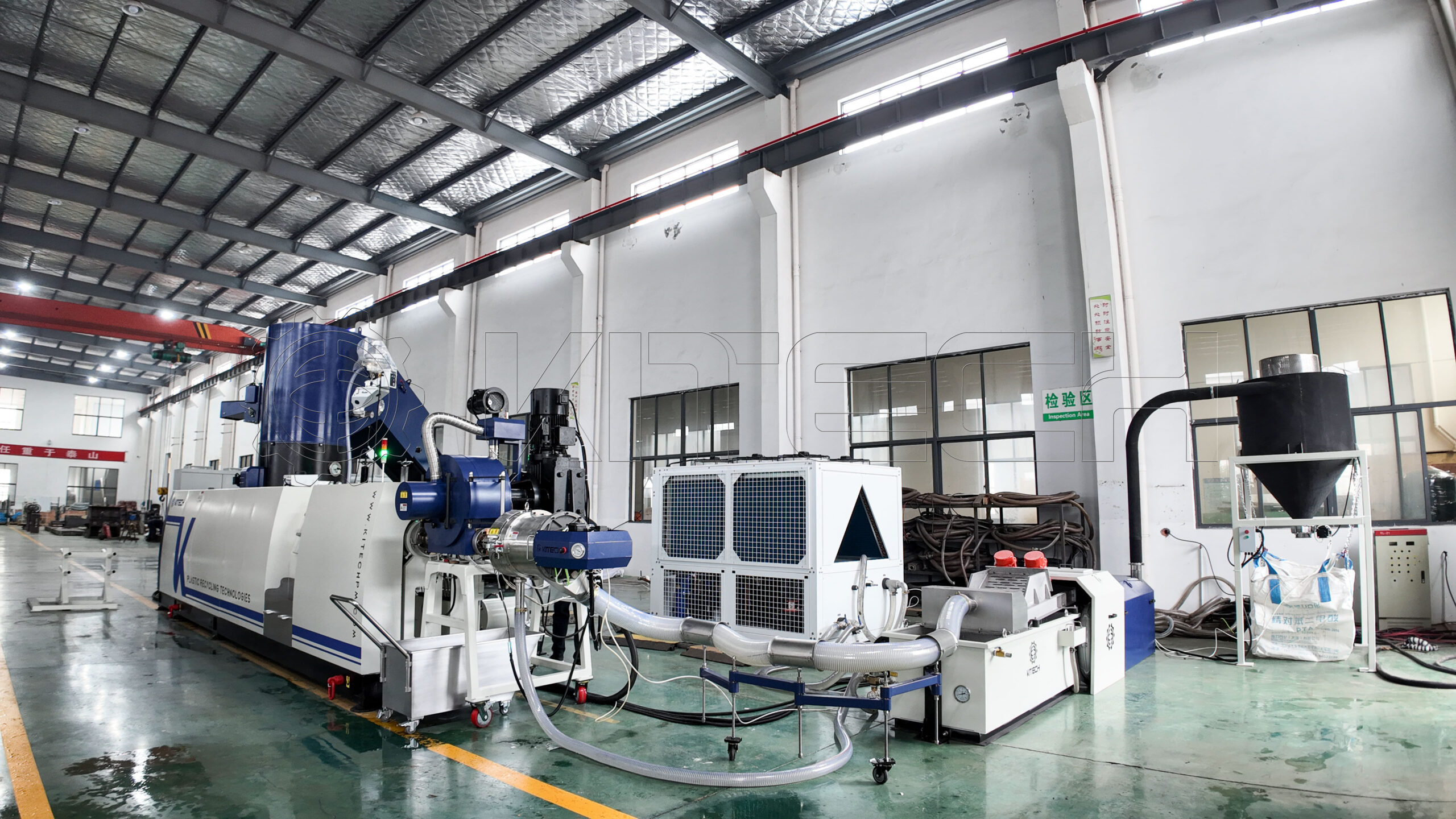
In water ring pelletizing, cutter blades chop the strands at the die face and the water ring cools the chips. This works well with film because the low melt strength polymers characteristic of film will strand break if attempt is made to draw the strands. This method produces lens-shaped and spherical pellets. It has a small footprint and moderate maintenance costs. This system is most common with recycling film but, as it is also the most common for rigid plastics, may be mixed in the future with strand pelletizing systems that also will process rigid plastic. Since this is the easiest system to set up, it is the default on KITECH KCP line.
Strand Pelletizing
The process is similar to water ring, but instead of water the molten plastic exits the die and is extruded through a series of long strands which are cooled in a water bath before being cut with a strand cutter. This creates pellets with a cylindrical shape. This system is easier on cutter blades and is more efficient with higher melt strength polymers (HDPE, PP homopolymer). However, its higher capital costs and the greater amount of room needed for the water trough means it is more expensive to operate and likely less popular for film processors.
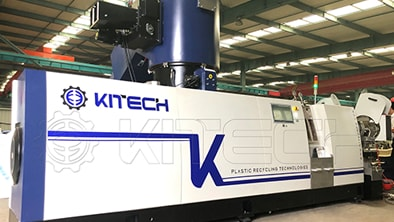
Die Face (Hot-Cut) Pelletizing
The die face pelletizer cuts at the die face itself. Instead of water contacting the pellets as they are cut, the pellets are immediately injected into a chamber of circulating air which cools and transports them. This system is used for engineering plastics, filled compounds, and masterbatch. It has a higher capital investment and requires more maintenance on the blades because they are exposed to more product and hotter temperatures; the cost is justified if you need to pelletize an engineering plastic or a heavily filled compound in the same line that will also pelletize film. For typical film recycling, your first choice is likely to be one of the others.
Which System Fits Your Film Recycling Operation?
For most PE and PP films where throughput ranges from 200-1500 kg/hr, water ring pelletizing is the best option of structure, handling, and operating cost. Strand pelletizing offers flexibilities that make sense if you process rigid plastics on the same line and want to have an option. Die face pelletizing systems are expensive and do not offer sufficient benefit for film to be used routinely; they are specialty equipment for other applications.
Some common errors:
purchasing a pelletizing extruder geared towards rigid plastic and expecting it to handle film efficiently. Film needs a different feeding strategy to compensate for low bulk density and bridging potential. A cutter-compactor or force-feeder at the inlet is essential or else the screw starves and output quality suffers. Check references – ensure the systems supplier has genuine film recycling plants in operation, not just rigid plastic references.
If you want to narrow the configuration before speaking with engineering, use the selector below to match your material, contamination level, throughput, and output goal to a practical KCP line size.
Film Pelletizing Line Selector
Pick your material, contamination level, throughput and output target. The selector maps those inputs to a practical KITECH KCP recommendation using the capacity, washing, filtration and method guidance already used on this landing page.
1. Material Type
2. Feedstock Condition
3. Throughput Target
4. Output Priority
Recommended Setup
KCP-150
Suggested Line
Pelletizing Method
Washing Need
Price Band
Why This Fit Makes Sense
Send us your material photos, contamination level and hourly output target. Our engineers can confirm whether you need a simple pelletizing line or a full wash-dry-pelletize layout.
Request a Line RecommendationSelector logic uses the KCP-100 to KCP-200 capacity table, published price tiers, and the page’s own guidance on washing, filtration and water ring vs strand choices.
Choose all four inputs on the left, then generate a recommendation. It is designed for PE/PP film buyers deciding between a simple in-house scrap line and a heavier post-consumer recycling setup.
PE PP Film Pelletizing Machine Technical Specifications & Machine Performance
KITECH KCP series pelletizers cover a range of processing sizes; the following details span the full KCP range from the KCP-100 to the KCP-200. All machines feature a standard Siemens S7 PLC with a HMI touchscreen interface for temperature control, recipe storage, and PID alarm management.
| Parameter | KCP-100 | KCP-120 | KCP-150 | KCP-180 | KCP-200 |
|---|---|---|---|---|---|
| Screw Diameter (mm) | 100 | 120 | 150 | 180 | 200 |
| Output Capacity (kg/h) | 200–300 | 300–400 | 400–600 | 600–1000 | 1000–1500 |
| Main Motor Power (kW) | 55–75 | 75–90 | 110–132 | 160–200 | 250–315 |
Universal KCP Series Specifications
Screw Material
Bimetallic alloy (38CrMoAl + alloy layer) — ~1.5× service life vs. standard nitrided screw
Degassing
Double vacuum degassing (two vent zones + vacuum pumps)
Pelletizing Method
Water ring pelletizing (standard) / Strand pelletizing (optional)
Control System
Siemens PLC + 10″ HMI touchscreen, recipe storage, remote diagnostics
Feeding System
Belt conveyor + cutter-compactor (for film) / Force feeder (for rigid scrap)
Filtration
Continuous hydraulic screen changer, 80-150 mesh
Performance Considerations for Film Recycling
Rated throughput based upon clean, pre-shredded single-polymer film. In reality, throughput will be about 10-15% below these values on post-consumer contaminated film, due to the time consuming nature of screen changer changes and the buffer time required to stabilize density fluctuations in the fed material. On a clean factory edge trim based line, operators have been known to run 5-10% above rated throughput as they become more experienced at optimizing cutter-compactor feed input.
Pay particular attention to your specific energy consumption on the SEC (specific energy consumption) vs. time graph. A good pelletizing line will consume about 0.25-0.35 kWh per kg of processed film. Increased contamination will increase specific energy use, because more motor torque is needed to force the melt through finer filter membranes to maintain flow. Keeping a record of your specific energy usage per kg of output on the Siemens HMI helps staff to identify process drift early - once specific energy passes 15% above baseline values it is usually time to check the screw and barrel set clearance.
The comparison tool below turns that specification table into a quicker shortlist, especially if you are choosing between KCP-120, KCP-150, KCP-180, and KCP-200 for future expansion planning.
Materials & Applications: PE, PP, LDPE Film Recycling
KITECH KCP range of plastic pelletizing systems are suitable for all thermoplastic film groups, from pre-consumer factory scrap to post-consumer municipal waste.
LDPE
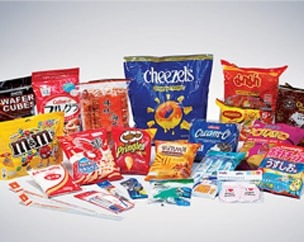
Common Sources
Stretch wrap, agricultural film, greenhouse cover
Processing Notes
Low melt temp (160-180°C), sensitive to overheating
Applications
Bin liners, irrigation pipe, construction film
LLDPE
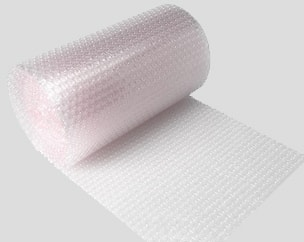
Common Sources
Packaging film, pallet wrap, silage wrap
Processing Notes
High viscosity, excellent melt strength
Applications
Film blowing, heavy-duty bags, geomembranes
HDPE
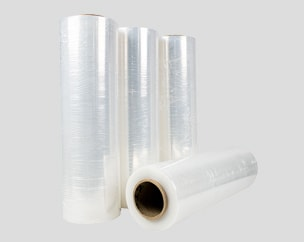
Common Sources
Shopping bags, industrial liners, bottle caps
Processing Notes
Melt temp (190-210°C), stiffer melt, good pellet shape
Applications
Pipe extrusion, injection molding, blow molding
PP

Common Sources
Food packaging, woven bags, BOPP label film
Processing Notes
Narrower processing window (190-220°C)
Applications
Injection molding, automotive parts, textile fibers
BOPP
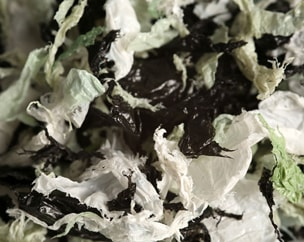
Common Sources
Snack packaging, cigarette wrap, lamination film
Processing Notes
Requires deorientation during compacting
Applications
Non-woven fabric, injection molding compound
Mixed PE/PP
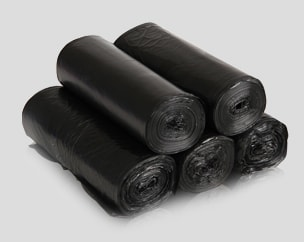
Common Sources
Multi-layer packaging, factory co-mingled scrap
Processing Notes
Requires broad-window screw design
Applications
Composite lumber, drainage board, pallets
Case Studies: Plastic Film Pelletizing Machine Projects in Action
Every operation's targets, feedstock, and budget constraints are different. Here are a few examples of how KITECH KCP pelletizing units operate in real time.
Agricultural Film Recycling — Shandong Province, China
KCP-150 | LDPE mulch film | Installed 2023
A Shandong farm co-operative gathered used LDPE mulch film from 200-hectare cropland; the heavily caked-up film was washed on-site using a wet type system with hot wash tanks and friction washers. A KITECH KCP-150 pelletizing line with a wet washing system came immediately afterward; the thoroughly washed film was fed at a steady pace through a cutter-compactor into the extruder; the double vacuum degasser vented off moisture still present after the hot-air dryer.
The line is running two shifts per day, turning out recycled film grade LDPE in pellet form for sale to a local pipe maker of irrigation tubing. On average, monthly production of recycled pellets is 150-180 tonnes, with seasonal variation reflecting the fluctuation in community film collection.
"The biggest change was pellet consistency. Before, with our old machine, the pipe maker rejected about 15% of our shipments for black specks and moisture. Since installing the KITECH line with the double degassing, our rejection rate dropped to under 2%." — Operations Manager, recycling cooperative
Packaging Film Scrap Recovery — Ho Chi Minh City, Vietnam
KCP-120 | LLDPE/LDPE stretch wrap | Installed 2024
A film converter in Vietnam produces about 800 kilograms of fresh, 100% virgin LLDPE and LDPE edge trim and start-up scrap every work shift, but chooses not to sell it as baled scrap, instead installing a KITECH KCP-120 pelletizing line on premises to reprocess the scrap in-house. This clean, single-material factory waste does not need a washing system, and feeds directly into the pelletizer cutter-compactor.
The in-house recycled pellets are re-blended into the factory's film making process at a 15-20% ratio, replacing some virgin material and cutting raw material costs. Because the production run is entirely from purified factory waste, with no soil or organic matter, upstream trucking and delivery costs for selling baled scraps become unnecessary.
"We calculated payback in about 14 months based on the spread between scrap sale price and virgin LLDPE; the actual payback came faster because virgin prices went up after we installed." — Plant Director, packaging manufacturer
Post-Consumer PP Woven Bag Recycling — Karachi, Pakistan
KCP-180 | PP woven bags + BOPP lamination | Installed 2022
A recycling operation in Karachi takes in washed, shredded used woven PP bags, mostly rice, fertilizer, and cement ones. A large percentage of these bags are laminated with a thin BOPP film layer, making it very difficult to process. KITECH set up a KCP-180 pelletizer with an extended screw length (L/D ratio of 36:1 vs. 32:1 factory standard) to enable longer melt residence time in the face of dual-material blending, along with a double-piston continuous screen changer to cope with the ink.
The plant runs at 12-15 tonnes per day; the recycled pellets are sold for use in injection molding of plastic crates, buckets, and automotive under-body panels where the dark color of reprocessed scrap is not stigmatized; the extended screw length and dual vacuum degassing zone proved to be essential in controlling the vapor pressure of the ink, resulting in a superior pellet for injection molding applications.
"We tried three other machines before this one; the problem was always the ink fumes — pellets came out with voids inside; the extended barrel length and double vacuum solved it. Our pellet density is consistent now and the injection molders stopped complaining." — Owner, Karachi recycling facility
Plastic Film Pelletizing Machine: After-Sales Service & Support
A pelletizing machine is a long-living investment. KITECH ensures long-term performance through professional support behind every machine we ship.
Installation & Commissioning
On receipt of your order, KITECH sends engineers from China to your site for installation supervision, electrical wiring, mechanical calibration and test-run commissioning (feedstock material shall be run through the line to several target specifications).
Operator Training
On the site, much work can be done including daily operating, parameter setting for various materials, troubleshooting basics, preventive maintenance, safety operation, etc. After training, operators will know how to operate the machine in a proper way. Normally 3-5 days training is made for one machine according to its function and the operator's proficiency.
Warranty Coverage
Warranty: 1 year fully on the main components of the machine (screw, barrel, gear box, motor, PLC system). Wear parts (cutter blades, screen meshes, heater bands) are not covered but offered in spare parts kits. Extended warranty available for the second and third year.
Remote Diagnostics
The remote access to the Siemens PLC system is by means of VPN. KITECH technicians from the Control Centre will be able to view the current process data, alarm records and trend charts for troubleshooting without requiring physical presence at the site; the typical response time for remote access support will be within 24 hrs on working days.
Spare Parts Supply
Critical wear parts - cutter blades, screen meshes, barrel heater bands, and thermocouple sensors - are in stock at the KITECH factory in Jiangsu, and can be sent anywhere around the world. Standard parts are sent within 3-5 business days. Screw and barrel sets, which are longer lead items, can be sent within 4-6 weeks. KITECH offers the advice that you keep a starter spare parts kit at your facilities so as not to stop production while waiting for shipment.
Plastic Film Pelletizing Decision & ROI Toolkit
Film Recycling ROI Calculator
The calculator uses the landing page's own published ROI logic: pellet value minus scrap value, then subtract electricity, labor and maintenance. It is built for film converters and recyclers evaluating a KCP pelletizing line.
KCP Model Comparison
Compare KCP-120 through KCP-200 side by side. These values are taken from the same specification table used on the landing page, including screw diameter, capacity, motor range, degassing and filtration setup.
Frequently Asked Questions
What is the difference between a pelletizer and a granulator?
Granulators do not heat plastics and chop it into flakes; while pelletizers melt the plastics and push them through a nozzle and cut into pellets. Pellets provide a more uniform input stream for injection molding and film blowing equipment than irregular granulator flakes.
What are the differences between water ring, strand, and die face pelletizing?
Water Ring uses the pump to push the melt through a die where it is cut at the die face using a rotating cutting knife. While the ring of water cools the pellets to allow them to be transported and cut the pelleting process takes place at the die face. This type is suitable for polymers with low melt strength like low density PE and produces lens like pellets in a small machine footprint. Strand pelleting pushes extrudate through a die into a water bath; this type is suitable for polymers with high melt strength like high density PE and produces cylindrical pellets, cleaning blades is more difficult in this design. Die face (hot-cut) uses a cutting knife at the die face. This design is ideal for a masterbatch production and compounding activity. For PE/PP film recycling most plants use Water ring pelleting because it balances cost and footprint with pellet quality over Strand and die face pelleting.
How much does a plastic pelletizing machine cost?
Market price for plastic film pelletizing equipment cost vary from $18,000 to $120,000 depending on capacity, configuration and level of automation. Small single stage system (200 kg/h) usually provides a lower range from $18,000 to $35,000. Sales of mid-range screen size (300-500 kg/h), double degassing, Siemens PLC controls, batch or continuous configuration would be $40,000 to $75,000. Larger configurations (800-1500 kg/h), greater automation, 24 hour packaging, higher-end filtration and water ring pelleting would cost over $80,000. Factors would be additional material handling, installation, and customized dies.
How much does a plastic pelletizing machine cost?
Market price for plastic film pelletizing equipment cost vary from $18,000 to $120,000 depending on capacity, configuration and level of automation. Small single stage system (200 kg/h) usually provides a lower range from $18,000 to $35,000. Sales of mid-range screen size (300-500 kg/h), double degassing, Siemens PLC controls, batch or continuous configuration would be $40,000 to $75,000. Larger configurations (800-1500 kg/h), greater automation, 24 hour packaging, higher-end filtration and water ring pelleting would cost over $80,000. Factors would be additional material handling, installation, and customized dies.
Can you pelletize printed or contaminated film?
Yes, but printed and contaminated film requires pre-treatment and additional filtration. Ink residue from printed film becomes a contaminant in the melt — a continuous screen changer with fine mesh (100-150 mesh) removes most ink particles. Heavy contamination (soil, adhesive, food residue) calls for a pre-washing line before pelletizing. Double vacuum degassing also helps extract volatiles from ink solvents; the resulting pellet color will be darker than virgin material, but the mechanical properties remain suitable for non-critical applications like black pipe, drainage board, or composite lumber.
How is pellet size controlled in a pelletizing machine?
Three variables control it: die hole diameter (usually 3-5mm), cutter blade RPM, and extruder throughput. Most operators target 3-4mm pellets. KITECH machines store size presets on the Siemens PLC so switching between LDPE and PP takes minimal adjustment.
What maintenance does a plastic pelletizer require?
Plan on daily cutter blade inspection — sharpen or replace every 200-400 operating hours depending on how abrasive your feedstock is. Weekly gearbox oil level checks, monthly screen changer mesh replacement, and quarterly screw-barrel wear measurement round out the routine. Keep the screw-barrel clearance under 0.5mm; once it exceeds that threshold, output drops and pellet quality suffers noticeably. KITECH uses bimetallic alloy screws rated for roughly 1.5 times the service life of standard nitrided screws, which stretches out the replacement cycle and reduces long-term operating costs. Keeping a basic spare parts kit on-site (blades, meshes, heater bands, thermocouples) prevents unplanned downtime while waiting for international shipments.
Can KITECH design a complete recycling line from shredding to pelletizing?
Yes. KITECH provides turnkey plastic film recycling lines that cover the entire process: shredding, washing (if needed), drying, compacting, extrusion, filtration, pelletizing, and pellet classification. Each line is engineered around the specific input material — post-industrial film scrap requires a simpler line than post-consumer agricultural film that needs a full washing stage. KITECH assigns a project engineer who visits the site or re