Get in touch with Kitech Company

Plastic Granulator & Pelletizing Machine — Complete Recycling Solutions
From post-industrial film scrap to post-consumer PET bottle flakes—Kitech supplies pelletising systems that convert plastic waste into sale-ready granules. Four product ranges meet every material type, every throughput capacity, and every budget.
25+
Years Experience
300+
Clients Worldwide
55+
Export Countries
2000
kg/h Max Capacity
What Is a Plastic Granulator?
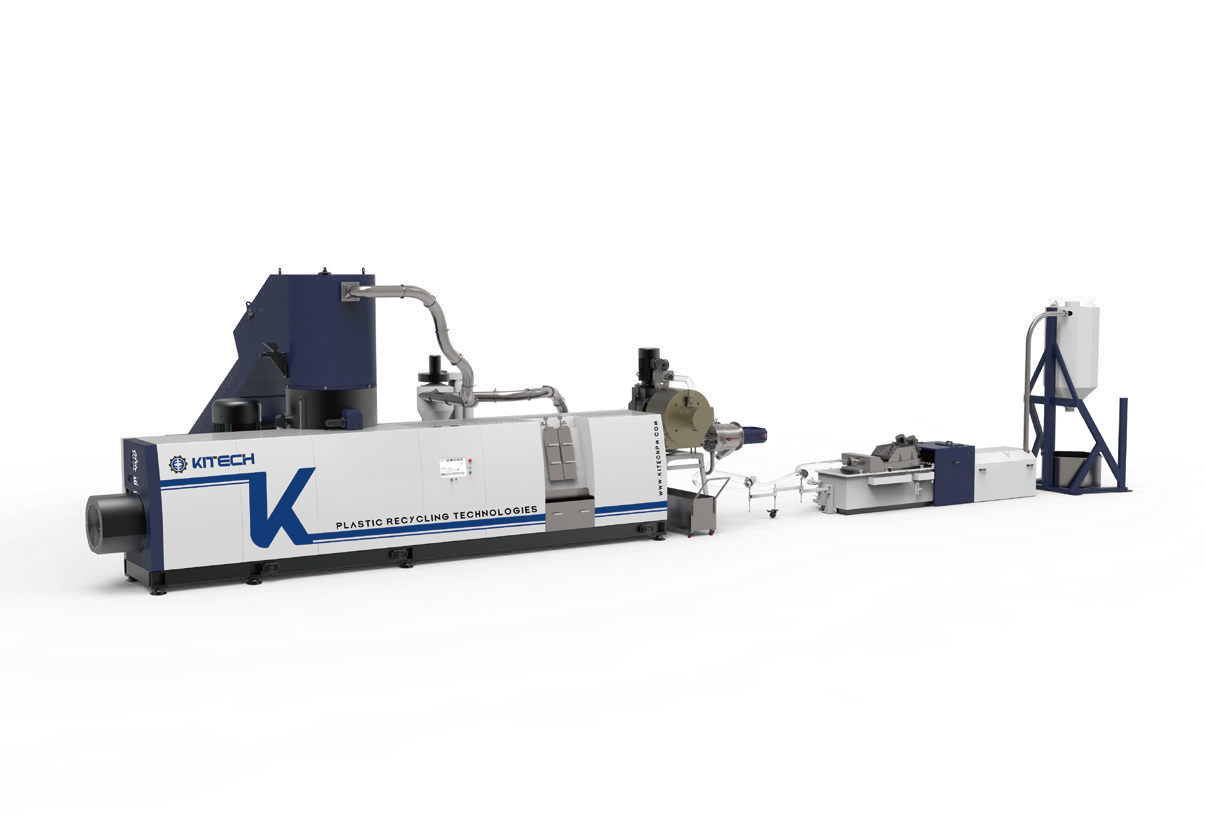
A plastic granulator (also called a grinder), pelletizing machine, pelletizer, or granulation system—designed for processing waste plastics into pellets—is the key piece of a recycling system that gives new raw material, in the form of uniformly sized granules, to downstream manufacturing processes such as injection molding, blow molding, film blowing, and profile extrusion.
Industry Terminology & Integration
The words “granulator” and “pelletizer” are used interchangeably in the plastics-processing industry, but the former traditionally refers to a size-reduction machine, while the latter refers to a plastics re-forming machine. Modern integrated systems (e.g., Kitech KCP and KSP series) use pelletizers that also incorporate a granulation function, as well as compaction, extrusion, filtration, and degassing, all in a single pelletizing line that accepts scrap and returns finished, dust-free pellets.
Pelletizing vs. Shredding Systems
Pelletizing systems differ from shredding systems in that while the latter simply reduce the size of plastic scraps, pelletizing involves melting and reprocessing the plastic to produce saleable, uniform pellets. This results in more time, money, and lower labor inputs invested in the material handling prior to sale; greater material value; and easier transport and better flow rate control when feeding a downstream process.
How Plastic Granulation Works
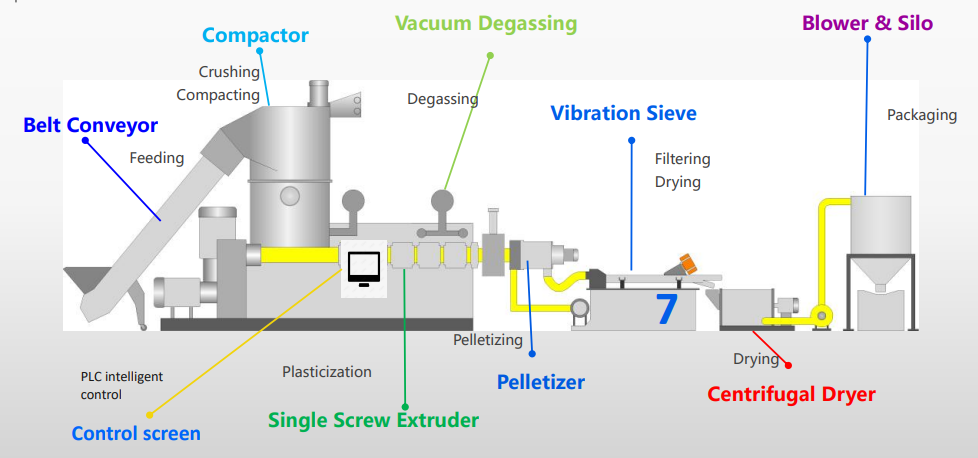
The granulation process, in general, involves a precise sequence of mechanical and thermal stages that convert plastic scrap—whether it is post-industrial film, washed flakes, or rigid regrind—into sale-ready pellets. Kitech relies on an integrated process to reduce handling and energy costs with an efficient approach.
1
Feeding
Dosing feeder or force feeder meters material into the system
2
Compacting
Rotary compactor cuts, mixes, and pre-heats film/soft materials
3
Extrusion
Single-screw extruder melts and homogenizes the plastic
4
Filtration
Screen changer or self-cleaning filter removes contaminants
5
Degassing
Vacuum systems extract moisture and volatile gases
6
Pelletizing
Die face cutting forms uniform pellets
7
Cooling
Water cooling and centrifugal drying produce ready pellets
Material-Specific Processing
For soft materials (film, raffia, woven bags), the compacting stage is critical-Kitech’s three-in-one compactor simultaneously cuts, friction-heats, and densifies the low-bulk-density material before it enters the extruder. For rigid flakes and regrind, a force-dosing feeder substitutes the compactor, feeding pre-sized flakes directly into the extruder barrel. PET processing includes a pre-heating/crystallizing stage and an optional solid-state polycondensation (SSP) process for food-grade output.
Compacting Pelletizing System Process Drawing
×
![Zoomed Compacting Pelletizing System Process Drawing]()
Plastic Pelletizing Systems for Every Material
Kitech offers four series of pelletizing systems, each developed for various types of materials, levels of contaminants, and throughput capacities. Each system is modular; components such as the extruder, filter, and pelletizer head can be combined in different arrangements to meet customer needs.

Film & Soft Materials
KCP Series — Compacting Pelletizing System
A three-in-one pelletizing system that combines cutting, mixing, and preheating with extrusion and pelletizing in one compact and highly efficient line. Suitable for PE/PP film, raffia, filament, woven sacks and nonwoven fabrics.
| Models | KCP80–KCP180 |
| Capacity | 150–1,300 kg/h |
| Energy | 0.3–0.4 kWh/kg |
| Extruder | L/D 36–42 |

Advanced & High-Volume
5G KCP Plus Series — Auto Self-Cleaning System
A high-performance pelletizing system with a 50% increase in throughput capacity and 20% reduction in energy costs. Features include a synchronous motor drive, intelligent multi-heating system, self-cleaning filtration, and full DAS data monitoring with remote diagnostics.
| Models | 5G KCP120–200 PLUS |
| Capacity | 600–2,000 kg/h |
| Energy | 0.32 kWh/kg |
| Extruder | L/D 50:1 |
Rigid Flakes & Regrind
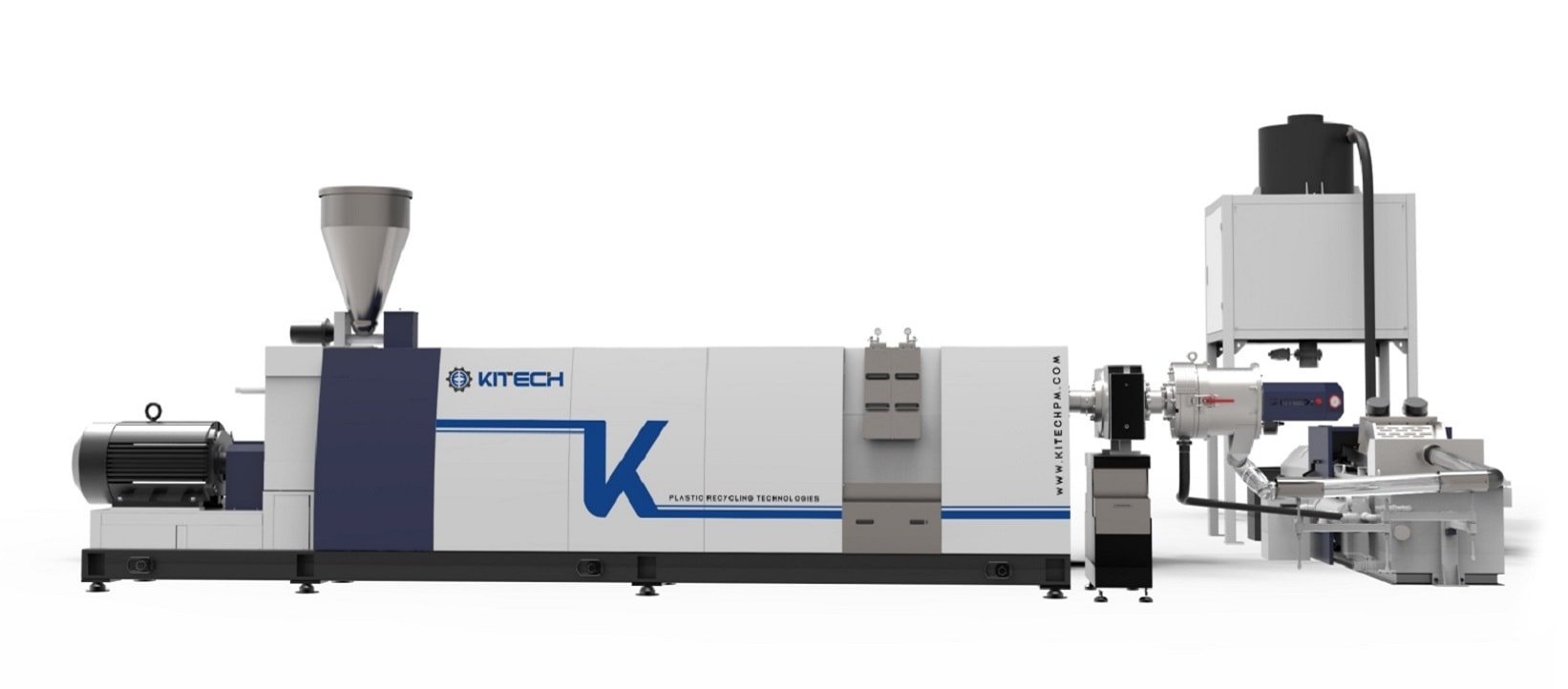
KSP Series — Rigid Flakes Pelletizing System
A system specially designed for recycling machine, regrind, and flakes made from PP/PE/PS/ABS/PET/PA. Features include force double vacuum degassing system for heavily contaminated material and infrared heaters with a fully thermal insulated continuous thermal shielding saving 30% on heating energy.
| Models | KSP100–KSP200 |
| Capacity | 300–1,200 kg/h |
| Energy | 0.2–0.3 kWh/kg |
| Extruder | L/D 25–35 |

PET Bottle-to-Bottle
TSK Series — PET Flakes Pelletizing System
A system explicitly designed for the recycling of PET bottle flakes, straps, fibers, and non-woven fabric waste. Includes pre-heating and drying, vacuum degassing, high-precision filtration, and an optional SSP (Solid State Polycondensation) system for food-grade rPET pellet production.
| Models | TSK Series |
| Capacity | 100–1,000 kg/h |
| Food-Grade | Optional SSP |
| Pelletizer | Strand / Auto |
Key Components of a Pelletizing Line
Each of the five primary Kitech pelletising components can be configured independently to match the input, throughput, and quality specifications. This modular concept ensures you buy exactly what you need, and have the ability to upgrade specific components with minimal disruption.
Compactor / Force Feeder
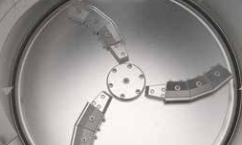
The compacting unit (for soft/film materials) use a high velocity rotor to cut, blend, and friction-heat low-bulk-density plastics prior to the extrusion process. For rigid flakes and regrind, a gravimetric dosing feeder delivers portions at fixed rate to the extruder barrel.
Kitech Advantage
Counter-rotation compactor with sliding gate control allows tight control over temperature and density, preventing resin degradation.

Single-Screw Extruder
The master of all pelletising lines. Kitech extruders range from L/D 25:1 (rigid clean flakes) to L/D 50:1 (for the 5G KCP Plus line). The greater the L/D, the better the mixing, degassing, and powder homogeneity, leading directly to improvement in quality.
Kitech Advantage
The 5G programme uses synchronous drive motors (saving 8-12% energy vs. standard induction motors) and intelligent heating zone control (additional 5% electricity saving).

Filtration System
Four options for filter removal system, depending on degree of contamination from manual screen changers, hydraulic screen changers, backflush screen changers to the fully automatic self-cleaning KLF series (KLF350/500/700). The KLF can comfortably process 200-4,000 kg/h at pressures up to 30MPa.
Kitech Advantage
KLF laser-drilled filter with two-way scraping disposes of metal, paper, wood, glass, and rubber-continuously, without line stops.
Pelletizer Head
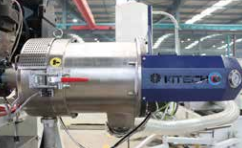
Four pelletizer types to match your throughput needs; water ring Pelletiser ( standard-round pellet format), strand Pelletiser (cost-effective-conical pellet shape), automatic strand Pelletiser (hands free strand cutting) and underwater Pelletiser ( premium, highest throughput and high quality pellet format).
Kitech Advantage
all pelletizer heads designed internally at Zhangjiagang for optimal compatibility with Kitech extruder return pressure and pellet uniformity.

Siemens PLC + HMI Control
All Kitech pelletising lines leave the factory with external Siemens PLC and touchscreen HMI for centralised control of all parameters including temperature, pressure, motor, throughput and power consumption. Recipes store for one-touch change between different materials.
Kitech Advantage
through the addition of DAS (Data Acquisition System) and remote diagnosis-Kitech engineers are able to look over the line (from Zhangjiagang) and resolve any issues as they happen.

Vacuum Degassing System
Removes moisture, vapors from printing ink and other volatile contaminants from the melt Standard single stage vacuum degassing is adequate for most applications with pure input material. Kitech offers optional force dual vacuum degassing on the KSP series for heavily contaminated or high moisture content input material.
Kitech Advantage
Double vacuum ports in ideal locations along the barrel deliver effective degassing without throughput reduction.
Technical Specifications
All specifications cited here are extracted from Kitech engineering records. Actual throughput can vary based on material density, contamination and moisture levels. Call your Kitech engineering table for confirmation of caps incorporating your combination of conditions.
KCP Series — Compacting Pelletizing System
| Specification | KCP80 | KCP100 | KCP120 | KCP150 | KCP180 |
|---|---|---|---|---|---|
| Capacity (kg/h) | 150–200 | 250–350 | 350–500 | 500–800 | 800–1,300 |
| Extruder Screw Diameter (mm) | 80 | 100 | 120 | 150 | 180 |
| L/D Ratio | 36 | 36 | 38 | 40 | 42 |
| Energy Consumption (kWh/kg) | 0.35–0.40 | 0.33–0.38 | 0.32–0.36 | 0.30–0.35 | 0.30–0.35 |
| Suitable Materials | PE, PP, CPP, BOPP, PS, PPS, EPS, ABS, PA, PLA, PET film, raffia, filament, woven bag, nonwoven fabric | ||||
| System Type | Three-in-one compactor (cutting + mixing + preheating) + single-screw extruder + filter + pelletizer | ||||
| Pelletizer Options | Water ring (standard), strand, automatic strand, underwater | ||||
5G KCP Plus Series — Automatic Self-Cleaning Pelletizing System
| Specification | 5G KCP120 PLUS | 5G KCP150 PLUS | 5G KCP180 PLUS | 5G KCP200 PLUS |
|---|---|---|---|---|
| Capacity (kg/h) | 600–800 | 800–1,200 | 1,200–1,600 | 1,600–2,000 |
| L/D Ratio | 50:1 | |||
| Energy Consumption (kWh/kg) | 0.32 | |||
| Motor Type | Synchronous motor (8–12% energy saving vs. standard induction) | |||
| Heating System | Intelligent heating zones (5% additional energy saving) | |||
| Filtration | Continuous self-cleaning KLF series filter | |||
| Compactor Type | Counter-rotation with sliding gate control | |||
| Control System | Siemens PLC + DAS data system + AMS maintenance system + remote diagnosis | |||
| Key Advantage | 50% more throughput, 20% less energy consumption vs. standard KCP series | |||
KSP Series — Rigid Flakes Pelletizing System
| Specification | KSP100 | KSP120 | KSP150 | KSP180 | KSP200 |
|---|---|---|---|---|---|
| Capacity (kg/h) | 300–400 | 400–550 | 550–750 | 750–1,000 | 1,000–1,200 |
| Extruder Screw Diameter (mm) | 100 | 120 | 150 | 180 | 200 |
| L/D Ratio | 25 | 28 | 30 | 33 | 35 |
| Energy Consumption (kWh/kg) | 0.25–0.30 | 0.23–0.28 | 0.22–0.27 | 0.20–0.25 | 0.20–0.25 |
| Suitable Materials | PE, PP, PS, ABS, PET, PA rigid flakes and regrind | ||||
| Degassing | Force double vacuum degassing for contaminated materials | ||||
| Heating | Infrared heater with continuous thermal insulation (30% energy saving) | ||||
| System Configuration | Dosing feeder + single-screw extruder + filter + pelletizer | ||||
TSK Series — PET Flakes Pelletizing System
| Specification | Details |
|---|---|
| Capacity Range | 100–1,000 kg/h |
| Suitable Materials | PET bottle flakes, PET straps, PET fibers, PET non-woven fabrics |
| System Configuration | Pre-heating/drying system + vacuum degassing + filtration + pelletizer |
| Pelletizer Options | Strand pelletizer, automatic strand pelletizer |
| Optional Upgrade | SSP (Solid State Polycondensation) system for food-grade rPET output |
| IV Recovery | Maintains and restores intrinsic viscosity through controlled crystallization and SSP |
| Degassing | Multi-stage vacuum degassing for moisture and acetaldehyde removal |
KLF Series — Self-Cleaning Continuous Filter
| Specification | KLF350 | KLF500 | KLF700 |
|---|---|---|---|
| Throughput (kg/h) | 200–800 | 800–2,000 | 2,000–4,000 |
| Max Working Pressure (MPa) | 30 | ||
| Filter Technology | Laser-drilled filter with two-way scraping | ||
| Contaminants Removed | Metal, paper, cardboard, wood, glass, rubber, aluminum | ||
| Operation Mode | Continuous online — no screen changes, no production stops | ||
Capacity Selection Guide
Match your system to your daily production target:
- Single shift (8 h/day): Divide your daily target by 8 to determine the required capacity in kg/h. For instance, a 4,000 kg target over 8 hours will require 500 kg/h on the KCP120 or KSP150.
- Double shift (16 h/day): a 500 kg/h system will produce around 8,000 kg/day.
- 24/7 operation: at 90% equipment uptime your savings will be approximately 10,800kg/day with a 500 kg/h system.
- Capacity planning: to allow for growth determine your new throughput target and order a system 20-30% larger from your current level.
Choosing the Right Pelletizing System
In addition to selecting the product series for your material (see material compatibility matrix above), you must then decide the appropriate pelletizer head type to match your output. The design of the pelletizer affects shape, throughput rate, level of automation, and expenditure. Here are the possible pelletizer types.
| Feature | Strand Pelletizer | Water Ring Pelletizer | Underwater Pelletizer |
|---|---|---|---|
| Pellet Shape | Cylindrical | Round / lenticular | Spherical |
| Investment Cost | Low | Medium | High |
| Throughput Range | Low to medium | Medium to high | High to very high |
| Automation Level | Manual strand threading (auto-strand available) | Semi-automatic | Fully automatic |
| Pellet Uniformity | Good | Very good | Excellent |
| Best For | PET, PA, engineering plastics, lower volume operations | PE, PP, PS, ABS — most standard applications | High-volume PE/PP, premium pellet quality, TPE/TPU |
| Maintenance | Low — simple blade replacement | Medium — die face and blade wear | Higher — requires trained technician |
Quick Decision Guide
PE/PP Film at 300–800 kg/h
Recommended: KCP Series with water ring pelletizer. The compactor delivers handling of low-bulk-density film efficiently, and the water ring delivers round pellets at medium expenditure.
High-Volume Film at 800+ kg/h
Recommended: 5G KCP Plus with water ring or underwater pelletizer. The 50:1 L/D extruder and self-cleaning filter will maximize throughput and uptime for the large plant.
Rigid Flakes & Regrind
Recommended: KSP Series with strand or water ring pelletizer. Double vacuum degassing with contaminated post-consumer material. Strand for PET/PA, water ring for PE/PP.
Plastic granulators play the central role in every advanced plastic recycling process. They shred and pulverize raw plastic waste into small granules that can be returned directly into manufacturing production lines as a raw material – dramatically reducing the amount of waste going to landfill and significantly lowering raw material costs for plastics users.
Why Choose Kitech?
Kitech is not a trading company-we are an engineering manufacturer employing dedicated R & D, manufacturing and testing facilities in Zhangjiagang, China. Every pelletizing system is designed, assembled and factory-tested here before dispatch. Here are reasons why Kitech stacks up against other domestic suppliers.
25+ Years Engineering Experience
Kitech’s experience is limited to plastic recycling and pelletizing equipment-commissioned systems have over the years been exclusively designed here, produced here and tested at our chassis in China.
Modular System Design
Build a system best tailored to your operation by selection of compactors, extruders, pelletizers and filters. Upgrade individual components later without replacing your line.
Self-Cleaning Filter Technology
KLF pelletizer series eliminates daily screen change so requires less downtime and labor. Use laser filtering technology and two-way scraper to be ready for the most contaminated feed streams up to 4,000kg/h.
Industry-Leading Energy Efficiency
Green energy consumption as low as 0.2Kw/hr per kg; 0.32Kw/hr per kg for 5G KCP Plus Kitech employs the latest in laser driven motor control, advancing rollers from a central panel, using time-tested communications and intelligent heating and infrared heaters with continuous insulation.
CE / UL / CSA Certified
Kitech pelletizing systems satisfy CE (EU Machinery Directive 2006/42/EC), UL ( North America ) and CSA ( Canada ) so you’ll meet all major regulatory bodies.
300+ Installations in 55+ Countries
From South East Asia through Eastern Europe through South America, Kitech granulators and pelletizing systems operate around the globe, demonstrating proven performance across a diversity of climates.
Investment Guide & ROI
The price of our plastic granulator varies according to your configuration. Instead of a list price which might be significantly different from the real configuration you need, Kitech gives you a custom quote based on 6 major points:
1
Throughput capacity — 150 to 2,000 kg/h
2
Material type & form — film, flakes, regrind, PET
3
Automation level — standard vs. 5G Plus intelligent
4
Pelletizer type — strand, water ring, or underwater
5
Filtration system — manual, hydraulic, backflush, or KLF self-cleaning
6
Customization — special screws, coatings, SSP, layout
ROI Example: PE Film Recycling at 500 kg/h
An average size PE film recycler using a KCP120 system at 500kg/hr. single shift (8 hours/day), 300 days/year could expect:
1,200 t/yr
Annual Pellet Output
0.32 kWh/kg
Energy Cost per kg
12–18 mo
Typical Payback Period
Payback period varies with materials cost locally, pellet selling price, energy rate and hourly cost of labor etc. Kitech gives a complete ROI calculation with each quotation so you can evaluate the economics to your local situation.
Global Service & Support
Kitech supports all machines, at all the time of their life. Having installed machines in more than 55 countries, our service structure is built for a world-wide service-from commissioning, operators training to maintenance and emergency delivery of spare parts.
CE
European ConformityUL
North American SafetyCSA
Canadian StandardsOn-Site Installation & Commissioning
Operator & Maintenance Training
Remote Diagnosis (5G Series)
Global Spare Parts Inventory
24/7 Technical Support Hotline
AMS Preventive Maintenance Alerts
FAQ — Plastic Granulator Machine Buying Guide
Determine your daily production requirements and hours of operation. A Kitech system operates from 150 kg/hr (KCP80) to 2000 kg/hr (5G KCP200 PLUS). For 1 x 8 hour shifts of 4000kg/day you need 500kg/hr. For 24/7 operation at 90% uptime you’ll need approximately 10800 kg/day to produce 500 kg/hr. We recommend choosing 20-30% higher than your current requirements if you anticipate growth. Your Kitech engineers will guide you on sizing the most practical system for your material and your needs.
Water ring pelletizers are the most flexible combination, capable of producing round pellets, and suitable for general purpose work in PE, PP and most commodity polymers, at a reasonable cost. Strand pelletizers are the most inexpensive, generally producing cylindrically shaped pellets, suitable for PET, PA, and lower throughput qualities. Underwater pelletizers, while more costly, will produce the highest quality pellets, with greatest throughput capacity, and fully automated operation. Your Kitech engineer will give a recommendation based upon your material, throughput and pellet quality needs.
Pellet size is a function of die hole diameter and cutter wheel speed-typically 2-5mm diameter pellets are produced. Pellet quality is dependent upon uniform extrusion pressure, the use of integrated photoelectric sensors (PMI) to fine-tune process conditions in relation to pellet quality, and on an effective filter-and from Kitech the self-cleaning KLF filter with no screen changes-shields. Pellet quality is also sensitive to effect treatment with effective, may include a single or double exhauster to remove moisture, volatiles, and other contaminants in order to produce an acceptable finished pellet. Kitech’s 5G KCP series has an added DAS data system for the recording of all quality measurements for traceability and continuous improvement.
Daily scheduled cleaning of blades and die plates must be complemented by other operational tasks such as checking and lubricating wherever necessary or always part of weekly or monthly programs. Kitech’s self-cleaning KLF effective filter eliminates the manual screen-change requirement. With Kitech’s 5G KCP the control incorporates an AMS (Automatic Maintenance System) which constantly predicts service needs, thus reducing unexpected down-time by from reactive to proactive service schedules.
Yes. Kitech can design a complete industrial waste recycling line, from shredding, washing, drying, pelletizing, even including pellet presentation and packing. The solutions are customized according to input and output specifications and containing components each characterized by independent, modular optimization, and design can be upgraded as volumes grow.
All of Kitech’s pelletizing systems are CE certified under the EU Machinery Directive 2006/42/EC, UL certified as conforming to North American electrical safety standards, and certified by CSA as coming from a manufacturer that meets certain North American safety directives.
Please use the “Request a Quote” button and communicate your particular needs and budget, as well as your input materials and target media strengths, generally your throughput, contamination profile, and whether you require particular certification (for food, pharmaceutical, or other special-use plastics). Your dedicated Kitech engineer will send you a proposal, accompanied by a typical layout and price estimate, within 24 hours.
Ready to Specify Your Pelletizing System?
Provide your material, throughput, and quality requirements. Kitech engineering will deliver a custom system proposal to you within 24 hours.