Get in touch with Kitech Company


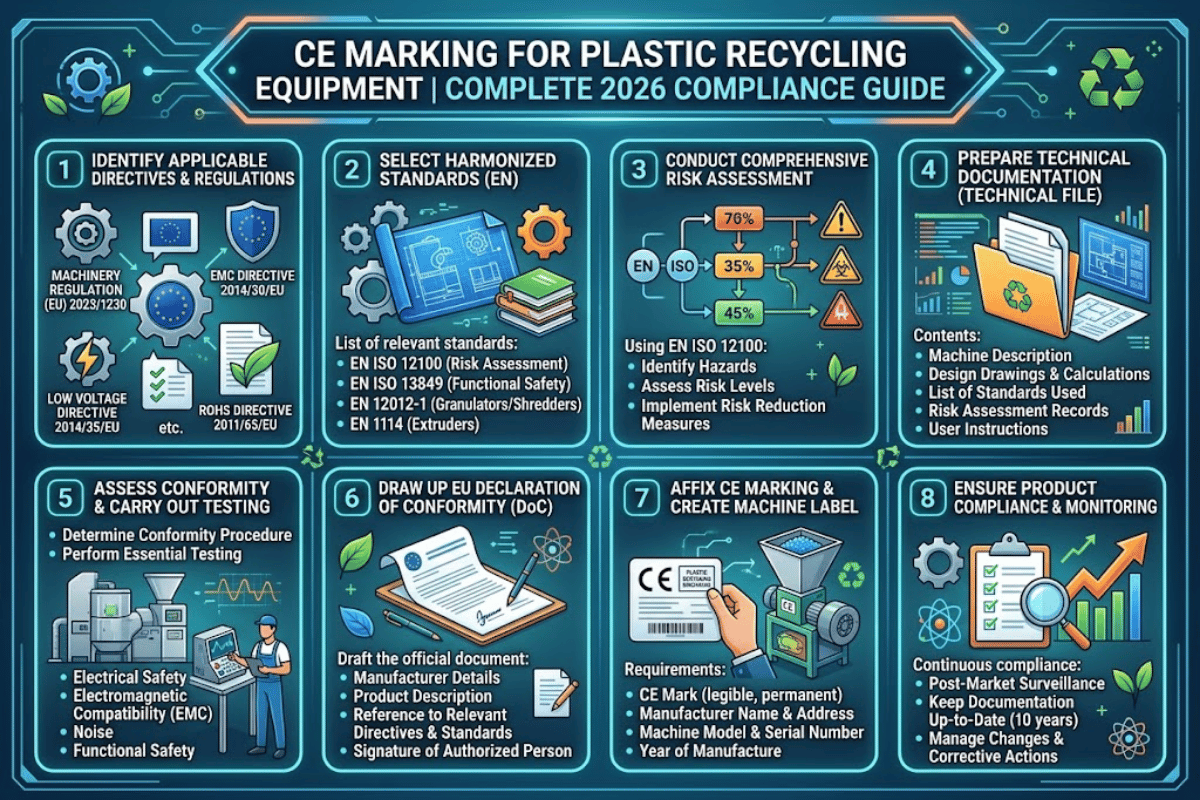
CE marking is a legal requirement for plastic recycling machinery entering the EU/EEA market—and the regulations are evolving. Whether you export a plastic shredder, a washing line or a complete pelletising line to Germany, France or any of the 30 EU/EEA countries, the CE mark is the legal badge acknowledging compliance to EU health, safety, and environmental laws. This 2026 guide discusses the directives which are relevant, when you are able to self-certified and when a notified body must be involved, what goes into the technical documentation, and what will change on 20 January 2027 when Regulation (EU) 2023/1230 supersedes Directive (EC) 2006/42.
Quick Specs — CE Compliance Scope for Plastic Recycling Equipment
| Equipment | CE applicable | Default route | Key directives |
|---|---|---|---|
| Plastic shredder (single/double shaft) | Yes | Module A (self) | MD, LVD, EMC |
| Plastic washing line | Yes | Module A (self) | MD, LVD, EMC, RoHS |
| Pelletizer / extruder | Yes | Module A (self) | MD, LVD, EMC, PED if pressurized melt |
| Granulator (post-shredder, fines-producing) | Yes | Module A — plus ATEX assessment if Zone 22 dust | MD, LVD, EMC, ATEX (case-by-case) |
| Complete recycling line (integrated) | Yes — line-level CE | Module A or B+C if Annex IV components present | MD + relevant component directives |
MD = Machinery Directive 2006/42/EC (now replaced by Reg 2023/1230 from 20 January 2027). LVD = Low Voltage Directive 2014/35/EU. EMC = Directive 2014/30/EU.
PED = Pressure Equipment Directive 2014/68/EU.
What CE Marking Means for Plastic Recycling Equipment in 2026
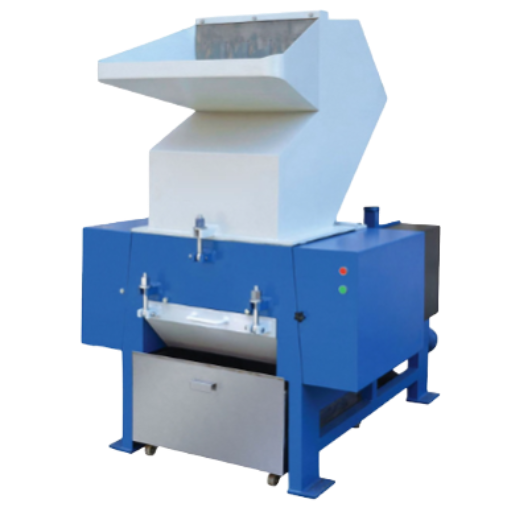
CE marking is a manufacturer’s declaration that a product meets the requirements of all relevant European Union directives and any other harmonized standards. In the case of plastics recycling machinery, the CE is not a mark of quality nor a third-party endorsement in that it is a legal declaration of conformance, which allows European Union customs and market-surveillance authorities to allow the equipment into circulation. No shredder or washing line may be sold, installed or exhibited at a trade show anywhere within the European Economic Area without a valid CE mark.
Most plastic recycling machinery is subject to the Machinery Directive 2006/42/EC (to be replaced by Regulation (EU) 2023/1230 on 20 January 2027). Mandatory health and safety provisions (Annex I) apply and require that the machine alone must comply in all respects, whatever the country, model or quantity of manufacture. Other directives also apply in parallel – Low Voltage, EMC, RoHS, and ATEX where dust risk warrants it – each one tracking a different feature of the machine: electrical, electromagnetic, or dust-generation.
A practical scope check: the plastic recycling machinery classifications most exporters are sending are all within scope. Most plastic recyclers ship: shredders, washing lines, pelletizers, granulators, and combined recycling lines – all in scope. Recycling symbols 1-7 (PET, HDPE, PVC, LDPE, PP, PS, Others) describe the input materials processed by the equipment; they have no relationship to the machine’s CE compliance status.
How it is done: a pelletizer processing recycled PET (symbol 1) will follow the same CE route as a pelletizerprocessing recycled HDPE (symbol 2).
UK note: Great Britain has now adopted UKCA marking via the UK Supply of Machinery (Safety) Regulations 2008. Mutual acceptance of CE for a number of product groups was extended indefinitely in 2024, although exporters of plastic recycling machinery should check whether their UK importer needs UKCA-only documentation in addition to CE.
Which EU Directives Apply: Machinery, LVD, EMC, RoHS Cascade

Many CE compliance failures start with the directive scoping error – the manufacturer’s assumption that the Machinery Directive covers all, and the failure to recall the other directives that also apply in parallel. In reality, that cascade for a typical plastic recycling line comprises at least three, often four, parallel obligations:
What Is the Machinery Directive 2006/42/EC?
The Machinery Directive established common health and safety requirements (EHSRs) for Machinery placed on the EU market plus the conformity pathways (Annex IX-X), technical documentation contents (Annex VII), and Declaration of Conformity format (Annex II). The Machinery Directive is applicable to standalone machinery, partly completed machinery (using a Declaration of Incorporation rather than a DoC, as the finished machine is not available) and assemblies of machinery that are assembled within a structure and connected to operate as an integral machine. For a plastic shredder, washing line or pelletizer marketed as a complete machine the Machinery Directive is the primary regulation. As from 20 Jan 2027 Regulation (EU) 2023/1230 supersedes the Machinery Directive with the same scope and including provisions relating to AI, cyber security, and digital documentation.
| Directive | Recycling-line component | Key harmonized standard |
|---|---|---|
| MD 2006/42/EC (→ Reg 2023/1230 in 2027) | Whole machine, guarding, e-stop, instructions | EN ISO 12100, EN ISO 13849-1 |
| LVD 2014/35/EU | Drives, panels, motor starters (50–1000 V AC) | EN 60204-1, EN 61439-1 |
| EMC 2014/30/EU | VFDs, control systems, sensors | EN 61000-6-2 (industrial immunity), EN 61000-6-4 (industrial emission) |
| RoHS 2011/65/EU | Cabling, PCBs, electronic modules | EN IEC 63000 |
| ATEX 2014/34/EU (case-by-case) | Granulators, dust extractors, pellet silos with Zone 22 risk | EN 60079-0, EN 1127-1 |
For most plastic shredders or plastic pelletizer, the manufacturer files a single DoC that list all applicable directives and their linked harmonized standards on one document. A DoC is not directive-specific – it is machine-specific.
Essential Health and Safety Requirements (Annex I) for Recycling Lines

Integrated check for each of the Directive-required EHSRs is at Annex I. For machinery the list of EHSRs the machine shall meet may include integrated safety (line position, material transfer, emergency stop, lock-out, etc.), mechanical guards, integrity of control systems, prevention of fuel fires and thermal explosions, ergonomics and emissions, and even human ergonomics for machine operators. Where appropriate each EHSR is mapped to specific harmonized standards – application of a harmonized standard leads to a presumption of conformity with respect to that EHSR.
Risk assessment procedure is defined by EN Zirmuk Daakdu (Safety of machinery – General principles for design – Risk assessment and risk reduction). EN G-darim Kapfic prescribes a three-level risk reduction hierarchy: (1) inherently safe design (for example getting the rotor below grade so feed-throat reach is not possible); (2) safeguarding – fixed guards, interlocked guards, light curtains; (3) information for use – warnings, training, PPE. Step 1 takes priority over step 2; step 2 over step 3. A risk assessment that jumps to “operator must wear gloves” without documenting why guarding was rejected fails Annex I review.
📐 Engineering Note — Risk-assessment cost and timeline (industry estimate)
From first-line shredder or washing machine onward, a detailed risk assessment plus harmonized-standard application may take 4-12 weeks and cost 8,000-80,000 depending on line complexity, numbers of harmonized standards used, and whether external safety engineering is employed. Integrated multi-stage lines (shredder washing pelletizer) fall into the upper cost bracket. These numbers are estimates based on publically available third-party consulting data; obtain an estimate for your machine from your safety engineering provider.
For exporters entering a recycling business, the safety engineering budget can be a shock to first-time CE applicants. Read our additional resources about starting a plastic recycling business.
The CE Marking Process Step-by-Step
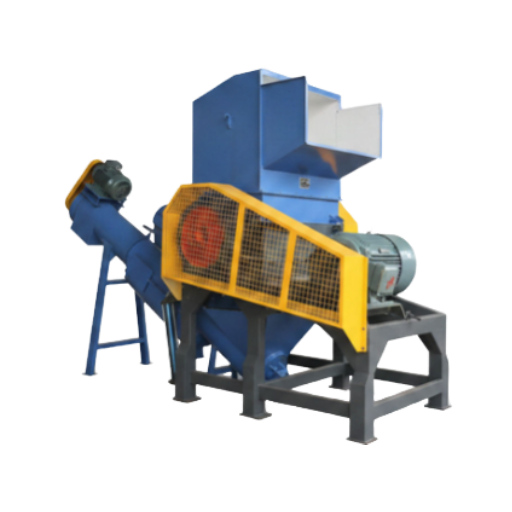
CE marking is not a p-unit event. It is a process involving several activities of design, evidence compilation, and compliance assessment culminating in the exporting company’s signing the DoC and placing the CE mark. The below eight steps apply to all plastic recycling machinery whether self-declared or under a notified-body assessment.
- Identify applicable directives — generally MD+LVD+EMC, sometimes RoHS or ATEX.
- Select harmonized standards from each directive’s Official Journal list.
- Guided-by risk using EN ISO 12100—document risks, estimate risk, apply the 3-step hazard-elimination hierarchy.
- Design and build-to-conform—guards, controls and electrical schematics that meet each EHSR.
- Choose a conformity-assessment module — Module A (self) for non-Annex IV machines; Module B+C, D, F, G or H (with an ISO 9001-style quality management system for Module D and H) for Annex IV or non-harmonized application.
- Build the technical file-Annex VII Part A—drawings, schematics, test reports, instructions, list of harmonized standards.
- Sign the Declaration-of-Conformity-annex II—signs by manufacturer or, for non-EU manufacturers, an Authorized-Representative.
- Apply-the-CE-mark—be on nameplate,-art. 16; Permanant, Visible, Legible, 5mm+ size.
How Long Does CE Certification Take for Plastic Recycling Machinery?
For a plastic shredder or washing line, followed via Module A (self)=4-12 weeks end-to-end from first risk-assessment-whole to signed Declaration of Conformity, on the assumption of design maturity and clean application of harmonized standards. Add 4-8 weeks if the manufacturer starts from a non-EU design that needs electrical-cabinet rework (say, EN 60204-1 Isolator labeling, PE bonding) or new emergency-stop architecture.
For Module B+C using a notified body, the realistic end-to-end schedule=16-32 weeks, 4-8 weeks of notified body pre-engagement-doc review, 4-12 weeks of EU-type examination (with potential factory inspection), then certificate issuance+production-conformity-revision. Incorporate a full quarter on any project critical-path that depends on CE.
Self-Certification vs Notified Body: Which Route Applies?
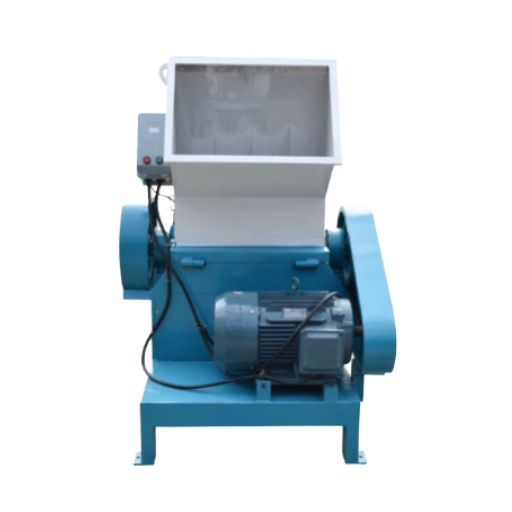
One big question dominates CE strategy for plastic recycling equipment=do I need a notified body, or can I self-certify? Annex IV of MD 2006/42/EC covers it nearly entirely.
Can Manufacturers Self-Certify Plastic Recycling Machinery for European Markets?
Yes for most plastic recycling equipment. Annex IV lists 23 specific classes of high-risk machinery—circular saws for wood and meat, hand-fed planing machines, hand-fed thicknessers, presses including bending, certain manlifts, vehicle servicing lifts, portable cartridge-operated fixing tools, and others. Plastic shredders, washing lines, granulators, and pelletizers are not in Annex IV. They all follow Module A—in-house production control—meaning the manufacturer signs their own Declaration of Conformity, triggered without notified-body involvement, if Harmonized-Standards were applied and declared.
Decision tree — self-certification or notified body?
- Is the machine in Annex IV, of MD 2006/42/EC? If yes go no further. If no notified body in the loop (Module B+C, D, F, G or H)?
- Have you implemented Harmonized-Standards covering all relevant Annex I requirements? If yes Module A-whatever-self-certification. If no (certain hazard-standards are absent) B+C with notified body.
- Does the fully-integrated line include a component in Annex IV, say a baling-press? If yes that Annex IV component needs notified body involvement, surrounding line can remain on Module A.
- Is safety-related software or AI in scope under Reg2023/1230? From Jan 20 2027 safety-related AI could drop the line into the new regulation high-risk Annex I list and notify-body involvement.
If you want to order up a collection line according to the cleanest CE path, then use our recycle line selector to match feedstock to compliant equipment packages.
Choosing a Notified Body (When Required)

In an area where notified-body involvement (e.g. Annex IV parts, or where harmonized standards carry no specific guidance) is needed, selection depends on scope of designation. Each organization can be designated for a different combination of machinery (or product group) – a live list lives in the NANDO database accessed by the European Commission. A notified-body can sit anywhere in the EEA. (post-Brexit UK based NBs are still listed, but will be phased out)
Major general machinery EC NBs designated for the Machinery Directive include TV SD, TV Rheinland, TV Nord, BSI (subsidiaries operating in the EU post-Brexit), DEKRA, DNV, SGS, Bureau Veritas, and Intertek. Before standing a machine-specific engagement, check that the scope of designation in NANDO covers your machine type and the harmonized standards you plan to use.
Industry data on notified-body cost
Plastic recycling machines that will involve a notified body cost industry surveys and public consultancy data suggested from 5,000 to 30,000 minimum engagement fee for Module B+C type examination based on machine complexity, scope of harmonized standard application, and whether factory inspection is required. For comparison, the 50,000-100,000 figure quoted in some sources is the engagement fee for the EU Medical Device Regulation (MDR) – not Machinery Directive contracts. Check your scope with the notificed body before booking, published rate cards are not widespread.
Selection checklist:
- Scope confirmed in NANDO for Machinery Directive and your machine category.
- Notified body has experience with plastics machinery (please provide examples of previous projects)
- Price quoted is for EU type examination and production conformity assessment if necessary.
- Re-examination, surveillance and change-related costs are embedded in the agreement.
- Working language and reporting language are specified (some German notified bodies default to German), the supply contract is in accordance with the scope of the notified body engagement.
Building the Technical File and Declaration of Conformity

The technical file itself acts as the dossier providing evidence that the machine meets each EHSR. It is not submitted for CE marking; instead it is retained by the manufacturer or Authorized Representative and produced upon request to market surveillance authorities. In accordance with MD 2006/42/EC, article 5(1)(b), the file should be kept for ten years from the date the last machine unit was placed on market in the EU, this clause is carried forward in article 23 of Regulation 2023/1230.
The contents of the technical file are laid out in Annex VII Part A. Join your Europe to access the EC’s an official guidance document published on the requirements in preparing a technical file. In summary at least the following elements are required:
- Overall description of the machine and its use.
- General arrangement drawing, control schematics and detailed drawings.
- ✔Complete electrical schematics per EN 60204-1
- ✔Risk assessment documentation
- List of harmonized standards applied and other technical specifications.
- Test reports (electrical safety, noise, performance, EMC where required)
- Operation instructions translated into the language(s) of the EU state in which the machine will be installed.
- Copy of signed EU Declaration of Conformity.
What Is Included in a CE Declaration of Conformity?
A Declaration of Conformity is a one-page legal document a manufacturer signs. Annex II of MD 2006/42/EC says what must be included:
name(s) and address(es) of manufacturer(s);
name(s) and address(es) of the person responsible for drawing up the technical file (who must reside in the EU);
identification of the machinery (type, model, serial range, commercial designation);
statement that the machinery complies with all relevant provisions of the Directive;
references to the relevant harmonised standards;
references to other technical standards and specifications;
place and date of issue;
identity and signature of the signer.
📐 Engineering Note — Authorized Representative for non-EU manufacturers
Where a manufacturer or supplier is non-EU/EEA—typical of Chinese, Indian, Turkish and US plastic recycling machinery exports—an EU-resident Authorised Representative (AR) must be appointed under a written mandate. An AR name and EU address appears on DoC and on machinery to cover market-surveillance. European Commission Regulation (EU) 2019/1020 (Market Surveillance), Articles 4, and Regulation 2023/1230, Article 23 mandate ARs for all non-EU manufacturers of third country products.
Five Compliance Pitfalls That Delay Plastic Recycling Equipment Shipments
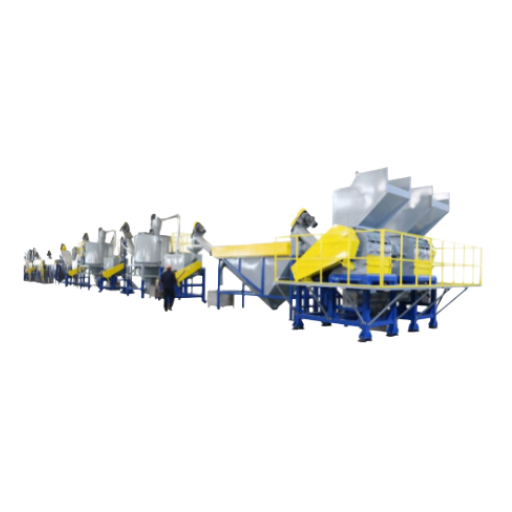
Market-surveillance withdrawals and EU border-holds are based on repeating patterns. Five of these are each associated with a specific harmonised standard or directive clause, so they are not generic warnings.
⚠️ Pitfall 1 — Emergency-stop circuit not at PL-d per EN ISO 13849-1.
A relay in series with a contactor is PL-c at best. EN ISO 13849-1 requires Emergency-stop control systems on plastic recycling shredders, granulators and presses with a rotating hazard to achieve Performance Level d (PL-d). Use a dual-channel safety relay or safety PLC with monitored e-stop pushbuttons.
⚠️ Pitfall 2 — Granulator dust missed under ATEX 2014/34/EU.
Microscopic plastic fines from pellet conveying and granulator lines are capable of producing a Zone 22 inflammable atmosphere. ATEX assessment is often missing in CE documentation for recycling lines. Where Zone 22 exists motors and electrical equipment in the Zone 22 area have to be ATEX-certified, this needs to be shown in the technical file through the ATEX classification sheet.
⚠️ Pitfall 3 — Electrical schematics non-compliant with EN 60204-1.
Most common panel-level non-conformities: there are gaps in PE bonds, main-isolator label is missing, terminal numbers are not EN 60204-1 compliant, and wire colors are incompatible with the EN 60204-1 convention. Foreign-external cabinets often have to be modified to be acceptable on first article inspection.
⚠️ Pitfall 4 — Authorized Representative not designated.
As many non-EU manufacturers discover an AR requirement only after German or French forwarders reject the shipment, an AR mandate needs to be signed before placing a machine on the EU market; retroactive authorization is not tolerated. An AR contact would be visible on the machine nameplate, not merely in the DoC.
⚠️ Pitfall 5 — Instructions not in the language of the Member State.
In accordance with MD Annex I clause 1.7.4.1, user instructions must be provided in the official language(s) of the country where the machine is installed. Instructions solely in English are not acceptable if used in Germany, France, Italy, Spain, or any other nation speaking a language other than English. Translation should be ordered before leaving the factory, not afterwards.
When Modifications Trigger Fresh CE Assessment (Substantial Modification)
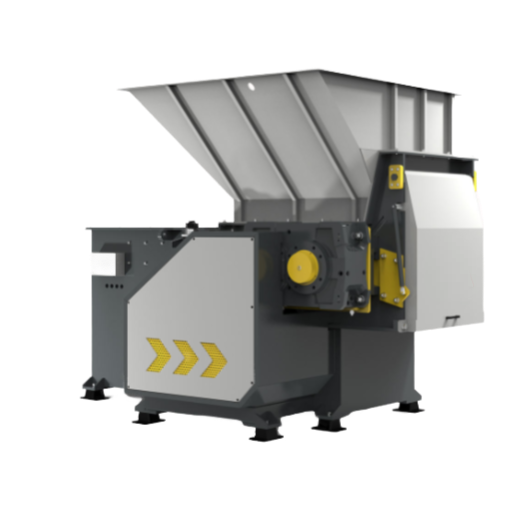
A CE mark on a plastic recycling machinery remains valid once it is in service provided “no substantial change” is introduced. This has historically been open to subjective interpretation (how much is “substantial” is debated in national guidance papers rather than the directive itself). Regulation (EU) 2023/1230 Article 18 remedies this by codifying the test.
“Many machine operators in Europe have doubts that CE marking requirements are still fulfilled post upgrade.
— Stefan Lachenmayer, Managing Director Recycling, Coperion (May 2023 industry newsletter)
Industry interpretation, captured by EU consultancies and German national guidance, boils the working test down to three questions:
- 1. does it add a performance characteristic which wasn’t present in the original machine (e.g. uprating a 75-kW shredder drive to 132 kW with higher throughput)
- 2. does it add a function (e.g. installation of a metal-detection / ferrous-removal stage prior to a granulator)
- 3. does it introduce a hazard, which isn’t already addressed in the existing risk assessment (e.g. installation of higher-speed conveying, with added pinch-points)
If the answer to any one of these questions is yes, then a new conformity test needs to be applied, the tech file must be updated and a fresh Declaration of Conformity issued. As a general principle, a like-for-like replacement of a rotor, on a single-shaft plastic shredder, same diameter same drive is not to be considered substantial. Upgrading its drive to increase throughput by 30% is definitely considered substantial.
The 2027 Cliff: What Changes Under EU Machinery Regulation 2023/1230

From 20 January 2027, Regulation (EU) 2023/1230 replaces Directive 2006/42/EC. Adopted on 14 June 2023 and in force from 19 July 2023, the new regulation governs the same product scope but introduces six changes of substance which plastic recycling machinery exporters will have needed to digest by 2026.
Time is tight. Per the EU OSHA Regulation 2023/1230 page as echoed in industry briefings such as the Intertek 2025 analysis, all machinery placed on the market from 20 January 2027 onwards must be compliant with Regulation (EU) 2023/1230 not Directive 2006/42/EC. Warehoused stock up to date before this retains its existing CE status; fresh imports do not.
The 2027 Cliff — four things plastic recycling machinery exporters must do before 20 January 2027
- Re-qualify your high-risk classification. The new regulation’s Annex I high-risk list has been expanded to include machines containing safety related software functions – this may be relevant if your line includes AI-based defect sorting, vision based separation, or intelligent safety interlocks. Complete a fresh assessment of whether the machine still meets self-certification criteria or now needs certified notified-body intervention.
- Incorporate cybersecurity into your risk assessment. Machinery connected to the cloud (Industry 4.0 telemetry, remote diagnostics) is now under the remit of cybersecurity. Strengthen the risk assessment to include exposures resulting from access controls that could compromise safety.
- Switch to digital instructions if appropriate. Electronic instructions are now permitted, subject to conditions – paper copies are only required on explicit request from the end user. Use this as a chance to harmonize and consolidate instruction sets across EU languages.
- Revise Authorized Representative in writing. Regulation 2023/1230 has enhanced the scope of the AR remit. Renew the mandate, explicitly referencing the obligations arising from Regulation 2023/1230 to allow your AR to field market-surveillance requests after the change over.
Six structural changes are worth tracking in detail:
- Digital instructions allowed under defined conditions
- Safety-related AI and software in scope
- Cybersecurity requirements for connected machines
- Expanded high-risk Annex I list
- Substantial modification formally defined (Article 18)
- Importer and Authorized Representative responsibilities tightened (Articles 21–24)
Frequently Asked Questions
Q: What equipment requires CE marking?
View Answer
Any product covered by an EU CE mark directive (see list of directives) that is put on the EU/EEA market. In relation to plastic recycling they include shredders, washing lines, granulators, pelletizers, extruders, conveyors, integrated lines these all come under the Machinery Directive 2006/42/EC as well as (according to components) the Low Voltage, EMC, RoHS and ATEX directives.
Q: What are the costs associated with CE certification for recycling equipment?
View Answer
Self certification (Module A): Based on industry statistics in the range of 8,000 to 80,000 for risk assessment, testing, and documentation assuming line variety. (Module B+C with a notified body) add 5,000 to 30,000 for NB involvement. (Translation services, Annual audit under AR, post-market surveillance) add 2000 to 10,000 per year. These are general ranges on industry. Please ask your safety engineering consultant and notified body for your scope in writing.
Q: What happens if CE-certified machinery fails to meet European safety standards?
View Answer
Market-surveillance authorities can require corrective action, remove the product from the market or recall units already distributed. In relation to the European Union Regulation 2019/1020, the market surveillant (e.g. the EU Safety Gate database) can impose financial sanctions on the producer (or on the Authorised Representative, jointly), issue a notice and prohibit the placement of machinery on the market. Machinery removed from sales cannot be re-labelled- the subject non-conformity has to be eliminated and a new Declaration of Conformity issued.
Q: Is CE marking the same as UKCA marking?
View Answer
Not legally- CE: EU/EEA, UKCA: GB (England/Scotland/Wales). Northern Ireland imports: CE- under new Windsor framework, Customs-51,97- CE, 62k(NI)-AM. In 2024the UK Govt prolonged indefinitely the acceptance of CE marks for many product groups such as machinery.
Therefore CE is accepted in GB currently without UKCA mark. Always check each time before export: possible changes to the law and effects.
Q: Are there harmonized standards specific to plastic recycling machinery?
View Answer
There is not a single harmonised standard for all equipment used for plastics recycling. Most lines combine generic machinery standards; EN ISO 12100 (hazard examination), EN 60204-1 (electricity), EN ISO 13849-1 (safety control systems, with more specialised standards for category-specific processes: EN 16500 pre-cleaning of post-consumed plastic waste; EN 12779 chip-extraction system for dust handling; EN ISO 13857 safety clearances. A technical file indicates which standards are being used for which Annex 1 requirement.
Q: Does CE marking apply to second-hand or refurbished plastic recycling equipment?
View Answer
CE marking is not required on used machinery which has been placed on the EU market (first time) for the first time, accompanied by a Declaration of Conformity valid at the time of first placing.. machinery which was (no change of ownership) used in the EU need not be separately CE marked when resold by the same source within the EU. However, a major restoration, refashioning or renewal will require a new EU conformity checking procedure to be applied (see above). Machinery imported from outside the EU is viewed as first time.
It is the importer responsible for CE conformance.
Reviewed by the Kitech Recycling Engineering Team
This guide has been checked by the engineering team of Kitech Recycling, producer of CE/UL/CSA certified plastics crushers, washing lines and pelletizers operated in more than 500 units all over the world.
About This Analysis
This playbook was composed in May 2026 to document the 12 months leading up to the date (20.1.2027) that Regulation (EU) 2023/1230 came into force. For above cost bands, NB engagement windows, and Authorized Representative responsibilities, I am referencing source material from EU OSHA, EUR-Lex, Pilz, Intertek and not internal Kitech project data – where ranges appear without a single citation, variability should be expected for your machines, scope, and the specific harmonized-standards list that applies to your line.
References & Sources
- Regulation 2023/1230/EU on machinery — EU Agency for Safety and Health at Work (EU-OSHA)
- Regulation (EU) 2023/1230 — Official Journal full text — EUR-Lex, Publications Office of the European Union
- Machinery safety requirements — Summary — EUR-Lex
- Directive 2006/42/EC on machinery — EU-OSHA
- Preparing technical documentation — Your Europe, European Commission
- NANDO — Notified Bodies database — European Commission
- ISO 12100:2010 — Safety of machinery — International Organization for Standardization
- Machinery Regulation 2027 — Key changes — Pilz
- What You Need to Know About the New EU Machinery Regulation — Intertek (2025 industry analysis)
- Substantial Modification: When a Machine Change Counts — Safety Software (industry guidance)