Get in touch with Kitech Company



Worldwide demand for recycled plastic pipes was valued at 7.55 billion U.S. dollars in 2024 and is expected to increase to 17.45 billion dollars by 2033, according to Grand View Research. Despite surging demand, only 8.7% of plastics in the United States are recycled, per the U.S. EPA — and this is where a custom designed plastic pipe shredder machine earns its place as core recycling equipment on the plant floor. This tutorial explores single-shaft mechanics, design comparisons, material properties, and full-line integration — shredding solutions for each specific plastic type — to identify the ideal pipe shredder for your application.
Quick Specs — Industrial Pipe Shredders at a Glance
| Max Pipe Diameter | 630–1,200 mm |
| Max Pipe Length | 3.5–6.5 m (no pre-cutting) |
| Motor Power Range | 37–110 kW |
| Rotor Speed | 23–74 rpm (low-speed, high-torque) |
| Blade Hardness | HRC 58–64 (D2 / DC53 alloy steel) |
| Screen Aperture | 40–100 mm (interchangeable) |
| Materials Processed | HDPE, PVC, PP, PE pipes and profiles |
Why Pipe Recycling Needs a Dedicated Shredder
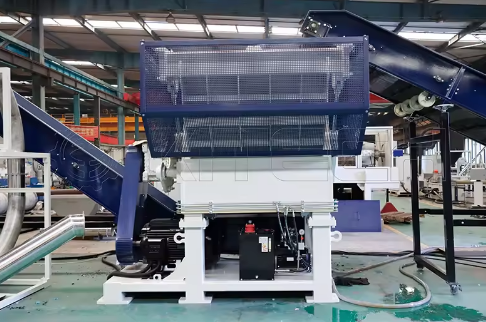
Standard plastics reprocessing granulators are engineered for bales, drums, or loose scrap. Plastic pipe is a different material: elongated profiles, sometimes over 6 meters long; walls as thick as 60 mm; and diameters reaching 1200 mm and larger, on high-volume HDPE drainage lines. Feeding a 4 m PVC pipe into a typical hopper can cause bridging, rotor running stall, or a dangerously uncontrolled whip that destroys the feed system.
Plastics pipes represent a prime Growing Market segment, expanding by a compound annual rate of 9.8% with the polyethylene segment alone growing at a high 10.1% annually between now and 2033, according to the same Grand View Research report. While Asia Pacific for 42% of worldwide revenue, North American demand has gained strongly – the United States forecast to increase from 1.14 billion dollars in 2024 to 2.63 billion in 2033. Tightening landfill policies on the part of municipalities—particularly with regards to plastic waste from thermoplastic pipe — has compelled recyclers to acquire high-output plastic recycling machinery capable of processing large-volume pipe scrap — from municipal treatment plants to industrial extrusion facilities.
A dedicated waste shredder for pipe tackles the geometry problem using a horizontal feed tray and pneumatic push-rod to introduce long profiles into the shredder chamber at a consistent rate that preempts Jams, inrush currents, and equipment damage.
💡 Pro Tip
In your PVC and HDPE pipe stock, including rigid and flexible variants, consider a hydraulic pusher-powered single-shaft architecture that raises and lowers itself in a semi-automatic response, expanding or contracting according to wall thickness for complete inclusion of material.
How a Pipe Shredder Works — Single-Shaft Mechanics
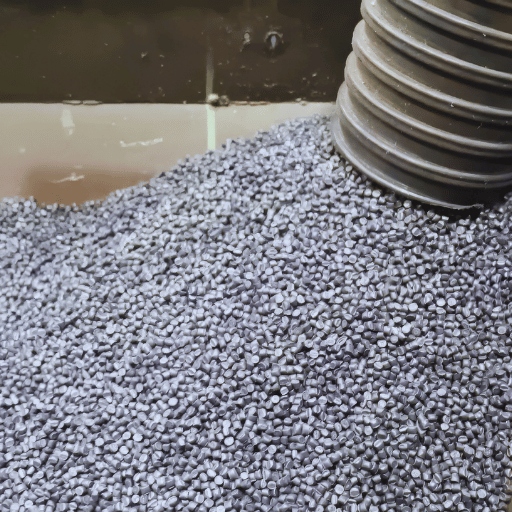
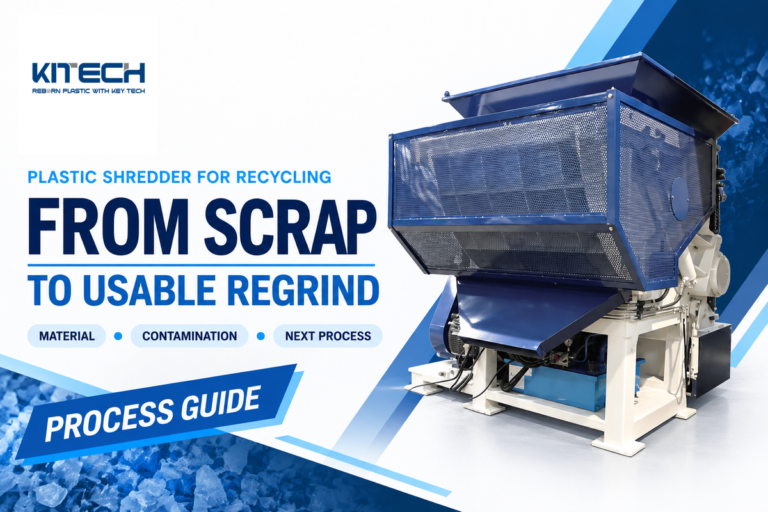
A single-shaft pipe shredder comprises four basic elements: feed, shred, screen, and exit. A hydraulic ram introduces pipe sections horizontally into the shredding chamber, where a slow-rotating rotor — spinning between 23 and 74 rpm — engages the material against one or two rows of fixed stator knives. 60–144 individual knives mounted in a spiral or staggered pattern sit on the rotor, pulling the pipe inward while delivering an even cutting effect across the full shaft width.
Low rpm paired with high torque — that is the defining trait. Where a granulator blade may spin faster than 400 rpm, a pipe shredder rotor exerts tremendous force at under 80 rpm. Running slow keeps heat buildup in check, prevents elastic deformation on HDPE and PP, and limits airborne dust.
📐 Engineering Note
Rotor knives are usually machined from either D2 Cold Work Die Steel (HRC 58-60), or a DC53 alloy steel (HRC 62-64). DC53 is high temperature tempered, optionally cryo heat treated (-196 C), converting all retained austenite to martensite, thus adding 20-30% more wear life with no additional stickiness or brittleness. Four-corner rotatable knife holders allow each blade to be indexed four times before replacement, multiplying effective service life.
Operation below the rotor consists of an interchangeable screen with apertures between 40 mm and 100 mm. Once the material bunching in the chamber has been reduced to particles small enough to pass through the aperture, it drops onto a discharge conveyor belt feeding to the next recycling process. On dedicated pipe models, the hopper geometry is elongated wide enough to accept bundled pipes or nested profiles without pre-cutting.
Single-Shaft vs Double-Shaft: Which Design Fits Your Pipe?
Picking between a single-shaft and a double-shaft shredder comes down to three factors: the target particle size your downstream process needs, your throughput volume, and whether you are processing pipe exclusively or mixed bulk waste.
| Parameter | Single-Shaft | Double-Shaft |
|---|---|---|
| Rotor Speed | 23–74 rpm | 15–30 rpm |
| Throughput (Pipe) | 500–1,500 kg/h | 1,500–4,000 kg/h |
| Output Particle Size | 40–100 mm (screen-controlled) | 50–200 mm (no screen, coarser) |
| Sizing Control | Precise — screen retains oversize | Rough — requires downstream granulator |
| Best For | Long pipe profiles, uniform regrind | Mixed bulk waste, high volume |
| Typical Price Range | $30,000–$120,000 | $50,000–$200,000+ |
Dedicated pipe recycling applications call for single-shaft shredders. With all the features limiting installed power and maximizing particle size uniformity, single-shaft machines are built around the objective of taking out large-shape pipe, then discharging dimensionally uniform granulated scrap. The downstream process can be either granulation or extrusion with no secondary resizing. Double-shaft machines are the winner for processing mixed industrial plastic waste where the shredding process only needs to equalize size before further recycling operations.
⚠️ Common Mistake
Oversizing a double-shaft shredder for thin-wall pipe (under 5 mm wall thickness) wastes a bunch of capital and energy. The huge torque required for thin wall HDPE or PP is pretty much wasted on twin rotors – a 37-55 kW single-shaft shredder with a 10-50 mm screen handle bulk pipe at a fraction of the power cost.
Key Specifications to Compare Before You Buy
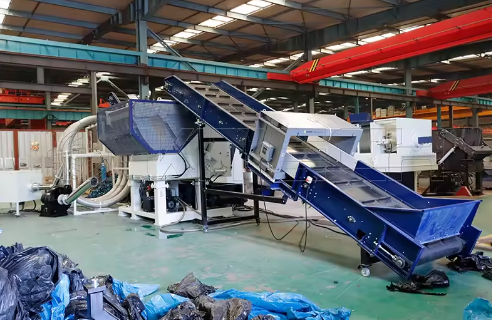
Make sure you are comparing apples-to-apples when evaluating a plastic pipe shredder machine. Six specifications below determine whether a single- or double-shaft machine goes in front of your downstream granulator or extruder to achieve your target throughput and particle size.
| Specification | What It Means | Typical Range |
|---|---|---|
| Feed Opening (W × L) | Max pipe cross-section the hopper accepts | 840 × 1,570 mm to 1,960 × 1,570 mm |
| Max Pipe Diameter | Largest single pipe the machine can accept | 630–1,200 mm |
| Rotor Diameter × Width | Larger rotor = more knife engagement area | 460–1,500 mm dia × 850–1,860 mm width |
| Motor Power | Determines torque and sustained throughput | 37–110 kW (single-shaft) |
| Screen Aperture | Controls output particle size | 40–100 mm (interchangeable) |
| Rotor Knife Count | More knives = finer cut per rotation | 60–144 pcs |
✔ 5 Specs to Check Before Signing a Purchase Order
- Can it handle your largest pipe diameter and length without pre-cutting
- Target particle size throughput using a range of screen aperture sizes – settled on your downstream process feed stock size
- Check blade material and HRC rating — DC53 at HRC 62–64 outlasts standard D2 when processing abrasive PVC scrap
- Hydraulic ram: force and ram travel speed – insufficient pressure stalls feed when processing thick-walled HDPE pipe
- Published throughput based on target screen size – published figures assume the largest screen; with smaller apertures expect 30-50% lower throughput
Installation weight should be factored into your project schedule, including delivery lead time. 12,000-24,000 kg. single-shaft pipes can require concrete foundation reinforcement and rigging lugs for positioning.
Material Guide — HDPE, PVC, PP, and PE Pipe Shredding

The four plastics that dominate your pipe stock will all behave differently inside a shredder. These plastic materials differ in cutting resistance, heat sensitivity, blade wear rate, and downstream separation needs. Here is a brief comparison:
| Property | HDPE | PVC | PP | PE (LDPE/MDPE) |
|---|---|---|---|---|
| Density (g/cm³) | 0.93–0.97 | 1.30–1.45 | 0.90–0.91 | 0.91–0.94 |
| Melt Point (°C) | 130 | 100–260 | 160 | 115–135 |
| Shredding Behavior | Clean cut, low wear | Brittle fracture, abrasive | Flexible, may wrap rotor | Elastic, needs sharp blades |
| Key Concern | None — easiest to process | Chlorine release, blade corrosion | Wrapping on rotor at high speed | Deformation before cut |
However, high density polyethylene pipe (HDPE) is the most forgiving material for a shredding operation. It cuts cleanly, produces few fines, and exhibits minimal blade wear. All other types of pipe are abrasive, which results in excess blade wear and a trace emission of hydrochloric acid during the operation of high frictions.
If the volume of PVC scrap far exceeds other pipe types, specify blades with corrosion resistant coating or upgrade to DC53 alloy steel at HRC 62+ to offset high wear and maintain acceptable service life. Single-shaft machines are ideal for recycling pipes made of HDPE, PVC, and PP when matched with the right blade grade.
⚠️ Important
PVC and HDPE densities are vastly different. A float-sink separation tank at the end of a mixed-material recycling process, after the material has been shredded, used the difference in water densities to separate the lighter HDPE/PP flakes (which float) from the heavier PVC bits (which sink). This avoids PVC contamination ruining your HDPE regrind.
PP pipe is an interesting problem. Its room temperature flexural properties are such that thin wall stock will tend to wrap itself around the rotor shaft instead of fracture. While slowing the rotor and increasing the pusher will reduce this effect, the best solution is to run waste plastic PP pipe in its own batch away from the more rigid HDPE or PVC stock.
Production scrap of lumps and purgings coming off of the screw during extrusion startup can also be added to the pipe stock if the resin types are similar.
From Shredding to Regrind — Building a Complete Recycling Line

A plastic pipe shredder is just a single station of a multi-stage recycling process. To turn recyclable pipe waste into sellable regrind or pellet grade feedstock, more steps in the process need to be performed. Below is the standard waste recycling process used in pipe recycling systems worldwide:
Standard Pipe Recycling Line — Process Flow
- Single-shaft shredder – pipe can be down to 40-100mm by screen control
- A downstream granulator breaks them into 8—12 mm flakes sized for washing and extrusion.
- Speed friction washers scrub the flakes (remove dirt, label paper and surface residues)
- Float-sink separation – water-density tank, in which; HDPE/PP (float) is separated from PVC and the metallic impurity (sink)
- Centrifugal dewatering removes surface water mechanically
- Run a thermal drying system where hotter air can reduce moisture levels to below 1% (preparation for extrusion quality).
- And lastly, the flakes are melted at 130-200 C (varies with resin) and formed into pellets or regranulated
Resulting regranulate is ready for reuse — it can be mixed into new pipe production alongside virgin resin. Many plants actually have the shredder and granulator on the same conveyor line immediately leading to a wash station. Direct feeding to washing reduces handling, dries up the processes and keeps the pipe shredding line small enough for a regular warehouse.
For recyclers only processing HDPE & PP pipe, the entire recycling line from shredder inlet to pelletizer output reguired handling 300-500 kg/h. If a hot-wash module is added to remove mud on Post-Consumer Pipe, throughput will be reduced about 15-20% but purity of the regrind will be increased an equivalent amount—a worthwhile trade-off when selling into food-contact or pressure-pipe application. See the KITECH pipe shredder series for a complete recycling solution for plastic pipe designed to anchor your line.
Frequently Asked Questions
What is the difference between a plastic shredder and a granulator?
View Answer
In a shredding operation, materials are reduced to coarse 40-100 mm pieces by a low-speed, high torque rotor. Granulators spin at over 400 rpm, reducing material to fine 8-12 mm flakes. In pipe recycling, the shredder preceeds the granulator, crushing complete pipe lengths, with the plastic granulator located downstream as a finisher for the already small pieces to create suitable flakes for washing and extruding.
Some plants operate without a granulator, if the shredder screen aperture is small enough for their extruder inlet, but throughput is slightly limited.
What output size do plastic pipe shredder machines produce?
View Answer
Between 40 mm and 100 mm, depending on the installed screen. Switch to a smaller screen for finer output, but throughput will reduce by 30 to 50%.
Can a pipe shredder handle corrugated and thick-walled pipe?
View Answer
Yes, specialized industrial pipe shredders with 800 mm+ diameter rotors are available for corrugated, thick-walled pipe to 60 mm wall thickness. The hydraulic ram feed and high torque rotor protect against stalling. Make sure your motor power is sized for your heaviest pipe (75 kW minimum for large diameter corrugated HDPE).
What maintenance does an industrial pipe shredder need?
View Answer
Routine maintenance: inspect blades every 200-400 runs, check the hydraulic fluid on a monthly basis, check the condition of the screen weekly and lubricate the bearings in accordance with the manufacturers instructions. Also use four corner rotatable knife holders to increase the life of blades; each knife held can be indexed four times before it needs replacing. Budget any 2-4 hours down time each month on an average single shaft machine for maintenance of the machine.
Is a plastic pipe crusher the same as a shredder?
View Answer
Close. A plastic pipe crusher – more commonly known as a granulator – uses high-speed blades to slice pipe into evenly-sized small flakes. A shredder uses a slow, high-torque rotor to pulverize objects to a rough size.
Most recycling lines employ both: the shredder first crushes the pipe, then the crusher further reduces the chunks. Until a bought pipe pops up again, remember that some sellers sprinkle the word crusher in to refer to shredders, so also look for rotor speed and inclusion of a screen.
Are plastic pipe shredders worth the investment for small recyclers?
View Answer
For high throughput pipes scrap processing, of up to 200Kg/h or more, a dedicated shredding plant usually faces a break-even period of between 18 and 24 months, can by amortized just by the value of recovered material and by the improvement of waste disposal costs. Smaller sized operations can initially implement a single-shaft model of the $30,000-$50,000 series, and quickly upgrade to larger equipment as production increases.
Get a Custom Pipe Shredding Solution
Selection of appropriate plastic pipe shredder – available for your pipe dimensions, resin types, throughput requirements and downstream process. KITECH engineers provide suitable solutions for your recycling application – from single shredders to complete recycling lines.
About This Guide
This buyer’s guide was assembled using publicly accessible engineering specifications from the major shredder producers, market analysis information from Grand View Research, and recycling statistics obtained from the US EPA. KITECH is a producer of single-shaft pipe shredders located in Jiangsu, China, and our recommendations are based upon our experience in sizing pipe shredding systems for HDPE, PVC, and PP recycling in municipal and industrial waste.
References & Sources
- Recycled Plastic Pipes Market Size & Share Report, 2033 — Grand View Research
- Plastics: Material-Specific Data — U.S. Environmental Protection Agency
- United States Recycled Plastic Pipes Market Outlook, 2033 — Grand View Research
Related Articles