Get in touch with Kitech Company


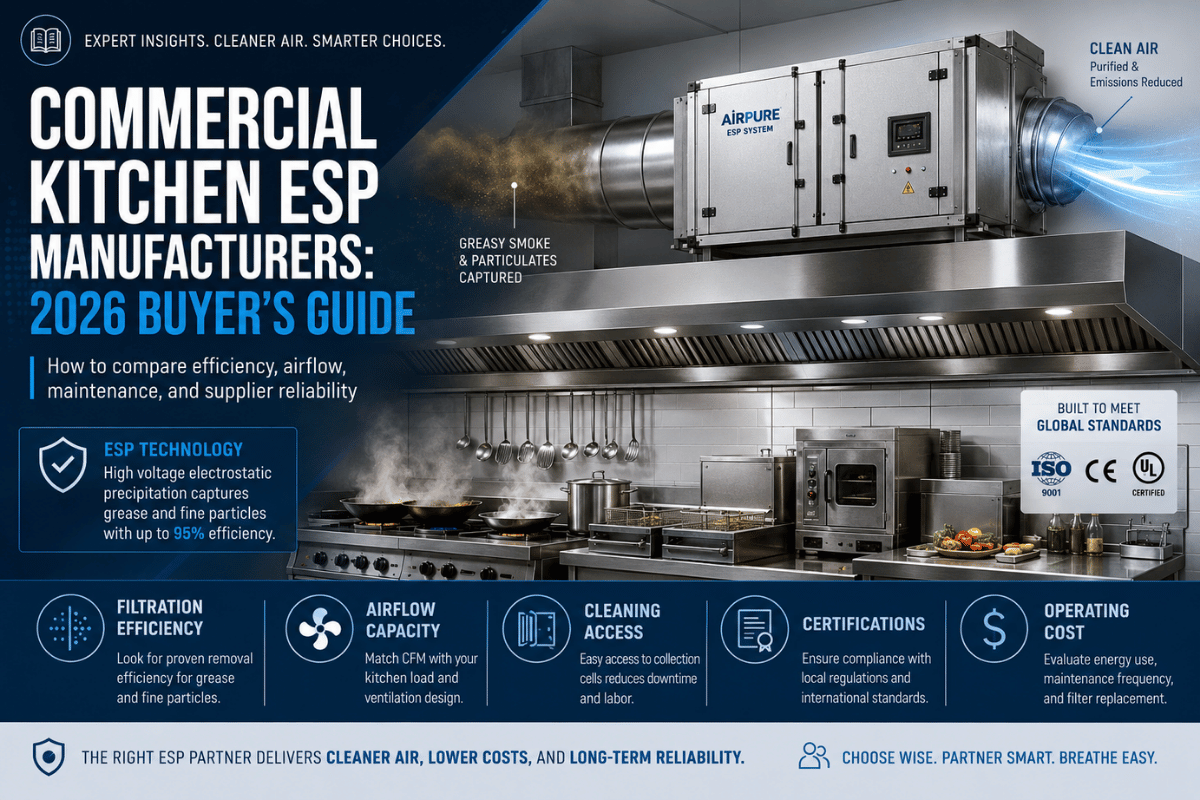
If your kitchen is spewing visible smoke or oily mist out of the rooftop stack, your baffle filters aren’t up to the job. A commercial kitchen electrostatic precipitator (ESP) captures the fine grease and smoke that baffle and mesh filters miss-and choosing the right ESP unit, and the right commercial ESP manufacturer behind it, is the decision that this guide is designed to help you make. Read on for a deep dive into how ESPs work, what they capture-and what they don’t-and the codes and maintenance trade-offs that matter when you invest in the technology.
Quick Specs, Commercial Kitchen ESP at a Glance
| Operating principle | Two-stage: high-voltage corona ionizer charges particles, oppositely charged collector plates capture them |
| Rated filtration efficiency | Often rated to a ~95%-at-0.3-micron design criterion; >99% achievable in ideal applications, but real efficiency is size-dependent |
| Particles targeted | Sub-micron grease and smoke that baffle/mesh filters pass |
| Typical airflow range | ~1,500–20,000+ CFM in modular cells |
| Listings to demand | UL 867 (air-cleaner safety) and UL 8782 if supplied as a Pollution Control Unit |
| Maintenance reality | Requires scheduled cell washing; efficiency falls sharply if neglected |
What a Commercial Kitchen ESP Does in the Exhaust Hood System
An ESP isn’t a stand-alone filter, it’s one component of the commercial kitchen ventilation train. Air exits the cooking appliance, is collected by an exhaust hood, is filtered for heavy, large droplet grease by baffle filters, then travels to the ESP, which the U.S. EPA classifies as a fine-particulate control device. It then pulls from that stream the smaller particles that carry oil, grease and odor, returning cleaner air. That fills the gap in the process, collecting the sub-10-micron grease and smoke fraction after the large droplets have been removed.
Why baffle filters alone won’t do the job. Both baffle and mesh grease filters rely on the principle of inertial impaction. The airflow change direction suddenly at baffle vanes or in a mesh filter, and inertia prevents large oil, grease and soot particles from following the bends. This effectively captures the heavier grease and smoke. However, because there’s so little mass and velocity, small grease and smoke particles with an average size of approximately 10 microns (the range for visible emissions from many food preparation processes) don’t change trajectory. They continue on the straight path into the duct and out the stack as that bluish haze. By applying an electric charge to these small particles in the first stage, then attracting them to charged plates in the second stage, an ESP ensures that the air that leaves the building is far cleaner, not merely de-greased. Removing that fine fraction also helps reduce grease carried deeper into the ductwork, lowering the fire risk it would otherwise feed.
⚠️ Common misconception
An ESP will not substitute for your grease filters. It is a secondary step. Allowing a system to operate with your commercial kitchen electrostatic precipitator without appropriate grease pre-filtration results in rapid loading of the collector cells with grease, the main reason why most field failures occur.
How Electrostatic Precipitation Works: Ionize, Charge, Collect
How does an electrostatic precipitator (ESP) work?
Most commercial kitchen ESP units use a two-stage design. In the first stage, ionizing elements are maintained at a high potential that corona discharge through ionizing wires produces an abundance of ions that flow with the air and collide with grease and smoke particles, charging them electrically. In the second stage, these positively charged particles flow through a section with an array of plates having the opposite potential where the electric field attracts the particles to the plates where they accumulate. The U.S. EPA describes the same charge-attract process as the principal mechanism for ESPs across industries and notes that such devices are capable of collection efficiencies greater than 99 percent in appropriate applications.
“Greater than 99 percent” is for real but it’s a design point – not the true efficiency down to every particle size. In peer-reviewed two-stage ESP testing, collection efficiency for 0.25-micron particles rose from 68.4% to 91.4% as the charger current increased, so the sub-micron number depends heavily on how the unit is energized and the air flow rate. If the supplier lists “98% down to 0.01 micron,” assume this refers to the peak value in the ideal case and then ask for a efficiency vs. particle size curve.
The Micron Capture Ladder — what each stage actually catches
| Particle size | What it is | Best-suited stage |
|---|---|---|
| > 10 micron | Heavy grease droplets | Baffle / mesh filter |
| 1–10 micron | Fine grease aerosol | ESP (high capture) |
| < 1 micron | Visible smoke | ESP (capture is current/velocity-dependent) |
| Gas-phase | Cooking odor / VOCs | Needs carbon or UV — not an ESP job |
📐 Engineering Note
Charging happens in milliseconds, but only if a particle stays in the ionizer long enough. Push more air through an ESP than its design face velocity and dwell time drops below what sub-micron particles need to get charged, so a unit “sized” only for peak CFM, then run hard, under-performs in the field. Size an ESP to your system’s design airflow, not its maximum.
ESP vs Baffle, Water-Wash, and UV: A Commercial Kitchen Filtration Crosswalk
No single device does everything, most real installations stack two or three of these. Use the crosswalk below to see where the ESP fits and where it needs help.
| Method | Effective on | Maintenance mode | Odor control? |
|---|---|---|---|
| Baffle filter | Droplets >10 micron; lowers fire risk | Wash in place / dishwasher | No |
| Media / paper filter | ~90–95% on finer dust, but disposable | Replace cartridges (ongoing cost) | Partial |
| ESP | ~95% at 0.3 micron rating; sub-micron grease & smoke | Wash reusable cells on a schedule | No (needs add-on) |
| Water-wash | Grease via continuous wash; good for solid-fuel | Self-cleaning, but water + detergent cost | Partial |
| UV-C | Cracks grease vapor + odor (adjunct only) | Lamp replacement | Yes (gas-phase) |
The 95%-at-0.3-micron figure is a design rating criterion used to rate ESPs in commercial kitchen design, not a guaranteed field measurement. The 90–95% barrier/media figures come from separate kitchen-exhaust engineering comparisons on a different test basis, so treat the columns as directional, not head-to-head.
✔ ESP advantages
- Captures the sub-micron smoke baffle filters pass
- Reusable cells, no disposable cartridge stream
- Low pressure drop, so lower fan energy than dense media
⚠ ESP limitations
- Performance collapses if cells aren’t cleaned
- Does nothing for gas-phase odor without carbon/UV
- High-voltage system needs trained service + can emit trace ozone
Sizing and Efficiency: CFM, Collection Rate, and Cooking Type
A designer’s ESP is given a rating of “design” air flow, which is good only for systems that are appropriately matched to both your volume exhaust and cooking load. Modular cells range from about 1,500 CFM on a single hood up to 20,000+ CFM on a multi-line restaurant. But the unit isn’t specified by CFM; it’s specified by your grease load. A system designed to collect very heavy cooking loads like charbroil or wok will generate more fine grease per hour than a sandwich or steam line. Because these systems generate more grease, they require larger collecting surfaces, pre-filtration of a heavier rating and may benefit from auto-wash capabilities. A California Energy Commission commercial-kitchen ventilation study documents how the cooking-line load, not the headline airflow number, drives exhaust and filtration sizing.
Cooking-Type → ESP Configuration Selector
- Light / steam / sandwich: single-pass ESP cell with a standard baffle pre-filter
- Fryer / oven / griddle: two-stage ESP, scheduled manual wash
- Charbroiler / wok / heavy grease: two-stage ESP + heavy baffle pre-filter + auto-wash; consider a catalytic or UV add-on where odor control and code compliance are issues
Picture a high-volume Korean BBQ kitchen running rooftop charbroilers ten hours a day, venting through a stack thirty feet from an apartment building’s windows. Size the ESP on peak CFM alone and it looks fine on paper, but factor in the real grease throughput and a single-pass cell clogs within weeks, smoke breaks through, and the neighbor complaints start. By contrast, a kitchen with a properly oversized two-stage cell, heavy pre-filters, and a nightly auto-wash hold its capture rate because the cells never foul past the point of no return.
Compliance: UL 867, UL 8782, NFPA 96 and Local Smoke Ordinances
This is where almost all buyer’s guides and competitor pages drop the ball. “We’re UL Approved!” they exclaim, and everyone assumes high performance. It doesn’t quite work that way, and that difference is the biggest lever when you talk to manufacturers.
Commercial Kitchen ESP Standards & Codes Matrixthe full stack a buyer (and an AHJ) will check, by category:
| Standard / Code | Category | What it governs |
|---|---|---|
| UL 867 | Product safety | Electrostatic air-cleaner safety (electrical, fire, ozone) — not grease-capture efficiency |
| UL 8782 | PCU performance | Pollution Control Units for Commercial Cooking (UL category YZHK) |
| UL 710 | Hood | Exhaust hoods for commercial cooking equipment |
| UL 762 | Fan | Power exhaust ventilators — the fan serving the system |
| UL 1978 | Duct | Grease ducts (legacy; the 2021 IMC replaced this reference with UL 8782) |
| NFPA 96 | Fire / ventilation | Ventilation, fire protection and cleaning frequency for the whole cooking operation |
| ICC IMC (2021) | Model code | 15 specific PCU installation requirements (mounting, clearances, drainage) |
| NYC Local Law 37 | Local ordinance | Charbroilers above a meat-throughput threshold must cut particulate ≥75% |
| NYC Local Law 38 | Local ordinance | New cookstoves / solid-fuel appliances must reduce particulate |
| SCAQMD Rule 1138 | Local ordinance | 875-lb/week charbroiler threshold for control-technology requirements |
| ASHRAE (Ch. 29) | Reference | Notes that UL air-cleaner tests do not evaluate grease-capture or flammability of collected material |
UL itself readily acknowledges that its UL 867 standard covers the safety of air-cleaning devices like electrostatic, but cautions that the test associated with this standard don’t measure the grease capture or flammability performance of the material captured in the unit (according to ASHRAE). A more pertinent recent standard is UL 8782, developed by UL as an Outline of Investigation for Pollution Control Units for Commercial Cooking. In its 2021 edition, the International Mechanical Code updated its reference from UL 1978 to UL 8782. If your ESP system is part of a packaged unit (a pollution control unit), the meaningful test should be whether the package is listed to UL 8782.
More and more, local code authorities are driving ESP purchasing. New York City’s charbroiler rules require operations above a set meat-throughput threshold to cut particulate by at least 75% and reference UL-listed control devices by type. California’s South Coast air district, in its Rule 1138, sets an 875-pound-per-week charbroiler threshold above which control technology is required; the California Air Resources Board documents the under-fired charbroiling control technology behind such rules. The takeaway: confirm what your local authority having jurisdiction (AHJ) requires before you spec a unit.
Maintenance Reality, the Grease-Fire Connection, and ESP Disadvantages
What are the disadvantages of a commercial kitchen ESP?
The correct (but rarely quoted by competitors) answer is this: The ESP is only as good as your cleaning schedule. ESP technology isn’t a universal solution. As particles collect, layers of grease, mixed with food particulate and baked, form solid bridging elements between charged plates, causing “arcing” and collapsing the ESP’s field. Particles no longer captured and your ESP light says everything is fine! (Pure cooking oil has very poor conductivity; it’s this accumulated and gap-filling conductive deposit that causes the short, hence the specialized corona electrodes used in grease-rich atmospheres, such as patent WO2005057613A2, a corona electrode designed to operate in a conductive grease atmosphere.) According to the U.S. EPA’s guidance documents on control techniques, particle resistivity is a major factor in ESP performance – yet another reason why real-world ESP results often fall far short of brand-new equipment promises.
Is a commercial kitchen ESP easy to clean?
Cleaning isn’t nearly as difficult as changing a filter, but it takes time and is real effort. Metal collector cells should be soaked (not just rinsed) in hot water with an aggressive de-greasing agent to loosen the “baked-on” grease layer. Most automatic wash units will run a cleaning sequence after closing, but you’ll likely still need periodic manual deep cleans in heavy service restaurants. No matter how well your ESP captures particles, NFPA 96 dictates regular cleaning of exhaust system ductwork at intervals determined by the type of cooking and the amount you serve.
If ESP ships as a packaged pollution control unit (PCU), treat it as system – UL’s PCU guidelines specify a cooking-area airflow differential sensor with alarm on CLOG/failure, plus an integrated fire suppression system. This is what any serious ESP buyer inquires about, not a spec sheet capture efficiency value.
⚠️ From the field
A common complaint among HVAC technicians: An ESP discovered inside a ‘smoke less’ recirculating hood and that had simply never been cleaned; operation was restored after washing out the ESP’s cells. The message: ESP’s are often forgotten after they’re installed, turning into a money trap rather than useful equipment.
How to Vet a Commercial ESP Manufacturer: A 7-Point Checklist
Technology is mature; brand, not underlying type, is your variable now. Most search results for ‘commercial ESP manufacturer’ are trading sites or lightweight product-level pages. Vigorously check out suppliers based on these 7 factors prior to commitment:
- 1. Verifiable UL 867 listing. Request the file number to verify it, don’t settle for ‘UL approved’.
- 2. UL 8782 PCU listing if it comes as a packaged PCU – don’t let them rely on an air-cleaner only mark.
- 3. A valid efficiency test method with corresponding curve; look for variations across particle size-not one peak.
- 4. OEM vs. Trader. Verify they manufacture the cell and high-voltage power supply, not just relabel one.
- 5. Spare parts availability and turnaround for the cell and high-voltage power supply.
- 6. Written warranty that covers arcing events in both the cell and the HV power supply.
- 7. Comparable installed reference installations relevant to your cooking operation type; char-broiler reference trumps generic logo walls.
“Originally, the objective with UL was for manufacturer input in defining PCU requirements for safe operation and performance equal to or better than the systems into which the equipment is installed.”
For a working example of how a dedicated manufacturer presents this class of equipment, see Polygee’s commercial kitchen ESP systems for restaurant exhaust and air purification. Whatever supplier you shortlist, hold them to the seven check above.
What a Commercial Kitchen ESP Costs, and the 5-Year Total Cost of Ownership
An installed-cost of a commercial kitchen ESP isn’t available from one source, it varies dramatically based on airflow, integration within existing hood work, and the availability of wasdown-capability at a floor drain. While a base cell may be quoted anywhere from $1,150 to $3,100 per unit in a manufacturer’s open market site, a full installed unit will be substantially higher. The EPA Air Pollution Control Cost Manual details ESP cost methodology, calibrated to industrial units, but the line-item structure transfers. Budget against the items below.
5-Year Cost-of-Ownership Breakdown
| Capital (ESP cell + HV supply) | Factory-gate ~$1,150–$3,100/cell; multiple cells for high CFM |
| Installation | Hood/duct integration, UL 762 fan, and — if washdown is fitted — a grease interceptor and duct sloped to the PCU drain |
| Energy | Low pressure drop = lower fan energy than dense media filters (an ongoing saving) |
| Cleaning labor | Scheduled cell washing — the line item that decides whether the ESP keeps performing |
| Replacement | Collector cells and HV power supply over the unit’s life (vs recurring disposable-filter spend avoided) |
Reusable cells are where the ESP wins on long-run cost, no disposable-cartridge stream, and the low pressure drop trims fan energy. Those savings only materialize if the cleaning-labor line is actually funded. An unmaintained, dirty ESP delivers neither cleaner air nor savings at the fan.
Industry Outlook: Why Emission Rules Are Pushing ESP Adoption
By far the clearest signal to buy a commercial kitchen ESP isn’t marketing, it’s regulation. As of 2025–2026, tightening air-emission rules (New York City’s charbroiler and cookstove laws, California South Coast’s charbroiler control rules, and the steady spread of particulate ordinances) are making effective fine-particulate control unavoidable rather than merely desirable. UL highlights a structural driver too: “town center” developments that mix residential and commercial uses in one building footprint limit where kitchen exhaust can terminate, pushing operators toward pollution control units instead of simple rooftop discharge.
Market-research firms estimate roughly 3% to 6% annual growth for the broader ESP market, and because most of those forecasts fold in large industrial and power-generation units, treat the figures as directional only. What matters for an ESP decision-maker is one point: check the current emission code, which decides whether an ESP is required or optional for your operation, before you specify any equipment. That, not a market chart, drives the decision.
Frequently Asked Questions
What is an ESP in a commercial kitchen?
View Answer
ESP stands for electrostatic precipitator — an electronic air cleaner installed in the kitchen exhaust duct that uses a high-voltage corona to electrically charge fine grease and smoke particles, then captures them on oppositely charged collector plates. It removes the sub-micron fraction that baffle and mesh grease filters cannot catch, so the air leaving the building is cleaner and less visible.
How effective is a commercial kitchen ESP at removing smoke and grease?
View Answer
ESPs are commonly rated around 95% efficiency at 0.3 micron and can exceed 99% in well-designed applications, but the real number is size-dependent — peer-reviewed testing showed sub-micron capture climbing from about 68% to 91% as charger current increased. Effectiveness also drops sharply if the collector cells are not cleaned on schedule, so the rating on the spec sheet is a ceiling, not a guarantee.
Do I still need grease filters if I install an ESP?
View Answer
Yes. Baffle or mesh grease filters remain the first stage — they catch the large droplets and reduce fire risk before air reaches the ESP. Running an ESP without proper pre-filtration loads the collector cells with heavy grease far faster, accelerating fouling and arcing. An ESP supplements your grease filters; it does not replace them.
How often does a commercial kitchen ESP need cleaning?
View Answer
It depends on cooking volume and grease load — heavy charbroiling may need weekly cell washing, lighter cooking less often. Auto-wash units reduce the burden but do not eliminate manual deep-cleans.
How much does a commercial kitchen ESP cost to buy and run?
View Answer
There is no reliable single installed price, because cost depends on airflow, hood integration, and whether washdown drainage is required. Factory-gate ESP cells are listed from roughly $1,150 to $3,100 per unit on manufacturer marketplaces, but a fully installed pollution control unit costs considerably more once the UL 762 fan, ductwork, fire suppression, and any grease-interceptor drainage are included. Over five years, the bigger numbers are cleaning labor and eventual cell/power-supply replacement — though the reusable cells avoid the recurring spend of disposable filters, and the low pressure drop trims fan energy. Always get a quote tied to your specific CFM and cooking type.
Can an ESP be retrofitted to an existing commercial hood?
View Answer
Often yes — modular ESP cells are designed to be added in-line in the exhaust duct downstream of the hood and grease filters. The constraints are physical space for service access, adequate duct run, and your jurisdiction’s installation code (the 2021 IMC sets specific pollution-control-unit requirements). Confirm fit and code compliance with the manufacturer and your AHJ before ordering.
References & Sources
- Monitoring by Control Technique, Electrostatic PrecipitatorsU.S. Environmental Protection Agency
- Pollution Control Units for Commercial Cooking Systems (UL 8782)UL Solutions
- NFPA 96: Ventilation Control and Fire Protection of Commercial Cooking OperationsNational Fire Protection Association
- Two-stage electrostatic precipitator collection efficiency studyChemical Engineering Journal (peer-reviewed)
- Under-fired Charbroiling Control TechnologyCalifornia Air Resources Board
- Catalytic oxidizer PM2.5 reduction on chain-driven charbroilerspeer-reviewed (PubMed)
- Commercial Kitchen ESP, High-Efficiency Restaurant Exhaust & Air Purification SystemsPolygee (manufacturer resource)
About This Guide
This buyer’s guide to commercial kitchen electrostatic precipitators was researched and written by the editorial team at Kitech and reviewed against published UL 867, UL 8782, NFPA 96, and U.S. EPA documentation. We’re an industrial-equipment manufacturer, not an ESP vendor, so the comparisons and the 7-point vetting checklist here are written from a buyer’s standpoint rather than to sell a specific unit.