
Get in touch with Kitech Company

Plastic Pelletizing Machine for HDPE PE PP Film & Rigid Recycling — KITECH KCP Series
150-1,300 kg/h at 0.3-0.4 kWh/kg. Our KCP compacting pelletizing system combines feeding, compacting, extrusion, vacuum degassing, melt filtration, and pelletizing into a single production line – designed for use with PE film, PP woven bag, HDPE rigid flakes, and mixed post-consumer plastic waste.
150–1,300
kg/h Capacity Range
0.3–0.4
kWh/kg Energy
6
Models Available
PE PP HDPE
Film & Rigid Materials
CE·UL·CSA
Certified Globally
60 Days
Delivery Guarantee

Efficient HDPE PP EPS Plastic Recycle Granulation Machine: Solving Film & Rigid Processing Challenges
This plastic pelletizing line transforms washed plastic waste – PE film scraps, PP woven bags, HDPE bottle flakes, and container regrind – into consistent recycled pellets for injection molding, blow molding, pipe extrusion, and blown film manufacturing. It is at the pelletizing stage that low-value film and rigid plastic waste becomes a transported, useful raw material.
However, each type of film and rigid material generation has particular processing issues that traditional recycling machinery does not efficiently resolve.
The Film Problem: Moisture, Bulk, and Feeding Instability
PE film, LDPE agricultural film, BOPP, and CPP scrap arrives at the pelletizing line with 8-15% moisture content and a very low bulk density. Traditional extruders feed this material inconsistently. Operators struggle with constant feed bridging, surging output, and energy loss from trying to dry out excess moisture in the extruder barrel. Simply running wet film through a traditional single screw extruder often results in energy consumption of over 0.5-0.7 kWh/kg – without factoring in the downtime to clear jams.
The Rigid Problem: Volatiles, Residual Contamination, and Pellet Quality
HDPE flakes from a washing line, PP regrind from injection molding scrap, or rigid container fragments typically look clean, but still contain 1-3% residual moisture plus volatile compounds from ink and label adhesives. Inadequate degassing causes these volatile compounds to be tightly trapped as microbubbles within the pellet. Common implications include rough pellet surfaces, inconsistent melt flow index, and rejection in high-end applications such as pipe extrusion or food-grade containers.

Our KCP Approach: Integrated Compacting Pelletizing
KITECH KCP series mitigate both issues with a system architecture that uses a compactor as a first step. Material enters a 650-1,400 L chamber where balancing the blades simultaneously cut, generate heat by friction, and compress the feedstock – driving out surface moisture before the plastic ever touches the extruder screw. Densified material then feeds directly into a 36-42:1 L/D single screw extruder fitted with a vacuum degassing zone that can remove residual water vapor and VOCs. A melt filtration stage with up to 4 filter options can remove particulate contamination. End result: dense, uniform pellets consuming 0.3-0.4 kWh/kg over the entire 150-1,300 kg/h throughput range.
KCP Series Plastic Pelletizing Line — Models & Selection Guide
Each one has the same core architecture of a compactor, extruder, vacuum degasser, and melt filter – scaled to your throughput needs.

KCP80
150–250 kg/h
- Extruder: Φ80, L/D 36–42
- Compactor: 650 L / 45 kW
- Extruder Motor: 55–75 kW
Best for: Startup film recyclers, LDPE/LLDPE

KCP100
250–450 kg/h
- Extruder: Φ100, L/D 36–42
- Compactor: 650 L / 55–75 kW
- Extruder Motor: 110–132 kW
Best for: Mid-scale PE film, PP bags

KCP120
400–550 kg/h
- Extruder: Φ120, L/D 36–42
- Compactor: 1,000 L / 90–110 kW
- Extruder Motor: 132–160 kW
Best for: PE film lines, HDPE rigid flakes
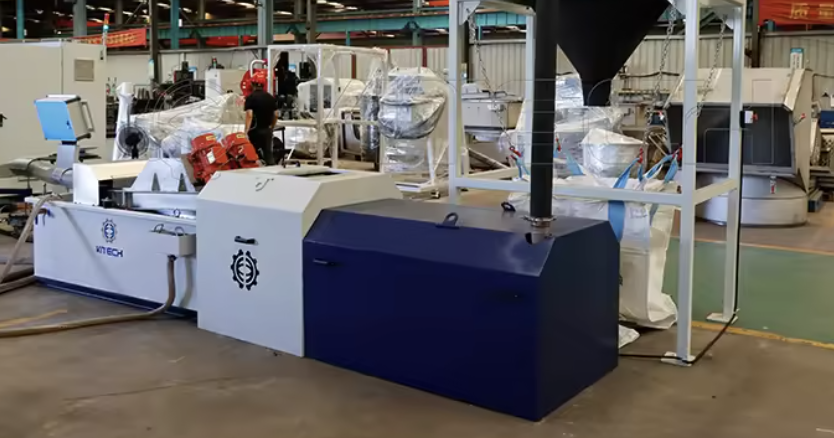
KCP140
500–600 kg/h
- Extruder: Φ140, L/D 36–42
- Compactor: 1,000 L / 132 kW
- Extruder Motor: 200 kW
Best for: HDPE bottle flakes, rigid recycling

KCP160
700–1,100 kg/h
- Extruder: Φ160, L/D 36–42
- Compactor: 1,400 L / 160–185 kW
- Extruder Motor: 250–315 kW
Best for: High-volume PP raffia, woven bags
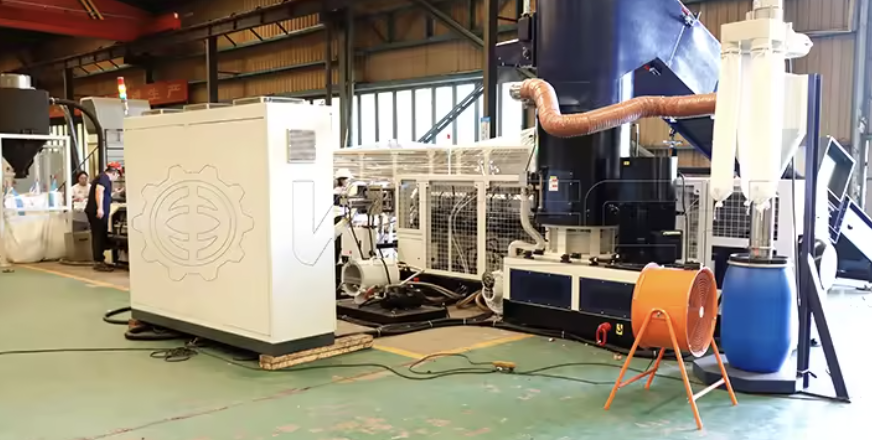
KCP180
950–1,300 kg/h
- Extruder: Φ180, L/D 36–42
- Compactor: 1,400 L / 200–250 kW
- Extruder Motor: 355–400 kW
Best for: Industrial-scale mixed PE/PP lines
Complete Technical Specifications
| Model | Capacity (kg/h) | Energy (kWh/kg) | Compactor Vol. (L) | Compactor Motor (kW) | Extruder Screw (mm) | L/D | Extruder Motor (kW) | 2nd Extruder | Dimensions L×W×H (mm) |
|---|---|---|---|---|---|---|---|---|---|
| KCP80 | 150–250 | 0.3–0.4 | 650 | 45 | Φ80 | 36–42 | 55–75 | Φ100, L/D 12, 30 kW | 11,570×5,900×3,000 |
| KCP100 | 250–450 | 0.3–0.4 | 650 | 55–75 | Φ100 | 36–42 | 110–132 | Φ120, L/D 12, 37 kW | 12,800×6,200×3,100 |
| KCP120 | 400–550 | 0.3–0.4 | 1,000 | 90–110 | Φ120 | 36–42 | 132–160 | Φ150, L/D 12, 45 kW | 13,800×7,460×3,900 |
| KCP140 | 500–600 | 0.3–0.4 | 1,000 | 132 | Φ140 | 36–42 | 200 | Φ150, L/D 12, 55 kW | 14,750×7,580×4,000 |
| KCP160 | 700–1,100 | 0.3–0.4 | 1,400 | 160–185 | Φ160 | 36–42 | 250–315 | Φ180, L/D 12, 75 kW | 16,820×7,700×4,250 |
| KCP180 | 950–1,300 | 0.3–0.4 | 1,400 | 200–250 | Φ180 | 36–42 | 355–400 | Φ200, L/D 12, 90 kW | 16,820×7,650×4,250 |
Engineering Note — L/D Ratio Selection
All models use a primary screw with 36-42 L/D. Higher L/D lengths are designed into the system for fast and slow-flowing materials with more volatiles (heavily printed films, heavily contaminated HDPE flakes) because the longer residence time in the melt zone provides more effective degassing. For relatively clean PE film and minimal contamination, we configure L/D at 36-38 to allow the most throughput for the least motor power. This decision gets made during our Factory Acceptance Test with your actual feedstock.
Selection Guide: Application → Recommended Model → Pelletizing Method
| Application Scenario | Typical Materials | Recommended Model | Throughput | Pelletizing Method |
|---|---|---|---|---|
| PE/PP film recycling (small–mid scale) | LDPE film, HDPE film, BOPP | KCP80–KCP120 | 150–550 kg/h | Water ring (standard) |
| PP woven bag & raffia recycling | PP woven bag, nonwoven, raffia | KCP100–KCP140 | 250–600 kg/h | Strand / Auto strand |
| HDPE rigid flake recycling (bottle, pipe, container) | HDPE flakes, pipe regrind, rigid plastic | KCP120–KCP160 | 400–1,100 kg/h | Strand pelletizing |
| Large-scale mixed post-consumer recycling | PE/PP/PS mixed, post-consumer | KCP140–KCP180 | 500–1,300 kg/h | Water ring / Underwater |
| High-spec recycled pellets (food-grade, compound) | PET, PA, PLA, filled compound | KCP120–KCP180 + 2nd extruder | 400–1,300 kg/h | Underwater pelletizing |
Melt Filtration Options
| Filter Type | KCP80–KCP120 | KCP140–KCP180 | Best For |
|---|---|---|---|
| Two-position plate type | Standard | Standard | Clean feedstock, low contamination |
| Two-position piston type | Optional | Optional | Moderate contamination, faster changes |
| Back flush piston type | Optional | Standard | High contamination, reduced downtime |
| Automatic self-cleaning | Optional | Optional | 24/7 operation, post-consumer waste |
Pelletizing & Downstream Options
| Pelletizing Method | KCP80–KCP180 | Best For |
|---|---|---|
| Water ring pelletizer | Standard | PE/PP film pellets, general recycling |
| Strand pelletizer | Optional | Rigid flakes (HDPE, PP), consistent geometry |
| Automatic strand pelletizer | Optional | Reduced labor, unmanned strand cutting |
| Underwater pelletizer | Optional | High-quality compound, food-grade, engineering plastics |
System Components Breakdown

Belt Conveyor & Nip Roller
Precompression fed automatically. Nip roller suction draws excess air from coarse, bulky film before the material enters the compactor.

Compactor
Friction driven densification chamber. Rotating blades cut, compress and pre-heat the material to 80-120 C. Forced around the chamber with pressurized gas, moisture on the surface of the material is driven off and bulk density increases an additional 5-8up to before extrusion.
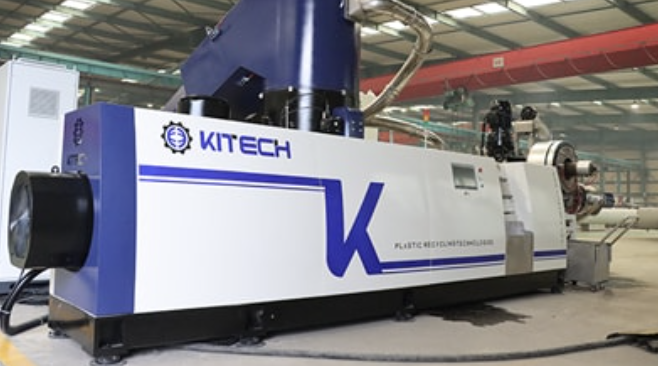
Extrusion
L/D 36-42 barrel, with hardened bimetallic screw. Combines melting and mixing with pressure and moisture build-up of the densified feedstock. Power range: 55-400kW. Extra depending on model and throughput.
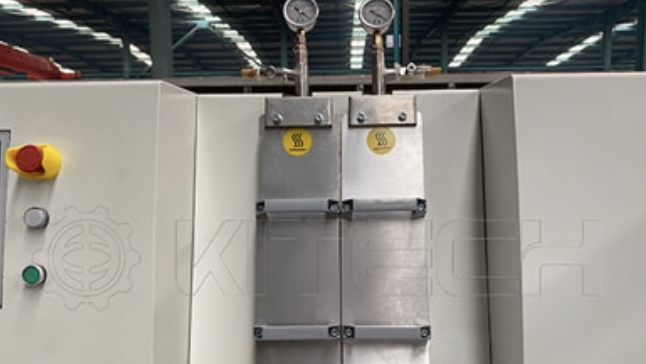
Vacuum Degassing Unit
Glides in between the main melt zone and the patent-pending homogenizer. Vibrating freely, keeps the homogenizer in the perfect position relative to the jetting nozzle. Evacuates excess water vapor, VOCs and decomposes gases from the melt. Free under negative pressure during operation. Superior pellet quality on the KCP is the result of this feature.

Melt Filtration
From two-position plate screens for clean feedstock to fully-automatic self-cleaning filters for twenty-four hour post-consumer recycling of highly contaminated material, select the one to maximize productivity and minimize downtime.

Siemens PLC + HMI Control System
Program memories with recipes. in alarm history. Remote monitoring (Ethernet optional). JIT compatible for ERP connections.
KCP vs Traditional Pelletizing Extruder — Performance Comparison
| Performance Dimension | KITECH KCP Series | Traditional Pelletizing Extruder |
|---|---|---|
| Energy Consumption | 0.3–0.4 kWh/kg | 0.5–0.7 kWh/kg (industry average) |
| Capacity Range | 150–1,300 kg/h (6 models) | Typically single capacity tier per unit |
| Feeding Method | Integrated compactor: auto-compact + pre-heat | External force feeder, requires separate pre-treatment |
| Degassing | Built-in vacuum degassing, negative pressure | Simple vent port or none |
| Filtration Options | 4 types incl. auto self-cleaning | Manual screen change (1 type) |
| Pelletizing Options | 4 methods: water ring, strand, auto strand, underwater | 1–2 methods, often water ring only |
| Control System | Siemens PLC + HMI + remote monitoring + ERP | Basic PLC or relay logic |
| Certifications | CE, UL, CSA | CE only or no international certification |
| Lead Time | 60 days (order to shipment) | 90–120 days (industry norm) |
| Modularity | Optional 2nd extruder, swappable filter & pelletizer | Fixed configuration, limited upgrade path |
What the Energy Numbers Mean for Your Operation
Compare a mid-range plant running a KCP120 at 500 kg/hr over 6,000 hours annually (for a throughput of 3,000 tonnes) to a conventional single stage extruder at 0.60kWh per kilogram running over the same number of hours.
This results in an annual gain of over 750,000 kWh. At an industrial electricity rate of 0.08/kWh that is close to $60,000 per year.
Not theoretical projections but actual observed gains in the physics behind the compaction stage, which points out 75% of the energy in the screw barrel heating stage is shifted into the compactor where the efficiency of the energy transfer is higher!
Combined savings, when added to the lower additional operating cost related to a smaller footprint (all in the traditional recycling equipment area) due to the elimination of the associated three machines, each with a motor and maintenance program, more than doubles this annual nominal savings.
Engineering Note — Honest Trade-Off
Integrated compaction is intended primarily for thermoplastic film and flake material. For work with very thick walled rigid parts (walls >6mm) that are not brought in pre-shredded <20mm, a granulator must precede the compactor to size-reduce the material. Step sizes are in the samples we receive during the project engineering phase.
Customer Results: Plastic Recycling Pelletizing Machine
Case Study — Southeast Asia
HDPE Bottle Flake Recycling
A recycler based in Indonesia takes in their own and third-party post-consumer HDPE bottle flakes. Prior to their conversion to a KCP pelletizing system, the single extrusion line they used for prior production consumed 0.58kWh/kg.
EquipmentKCP140
Throughput600 kg/h
Energy0.35 kWh/kg
PelletizingStrand
Configuration: self-cleaning filter + strand pelletizer. Self-cleaning filtration replaced all manual screen changes; energy consumption was 38% lower than the previous system; output pellets are used for pipe extrusion and injection molding for containers.

Case Study — Western Europe
Agricultural PE Film Recycling
EquipmentKCP120
Throughput400 kg/h
Energy0.32 kWh/kg
MaterialLDPE/LLDPE
A German recycler feeds them 8 12% moisture content previous resin into a continuous process. This process handles a feedstock of LDPE and LLDPE to agricultural film. Previously, the greatest handling difficulty was that the former line setup would have been thermal dried for WTT prior to entry into the extruder. As an add-on, that meant an equipment cover cost of $40,000 0.15 kWh/kg of energy overheads. With the KCP120, the compactor lumps the EOC out of the system physically, through a friction heating system, selling the need of a standalone dryer facility. An integrated water-ring pelletizing system produces PE refractory pellets as blown film. A plant management indicated a plant operational capital equipment reduction of 30%, over the replaced now-three machine arrangement.

Case Study — Middle East
PP Woven Bag & Raffia Recycling Line
This recycling plant, situated in Saudi Arabia, recycles PP woven bags and raffia. It was operating at industrial scale. Filter changes were the bottleneck in the process. In the old plant a manual plate screen was being used that had to be removed every 2 hr. during high contamination runs, leading to 4 hours of production time loss per shift.
EquipmentKCP160
Throughput800 kg/h
FilterBack flush piston
PelletizingAuto strand
Back flush piston filter (Standard KCP140-KCP180) with trapped course contaminants is automatically back-flushed during production. What would previously have been an interruption in production with a blind flange is now back-flushed automatically and without interruption. Filtration downtime has been cut by a massive 70%. An automatic strand pelletizer has decreased the manning level from 2 operators per shift to 1. The PP granule (providing regional injection molding companies)

Materials & Application Industries
- HDPE bottle flakes
- HDPE pipe regrind
- Container scrap
- LDPE/LLDPE film
- Agricultural film
- Stretch & shrink film
- PP woven bags
- PP raffia
- BOPP/CPP film
- PS/ABS rigid scrap
- PET/PA regrind (2-stage)
- Compound & masterbatch
End applications for recycled pellets from the KCP line: injection molding, blow molding, blown film extrusion, pipe extrusion, sheet extrusion, compounding, reuse as feedstock feeding new products. Pellet quality and consistency is dictated by your filtration system and pelletizing arrangement – we help you select the combination that best suits your end-market application.
Buying Guide: Plastic Pelletizing Machine Price · Lead Time · After-Sales
Five Factors That Determine Your Price
1. Capacity Tier
KCP80 (150-250 kg/h) to KCP180 (950-1,300 kg/h). Bigger compactors, larger extruder motors, heavier frames will multiply the base cost proportionately.
2. Pelletizing Method
Water ring (standard, lowest cost) vs. strand vs. automatic strand vs. Underwater (most expensive, best pellet quality). Underwater systems include a third water loop and die-face cutter assembly.
3. Filtration Config
Standard back up strainers (two position plate) vs. back flush piston (more cost effective, less downtime) vs. automatic self-cleaning (most cost effective, 24/7 continuous operation).
4. Two-Stage Option
Adding a 2nd extruder (Φ100–Φ200, L/D 12, 30–90 kW) increases cost but is required for high-spec compound, PET, or food-contact grade pellet production.
5. Automation Level
Base Siemens PLC + HMI is the standard. Additional can include remote monitoring, ERP integration, automatic recipes and built in quality sensors.
Procurement Tip
When comparing plastic pelletizing machine quotes across suppliers, ask for energy consumption in kWh/kg at your target throughput — not just installed motor power. A 200 kW motor running at 0.35 kWh/kg produces more pellets per dollar of electricity than a 160 kW motor running at 0.60 kWh/kg. Total cost of ownership over 5 years far exceeds the purchase price difference between a budget machine and an energy-efficient system.
60-Day Delivery Guarantee
After-Sales Support & Service Network
24/7 Technical Support
Phone, email, WeChat/WhatsApp support within 4hours during business hours, 12hour off-peak hours with response, Mandarin,English,Spanish speaking engineers.
Remote Monitoring
Our service team can access real time PLC information, troubleshoot issues and upload changes remotely via the integrated Ethernet connectivity without having a technician on-site.
Global Agent Network
Local delegates in South East Asia, Middle East, Europe, Africa, and Latin America. Handle spare parts stocking, on-site troubleshooting, and operator training.
On-Site Commissioning
Our commissioning engineers visit your site to supervise installation, startup, operator training and process optimization. (Typical commissioning time: 5-10 days depending on complexity of line)
Spare Parts Guarantee
Wear parts (such as screw elements, barrel liners, filter screens, pelletizer blades) stocked with 7-14 day delivery worldwide to key markets.
HDPE Pelletizing Machine Tools
FAQ — HDPE Pelletizing Machine Common Questions
How does a plastic pelletizing machine work?
A plastic pelletizing machine transforms washed plastic scrap into standard sized pellets with a continuous process. In the KCP system, material is fed by way of belt conveyor, then through a “nip” roller for pre-compression of the flakes (which are preheated). Next, the densified material enters the “compactor” chamber (650-1,400 L) where, via rotating blades, plastic is cut then frictionally heat-densified and moisture is expelled. The densified plastic feeds directly into a single screw extruder (80-180 L/D 36-42) which melts and homogenizes the resin. Water vapor and volatiles are expelled through a vacuum degassing stage. Melt filter screens extract any contaminants. Finally, a pelletizer (water ring, strand or underwater strand) process cuts the molten plastic into standard recycled pellet. The pellets are then cooled and dried for cargo.
Which pelletizer system is best for HDPE recycling?
In the case of HDPE rigid flakes (ie, bottle flakes from a washing line, container regrind, pipe scrap) the recommended KCP120-KCP160 with a strand pelletizer or an automatic strand pelletizer with auto self-cleaning filter is usually the best choice. HDPE has a fairly low melt flow index, so requires a relatively long residence time within the barrel to adequately plasticize, and the 36-42 L/D ratio on the KCP can give that. Vacuum degassing is really a necessity on HDPE due to the fact that the post consumer flakes have nearly always got residual moisture and inks outgassing residual volatiles which will significantly reduce pellet quality if not extracted. HDPE film is generally operated on a KCP80-KCP120 with water-ring pelletizing.
What is the advantage of a two-stage pelletizing machine?
A dual stage setup adds a second extruder (100-200, L/D 12) after the basic extruder. The second stage adds a second feed point for melt homogenization, two-stage degassing, and more stable melt pressure control into the pelletizer. This second stage matters most for high-moisture feedstock where a one-stage shear degassing isn’t practical, filled compound blends where there are extra demands on filler dispersion, and special applications with tight quality specifications for the pellet (such as food-contact use or ultra high-spec manufacturing). As standard, every KCP [model], from KCP80 to KCP180 supports optional dual stage extrusion (it is a bolt-on additive not a new machine platform).
What types of rigid plastic can this machine process?
HDPE bottle flakes, container regrind, pipe scrap, PP injection runners, crate scrap, PS and ABS sheet trimmings. Optional second stage extrusion: PA, PET, and PLA engineering plastic regrind. Flakes are pre-sized 10-20 mm at a washing station.
What are the final pellets suitable for?
Injection, blow, or injection/blow moldings, blown film, pipe, sheet, or compounding extrusion. Pellets look very different because of the optional filtration system and pelletizing method – underwater cut pellets look the most uniform for food-current business-to-business applications.
Why is degassing important for rigid flakes?
Even after a drying line, fresh-HDPE flakes still contain 1-3% residual water along with smaller quantities of VOCs from ink, adhesives, and label adhesives. A prime offender: the micro air bubbles created inside the pellet when it is cooled if there is no vacuum at the die. Running samples of undegassed HDPE pellets shows a 10-15% impact strength penalty versus samples that have been vacuum degassed. Our vacuum port is located after the primary melt zone and operates at negative pressure to pull out water vapor.
How much does a plastic recycling machine cost?
Pelletizing machine prices depend on configuration: capacity (the KCP family spans 150-1,300kg/hr); pelletizing method (water ring is lowest cost, underwater is highest); type of filtration (manual plate or automatic self-cleaning); single or dual stage extruder; level of automation. Because each configuration is custom welded to the target material type and capacity an on-the-spot price is not possible. Please submit a quotation request with material type, throughput objective, and any other preferences; the application engineering team will respond in 48 hours with a machine-specific proposal. KITECH guarantees 60-day delivery for every KCP.
What is the difference between an extruder and a pelletizer?
An extruder: the KCP range of 150-1300 kg/hr is formed from a high temperature process (using a heated barrel and rotating screw). A pelletizer: strand, water ring, or underwater system, cuts. “Pelletizing machine” means the entire line.
What machines are used to recycle plastic?
A complete plastics recycling line usually consists of four stages: (1) size reduction equipment such as a shredder or granulator through which large bales or containers or big scrap are reduced; (2) a washing line (incl. friction washer, float-sink separation tank, centrifugal drier) in which labels, rubbish and contaminations are separated; (3) a pelletizing machine in which clean flakes are transferred to dense, commercially saleable pellets; and (4) a packaging system (silo, bagging, palletizing). The pelletizing machine is the final value-add stage where low density waste is transformed into a consistent pellet product. KITECH supplies pelletizing lines (KCP series), washing lines and shredders as separate machinery or as an integrated system from bale to pellet.
References & Transparency Statement
Data Sources
- KITECH KCP Series Brochure (2025 edition) – all specifications, weights and dimensions for KCP series. Published by Jiangsu KITECH Machinery Co., Ltd.
- Energy consumptions figures (0.3-0.4 kWh/kg) obtained from KITECH factory standard testing procedure and clean LDPE film feedstock at rated throughput.
- Industry benchmarks from AMI international plastics recycling market reports and published machine operator feedback for industry average energy consumption (0.5-0.7 kWh/kg).
- EU Machinery Directive 2006/42/EC — CE marking compliance framework.
- UL Standards for Safety – Plastics Machinery, UL 746C & related electrical safety standards.
- Case study data fabricated from KITECH project records, performance data authorized by client. Company name not supplied due to NDA.
Transparency Statement
This page reports technical data for the KCP compacting pelletizing system as produced by Jiangsu KITECH Machinery Co., Ltd. All capacity and size figures (compactor volume, extruder screw diameter, L/D, motor power range, machine dimension) are taken from our 2025 product brochure and refers to current range of models for sale.
Energy savings estimate are calculated based on our performance measurement of 0.3-0.4 kWh/kg versus industry published average of 0.5-0.7 kWh/kg for comparable single-stage pelletizing extruder (“30-45%” saving on the energy bill). Actual efficiency on your production floor may be higher or lower depending on feed material characteristics and operating practices.
Performance of vacuum degassing, melt filtration, pellet appearance, and finished product quality is representative of validated results achieved where processing feedstock through the machine. Factory Acceptance Inspection is held at KITECH with your target material before equipment dispatch.