Get in touch with Kitech Company

Self-Cleaning Laser Filter — No-Mesh Melt Filtration for Plastic Recycling Extruders
KITECH KLF Series laser disc screen changers take out metal, wood, paper, glass and rubber in recycled polymer streams – without wire mesh, without downtime, and without operator over-watch. Four models operate from 200-2,400kg/h throughput on LDPE, HDPE, PP, PS, ABS, POM, PA and PET.
Request a Quote
4
Models Available
200–2,400
kg/h Throughput
25 MPa
Max Working Pressure
100–500 μm
Filtration Fineness
3–6 mo
Disc Screen Life
Zero
Downtime for Screen Change
Why Recyclers Are Moving Beyond Wire Mesh Screen Changers
01
Industry Challenges
Post consumer and post industrial-derived plastic waste streams – LDPE film bales, HDPE bottle regrind, mixed PP packaging – carry contaminant loads that increase with each reprocessing cycle. Metal lumps, wood splinters, paper fibrils, un-melted plastics, sand, aluminum shavings mix into the polymer melt and undermine the quality of both the extrudate and downstream pelletizers. Conventional manual screen changers mean line stops every 2-8 hours, breaking wire mesh screens by hand and restarting with fluctuating pressure. Each screen change means 15-30 minutes lost production, transition scrap, and hot operator hands and knees under the hot breakout plate.
Read More ▼
02
Wire Mesh Issues
Wire mesh distorts in the presence of sustained melt pressure. Aperture openings grow larger as the wire mesh adapts and stretches, letting larger and larger contaminants slip through until the mesh tears or backs up completely in process pressure. Pressure variation runs throughout the process line – uneven pellet weight, strand break at the die, uneven melt temperature across filtration path.
Read More ▼
03
The KLF Solution
To solve these problems at their source, the KITECH KLF automatic laser filter replaces the mesh with a series of solid metal disc screen plates with laser drilled or precision punched orifices. Apertures achieve a consistent dimension under 25 MPa working load – no wire intersections to pull apart – and a set of dual-direction hardening machine tool scraper blades rotate against both sides of each disc, shaving off the introduced contaminants and piping the refuse into a dedicated discharge screw – all while the polymer melt moves through the filter’s body. The result: continuous processes with no stoppages, no changes, and no operator touchpoints.
Read More ▼
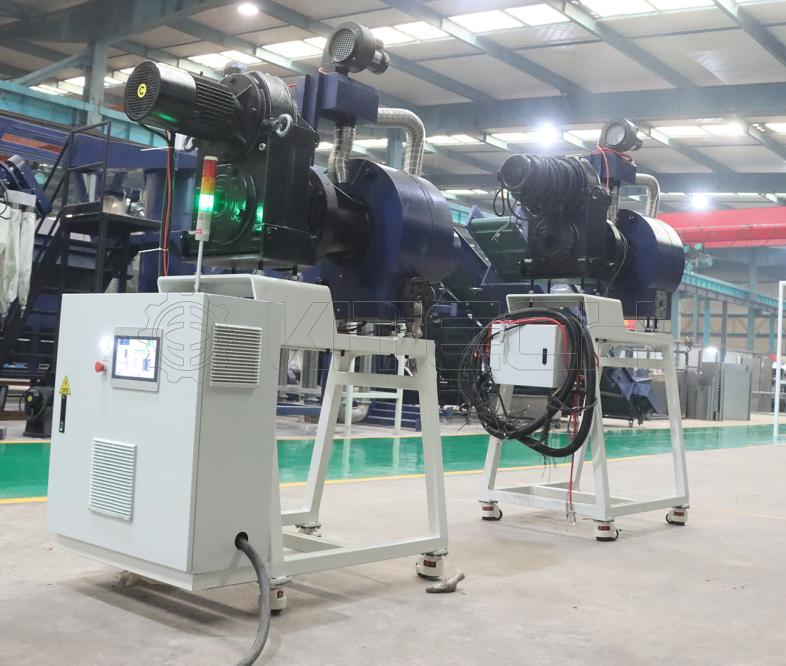
Engineering Note
KLF disc screen plates are made from zero-impact high quality steel – not wire mesh laminate. Laser drilling creates orifice bores with uniform cylindrical cross section (100-500 m diameter), ensuring good hole integrity and dimensional tolerances against aperture creep and deformation seen with woven wire mesh stretched under cyclic pressure. Up to four disc screens, each with 2751 cm or 6,556 cm of filtration surface area depending on model, run in each standard unit, or double that in dual type KLF units compared to other slide plate screen changers (50-200cm per cavity).
KITECH KLF Series — Models & Selection Guide
Four models in a range of two filter diameters (365 mm and 520 mm), individual and dual configurations. A standard model uses 2 disc screen plates, a dual configuration uses four plates and offers 2x filtration surface and throughput capacity. Match the model to your extrusion line throughput (kg/h, based on LDPE as the baseline), contamination present in input feedstock, and desired throughput pile fineness for final product.
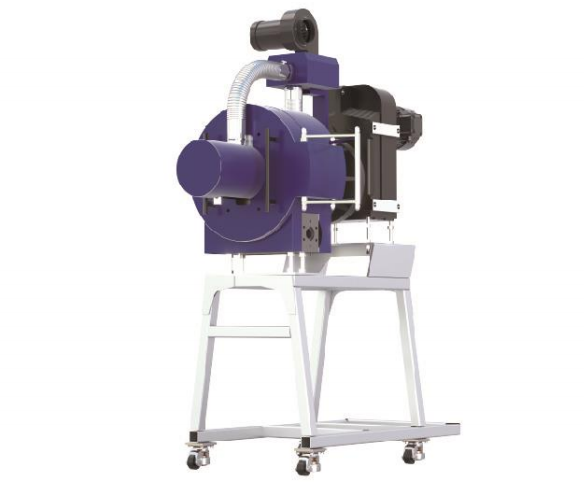
KLF365
Standard- Filter: Φ365 mm
- Area: 1,295 cm²
- Capacity: 200–700 kg/h (LDPE)
- Power: 4 kW drive / 32 kW heater
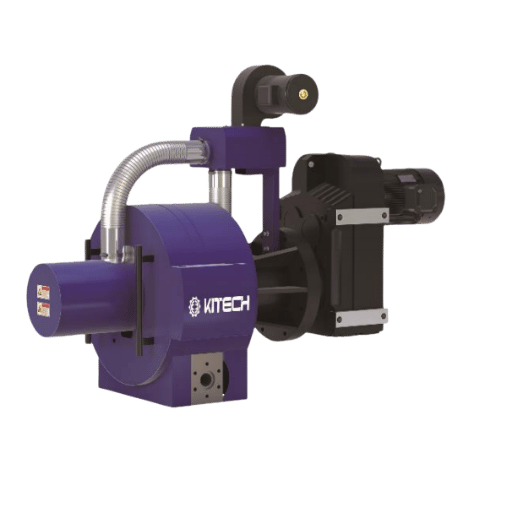
KLF520
Standard- Filter: Φ520 mm
- Area: 3,278 cm²
- Capacity: 700–1,200 kg/h (LDPE)
- Power: 5.5 kW drive / 48 kW heater
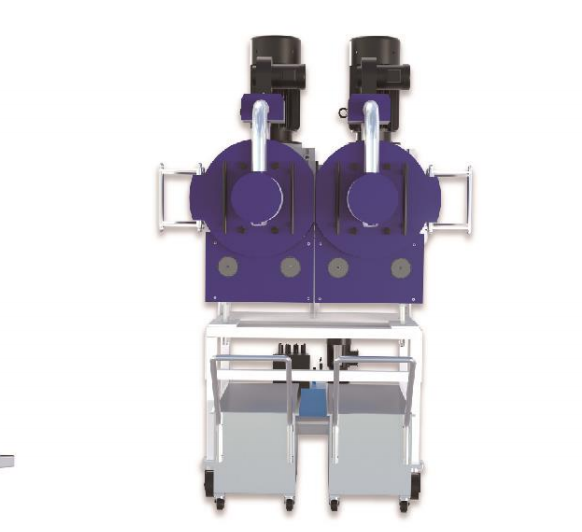
KLF365D
Dual Type- Filter: Φ365 mm × 2
- Area: 2,590 cm²
- Capacity: 400–1,400 kg/h (LDPE)
- Power: 4×2 kW drive / 32×2 kW heater
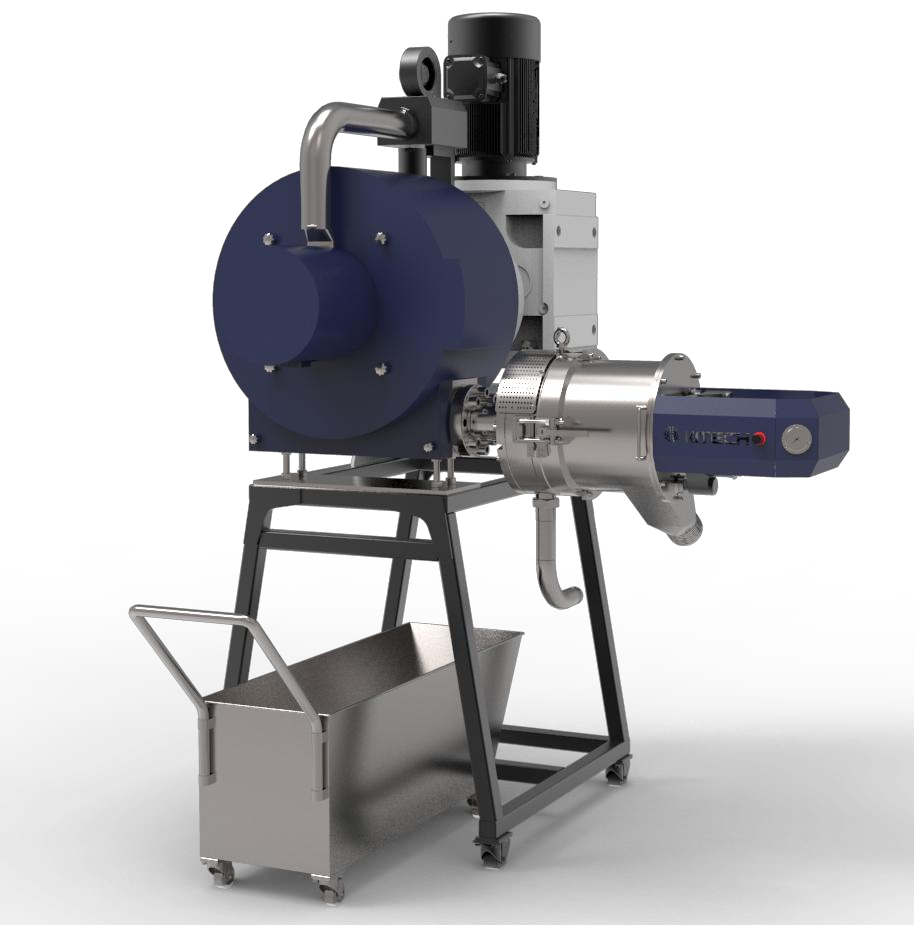
KLF520D
Dual Type- Filter: Φ520 mm × 2
- Area: 6,556 cm²
- Capacity: 1,400–2,400 kg/h (LDPE)
- Power: 5.5×2 kW drive / 48×2 kW heater
Full Technical Specifications
| Parameter | KLF365 | KLF520 | KLF365D | KLF520D |
|---|---|---|---|---|
| Filter Diameter | Φ365 mm | Φ520 mm | Φ365 mm | Φ520 mm |
| Filter Area | 1,295 cm² | 3,278 cm² | 1,295×2 cm² | 3,278×2 cm² |
| Disc Screen Qty | 2 | 2 | 4 | 4 |
| Filtration Range | 100–250 μm | 100–250 μm | 100–250 μm | 100–250 μm |
| Drive Power | 4 kW | 5.5 kW | 4×2 kW | 5.5×2 kW |
| Heater Power | 32 kW | 48 kW | 32×2 kW | 48×2 kW |
| Scraper Speed | 1–6 RPM | 1–6 RPM | 1–6 RPM | 1–6 RPM |
| Throughput (LDPE) | 200–700 kg/h | 700–1,200 kg/h | 400–1,400 kg/h | 1,400–2,400 kg/h |
| Max Pressure | 25 MPa | 25 MPa | 25 MPa | 25 MPa |
| Applicable Materials | LDPE, LLDPE, HDPE, PP, CPP, BOPP, PS, EPS, XPS, ABS, POM, PA | |||
| Contaminants Removed | Metal, paper, cardboard, wood, glass, rubber, aluminum | |||
Selection Shortcut
Under 700 kg/h, medium contamination? KLF365 to start with. More than 1000 kg/h: high-volume, LDPE film wash line? In the dual layout of the KLF520D, the filtration area is sufficient for high-volume, medium- to heavily contaminated flows without throttling throughput. Tell us what you need: type of raw material, target throughput, and level of contamination. Our application engineers will send you the correct model in 1 day.
Design & Operation
All four models use the same user-friendly self-cleaning design, scraper blade assembly, and 25 MPa operating pressure. Two parameters drive model selection: filtration area—larger area means higher throughput, at your given material viscosity—and heater power—match this to your operating temperature needs. Compatible MFI range is from 0.124 to 200 g/10 min, including stiff HDPE pipe regrind to run in the same line as soft, low-MFI LDPE film.
Laser Disc Filter vs Wire Mesh vs Hydraulic Piston — Performance Comparison
Three dominant plastic extrusion filtration technology categories exist: traditional wire mesh screen changers (manual and slide-plate), hydraulic piston screen changers, and self-cleaning disc filters, such as the KLF Series. Each offers a different balance of capital expenditure, operating expense, filtration accuracy, and automation. The specifications and standard operating parameters published here provide an apples-to-apples comparison, in actual numeric terms— not subjective rankings.
| Performance Metric | KITECH Laser Disc (KLF) | Wire Mesh (Manual/Slide-Plate) | Hydraulic Piston |
|---|---|---|---|
| Screen/Filter Life | 3–6 months per disc set | 2–8 hours per screen pack | Varies by mesh insert |
| Filtration Consistency | Constant — laser holes maintain diameter under pressure | Degrades — wire mesh apertures enlarge under cyclic loading | Moderate — depends on mesh condition |
| Max Working Pressure | 25 MPa | 10–20 MPa (typical) | 25–50 MPa |
| Downtime per Screen Change | Zero — continuous self-cleaning | 15–30 min per change | Near-zero (backflush cycle) |
| Operator Intervention | None during normal operation | Every 2–8 hours | Minimal (PLC-controlled) |
| Melt Loss During Change | None — both-sides discharge captures all contaminants | 0.5–2 kg per change event | Small purge volume |
| Filtration Area per Unit | 1,295–6,556 cm² | 50–200 cm² per cavity | 200–800 cm² per cavity |
| Contamination Handling | High — designed for post-consumer recycling | Low to moderate | Moderate to high |
| Moving Seals/Hydraulics | No hydraulic seals | Slide-plate seals wear | Hydraulic piston seals |
| Typical Capital Cost | Medium-High | Low | High |
Cost of Ownership
On initial capital investment, wire mesh wins: a manual slide-plate screen changer commands the lowest purchase price for a new extrusion line. When the month-to-month operating costs of picking and installing new screen packs ($750+ per week, 52 weeks per year), needed for loads of 250+ kg/h, are added, the lifetime cost of ownership moves toward a continuous, self-cleaning solution for medium- to heavily contaminated, high-volume applications in excess of 500kg/h.
Operational Reliability
Though hydraulic piston screen changers maintain almost-continuous throughput through backflush cycles, their hydraulic components—seals and power packs—increase process- and maintenance-related expenses, system complexity. Conversely, the KLF Series’ no-hydraulic design means there are fewer leak-prone parts to service and replace: the scraper drive is a manual gearmotor, and the discharge screw is mechanically driven by the product-pressure-driven extrusion screw.
Operational Results — Throughput, Uptime & Cost Savings
50%+
Typical reduction in screen replacement and labor costs compared to manual screen changers
Based on comparison of disc screen 3–6 month replacement cycle vs. wire mesh screen pack changes every 2–8 operating hours. Actual savings depend on contamination levels, throughput, and operating conditions.
We designed the cost analysis below based on the KLF520D processing 1,000kg/hr of post-consumer LDPE film, which happens to be one of the more popular recycling business models in Europe and South East Asia today. The figures are based on the industry-standard operating parameters cited earlier. Your “point of parity” will vary depending on your contamination levels and uptime expectations.
TCO Scenario: KLF520 vs Manual Screen Changer at 1,000 kg/h LDPE
| Cost Factor | KLF520 (Self-Cleaning) | Manual Slide-Plate |
|---|---|---|
| Screen/Filter Replacement (annual) | 2–4 disc sets | 500–1,500+ screen packs |
| Downtime for Screen Changes (annual) | 0 hours | 125–375 hours (based on 3–5 changes/day × 15–30 min) |
| Operator Labor for Screen Changes | Near-zero | 250–750 operator-hours/year |
| Transition Scrap per Change Event | None | 0.5–2 kg × 1,000–1,800 changes/year |
| Pressure Consistency | Constant — continuous scraping | Sawtooth pattern between changes |
| Product Quality Consistency | Stable — constant aperture size | Variable — mesh stretches between changes |
Procurement Note
To accurately determine life-time ownership costs, request the price of a screen pack, and the number of change-outs you experience per week. These numbers, combined with your available operating hours per year, can give you the statistic you may not have contemplated in your capital investment comparisons. For the average recycling facility that is running over 6,000 hours per year, the yearly replacement cost for a disc screen equals less than 10% of the equivalent screen pack for a double- or triple-flighted mesh screen changer.
Application Industries & Material Compatibility
Pure post-consumer and post-industrial waste streams from the categories below are subjected to KLF filtration every day:
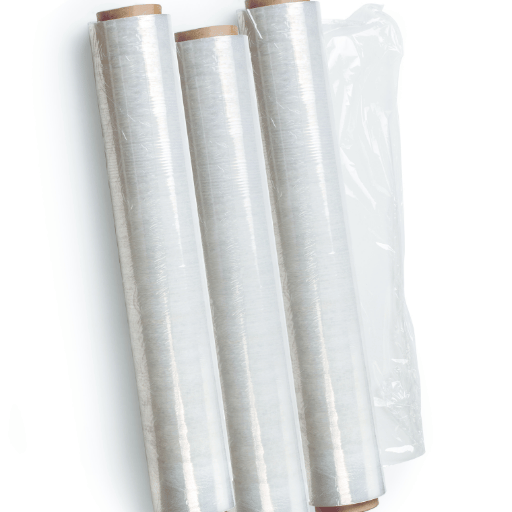
LDPE/LLDPE films. Recycling application: agricultural film, stretch wrap, shrink film. Raw material contamination includes metal fragments, soil, adhesive residue from labels. For high-volume lines, the KLF365D or KLF520D are desirable.
HDPE and PP container recycling- bottle flakes, crate regrind, cap material. Fairly high level of contamination. Standard models KLF365 or KLF520 not invariably required.
BOPP/CPP flexible packaging.- snack packaging, laminated pouches. Needs to be finely filtered (100-150 m) because of thepresence of ink and glue traces.
Chlorinated polyolefins – used for PS/EPS recycling—food packaging trays, expanded foam. Very sensitive to variations in melt temperature; KLF set operation ensures consistent foam quality during pelletization.

Car−born plastics (ABS, POM, PA)—offcuts from automotive and electronics manufacture. Less contaminated, but high melt temperatures over 320 deg C require higher capacity heaters.
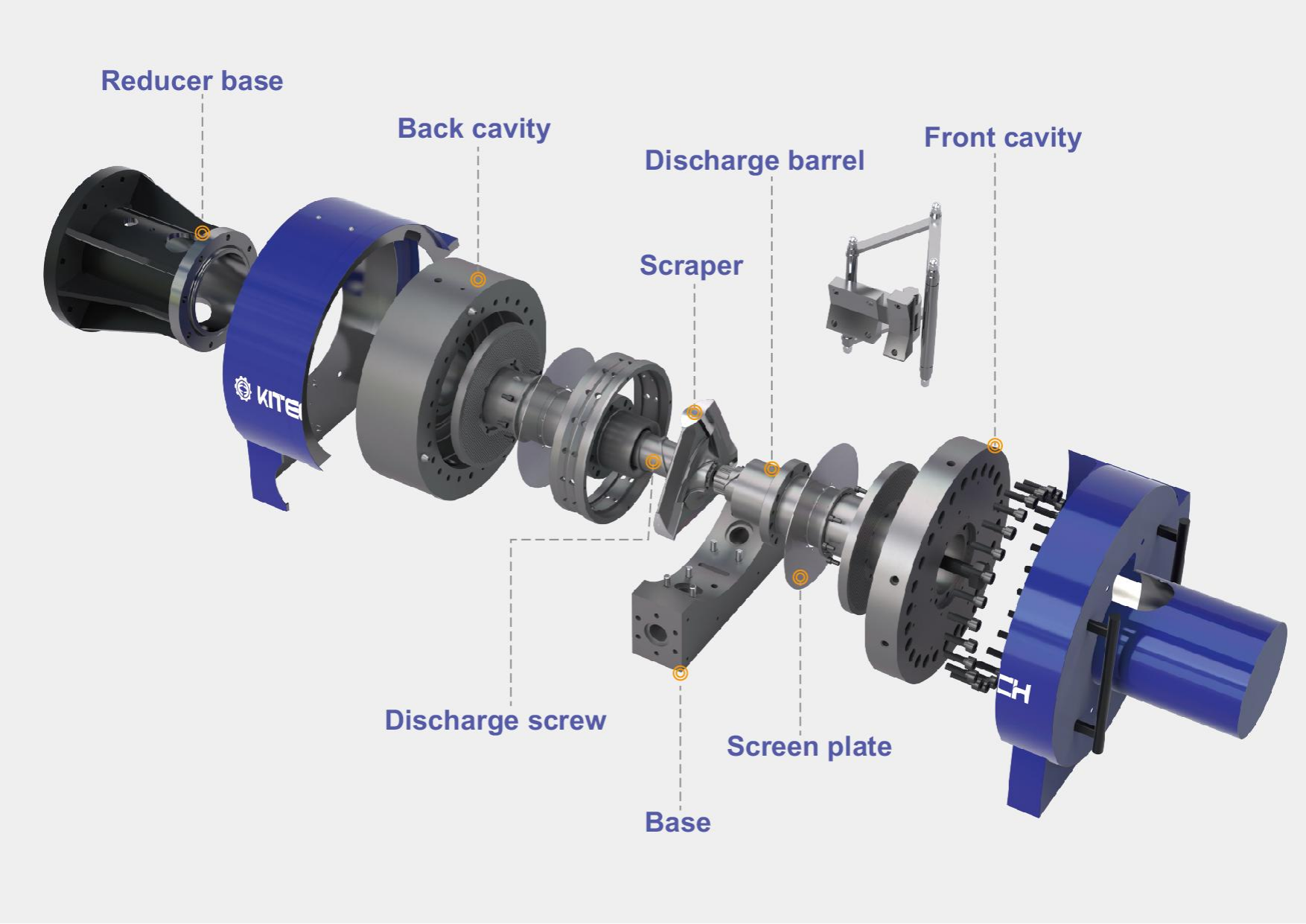
Self-Cleaning Laser Filter Construction Diagram
×
![Full Screen Construction Diagram]()
Engineering Deep-Dive — How the Self-Cleaning Mechanism Works
System Overview
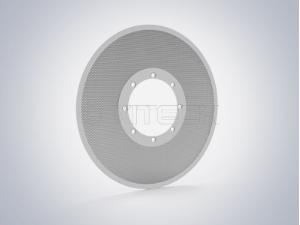
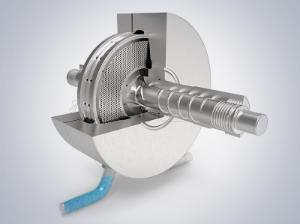
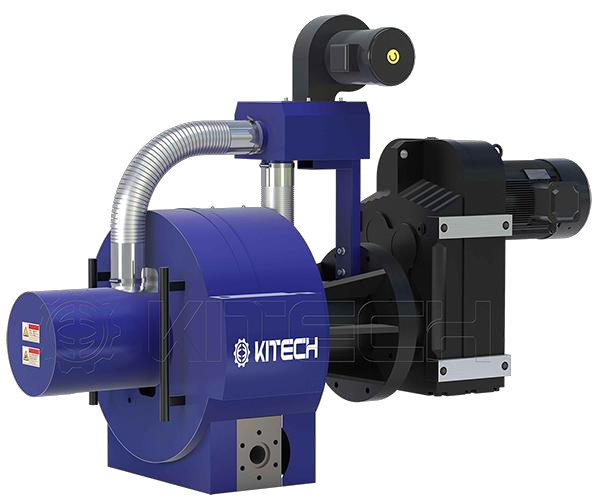
Five major assemblies form the KLF laser filter: a gear reducer (drive unit), front and back filter chambers, a scraper assembly, the disc screen plates and a discharge screw with barrel. Polymer melt feeds into the front cavity under extrusion pressure, flows through the laser-perforated disc screen plates and collects in the back cavity as filtered melt. Contaminants build up on the upstream face of the disc if they are too large to pass through the holes.
Disc Screen Plate
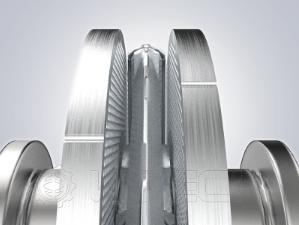
Each disc screen plate is constructed from solid metal stock – not woven wire mesh, not sintered mesh laminate. The holes are formed by laser drilling or CNC precision punching, with a consistent cylindrical aperture of 100, 125, 150, 200, 250 m dia. Because the aperture is cut through solid metal rather than single strands of interlocked wire, the aperture does not expand under normal sustained melt pressure as wire mesh apertures do, and can last for several hundred thousand hours of operation. An individual pair of disc screens has operated up to six months continuously, with 10-15 vacuum-oven cleaning cycles in the six months.
Scraper Assembly
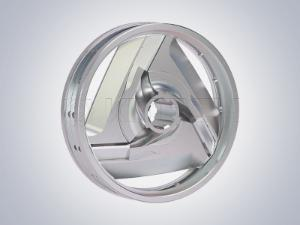
Six (3 per disc screen plate) hard-alloy (DC53) scraping blades are fixed onto the scraper base. The cutting edges are sharpened on the front face or the back face of the blade dependent on the contamination type; the front sharpened blades are used for fibrous contamination (including paper, textile contamination), while the back sharpened blades are used for adherent hard particles (metal, glass, stone contamination). Scraper rotation is variable from 1-6/ minute using a speed control from the control panel, according to contamination loading. Both back and front scraping blades can run simultaneously to continually peel off the accumulation without causing any effect to the flow path of the polymer.
Discharge System — Both-Sides Discharge
Separated contaminants enter the discharge barrel where they are transported out of the system via a screw conveyor. Both-sides discharge simultaneously purges contaminants from both the front and back filter chambers, minimizing melt loss during discharge — only dirty polymer exits, not the good polymer melt. The discharge screw can work continuously or intermittently depending on the nature of the contamination, managed through the pressure differential across the disc screens.
MFI Compatibility & Pressure Regulation
MFI compatibility spans a broad range – from 0.124g/10min (stiff HDPE pipe grade) to 200g/10min (high-flow PP injection grade). At the minimum end of this spectrum, extrusion pressures were high such that the entire 25 MPa capacity was required. This was necessitated in the respect that the high level of solid material in the melt will result in high back pressures leading to high drive loads. Maximum filtration area (KLF520D) was also required. Conversely, at the maximum end of the spectrum, the low viscosity grade could be handled with the disc screens and thus the maximum throughput was achieved with the lowest possible back pressure buildup. Scraper speed was then varied accordingly – slower for clean, low contamination, post-consumer feeds and faster for high contamination streams.
Material Specification — DC53 Hard Alloy
DC53 is a high- carbon, high-chromium cold work tool steel produced by Daido Steel (Japan). this steel offers some 25 % more toughness than standard D2 tool steel with HRC 60 – 62 hardness maintained after tempering. This toughness / hardness balance makes DC53 a very suitable material for use as scraper blades working against a hardened disc screen under continuous melt pressure, the above finding its optimum as the blade is exposed to the abrasive effects of metal inclusions, yet must not chip or crack when in contact with the screen surface.
Screen Changer for Extruder Procurement Guide
KLF Pricing
KLF pricing based on 3 components: model size (KLF365 up to KLF520D), spare parts packages, import destination. Instead of providing standard pricing that get obsolete or flat out wrong for some countries, we prefer providing specific quotations according to your needs. You will get it 48 hours after your application data.
What Affects Your Total Investment
- Model selection – this will depend on throughput requirements and the level of contamination
- Specification disc screen – chosen according to your end-product quality requirements (permeability fineness 100/125/150/200/250 μm).
- Integration engineering – flange adapter and control integration with your existing extrusion line
Lead Time & Delivery
Standard KLF models: 60 calendar days from order confirmation to ex-works (E.U. or U.S.). This delivery date is a guarantee, as all standard KLF production is allocated to dedicated production teams for KLF product. Custom specification, (i.e. non-standard filtration fineness, special flange size, or ATEX rated equipment) extension of the turnaround time (by a further 15-30 days) can be confirmed at quotation time.
After-Sales Support
- Installation guidance: either do-it-yourself, or remotely/locally through our agents in over 80 countries.
- Licensing: optimizing parameters for the specific material and throughput you require
- 24/7 technical support: remote diagnosis via video call; critical spare parts shipped within 48 hours
- Disc screen cleaning protocol: vacuum oven cleaning instructions provided; 10–15 cleaning cycles per screen set
- Annual maintenance program: optional preventive maintenance schedule covering scraper blades, bearings, and heater bands
Get Your Customized KLF Quotation
Tell us your material type, target throughput, and contamination profile. We will recommend the right model and deliver a detailed quotation within 48 hours.
Request a Quote NowSystem Configuration & Evaluation Tools
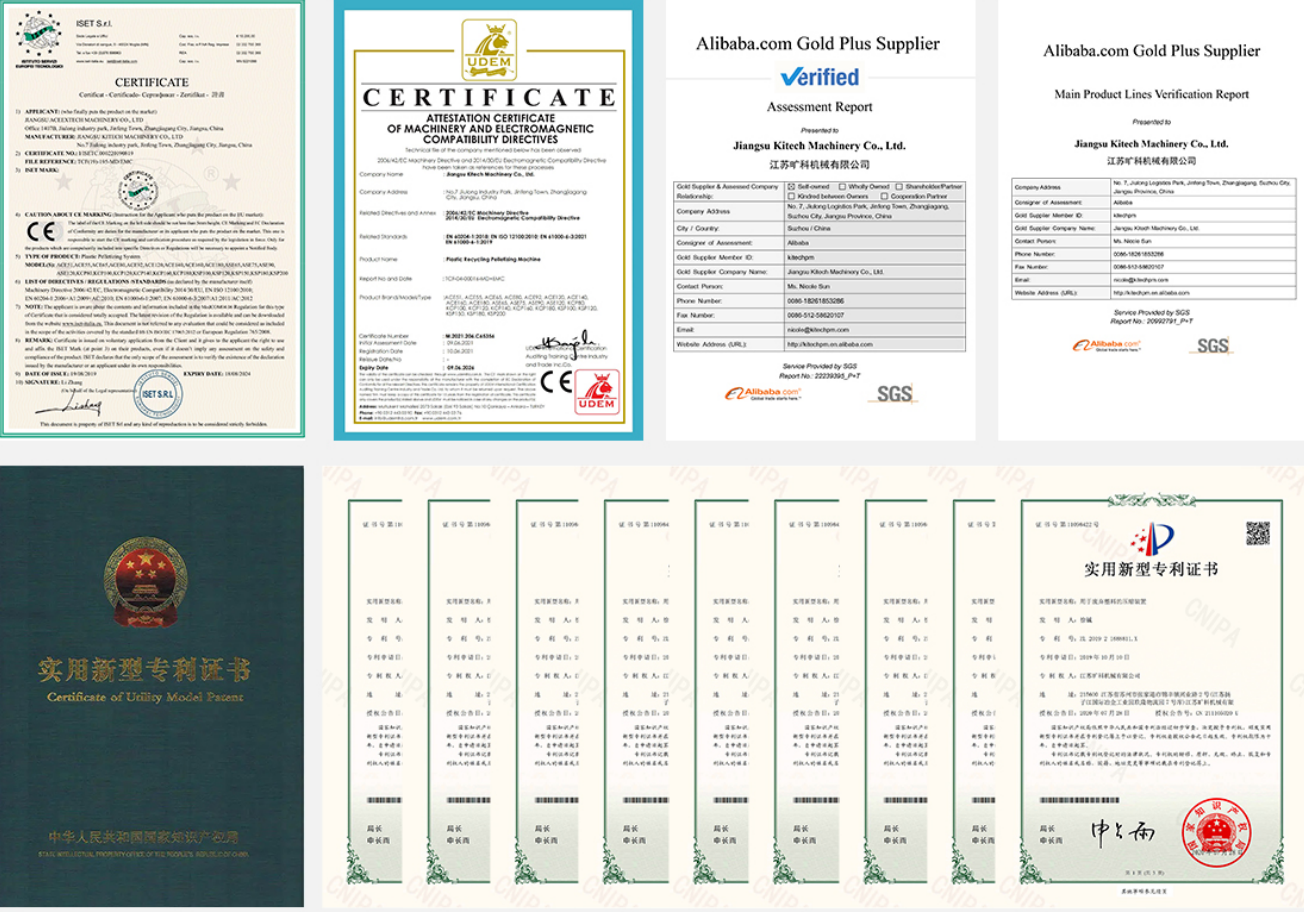
KITECH’s Related Certifications and Qualifications
Frequently Asked Questions
What is the difference between a laser disc filter and a wire mesh screen changer?
Woven metal mesh in a wire mesh screen changer needs replacement every few hours – apertures increase under melt pressure; thus, filtration becomes less accurate. KITECH’s laser disc filter ensures aperture remnants do not increase under the same 25 MPa melt steady pressure, thanks to the laser-drilled, solid metal discs. With all-electronic, continually-scraper self-cleaning, the disc filter means no stopping production for screen change.
How long does a disc screen plate last before it needs replacement?
Two disc screens will last three to six months on a continuous production line. Each screen set handles 10-15 vacuum oven cleaning cycles before needing replacement. Expected screen life will be affected by contaminants in your feed, your chosen filtration fineness and your daily operating hours.
What plastics can the KLF Series filter?
KLF handles all common thermoplastics used in recycling: LDPE, LLDPE, HDPE, PP, CPP, BOPP, PS, EPS, XPS, ABS, POM and PA. MFI compatibility range is 0.124-200 g/10 min, and covers standard rigid applications such as HDPE pipe compound, flexible LDPE film and high-MFI PP. It has an effective removal rate of paper, card cardboard, wood, rubber, glass, metal and aluminum particles and fragments.
What is the maximum throughput of the KLF Series?
Maximum throughput on the KLF520D dual-type reaches 2,400 kg/hr on LDPE. Throughput range is classification dependent; high-MFI materials (like LDPE film) tend to move through the disc screens faster than lower-MFI ones (such as rigid HDPE). Smaller-scale recyclers may wish to start with the KLF365, at 200kg/hr.
Does the self-cleaning filter require operator intervention?
Under normal operation conditions, no. Scrapers run constantly at 1-6 rotations per minute, and contaminants are automatically ejected through the discharge screw. Scheduled maintenance is limited to disc screen replacement (every three to six months) and scraper blade inspection (every four to eight weeks, depending on abrasive contaminant).
What contaminants can the system remove?
Contaminants like paper, steel and iron chips, aluminum, copper, glass, wood, particles, and un-melted plastics. Disc screens’ Fineness of filtration (standard discs are 100 250 micro meters) means they are effective down to those particles size. For a finer filtration (less than 100 micro meters), please discuss with our technical team.
Can the laser filter handle highly contaminated post-consumer plastics?
Yes it is. The system was primarily designed for heavier post-consumer waste streams (agricultural film, household plastics, regrind). We find, on average, such feedstocks are 3-10% contamination, and the dedicated self-cleaning design means no decrease in throughput is experienced after several months of operation.
What is the typical price range for a self-cleaning melt filter?
Self-cleaning melt filter technology varies across specifications; automated operation, bulk filtration area, and automated screen-cleaning mechanism being the main differentiators. The price of a KLF will depend on the selected model, the spare parts package required and where the product will be delivered. To obtain an individual quotation, send your application details to our sales team and receive your price within 48 hours. To evaluate value for money, remember to compare annual costs of screen-replacement and labor time, not just the initial purchase cost.