Get in touch with Kitech Company

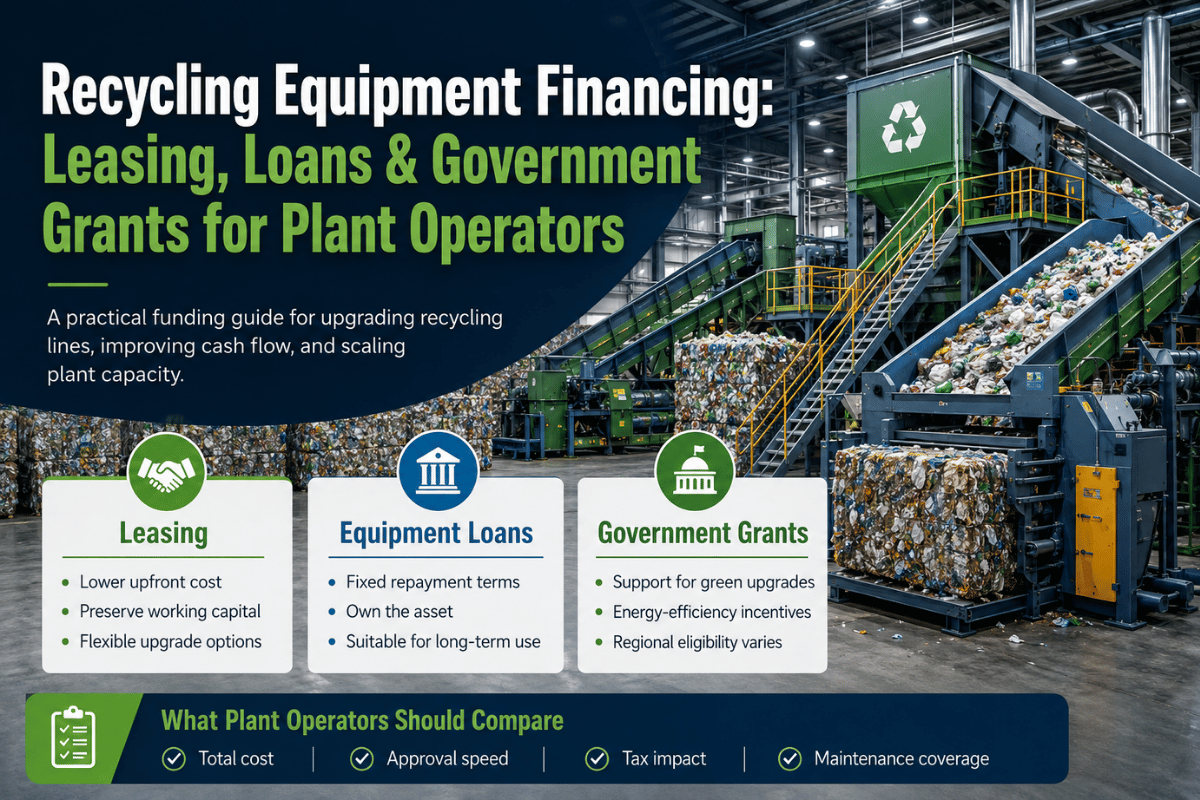
Recycling equipment financing lets you acquire balers, shredders, washing lines, and pelletizers by spreading the cost over fixed monthly payments instead of paying the full price upfront. For a recycling business, that single decision often separates a plant that scales from one that stalls, because the machinery is expensive and the cash you keep in reserve is the cash that keep you running during the slow first quarter.
This guide is written from the other side of the invoice. We build plastic recycling lines, so instead of pitching you a loan, we’ll show you what the equipment actually costs, which financing structure fits which situation, what the 2026 tax rules now allow, and a simple test for whether a financed machine will pay for itself.
Quick Specs, Recycling Equipment Financing at a Glance
| Common financing structures | Equipment loan, lease, $1-buyout lease, sale-leaseback, line of credit, SBA loan |
| Typical repayment term | 24 – 84 months (most equipment runs 36 – 60) |
| Typical down payment | 0 – 20% depending on credit and equipment |
| 2026 Section 179 deduction cap | $2,560,000 (plus 100% bonus depreciation) |
| Realistic payback (turnkey line) | 18 – 36 months when uptime stays above 80% |
| Used equipment | Financeable, and still qualifies for Section 179 if new to your business |
What Recycling Equipment Financing Is, and When It Beats Cash
Recycling equipment financing is business funding that lets a recycling or waste management company buy or lease processing machinery, shredders, washing systems, pelletizers, balers, conveyors, sorters, without paying the full cost upfront. You spread payments over a fixed term, and the equipment itself usually serves as collateral, which makes approval easier than an unsecured loan even when your credit is imperfect.
What matters isn’t “can I get financing” but “should I finance instead of paying cash.” Here’s the logic that decides it. One plastic recycling line can tie up a large share of your liquid capital. Once that capital leave your account, it’s no longer available for feedstock, payroll, spare wear parts, or the inevitable permit delay. Most recycling plants don’t fail because the machine was wrong, they fail because the owner spent the cash buffer on the machine and then couldn’t survive the ramp-up months before pellet revenue arrived. Financing keeps that buffer intact. That’s its real job.
💡 Pro Tip
Pay cash only when the purchase leaves you with at least three months of operating expenses still in reserve. If it does not, finance it — even if you could technically afford to buy outright.
The 6 Financing Structures for Recycling Equipment
Recycling business owners have several financing options, and each financing solution solves a different problem. Whichever structure you pick changes who owns the equipment, how the tax treatment work, and how much cash you keep. Here’s how they compare.
| Structure | Who owns it | Best for |
|---|---|---|
| Equipment loan | You, from day one | Long-life machines you will keep 10+ years (shredders, washing lines) |
| Equipment lease (FMV) | The lender | Lower monthly payment; tech you may upgrade (optical sorters) |
| $1-buyout lease | You, at term end for $1 | Ownership intent + lease accounting; qualifies for Section 179 |
| Sale-leaseback | Lender (you sell, then lease back) | Freeing cash from equipment you already own |
| Business line of credit | N/A (revolving credit) | Down payments, installation, soft costs, ancillary purchases |
| SBA 7(a) / 504 loan | You | Lowest rates, longest terms; large fixed assets if you can wait |
Two structures deserve a flag. True (FMV) leases keep payments low but the tax treatment is different from a loan, more on that below. Sale-leaseback deals are the quiet favorite of established recyclers: if you already own a paid-off baler or washing line, you can sell it to a finance company and lease it back, converting a fixed asset into working capital without losing a minute of processing capacity. Vendor financing, offered directly by some equipment manufacturers, is a seventh path worth a quote, though terms vary widely by supplier.
Industry data from the Equipment Leasing and Finance Association notes that the three main sources of equipment funding are bank-affiliated lenders, captive finance arms, and independent lenders, and they price the same machine differently, which is why getting more than one quote is rarely wasted effort.
Lease vs Loan: Which One Fits Your Recycling Business?
This is the decision most recycling business owners get stuck on. Honestly, it depends on three things, your cash position, how long you’ll keep the equipment, and which tax treatment helps you most. Use the matrix below as a starting point, then confirm with your accountant.
Lease-vs-Loan Decision Matrix
- Keeping it 10+ years (shredder, washing line)? → Equipment loan or $1-buyout lease. The machine hold value and you build an asset.
- Technology you’ll replace in 3–5 years (optical sorter, e-waste processor)? → FMV lease. Let the lender carry the obsolescence risk.
- Cash is tight and the lower monthly payment matters most? → FMV lease, lowest payment.
- Want the full first-year tax write-off? → Loan or $1-buyout lease (a true lease doesn’t qualify for Section 179).
How Does Equipment Leasing Differ From Taking Out a Loan?
With an equipment loan you own the machine immediately and build equity; payments are fixed and the equipment is collateral. With a true lease you pay for the use of the equipment, the lender keep title, and your monthly payment is usually lower, but at the end you own nothing unless you buy it at fair market value. In practical terms, loans suit long-life recycling machinery with a strong resale market, while leases suit equipment that changes quickly or that you only need for a defined project. Sitting between the two is the $1-buyout lease, low-friction monthly payments with guaranteed ownership for one dollar at the end, and it’s treated as a purchase for tax purposes.
What Recycling Equipment Actually Costs (So You Finance the Right Amount)
Lenders quote you a payment; they rarely tell you what the machine should cost. As an equipment manufacturer, we can. Below, you’ll find real FOB price bands for the four machine families in a plastic recycling line, by throughput. Add roughly 8–15% for installation and commissioning, and remember that machinery is only 40–50% of a turnkey project, civil works, electrical upgrades, wastewater compliance, and three months of working capital make up the rest.
| Equipment | 300 kg/h | 1,000 kg/h | 2,500 kg/h |
|---|---|---|---|
| Industrial shredder | $3,000 – $25,000 | $25,000 – $60,000 | $60,000 – $100,000+ |
| Washing system | $50,000 – $120,000 | $120,000 – $300,000 | $300,000 – $600,000 |
| Pelletizing system | $30,000 – $80,000 | $80,000 – $150,000 | $150,000 – $250,000+ |
| Auxiliary (conveyors, sensors) | $8,000 – $20,000 | $20,000 – $50,000 | $50,000 – $100,000 |
FOB price bands, Q1 2026; prices move with steel and motor costs and may not reflect the current market beyond six months. Source: Kitech installation data across 80+ countries.
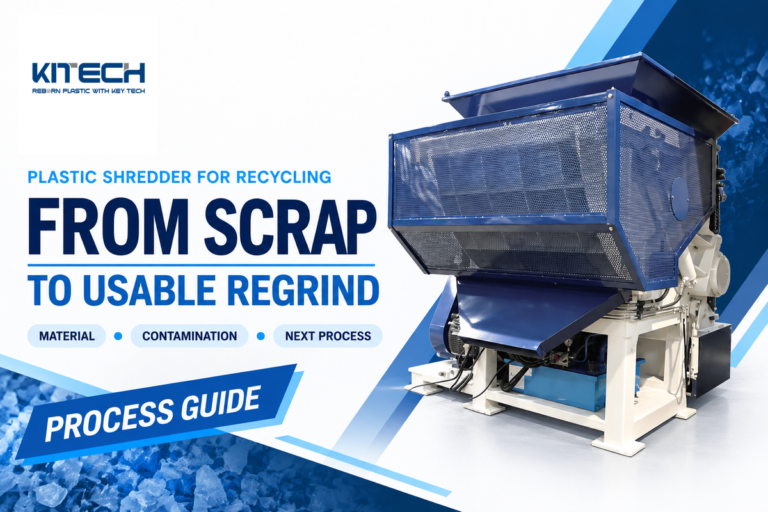
Turnkey plastic recycling lines run about $150,000 for a small 100–300 kg/h plant up to $2,000,000+ for a fully automated 3,000 kg/h line. By far the most expensive block is almost always the pelletizing system, extruder, melt filter, and die-face cutter can claim 40–50% of total cost on a food-grade rPET line. For machine-by-machine detail, see our guides on industrial plastic shredder cost, plastic washing line cost, and plastic pelletizing machine cost, or the full plastic recycling plant cost breakdown.
📐 Engineering Note
Finance machinery at 40–50% of your total budget, not 100%. If a vendor quotes a turnkey line at $400,000, plan to finance roughly $700,000–$850,000 once civil works, three-phase electrical upgrades, wastewater pre-treatment, and three months of working capital are included. Financing only the sticker price is the fastest way to run out of cash during commissioning. Pair this with recycling capacity planning before you sign anything.
⚠️ Common Mistake: Financing Capacity You Cannot Feed
In our experience, the costliest financing error is not a high interest rate — it is buying an oversized line. An owner finances a 1,500 kg/h line on the strength of a feedstock pipeline that has not been signed yet, then runs it at 300 kg/h. Payment is sized for 1,500; revenue is sized for 300. Idle capacity does not generate cash, but it still owes the lender every month. Size the financing to confirmed feedstock, not to ambition.
Section 179 & Bonus Depreciation: The Tax Side of Financing
Financing and tax savings aren’t mutually exclusive, this is the part many guides get wrong. Under IRS Section 179, you can deduct the full purchase price of qualifying equipment in the year it’s placed in service, even if you financed it and have only made a few payments. For tax years beginning in 2026, the maximum Section 179 deduction is $2,560,000, with a phase-out that begins at $4,090,000 of equipment placed in service. On top of that, the 2025 tax law restored 100% bonus depreciation for property acquired and placed in service after January 19, 2025, which applies to any basis remaining after your Section 179 election.
Two details change real decisions. First, used equipment qualifies for Section 179 as long as it’s new to your business, so a financed second-hand shredder can still be written off. Second, a true (FMV) lease generally does not qualify for Section 179; you deduct the lease payments instead. A $1-buyout or finance lease, by contrast, is treated as a purchase and does qualify. That single rule often tips the lease-vs-loan choice for a profitable plant.
Are There Tax Benefits to Financing Recycling Equipment?
Yes, and they can be large. Because Section 179 reduces taxable income dollar-for-dollar, a recycling business in the 24% bracket that finances and places a $200,000 washing line in service could cut its federal tax bill by roughly $48,000 in year one, while having paid only a fraction of the price in actual cash. You claim the deduction on IRS Form 4562, and it’s limited to your taxable income for the year, with any excess carried forward. Bonus depreciation isn’t capped by income and can even create a loss. These numbers shift by entity and state, so confirm the specifics with your CPA before you plan around them.
How to Qualify: Credit, Time in Business, Startups & Used Equipment
Approval for recycling equipment financing is more accessible than most owners expect, because the equipment, new and used alike, is collateral. Lenders weigh a handful of factors, and knowing how the application process work lets you position your file before you apply.
- ✔ Time in business: most lenders prefer 1–2 years; startups can still qualify through specialized programs (see below).
- ✔ Credit score: many equipment lenders work with scores commonly reported in the 550–600 range because of the collateral; 680+ earns the best rates.
- ✔ Revenue: lenders typically want monthly revenue of roughly 2–3× the proposed payment.
- ✔ Down payment: commonly 0–20%; well-qualified borrowers can find no-money-down offers.
- ✔ Documents: an equipment quote, 3–6 months of bank statements, business tax returns and financial statements, and usually a personal guarantee.
Can a Startup Recycling Business Get Equipment Financing?
Yes, though the path is narrower. New recycling businesses can look at U.S. Small Business Administration loan programs, including the Microloan program, which funds equipment purchases under $50,000 with terms up to six years, or at manufacturer/vendor financing programs that sometimes relax credit requirements for buyers of their own machines. A business line of credit can fund equipment in stages, and a personal guarantee or personal collateral can open doors that thin business history would otherwise close. A clear business plan with a signed feedstock source and a named pellet buyer does more for a startup application than any other single document. For larger purchases, the SBA 504 program is built for major fixed assets and offers long, fixed-rate terms.
Will It Pay for Itself? The 18-Month Capacity-Payback Test
Lenders will tell you whether you qualify for a payment. Only the math tell you whether you should make it. Before you finance any recycling machine, run what we call the 18-Month Capacity-Payback Test: finance the equipment only if the added monthly gross margin from its extra throughput repays the monthly payment within about 18 months. If the added capacity can’t clear its own payment inside roughly a year and a half of real, after-yield margin, you’re financing ambition, not cash flow.
Here’s the test applied. A regional HDPE recycler is weighing a 500 kg/h line at about $345,000 in total project cost. Financed over 60 months, the payment lands near $6,800 per month. At 70% yield and a $0.40–0.70/lb recycled pellet spread, a realistic loaded plant nets roughly $32,000–$62,000 per month on that added output. The added margin clears the payment many times over, and the line pays back in roughly 14–22 months, it passes. Flip the inputs to 50% uptime and a soft pellet market, and the same machine can take 24–40 months to pay back, which fails the test and signals you should shrink the line or lock a buyer contract first.
“A plant running below 80% uptime spends almost the same operating cost whether the line is making pellets or sitting idle. Energy and labor barely move with throughput, but revenue collapses. The single best return after commissioning is whatever buys you the next ten points of uptime, usually spare wear parts and a continuous melt filter.”
Macro data supports sober math. Research from the U.S. National Institute of Standards and Technology found that only about 20% of plastics collection clears a 15%+ ROI threshold, roughly 50% lands modestly positive, and about 30% runs negative. What divides winners from losers is almost never the machine brand, it’s feedstock certainty, buyer grade, and uptime. Run your own numbers against our plastic recycling plant profitability analysis before you commit to a payment schedule, and size the line with a rigid plastic recycling line or plastic pelletizing line configuration that matches confirmed volume.
Recycling Equipment Financing in 2026: Grants, Green Loans & What’s Changing
Three shifts are reshaping how the recycling industry funds equipment this year, and they reach recycling companies of every size, the direction of each one favors acting sooner rather than later.
Government-backed limits just doubled. In May 2026 the U.S. Small Business Administration doubled its cumulative 7(a) and 504 loan limit to $10 million. For recyclers, the 504 program, long-term, fixed-rate financing for major fixed assets, now reaches further into large washing-and-pelletizing line builds than it did a year ago, often at rates below conventional equipment financing.
Tax tailwinds are unusually strong. The combination of a $2,560,000 Section 179 cap and restored 100% bonus depreciation means a financed line placed in service before your tax year closes can be largely written off in year one. The Equipment Leasing and Finance Association’s 2026 outlook points to continued moderate growth and steady equipment demand, which usually keeps lender appetite healthy.
Green money and rising hardware prices pull in opposite directions. State Extended Producer Responsibility programs and recycling-infrastructure grants are, across a growing patchwork of jurisdictions, covering 30–50% of permitted plant CAPEX, real money that lowers the amount you need to finance. At the same time, steel and electric-motor costs are tracking 6–10% higher into the second half of 2026. The practical takeaway: if your project schedule allows, lock equipment quotes and file for any available subsidy early in the year, then finance the balance. Waiting six months may cost you both the lower hardware price and the grant window.
Frequently Asked Questions
Q: Can I finance used recycling equipment?
View Answer
Yes. Used balers, shredders, and washing lines are widely financeable, and they still qualify for Section 179 if new to your business.
Q: Does recycling equipment financing require a personal guarantee?
View Answer
Most small business equipment loans do. A personal guarantee means the owner is personally liable if the business cannot repay. Some lenders waive it for established companies with strong financials, but for newer recycling businesses it is the norm and often the reason an application gets approved at all.
Q: Can I finance installation and delivery costs along with the equipment?
View Answer
Often, yes — many lenders fold soft costs like delivery, installation, operator training, and site work into the financed amount, sometimes up to 20–25% of equipment cost. Since these soft costs are real on a recycling line, financing them keeps your cash buffer intact instead of paying out of pocket.
Q: How much can I borrow for recycling equipment?
View Answer
Loan amounts commonly run from about $10,000 to several million dollars, depending on your financials and the equipment. Most small to mid-sized recycling operations finance in the $25,000–$500,000 range, while a full material recovery facility or large washing-and-pelletizing line can support a larger package — and the SBA 504 limit now reaches $10 million. How much you actually qualify for tracks the equipment’s collateral value and your monthly revenue against the proposed payment, so a signed feedstock contract and clean financials usually unlock a higher number.
Q: Can I refinance existing recycling equipment to free up cash?
View Answer
Yes. Equipment refinancing can replace an existing loan with better terms, and a sale-leaseback on paid-off equipment turns a fixed asset into working capital while you keep using the machine. Both make sense when rates have dropped or your credit has improved since the original purchase.
Q: What is the fastest way to get recycling equipment financing?
View Answer
Alternative equipment lenders are the quickest route, often approving applications in 24–48 hours and funding within a few business days, versus weeks for a bank and two to three months for an SBA loan. To move fast, have your documents ready before you apply: the equipment quote, recent bank statements, and basic business details. Clear, specific equipment needs also help a lender decide quickly.
Know the equipment cost before you talk to a lender
As a plastic recycling line manufacturer, Kitech can size your line to confirmed feedstock and give you a real cost and ROI figure to finance against, not a sticker price. Get a custom line quote with a payback estimate in 48 hours.
Why We Wrote This
Kitech builds plastic recycling lines, shredders, washing systems, and pelletizers, installed across 80+ countries. We aren’t a lender and earn nothing from your financing choice, which is why this guide focuses on the equipment economics most financing articles skip: real cost bands, the 18-Month Capacity-Payback Test, and the lease-vs-Section 179 trap. The tax and loan figures here are current as of 2026; confirm your specific numbers with a CPA and your lender.
References & Sources
- Section 179 Deduction FAQs (2026)Section179.org (citing IRS Rev. Proc. 2025-32)
- Instructions for Form 4562 (Depreciation and Amortization)U.S. Internal Revenue Service
- SBA Funding Programs, 7(a) and 504 LoansU.S. Small Business Administration
- SBA Doubles Cumulative 7(a) and 504 Loan Limit to $10 Million (2026)U.S. Small Business Administration
- U.S. Plastic Recycling EconomyNational Institute of Standards and Technology
- 2026 Equipment Leasing & Finance U.S. Economic OutlookEquipment Leasing and Finance Association
- Plastics: Material-Specific DataU.S. Environmental Protection Agency
Related Articles
- Plastic Recycling Plant Cost Guide (2026)full CAPEX, OPEX, and hidden-cost breakdown
- Is a Plastic Recycling Plant Profitable? Real ROI Maththe model behind the payback test
- PET Bottle Washing Line: Selection, Costs & ROIthe most CAPEX-intensive stream
- Plastic Washing Line: Complete Recycling Guidehow the core wash stage works