Get in touch with Kitech Company


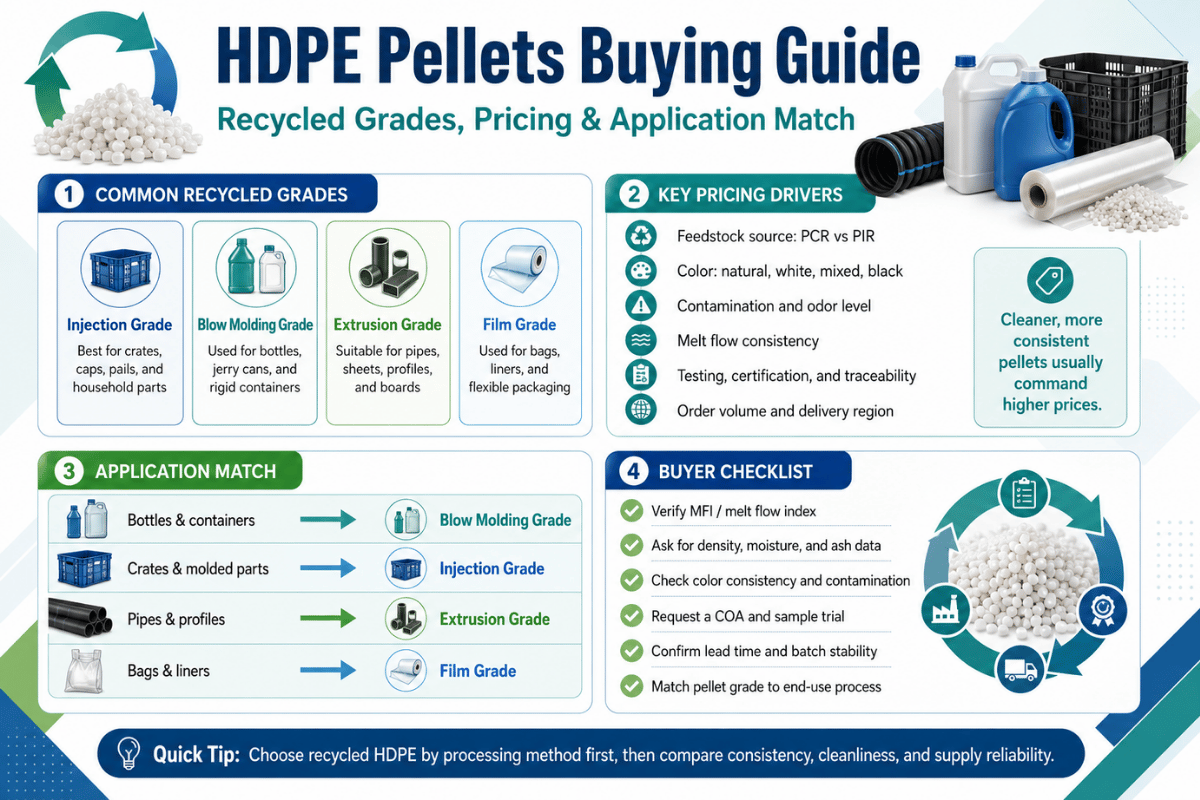
⚡ Quick Specs: HDPE Pellets at a Glance
| Resin Identification Code | #2 (HDPE) |
| Density | 0.941–0.965 g/cm³ (ASTM D792) |
| Melt Point | 120–1³0°C |
| Tensile Strength | 26–³3 MPa (ASTM D638) |
| MFI Range (all grades) | 0.05–20 g/10 min @ 190°C/2.16 kg (ASTM D1238) |
| ESCR (grade-dependent) | 100–5,000+ hours (ASTM D1693) |
| Standard Pellet Diameter | 2–5 mm, cylindrical |
| Spot Price Range (Q3–Q4 2025) | $1,080–$1,400/MT (region and grade dependent) |
Why this high-density polyethylene pellets buying guide is important “HDPE” on a bag means it’s made from HDPE, that’s all. An injection molder and a pipe e×truder both use HDPE but melt flow rates differ between those two processes by 20X. Otherwiseidentical pellets can become production day nightmares. This guide to selecting an HDPE grade via melt flow inde× (MFI), 2025-2026 prices for three regions, key elements of selecting a supplier, important certificates of analysis, and outlook through 2026 – including a shocking finding about recycling economics for virgin versus post-consumer HDPE – explains everything the HDPE pellets buyer must know.
What Are HDPE Pellets? Properties, Applications, and Why Pellet Form Matters
High-Density polyethylene HDPE is a thermoplastic, produced from polyethylene’s monomer, ethylene, using a low-pressure polymerization process ( Ziegler-Natta or metallocene catalysts used, typical range of 10-80 bar) . HDPE’s linear structure with relatively little branching leads to crystallinity (70%-90%) and greater rigidity, stiffness and strength compared to low-density polyethylene LDPE.
For instance, tensile strength of HDPE ranges from 26 to 33 MPa according to ASTM D638, whereas LDPE’s ranges from 8 to 25 MPa, a direct consequence of the tighter packing of its linear molecules.
HDPE pellets are what are colloquially (or in the European or many Asian regions, granule) referred to in industrial melt-processing applications as “plastic” ready to be made into an infinite number of products. The standard size is 2mm-5mm cylinder which means that when filled into an extruder’s hopper it fills predictable space volume to insure consistent melt times and low moisture content (compared to powder or regrind pellets, the’d are more porous and adsorb more humidity). Understanding what a plastic pellet is and how it’s made matters for buyers because pellet characteristics, fines content, bulk density, surface-to-volume ratio, directly affect how reproducibly the material feed and melts in your specific equipment. How do those effect processingability and predictability?
Global demand for HDPE was >48 million metric tons in 2024 with usage by method: Blow molding 35%, Injection molding 25%, Pipe extrusion 20%, Film 12%, Rotomolding & others 8%. HDPE’s recyclability is well-established: its RIC code is “2,” and in the USA 27–30% of discarded HDPE bottles are recycled each year (NIST, 2024). National Institute of Standards and Technology, 2024.
Key properties for plastics buyers include HDPE’s relatively high tensile strength: 26 to 33 MPa, a density of 0.941 – 0.965 g/cm3, a flexural modulus between 800 – 1400 MPa, almost zero moisture absorption below 0.01% and excellent chemical resistance to most common acids, bases, alcohols, and salt solutions. Downsides: Environmental stress cracking, or ESCR, which HDPE is notoriously weak in-in conjunction with some liquid immersion, it’s the single-largest failure mode that most buyers don’t appreciate. Additionally,UV light and some organic solvents- such as benzene and toluene- degrade HDPE over time.
📐 Engineering Note: ESCR, The Hidden Grade Differentiator
ESCR goes from 100 hours for general-purpose injection grade up to over 5,000 hours for high molecular weight pipe grades. We’ve all seen how rapidly ESCR can drop if an HDPE part is subjected to both mechanical stress and an exposure to detergent or surfactants-just as in detergent bottles, chemical process piping, and detergent packaging. When your application comes in contact with anything that has detergent properties under mechanical stress, you’ve got to write a minimum ESCR (for instance, 500 hours via ASTM D1693) into your purchase order, just as sure as you have to specify the melt flow index (MFI).
The HDPE pelletizing machine that produces the pellets you buy is a factor in pellet quality that most buyers underestimate. Such pelletizer process variables as strand diameter; stringer height and speed in a pelletizer water bath; and die height adjustment are all critical, especially in strand pelletizing, for determining how consistent are pellets in size; how many fine powders are entrained; and how “slick” the surfaces of the pellets are. In some way the pellet quality determines how readily will those pellets feed, and subsequently, how readily will they melt, in your particular processing equipment. Understanding the distinctions between strand, water-ring, and underwater pelletizing systems is one way a prospective buyer can assess whether a supplier’s production equipment matches the required pellet specification.
HDPE Pellet Grade Classification: Choosing the Right Melt Flow Index
When to Use High Or Low Melt Flow Rate (MFI)-As stated in the prior paragraph, perhaps the best approach when buying HDPE pellets is to base your grade choice primarily on MFI. MFI (melt flow index), grams per 10 minute @ 190°C/2.16 kg load (ASTM D1238) is the “reverse molecular weight.” This is because there is an inverse relationship between MFI and Molecular Weight; higher MW materials have low melt flows, flow with high back pressure but are generally strong while lower MW material flows more readily into complicated dies, etc., but exhibits lower strength and impact resistance. Material selection for HDPE therefore starts with MFI — it’s the single most consequential decision in grade specification, entirely dependent on your processing equipment and end-use requirements.
From a pelletizer design perspective “When we are selecting our pelletizer processing equipment-based on typical production parameters-we first look at the intended HDPE product-especially how the pellets are to be fed into downstream process equipment. The HDPE’s MFI specification is generally considered the first item of interest, because an improperly designed or improperly operated pelletizing line that’s intended to produce, for example, 4 MFI to 7 MFI product would also struggle if it were configured to process, say, a 30 or 50 MFI pellet.” A differential between the target MFI specification and your specific line can account for anywhere from 5 g/10 min difference to the entire specified MFI, which will result in endless operation and aggravation with your line operation even though all other operating parameters have been optimized.
Below is a reference table correlating process with the corresponding range of HDPE melt flow rate (MFI) expected to provide trouble-free processing based on typical industry practices, material science knowledge, and general practitioner opinion on best practices: Note that the process-equipment supplier’s specifications should always take precedence when defining optimal set-points.
| Processing Method | MFI Range (g/10 min) | Typical Products | Why This MFI? |
|---|---|---|---|
| Injection Molding | 8–20 | Caps, closures, crates, pallets, thin-wall lids | High MFI fills complex cavities cleanly; lower MFI causes excessive back pressure and short shots |
| Blow Molding | 0.3–1.5 | Milk jugs, bottles, drums, IBCs | Parison strength demands high molecular weight; too high MFI causes parison sag and thin walls |
| Pipe / Profile Extrusion | 0.1–0.5 | Water pipe, gas pipe, conduit, profiles | Very high molecular weight required for long-term pressure resistance; PE100/PE4710 grades in this range |
| Film Extrusion | 0.05–0.3 | Geomembranes, agricultural film, liners | Ultra-high molecular weight delivers tear resistance and barrier integrity over years of outdoor service |
| Rotational Molding | 2–8 | Tanks, playground equipment, kayaks, bins | Mid-range MFI balances powder flow in the rotating mold against finished-wall impact resistance |
| Sheet / Compression Molding | 0.5–2.0 | HDPE sheets, marine boards, cutting boards | Low-mid MFI provides structural rigidity and impact resistance for thick-section applications |
One example illustrates what the cost of ignoring the above table may be: we’ve had customers purchase and test ten tons of HDPE pellets designated only as “HDPE” when it actually was a lower MFI pipe- grade product that processed best on an extruding equipment application and not in their injection mold process. The result was excessive back pressure, short shots on their thin wall lids, and 18 hours of unscheduled plant downtime. Correcting the issue simply meant reordering the appropriate 10 ton trial of HDPE pellets with the specified correct melt flow index (e.g. 12-14 g/10min), on which all process variables remained the same and the problem was instantly corrected. If a melt flow specification had been used the entire failure could have been averted.
Are There Different Grades of HDPE?
Sure – and there’s more to a grade name than just the MFI. A HDPE grade name describes not only melt flow rate (processability), density (between 0.941 to 0.965 g/cm3 which controls crystallinity and rigidity), MWd (unimodal, or bimodal in larger MWd grades that offer improved ESCR in pipe and pressure rated applications) and a additive package, but possibly pipe application related cell class (the D3350 code that further defines density, MFI, flexural modulus, tensile strength, ESCR and carbon black content). So unless your material is being specified under ASTM D3350, ask the vendor for a technical data sheet and make sure that the additive package in their material is suitable for your application needs (a food contact grade requires different UV stabilizers and antioxidants than a 50-70% recycled outdoor furniture grade that has both the same MFI).
Virgin vs. Recycled HDPE Pellets: Which Should You Specify?
However, the old assumption that recycled HDPE will always be cheaper is dead in many markets. In the USA post consumer content recycled HDPE was hovering around$ $1,394 per MT in Sept 2025 (or even a bit above some virgin grades traded in the same period per IMARC Group); and the Europe 30% recycled color HDPE pellets, for use in blowing molded packaging parts, was imported around $ $1,080-$1,150 per tonne in the same time (per Procurement Resource) and again this pricing is very much on par with Virgin HDPe prices. Demand for recycled content from state legislative like the California SB54 and European Parliament PPWR policy is outstripping what existing recycling infrastructure is capable of processing.
Therefore, you choose virgin or recycled, based on application requirements and legislative requirements and not a automatic low cost win for recycled content.
✔ Virgin HDPE Pellets, Advantages
- Consistent MFI batch-to-batch (typically ±0.5 g/10 min)
- FDA 21 CFR 177.1520 food-contact approved
- ESCR up to 5,000+ hours available (high-MW grades)
- Natural white / translucent color options available
- Zero contamination or residual odor concern
- Stable, verifiable ASTM test data direct from producer
- No regulatory process approval requirement
⚠ Recycled HDPE Pellets, Considerations
- 5–15% tensile strength reduction per recycling cycle — thermal history causes chain scission in the polymer chains, shortening average molecular length
- MFI distribution broader on a batch to batch basis; blends needed for some processes requiring tight specifications.
- Color: gray to dark; limits natural-color applications
- Food contact: only with FDA-recognized PCR decontamination process letter
- ESCR is generally lower; alway test and confirm results in the Certificate of Analysis (CoA) for specific grade ASTM D1693 test results for each delivery lot.
- Price at or above virgin on high content recycled demand-driven Markets; (2025 pricing).
- Meets and Fulfills new European Union PPWR and california SB 54,post-consumer recycled content, targets.
One Europoean manufacturer learned this the hard way when specifying 30% “recycled polyethylene” (which can be both post-consumer or post industrial) in a private labeling project for “specialist detergent brand” as part of the “brand green commitment.” They chose to buy from a new supplier of recycled polyethylene (HDPE); the new supplied material reported a 8.0 g/10 min MFI, which matched the virgincaterial’s specification perfectly on paper. What wasn’t identified until testing commenced, however, was that the virgin material offered > 500 hr of ASTM D1693 ESCR; whereas the recycled material registered 180 hours. This because the material experienced greater thermal degradation via multiple passes thru extrusion processes; and suffered a narrow MD and low ESCR performance due to lack of broad MWd. Buyers now insist on ESCR data in the CoA for every recycled material lot they purchase.
Beyond these types of special needs applications, recycled HDPE — as a recycled plastic feedstock — can generally be blended with virgin up to 25–50% recycled content for drainage pipe, industrial parts, lumber, and similar applications with minimal impact on performance requirements. For non-food applications, the main concern shifts to consistency and supply security of the recycled pellets, not performance. See our guide on the HDPE recycling process from collection to resin, and our detailed breakdown of recycled pellet quality grades and how buyers evaluate PCR resin.
But in reality, for food contact applications, the policy does not revolve around the polymer specification itself, but around the FDA recognition letter for the particular decontamination method that was performed on the particular recycled resin. As FDA 21 CFR 177.1520 outlines the requirements under which polyethylene, including recycled polyethylene, may be used in food-contact applications. Thus not all recycled HDPE pellets will be suitable for use in food contact applications even though the supplier says that it is food-grade.
HDPE Pellet Pricing in 2025–2026: Benchmarks, Regional Spreads, and Cost Drivers
HDPE resin prices are notoriously regional and volatile. Quoting “per ton” without a grade, a specific region, and a particular date would be to mix up markets that are typically 20-30% or more from each other.
| Region | Grade | Price (USD/MT) | Period / Source |
|---|---|---|---|
| China | General purpose (packaging grade) | ~$1,114 | Q3 2025 spot (Procurement Resource) |
| Europe | Virgin HDPE (general) | $1,100–$1,250 | Q4 2025, declining trend (Procurement Resource) |
| Europe | Recycled colored pellets (blow molding) | $1,080–$1,150 | Import, in line with virgin (Procurement Resource) |
| North America | Virgin (film/injection, mixed grades) | $1,100–$1,400 | 2024 average (Laird Plastics) |
| North America | Post-consumer recycled HDPE | ~$1,394 | September 2025 average (IMARC Group) |
Prices depend on the cost of ethylene feed-stock and regional demand. Date reflects market condition for date shown. Please request current prices from your supplier prior to any purchasing decision.
How Much Is 1 Ton of HDPE?
Q3-Q4 2025 Market Data A ton of virgin HDPE pellets has a market value from ~$1,080-$1,400 USD depending on the virgin pellet’s grade and geographic location. China is at the low end of this range at ~$1,114/MT in Q3 2025 due to an environment of cheaper energy and feedstock prices. North American and European markets range depending on the Virgin grade as well as contractual arrangement. Post consumer HDPE in North America ranges in September of 2025 around ~$1,394/MT, at a level at/around or higher than certain virgin grades. Demand in North America from CA SB54 compliancy regulations in some states has surpassed the availability of sourced recycled feedstock. Be prepared to pay a discount of about 3% – 8% off spot for direct contract volume purchasing agreements >20 MT with top Virgin material manufacturers.
The five key factors driving HDPE pellet prices:
- Ethylene feed cost largest input, follows crude and Naphtha/Ethane spreads
- Regional energy pricing – European gas costs push production higher than in the Middle East & the US, resulting in structural regional spreads
- Capability utilization: •New Middle Eastern and North American capacity at crackers had maintained HDPE as oversupplied and put pressure on virgin pricing in 2023.
- Sustainability mandatory demand: EU PPWR and CA SB54 PCR content mandates are creating a structural premium for certified rHDPE – this premium is expected to expand over the next year through to 2027
- Flows of Trade: China exports oversupply cheaply – and has a direct effect on European and SE Asia spot markets
How to Source HDPE Pellets: Supplier Types, MOQ, and a 7-Point Buying Checklist
The supply chain for HDPE resin comprises four tiers. Select the right tier for your volume needs, specification needs and you can save on cost and risk.
| Supplier Type | Representative Names | Typical MOQ | Best For |
|---|---|---|---|
| Petrochemical Producers | Dow, INEOS, LyondellBasell, SABIC, Chevron Phillips, ExxonMobil, Reliance Industries | 20+ MT (railcar or ISO container) | High-volume buyers with stable, repeated specifications |
| Regional Distributors | Laird Plastics, national resin distributors | 500 kg – 5 MT | Mid-volume buyers needing technical support and shorter lead times |
| Recycled Resin Compounders | Regional rHDPE compounders (market-specific) | 1–10 MT | PCR-mandated applications; blended rHDPE grades with CoA |
| Trading Companies / Brokers | International commodity traders, Alibaba-listed HDPE suppliers | 1–20 MT, negotiable | Spot market access, price discovery — quality verification is essential before committing |
Such documentation gaps aren’t just academic issues and have direct financial implications for companies: A Vietnamese pipe factory buying HDPE pellets from Middle East supplier for the first time, received a container without a fumigation certificate (required for wood pallet packaging and material by Vietnam Customs). Custom clearance was postponed for 11 days and 11 days storage fees+demurrage cost by $4,200… A value add to include fumigation, phytosanitary, country-origin certificate to purchase order template was free of charge. No problem since that was.
7-Point HDPE Pellets Buying Checklist
- If mode enhanced, provide range of MFI and the treatment process in the PO: “HDPE pellets for injection molding grade, MFI range is from 12 to 16 g/10min@190C/2.16kg as per ASTMD1238”. Can’t be simply written as “HDPE”
- Ask for a Certificate of Analysis with these minimums fields: density (ASTM D792), MFI (ASTM D1238), ESCR (ASTM D1693-for any applications requiring contact with chemicals or sustained load), tensile strength (ASTM D638), additive package declaration.
- Specify virgin versus recycled- For food contact, this requires FDA 21 CFR 177.1520 compliance documentation and a letter from the FDA recognizing the recycling decontamination process (not just an unqualified “food-grade HDPE” claim).
- Verify the additive package-Determine the type and loading of UV stabilizer required for outdoor applications, antioxidants used for processability, nucleating agents needed if you have a lot of material movement or if you need tight dimensional tolerance and if your intended use complies with regulations like REACH, RoHS, NSF, and FDA.
- Confirm the ASTM standard against which the product is manufactured-Pipe grades need to meet ASTM D3350; any product contacting potable water needs to meet NSF/ANSI 61; anything touching food equipment needs NSF/ANSI 51; General Industrial requires ISO 1872-1.
- Check packaging and storage conditions-Ensure that the product come in sealed polyethylene bags of no more than 25kg, or bulk bags. It also requires a free moisture content no greater than 0.05 percent, as well as prior storage to prevent temperature exposure to sunlight and direct heat.
- Perform a trial order before buying 24,000kg in volume-High-quality, reputable suppliers will sell 500 kg to 1 MT trial lots, even at a small premium. A trial run of 500–1,000 kg through your actual molds at production temperatures is far more predictive than lab data from the supplier’s spec sheet.
Processors running their own recycled HDPE streams can eliminate much of this supply chain variability by pelletizing in-house. A well-configured plastic pelletizer gives direct control over pellet size uniformity, MFI (via extrusion temperature and screw speed), and additive dosing, replacing batch-to-batch variability from external suppliers with a consistent internal feedstock specification.
Quality Verification and Storage: Standards, Certificate of Analysis, and Pre-Processing Handling
A CoA with only melt index and density alone is insufficient for use in a product manufactured with that plastic. The ASTM test protocols you should use when specifying plastic resins depend on the requirements of the end-use application.
| Test | Standard | What It Reveals | When to Require It |
|---|---|---|---|
| Melt Flow Index | ASTM D1238 | Processability; molecular weight proxy | Every order |
| Density | ASTM D792 | Crystallinity; stiffness and barrier level | Every order |
| Environmental Stress Crack Resistance (ESCR) | ASTM D1693 | Long-term resistance to chemical-stress cracking; critical failure predictor | Blow molding, pipe, chemical storage, all rHDPE grades |
| Tensile Strength | ASTM D638 | Structural performance; detects recycled-content dilution or degradation | Structural applications; first orders of rHDPE grades |
| Specimen Conditioning | ASTM D618 | Reproducible test conditions for cross-supplier comparison | When comparing data across different supplier labs |
| Oxidation Induction Time (OIT) | ASTM D3895 | Residual antioxidant level; predicts thermal processing stability and outdoor service life | Recycled grades; outdoor / UV-exposed applications |
💡 Tip: Independent Third-Party Verification
For first orders with a new supplier-Especially trading companies, send 500 g of their product to a HOKLAS-, ACLASS-, CNAS-, or ILAC- certified lab and request a test report for melt index, density and the ESCR test (if applicable). Total cost runs $200–$400. It’s the lowest insurance premium available from any plastics supplier and can save thousands, or tens of thousands, of dollars, when a bad run cost several weeks of manufacturing downtime.
Storage Conditions Before Processing
HDPE pellets are virtually nonhygroscopic (0.01% free moisture content per ASTM D570), but condensation resulting from the accumulation of heat during hot weather can create as much as 1,500-2,000 ppm free surface moisture on and in the resin beads. According to recent research on plastic processing stability, even minor contamination from various commodity resins can drastically impact polymer melt processing and output efficiency. A study published in 2025 indicates significant process efficiency degradation if polypropylene (PP) caps or melted label debris is included in the incoming feedstock of post-consumer HDPE at concentrations exceeding 0.5%. Industry practitioners recommend maintaining free moisture below 0.05% by storing pellets in:
- •cool, dry conditions (away from heat sources and boilers)
- Humidity: <65% RH; store in sealed polyethylene bags or covered silos and bins
- UV Protection: keep indoors and/or cover with UV-impervious protective sleeves or packaging-UV degrades the antioxidant package present in non-black filled HDPE during its pre-processing storage
- Polymer separation: HDPE granules must be stored separately from PP, LDPE, and PET to prevent cross-contamination, which can affect processing stability above 0.5% concentration
- Shelf Life: Infinite when stored under appropriate conditions-HDPE is resistant to both natural degradation (no auto-oxidation in ambient conditions) and hydrolysis
HDPE Market Outlook 2025–2026: Volume Growth, Price Pressure, and Sustainability Mandates
Three forces are reshaping the global HDPE market and how buyers purchase pellets through 2026: overcapacity driving down virgin prices, a structural gap in the PCR supply of recycled HDPE, and regulatory compliance deadlines that are no longer theoretical. HDPE pellets — the primary raw materials input for blow molding, pipe extrusion, and injection molded parts — are at the center of all three dynamics.
Recycled HDPE Demand Trend: The global HDPE market — both virgin and recycled — is reshaping fast. The global market for recycled HDPE was valued at USD 19.44 billion in 2025 and is expected to expand to USD 21.05 billion in 2026, a compound annual growth rate (CAGR) of -0.38% from 2025 to 2026. Fortune Business Insights projects it to reach USD 39.86 billion by 2034. This growth is driven less by traditional demand and more by compliance-driven demand for certified plastic recycling output, specifically through packaging mandate regulations. In the US, California’s SB54 requires 30% of packaging sold by 2030 be made of post-consumer recycled (PCR) plastic and has intermediate goals from 2025 onward. A similar scheme is implemented in the EU via the Packaging and Packaging Waste Regulation (PPWR), which has identical goals for EU packaging.
PCR Supply Gap Reality Capacity to process recyclable HDPE in Europe doubled from 2018-2022, but stagnated from 2022-2023 because the broader polyolefin oversupply market reduced margins for recyclers (Source: Plastics Recyclers Europe, HDPE & PP Rigids report 2023). The gap between mandated PCR usage targets and certified, available PCR supply is a critical purchasing challenge for European converters entering 2026. North AmericanrHDPE faces a similar limitation. Price volatility and inversions, where rHDPE can become more expensive than virgin plastic in some grades (as seen in 2025), are direct manifestations of this supply-demand disconnect.
Virgin HDPE Price Outlook The final quarter of 2025 is currently characterized by soft prices in virgin HDPE across China, Europe and North America. This price softness is primarily attributed to newly installed Middle East capacity coming online, conservative downstream purchasing activity, and seasonality. Consensus market analysis by Procurement Resource (Q4 2025 outlook) expects weakness in virgin HDPE to likely continue into Q1-Q2 2026. Buyers with flexibility on their purchasing timing might find the upcoming months an attractive period for contract renegotiations on virgin material.
Action recommendation: If your production process will require certified PCR HDPE content in 2026 or 2027, because of a brand sustainability commitment, a retail customer requirement, or a regulatory mandate, begin supplier qualification now, not at the mandate deadline. Post-consumer rHDPE supply chains have longer qualification timelines than virgin, food-grade PCR sources are limited, and spot-market premiums for certified rHDPE are likely to widen further as 2030 mandates approach. Early contract commitment protects both supply security and cost.
Frequently Asked Questions About HDPE Pellets
Are there different grades of HDPE?
View Answer
Yes-and the grade distinctions are important for processing. HDPE grades differ in MFI, density,molecular weight distribution and additive packages. High melt flow rate grades for injection molding have MFI’s between 8 and 20 g/10 min; lower MFI, slow blow molding grade HDPE between 0.3 and 1.5 g/10 min; and slow extruding pipe grade between 0.1 and 0.5 g/10 min.
High and low MFI’s will not work for the other application type. Pipe extruders commonly reference the ASTM D3350cellclassification for pipe grades, a very thorough multi-parameter specification system. Otherwise, always order from a specification sheet and tell your supplier your process type and preferred MFI range on every PO.
How much is 1 ton of HDPE?
View Answer
Current Q3-Q4 2025 pricing for virgin HDPE pellets range between $1,080-$1,400 USD / tonne depending on type and location. Chinese market spot pricing is near the lower end of this range in late September 2025 (~$1,114 / MT);North America contract pricing depends on grade and volume. North American post-consumer recycled (PCR) HDPE in September 2025 prices at approximately $1,394/ MT – the equivalent, and in many cases, higher value than some virgin pellet types, driven by mandate driven demand out stripping supply. Ethylene feedstock price, and regionally supply and demand impact pricing; ask suppliers for updated pricing before allocating budget.
Which is stronger, HDPE or polyethylene?
View Answer
HDPE Is A Stronger, More Rigid PE Because HDPE, which is short for high-density polyethylene, refers to high-density PE, and this distinction signifies that this particular type of polyethylene is the strongest and stiffest of the family. Compared with standard low-density polyethylene (LDPE) , which is available with tensile strength in a 8-25 MPa range, and flexural modulus, 150-250 MPa, on ASTM D638 test methods, high-density PE has tensile strength 2-3 points higher (26-33 MPa) and flexural modulus approximately five points higher (800-1,400 MPa). HDPE achieves this strength by taking advantage of its linear structure with fewer molecular branchs to create greater molecular chain packing and about 70-90% of crystallinity in contrast to the 40-60% in LDPE.
In this area, there is polypropylene(PP) that comes on with close resistance, yet provides better high-temperature durability (over 80C) thus making use in hot fill containers and sterilizable plastic bottles .
How long will HDPE last outside?
View Answer
Proper UV stabilization means that an HDPE product is warranted to have a 20-50+ year useful outdoor lifetime. Carbon black at a 2-3% loading rate is an excellent uv stabilizer because it physicallyblocks UV energy. This allows such items as an HDPE pipe, HDPE geomembrane or outdoor HDPE chair or table to have a decades-long useful service life. Where there’s an issue with using black, such as for an outdoor colored HDPE product, you use UV absorbers and HALS (hinderedamine light stabilizers). If you don’t use any Uv additives, HDPE issubject tophotodegradation and surface embrittlement in less than 6 to 18 months of outdoor exposure. When purchasing pellets for outdoor end products, always check the technical data sheets for the type of UV package to ensure it provides a safe service lifetime.
What certifications does HDPE have for food contact?
View Answer
Virgin HDPE meets the FDA 21 CFR 177.1520 requirements for food contact in the US. If the plastic is being used for food contact in Europe, compliance must comply with Regulation (EU) No. 10/2011 on plastic materials and articles in contact with food. If the plastic is being used in the manufacturing of equipment (e.g. food preparation surfaces and cutting boards), it also must meet NSF/ANSI 51 Food Equipment Materials.
For recycled HDPE plastic, compliance also necessitates a separate process, in addition to polymers meeting the specification (i.e., the specific decontamination method used in recycling must have an FDA no-objection letter), for food contact. Don’t just assume a blanket “food grade” claim, ask for documentation and ensure the material meets the regulatory requirements of the jurisdiction in which the application will be used.
Processing HDPE In-House from Recycled Streams?
Kitech engineers strand, water-ring and underwater pelletizing line designs tailored to HDPE recycling streams – providing complete command of pellet size, MFI specification, and additive addition rates.
Reviewed by the Kitech Engineering Team. Pricing data provided within this article represents information from published market reports at the times identified, and may not be reflective of present market conditions-it’s advisable always to secure contemporary supplier quotations before any procurement activity. MFI application ranges provided in this article represent industry practitioner guidelines and were derived from various fabrication sources-always refer to your equipment supplier’s specifications.
References & Sources
- Quantifying High-Density Polyethylene Flows in the United States Using Material Flow Analysis – Chatterjee et al., National Institute of Standards and Technology (NIST), ASME MSEC 2024
- 21 CFR 177.1520, Olefin Polymers (Food-Contact Conditions)U.S. Food and Drug Administration
- Advancing Sustainable Materials Management: Facts and Figures – U.S. Environmental Protection Agency
- Impact of Seasonal Input Stream Fluctuations on HDPE Processing Stability – MDPI / PubMed Central, 2025
- California SB 54, Plastic Packaging: Post-Consumer Recycled Content RequirementsCalifornia Legislature
- HDPE & PP Rigids Market in Europe: 2023 Report – Plastics Recyclers Europe
- HDPE Price Trend Analysis 2025–2026Procurement Resource
Related Articles
- What Is a Plastic Pellet? Forms, Uses, and How They Are Made
- Recycled Pellet Quality Grades: How Buyers Evaluate PCR Resin
- HDPE Recycling: From Post-Consumer Collection to Pelletized Resin
- Strand vs. Water-Ring vs. Underwater Pelletizer: Which Is Right for Your Line?
- Kitech HDPE Pelletizing Machine: Throughput Specs and Configuration Guide