Get in touch with Kitech Company


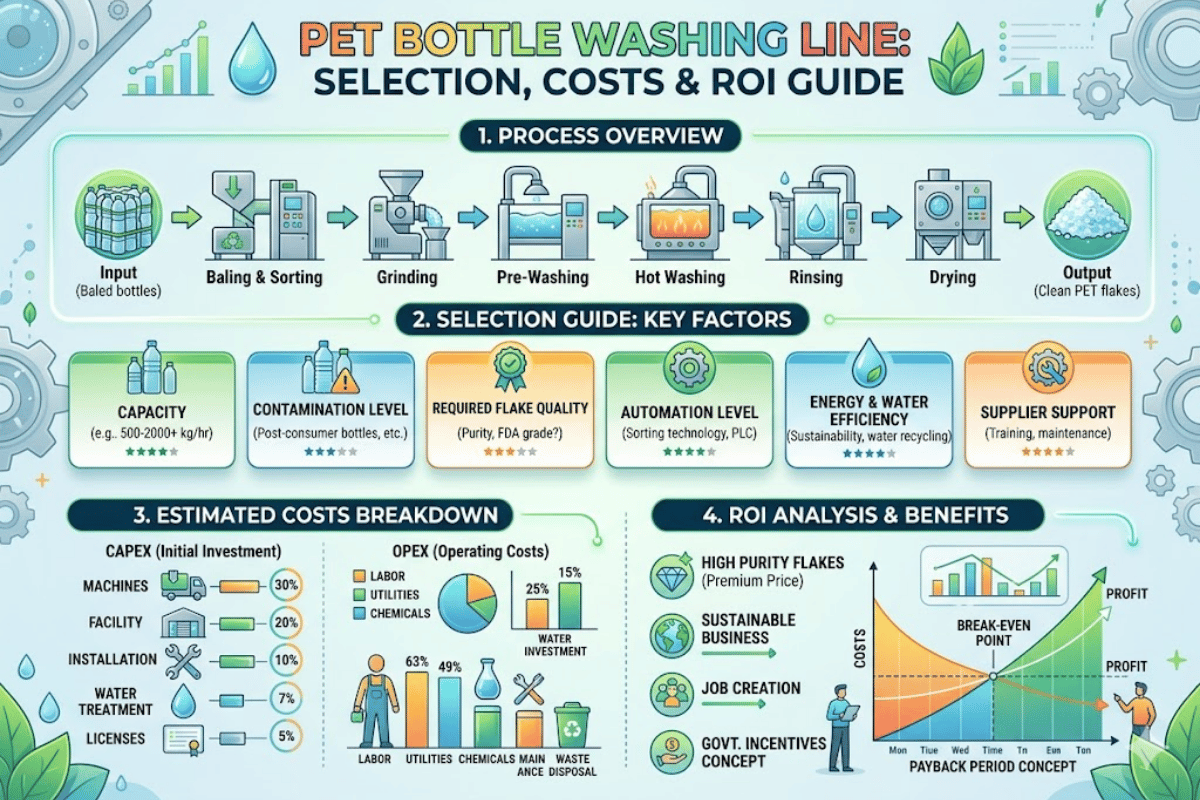
A PET bottle washing line transforms contaminated consumer plastics into high quality, ready-to-re-melt bottle-to-fiber / strapping / sheet recyclate (flake). Selecting a suitable system—production capacity, single or multi-stage wash setup and downstream logistics coupling—can mean the difference between getting your recycling plant into the black in under 18 months or hardly breaking-even. This paper discusses PET wash lines engineering, hot-vs-cold water debate, true cost-per-GPap comparison and pitfalls for first timers.
Quick Specs: PET Bottle Washing Line
| Throughput Range | 500–5,000 kg/h |
| Power Consumption | 80–780 kW (varies by model and hot wash config) |
| Line Length | ³0–65 m |
| Output Flake Moisture | < 1% |
| PVC Contamination | < 100 ppm (standard) |
| Key Standards | CE, UL, CSA; ISO 9001 quality management |
What Is a PET Bottle Washing Line and How Does It Work?
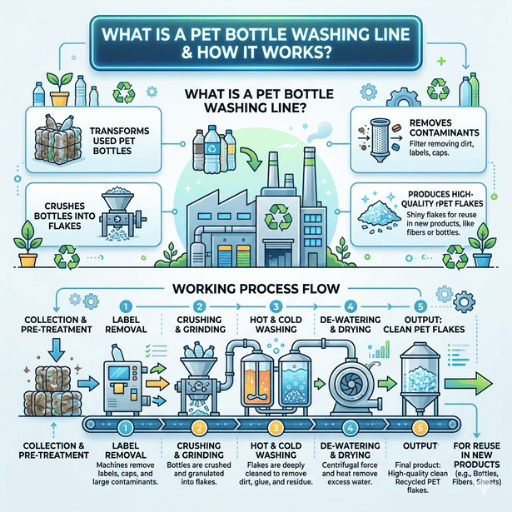
Polyethylene terephthalate(PET) is the most highly recycled plastic. The PET bottle washing line is the industrial machinery that enables bulk recycling of plastic bottles to be achieved. It takes the bales of used bottles, crushed into a block and placed under pressure, collected at cities in solid waste collections, at deposit return schemes or given to scrap dealers and strands them using a number of stages.
The importance of the process is that each step removes a specific group of impurities. The bale breakers segregate densely packed bottles. The label stripper and trommel screen remove free labels, dirt, dust and other small e×traneous matter prior to size reduction.
A crusher reduces the entire bottles to 12-18 mm flakes of stainless steel with highly resistant blades. Screw conveyors and belt conveyor system(s) conduct the material to the subsequent stage. After crushing, a friction washer mechanically rubs off dirt and other thick adherences, which is almost impossible with cold water.
The hot washer, which completes the cleaning process by bringing the water temperature to 80-90 C, loosens and eliminates heavily glued-on adhesives, oils and greases that cold water can remove. A sink-float separation tank segregates plastics by specific gravity, PET flakes (1.38 g/cm) getting carried to bottom of the tank by means of centrifugal force, while PP bottle caps and PE labels rapidly last to the top. A vibration screen directs the plastics toward dewatering equipment, which use centrifugals and hot-air currents to dry the plastics to below 1% total moisture content.
The whole recycling system is a continuous automated process -bale input to clean PET flakes out- driven by a PLC electrical cabin. The ISO/TR 23891:2020 technical report on plastic recycling, makes clear that the standard processes used in mechanical recycling, like the previous one, are the key element for a global plastics circular economy.
📐 Engineering Note
The dynamic balancing of the crusher blades to 3-5 g accuracy. Is paramount to maintaining acceptable vibration levels and prolonging blade life. Unbalanced rotors increase bearing wear and cause poorer, more unstable flake profiles.
Both of these will have a direct effect on downstream washing efficiency and final quality of the flake. Blade replacement periods are approximately 500 – 1000 hours operation depending on the level of contamination in the raw feedstock.
Hot Wash vs Cold Wash PET Recycling Lines: Which Do You Need?
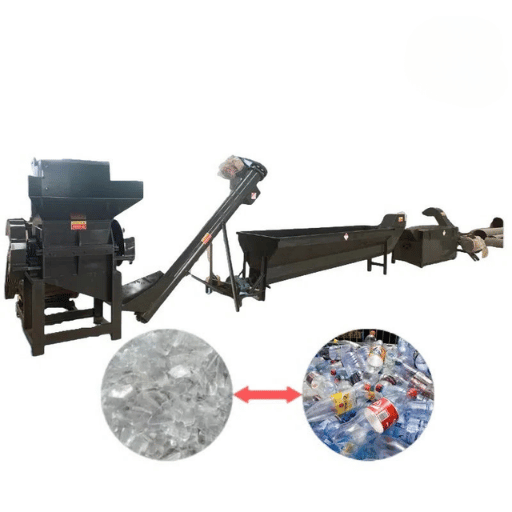
Deciding whether to have a hot wash stage in your PET washing line is the single most important decision of specifications. It determines your output quality ceiling and your future target end markets, as well as your operating cost profile for years to come.
| Parameter | Hot Wash Line | Cold Wash Line |
|---|---|---|
| Wash Temperature | 80–90°C | Ambient (15–30°C) |
| Chemical Agent | NaOH solution (1–2%) | Water with optional surfactant |
| Adhesive Removal | Excellent — dissolves most adhesives | Moderate — loose adhesives only |
| Output Grade | Bottle-to-bottle, food-grade rPET | Fiber, strapping, sheet |
| Capital Cost Impact | +15–25% over cold-only | Base cost |
| Energy Consumption | Higher (heating + wastewater treatment) | Lower |
Operators who begin with a cold wash pet recycling line to minimize initial capital investment are very likely to find themselves retrofitting hot washing modules between 1-2 years later. The total retrofit cost is greater than opting for hot wash from the outset. Hot wash retrofits involve re-designing the water treatment plant, re-instatement of the electrical system, as well as often the re-organization of the factory floor layout.
Use KITECH’s Free Hot Wash vs Cold Wash questionnaire to match your feedstock quality to your end-market needs and your most profitable configuration of washing system.
Can a Cold Wash PET Line Produce Food-Grade rPET Flakes?
Not on its own.
While a cold wash PET washing line can be used to make acceptable flakes for polyester fiber and strapping band applications, food-grade and bottle-to-bottle markets will need the deep decontamination available only from hot washing – with downstream SSP (solid-state polycondensation) or approved decontamination step – to be effective. If your business plan includes sale to the higher-value rPET flake industry, hot washing is not luxury.
How to Size a PET Bottle Washing Line for Your Plant
Matching a PET recycling plant to the right PET bottle recycling machine begins with three variables: your daily feedstock volume, your processing schedule, and your targeted throughput yield.
| Model | Capacity | Line Length | Power Range | Typical Application |
|---|---|---|---|---|
| KT-PET-500 | 500 kg/h | ~30 m | 80–120 kW | Startup / small-scale |
| KT-PET-1000 | 1,000 kg/h | ~40 m | 150–220 kW | Mid-scale recycling |
| KT-PET-2000 | 2,000 kg/h | ~50 m | 280–380 kW | Industrial facility |
| KT-PET-3000 | 3,000 kg/h | ~55 m | 400–520 kW | Large-scale operation |
| KT-PET-5000 | 5,000 kg/h | ~65 m | 600–780 kW | High-volume plant |
💡 Sizing Formula
Required capacity (kg/h) = Daily feedstock (kg) Operating hours per day Processing yield (commonly 0.85-0.92).
For instance, a plant processing 16 tons/day on a 16-hour schedule with 88% yield will require: 16,000 16 0.88 = 1,136 kg/h specify a KT-PET-1000 or KT-PET-2000 for headroom.
Larger-capacity plastic recycling machines do more mechanization – cutting labor requirements from 10-12 laborers for a 3,000 kg/h line down to 3-5 workers for a 500 kg/h system.
Use our PET washing line capacity calculator for determining which capacity machine best suits your specific feedstock volume.
PET Bottle Washing Line Cost: What You’ll Actually Pay

Price transparency has value in plastic recycling equipment.
Though exact PET washing line costs will reflect customization, capacity and automation, here are the ranges experienced buyers have found:
| Configuration | Capacity | FOB Price Range |
|---|---|---|
| Entry-level (cold wash) | 500–800 kg/h | $80,000–$150,000 |
| Mid-range (hot wash) | 1,000–2,000 kg/h | $150,000–$280,000 |
| Industrial (hot wash, full auto) | 3,000–5,000 kg/h | $300,000–$800,000 |
The 30-40% Rule: Equipment Is Not Your Total Investment
The sale price for the pet washing line itself tends to constitute between 30 and 40 percent of the entire project investment. The rest, 60 to 70 percent, includes site/site-related planning like water treatment, electrical systems, building renovations, and working capital for purchasing bottle bales to operate busses during startup.
A recycling facility that budgets $200,000 for a 1000kg/hr washing line should anticipate $500,000Kinalof in all total project expenditure. Many first-time recyclers underestimate this budget, and some projects fail not because of equipment inefficiency, but because working capital has dried up in advance of the plant’s reaching steady state operating efficiency.
Is PET Bottle Recycling Profitable?
📐 Engineering Note — Breakeven Calculation
Monthly profit = (Output tons rPET flake selling price) – (Feedstock cost + Electricity + Water + Labor + Maintenance). For a KT-PET-1000 processing 16 hours/day, 300 days/year: annual output 4,224 tons (at 88% yield). At current rPET flake prices – the global recycled PET flakes market reached $11.23 billion in 2024 and is projected to reach $29.42 billion by 2033 at an 11.38% CAGR – typical payback periods for well-operated plants in the business have been between 12 and 24 months.
5 Costly Mistakes to Avoid When Buying a PET Washing Line
A set of avoidable mistakes has remained unchanged across industry specialists and operational managers of recycling plants. These are the five worst culprits:
- Details of hot wash in the specification to minimize capital cost, then installation of hot wash modules as retrofit. Install hot washer module later than specified adds considerable engineering & capital costs. To upgrade water treatment, re-power electrical system and re-stage^floor plan can be more costly than specifying hot wash at the start-up.
- Overlooking crusher blade maintenance. Damaged, dull blades require more energy, causing additional heat in the cutting chamber, and lead to inconsistent flakes. That heat can spoil PET crystallinity which permanently decreases your product value.Keep crusher blades sharp or replaced every 500-1,000 hours. This may vary depending on contamination in feedstock.
- Pre-sorting during blunging is not performed thoroughly enough. The contaminants that come in at the bale breaker and travel through each of the subsequent steps – screws, PVC bottles, concentrated containers, canned material, etc., – to the end, could have been removed much earlier, for instance with pre-sorting labor or auto-sorters. Experienced operators say that the overall weight of output decreased by over 50% if the input was poorly pre-sorted.
- Only equipment through budgeting is a very common mistake. If you forget total project cost, the washing line being only 30-40% of the project investment, the total other elements including site preparation, water treatment, electrical infrastructure, and working capital of 3-6 months for bale purchase may be severely under estimated. All projects have failed when they run out of working capital before achieving steady state operation—even with the optimum operation of the recycling machines.
- As a buyer, select solely on price and don’t check the guarantees. Each manufacturer cites different limits of acceptable PVC residues (like < 100 ppm, or < 20 ppm). Request independent lab test results on the plastics used in relevant other plants, rather than relying on manufacturer statements.Your performance standards are set by your downstream buyer:
The most critical maintenance need is maintaining sharp crusher blades. A dull blade results in higher consumption of power and heat and causes poor product quality. This issue is common to all recycling plants worldwide.
— KITECH Engineering Team, Jiangsu Kitech Machinery Co., Ltd
PET Flake Output Quality: Grades, Standards & End Markets

PET recycling generates clean pet flakes, the value of which in the market is based on a range of quantifiable quality factors. The most widely used recycling compatibility specification within the industry is the Association of Plastic Recyclers (APR) PET Rigid Design Guide.
| Quality Parameter | Standard Target | Premium Target |
|---|---|---|
| Moisture Content | < 1% | < 0.5% |
| PVC Contamination | < 100 ppm | < 50 ppm |
| Flake Purity | > 98% | > 99.5% |
| Metal Content | < 20 ppm | < 10 ppm |
| Flake Size | 12–18 mm | 12–16 mm |
Following these repsonet flakes, complete bales of rpet are used for four end markets: bottle-to-bottle recycling (highest value, must be decontaminated to food grade standards), polyester fiber and filament (debatably the most significant volume market), strapping band manufacturing, and sheet/thermoforming. The recycled pet flakes market is experiencing rapid growth—the PET bottle recycling washing line market was valued at $0.8 billion in 2024 and is projected to reach $1.5 billion by 2034 due to brand sustainability goals and regulatory demand for recycled content.
Always crosscheck by asking for third-party test reports from the manufacturer of current equipment when considering a PET flake quality grade for evaluation. Archive specification varies widely across manufacturers—consult lab data before finallaying your purchase. Know PET flake current prices so you can compare your projected revenues.
Frequently Asked Questions
Q: What capacity PET washing line do I need for my recycling plant?
View Answer
Capacity is based on your daily feedstock throughput, hours of operation and system yield. Typically an 8 Tonne/Day operation on a two shift basis would require a 1,000kg/hr wash line. An 20+Tonne/day operation should look at a 2-3 Tonne/hr range.
Q: How much water and electricity does a PET washing line consume?
View Answer
A water recycle system in a PET wash line can recover 80-90% of system water. Power usage for a PET washing line will be 80kw for a half tonne/hour line, or 780kw for a 5 tonne/hr system. Hot washing runs can use up to 2-3 times the power of a cold washing line since the energy costs of heating need to be considered – exact numbers depend on line configuration and utility cost.
Q: What maintenance does a PET bottle washing line require?
View Answer
Regular preventive maintenance includes sharpening or changing crusher blades every 500-1,000 hours work, bearing lubrication, trommel inspection, water quality and water chemistry testing, general cleaning procedures. Blade replacement and sharpening is the task with the highest performance impact – neglecting it will increase energy costs and reduce output quality. Set aside 3% of equipment purchase price per year for maintenance costs.
Q: How long does it take to install and commission a PET washing line?
View Answer
Equipment will typically take 60 days after the purchase order is issued to be delivered to the project site. An additional 2-4 weeks on-site installation and commissioning will be required.
Q: Can a PET washing line handle mixed plastic bales?
View Answer
If a PET washing line is designed to process PET bottles, it is not necessarily well-suited for the sort of mixed plastics feedstock stream used in a typical mixed plastic waste separation plant. Mixed bales of plastics containing high volumes of PP, PE or PVC can not be processed without additional step of pre-sorting before entering the wash line. line configurations that include optical sorters or manual separation stations are suitable for ‘moderately’ contaminatedinputs, but heavily mixed bales require pre-sorting equipment ahead of the processing line.
Q: What is the difference between a PET washing line and a PET recycling line?
View Answer
A PET washing line features equipment designed to clean existing PET bottles into flakes. A PET bottle recycling line is an all-inclusive terminology that may include some downstream pellets to produce rPET pellets. Some integrated recycling solutions combine the PET bottle Washer with PET pelletizer downstream into turnkey projects.
Ready to Specify Your PET Bottle Washing Line?
Our engineering team can prepare a detailed equipment proposal that includes equipment specifications, factory layout drawings, and transparent costs estimates tailored specifically for your feedstocks, system capacity, and target market.
About This Analysis
This “PET Bottle Waste Recycling & Washing Line Handbook” is authored by KITECH (Jiangsu Kitech Machinery Co., Ltd), the professional PET bottle washing line manufacturer for 25 years with installations in 80 countries and regions worldwide. All technical parameter and costing data used is derived from our direct engineering projects carried out. The market data used and cited from independent third-party research firms originating from the references cited below. When referencing industry standard specifications, we have cited ISO standards and APR guidelines rather than only our own range of product data.
References & Sources
- ISO/TR 23891:2020 — Plastics Recycling — International Organization for Standardization
- APR PET Rigid Design Guide – Association of Plastic Recyclers
- Standards and Plastic Pollution – ISO
- Recycled PET Flakes Market Size & Industry Report, 2033 – Grand View Research
- PET Bottle Recycling Washing Line Market Report – Reports and Data
Related Articles
- How to Start a PET Bottle Recycling Business – Business planning and market entry strategies
- PET Bottle Baler Machine Guide – Upstream baling equipment selection
- PET Bottle Label Remover: Types and Selection – Label removal technology comparison
- Energy Efficiency in Plastic Recycling Lines — Reducing operating costs through equipment optimization