Get in touch with Kitech Company


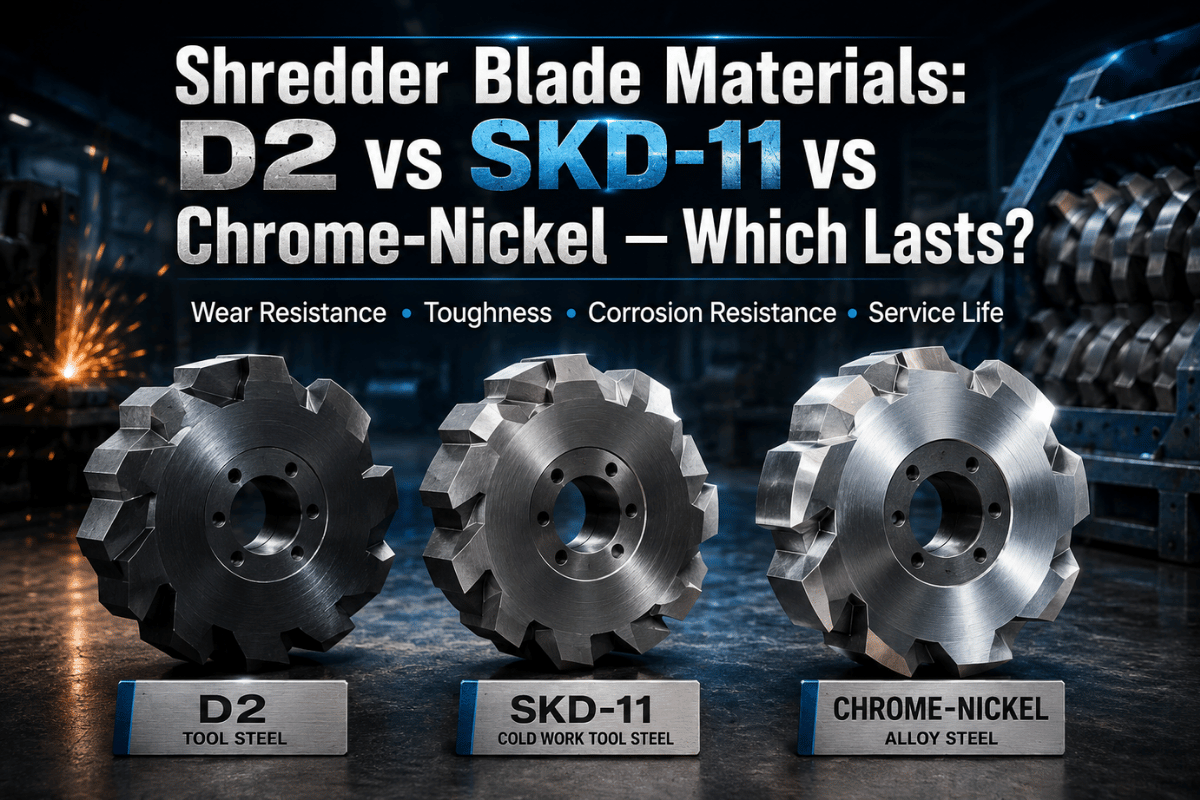
This shredder blade material guide breaks down the steels that actually go into industrial cutting tools – D2, SKD-11, H13, 9CrSi, high-speed steel and carbide – and shows how to match each one to what you shred. Pick wrong and you pay for it in chipped edges, downtime and rising energy draw. Pick right and the same machine run longer between blade changes.
Most guides on this topic are written by blade vendors and stop at “D2 is wear-resistant.” That’s true and useless. Below you get specific hardness ranges, the toughness trade-off that causes most edge failures, an application-to-grade decision matrix, and the procurement checks that separate a blade that lasts from one that look identical on paper and fails in a month.
Quick Specs: Shredder Blade Materials at a Glance
| Common grades | High carbon (T10/60Si2Mn), D2/SKD-11, Cr12MoV, H13, 9CrSi, HSS, tungsten carbide |
| Typical hardened hardness | HRC 44–67 (steel); ≈89–91 HRA for carbide |
| The core trade-off | Hardness/wear resistance vs impact toughness — you rarely get both |
| Most common failure | Edge chipping from stress concentration — not gradual wear |
| First decision input | What you shred (abrasiveness + impact risk), not the steel name |
What Shredder Blades Are Actually Made Of
A shredder blade – sometimes called a shredder machine blade or simply the blade for a shredder – is a hardened steel (or carbide-tipped) tool that shears, tears or crushes material as a rotor turn it past a fixed counter-blade. Whether the feed is plastic, rubber, wood, scrap metal or e-waste, the material the blade is cut from decides almost everything downstream: how long the edge hold, whether it chips on a stray bolt, and how often you stop the line to swap blades. Five families cover nearly every industrial blade in service.
- High carbon steel (T10, 60Si2Mn) – affordable, tough, moderate hardness. The workhorse for soft, non-abrasive feed.
- Alloy / cold-work tool steel (D2, SKD-11, Cr12MoV, 9CrSi) – the most common choice, balancing wear resistance and cost.
- Hot-work tool steel (H13) – keeps strength at high friction temperatures and resists impact chipping.
- High-speed steel (HSS) – superior edge retention for fine, high-RPM cutting; brittle under shock.
- Tungsten carbide-tipped (TCT) and bimetallic – extreme wear resistance for tires, e-waste and abrasive streams, at the highest cost.
Tool steels are standardized – the alloy tool steel family is covered by ASTM A681 in the US and ISO 4957 internationally, which is why a “D2” blade from two suppliers should share the same nominal chemistry.
💡 Key takeaway
There is no single best steel. The “best” blade is the family whose strengths match your feedstock and machine – which is the rest of this guide.
The Four Properties That Decide Blade Life
Why does one D2 blade outlast another that shares the same grade stamp? Because grade alone doesn’t set performance – four measurable properties do, and they pull against each other. Understanding the tug-of-war between them is what lets you specify a blade instead of guessing.
| Property | What it means | Why it matters in shredding | Measured by |
|---|---|---|---|
| Hardness | Resistance to deformation; holds a sharp edge | Cutting efficiency and edge retention | Rockwell C (HRC) |
| Wear resistance | Resistance to abrasion as material rubs the edge | Time between sharpening, lifespan on gritty feed | Abrasion testing; tied to carbide content |
| Toughness | Ability to absorb impact without chipping or fracturing | Survives contaminants (a stray bolt, metal in plastic) | Charpy impact energy (J) |
| Corrosion resistance | Resistance to rust and chemical attack | Wet feed, washed plastic, humid plants | Chromium content; salt-spray tests |
The missing part. A 2022 peer-reviewed study of PET shredder blades published in the journal Machines found that blade chipping is driven by a concentration of stress at the cut – and that isn’t simply because the steel is too soft. The same work categorized actual wear as “progressive,” meaning it combines abrasive, adhesive, and oxidation at once. That’s why always cranking the hardness up to maximum can actually backfire: a harder, more brittle edge may resist abrasion, but it will chip much easier when a shock wave hit it. So, strategically choose a hardness matched to your feed’s impact risk. Don’t just chase the highest HRC number on the spec sheet.
📐 Engineering Note
Match hardness to the application, not the maximum. Impact-oriented blades (mixed scrap, risk of contamination) perform well at HRC 50-55; for high-wear applications (clean abrasive plastics), run with blades in the HRC 58-62 range. Call out the tempering operation on your purchase order, and specify a hardness range rather than an exact HRC number (e.g., “HRC 58-60”) – there will always be some variance from ideal with real-world heat treatment. Rely on standards like ASTM A681 chemistry + HRC range on your purchase order.
⚠️ Common mistake
“Hardness = longevity” assumes chipping is rare. Even the hardest blade won’t be the longest-lasting, because edges are far more frequently defeated by chipping than by gradual wear.
Shredder Blade Material Grades Compared: D2, SKD-11, H13, 9CrSi, HSS & Carbide
With the four characteristics laid out, those intimidating-looking steel codes begin to transform into a readable summary of the trade-offs you’ll face with each blade material. The table below offers the one comparison that most vendors conveniently omit. hardness, relative wear and toughness, cost index and the feed streams each grade best handle.
| Grade | Type | Typical HRC | Wear | Toughness | Cost | Best-fit feed |
|---|---|---|---|---|---|---|
| High carbon (T10, 60Si2Mn) | Carbon steel | 50–55 | Low–mod | High | $ | Film, paper, soft plastics, rubber |
| D2 / SKD-11 | Cold-work tool steel | 58–62 | High | Moderate | $$ | Hard plastics, GFRP, general scrap |
| Cr12MoV | Cold-work tool steel | 58–62 | High | Mod–high | $$ | Dual/quad-shaft, mixed scrap |
| H13 | Hot-work tool steel | 44–52 | Moderate | High (impact/heat) | $$ | Impact-prone, hot, contaminant risk |
| 9CrSi | Cold-work die steel | 58–62 | Good | Decent | $–$$ | Copper cable, wire granulation |
| HSS (M2 / T-series) | High-speed steel | 62–65 | Superior edge | Low (brittle) | $$$ | Fine/precision granulation |
| Tungsten carbide (TCT) | Carbide tip on steel | ≈89–91 HRA | Extreme | Low (brittle) | $$$$ | Tires, e-waste, abrasive high-volume |
Figures are in the industry typical ranges where hardened. Wear/toughness is the relative comparison. D2 information based on cross reference to published D2 tool steel reference data. Always confirm spec by heat-treatment certificate.
What is the best material for shredder blades?
Ultimately, there’s no single “best.” The best material for you simply matches your feed and impact risk. As a quick reference: choose D2/SKD-11 (HRC 58-62) for long wear life on clean, abrasive plastics; select H13 for mixed scrap, contamination, and high-impact feed streams to prevent chipping; pick 9CrSi for abrasive wires/cables as an affordable D2 alternative; invest in carbide-tipped blades for tires, electronics scrap, and the most abrasive feeds for the longest life; HSS is justified only on high-RPM fine granulators, prioritizing sharp edges over wear.
“‘Which steel is hardest?’ is almost always the question we get,” says one experienced plastics engineer. “But in practice, ‘what’s in your feed that shouldn’t be?’ is the more critical question. A magnet drum and a sufficiently tough blade are a far better defense against edge failure than a few points of added hardness.”
Matching Blade Material to What You’re Shredding
Blade life most predictably correlates to only one of the four material attributes – the feed, not the steel. Friction wear is dictated by the abrasion and Impactwear from contamination and density, The below decision matrix ensures that even after inputting your materials information that only a narrow selection of grades will emerge in the shortened list.
| Feedstock | Primary demand | Recommended grade | Notes |
|---|---|---|---|
| Soft plastics: film, bags, PE/PP | Toughness, moderate hardness | High carbon / Cr12MoV | Plastic elasticity dulls over-hard edges fast |
| Rigid plastics: PVC, HDPE pipe, GFRP | Wear resistance | D2 / SKD-11 | Glass-filled plastics are highly abrasive |
| Rubber and tires | Wear + abrasion | Carbide-tipped / bimetallic | Steel belts inside tires demand extreme wear life |
| Mixed / bulky scrap | Toughness (shock load) | H13 / alloy steel | Contaminants will hit the edge — plan for it |
| Copper cable / wire | Wear at low cost | 9CrSi | Gritty insulation abrades; cost-per-ton matters |
| E-waste / circuit boards | Extreme wear | Carbide-tipped | Fiberglass and metal mix is brutal on edges |
The 3-Question Blade Material Test
- How abrasive is your feed? We use wear resistant steels for glass fill (D2), grit (9CrSi) and dirty scrap.
- Contaminant/impact threat level Scrap with solid contaminants (humps/solid bulky scraps) focus on toughnes (H13 or steel with alloying) over the maximum hardness.
- What’s your throughput? Higher volume, more initial wear life. Lower volume see economy…more durable, tougher steel and more frequent re-grind.
Answer the three questions below. Before you look at a single price.
This is where feed control can alter the calculations for the more hardened plastics recyclers. On a plastic shredder machine running washed, screened, rigid plastic, D2 at HRC 58-62 often win’s cost per ton, as it’s a consistent predictable abrasive. It’s a very different story when your looking at a mixed-bale rigid plastic recycling line where the threat of the occasional piece of metal contamination suggests strength as priority. What even comes into it now on bioplastics – see our remarks on PLA bioplastic recycling, and that for ABS recycling where you’ve to contend with a rather brittle character and high level of additives contributing to cutting load.
Another practical example: a medium-sized plastics recycler was shredding post-industrial pipe. The shop ordered blades identified as HSS due to a vendor’s claims that they were “the hardest on the market.” Within a few weeks the HSS blade chipped, every time an offcut, thrown from the grinder, struck edge-on. The solution wasn’t a harder steel-it was D2 at HRC 60, along with a magnet on the feed. the brittle HSS failed on impacts that the shredder line was unaware of occurred.
How Shaft Type and Blade Geometry Affect Material Choice
The same steel will produce variable results depending on the environment (which machine it’s running on) since the overall geometry of the shaft determines the torque, speed, and impact to the edges. Buying material without geometry specification is why two plants buy the same “D2 blade” and get completely opposite results.
- Single Shaft Shedders High torque low speed, blade design follows a helical pattern and will give a steady, uniform load. Generally preferred using wear resistance grade of materials like D2/ Cr12MoV, as the cutting load will be constant.
- Double shaft shredders – dual rotating axes grab and rip material, for mixtures and scrap metal. Toughness / resistance increases with more impact resistance as you’re dealing with stronger impacts. Cr12MoV is the compromise you often make.
- Four-shaft Shredders / Granulators – lower profile particle / higher speed. If the fine nature of the cutting warrants it, HSS on the blade can achieve excellent edge retention – if impact can be avoided.
Geometry isn’t a footnote. The 2022 Machines study on PET shredder blades concluded that altering the offset angle of the rotating and fixed blades changed the wear pattern on the cutting edges – and that a double-edge blade oriented spiral-to-spiral achieved recycling efficiency of 97.39%; provided longer blade life by spreading wear over both edges; and caused wear to the edges to change location on the same steel. In other words, the edge angle and orientation affect blade life like a step change in grade can on the steel. When you re-grind a blade, keeping the original edge geometry is part of preserving blade life, not just regaining sharpness.
Once a stream is shredded, downstream equipment like a plastic pelletizer has its own cutting need, so blade strategy must encompass the whole line rather than individual machines.
Heat Treatment and Coatings: Why the Same Steel Performs Differently
If two blades are both marked “D2”, but one wears more than the other, it’s quite possibly the heat treatment at fault. The grade provides the maximum heat treatment achievement target, the heat treatment process determines how close to that target actually work.
The hardening process heat the steel to form a hard martensitic matrix, and the quench process them converts some retained austenite into martensite to maintain a tough core. If this is performed poorly, the blade can measure correct, but still chip out in service: a sure sign of brittle, low toughness material. Additional optional steps give extra service margin: vacuum hardening produces clean, even results; cryogenic treatment turns retained austenite (sometimes the result of low-grade free-cooled steel) into martensite for extra wear; and surface treatments like nitriding or TiN/TiCN coatings increase surface hardness and resistance to wet or abrasive wear.
📐 Engineering Note
State heat treatment on the purchase order, not only the grade. Specify up front the hardness band you seek (e.g. HRC 58-60); the post-heat treatment tempering technique; and for abrasive streams, coating material and amount of coating. For effective overlay protection, supply the heat treatment results with the material order and request the certificate when you order. Coatings only matter when the underling heat treatment is sound: a layer of TiN over an under-tempered core may well be hard enough, but it will chip.
How to Choose and Verify a Blade Order
Selecting the grade is only half the battle. The other is ensuring that the blade you get is the blade you ordered – because the word “D2” on an invoice isn’t the same thing as a piece of HRC 60 D2 properly cor-rectly double-tempered. Use this checklist, to specify and then to verify on receipt.
- Define the feed first – abrasiveness, contaminant risk, throughput (3-Question Test).
- Specify grade + hardness band + tempering – e.g. “D2, HRC 58-60, double-tempered.” Consult ASTM A681 or ISO 4957 chemistry.
- Confirm fit and geometry – dimensions, bolt pattern, edge angle, tolerance (typical machined tolerances are ±0.01-0.05 mm; check this against your machine).
- Require a material/heat-treatment certificate – chemistry plus measured hardness. Spectrographic analysis confirms the alloy actually matches the grade.
- Test on arrival: A portable Rockwell hardness tester should be used to verify the HRC; check edge straightness and ensure certificate numbers match the shipment.
⚠️ Common mistake
Buying on price-per-blade only. A low price may well mean an inferior material or the sacrifice of heat-treatment steps – a failed blade in a month will cost far more in time and output than one at a higher initial price that lasts a year or more. Buy on cost-per-ton, not cost-per-item.
Blade Cost, Lifespan and Replace-vs-Resharpen Economics
Here’s the calc that almost no blade seller offers, yet it determines your true operating cost: a blade isn’t a purchase, it’s a consumable and has a cutting, sharpening, downtime, and energy cycle. You should be looking at cost per ton, not sticker price.
Blades fail after they’re already worn out. Wear translates to increasing cutting load, higher energy demand, and declining product quality as chips grow on the edge. Increased energy consumption and chipped blades are almost always precursor conditions to complete failure, according to field reports. Running to the break point is actually more expensive than performing preventive maintenance-since a worn industrial blade can be re-ground several times to regain a cutting edge at a fraction of the cost of new, so long as material remains to be ground and some material remains on the original edge.
✔ Re-grind when
- Edge is chipped/dull but body is intact
- Enough material remains to keep the design clearance
- Energy consumption creeps higher, but cuts are still OK
⚠ Replace when
- Chips are deep or the body is cracked
- Re-grinding would breach minimum thickness/clearance
- Hardness has dropped from overheating during prior grinds
When that cost-per-ton lens is applied, the grade choice from previous sections often reverses. While a carbide blade might be multiple times the cost of a D2 blade on paper, the life and downtime savings from the carbide on a tough, abrasive feed stock often end up driving a lower total per-ton cost-whereas, a carbide would be a complete waste of money on some low-abrasion feed materials such as plastics. See our full plastic recycling plant cost guide for help visualizing how blades fit into the total economics of your operation, or if the main constraint is initial capital outlay, solutions for financing the equipment may make one machine over another-and one blade type over another-more appropriate.
💡 Key takeaway
Price-per-blade is the wrong metric. Cost-per-ton-purchase price plus sharpening costs, downtime, energy and multiplied by tonnes is the only metric that ranks blade value, not dollars per piece.
What’s Changing in Shredder Blade Materials in 2026
The basic metallurgy of blades is already mature, but demand and design of edged technologies are shifting. The global recycling equipment market is projected to increase from $5.84 billion in 2026 to $9.14 billion by 2034, with a CAGR of ~5.8%. This is attributed to a rise in mandates for recycled content and a still low overall plastic recycling rate, as documented by various EPA data. Higher rates of plant operation, and thus longer run hours, will mean increased blade wear and overall blade spend.
From a tech perspective, look for two changes through 2026 and beyond: First, bimetallic (steel-alloy body with a wear-resistant edge) and hard-faced edges are migrating from premium-tier tire and e-waste machines into a wider range of mainstream plastics shredding equipment, because they sidestep the hardness-versus-toughness compromise rather than just balancing them. Second, powder-metallurgy (PM) tool steels enable finer, more uniform carbides than D2 or H13 for the most wear-intensive, money-permitted feed types. NEITHER replaces D2 or H13 for most plastics recyclers, but worth a quote if you’re already ponying up for frequent knife changes.
What To Do Now: If your plans involve an additional processing capacity sometime in 2026, ask all your industrial blade suppliers to bid bimetallic cutting for your toughest feed and compare them on the basis of cost-per-ton, rather than a sticker price. D2 or 9CrSi remains the obvious choice if your stream consists of stable, clean plastics; new materials deliver their premium benefit only where the cutting is truly punishing.
Frequently Asked Questions
Q: What is the best material for shredder blades?
View Answer
No single best grade exists-the decision depends upon exactly what your shredding equipment chews up:D2 / SKD-11 (hardness Rhc58-62)-good with tough feed stock like some brittle plastics. H13-balances wear resistance with excellent chip toughness to cut mixed, dirty scrap. 9CrSi-a cost effective alternative for cable.tungsten carbide tipped blades for tires and e-waste.
The appropriate steel for the job matches the feedstock’s abrasiveness against the likely risk of contamination that contacts the blades. The fastest way to make a choice is the Three-Question Test: How Abrasive Is the Feed?
How likely is the Feed to Knock or Bang?
How High Is YourThroughput Rate?
The answers guide you toward an emphasis on wear resistance, impact toughness,or the additional expense of carbide blades. Cost-per- ton, not list prices, helps break the deadlock between two closely ranked contenders.
Q: What are shredder blades made of?
View Answer
Most high-throughput, industrial shredder blades consist of hardened steel-either a high-carbon steel for softer feeds; a cold-work tool steel such as d2, SKD-11, or Cr12MoV for most applications; a high-toughness, hot-work tool steel such as H13 for wear resistant applications where chips or contamination cause wear resistance to be of secondary importance; a high-speed steel (HSS) for fine cutting; or tungsten carbide-tipped or bimetallic construction for ultra wear-resistant applications.
Q: How hard should a shredder blade be?
View Answer
Industrial shredder blades usually come in hardness RHC 50-62-the lower end is used when impacting resistance is of more importance and the upper is for resistance to cutting wear-HSS comes in at RHC62-65.Higher values aren’t necessarily better, as excessive hardening could make blade brittle and susceptible to breakage or chip.
Q: How long do shredder blades last before replacement?
View Answer
With that said, wear life varies significantly according to the feed, how the knives are treated, and even maintenance-just putting a numerical value is somewhat misleading. In the field, blades typically wear and are ground and reground until they are too thin to work effectively.
In order to know how many cuts it takes, pay close attention to operating hours and rising motor current-the longer a new pair of blades lasts, the lower the operational cost of each cut and the higher the throughput. Requesting a demonstration or test cut on a representative sample of the feed stock would give a good, accurate measurement of knife wear life for your system.
Q: Can shredder blades be resharpened?
View Answer
Yes. Most high-capacity industrial shredder knives are designed to be ground a number of times prior to retirement from service. In the process, the knives shouldn’t be over-heated, however.
Overheating can alter the temper and, by extension, lower hardness. Zegbrk_0006.
Q: What is the difference between D2 and H13 for shredder blades?
View Answer
D2 is a cold-work tool steel hardened up around HRC 58-62 known for abrasion resistance, good for abrasive plastics and generic scrap. H13 is a hot-work tool steel hardness of roughly HRC 44-52 that’s much tougher, and heat-resistant, so it holds up to impacts where a harder D2 might chip. We use D2 for abrasion. Use H13 for impact.
Not sure which blade material fits your feedstock? Kitech’s engineers spec blades around your plastic recycling line, match the steel, hardness and geometry to what you actually shred.
Why We Wrote This Guide
At Kitech, we make plastic recycling shredders, so we regularly see failures caused by blade mismatch. Our team pulled hardness range data from published tool-steel information and the chipping mechanisms from peer-reviewed wear research on PET shredder blades, and we tailored our selection to the plastics streams our customers are actually shredding.
References & Sources
- Wear Mechanisms and Performance of PET Shredder Blade with Various Geometries and OrientationsMachines 2022, 10(9), 760 (MDPI, peer-reviewed)
- ASTM A681, Standard Specification for Tool Steels AlloyASTM International
- ISO 4957:2018, Tool steelsInternational Organization for Standardization
- Plastics: Material-Specific DataU.S. Environmental Protection Agency
- D2 Tool Steel, Composition and PropertiesAZoM Materials Reference
- Recycling Equipment Market Size & ForecastFortune Business Insights
Related Articles
Reviewed by the Kitech engineering team – plastic recycling shredder and pelletizing system design.