Get in touch with Kitech Company

Recycled Plastic Pellet Quality Grades: rA-rD Standards Explained

When purchasing agents ask a recycled pellet supplier to price out “prime quality” grades, the answers they receive are never the same. “We have prime-grade rHDPE, sir,” one recycled pellet vendor says. “We can quote on commercial-grade recycled pellets,” another responds. “Standard quality… with no specification to back it up,” says a third. Since virtually all virgin plastic resin grades conform to ISO standards, complete with published specification data sheets, they can be compared to each other more easily than this tangled world of informal recycled pellet labels. Buyers, of course, lose money due to this ambiguity, but production stops and product recalls may be more costly for those products going to consμmers in the auto industry and food industry.
“Recycled Pellets” Is Not a Quality Statement — Here Is Why That Matters
Try searching the ASTM catalog for a generic, universal performance grade specification for recycled plastic pellet and you will fail.ASTM offers ASTM D5491-08(2022) a classification standard for recycled post-consμmer polyethylene film,and ASTM D5577-19to identify contaminants in recyclate materials. The European Committee for Standardization (CEN) published EN 18065:2025 in August 2025 which, classifies data Quality Levels (DQL 1-4) for recycled plastics- this classifies the transparency of the recyclate rather than its performance. It tell you what data surrounds the recyclate but nothing of how it will perform on your injection molding press.
The absence of a standard system meant that industry created its own le×icon. In fact, a 2024 report published in Nature Communications detailed the sale of commercial, PCR HDPE plastics known as “Natural” and “Jazz” — evidence that has now received peer review as confirmation that this grade nomenclature is informal, commercial, and unregulated. A report from the California Integrated Waste Management Board found that many of the producers’ materials were coming in at grade level 1 of their five-tier scale- and did not have quality control equipment on line to produce otherwise.
The practical result: 2 bags of ‘recycled HDPE pellets’ from two different sources might have an MFR value difference of 5-10, moisture a magnitude higher and the content of contamination might have two very different consequences when used in production. If you are buying recycled resin, you should be describing something – not describing a prayer, you know, a wish and a prayer. Learn more in our guide on what a plastic pellet is and how it is made.
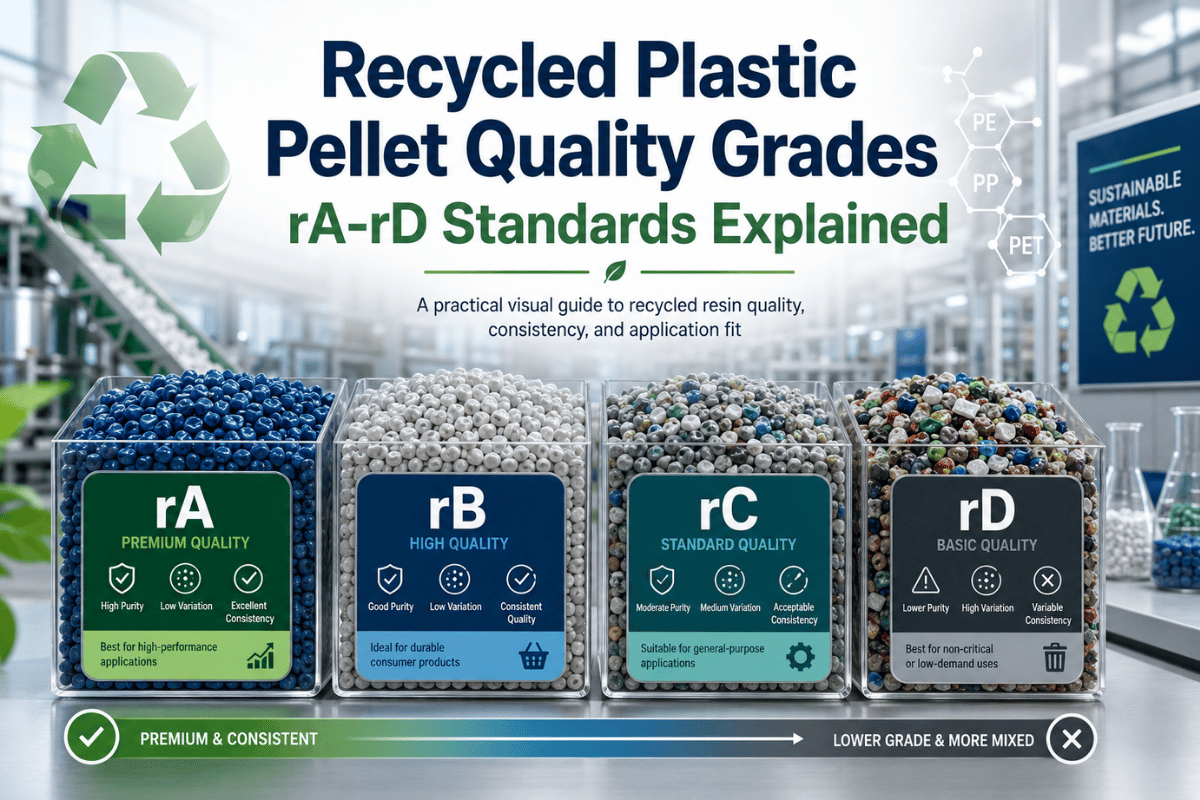
The 4-Tier Grade Framework: Prime, Commercial, Utility, and Regrind
Although not officially defined in any international standard, in practice the commercial qualities of recycled plastic pellets are defined on a four-level system. This has been synthesized from the CIWMB/CSU Chico five-grade quality system , the DataIntelo market grades, and peer-reviewed MFI data from studies on commercial PCR pellets .10 The below outlines the expectations you should place upon any supplier of recycled plastic pellets.
Buyer case-Rotterdam, Netherlands A procurement manager, looking to purchase rHDPE for their detergent bottles, is sent two prices, “prime grade rHDPE”, for “€1850/MT” and “recycled HDPE pellets” for “€1420/MT”. Without a common language regarding the materials she will be able to go no further comparing offers. The less expensive could have an MFR value 0,95g/10’ – which cannot be used in the process.
The more expensive material has already been validated on 190C/2.16kg per ASTM D1238-23a relative to commercial grade MFI specifications. Using the table below she’ll be ready to provide the adequate specifications to finalize the order.
| Grade Tier | MFI Consistency | Moisture | Contamination | Typical Applications |
|---|---|---|---|---|
| Prime | ±5–10% of target | <750 ppm | <0.05% | Film, food-adjacent packaging, automotive, precision injection |
| Commercial | ±15% of target | <1,500 ppm | 0.05–0.95% | General injection molding, blow molding, pipe extrusion |
| Utility | ±30% of target | <5,000 ppm | 0.5–2% | Construction pipes, agricultural uses, drainage, industrial parts |
| Regrind | Uncontrolled | Variable | >2% possible | Blend carrier with virgin resin; plastic lμmber; low-spec moldings |
One big caveat: a more sustainable tier is not necessarily more expensive every time, during each market cycle. At the peak of the 2020 crude oil crash, select recycled HDPE grades actually spent time briefly trading at a slight premiμm to virgin material due to virgin pricing declining more rapidly than recycled contracts re-aligned. Most of the time, prime certified pellet products will trade at a 5 to 15 percent discount to uncategorized pellets; however buyers need to run sensitivities both ways.
The 8 Quality Parameters That Define Each Grade Level
Always ask for test data to support each grade claim for each of the eight parameters. When assessment is made of a new recycled resin supplier ask for the test reports to verify their compliance to these parameters.
| # | Parameter | Test Standard | Prime Grade Threshold | Deviation Indicates |
|---|---|---|---|---|
| 1 | Melt Flow Index (MFI/MFR) | ASTM D1238-23a / ISO 1133 | ±5–10% of grade spec | Chain scission, cross-linking, PP contamination in HDPE |
| 2 | Density | ASTM D792 / D1505-25 / ISO 1183-1 | rHDPE: 0.941–0.965 g/cm³ | Filler or additive contamination (>0.970 g/cm³ is non-preferred for HDPE recycling) |
| 3 | Moisture Content | ASTM D4019 | <750 ppm (film grade); <200 ppm (hygroscopic rPET/PA) | Splay marks, voids, hydrolytic degradation in melt |
| 4 | Contamination / Gels | ASTM D5577-19 / D6265-23 | <15 gels per sq.in. (Prime); <0.05% unmelted particles | Mixed polymer streams, insufficient sorting or washing |
| 5 | Color (L* value) | Colorimetry (CIE L*a*b*) | L* > 60 for natural/clear applications | Mixed-color feedstock, oxidative degradation, carbon black contamination |
| 6 | Particle Size & Uniformity | ASTM D7486-22 | 3–5 mm; size coefficient of variation ≤ 10% | Inconsistent die cut, hopper bridging, uneven plasticization in barrel |
| 7 | Odor / Total VOC (TVOC) | VDA 270 / ISO 16000-6 (GC-MS) | TVOC < 50 μg/g (food-adjacent); VDA 270 ≤ 3 (automotive) | Retained VOCs from food, detergent, or chemical packaging |
| 8 | Thermal Stability (DSC / FTIR) | DSC / ASTM E1131 / FTIR-ATR | Single melt peak; no secondary polymer peaks | Mixed polymer contamination — e.g., PP secondary peak in HDPE signals “Jazz grade” quality ceiling |
It’s true that melt flow index (parameter 1) is always talked about, but actually parameters 7 and 8 are the ones where premiμm claims most often falter. Depending on collection source (mixed detergent/dairy streams) and processing rigours, post-consumer r-HDPE can contain total VOCs of 150-400 g/g even pre-odorization – the ‘food-related’ tolerance limit for this being 50g/g – meaning an 8-10 ‘factor’ increase. Identifying pp contamination of HDPE by heat (DSC additional peaks) is likely to be quicker than waiting through a full battery of mechanical properties.
Post-Consumer (PCR) vs Post-Industrial (PIR): What the Grade Ceiling Looks Like
Feedstock origin — whether the plastic was consumer-used or diverted from manufacturing — directly sets the grade ceiling attainable from any pelletizing system.
Post-Consumer Resin (PCR)
- Sourced from household or commercial waste
- Highly variable purity; mixed polymer risk
- rHDPE 12-18% off virgin; rPP 10-15% off
- PCRs needed for EU PPWR and APR, and for brand sustainability claims
- will account for 61.4% of worldwide recycled pellet revenues in 2025.
- Except for food-grade rPET made by SSP it can reach to 21 CFR FDA Compliance
Post-Industrial Resin (PIR)
- Factory offcuts, sprues, runners — never consumer-used
- Single-polymer, uncontaminated, often pre-sorted by color
- Les compléments 8-12% de plus que les mêmes pour les grades après consommation
- PIR does not contribute to US Plastics Pact PCR calculation and it is not eligible for APR PCR certification.
- Best suited for demanding technical applications requiring consistent composition
The common assumption — that PCR pellets are always lower quality than PIR — is contradicted by one important exception. Post-consumer rPET processed through solid-state polycondensation (SSP) and super-clean decontamination can achieve intrinsic viscosity (IV) values and food-contact purity that most PIR sources cannot match. The Canadian government’s regulatory guidance confirms that food-grade rPET and rHDPE recycling processes are “relatively mature” while most other polymer streams are not. For all other polymers, PIR remains the higher-ceiling feedstock for prime-grade production. Read our dedicated guide on food-grade rPET FDA and EFSA regulations for the full compliance picture.
How Grading Criteria Differ by Polymer Type
One the most frequent grading blunders is to use exactly the same parameter – most commonly MFI – as the dominant condition for all plastic grades. What is the right dominant parameter and test conditions, depends on resin grade.
| Polymer | Primary Grading Parameter | Standard Test Conditions | Prime Grade Notes |
|---|---|---|---|
| rHDPE | MFR (Melt Flow Rate) | 190°C / 2.16 kg (ASTM D1238) | PCR HDPE blow-molding grade: MFR 0.1–0.89 g/10 min. “Natural” grade is prime-equivalent. PP contamination (immiscible) is the #1 barrier. |
| rPP | MFI | 230°C / 2.16 kg (ASTM D1238) | 2–12 g/10 min for injection grade. Mixed-stream rPP from automotive, packaging, and fiber can each have different MFI targets. Processing temp: 200–230°C (10–20°C lower than virgin). |
| rPET | Intrinsic Viscosity (IV) | IV measured in solution (not MFI) | SSP process can restore IV to near-virgin. Food-grade rPET possible with FDA/EFSA decontamination approval. MFI is a secondary check. |
| rLDPE / rLLDPE | MFR (Film grade) | 190°C / 2.16 kg | Film-grade MFR: 0.5–2.5 g/10 min. Mixed flexible film streams limit purity ceiling. Commercial is the practical maximum for most post-consumer LDPE streams. |
| rABS | MFI + Heat Deflection Temp | 220°C / 10 kg (ABS) | Multiple heat histories reduce heat resistance and impact strength significantly. Utility grade ceiling in most post-consumer streams. E-waste sourced rABS may contain restricted substances (REACH). |
The EU has established specific standards for characterization of each key polymer-recyclate, EN 15342 for PS, EN 15344 for PE, EN 15345 for PP, EN 15346 for PVC, EN 15348 for PET. For each one, the dominant test property is specified for that polymer-recyclate. For producers handling HDPE, see our complete HDPE recycling guide. For rPET in particular, our PET recycling pelletizing machine information pages cover the decontamination technology enabling food contact grade results.
Matching Grade to Application: The Procurement Decision Matrix
Once you know whether a bundle of granulates belongs to a specific grade level, the next question is whether that grade level is suitable for your intended application. The grid correlates grade to end-use suitability by referring to CIWMB application testing, ASTM ESCR requirements, and FDA/EFSA framework for food contact.
Customer scenario-Monterrey, Mexico: An automotive components producer sourcing recycled PP for the lining panels of vehicle interiors needs to meet VDA 270 odor class 3 and appends tensile strength within 15% of virgin PP. Absent a grade grid, they might agree to a “generally recycled PP” quote blended from separable waste streams, untested for odor. Using the grid below, they demand Commercial grade minimum – a certified test report stating TVOC below 50 g/g; and MFI within 15% of their functionally specified value.
| Application | Prime | Commercial | Utility | Regrind Blend |
|---|---|---|---|---|
| Food / beverage packaging | ✅ + certification | ❌ | ❌ | ❌ |
| Automotive interior parts | ✅ | ⚠️ require odor test | ❌ | ❌ |
| Consumer goods injection molding | ✅ | ⚠️ with test report | ❌ | ❌ |
| Blow molding (HDPE bottles) | ✅ | ✅ | ❌ | ❌ |
| Agricultural film / packaging film | ✅ | ✅ | ❌ | ❌ |
| Construction pipes / conduit | ✅ | ✅ | ✅ | ⚠️ <25% blend |
| Crates, pallets, bins | ✅ | ✅ | ✅ | ✅ |
| Plastic lumber / low-spec industrial | ✅ | ✅ | ✅ | ✅ |
Fit for purpose | Conditional – require documented reports of testing | Not fit for purpose
Note: Medical devices with safety-critical function must always be virgin. Non-safety-critical medical device components (enclosures, packaging) may accept prime grade PIR granulate if it is supported by verifiable test data.
Certifications That Validate Grade Claims
Marketing grade claim without third-party certification is an advertising statement. These are the certification processes and test specifications that establish the legality and marketability of grade claim.
Global Recycled Standard (GRS) — Textile Exchange
GRS is the certification most often demanded for recycled granulates in international value chains. It has two equivalent levels of requirement:
- 20% recycled content – required for B2B supply chains and transaction certification
- 50% recycled content – used for customer marketing label and Amazon Climate Pledge.
Certificates address every pillar of suitability: recycled content, chain-of-custody distribution, management sustainability, social accountability, chemical regulation. Certification costs are about Dollars-GBP per facility per year, 3-6 months from registration through certification. 2026 Watch: Textile Exchange announced the Materials Matter certification on December 12, 2025 – this will supercede GRS 4.0, implementing by December 31, 2027. If your supplier is GRS registered today, check for their outlined deadline to upgrade.
APR PCR Certification Standard (November 2024)
In November 2024, the Association of Plastics Recyclers published APR-PCR-101; this standard demands:
- Minimum 90% post-consumer plastic material in certified output
- Up to 10% PIR permitted but considered not certification-worthy PCR.
- CoC oversight as backed by ISO 14021 (definition), ISO 22095 (CoC), and EN 15343 (traceability).
- Annual fees: $850 (APR member) / $1,700 (non-member) per site.
Key ASTM Test Standards for Grade Verification
- ASTM D1238-23a — Melt Flow Rate/Index (current 2023 version)
- ASTM D1505-25 — Density by density-gradient technique (2025 version)
- ASTM D5577-19 – Techniques to separate and identify contaminants in recycled plastics.
- ASTM D7486-22 – Measurement of fines and dust particles on plastic pellets.
- ASTM D5491-08(2022) – Classification for recycled post-consumer PE film sources.
EN 18065:2025 — The New EU Data Quality Level Standard
Published August 2025, the European national standard from February 2026, EN 18065:2025 creates a DQL 1-4 classification for recycled plastics – most applicable for digital product passports and B2B trade documentation. DQL 4-A means food-contact qualified (EFSA, FDA, automotive VDA 284 apply). Note this standard does not provide any performance thresholds, only data transparency thresholds. It’s a complement to, not replacement for, the ASTM/ISO standards.
How Your Pelletizing Equipment Determines Your Grade Ceiling
The grade ceiling of a recycled pellet will be dictated by the weak link in the manufacturing process. Most commonly that weakness is in the melt filtration stage. Independent peer-reviewed research (Fuel Processing Technology, 2022) validated that adding melt filtration of the PP feedstock into the process directly enhances the mechanical properties of the recyclate — confirming what experienced equipment operators have known for decades through direct observation.
Filtration technology choice is determined by input contamination level:
- Wire mesh / piston screen changers (minimum 32 micron effective opening): When incoming contamination is at the 0.05% level, then these can be a viable choice and can ensure prime-grade output to a standard screen-pack system.
- Laser filter screens (minimum 70 micron effective orifice): When the incoming contamination levels can range from 3 to 5 percent, laser screen filtration will offer the most efficient classification capability at the micron level with consistent sizing over the screen area compared to woven screens of similar nominal micron rating.
- Continuous Self-Cleaning Filtration: Will keep your production lines up and running seamlessly, even when handling feedstock of inconsistent quality, particularly important for consumers of post-consumer plastic that is often difficult to sort into batches of consistent contamination levels.
A Case Study: Improving Grade and Selling to High-Value Markets. (Vietnam): A plastics recycler using a basic strand pelletizing system with 150 micron wire mesh upgrade to a Kitech ultra-fine 80 micron melt filter. His product immediately “graduated” from Utility grade to Commercial grade because the unmelted plastic fines, metals and other contaminants previously entrained in the pellets now stay in the filter. Suddenly, Japanese and South Korean buyers (known for demanding and paying a premium for high quality pellets) will accept his plastic. The grade difference paid for the entire upgrade within the first year.
Highly precise temperature control, combined with effective melt filtration systems, can produce an MFI with a consistent tolerance of ±5% of the target value. Underwater pelletizing systems deliver superior pellet geometry and consistent flowability — critical for automotive and electronics applications.
Kitech’s plastic pelletizer range — from standard granulators to HDPE-specific lines — delivers consistent output grade from variable post-consumer feedstock. The auto self-cleaning no-mesh laser filtration system eliminates manual screen changes while maintaining fine-filtration performance on contaminated PCR streams. See the dedicated HDPE pelletizing machine page for specifications.
Regrind vs Recycled Pellets: When Each Format Is Acceptable
Regrind plastic — shredded or ground plastic that has not been re-extruded and pelletized — occupies the lowest position in the quality hierarchy but has legitimate uses. Understanding the format differences prevents over-specifying (paying for pellets when regrind would serve) and under-specifying (using regrind where pellets are required).
| Property | Regrind (Unprocessed) | Recycled Pellets |
|---|---|---|
| Physical form | Irregular, 2–12 mm; angular | Uniform cylinder/sphere, 3–5 mm |
| MFI consistency | Uncontrolled; batch-to-batch variable | ±5% achievable with fine filtration |
| Contamination removal | None (post-shredding) | Filtered during melt extrusion |
| Moisture profile | Variable; requires pre-drying | Post-pelletizing dried; more stable |
| Processing cost (relative) | Lower | +$50–$200/MT pelletizing cost |
| Market value vs virgin | 20–60% discount | 12–18% discount (rHDPE) |
| Suitable applications | Lumber, drainage, low-spec industrial; blended with virgin (10–25%) | All applications including film and precision injection molding |
For semi-structural injection molded applications, the industry standard for regrind content is 10-25% added tovirgin resin – this level is sufficiently low to avoid issues with color shifts and changes in Melt Flow Index (MFI). At >50% regrind content, the application choices are limited to constructions, drainage, and some industrial applications with less strict dimensional/aesthetic specifications. In the case of plastics recyclers who are looking to move from a Regrind to pellet blend model on their path to offering their recycled pellets, there’s a specific challenge for processing low-density-bulk-density flexible film regrind into consistent pellets, addressed on the plastic film pelletizing machine page.
The 2025–2026 Market Forces Reshaping Grade Demand
The business dynamics of the recycled pellet quality grades is fundamentally being remade not by future policy – but existing legislation and enforcement that is in the public policy domain. European Union Regulation 2025/40 on Packaging and Packaging Waste (PPWR), which came into effect on February 11, 2025, to be generally applicable by August 12, 2026, includes, among others:
- 30% recycled content for contact-sensitive PET packaging by 2030
- 10% in for other contact-sensitive plastics; 35% in for other plastic packaging
- Increasing thresholds through 2040
Based on ICIS/CPCIF analysis for November 2025 that was reported by Resource Recycling, the EU will need ~5.4 million Metric Tons/year (MMT/y) of recycled PE, PP, and PET material to meet PPWR minimums for plastic packaging by 2030. This amount is forecasted to more than double by 2040 to ~11.5 MMT/y. Global market value of recycled plastic pellets reached $8.6 Billion in 2025 and is forecasted to grow to $16.4 Billion by 2034. The value of recycled plastic pellets globally is expected to grow with a CAGR of 7.4% during the forecast period (2026-2034). Europe is expected to be the largest and fastest-growing regional market at 8.1% CAGR during the forecast period.
The “supply issue” is not a capacity problem-it’s a feedstock problem. Only 14% of all plastic packaging collected for recycling globally is believed to be recycled at an appropriate value level, according to available industry data. Perhaps only 2% is effectively recycled into a higher value application. Some 25% of collected plastic packaging is disqualified during the sorting process based on contamination and mix of polymers. In summary, the availability of “prime grade” recycled pellets that can be used in a “high value” application such as food packaging, automotive interiors, or precision injection molding is limited in a mandated growth market. For plastic package converters and compounders this means that the long term supply agreements with certified prime material producers is paramount- not simply a desirable capability. Board-level sustainability reporting requirements — CSRD in the EU, SEC climate disclosure rules in the US — mean that traceable, certified recycled content is a C-suite conversation, not just a procurement line item. For manufacturers committed to a circular economy model, high-quality recycled pellets from verified prime-grade sources are both a regulatory necessity and a competitive signal.
Frequently Asked Questions
What is the difference between post-consumer and post-industrial recycled plastic pellets?
Post-consumer resin (PCR) – comes from discarded items used by consumers. This could be packaging or any type of product made of plastic. Post-industrial resin (PIR) – comes from discarded items produced by manufacturers during their operations- such as excess material from sprues and runners in the injection molding process. Since PIR is from a single polymer feedstock and uncontaminated by consumer debris, it is generally more clean and consistent than PCR. PIR is 8 to 12 percent more expensive than comparable PCR content in most cases due to their respective quality difference. Only PCR may be designated with APR PCR certification and may be reported under PPWR claims.
What is the melt flow index and why does it matter for recycled pellets?
The melt flow index (MFI), also known as melt flow rate (MFR), reflects the degree to which a thermoplastic plastic can flow under controlled conditions (standard temperature and pressure). For HDPE, MFRs are measured at 190C using a load of 2.16 kg (ASTM D1238-23a / ISO 1133). Typical MFR for food-grade commercially-available recycled HDPE post-consumer (PCR) that can be blow-molded is in the range of 0.1 to 0.89 g / 10 min. When you reuse recycled plastic pellets, MFI will gradually increase through the chain scission process of each processing step or decrease through cross-linking and degradation processes. Therefore, recycled pellets without controlled MFI tend to be problematic to be used in molding process, leading to the short shot, dimensional failure and warpage problems. Accordingly, it is the basic prerequisite to control the MFI tolerance of the shipped lot at the 15% range for a commercial grade or the 5% range for a prime grade product, not to over that level.
How can I tell if recycled pellets are food-grade?
For a food-grade certification to a recycled plastic, a document of regulatory approval based on scientific and risk evaluation is required, not a statement by the producer of the pellets. For example, you should ask for a positive opinion of FDA 21 CFR Part 170-199 (United States) or EFSA (Europe) related to the decontamination process applied. For recycled HDPE, food-contact certification will require demonstrating very clean decontamination process followed by chain-of-custody procedures. Regarding a Food Contact Approval (FCA), regulatory guidance from the Canadian government indicates that “the recycling technologies for RPET (Recycled PET) and RH DPE (Recycled H DPE) are considered fairly mature while that for other plastic waste streams such as RP P (recycled polypropylene) and R L DPE (Recycled Linear Low Density Polyethylene) are yet to obtain the broad FCA on other plastics”. So you should ask for an individual positive opinion letter from the respective regulatory agencies rather than GRS certification which only certifies recycled content.
What certifications should I ask for when buying recycled plastic pellets?
As for all types of recycled plastic pellets for end use applications you would ask for: GRS certification (Textile Exchange); and MFI (ASTM D1238), Density (ASTM D792/D1505), and contamination test report (ASTM D5577). For a post-consumer content for end-of-life product packaging required by EU’s EU PPWR (Packaging and Packaging Waste Regulation) or any company sustainability targets, ask for APR PCR certification (APR-PCR-101, Nov 2024 edition) which certifies a minimum of 90% post-consumer content and chain of custody of that content according to ISO 22095 procedures. If pellets are specified for automotive, request for a VDA 270 odor test result. If specified for food-contact application you should ask for Food contact letter as mentioned above. Please take note GRS certification will migrate to new Materials Matters Standard in Dec 31, 2026 and be familiar with your supplier compliance in terms of this migration.
How does pelletizing equipment affect the quality grade of recycled plastic output?
The limiting factor dictating the highest output grade of recycled pellet that can be produced from a given feedstock on a particular pelletizing line is its filtration system. Typically, a 32-mesh minimum on a continuous self-cleaning screen changer will suffice to produce prime grades if the incoming contaminants are low (<0.05%). For the average incoming contamination level of 3-5% commonly seen from PCR, a high performance continuous self-cleaning filtration system, often based on the use of laser filter technology, becomes necessary to achieve high cleanliness standards without production interruptions. Advanced filtration coupled with accurate process control of temperature at the die can achieve up to 5% MFI uniformity, the required tolerance for many applications, including automotive and electronic grades. Underwater pelletizers offer superior geometric uniformity to strand systems for reduced downstream process variability. Achieving higher pellet quality in terms of cleanliness through the implementation of finer melt filtration is generally the quickest route to upgrade a processor’s output quality from Utility or Commercial to Prime.
Related Articles
- Strand vs Water-Ring vs Underwater Pelletizer: Which Produces Better Recycled Pellets?
- What Is a Plastic Pellet? Production Methods and Applications Explained
- Food-Grade rPET: FDA and EFSA Regulations for Recycled Packaging
- The Complete Guide to HDPE Recycling: Properties, Process, and Applications
- Self-Cleaning Laser Filter for Plastic Recycling: How It Works and When to Use One
- Plastic Pelletizing Line: Complete System Configurations for Post-Consumer Streams