Get in touch with Kitech Company



The best choice of strand vs water ring vs underwater pelletizer is the most significant decision in a polymer compounding or recycling line — all three options yield different pellet shape, average throughput, capital expenditure, and the range of materials a plant will be running for the next 15 years. Each method follows a different cooling-and-cutting sequence to cut into pellets, and the right choice has more to do with resin chemistry, plant capacity, and downstream feed equipment than marketing speak about “best quality.” Use this comparison to evaluate all three pelletizing methods on pellet output, material fit, capacity, capital and operating expenditure, and choose the right pelletizing system using the decision matrix shown at the end.
Quick Specs: Three Pelletizing Methods at a Glance
| Method | Throughput Ceiling | Pellet Shape | Best Resins | Capital Cost |
|---|---|---|---|---|
| Strand | ~20,000 kg/h | Cylindrical | ABS, PS, PC, engineering plastics, short-run compounding | $ (lowest) |
| Water Ring | ~5,000 kg/h | Lens / oval | PE, PP, polystyrene, film recycling | $$ (mid) |
| Underwater | ~31,750 kg/h | Spherical | PET, PA, masterbatch, micropellets, virtually any polymer | $$$ (highest) |
All throughput numbers cite Nordson Corp data published in Plastics Technology. Capital cost rankings are relative — obtain quotes for your specific kg/h rate. For Kitech options across these processes, see the plastic pelletizer system hub.
How Each Pelletizing System Works

It is useful to intuit what the processes are physically doing prior to comparing output and cost. All three start with a flow of molten plastic from a heated extruder die, but their pelletizing process steps — when the cut happens relative to cooling — diverge sharply, and that difference dominates every eventual characteristic of the pellet.
Strand pelletizing — cool first, then cut
In strand pelletizing, polymer is melted and extruded through a die plate with many orifices to form continuous strands of molten material. Those strands enter a water bath or trough where they cool and solidify, then pass through a de-watering unit or air knife into the rotary cutter, which chops them into cylindrical pellets. Because cutting happens after solidification, the cutter wears against hard plastic rather than molten polymer. Stringing up to 75 strands at every job startup is the labor reality of this method, and dropped strands during the run are a recurring nuisance throughout the shift.
Water ring pelletizing — cut at the die face, throw into water
A water ring pelletizer is a die-face cutter. As the molten polymer leaves the die holes, rotating knives shear it and propel the pellets into an annular ring of cooling water. A tangential water ring then carries the still-soft pellets into a centrifugal dryer. Cutting happens against the molten extrudate, so this only works where the resin has enough melt strength to hold its cut shape briefly before water hits it. Polyolefins and polystyrene fit; high-temperature or sticky resins are outside the working window.
Underwater pelletizing — cut with the die submerged
Water can be used in underwater pelletizing, in which the entire cutting chamber is flooded with high-pressure process-water solution. Shear is applied to the die face by knives before the polymer is already under the fluid, which draws it into a sphere through surface tension, where it is cooled by the process water solidifying the pellet. The process water also carries the spherical pellets through a series of pipes to an agglomerate catcher and then to a centrifugal dryer.
Water tempering, in which hot and cold water can be mixed to an exact setpoint to maintain a constant temperature, can be automated through the process-water unit. Failure to balance water temperature to the selected polymer properties is the most frequently cited cause of worm-like or otherwise malformed pellets.
Pellet Quality and Shape Compared
Pellet shape may seem aesthetic until you see a hopper bridge or a polycondensation reactor stall on uneven feedstock. Each of the three pelletizer types produces a distinctly different pellet geometry, which directly impacts bulk density, free-flow behavior, and the size of the downstream drying unit.
Three pellet shapes correspond to the three pelletizing methods: strand cutters produce cylindrical pellets with flat ends (which can bridge in feeders); water ring cutters produce rounded but flattened lens or aspirin-tablet shapes; underwater cutters uniquely produce true spheres. Sphericity arises because the molten polymer droplet is fully submerged at the moment of cutting, and surface tension pulls it into a near-perfect sphere before solidifying. Spherical pellets pack denser, flow more reliably into hoppers and feed throats, and have lower bridging tendency — measurable advantages in any high-speed feed line.
Underwater is also the only method that reliably produces the sub-millimeter micropellets used in masterbatches, expandable polystyrene, and rotomolding.
Pellet size distribution is governed by the industry standard ASTM D1921-18, sieve analysis for plastic pellets and granulars. The uniformity between lots according to D1921 is how you will be judged by your downstream feed-stock customers – especially the PET solid-state polymerization operators.
📐 Engineering Note
But with PET to be sent for solid state polymerization, sphericity is important: just as for regrind, cylindrical strand pellets and lens-shaped water-ring pellets cause uneven heat transfer and gas diffusion within an SSP reactor. Spherical underwater pellets – tested to ASTM D1921-18 size distribution tests – will deliver maximum consistent IV projection with minimum fines buildup down-stream. If your end user customer is a PET bottle reclaimer, your choice of pellet shape is made already.
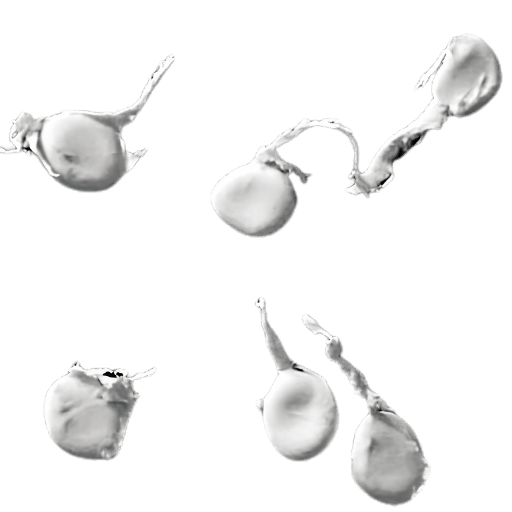
There is ample discussion of common pellet defect modes in the literature for industry pelletizers. Twins and triplet groups, dog-bone configurations, internal voids, “popcorn” pellets, tails, and angel hairs are common failure modes with known origins: moisture in the polymer feed, knife clearance migration, swings in water temperature, and chipping of die orifice lips. The drying system you specify following the pelletizer must be robust for the mode(s) of failure your method engenders and the moisture levels the pellets are delivered with.
Q: How does pellet quality vary across different pelletizing systems?
The short answer: underwater wins on uniformity and sphericity; water ring delivers consistent lens shapes for polyolefins; strand is fine for engineering plastics with downstream feeders to handle cylinders. The longer answer: good downstream system processing will determine the pelletizer decision. For SSP-bound PET, the uniformity of sphericity and uniform residence time in the reactor cells-up controls the reactor residence time; for masterbatch carrier resin heading to letdown screws, micropellet uniform size controls dose accuracy; for the bench-scale color compounding process using 50kg batches, cylindrical strand pellets are fine and the underwater cost differential hard to justify.
The pelletizer choice is downstream driven, not upstream driven.
Material Compatibility — Which Resin Fits Each Method?

Resin chemistry is the strongest constraint on pelletizer selection — some resins simply cannot run on certain systems, regardless of throughput or budget. Plastics Technology/Nordson summarizes the position: water ring is “limited chiefly to processing high-melt-strength materials such as polyolefins and polystyrene” and “particularly unsuited for high-heat or sticky materials.” That single constraint rules PET, polyamides, TPEs, and most engineering plastics out of the water ring working window. Strand systems handle most polymer families — though not hot melts. Underwater is the only method that processes “virtually any polymer” — masterbatch, recycling, polymerization output, PET reclaim, and polyamide compounds.
| Resin Family | Strand | Water Ring | Underwater |
|---|---|---|---|
| PE / HDPE / LDPE film recycling | Workable | Preferred | Workable, often overspec |
| PP woven bag recycling | Workable | Preferred | Workable |
| PET bottle reclaim | Limited (cylinders complicate SSP) | Not recommended (high heat) | Preferred |
| ABS / PS / PC engineering plastics | Preferred | Limited | Workable |
| PA, TPE, sticky compounds | Workable | Not recommended | Preferred |
| Masterbatch, micropellets | Limited (size restriction) | Not recommended | Only option |
| PVC pelletizing | Preferred (controlled dwell) | Limited | Workable |
Q: Which materials are more suitable for underwater pelletizers than strand pelletizers?
Three classes of resin need underwater processing quite effectively. PET – especially postconsumer recycled PET feeding into solid state polymerization – demands spherical pellets for predictable SSP residence time. Polyamides and other high-melt-flow engineering thermoplastics solidify too quickly in air to run dependably on strand lines and are too tacky for water ring.
Masterbatch concentrates and micropellets (sub-millimeter pellets used in metered let-down systems) fall dimensionally outside the range strand cutters can hit. For these materials, the options are underwater or nothing. In practice, fields data from polyolefin film recycling – Kitech’s plastic film pelletizing machine, for instance – usually shows the reverse direction: high-MFR film recycle goes to water ring, where the lens-pellet shape is acceptable and capital cost keeps reasonable.
Most common selections error can be grouped into two. One, selecting strand for high-Melt-Flow PE purely based on throughput calculations— usually yielded dog-bone pellets and high fines; for the reasons that the soft strand with low viscosities stretched under before the cutter could reach it. Two, selecting water ring for PET because the control target throughput was 1500kg/hr— water ring can never maintain the right temperature window for PET regardless of throughput.
Throughput and Capacity Range

Throughput-driven selection is where the most common misconception in plastic pelletizer comparisons lives. Most published guides describe strand pelletizers as “small to medium scale only,” but the actual upper limit — as documented in Nordson data published in Plastics Technology — is 44,000 lb/hr (about 20,000 kg/h). Underwater pelletizers reach 70,000 lb/hr (~31,750 kg/h). Water ring tops out at 11,000 lb/hr (~5,000 kg/h) — the strictest ceiling of the three, driven by die-face shear-rate constraints with high-MFR materials.
💡 Counterintuitive: Strand is not “small only”
A 20,000 kg/h strand line is not “big”—there are large compounders running high volume, long runs of onlyone rigid resin that still choose to run strand, simply because it is faster and more economical during changeover. (Strand=small batch is a common abbreviation in the literature of many suppliers; it is NOT a capacity limit).Strand cannot do this:
Capacity is also where labor cost diverges. A 20,000 kg/h strand line stringing 75 strands per startup carries different labor economics than a 30,000 kg/h underwater line where startup is automated through PLC water bypass and polymer diverter valves. Production efficiency on a high-throughput production line depends as much on this automation gap as on the pelletizer mechanics themselves. To compare your kg/h requirements against available equipment options, Kitech provides a system sizer tool that maps target throughput to recommended pelletizer type.
Capital Cost and Footprint

Cost ranking is consistent across every published comparison: strand is the lowest-cost pelletizer, water ring is mid-range, and underwater carries the highest capital cost. Underwater complexity is what drives the cost — pressurized water box, polymer diverter valves, water bypass automation, and PLC-controlled cutter pressure all add equipment line items. Process-water systems alone range in capacity from an entry-level 4,400 lb/hr skid-mounted unit with 150 µm filtration up to 77,000 lb/hr units with self-cleaning 70 µm filtration.
Footprint is the counterintuitive part. Although installation costs are proportional to equipment cost, the feature that makes strand a costly system is the need to cover linear distance with the water bath or water slide. Underwater systems, because process water moves through pipes and ducts, can be accommodated in another room or make use of an under-floor capacity. The most space-efficient pelletizer type is water ring, but a throughput premium makes it only viable if you add additional lines rather than scale linearly.
Q: How does total cost of ownership compare across pelletizing systems?
A comparison of all four cost buckets shows total cost of ownership implications for each system: equipment capital, footprint and installation expense, operation cost over years, and pellet defect downstream process costs. Water ring tends to be cheapest per ton for typical PE and film recycling flows at moderate throughput levels; underwater wins at large scale and high throughput. To compare CAPEX alternatives across pelletizer options, the plastic pelletizer model comparison page lists capacities and setups side by side, and the pelletizing line ROI estimator walks through TCO for full-line installations.
Operating Costs and Maintenance

Operating costs can be a headache to compare; all else being equal, operators have more to do with stringing strand, monitoring and attending to water rings, and implementing controls on underwater pelletizers. Operating costs impact the three options as follows:
✔ Underwater Strengths
- Automation potential is high, PLC control of die pressure, in-line die-grinding, and automated die head picker station
- Extended blade life through controlled cutter pressure
- Liow fines, dust, because of the inherent cutters characteristics
- Single operator interface that controls extruder, feeders, screen pack, melt pump
⚠ Underwater Limitations
- Die “freeze-off” if die is not maintained at uniform pressure
- Water-treatment OPEX often underestimated (filtration, chemical control, fines disposal)
- Longer recovery from upstream process variations
- Highest specialized maintenance burden — water box, hydraulics, PLC
Strand pelletizers on the other hand are much less complex to maintain (fewer hydraulic and water systems) but are more prone to automation issues: dropped strands which cause minutes of waste each time, blocking of the feed path or cut solidified polymer will lead to increased blade wear and dust. Water rings sit in the middle with easy to change blades and intermediate complexity of maintenance, but not much margin for automation.
Average pellet plant electrical energy consumption for the three methods cluster (assuming you count the total drying load in the energy consumed at the pelletizer) is approximately 0.18-0.50 kWh per kg of pelletized output, depending on resin viscosity, throughput, and percent of drying capacity counted in the measurement. Those ranges are common to industry pelletizer literature and should be regarded as indicative only – not as design data. Make sure you confirm the required energy consumption for your resin and target moisture spec with your equipment supplier.
Knife clearance drift, low-MFR product from a high-MFR network, and chipped orifice tips have all been repeatedly identified as common pellet defect sources in industry pellet-defect taxonomies, listed as twins, dog-bones, fines, angel hair, internal voids, and popcorn pellets, each of which adds subsequent filtration, drying energy, and quality production rejects.
Decision Framework — Which Pelletizer Fits Your Resin?

Most published comparisons end at “depends on your application.” The 4-Factor Pelletizer Selection Matrix below makes decision concrete by translating four buyer variables- resin chemistry, throughput band, capital budget and downstream process- into a single recommendation.
The 4-Factor Pelletizer Selection Matrix (Resin × Throughput × Budget × Downstream)
- Filter by resin first. PET, PA, masterbatch carrier or any material that is high heat or sticky – water ring is out. If you need micropellets – strand and water ring are out.
- Then go to filter by throughput. <500 kg/h is strand (capital efficiency). 500-5000 kg/h is water ring and underwater. 5000-20,000 kg/h is strand or underwater. 20000+ is underwater only.
- Then filter by budget. For the top end of tight CAPEX the strand with rigid-plastic resins. For the mid capex the film/PE-PP water ring.Budget for the comprehensive automation combined with the ongoing downstream quality gains underwater.
- Check downstream feed finally. Precise down the water SSP reactor or letdown (sphericity capable). Standard injection feeder acceptable for engineering plastics strand.High throughput pneumatic conveying for polyolefins water ring fits.
| Scenario | Recommended Method | Reason |
|---|---|---|
| PET bottle reclaim, 1,500 kg/h, going to SSP | Underwater | SSP needs spherical pellets; PET excludes water ring |
| PE film recycling, 800 kg/h, pelletizing for resale | Water ring | Best balance of cost + lens shape acceptable for resale |
| ABS engineering plastic, short-run color compounding | Strand | Fast resin/color changeover; lowest capital |
| Masterbatch micropellets, 600 kg/h | Underwater | Only method that produces sub-mm spherical pellets |
| PP woven bag recycling, 1,200 kg/h | Water ring | PP melt strength fits; cost-effective for recycling lines |
| High-throughput PE compounding, 18,000 kg/h | Strand or Underwater | Both scale; strand wins on cost, underwater wins on quality |
Q: When should a strand pelletizer be chosen over an underwater pelletizer?
Choose strand when 3 conditions apply: (1) resin type is stiff (ABS, PS, PC, engineering plastics) or general-purpose polyolefin and not stiff such as high-heat and sticky; (2) model of plant production is short runs, where a lot of frequent resin and color change is happening; strand allows quick clean out and quick changeovers; (3) capital cost constraints and downstream feed equipment can handle cylindrical form pellets without bridging. The canonical strand customer is a toll compounder that produces 30 grades a month of each of many masterbatches. The canonical non-strand customer is a polymerization plant that produces PET 24/7.
Risk/reward tradeoffs and competitiveness are fully revealed only when combining resin and run time on the grid above. For the pelletizing line alone, including the pelletizer drying machine and cooling machine, see the world plastic pelletizing line.
Industry Outlook — Where Pelletizing Is Heading Through 2030

All three approaches to pelletizing are expanding through 2030-2035, across the plastic industry. But they are doing so at various rates— and it is the recycled content requirements that are determined to be the force behind the higher forecast emerging in the respective usage growth of raw plastics.
The global underwater pelletizing market was valued at USD 400 million in 2024 and is projected to reach USD 647 million by 2032 — Credence Research data. The polymer-specific underwater pelletizing system segment was valued at USD 727 million in 2025, projected to reach USD 950 million by 2034 at 4.3% CAGR per Intel Market Research. Water ring pelletizers as a segment are projected to reach USD 1.5 billion by 2033 at 5.8% CAGR, according to Strategic Revenue Insights. Future Market Insights places China as the regional growth leader for underwater pelletizing at 5.1% CAGR, driven by post-consumer PET demand.
Speediest regional growth for US underwater pelletizer demand- forecast 10.8% CAGR 2026-2033- arising from recycled-content mandates like California SB 54 and federal extended producer responsibility regimes. Last pre-emptory call for capacity additions 2026-28?
Underwater if you want to align with where the demand curve is head.
For 2026 buyers:when line will be run on rigid resin compounding, strand continues to be the most budget-friendly option and market is steady. When spec’ing for film/PE-PP recycling, water ring is the segment on the rise with enough throughput headroom for most municipal recovery lines. If end user buyer is PET reclaimer, SSP operator or masterbatch producer – spec underwater now, before the lead time on automation-grade water boxes grows even longer with the demand surge.
FAQ
Q: What is the main difference between strand, water ring, and underwater pelletizers?
View Answer
Strand cuts solidified polymer subsequent to a water bath, producing cylindrically-shaped pellets at low cost. Water ring cuts molten polymer directly on the die face into a tangential water ring, to produce lens-shaped pellets for high-melt-strength polyolefins. Underwater submerges the cutter in pressure water, producing spherical pellets by surface tension – the only method for PET, PA, masterbatch & micropellets across practically any resin family.
Q: How does pellet quality vary across different pelletizing systems?
View Answer
Underwater yields the most homogeneous, most spherical pellets with minimum dust and fines; Water ring gives return homogenous lenses in polyolefins. Strand pellets are in the shape of cylinder and there is a chance of bridging in the feeders.
Q: Is there a significant difference in maintenance costs between different pelletizing systems?
View Answer
Strand has the fewest hydraulics, no pressurized waterbox and the lowest cost to sustain. Water ring is of moderate maintenance, blades are easy to replace. Underwater has the greatest special maintenance burden (waterbox,hydraulic cutter pressure,water filtration,PLC controls) but offers the longest cutter life due to the extent the cutter pressure can be controlled.
Q: How do underwater pelletizers affect pellet moisture and drying needs?
View Answer
Pellets leave the underwater cutting chamber flowing with process water and then enter a centrifugal dryer (with rotating lifting vanes). Round shape and consistent size allow the drying phase to be predictable; later on there is a final cooling system and/or a desiccant or thermal drying systemto eliminate remaining moisture prior to packaging. PET and PA typically require an after-dryer no matter what pelletizer is used.
Q: How does pelletizer choice impact fines generation and dust control?
View Answer
Molten polymer (water ring, underwater) cutting produces very low amounts of dust. When solidified strands are cut there are higher dust and fines which are produced as the cutter wears against the hard plastic. For the underwater strand pelletizing water-slide version there are reduced fines compare to dry cut strand.
Q: Is it possible to switch or upgrade the pelletizing method later?
View Answer
Both water-ring and strand switching is quite simple, as they have similar extruder geometry and downstream conveying. Moving up to underwater might mean overhaul of the entire pelletizing systems, i.e. water-box, polymer diverter valves, water-treatment skid and slab floor arrangement. Select target approach in your first line specification to minimize retrofit cost.
About This Comparison
This summary provides engineering data based on published factory data from Plastics Technology / Nordson Corp on pelletizing analysis and ASTM D1921-18 pellet sieve analysis industry standard, plus our 2024-2025 analysis research from 5 named industry analysts of the three main segments, strand, water ring and underwater pelletizer. Our 4-Factor Pelletizer Selection Matrix is new to this analysis. And reviewed by the Kitech engineering team to confirm that it corresponds with the current Kitech plastic pelletizer configuration of PET, HDPE, film and rigid-plastic recycling line setups.
References & Sources
- Follow These Guidelines to Select the Right Pelletizing System — Plastics Technology / Nordson Corp (Merritt H. Christian, Pelletizing Market Development Manager)
- ASTM D1921-18 Standard Test Methods for Particle Size (Sieve Analysis) of Plastic Materials — ASTM International
- Underwater Pelletizing Market Size, Share and Forecast 2032 — Credence Research
- Polymer Underwater Pelletizing System Market Outlook 2026-2034 — Intel Market Research
- Water Ring Pelletizers Market Size, Future Growth and Forecast 2033 — Strategic Revenue Insights
- Underwater Pelletizing Market — Global Market Analysis Report 2035 — Future Market Insights