Get in touch with Kitech Company


A plastic recycling equipment demo and factory acceptance test (FAT) guide is a buyer guide for deciding whether the supplier has proved the purchased recycling machine, line, or contracted module is ready to ship under the agreed factory-scope conditions.
After a short showroom run, the answer is rarely a simple yes or no. During a demo, the supplier can show movement, feeding, cutting, washing, drying, extrusion, pelletizing, filtering, controls, or operator screens. FAT evidence should go further. It should define the accepted object, the representative feedstock, the pass/fail criteria, the evidence records, the witness authority, the deviation process, and the items that remain for site acceptance testing.
In plastic recycling projects, that distinction matters because the machine is usually bought for a specific material stream, contamination profile, output target, utility window, and site handoff. Kitech Recycling works across plastic shredding, washing, pelletizing, and recycling-system categories, so the demo/FAT plan should be tied to the actual line configuration rather than a generic equipment checklist.
Quick answer
Treat the demo as proof of visible function and the FAT as a controlled release gate. Approve shipment only when the FAT evidence package proves the contracted factory scope and clearly lists what is still excluded, deferred, or assigned to SAT, environmental review, machine-safety validation, legal acceptance, or site-owner controls.
What a FAT does not prove by itself
A witnessed supplier-floor FAT should not be used as a shortcut for final import admissibility, destination-site anchoring, rigging execution, final utilities, site permits, environmental discharge approval, operator training, employer safety programs, legal acceptance, long-run production capability, or future feedstock variability.
Those topics may be connected to the FAT packet, but they need named owners and separate acceptance events. Buyers can release the machine from the factory while still holding open SAT, commissioning, EHS, customs, transport, utility, and contract-law items.
Demo vs FAT: Define What the Buyer Is Accepting
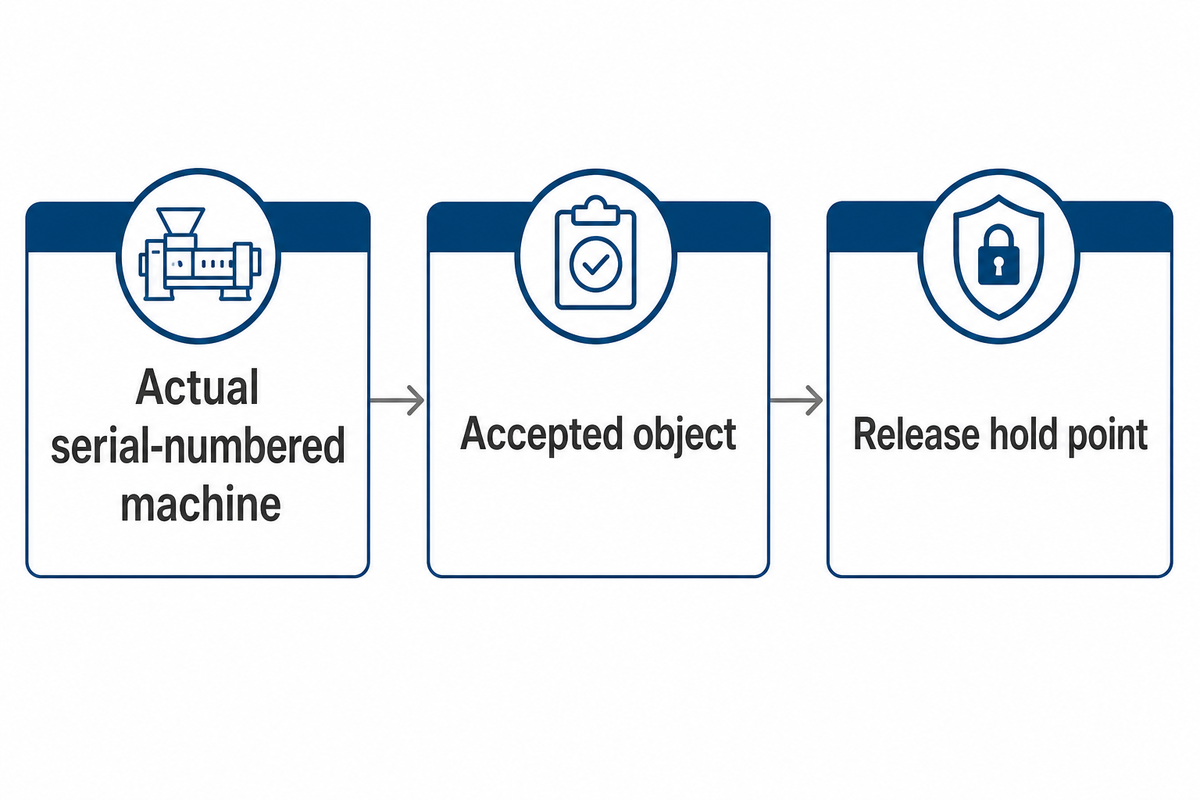
A useful demo starts by naming the acceptance object. Is the buyer watching the actual serial-numbered machine, a coordinated line, a module inside a larger line, a pilot setup, a showroom machine, or a similar reference system? Where the demonstrated equipment is not the purchased configuration, the protocol should state what transfers and what must be reverified before release.
During the demo, buyers can ask questions such as: does the shredder grip the supplied material, does the washer remove visible contamination, does the dryer discharge consistently, does the extruder reach stable operation, and does the pelletizer produce the expected form? Those observations are valuable, but they don’t automatically prove long-run reliability, site performance, legal acceptance, CE conformity, environmental permit compliance, or worker-task safety programs.
Consequently, the FAT should define the accepted object in contract language and evidence language. Complete recycling lines may need line-level interface checks, transferred-material hazard review, controls handoff, electrical documentation, and configuration freeze. Single machines may need a narrower evidence set. Partly completed machines or modules may need assembly instructions and downstream integration responsibilities before final conformity can be claimed.
With a line made of interconnected machines, the buyer should also ask whether the test covers only individual equipment or the integrated line behavior. Individual components such as a shredder, conveyor, washer, dryer, extruder, melt filter, pelletizer, silo, and control panel can each pass a component check while the combined line still has interface gaps. This acceptance object should identify common controls, transferred-material hazards, cross-machine stop/restart zones, guarded transfer points, recipe handoff, and configuration responsibility.
Use this simple rule: if the buyer will use the FAT result to release payment, authorize shipment, or waive a hold point, the test must say exactly what the buyer is accepting and exactly what remains outside the decision.
Build the Test Plan: Feedstock, KPIs, Witnesses, and Evidence Types
A strong FAT begins before the machine starts. Before testing, the buyer and supplier should freeze the test plan, feedstock description, machine configuration, recipes, screens, dies, water chemistry assumptions, utility boundaries, output target, and deviation rules. Without that freeze, a supplier can change the material, replace a screen pack, warm up the line differently, or adjust a recipe during the run without creating a clean acceptance record.
For plastic recycling equipment, the feedstock definition is often the first weak point. Within that plan, describe polymer family, physical form, density range, moisture, labels, metals, paper, wood, glass, adhesives, organics, original-product residue, hidden batteries or powered devices, and incompatible polymers. Buyer-supplied post-consumer flakes or pellets make the method boundary important when the result relies on contaminant classification. Methods that separate or classify contaminants are not the same as methods that quantify every contaminant at a binding limit.
Key performance indicators should be written as acceptance rows, not sales phrases. “High throughput” is not enough. That row should state feedstock mass, accepted output mass, rejects, purge, sludge or filter cake, sample withdrawals, start/end inventory, moisture or volatile change, and the calculation rule for recovery or yield. Without a contracted recovery-yield promise, the material balance can still be monitored, but it should not become a hidden pass/fail requirement.
Witness roles also need names. A supplier engineer, buyer project owner, buyer maintenance representative, laboratory, and independent inspection body don’t create the same evidence. Buyer witnesses can confirm that a run occurred. Laboratories can report tests within their scope. An inspection body can provide inspection evidence only if its competence, impartiality, scope, method, information control, and independence relationship are understood.
Readiness should also be defined before the run starts. Record whether the line has the agreed guards, screens, dies, cutters, filters, temperature setpoints, water levels, recipe versions, scale setup, logger setup, spare parts, tools, and trained operators in place. A buyer arriving to basic assembly, wiring, recipe creation, or guarding changes may be attending a build review or debug session rather than a FAT.
Good plans distinguish three evidence types. First, direct observations such as visible discharge, jam clearing, alarms, and operator actions. Second, measured values such as mass, moisture, temperature, throughput, energy, water, noise, or particle size. Third, document evidence such as drawings, bills of material, electrical schematics, safety manuals, backup files, inspection records, and deviation logs. Each type needs its own owner and storage location.
Before the witnessed run, ask the supplier for a pre-FAT readiness pack. It can be short, but it should confirm that the equipment is mechanically complete, electrical panels are closed and labeled, guards and interlocks are installed, known punch-list items are disclosed, utilities are available, the selected test material is on site, measuring devices are identified, and the draft protocol has been accepted by both sides. That pack prevents the buyer from spending the first day discovering that the machine is not ready for a real acceptance event.
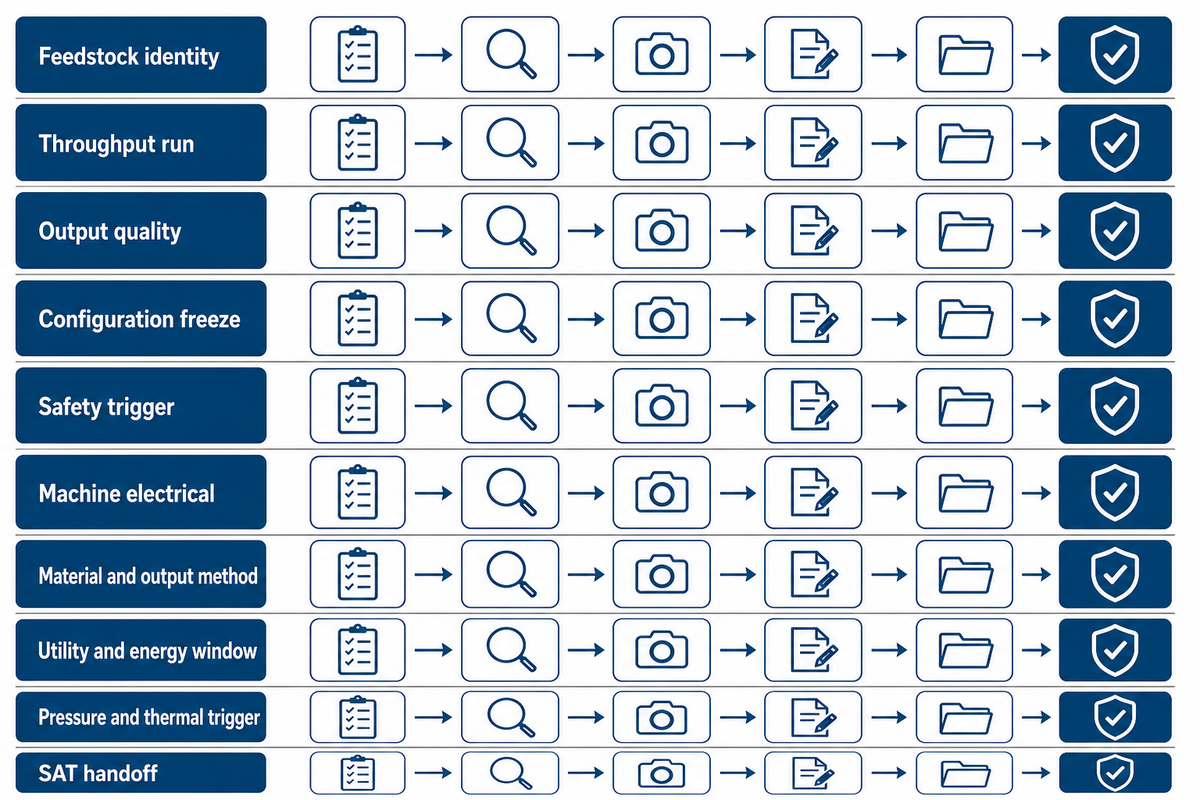
9-Row FAT Evidence Matrix
A practical test protocol should read like a factory acceptance test protocol, not a loose agenda. For new equipment, FAT testing should verify that the equipment meets the specified requirements under factory conditions, while factory and site acceptance remain separate. A good FAT procedure names the test procedure, equipment or system boundary, part of the FAT that each reviewer owns, FAT stage decision, safety requirements, testing process, and what must perform as expected before release.
The wording can stay direct: prior to the FAT, the manufacturer or supplier should provide a set of reference documents; the factory testing to meet a deadline should never trade away adequate factory testing to meet the design specifications; the purpose of the FAT is to confirm that the machine actually runs before it leaves the facility before the machine ships, not to duplicate every customer’s process conducted at the customer’s onsite plant. Customers are encouraged to send the production team early, focus on the personnel responsible for running the line, and decide whether training is provided as part of the FAT process or left for SAT.
| Evidence type | Minimum evidence | Common overclaim |
|---|---|---|
| Feedstock identity | Lot label, source, form, contamination class, custody, photos, retained sample | Treating one clean sample as proof for all future feedstock |
| Throughput run | Run time, stable window, input mass, accepted output, rejects, downtime exclusions | Claiming long-run capacity from a short demonstration |
| Output quality | Sample ID, method, lab or inspection scope, acceptance limit, retained split | Using visual appearance as full material-quality proof |
| Configuration freeze | Machine serials, controls versions, screen/die setup, recipes, utility settings | Accepting a machine after undocumented tuning |
| Safety trigger | Guard list, emergency-stop result, interlock row, stop-zone logic, 85 dBA noise trigger where relevant | Treating one witnessed function as complete safety compliance |
| Machine electrical | IEC 60204-1 edition, panel records, protective bonding, drive notes, 24 V control-circuit records where used | Replacing machine-electrical evidence with a general visual check |
| Material and output method | Polymer form, 300 kg/h or 500 kg/h example row only when contract-backed, sample method, retained split | Using a recycled plastic sample as proof for all post-consumer waste |
| Utility and energy window | Same-window kWh/kg, water %, load state, 15 min warm-up exclusion, accepted-output denominator | Mixing idle, warm-up, and steady production readings |
| Pressure and thermal trigger | 0.5 bar pressure boundary, hydraulic hose condition, 80 °C hot-surface trigger, molten-plastic PPE note | Hiding pressure or heat risks inside a generic mechanical row |
| SAT handoff | Open deviations, 20 January 2027 EU trigger where relevant, anchoring, utilities, backups, spare parts | Assuming a successful FAT proves destination-site startup |
Run the FAT Matrix Without Overclaiming: Sampling, Lot Disposition, Stability Limits, and Guard Bands
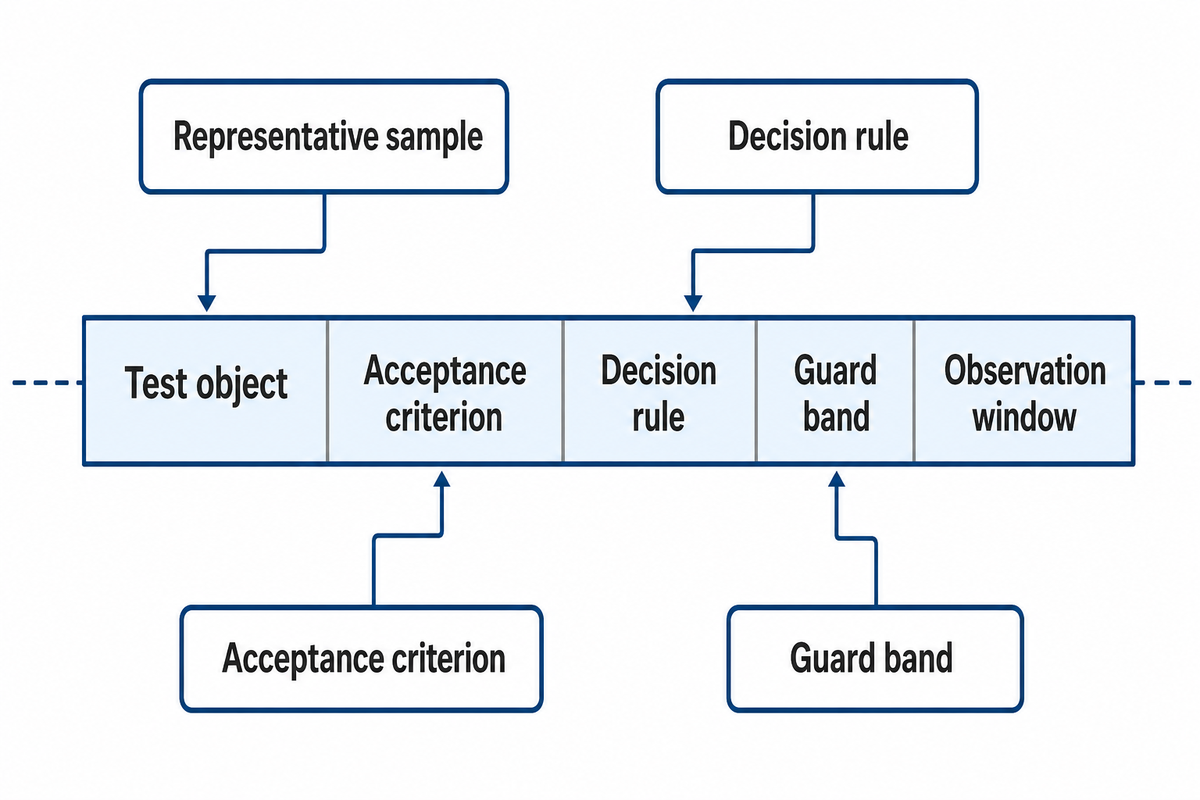
The FAT matrix should turn each promise into a decision row. Useful rows contain the test object, acceptance criterion, method, owner, witness, evidence file, result, deviation rule, and release consequence. Weak rows only say “pass” beside a vague phrase such as “machine running normally.”
Sampling needs similar discipline. Retained samples are not automatically representative. Protocol language should explain where the sample came from, when it was taken, who held it, whether it was washed, dried, sorted, ground, blended, or otherwise prepared before testing, and whether the result applies to the lot, the output split, or only the observed specimen. ASTM sample-preparation and custody concepts are useful only within their stated scope; a water-analysis custody guide, for example, should not be treated as direct plastics authority without a clear analogy label.
Measured acceptance limits also need decision rules. Measured criteria such as moisture limits, pellet size windows, contamination thresholds, melt-flow results, energy-intensity targets, or output-mass requirements can sit close to the specification boundary. In that case, calibration status alone is not enough. Buyers should ask how uncertainty, resolution, bias, repeatability, reproducibility, operator setup, and working environment affect the result. NIST metrology guidance separates a measurement result with traceability and uncertainty from a general inspection statement.
Guard bands are useful when a result near the limit could create a false accept or false reject. Contract language should state whether the supplier, buyer, or a shared decision rule owns that risk. That’s especially important when the supplier-floor environment differs from the destination site or when a short FAT run is used to make a shipment decision.
Process capability should be excluded unless a separate study is actually designed. Short FATs can support observed run results, lot disposition, or repeatability under fixed supplier-floor conditions. It should not claim process capability, capability indices, long-run stability, production release, or destination-site performance without a longer controlled study.
When the buyer compares two materials, two recipes, two suppliers, two screen packs, or two machine settings, the protocol should not rely on a simple first-run versus second-run sequence. Prior-run residue, warm-up state, operator behavior, ambient conditions, screen fouling, and material carryover can change the result. When comparison matters, write a small experimental design: order of runs, washout or purge, replication, blocking factors, nuisance factors, and the rule for inconclusive results.
Lot disposition also needs a practical limit. This FAT can decide whether the demonstrated lot met the contract criterion under supplier-floor conditions. It should not imply that all future lots will meet the same result unless the buyer has separately designed process control, acceptance sampling, stability, and ongoing verification. That’s the difference between a shipment release decision and a production-quality system.
Matrix rows should also identify observation windows. Recycling lines may need one window for warm-up, one for steady running, one for material changeover, one for screen or filter change, and one for shutdown. Only the agreed windows should feed the acceptance calculation. When warm-up rejects, purge material, operator adjustments, or intentional pauses are excluded, the exclusion must be visible in the calculation sheet. Hidden exclusions are one of the easiest ways for a FAT result to look cleaner than the actual operating evidence.
Boundary-qualified FAT matrix rule
For every pass/fail row, add one sentence that says what the result does not prove. That single exclusion line prevents a factory demo from being mistaken for site readiness, long-run capability, legal acceptance, or full compliance certification.
Protect Evidence Validity: Custody, Measurement System Checks, Lab Scope, Inspection Bodies, and Raw Data
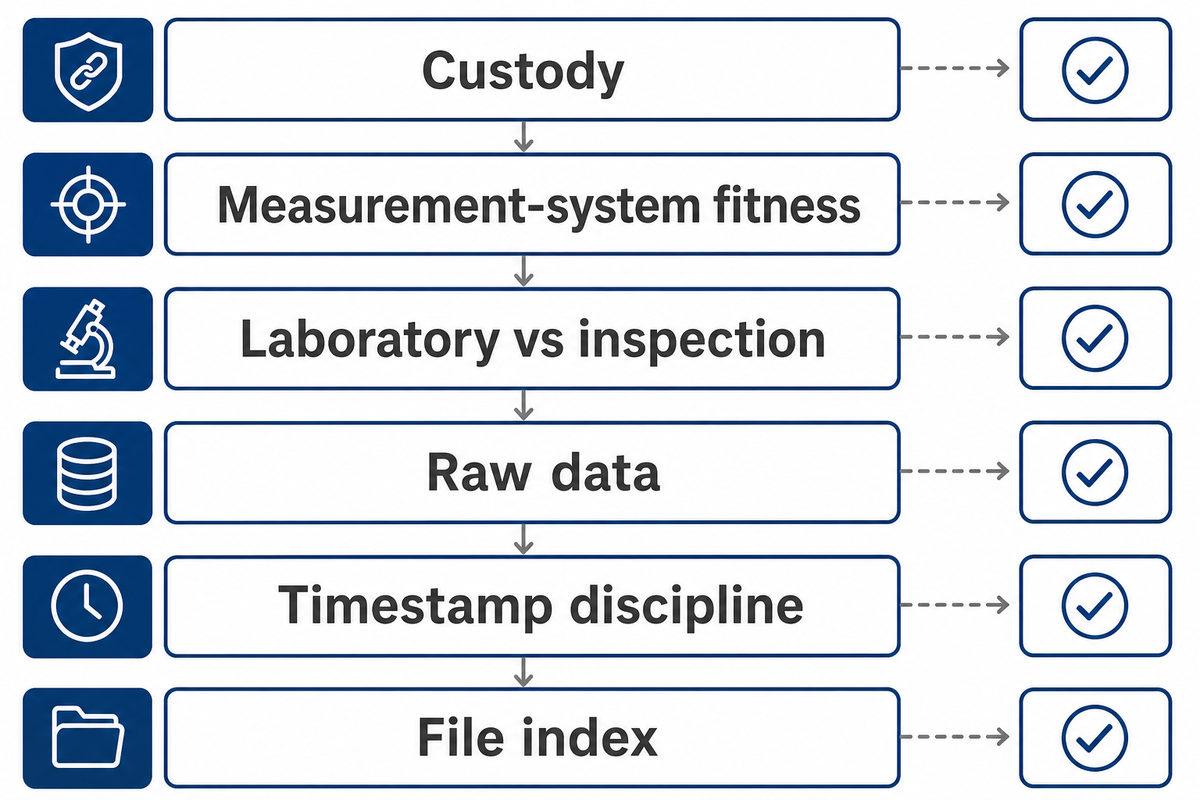
Evidence validity is where many equipment FATs look strong but fail under audit. Videos, signed checklists, laboratory results, historian exports, and witness notes can all be useful. They aren’t interchangeable.
Start with custody. For plastic samples, the record should cover possession, transfer, seal or tamper condition, shipment, receipt, storage access, laboratory handoff, analysis consumption, retained split, and disposal or return. When a sample is transformed before testing, the record should say so. Unaltered output, prepared specimens, and retained splits are different evidence objects.
Next, separate calibration from measurement-system fitness. Calibration can support traceability, but it does not by itself prove bias, resolution, linearity, hysteresis, repeatability, intermediate precision, reproducibility, operator setup effects, or working-environment limits. Gauge R&R or an equivalent measurement-system study becomes important when measured thresholds decide acceptance, especially near a specification limit.
Third, distinguish laboratory testing from inspection. ISO/IEC 17025 is the common laboratory-competence reference. ISO/IEC 17020 is the inspection-body competence reference. A third-party witness, buyer witness, supplier report, and laboratory report should be labeled separately. Buyers should know who has competence for each evidence type and who is authorized to sign the acceptance row.
Finally, protect raw data. Acceptance evidence should not remain only in supplier-controlled screens. Define raw file owner, export format, synchronized timestamp source, sampling interval, transformation formulas, calculation sheets, edit history or audit trail, retention period, access rights, and what happens if supplier software access changes. This matters for PLC logs, HMI trends, drive data, scale readings, energy logs, laboratory data, and production records.
Timestamp discipline is more important than many FAT teams expect. Throughput rows may rely on feeder speed, scale readings, discharge weights, current draw, water flow, temperature, downtime events, and HMI alarms. When those records use different clocks or export intervals, the buyer may not be able to reconstruct the actual run. Protocol text should state the time base, clock synchronization method or limitation, sampling interval, and how manual notes are tied to the electronic records.
Evidence packages should also include a file index. Simple folders of photos and spreadsheets can be hard to audit later. Use a numbered evidence list that ties every file to a FAT row, source machine, timestamp window, owner, and retention rule. When the supplier uses proprietary software to view raw data, include exported open-format files where possible and state what software is required to read the native files.
For buyer teams with multiple reviewers, the file index should support a fast second read. Maintenance reviewers may need guard, access, spare-parts, and lubrication evidence. Process reviewers may need output samples, throughput, water, energy, and residue evidence. Automation reviewers may need backups, versions, alarms, accounts, and network state. Commercial reviewers may need deviation categories, payment hold points, shipment release language, and warranty start rules. Useful FAT packages let each reviewer find the relevant evidence without reopening the whole negotiation.
| Evidence object | Ask for | Do not treat as |
|---|---|---|
| Witnessed run | Date, time, attendees, machine configuration, feedstock lot, result file | Independent inspection or long-run reliability proof |
| Lab result | Lab scope, method, sample ID, uncertainty where relevant, retained split | Evidence for every output lot or every end use |
| Inspection-body record | Inspection scope, competence, impartiality, consistent operation, data control | A laboratory test report or legal acceptance by itself |
| PLC/HMI export | Version, time base, tag list, sampling interval, raw export, access owner | A complete OT cybersecurity or SAT handoff |
Close the Loop: Nonconformities, Correction, Change Impact, Retest, and Reverification
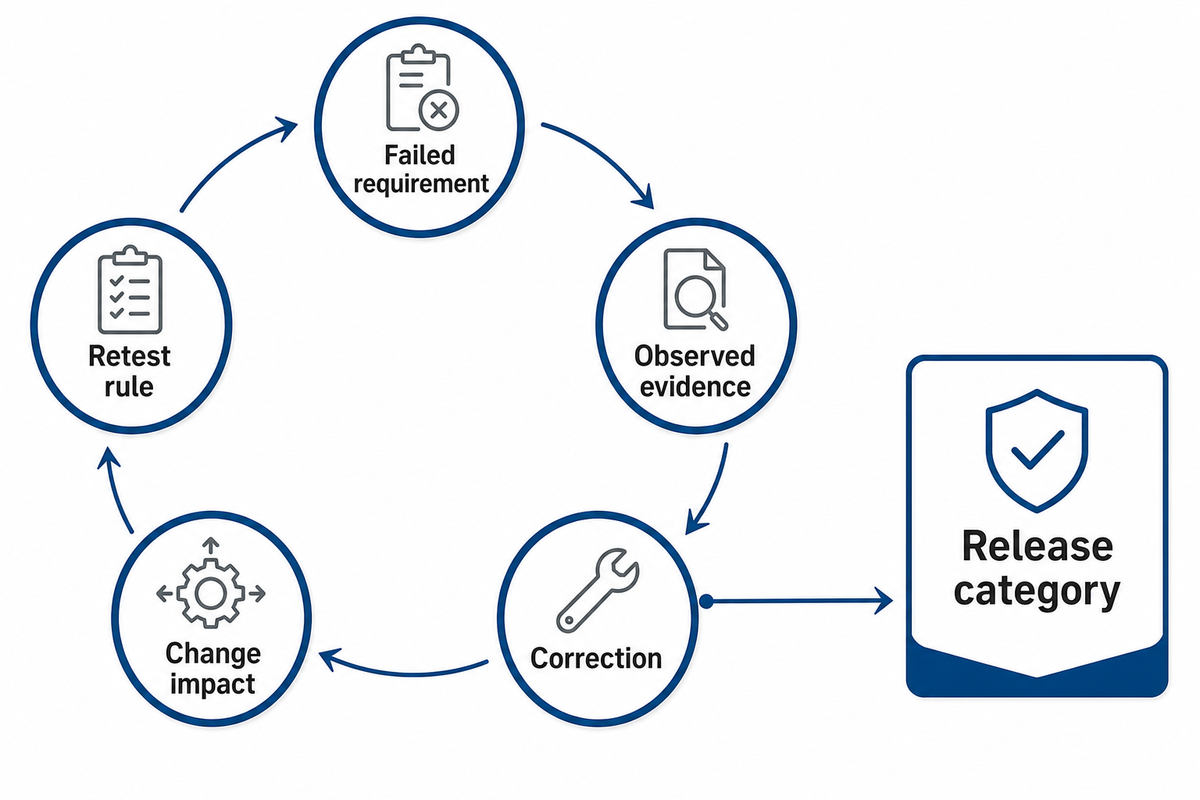
A FAT is not only a pass/fail event. It’s also a controlled way to handle exceptions before the machine leaves the supplier. Deviation logs should do more than list a problem and a promise to fix it.
For each nonconformity, record the failed requirement, observed evidence, severity, owner, immediate disposition, correction, root cause where needed, change impact, retest rule, reverification evidence, and release decision. When a correction changes a screen, knife set, drive parameter, recipe, guard, interlock, PLC program, HMI alarm, electrical component, or utility setting, the buyer should ask which other FAT rows were affected and whether they must be repeated.
This step prevents a common failure mode: the supplier fixes one visible issue, the buyer signs the report, and nobody checks whether the change altered throughput, output quality, safety functions, energy readings, alarms, or documentation. Good FATs keep the correction and retest chain visible.
Legal acceptance should also stay separate. U.S. UCC references such as sections 2-606 and 2-607 describe acceptance and notice concepts in a sales-law context, but a FAT signature is engineering evidence unless the contract and governing law give it legal consequences. Cross-border equipment contracts should define acceptance, rejection, remedies, risk transfer, CISG applicability or exclusion, and notice deadlines with counsel review.
For expensive lines, the deviation log should separate release categories. Some deviations block shipment. Some allow shipment with a payment holdback. Some can move to SAT. Some need a supplier field visit. Some are accepted as contract changes. Without those categories, the final FAT meeting becomes a negotiation instead of an evidence review.
Use a retest rule that’s specific enough to prevent debate. When a failed output-quality row is corrected by changing screen size or temperature, retest the affected output-quality row and any connected throughput, energy, and residue rows. When a failed safety row is corrected by changing an interlock or guard, retest the function and update the drawing, risk note, and residual-risk instruction. When a failed OT row is corrected by changing firmware, software, account settings, remote access, or recipe logic, retest backups, version records, and affected operations.
Use a Safety Trigger Register Instead of a Compliance Claim
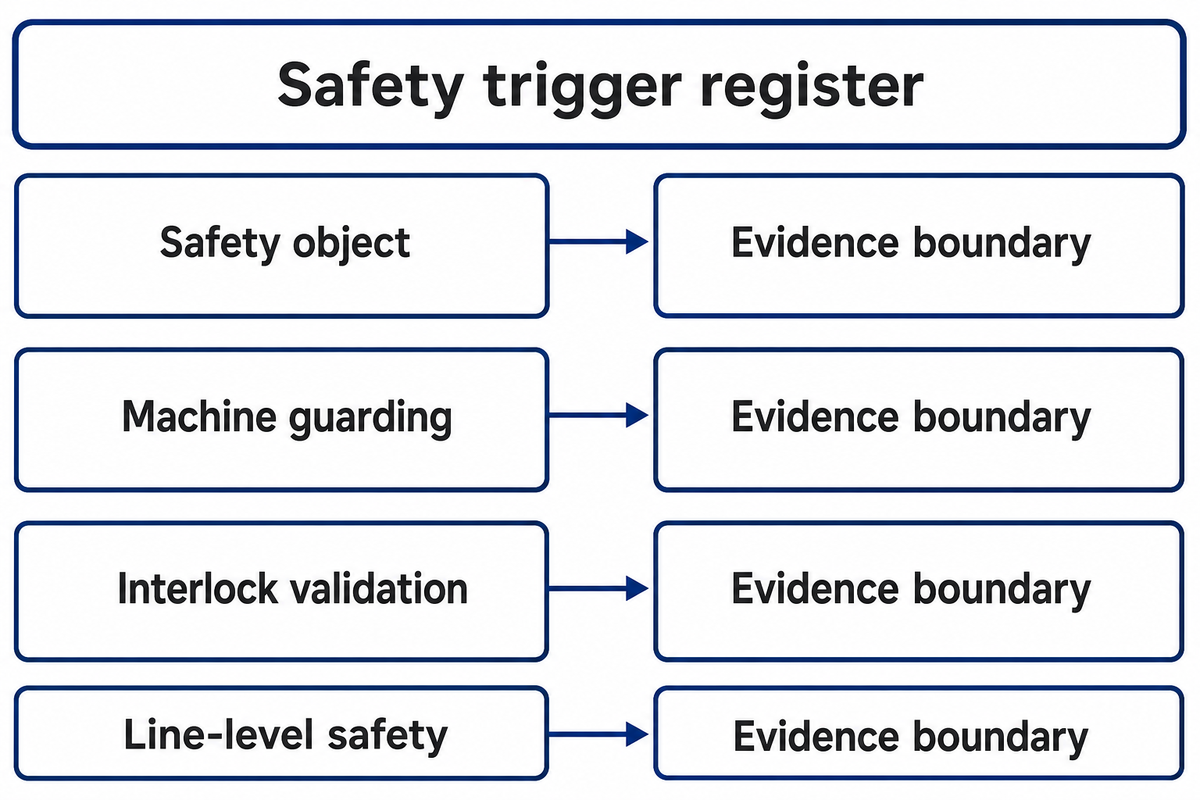
Machine-safety evidence belongs in the FAT, but the article should not imply that one factory test proves complete safety compliance. Better practice uses a safety trigger register. Registers name the safety object, when it applies, who owns it, what evidence belongs in FAT, what stays for SAT or site controls, and what is excluded.
Machine guarding is a core example. OSHA explains that moving machine parts can cause severe injuries and that safeguards are needed where machine parts, functions, or processes can cause injury. ISO 12100 gives the risk-assessment and risk-reduction framework. For a plastic recycling line, the FAT should therefore document guard locations, interlocked doors, access panels, emergency stops, unexpected-start prevention, fixed access, and residual-risk instructions according to the actual machine configuration.
However, a visible interlock response is not the same as functional-safety validation. Interlocked guards need their own evidence object for design selection, defeat minimization, guard-actuated parts, trapped-key scope where relevant, signal-processing handoff, and functional-safety validation. ISO 14119 and ISO 13849-2 support those boundaries.
Other safety triggers depend on the equipment and site. Confined-space entry is task- and space-specific. Lockout/tagout obligations depend on covered servicing and maintenance activities. Energized electrical work practices are separate from normal run observation. Combustible dust needs material-specific hazard assessment. Noise emission from a machine is not the same as worker exposure over a shift. Hidden lithium batteries, hot plastic splatter, heated barrels, hydraulic or pneumatic stored energy, pressure vessels, conveyors, and manual handling each need a defined trigger instead of a blanket claim.
For shredders, granulators, extruders, agglomerators, dryers, conveyors, and pelletizers, the buyer should ask the supplier which type-A, type-B, and type-C safety standards or local equivalents were selected by the risk assessment. Don’t force every standard into every machine. Useful FAT rows are configuration-specific: what hazard exists, what safeguard or control reduces it, how the supplier verified it, and what residual risk remains for installation, operation, cleaning, screen changes, blade changes, purging, maintenance, and training.
Line-level safety is another frequent blind spot. Two machines can be individually guarded while the transfer between them creates reach-in, nip, jam-clearing, unexpected-start, or cross-machine restart hazards. A line FAT should therefore include interface guarding, stop-zone logic, restart behavior after an emergency stop, conveyor pull cords or stops where supplied, and the handoff between machine-level instructions and the buyers operating procedures.
| Trigger | FAT evidence | Boundary |
|---|---|---|
| Guarding and access | Risk-mapped guard list, interlock tests, emergency-stop function, fixed-access review | Not full legal conformity or site operator training |
| Hazardous energy | Energy-isolation points, stored-energy release, temporary restoration rules for testing | Not a complete employer LOTO program |
| Dust and fire | Material state, dust points, extraction interfaces, housekeeping assumptions, trigger handoff | Not a facility combustible-dust classification by itself |
| Noise | Machine-emission reading method, operating condition, position, duration | Not full worker-exposure monitoring |
Check Machine Electrical, OT, Energy, Noise, and Utility Boundaries Only When Triggered
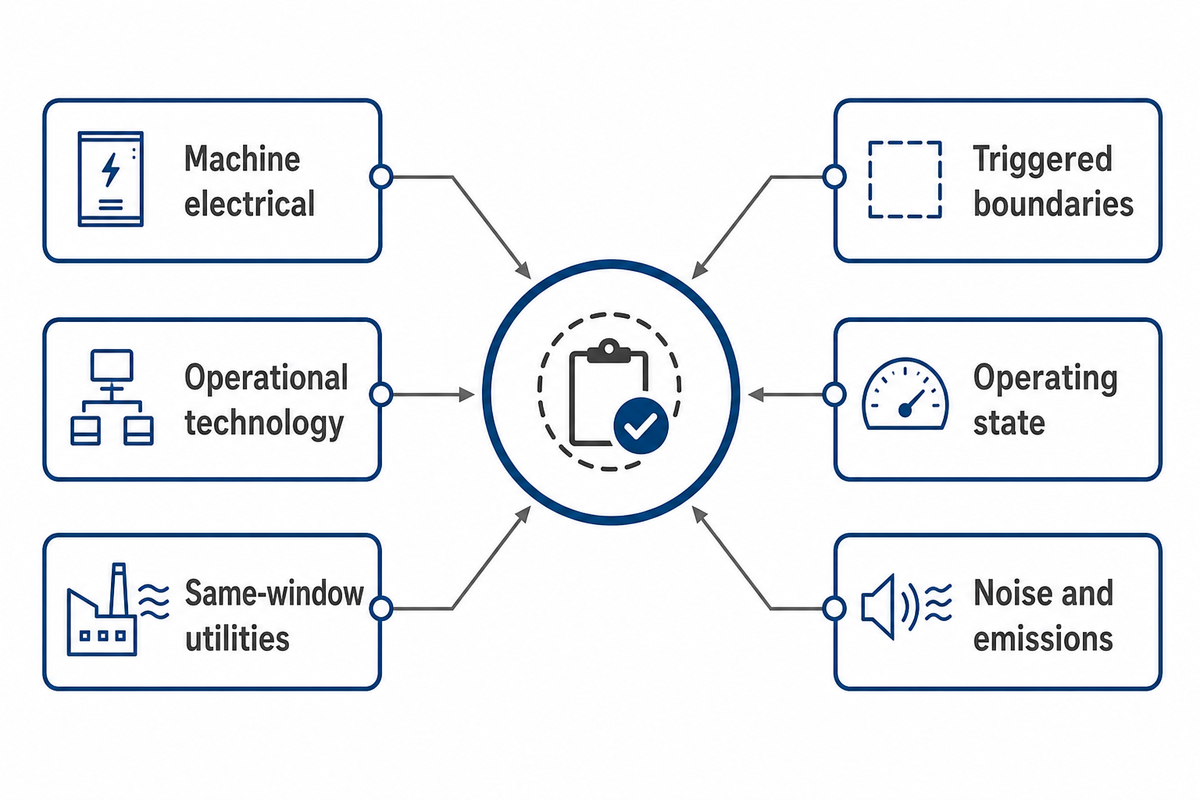
Many FAT disputes happen because a buyer asks for “electrical check,” “energy test,” or “controls backup” without defining the boundary. Scope should depend on the machine, contract, and destination site.
For machine electrical equipment, IEC 60204-1 is the relevant evidence object for electrical, electronic, and programmable electronic equipment of machines, including coordinated groups of machines, from the supply connection onward. FAT rows can request the applied edition, electrical documentation, protective bonding, protection records, control-circuit realization, emergency-stop electrical implementation, drive or EMC records where triggered, and deviation or not-applicable rationale. OSHA electrical condition or NRTL approval may be relevant in a U.S. context, but they are different evidence objects and should not replace IEC 60204-1 machine-electrical evidence.
Operational technology needs the same precision. When the FAT configures PLCs, HMIs, recipes, alarms, historian logs, drive parameters, remote support, VPN access, cellular devices, cloud links, accounts, or firmware/software versions, the buyer should request an asset and access inventory. NIST SP 800-82 is OT security guidance, not a product-specific pass/fail standard. IEC 62443 can be useful when the contract defines a system under consideration, zones and conduits, security requirements, service-provider process duties, and owner acceptance or risk handoff.
Energy and utilities should be tied to a same-window boundary. When the buyer cares about kWh/kg, water consumption, compressed air, steam, chilled water, or wastewater, the FAT should state the process boundary, included loads, excluded loads, meter identity, time window, output denominator, startup and idle treatment, normalization variables, uncertainty, and guard-band rule. ISO 50002-1 and ISO 50002-3 provide current energy-audit framing; ISO 50001 is broader organizational energy-management context.
Noise, wastewater, air emissions, stormwater, pressure systems, hazardous-location classification, and EU machinery-law transition items should be treated as triggered boundaries. As one example, EU Machinery Regulation 2023/1230 is a destination and placing-on-market trigger with the 20 January 2027 transition date; an ordinary supplier-floor FAT does not prove every EU market-access obligation.
Utility readings should be stored with operating state. Grinders idling, washers running water without representative solids, extruders warming up, and pelletizers in stable production all produce different utility profiles. Utility commitments require the test to connect the reading to feedstock, load, accepted output, ambient conditions, and the same time window. Otherwise, the reading is useful diagnostic evidence but weak acceptance evidence.
Noise and emissions follow the same logic. Supplier-floor sound readings may help select enclosure, layout, or PPE assumptions, but they are not a full employee-exposure program at the destination plant. Smoke, fume, dust, or odor observations during pelletizing, purging, drying, or shredding may trigger ventilation, LEV, filter, fire, explosion, or permitting questions, but the FAT should label those as triggered handoffs unless the contract includes the full assessment.
Separate Automation FAT, FIT, SAT, SIT, and OT Access Handoff
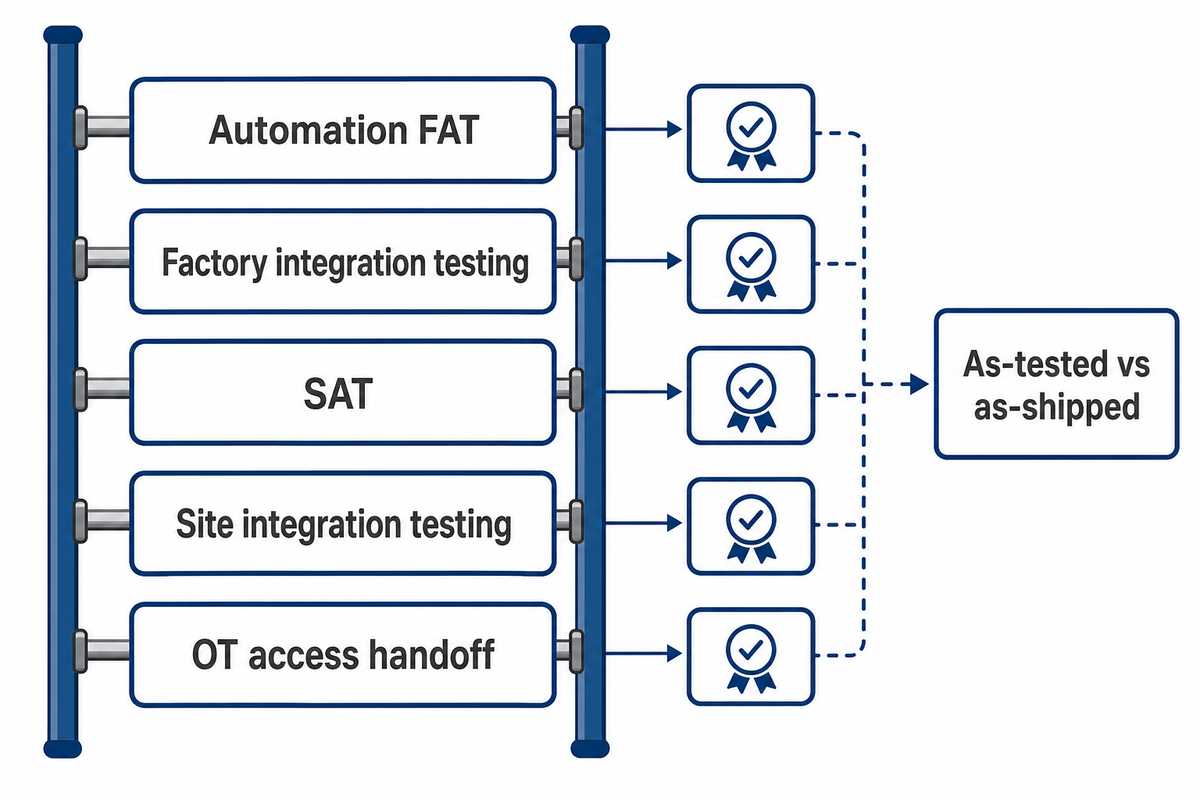
Automation evidence deserves its own handoff because many recycling lines rely on PLC logic, HMI recipes, sorter integration, weighing systems, metal detection, optical or spectroscopy sorting, alarm lists, conveyor interlocks, drive parameters, and remote support. Simple “controls checked” language is not enough.
IEC 62381:2024 addresses FAT, factory integration testing, site acceptance testing, and site integration testing for process-industry automation systems. It should be used only when the purchased architecture or contract triggers that process-automation scope. It is not universal authority for every plastic recycling machine.
In this practical buyer guide, separate five objects. First, automation FAT confirms the supplier-floor configuration and functions that can be tested before shipment. Second, factory integration testing checks interfaces between supplied modules or external systems when they’re available at the supplier site. Third, SAT checks installed utilities, interlocks, sensors, integration, and site conditions after delivery. Fourth, site integration testing checks the line inside the wider plant architecture. Fifth, OT access handoff defines accounts, remote-support state, backups, software versions, network interfaces, cybersecurity responsibilities, and risk acceptance.
This separation prevents a buyer from accepting remote access, default accounts, unexported recipes, or incomplete backups by accident. At minimum, ask for PLC/HMI/drive backup files, restore-test evidence, account and role list, remote-access state, firmware/software versions, tag or recipe export, alarm list, network interface list, and a named owner for any unresolved OT risk.
Buyers should also request an as-tested versus as-shipped comparison. Automation changes often happen after a successful run: alarm limits are adjusted, recipe access is locked, remote support is enabled, drive parameters are tuned, or a spare HMI project is copied. Each change should either be documented as no-impact, retested, or moved to SAT with a named owner. FAT evidence loses value if the shipped control state no longer matches the witnessed control state.
RFQ Clauses and Release Rules Buyers Should Put in Writing
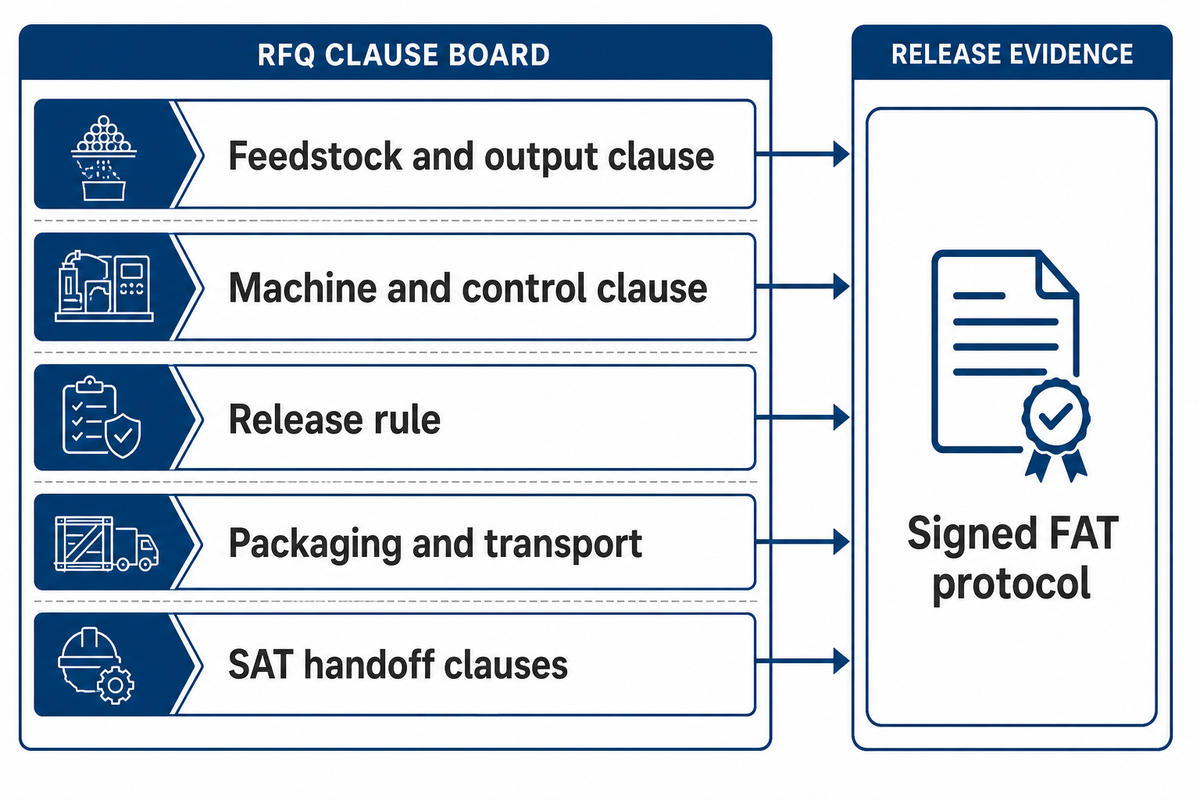
The best time to fix a weak FAT is during the request for quotation. Once the line is built and the buyer is standing in the supplier factory, negotiating room drops. Put the evidence package into the purchase documents.
Start with the feedstock and output clause. Define sample source, shipment, custody, allowed substitution, moisture, contamination classes, representative lot size, test duration, output form, retained samples, analytical method, and acceptance limits. When food-contact output, e-waste additives, brominated flame retardants, hazardous residues, or source-sector restrictions are relevant, write them as in-scope, out-of-scope, or specialist-review triggers.
Next, add the machine and control clause. Define the accepted object, serial-numbered equipment, included modules, excluded upstream/downstream equipment, recipes, screens, dies, knives, software versions, alarms, backups, access credentials, configuration freeze, and retest after change.
Finally, write the release rule. Buyers should not release shipment because the machine looked good for a few minutes.
Release should depend on the signed FAT protocol, deviation log closure, material and measurement evidence, safety trigger register, electrical and automation records, configuration freeze, spare-parts and manuals handoff, packing/transport plan, and SAT action list.
Packaging and transport deserve explicit RFQ language.
Heavy recycling equipment may need lifting drawings, center-of-gravity information, sling or lashing points, blocking and bracing photos, crate or container loading records, electrical panel protection, water drainage, corrosion protection, post-demo cleaning, and arrival-condition inspection. When wood packaging, batteries, oils, fuel, residues, or destination biosecurity cleanliness are relevant, the owner and evidence should be named before shipment.
SAT handoff clauses should be just as clear. Name foundation and anchoring data, utility specifications, upstream/downstream interfaces, operator training, spare-parts handover, commissioning support, open deviations, site safety controls, environmental triggers, controls access, and acceptance restart conditions. FAT can collect that packet, but SAT proves the destination installation.
Minimum release pack before shipment
- Signed FAT protocol with row-level results and exclusions.
- Closed or categorized deviation log with retest evidence where needed.
- Feedstock, output, sample, material-balance, and measurement records.
- Safety trigger register with machine, site, and owner boundaries.
- Electrical, automation, backup, access, and configuration-freeze records.
- Packing, transport, unloading, manuals, spare parts, and SAT action list.
| Clause | Buyer wording to include |
|---|---|
| Representative feedstock | Supplier may not substitute easier material without written deviation and retest decision. |
| Measured acceptance | Rows near limits require method, calibration, uncertainty, and agreed decision rule. |
| Configuration freeze | Any post-test change affecting process, safety, electrical, or controls evidence triggers impact review. |
| Legal acceptance | FAT signature has only the contractually stated effect and does not waive unresolved deviations or statutory rights unless expressly agreed. |
Conclusion: Accept the Evidence Package, Not the Whole Risk
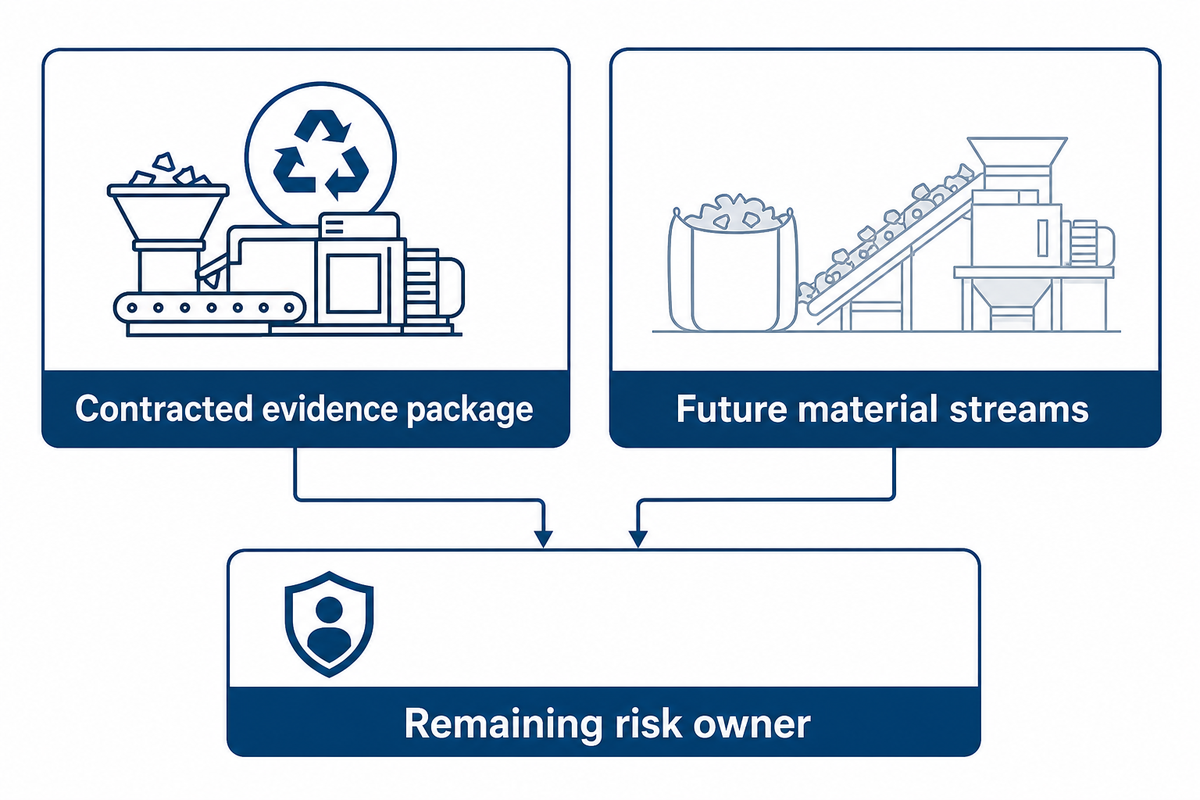
A plastic recycling equipment FAT is strongest when it stays honest.
It can prove the contracted factory-scope evidence package. It cannot prove every future material stream, destination-site condition, legal consequence, safety program, environmental permit, or long-run capability. Use the FAT to release the machine only when the evidence package is complete and every remaining risk has an owner.
Planning a recycling line FAT?
Use the RFQ stage to define the accepted object, material test plan, safety trigger register, controls backup, and SAT handoff before the machine is built.
FAQ
How do I prepare for a factory acceptance test?
Prepare by freezing the specification, sending representative feedstock, defining pass/fail criteria, naming witnesses, agreeing how deviations will be recorded, and requiring raw evidence preservation. Also cover contamination, moisture, output form, utilities, samples, retained splits, recipes, screens, and SAT handoff early.
What is the difference between FAT and SAT?
FAT verifies the contracted supplier-floor scope before shipment. SAT verifies installation, utilities, anchoring, integration, local controls, site conditions, and restart after delivery. Keep factory-testable machine performance in FAT and leave destination-site items for SAT with clear owners and handoff dates.
How long does a plastic recycling equipment FAT take?
Small standalone machines may need a short witnessed test. Full washing or pelletizing lines can need several days, especially when the buyer tests more than one material condition. Duration depends on warm-up time, steady-run windows, sample collection, output testing, safety checks, utility readings, controls review, deviation closure, and retesting. For multi-module lines, add time for automation backups, interlock checks, packing review, and the SAT handoff meeting.
Who should attend the FAT?
Bring the buyer project owner, a production or maintenance reviewer, the supplier process engineer, the electrical or automation lead, and one decision-maker who can accept deviations. Add a laboratory, inspection body, EHS reviewer, logistics reviewer, or legal reviewer only when their evidence object is in scope. Third-party names on the attendee list are not enough; define competence, impartiality, scope, data control, and which FAT rows that party can sign.
What documents should I ask for after the FAT?
Ask for the signed protocol, deviation log, configuration freeze, photos or videos, raw data exports, sample labels, retained-sample record, lab or inspection reports, measurement-system notes where limits matter, safety trigger register, machine-electrical records, automation backup and restore evidence, account and access handoff, spare-parts list, manuals, packing plan, and SAT action list. For any open deviation, the packet should say whether it blocks shipment, moves to SAT, creates a holdback, or becomes a contract change.
References & Sources
- OSHA Machine Guarding
- ISO 12100 Machinery Safety
- NIST Metrological Traceability
- ISO/IEC 17020 Inspection Bodies
- IEC 60204-1:2016+AMD1:2021
- IEC 62381:2024 Automation FAT/FIT/SAT/SIT
- IEC 62443-3-2:2020 IACS Security Risk Assessment
- ISO 50002-1:2025 Energy Audits
- Cornell LII UCC 2-606
- Cornell LII UCC 2-607
- Regulation (EU) 2023/1230
- Kitech Recycling About Us