Get in touch with Kitech Company


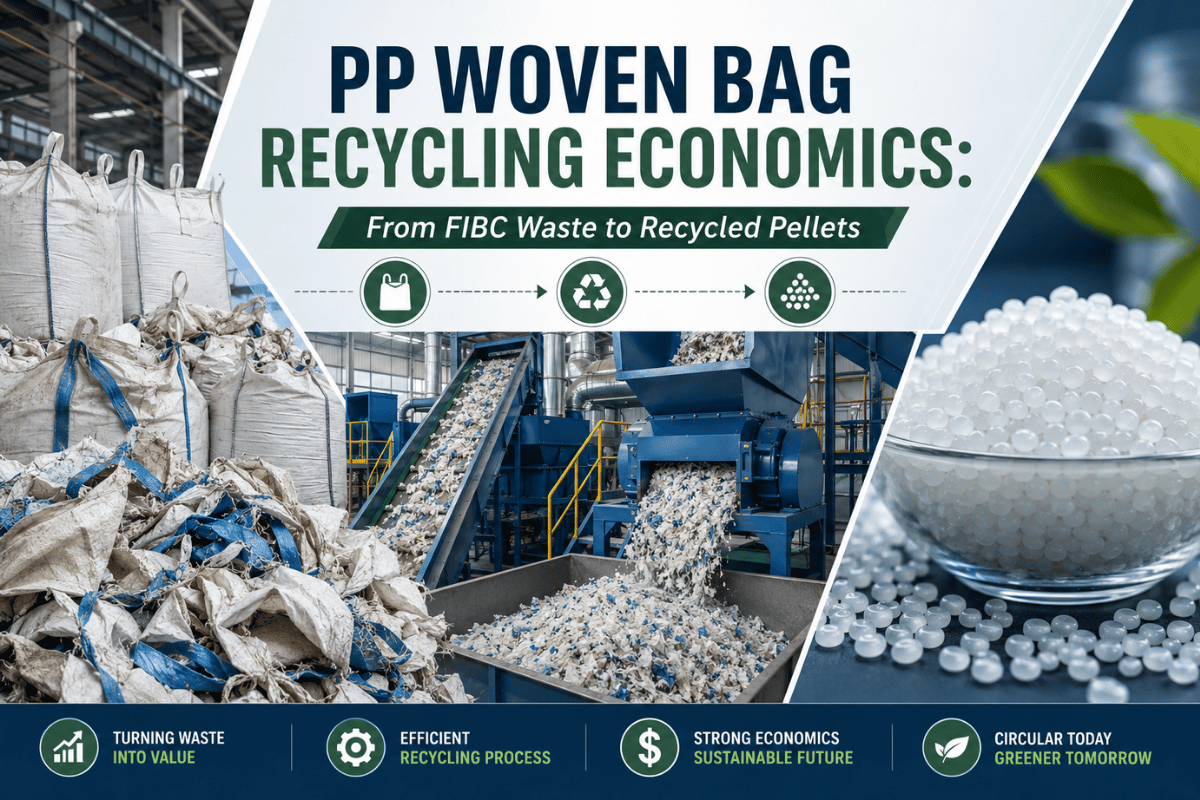
The pp woven bag recycling economics comes down to one figure: the difference between how much a ton of recycled pellets sells for and the cost to produce that ton. Everything else – feedstock, contamination, energy, the machines you choose – is just a lever that widens or shrinks the gap. Instead of the fuzzy “turn waste into treasure” pitch, this primer gives you the concrete revenue, cost, and return math a recycler need before signing on the dotted line.
Quick Take: PP Woven Bag Recycling at a Glance
- Material: polypropylene (resin code #5), density ~0.90 g/cm³ – it floats, and that floating is the basis of float-sink cleaning.
- Output: washed flake or pellet. A clean, single-polymer feedstock (FIBC, raffia, sacks) is the easy-money stream.
- The decision metric: the rPP Spread = (pellet price × yield) − all-in conversion cost, per ton.
- The surprising part: clean, food-grade rPP can trade at or above virgin PP, so recycling isn’t always “the cheap route.”
Can PP Woven Bags Actually Be Recycled? (And Why It’s Harder Than It Looks)
Yes – PP woven bags are recyclable, and physically simpler to handle than most mixed-plastic items, since they’re nearly pure polypropylene. What complicates it sits on the system side, not the material side. The U.S. Environmental Protection Agency puts the overall plastics recycling rate at just 8.7 percent (2018), against 29.1 percent for PET bottles, in its material-specific data. The U.S. Plastics Pact reports a 13.3 percent national recycling rate for plastic packaging. PP ranks low on that list because collection and sorting are still immature – not because the polymer resists processing.
Here’s the part most process guides skip: “polypropylene is more challenging to sort and process than PET or HDPE,” writes The Recycling Partnership and the Association of Plastic Recyclers. PP has only been collected at meaningful scale for less than a decade, and much of that recovered material was historically exported. That immaturity is a problem for municipal programs, but for a bag-focused operation it’s a strength, because woven PP arrives as a clean, identifiable, single-polymer stream rather than a mixed curbside bale.
PP’s low density does the heavy lifting in the wash plant. At roughly 0.90 g/cm³ it floats, while sand, dirt, and stray PET (density ~1.38 g/cm³) sink. That float-sink tank separates them with nothing more than water and gravity, so a single-resin feed need no optical sorter. That’s why a woven-bag line can hit high purity without the capital-heavy sortation a full mixed-plastics MRF demands.
Are woven polypropylene feed bags recyclable?
Woven polypropylene feed and grain sacks are recyclable, and they’re actually among the better feedstocks – heavy-gauge, single-polymer, and usually free of multi-material laminates. The limiter is residue: feed dust, fertiliser, and moisture get trapped in the weave, which a pre-wash plus a high-friction wash stage can overcome. Heavily printed or BOPP-laminated bags are a different story, since the inks and laminate dilute pellet quality and knock the bags down a grade. Clean, unprinted natural sacks are the ones that earn the natural-pellet premium.
💡 Key takeaway
The bag is the easy part; the system is the hard part. A single-polymer woven-PP stream sidesteps the sorting problem that keeps national PP recycling rates in single digits – which is exactly why a dedicated line can pay where curbside PP cannot.
The Revenue Side: What Recycled PP Is Actually Worth
Revenue is set by the recycled polypropylene you ship, and the price band is wider than most people imagine. Baseline PP resin traded between roughly USD 950 and 1,100 per tonne through 2024-2025 as new capacity and logistics settled. Recycled grades are not automatically the cheap option, though. ChemAnalyst pricing data has shown clean rPP assessments near USD 1,700/MT in some regional markets – at or above virgin PP, which sat near USD 1,519/MT in the U.S. as of April 2026. As The Recycling Partnership notes, “very little food grade rPP” is produced today even though the demand exists, and reclaimers are filing FDA Letters of Non-Objection to enter that market.
That inverts the usual assumption. People model recycling as the cheap raw material, but for high-purity, low-odor, food-contact-eligible rPP the opposite is true, because supply is scarce. Scarcity works for the recycler on the sell side.
What you ship decides which band you land in. Roughly three tiers:
| Output grade | What it is | Relative value |
|---|---|---|
| Washed flake / regrind | Shredded, washed, dried – not pelletized | Lowest. Sells fast, lowest margin; skips the extruder. |
| Mixed-color pellet | Pelletized, printed/colored bags blended | Mid. The default output for most woven-bag lines. |
| Natural / near-virgin pellet | Clean, unprinted feed; degassed, filtered | Highest. Can match or beat virgin PP for the right buyer. |
Figures above are 2024-2026 reference points; prices move with crude, virgin-resin contracts, and region, and may not reflect today’s spot market.
So the decision this forces is simple to state: sell washed flake and bank a fast, thin margin, or add a plastic pelletizing line to reach the pellet price band? Pelletizing costs time, energy, and equipment – but it’s what moves you from the bottom row of that table to the top.
The Cost Side: Where the Money Goes
Conversion cost is everything that happens between a baled bag and a saleable ton. With PP woven bags the biggest variable isn’t the polymer price – it’s yield loss, and yield loss tracks contamination and moisture. When a bag arrives 12% mud, residue, and fertiliser, it means you bought a ton of feedstock but only sell about 880 kg of product, and that shrinkage magnifies every other cost on a per-output-ton basis.
The standard process chain, and where each stage spends money:
| Stage | Cost driver | Where it bites |
|---|---|---|
| Collection & sorting | Labor | Manual sorting is labor-intensive; removing non-PP loops/labels is hand work. |
| Shredding | Power + blade wear | Bulky bags reduced to 1-2″ flakes; grit accelerates wear. |
| Friction wash + float-sink | Water + power + yield loss | The make-or-break stage; heavy soil = more water, more loss. |
| Dewater + dry | Thermal energy | Target moisture under ~1-5% before extrusion; drying is energy-hungry. |
| Pelletize + degas | Power + screen changes | Melt, filter, degas; needed to reach the pellet price band. |
Why moisture matters so much: water left in the flake flashes to steam in the extruder, creating voids and degrading the melt. That’s why lines push residual moisture as low as they can before pelletizing – it protects throughput and pellet grade together. Each remelt also shortens polymer chains a little (thermal degradation), which is why operators sometimes blend in a touch of virgin PP or additives to restore properties for demanding jobs. The takeaway: every percentage point of contamination you fail to remove upstream becomes either a yield loss or a quality downgrade downstream, and both shave the spread.
⚠️ Common mistake
Budgeting feedstock by input weight and ignoring yield. If you pay for a ton of dirty bags and recover 850 kg of saleable pellet, your true feedstock cost per output ton is about 18% higher than the invoice suggests. Model cost on output tons, never input tons.
Equipment & Capital Investment: Sizing the Line
Capital cost scales with throughput and with how far down the value chain you go. One standalone shredder is a five-figure buy; a complete washing-and-pelletizing line is a six-figure one. Industry-reported equipment ranges run from roughly USD 15,000 for a single shredder to USD 500,000+ for a fully automated pelletizing line, with 500-1,000 kg/h treated as mainstream industrial scale and 2,000 kg/h+ as plant scale. Treat these as planning brackets, not quotes – configuration, automation level, and contamination handling move the number a lot.
| Throughput tier | Typical scope | Who it fits |
|---|---|---|
| ~500 kg/h | Shred + wash + dry (+ optional pelletizer) | Entry operators, captive in-house bag waste. |
| ~1,000 kg/h | Full washing line + pelletizing + degassing | Merchant recyclers buying outside feedstock. |
| 2,000 kg/h+ | Automated plant, PLC control, low labor/ton | Plant-scale players chasing the lowest cost/ton. |
Throughput choice is really a labor-versus-capital trade. A higher-automation line cost more upfront, but it spreads fixed cost across more tons and cuts labor per ton – the lever that decides cost competitiveness at scale. A purpose-built PP woven bag recycling line is engineered around the specific failure modes of raffia and FIBC waste: aggressive shredding for bulky bags, multi-stage friction washing for embedded residue, and drying tuned to hit pellet-grade moisture. Buying a generic film line and forcing woven bags through it’s a reliable way to short your yield.
📐 Engineering note
Match the dryer to the wash load, not just the shredder. A line sized for 1,000 kg/h of clean offcuts will choke on 1,000 kg/h of muddy FIBCs, because the wash and dry stages become the bottleneck. Specify wash and drying capacity against your dirtiest expected feedstock, then rate the line’s real throughput from there.
Unit Economics: Building the Profit Model (The “rPP Spread”)
Cut through the noise and pp woven bag recycling profitability boils down to one figure we’ll call the rPP Spread: the per-ton gap between what your output sells for and what it costs you to make. Everything in this guide is a lever on that single number.
The rPP Spread – the one equation that decides the investment
rPP Spread per ton = (Pellet sell price × Yield) − (Feedstock + Processing + Overhead), all per output ton
Positive and large enough to clear your financing? Invest. Thin or negative once yield and energy are honest? The feedstock or the output grade is wrong – fix those before buying steel.
Here’s a worked illustration with conservative, clearly-labeled assumptions (your real numbers will differ by region and feedstock):
- ✔ Output: mixed-color pellet selling at, say, $900/ton.
- ✔ Yield: 85% after contamination and moisture loss, so 10 input tons gives 8.5 sale tons.
- ✔ Feedstock: bought at roughly half of output value – a rule of thumb from scrap-trade practice.
- ✔ Processing (power, water, labor, wear) + overhead: the remaining swing factor.
The “buy at half” instinct is grounded in how the trade actually work. As one operator put it:
“They pay out roughly half what they can sell it for. They also play the market, often sitting on higher-value stuff to take advantage of peaks to sell and buy.”
Is recycling PP woven bags profitable?
It’s profitable when the spread cover conversion cost and amortized CapEx with room to spare, and that hinges on two knobs you control: yield and output grade. A line running clean industrial offcuts into natural pellet can clear a wide spread, because it buys cheap, loses little, and sells high. A line buying filthy mixed bags and selling flake runs a wafer-thin spread that a few months of soft resin prices can erase. The breakeven table below shows how sensitive the answer is:
| Scenario | Feedstock + grade | Spread outcome |
|---|---|---|
| Best case | Clean offcuts → natural pellet, high yield | Wide spread; fastest payback. |
| Base case | Sorted bags → mixed pellet, ~85% yield | Workable spread; payback over a few years. |
| Marginal case | Dirty mixed bags → flake only, low yield | Thin/negative; vulnerable to price dips. |
So the decision isn’t “is PP recycling profitable” in the abstract – it’s whether you can secure clean feedstock and sell into a grade high enough to keep the spread wide. That reframes the whole purchase: the machine is necessary, but the feedstock supply deal and the offtake buyer are what actually pay back your capital.
Feedstock Supply: The Make-or-Break Variable
If the spread is the scoreboard, feedstock is the game. The United States alone sells close to 3.5 billion pounds of rigid PP packaging every year, according to The Recycling Partnership and APR – and that’s before counting the FIBCs, raffia offcuts, and woven sacks that are the bag recycler’s actual diet. The tonnage is there; the work is sourcing it clean and cheap enough.
Woven-PP feedstock comes in grades, and the grade sets your ceiling:
Feedstock sources, cleanest to dirtiest
- Post-industrial offcuts & rejects – bag-factory trim and misprints. Cleanest, single-color, highest yield.
- Used FIBC / jumbo / bulk bags – large, heavy-gauge; watch for nylon lift loops and liner films.
- Agricultural feed & grain sacks – single polymer, but they carry dust, residue, and moisture.
- Construction / chemical sacks – heavily soiled; cement, fertiliser, and chemical residue cut yield hard.
The contamination warning is real and specific. FIBC bulk bags are often mixed with contaminants that are hard to remove completely, especially ton bags used in chemical or agricultural service. Nylon lifting loops and PET labels are different polymers – if they survive sorting, they contaminate the whole batch. This is why the FIBC industry association (FIBCA) stresses source segregation: the cheapest contamination to deal with is the kind that never enters your shredder.
A load of clean factory offcuts and a load of muddy chemical sacks at the same price per ton aren’t the same purchase – the first might yield 95% natural pellet, the second 70% flake. Smart buyers price feedstock on expected output, grade their suppliers, and pay a premium for clean, segregated, single-color bags. Teaching waste suppliers to segregate at source is, over time, the highest-return move in the whole operation.
End Markets: Who Buys Recycled PP and What They Pay For
Of course, a wide spread only matters if you can sell the output, and recycled polypropylene has a deep, growing list of homes. The Recycling Partnership lists rPP going into caps and closures, cups, automotive parts, paint cans, transport packaging, and housewares – plus pipes, fiber and carpet, and new woven bags, closing the loop. Lower grades feed buckets, bins, and pallets; higher grades chase the premium applications.
Demand right now runs on corporate recycled-content commitments. Brands have made post-consumer recycled (PCR) pledges, and bodies like the U.S. Plastics Pact hold them to it, which pulls rPP through the supply chain regardless of virgin-resin price. One standout gap is food-grade rPP: demand exists, but “very little food grade rPP” is produced, the APR reports, and reclaimers are racing to qualify via FDA Letters of Non-Objection. The post-consumer recycled packaging market is projected to grow from USD 25.0 billion in 2026 to USD 46.9 billion by 2034 (an 8.17% CAGR), according to Fortune Business Insights. That is the demand wall your pellets sell into.
What buyers actually pay for: consistent melt flow, low odor, controlled color, and documented contamination limits. The closer your pellet is to a spec sheet rather than a “recycled, roughly PP” pile, the higher the band you sell into – which loops straight back to feedstock discipline and processing quality. For a deeper comparison of recovery routes, see our overview of mechanical vs chemical plastic recycling.
Market Outlook: Where PP Recycling Economics Are Heading
The economic case for pp woven bag recycling is getting stronger into 2026, on three measurable fronts. First, market size: the recycled polypropylene-in-packaging market sat near USD 9.7 billion in 2025 and is tracking toward roughly USD 10.3 billion in 2026, per Grand View Research, with longer-range forecasts pointing higher as PCR mandates bite. Demand is growing faster than recovered supply – structurally good news for anyone making quality rPP.
Second, technology: AI and robotic sorting are improving the quantity and quality of recovered #5 PP inside material recovery facilities, slowly easing the sorting bottleneck that has held PP rates down. As that feedstock pool clean up and grows, bag recyclers get steadier, better-graded supply. Third, regulation and brand pull: PCR commitments and Plastics Pact targets are converting “nice to have” recycled content into contractual demand, and with food-grade rPP so scarce, the premium tier is unlikely to soften soon.
Practically, for 2025-2026: if you’re planning a line, underwrite it on clean, segregated feedstock and aim your output at the highest grade your buyers will certify – natural pellet and, where you can qualify it, food-contact-eligible material. That’s where the spread is widest and the demand most durable. Operators who lock in feedstock contracts now, before competing capacity comes online, will hold the better cost position when the premium tiers open up.
💡 Bottom line
The macro trend favors the producer of clean rPP, not the producer of generic flake. The winners over the next few years will be the operations that treated feedstock quality and output grade as the strategy – and the machine as the tool that executes it.
Frequently Asked Questions
Q: How much does it cost to recycle a ton of PP woven bags?
View Answer
There is no single number – conversion cost is feedstock plus labor, power, water, and amortized equipment, divided by your saleable (not input) tons. The biggest variable is yield: dirty feedstock that loses 20-30% to contamination raises your true cost per output ton sharply. Model it on output tons and your own power and labor rates.
Q: What is recycled PP (rPP) used for?
View Answer
Recycled polypropylene goes into caps and closures, automotive parts, paint cans, transport packaging, pipes, fiber, buckets, pallets, and new woven bags. Higher-purity grades reach premium, food-contact-adjacent markets.
Q: How much do recycled PP pellets sell for?
View Answer
It varies widely by grade and region. Baseline PP traded around USD 950-1,100/tonne in 2024-2025, and clean rPP assessments have at times reached roughly USD 1,700/MT – at or above virgin PP. Natural, low-odor, high-purity pellet commands the premium; washed flake sits well below. Treat published prices as dated reference points, not quotes.
Q: What contamination ruins PP woven bag recycling?
View Answer
The worst offenders are different-polymer parts – nylon lift loops on FIBCs and PET labels – plus embedded sand, food, fertiliser, and chemical residue. Moisture is a second enemy, because water left in the flake degrades the melt during pelletizing. Source segregation and a strong friction-wash and float-sink stage are the defenses.
Q: Is PP (#5) harder to recycle than PET?
View Answer
As a whole system, yes. The Association of Plastic Recyclers notes PP is more challenging to sort and process than PET or HDPE, and its collection infrastructure is younger. But a dedicated woven-bag line sidesteps much of that, because woven PP arrives as a clean, single-polymer stream rather than a mixed curbside bale.
Q: How long is payback on a PP woven bag recycling line?
View Answer
Payback is the rPP Spread times your tonnage, set against the CapEx, so there’s no universal figure – it can run anywhere from a couple of years to well beyond, depending on the inputs. A line buying clean feedstock and selling natural pellet at high yield pays back far faster than one running dirty bags into flake at a thin margin. Because the spread is so sensitive to feedstock and grade, lock both in before you model a payback period; in practice they move the answer far more than the headline machine price does.
Sizing a line around your feedstock?
Kitech builds the shredding, washing, and pelletizing systems designed for raffia, FIBC, and jumbo-bag waste – the configuration that protect yield and pellet grade.
About This Analysis
This breakdown of pp woven bag recycling economics pairs public data from the EPA and the Association of Plastic Recyclers with current rPP and PCR market figures and on-the-ground sourcing practice. As a builder of PP woven bag recycling lines, Kitech’s perspective sits on the equipment and yield side; the price and market numbers are cited to their sources and were current as of 2024-2026 – check spot pricing before you model a specific project.
References & Sources
- Plastics: Material-Specific Data – U.S. Environmental Protection Agency
- The Growing Market for Recycled Polypropylene – The Recycling Partnership & Association of Plastic Recyclers
- 2023-24 Impact Report – U.S. Plastics Pact
- Recycled Polypropylene Price Trend and Forecast – ChemAnalyst
- Recycled Polypropylene in Packaging Market Report – Grand View Research
- Post-Consumer Recycled Packaging Market – Fortune Business Insights
- FIBC Recycling Resources – Flexible Intermediate Bulk Container Association (FIBCA)