Get in touch with Kitech Company

PET Pelletizing Machine Buying Guide for Recycling Lines

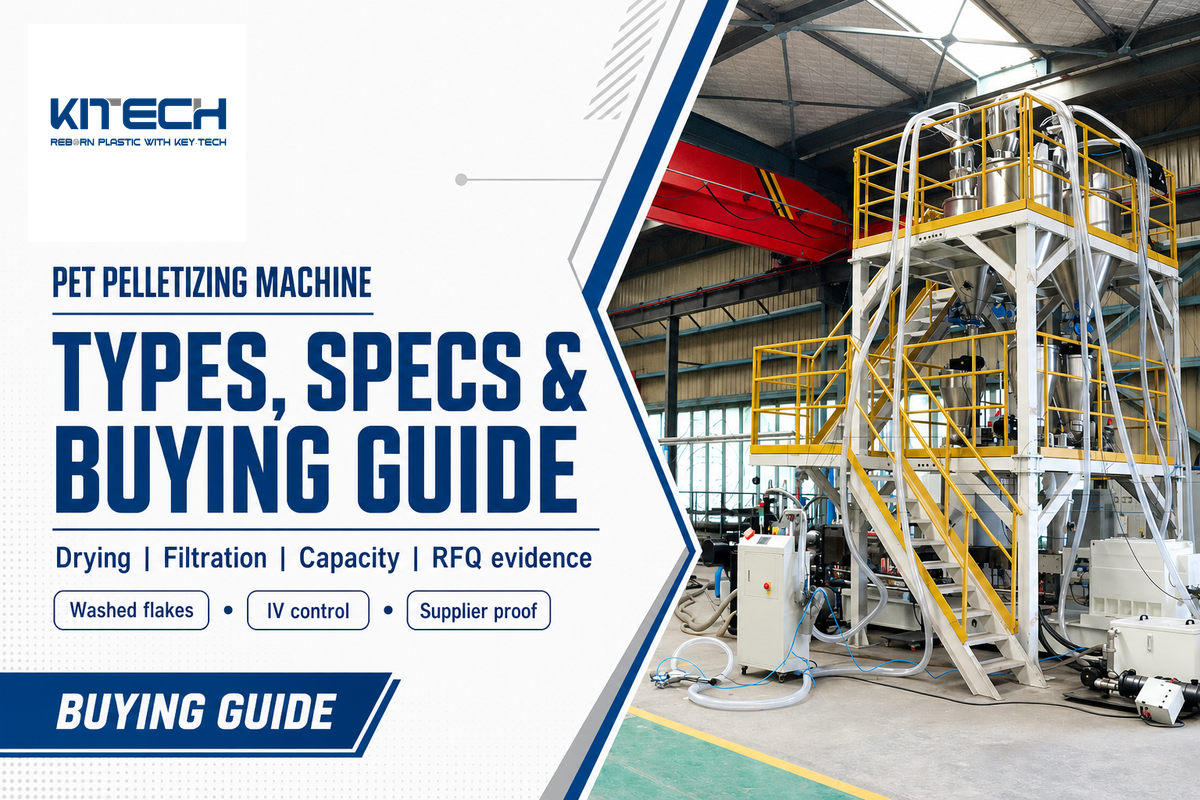
A PET pelletizing machine is a plastic recycling system that turns washed polyethylene terephthalate flakes into uniform pellets through drying or crystallizing, feeding, extrusion, melt filtration, vacuum degassing, cutting, cooling, and drying. This guide covers PET plastic recycling equipment, not a pet food pellet machine or animal-feed pelletizer.
For recyclers, the hard part is rarely the word “pelletizer.” Matching a pelletizing line to PET bottle flakes, packaging-sheet scrap, fiber waste, plant capacity, intrinsic viscosity targets, contamination risk, and the buyer’s downstream market is the harder work. The wrong plastic recycling machine can make plastic pellets look uniform while still losing IV, blocking screens, trapping volatiles, or creating dried pellets that fail a customer’s molding, sheet, strapping, fiber, or injection molding process.
Kitech builds recycling machines across shredding, washing, plastic pelletizing, laser filtration, and complete system projects. In PET applications, the buying decision should stay grounded in feedstock quality, moisture control, screw and extruder configuration, melt flow stability, filter strategy, pellet size, automation, and service support. For a new PET project, also separate pelletizing from upstream crushing or granulator duty: the granulator reduces size, while the pelletizing system melts, filters, degasses, and cuts the material into reusable pellets. In buyer language, that difference separates a pet bottle flakes pelletizing line from a general size-reduction machine.
What Is a PET Pelletizing Machine?
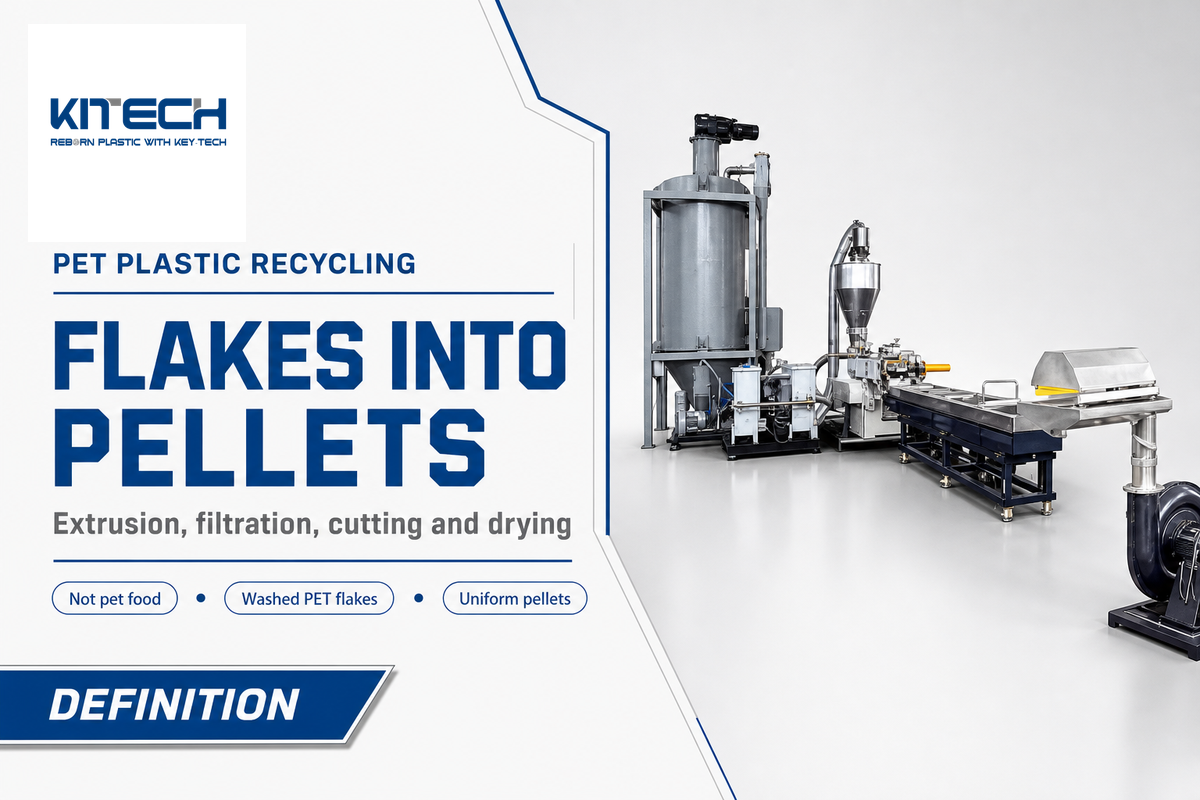
A PET pelletizing machine is a recycling and re-pelletizing system that turns clean flakes or PET bottle flakes into plastic pellets or granule material for downstream manufacturing. In a PET recycling line, the machine normally follows washing, sorting, drying, and crystallization. It then uses a feeder, single-screw or twin screw extruder, die head, filter, cutter, water handling, and drying equipment to produce uniform pellets.
Search results can be confusing because they also include pet food machinery. In this article, PET always means polyethylene terephthalate, the plastic used in bottles, containers, trays, sheets, fiber, and strapping. The job of PET pelletizing is not only to granulate material. It must preserve as much polymer value as practical while converting plastic waste into a stable form that buyers can transport, store, blend, and process; APR PET rigid guidance is useful context for why PET material properties need careful qualification.
Where PET Pelletizing Fits After Washing and Drying
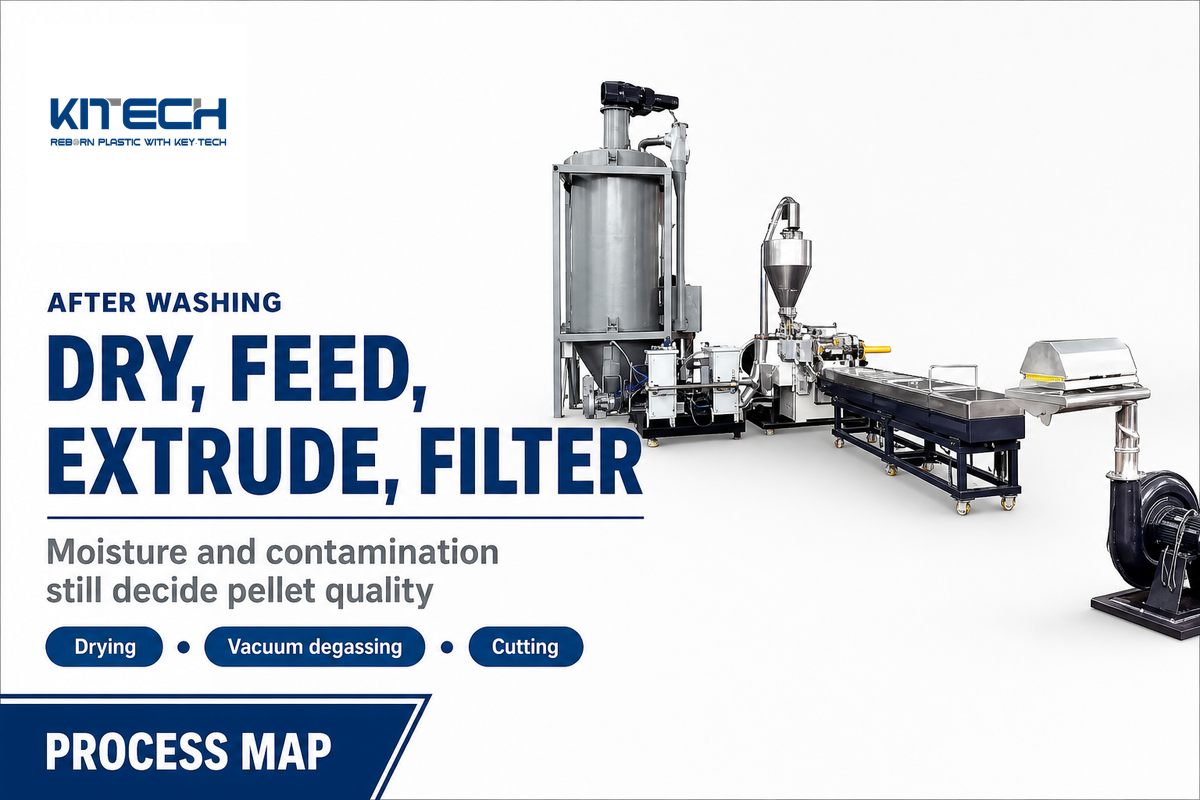
PET bottle recycling usually starts with bale opening, label removal, sorting, size reduction, washing, float-sink separation, rinsing, and drying. Pelletizing starts after the flake stream is clean enough for melt processing. Poor washing or sorting will not be fixed by the pelletizing process; paper, labels, PVC, sand, oil, metal, and high moisture can still create impurity problems inside the extruder and filter.
A typical PET pelletizing line moves through these stages:
- Drying and crystallizing to reduce moisture and avoid sticky amorphous PET behavior.
- Metered feeding into the screw extruder so melt flow stays stable.
- Extrusion and plasticization under controlled temperature and residence time.
- Vacuum degassing or volatilization to remove moisture and volatile components from the melt.
- Melt filtration through a screen changer or laser filter when contamination load requires it.
- Strand, water ring, or underwater cutting, followed by cooling and final drying.
Some production lines stop at pellets, while others include solid-state polycondensation (SSP) when the target market needs higher IV recovery or tighter food-contact review. APR PET laboratory processing practices put drying, extrusion, filtration, crystallization, and SSP into a technical benchmark context, but a production line still needs project-specific settings. SSP is not a cosmetic upgrade. It changes project cost, energy use, footprint, testing, and buyer qualification.
Selection rule: a PET pelletizing quote is safer when the supplier links material risk, test evidence, and the buyer’s output market before naming a model.
3-Type PET Pelletizing Decision Matrix
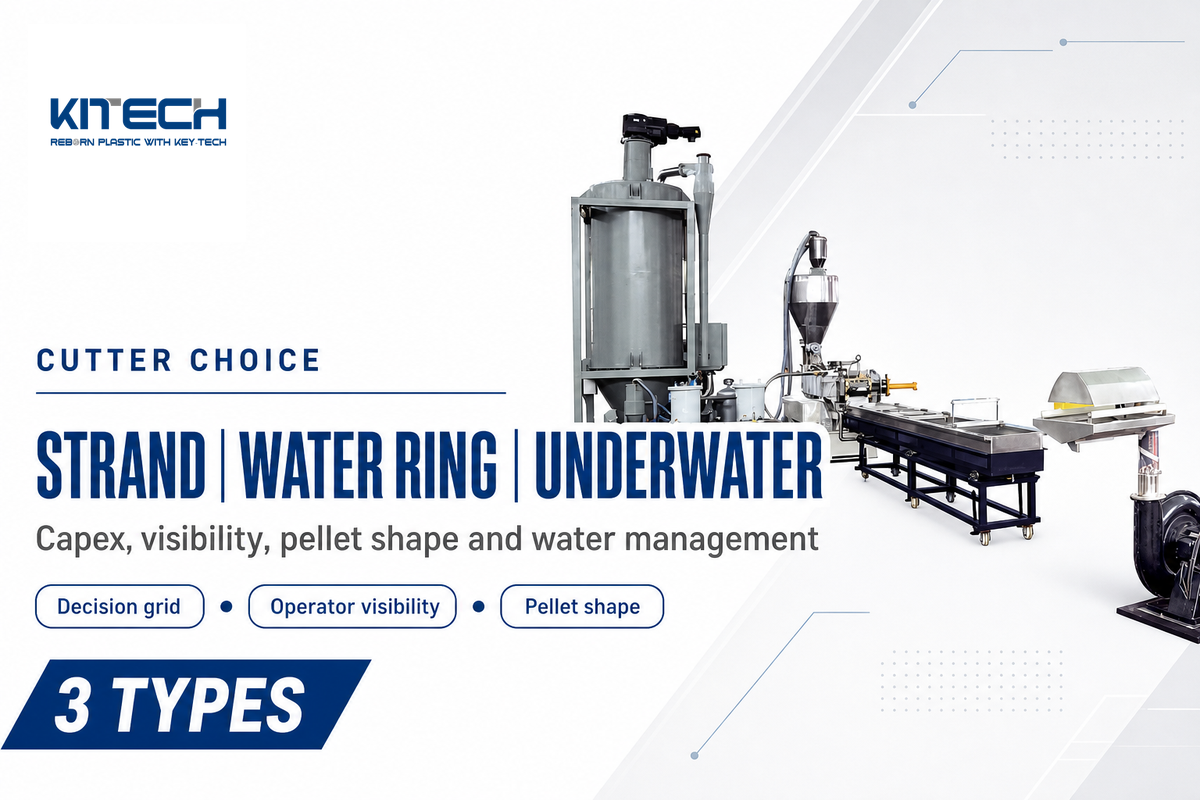
Most PET flakes pelletizing projects should start by comparing cutter type. This Cutting Method Decision Grid shows why the cutter affects capex, operator visibility, pellet shape, maintenance, water management, and the tolerance of the pelletizing system to melt instability.
Risk appears because a strand break, water carryover, or underwater cutter problem can delay a 100-1000 kg/h PET line even when the extruder is sized correctly. Kitech’s PET recycling pelletizing machine page and plastic pelletizer family give evidence for treating cutter choice as an RFQ item, not only as an accessory line on a quotation. Keep cutter choice tied to the APR PET processing benchmark, because moisture, filtration, and residence-time control come before pellet shape.
| Pelletizer type | Best PET fit | Buyer advantage | Watchpoint |
|---|---|---|---|
| Strand pelletizer | Washed PET flakes, PET bottle flakes, stable rigid regrind, lower to mid capacity | Lower upfront cost, clear operator visibility, easier troubleshooting when strands break | Needs stable melt flow, correct water bath length, and attentive strand handling |
| Water ring or water-ring pelletizer | Some lower-viscosity or blended plastic recycling cases where compact layout matters | Compact footprint and continuous cutting close to the die face | Not always the first choice for PET IV preservation or high-quality transparent pellets |
| Underwater pelletizing | High-throughput, high-performance, or automated pelletizing line projects with enough budget and process control | High-speed automation, uniform pellet shape, enclosed process | Higher capex, more utility requirements, and less visual feedback during upset conditions |
For a broader view of system families, compare Kitech’s plastic pelletizer options. That page is useful when the buyer is deciding between PET, PP, PE, film, rigid scrap, and laser filter configurations rather than only reading one PET product page.
9-Point PET Spec-to-Risk Matrix
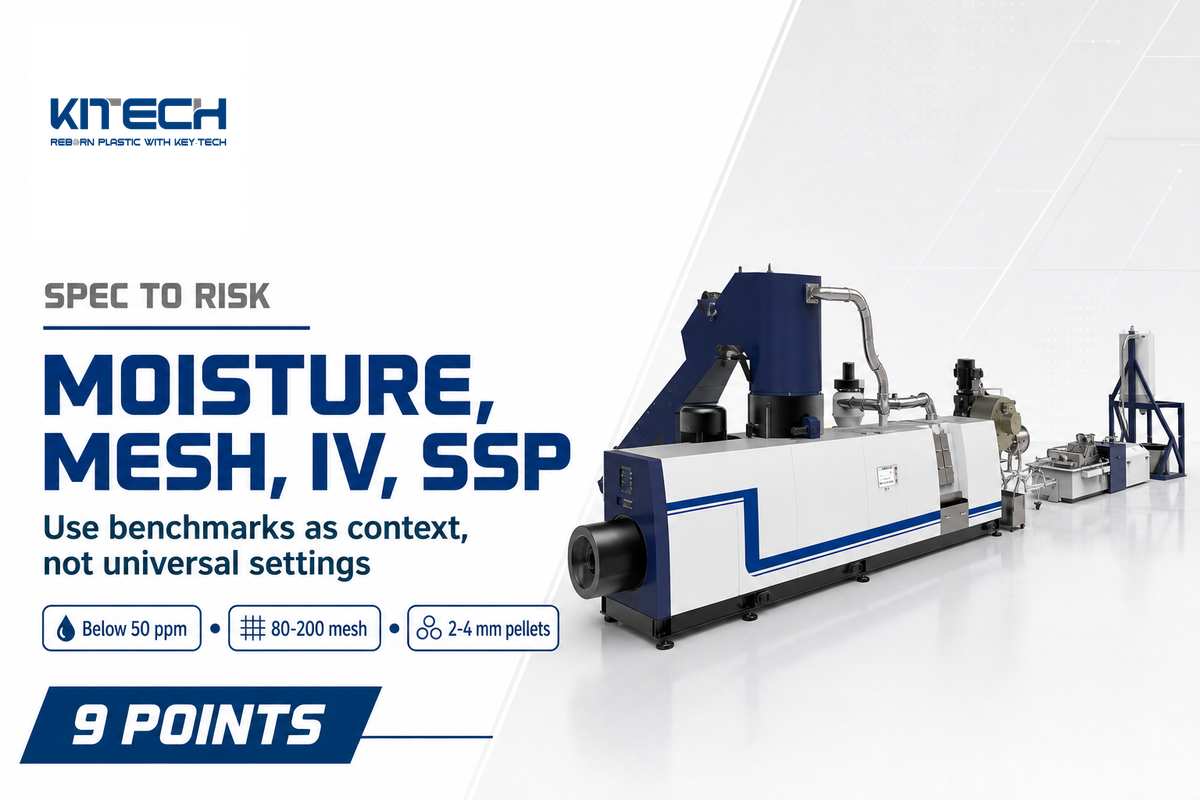
Use this PET Pelletizing Spec-to-Risk Matrix as more than a motor list. It connects material risk with process control. APR laboratory processing practices are useful compatibility benchmarks, but they should not be read as universal production-line settings or Kitech guarantees. Industrial settings depend on feedstock, end use, extruder design, filtration load, residence time, and buyer quality targets.
| Spec area | Evidence-based reference point | What it means for a buyer | RFQ question |
|---|---|---|---|
| Input moisture | APR lab practice cites below 50 ppm after drying; Kitech’s PET page also references drying to below 50 ppm. | Moisture can drive hydrolysis and IV loss during extrusion. | What inlet moisture will the dryer guarantee under my actual flake condition? |
| Melt temperature | APR lab practice uses about 280 C as a standardized processing benchmark. | Use it as a compatibility reference, not a universal line setting. | What melt temperature window is recommended for my IV and output market? |
| Melt filtration | APR lab practice cites a 40/250/40 mesh stack; Kitech PET configurations reference 80-200 mesh filtration ranges. | Filter choice depends on contamination, pressure, screen life, and desired granulate quality. | Which mesh, screen changer, or laser filter fits my labels, fines, aluminum, sand, or black speck load? |
| Vacuum degassing | Kitech PET lines include vacuum degassing; PET buyers often specify volatile and moisture removal as a quality control point. | Degassing supports pellet appearance and melt stability, but it does not replace drying. | What vacuum level, vent design, and maintenance access are included? |
| Pellet size | Kitech references roughly 2-4 mm pellets for PET systems. | Pellet size affects conveying, dosing, drying, and customer acceptance. | What cutter setup controls pellet length and fines? |
| Strand diameter | APR lab practice references about 2.5 mm strand diameter before cutting. | Strand geometry affects cooling, cutter stability, water bath behavior, and fines. | What strand diameter and water bath length will be tested on my flakes? |
| Residence time | APR lab practice limits residence time to about 6 min in its standardized testing context. | Long melt residence can aggravate thermal history and IV loss. | What screw speed, L/D, and barrel design control residence time at my output rate? |
| Crystallization | APR lab practice references crystallization around 160 C for 1 hr or fluidized-bed treatment around 175 C for 20 min. | Crystallization reduces sticking risk before drying and extrusion. | Is crystallization included, and how is temperature verified? |
| SSP or IV rebuild | APR lab practice includes SSP processing near 190-210 C after crystallization; Kitech treats SSP as application-dependent. | SSP changes energy, time, footprint, pellet qualification, and QA planning. | Does my target market need SSP, or only stable non-food pellets? |
9-Row TSK Capacity Ladder and Module Map
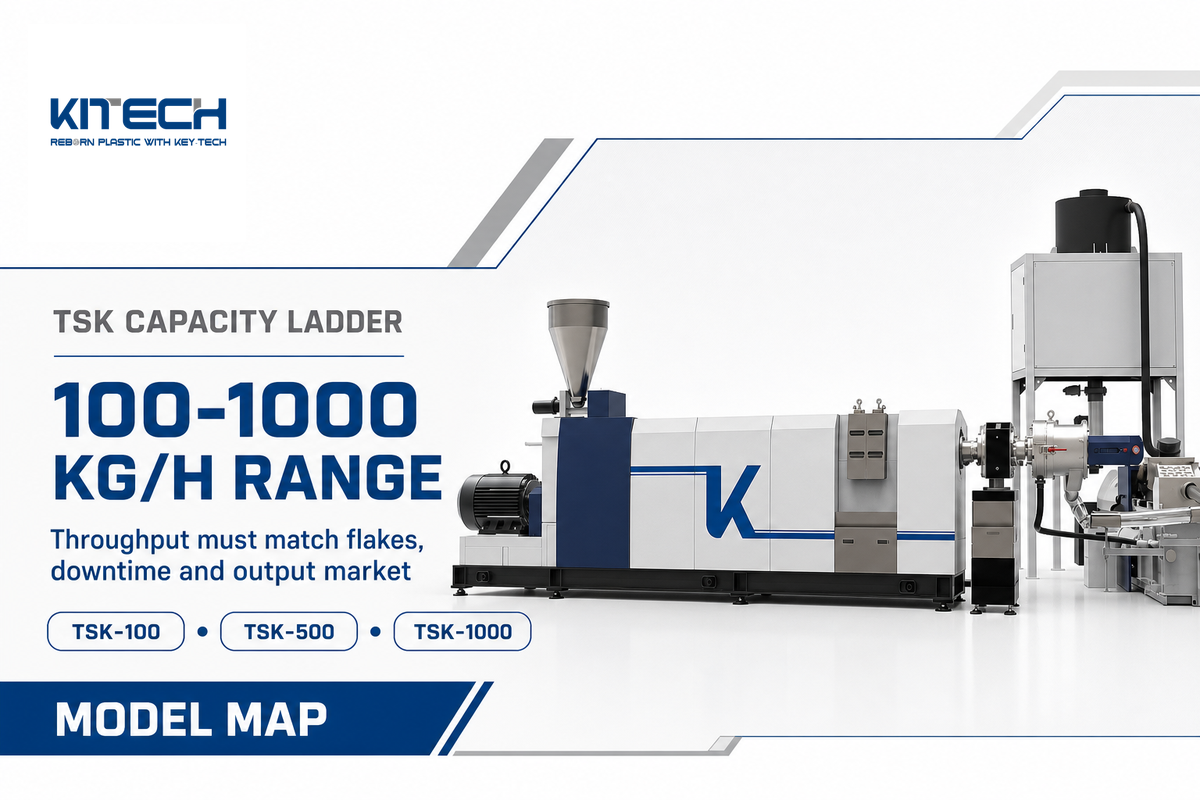
Kitech’s PET TSK series gives buyers a practical capacity ladder for washed PET flakes. Treat the table as a starting point for quotation, not a complete engineering selection. Actual output depends on flake density, moisture, contamination, IV target, operating hours, filter load, and whether the complete system includes SSP or extra drying capacity. Use APR PET processing practices as a benchmark checklist for the variables that a capacity table alone cannot prove.
| Model | Nominal output range | Typical buying situation | Selection note |
|---|---|---|---|
| TSK-100 | 100-150 kg/h | Pilot plant, small recycler, material validation, low daily volume | Good for learning feedstock behavior before a larger recycling line. |
| TSK-200 | 200-300 kg/h | Small commercial PET flakes pelletizing line | Check dryer size and filter change frequency before choosing. |
| TSK-500 | 400-500 kg/h | Mid-scale PET bottle flakes production line | Often where automation and uptime planning begin to matter more than purchase price. |
| TSK-800 | 600-800 kg/h | Large recycler with stable washed flake supply | Require stronger evidence for energy, vacuum, and screen-change assumptions. |
| TSK-1000 | 800-1000 kg/h | High-capacity pelletizing line for continuous operation | Plan utilities, spare parts, operator training, pellet handling, and QA lab capacity. |
| Crystallizing dryer module | Project-sized | Washed PET flakes with moisture variation | Confirm dew point, residence time, 150-160 C class drying window, and below-50-ppm verification method. |
| Vacuum degassing module | Matched to extruder | Volatile and residual moisture control | Ask for target vacuum range, vent cleaning access, condenser design, and alarm logic. |
| Melt filtration module | 80-200 mesh or project-specific | Label, fines, sand, aluminum, paper, and black-speck risk | Match screen area, pressure limit, and filter-change schedule to contamination load. |
| SSP option | Application-dependent | Higher IV recovery or tighter buyer qualification | Check whether the target market needs SSP near 190-210 C class processing, longer residence time, and extra QA. |
Ask Kitech to put the engineering assumptions beside the model name: screw diameter in mm, motor power in kW, vacuum level in MPa, screen mesh, expected kg/h output, drying h, pellet length in mm, water temperature in C, and pressure limit for the filter. This turns a sales table into a manufacturing process record that the plant can compare across recycling solutions.
The Moisture and IV Trap Buyers Miss
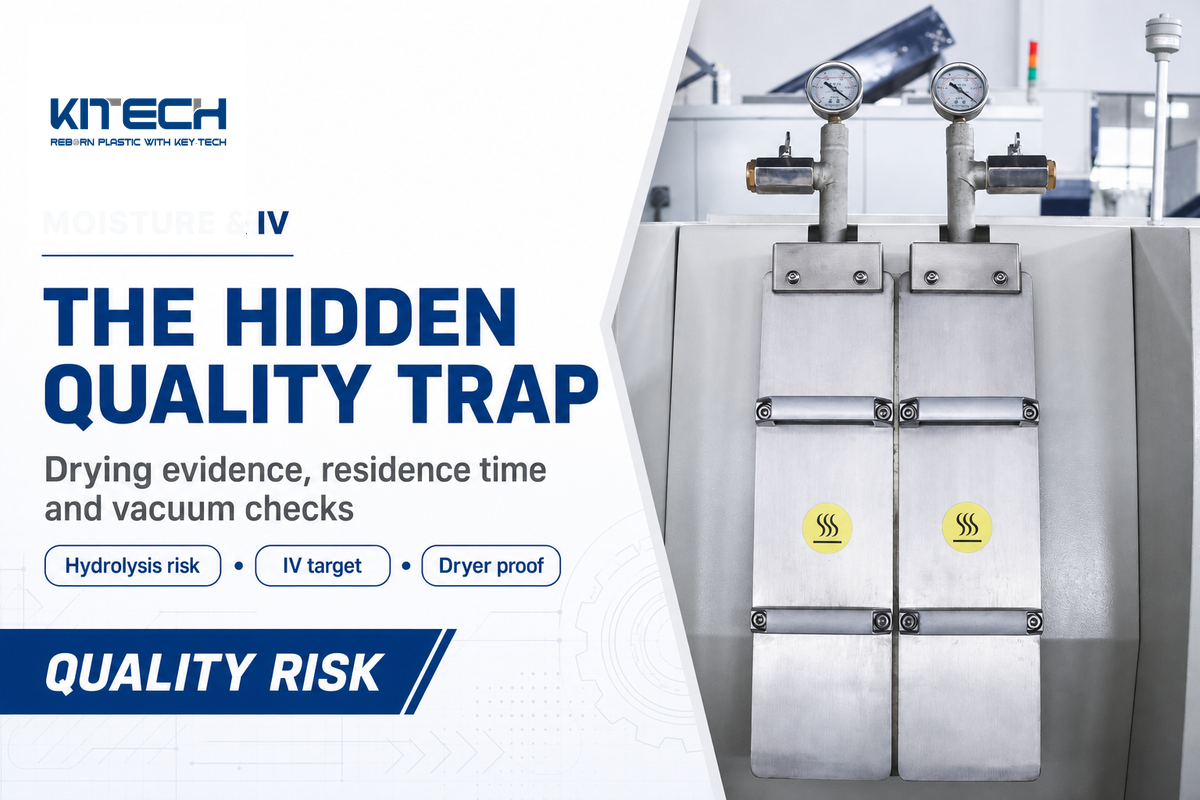
With PET, a larger extruder is not automatically safer. Even a high-efficiency line can still make weak pellets if the incoming flake is wet, the crystallizer is undersized, the melt stays too long in the barrel, the vacuum section is unstable, or the filter blinds too quickly. Moisture attacks viscosity during extrusion. IV loss then affects downstream strength, transparency, melt flow, and buyer acceptance.
APR PET rigid guidance gives 0.72-0.90 dL/g IV and a crystalline melting point of 225-255 C as packaging-design recyclability guidance. That range is not a universal output target for every PET end use. Fiber, sheet, strapping, molding, injection, and bottle applications can require different incoming and outgoing viscosity states. The safe way to buy machinery is to define the market first, then specify acceptable IV loss per pass and testing method.
This risk is measurable because APR gives laboratory reference conditions, FDA food-contact guidance explains why recycled plastic needs process review, and Kitech can connect dryer, vacuum, filter, and SSP choices to the buyer’s actual PET flakes before the line is quoted.
Similar logic applies to crystallization and filtration. Lower-melting or non-crystalline materials can stick during drying, while higher-melting materials may remain solid long enough to block screens. That is why a PET buyer should not ask only for “low power consumption” or “high-quality pellets.” Ask how the machine handles raw materials, contamination, drying, filter pressure, vacuum stability, and pelletizing process upset events. For upstream context, keep the PET recycling process separate from this pelletizing specification. This is where plastic recycling, PET bottle recycling, extrusion, filtration, and recycling solutions meet the manufacturing process rather than a brochure claim.
How to Match Output Capacity to Daily Throughput

Start with the daily target and work backward. If a plant wants 8 tonnes of pellets per day and plans 20 operating hours, the simple average is 400 kg/h. That does not mean a 400 kg/h line is enough. Real production loses time to startup, filter changes, cleaning, knife adjustment, material variation, QC holds, and maintenance.
A practical sizing method is:
- Daily output target divided by realistic operating hours.
- Add expected downtime and scrap allowance.
- Add 20-30 percent headroom when feedstock supply, moisture, or contamination varies.
- Check whether the dryer, feeder, screw extruder, filter, cutter, cooling, and storage can all sustain that number.
Do not buy capacity only from a nameplate. Ask for a material test, feedstock assumptions, melt-pressure limits, screen-life expectation, pellet-size tolerance, and energy measurement basis. Compact granulating machines may look attractive on price, but a poorly matched recycling line can cost more through low uptime and rejected pellets. The APR PET laboratory benchmark is a reminder that throughput claims have to be checked against drying, filtration, melt temperature, and residence-time assumptions.
The reason is simple: a 400 kg/h average can become a bottleneck when screen changes, wet flakes, or startup scrap interrupt the day. Kitech’s 100-1000 kg/h PET range should be used with buyer test data, RFQ notes, and factory layout constraints before the plant treats capacity as confirmed.
RFQ Checklist Before You Ask for a Quote
Anchor the RFQ to measurable risk: APR PET processing practice helps frame moisture, filtration, crystallization, and residence-time questions, while FDA guidance frames food-contact claims separately.
Moisture-IV-Filtration RFQ Checklist: send these points before asking for a final quotation.
- Feedstock form: PET bottle flakes, rigid regrind, film, fiber, printed waste, sheet scrap, or mixed PET waste.
- Input condition: bulk density, particle size, moisture, PVC risk, labels, paper, fines, metal, sand, oil, and color mix.
- Output market: internal reuse, sheet, fiber, strapping, molding, injection molding, or selling pellets to buyers.
- Waste route: whether rejects go back into granulation, return to the recycling line, or leave the plant for landfill disposal.
- IV requirement: incoming IV, acceptable IV loss, test method, and whether SSP is required.
- Drying system: crystallizer size, drying temperature, residence time, dew point, and moisture verification method.
- Extrusion system: single-screw or twin screw, L/D, gearbox, screw design, melt temperature window, and residence-time control.
- Vacuum degassing: number of vents, vacuum level, condenser or filtration, and cleaning access.
- Melt filtration: mesh, screen changer type, laser filter option, pressure limit, and expected filter life.
- Pelletizer: strand, water ring, or underwater pelletizing, target granule size, fines control, and dried pellets handling.
- Automation: PLC/HMI, recipe control, alarms, load monitoring, traceability, and maintenance prompts.
- Support: installation, commissioning, operator training, spare parts, remote diagnosis, and local service plan.
When a PET Pelletizing Line Needs SSP or Food-Contact Review
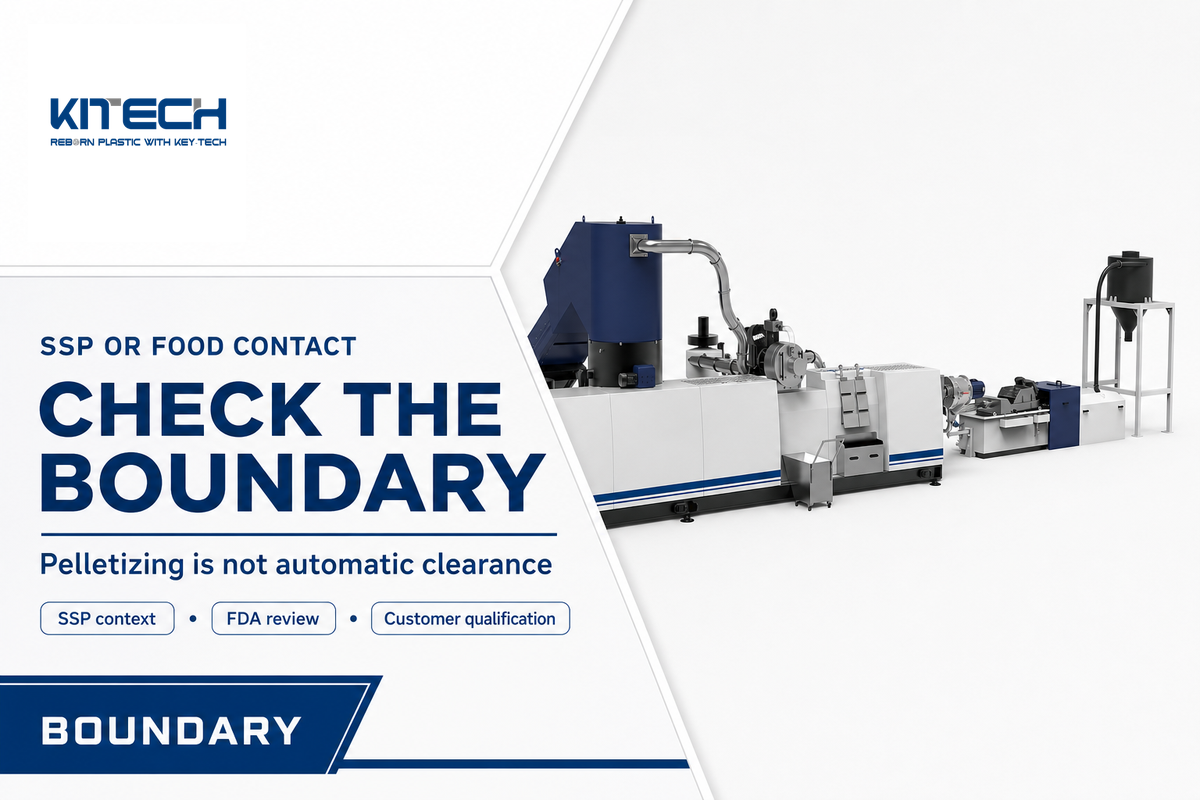
A PET pelletizing machine can support a food-contact rPET project, but it cannot prove food-contact suitability by itself. FDA guidance focuses on chemistry considerations, possible contaminants, process controls, and the intended use of recycled plastic in food packaging. That boundary keeps source control, process description, quality evidence, and buyer-specific regulatory review separate from a machinery quote.
FDA’s broader recycled plastics page also notes nuance for some tertiary recycling processes involving PCR-PET or PCR-PEN, including differences around surrogate contaminant testing and individual opinion letters. For non-U.S. markets, local rules may differ. An exporter or resin seller should confirm the target region, packaging type, conditions of use, process authorization path, and customer documentation requirements before promising food-grade rPET. Keep the equipment conversation precise: drying, degassing, filtration, SSP, traceability, and QA can support a qualified process, but a quotation should not become a regulatory approval claim.
SSP becomes relevant when the target market needs IV improvement, additional decontamination strategy, or tighter pellet qualification. A patent record for recycling metalized polyester film shows how extrusion, pelletising, degassing temperature, and SSP can sit inside one polyester recycling route. SSP adds equipment, time, energy, and process control. If the buyer only needs fiber or non-food sheet applications, SSP may not be justified. If the buyer wants bottle-grade or food-contact packaging markets, SSP and decontamination evidence may become central to the business case.
Next Step: Compare Plastic Pelletizer Systems
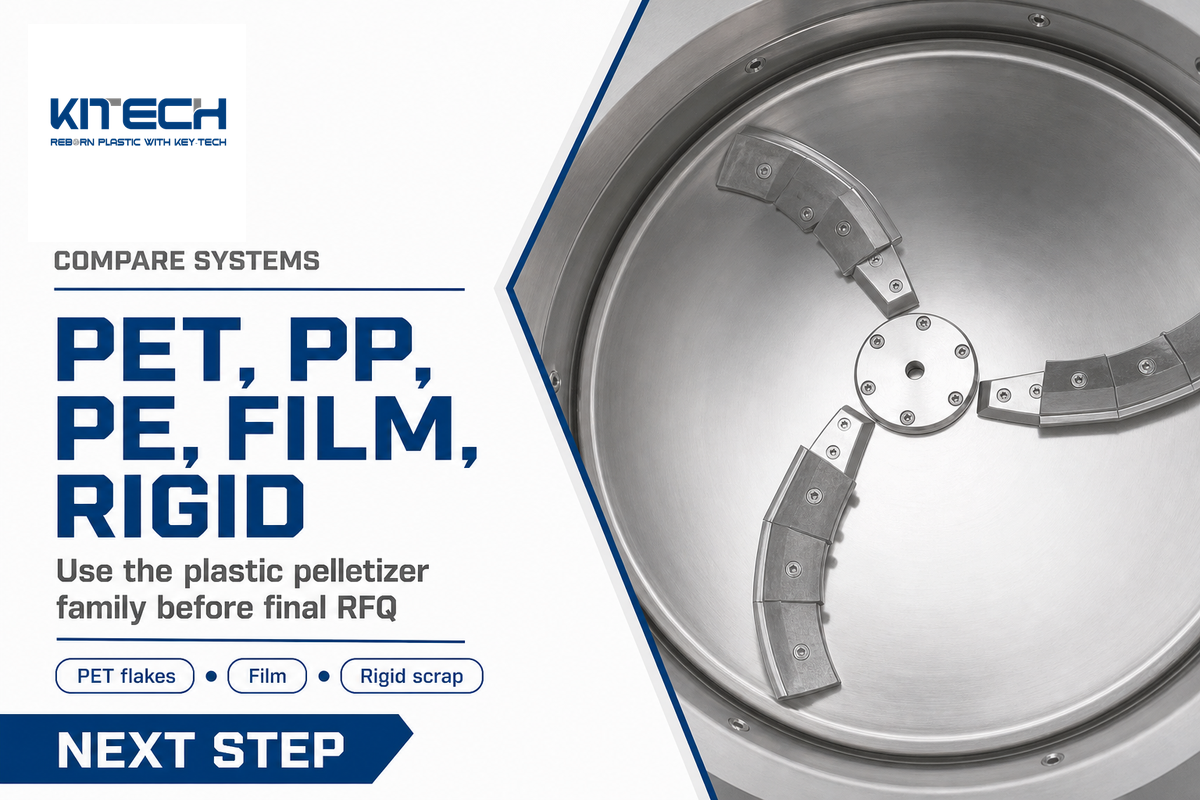
If your feedstock is washed PET flakes and your buyer cares about IV, filtration, pellet quality, and line uptime, begin with a PET-specific configuration. If your plant handles several polymers or needs to compare strand, water-ring, underwater, laser filter, or different extruder routes, review Kitech’s plastic pelletizer system family before narrowing the RFQ.
Plants that still need to stabilize flakes before extrusion should compare a PET bottle washing line with the downstream pelletizing line as two connected but separate equipment decisions. Buyers who want the broader terminology can also use Kitech’s plastic pelletizer types guide before returning to PET-specific moisture, IV, and filtration questions.
This final check matters because a mixed-polymer recycling plant can overpay for the wrong cutter, accept weak evidence, or miss a contamination risk that shows up only after the first production run. Keep the comparison grounded in APR PET processing benchmarks and the FDA food-contact boundary where relevant. Kitech can compare PET, PP, PE, film, rigid scrap, laser filter, and complete system options against the buyer’s 100-1000 kg/h plan before a quote becomes a purchase order.
Kitech’s best fit is a buyer who can share feedstock photos, flake test data, target market, expected output, contamination profile, and plant layout. That information lets the machinery discussion move from generic pelletizer pricing to a real plastic pelletizing machine specification.
FAQ
What is a PET pelletizing machine?
A PET pelletizing machine turns washed PET plastic flakes into uniform pellets for sheet, fiber, strapping, molding, or resale applications. The equipment sits after washing and drying, then uses extrusion, melt filtration, degassing, cutting, cooling, and final drying to stabilize pellet quality.
Which pelletizing type is best for PET flakes?
Strand pelletizing is often the safest starting point for PET flakes because operators can see strand behavior, react to melt instability, and keep upfront cost lower. Water ring and underwater systems can work, but IV goals and melt stability need closer checking.
How dry should PET flakes be before pelletizing?
APR laboratory processing practice cites below 50 ppm moisture as a PET benchmark, and Kitech’s PET product context also uses a below-50-ppm dryer target. Treat that as a serious reference point, not a casual number. Confirm drying design against incoming flake moisture, crystallization behavior, residence time, dew point, and acceptable IV loss.
What capacity should a recycling plant choose?
Divide the required daily pellet output by realistic operating hours, then add downtime, scrap, filter changes, startup loss, and 20-30 percent headroom if feedstock varies. An 8-tonne-per-day plant over 20 operating hours starts near 400 kg/h, but wet flakes or screen changes can make that tight.
Can a PET pelletizing machine make food-grade rPET?
A PET pelletizing machine can be part of a food-contact rPET process, but machine features alone do not prove food-grade suitability. Buyers need source control, washing and decontamination evidence, drying and degassing controls, filtration, possible SSP, testing, documentation, and review under the target market’s rules. For U.S. packaging projects, FDA’s recycled plastics guidance and recycled plastics food-packaging page are better starting points than a machinery brochure because they focus on process and use conditions before claiming food-grade output.
For U.S. food packaging, FDA’s recycled plastics guidance and recycled plastics food-packaging page are the better starting points than a machinery brochure. FDA discusses process and use conditions, not a generic approval that follows any machine shipment. Recyclers should confirm whether the feedstock was originally food-contact material, how source controls prevent unsuitable PCR from entering the stream, how the process removes possible contaminants, and whether the intended use matches the documentation. If the project sells pellets across borders, the same machine may need different paperwork, testing, and customer declarations in the buyer’s market.
References & Sources
- Association of Plastic Recyclers: PET Standard Laboratory Processing Practices.
- Association of Plastic Recyclers: PET Rigid Guidance.
- FDA: Guidance for Industry: Use of Recycled Plastics in Food Packaging.
- FDA: Recycled Plastics in Food Packaging.
- Google Patents: Process for recycling a metalized polyester film.
- Kitech: PET Pelletizing Machine and About Kitech.