Get in touch with Kitech Company


Research updated August 2026 · Public-evidence decision guide for industrial recycling projects
Turnkey vs modular plastic recycling line investment phasing is often presented as one either-or choice. That framing blinds the user to the real decision. Turnkey is mainly about ownership of the integration role. Modular is mainly about how equipment and functions are apportioned. A project can be both turnkey and modular, or physically integrated yet delivered in several contracts.
The short answer: define two axes before releasing capital: the responsibility model and the physical architecture. Then fund the next irreversible commitment only when feedstock, output, utilities, interfaces and acceptance evidence are strong enough for that commitment.
Executive decision brief
- Correct the category error: single-source responsibility and modular architecture are compatible.
- Don’t phase by dates alone: justify each capital release with an evidence package, a named approver and a failure-response plan.
- Price retained work: a lower first purchase price doesn’t enable flexible planning if future interfaces, duplicate work or ramp delay eat up that option value.
- Keep the decision conditional: no universal price, payback, capacity or lead-time cutoff can reliably determine architecture selection for a broad range of feedstocks and markets.
First Correct the False Binary: Turnkey and Modular Are Two Axes
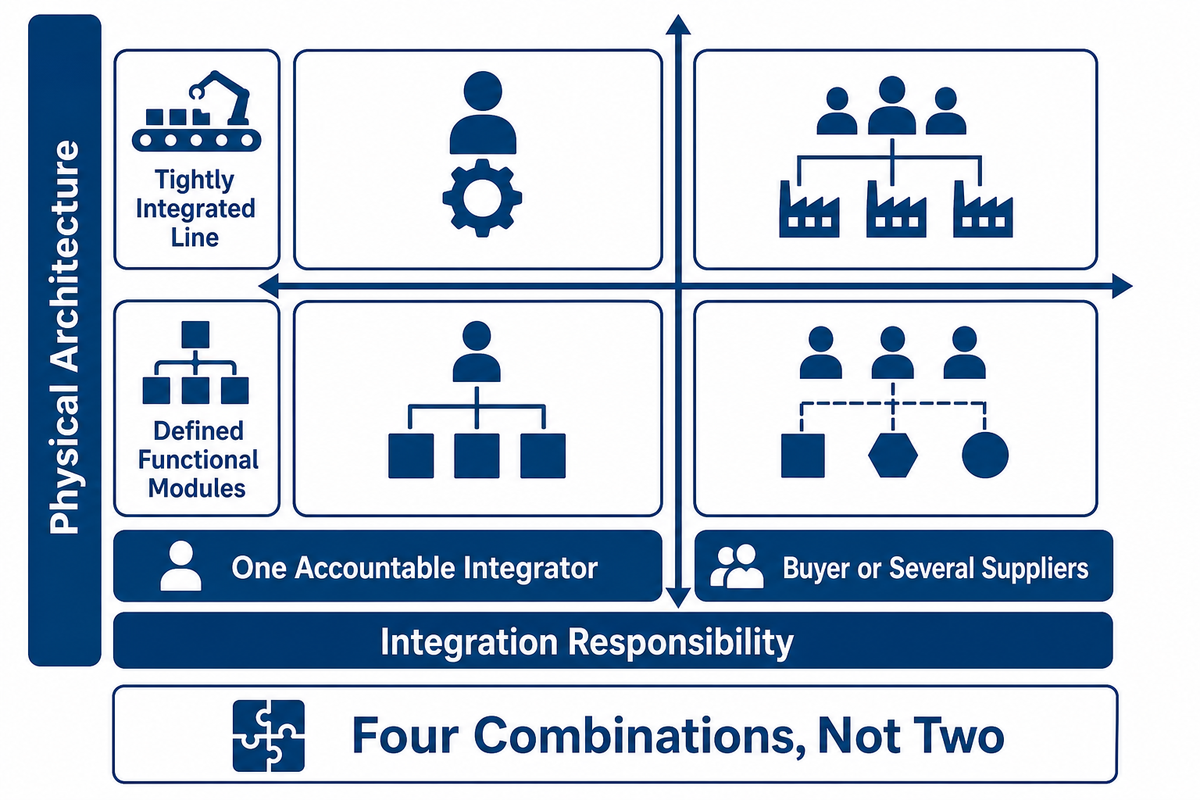
Turnkey is about responsibility concentration; modularity is about physical or functional demarcation. An owner should specify both, because the terms alone reveal neither who owns process design and integration, nor who performs site work, takes commissioning responsibility and manages future tie-ins.
One related UK public procurement framework specifies a turnkey package without ruling out volumetric modular and panelised alternatives. This is construction evidence, not a plastic-recycling standard. Its value is limited but significant: it shows that “turnkey” and “modular” need not be mutually exclusive categories.
| Decision axis | Option A | Option B | What the RFQ must state |
|---|---|---|---|
| Integration responsibility | One accountable integrator | Buyer or several suppliers share integration | Named owner for process design, controls, site tie-ins, commissioning and defect closure |
| Physical architecture | Tightly integrated line | Defined functional modules | Module boundary, connection standard, reserved capacity and future acceptance test |
This leads to four combinations, not two. Turnkey-modular packages can preserve module boundaries while keeping one integration owner. Multi-contract integrated lines can have few physical boundaries but leave the buyer coordinating several vendors. Neither is inherently safer. Choose the structure best aligned with the owner’s engineering, procurement and operational capabilities.
Prove the Process Envelope Before You Commit to the Architecture
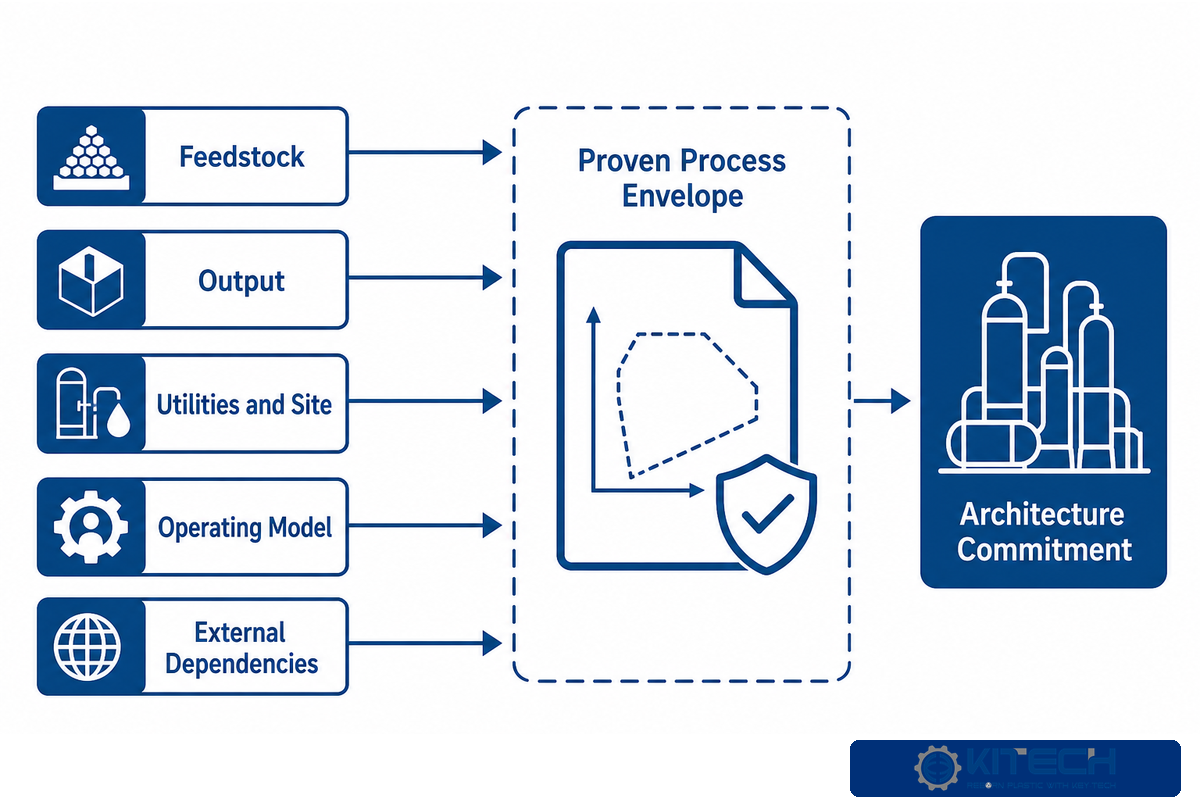
Prior to committing to major equipment, define the anticipated feedstock, desired output, utility conditions, site interfaces and target markets. Architectural decisions won’t turn an untested process envelope into a proven one.
One peer-reviewed systematic review of plastic recycling investigates the relationship between economic viability of mechanical recycling and contamination, sorting, cleaning and feedstock characteristics. Because the reviewed publications are heterogeneous, their thresholds shouldn’t be blindly imported into a generic investment appraisal. What remains defensible is qualitative: feedstock composition and processing specifications influence what a line must deliver.
Write the envelope as testable statements:
- Feedstock: polymer types, source, form, contamination levels, moisture, foreign materials and seasonal content.
- Output: flake or pellet specification, test protocol, sampling location, intended market and customer validation evidence.
- Utilities and site: available electrical power, water quality and flow, wastewater/discharge route, compressed air, drain points, space, access points and expansion options.
- Operating model: staffing levels, experience, maintenance skills, work pattern, equipment cleaning/on-line change plan and ramp-up owner.
- External dependencies: feedstock collection, storage facilities, planning permission, fire protection and market qualification. These are jurisdiction-dependent checks, not universal sequencing rules.
In its report, the European Court of Auditors noted that official municipal waste management plans frequently underestimate infrastructure capacity needs and can omit planning commitments. While a factory isn’t a municipal system, the report reveals a potential pitfall: a detailed equipment specification doesn’t mean collection, infrastructure, funding and market details are in place.
If the intended output serves EU packaging applications, current packaging rules belong in the acceptance envelope. According to the European Commission, Regulation (EU) 2025/40 entered into force on 11 February 2025 and generally applies from 12 August 2026. This is a conditional example; it doesn’t mean every recycler or every output falls under the same requirements.
Where site constraints could change the equipment boundary, hand the detailed location, utility and approvals work to KITECH’s plastic recycling plant site-selection guide rather than turning this architecture comparison into a second site checklist.
Use an 8-State Capital-Release Evidence Chain
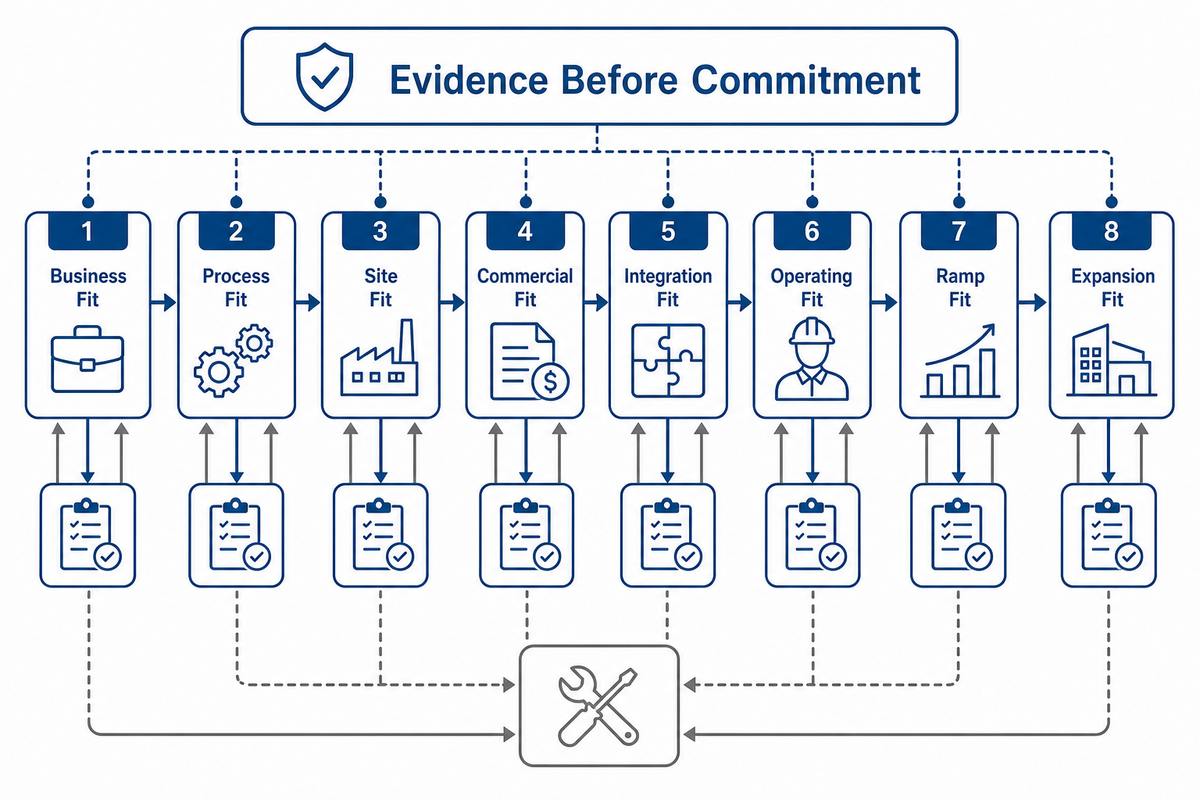
Release the next capital commitment when evidence retires the risk that the commitment would otherwise lock in. Calendar timing helps with planning, but it isn’t sufficient release evidence.
This chain is an original buyer decision aid, not a general industry standard. Its logic resembles evidence-completeness gates: for example, EFSA’s recycling-process application pathway moves through defined stages and can request missing information. Regulatory review isn’t equipment commissioning; the limited analogy is that progression depends on an adequate evidence package.
| Decision state | Release evidence | Evidence owner | If evidence fails | Next commitment |
|---|---|---|---|---|
| 1. Business fit | Feedstock access; output-market requirement; downside case | Sponsor + commercial team | Revise the market, feedstock or project thesis | Release process trials |
| 2. Process fit | Representative-feed trial; agreed output test; mass-balance assumptions documented | Process engineering + output buyer | Change pretreatment, output target or business case | Freeze the core process basis |
| 3. Site fit | Utility survey; layout; storage and environmental route; local approvals plan | Owner’s site team | Revise site works, capacity or location | Release long-lead core equipment |
| 4. Commercial fit | Comparable scope; exclusions; supplier-risk and payment-security review | Procurement + finance | Renormalize bids or change the contracting model | Award the defined package |
| 5. Integration fit | Approved interface register; controls philosophy; safety responsibilities; future reserves | Integrator + owner engineering | Concentrate responsibility or redesign boundaries | Release balance-of-line and site integration |
| 6. Operating fit | Acceptance plan; staffing; spares; training; defect and ramp ownership | Operations + procurement | Delay start-up; close readiness gaps | Commission the defined scope |
| 7. Ramp fit | Stable process window; defect closure; trained shift coverage | Plant management + supplier | Hold the next release and correct the bottleneck | Stabilize planned production |
| 8. Expansion fit | Stable operating data; confirmed demand; verified utility and interface headroom | Sponsor + plant management | Keep the option open or change expansion path | Add the next module or debottleneck |
Capital-release principle: release the next irreversible commitment only when the evidence package retires the risk that commitment would otherwise lock in.
Editorial synthesis from the cited public evidence; not an industry standard.
Each release gate should name the document, approver, test condition and failure response. “Trial completed” is weaker than “representative feed met the agreed output method at the stated sampling point.” Likewise, “permit in progress” isn’t the same as a documented approval path with an owner, dependencies and decision date.
Use the separate plastic recycling plant cost guide for cost categories and price context. Use the recycling equipment financing guide for funding instruments. Neither page replaces the evidence release conditions above.
Commercial caution: bespoke offsite modules can require expenditure before site delivery. UK government construction research surfaces design-freeze, supplier-solvency, progress-payment, title, inspection and recoverability risks. These are cross-industry questions for procurement and legal review, not plastic-recycling law and not a recommended universal payment structure.
Price Interface Debt Before Mixing Suppliers
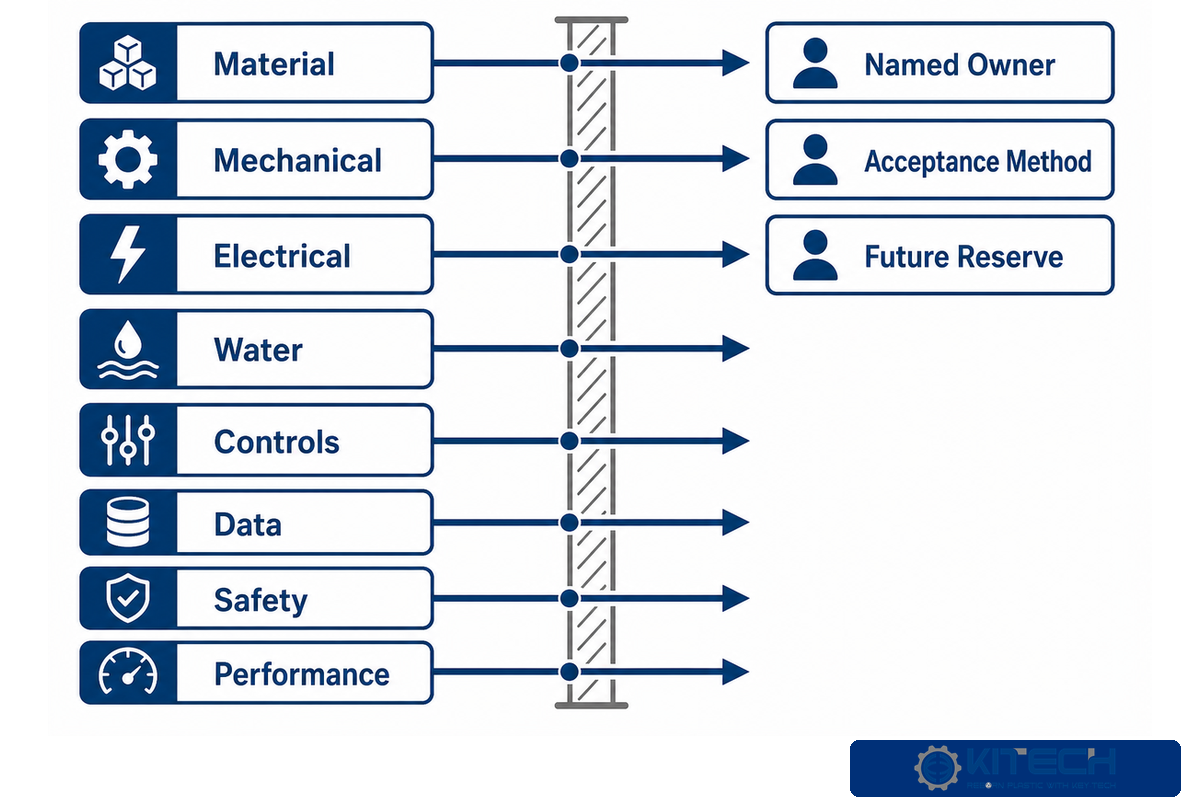
Modular sourcing maintains flexibility when future boundaries are measurable, assigned to named owners and economically viable. Otherwise, the lower current commitment may simply finance tomorrow’s engineering, rework and ramp-up debt.
An interface isn’t only a flange size. Material condition, physical compatibility, utilities, controls, data, safety and performance obligations all cross it. Capture them before award:
| Interface risk category | Upstream promise | Downstream requirement | Named owner | Acceptance method | Future reserve |
|---|---|---|---|---|---|
| Material | Flow, size, moisture, contamination | Defined receiving window | Process integrator | Sampling and test plan | Higher flow or new grade |
| Mechanical | Discharge elevation and load | Connection and support loads | Layout engineer | Approved drawings and inspection | Space and structural allowance |
| Electrical | Connected load and demand profile | Supply capacity and protection basis | Owner electrical lead | Load schedule and site test | Expansion headroom |
| Water | Demand, quality and discharge condition | Available supply and treatment route | Owner utility lead | Water balance and sampling plan | Reserved flow and treatment capacity |
| Controls | States, commands, alarms and permissions | Sequence, response and safe failure | Controls integrator | Interface and failure-mode test | Spare I/O and sequence reserve |
| Data | Tags, units, timestamps and retention | Protocol, naming and access | Owner digital lead | Point-to-point data test | Network and storage capacity |
| Safety | Module protective functions | Line-level risk controls | Named safety owner | Validated function test | Defined change-control rule |
| Performance | Module input and output claim | Line-level acceptance boundary | Process integrator | Agreed material and test method | Future output specification |
Then test the economics. One DOE-indexed peer-reviewed chemical-process study found that capacity, capital-equipment cost and ramp schedule affected modular suitability in its studied context. Those numbers don’t transfer to mechanical plastic recycling. Practically, interface quality alone can’t prove option value. Model duplicated equipment, site work, downtime, supplier management and ramp delay against the value of deferring commitment.
Use KITECH’s separate plastic recycling capacity-planning method when nominal throughput or expansion headroom needs calculation. Here, capacity remains a reversal variable rather than a duplicated sizing tutorial.
Find the Hidden Bottleneck for Each Decision Maker
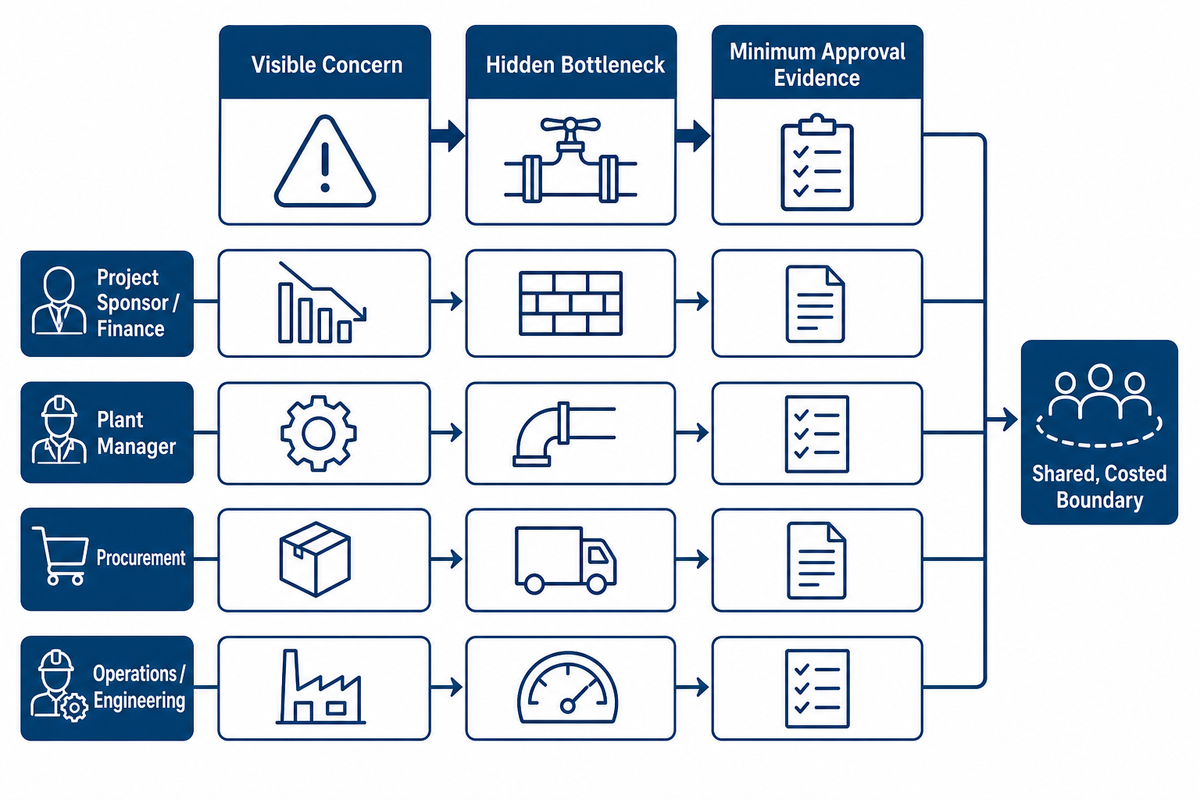
Even a technically credible proposal can fail because each stakeholder is approving a different risk. Put those risks on one page before the capital meeting.
Evidence boundary: The European Court of Auditors report is a public waste-system example, not factory procurement guidance. It is used here only to show how funding and infrastructure assumptions can remain unresolved inside formal plans.
| Role | Visible concern | Hidden bottleneck | Minimum approval evidence |
|---|---|---|---|
| Project sponsor / finance | Total capital | Whether the next tranche retires an irreversible risk | Evidence package, downside case and reversal trigger |
| Plant manager | Nominal throughput | Stable process window, maintainability and ramp ownership | Representative-feed trial, staffing, spares and training plan |
| Procurement | Quoted price | Unequal scope and unpriced future tie-ins | Normalized responsibility matrix and exclusions |
| Operations / engineering | Machine list | Material, utility, control and performance interfaces | Interface register with owner and verification method |
One recurring conflict is straightforward: finance may value a low initial commitment, while engineering sees future rework. Settle it with a shared, costed boundary, not by asking either side to trust a label.
Put Commissioning, Training and Defect Closure Into the Buying Model
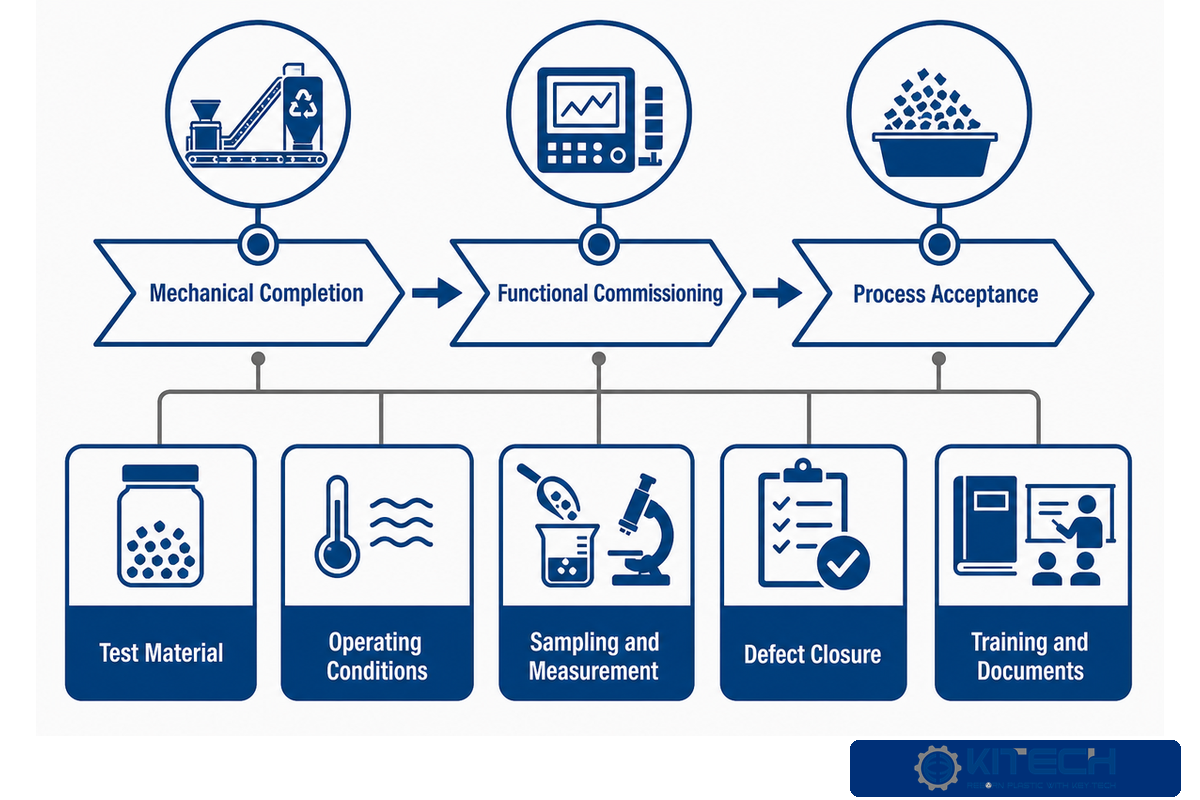
Acceptance should define what material is tested, under which conditions, where samples are taken, how results are measured, who closes defects and what training and documents are handed over.
Evidence boundary: EFSA’s plastics-recycling application process is not a factory acceptance standard. It is used only as an example of defining inputs, process descriptions, sampling, analysis and supporting evidence before a decision.
Turnkey labels don’t define acceptance by themselves. Modular labels don’t automatically divide acceptance correctly. For each test, state the input condition, operating condition, measurement point, test method, acceptance authority and response to failure. Don’t invent universal run durations, purity targets, energy values or throughput tolerances; those belong to the validated project basis and contract.
Separate three events:
- Mechanical completion: equipment and documented connections are installed and validated.
- Functional commissioning: controls, safety functions, utilities and interlocks perform as defined.
- Process acceptance: agreed material is processed under agreed conditions and measured at the agreed boundary.
Procurement documents must also specify operator training, maintenance documentation, spare-parts handover, software or parameter access, open defects and the owner of ramp-up support. Otherwise, it’s too easy to arrive at apparent equipment completion before operating readiness.
Run the Architecture Reversal Test Before Approval
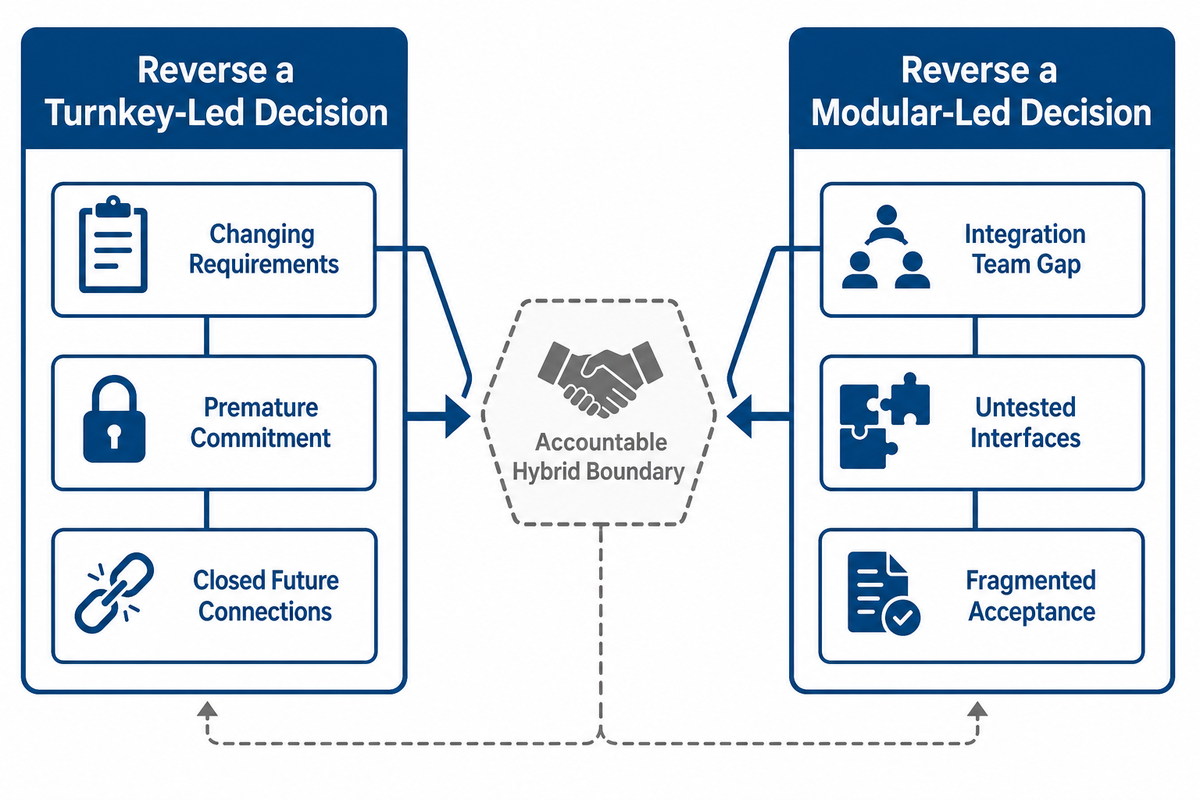
A sound recommendation indicates what new evidence would cause it to be overturned. Use the prompts below in the capital memo:
Reverse a turnkey-led decision if…
- feedstock or output requirements are still changing materially;
- one package forces premature commitment to unproven capacity or site assumptions;
- future connections are closed or economically prohibitive;
- commercial concentration exceeds the owner’s supplier-risk tolerance.
Reverse a modular-led decision if…
- the owner can’t staff integration and change control;
- interfaces can’t be tested before downstream equipment arrives;
- duplicated work and ramp delay erase the value of deferral;
- acceptance responsibility fragments across suppliers.
Hybrid structures can survive both tests: one integrator can own a modular package, or the buyer can stage selected auxiliary systems around a defined core. Hybrid is not a default recommendation. It’s a possible result when the evidence supports clear release boundaries and accountable integration.
Cross-industry evidence boundary: A DOE-indexed chemical-process study found that the studied modular economics changed with capacity, equipment-cost intensity and ramp assumptions. Its numbers are not transferred to plastic recycling lines here.
Convert the Decision Into an RFQ and Capital-Committee Package
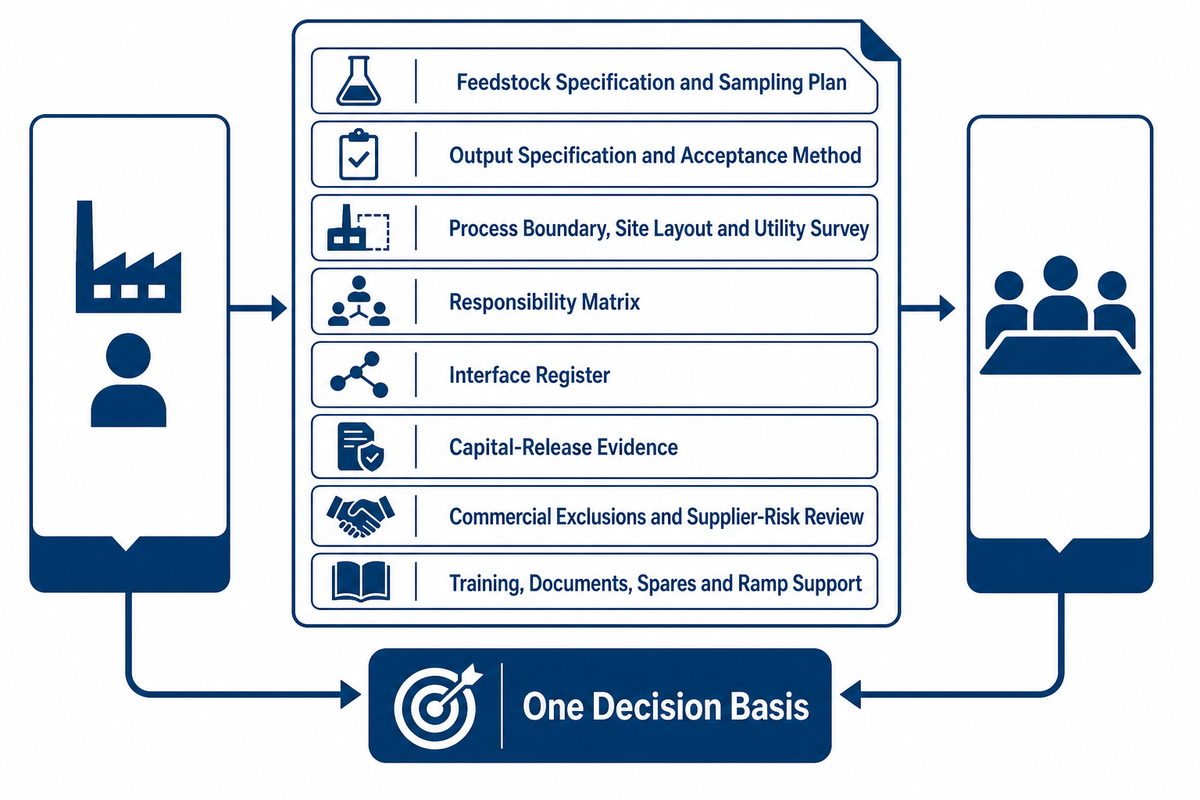
When the two axes and release gates are defined, the supplier and capital committee should be given the same basis for decision making:
- representative feedstock specification and sampling plan;
- output specification, intended market and acceptance method;
- process boundary, site layout and utility survey;
- responsibility matrix for engineering, supply, installation, controls, commissioning and defects;
- interface register with reserved capacity and change-control rules;
- capital-release evidence, approver and failure response;
- commercial exclusions, payment-security questions and supplier-risk review;
- training, documentation, spares and ramp-support scope.
A plastic recycling machine RFQ should say whether the recycling equipment covers plastic waste feeding, washing line machinery, an extruder or extrusion stage, and a pelletizing line. It should also define on-site automation, future upgrade boundaries, and whether the recycling facilities will process PP, PE or another validated feedstock family.
Use KITECH’s plastic recycling solutions page to explore relevant shredding, washing, drying and pelletizing solution families after the process envelope is defined. That page is the commercial next step; this guide remains the decision framework and doesn’t duplicate a product quotation.
Define the evidence boundary before you request the line
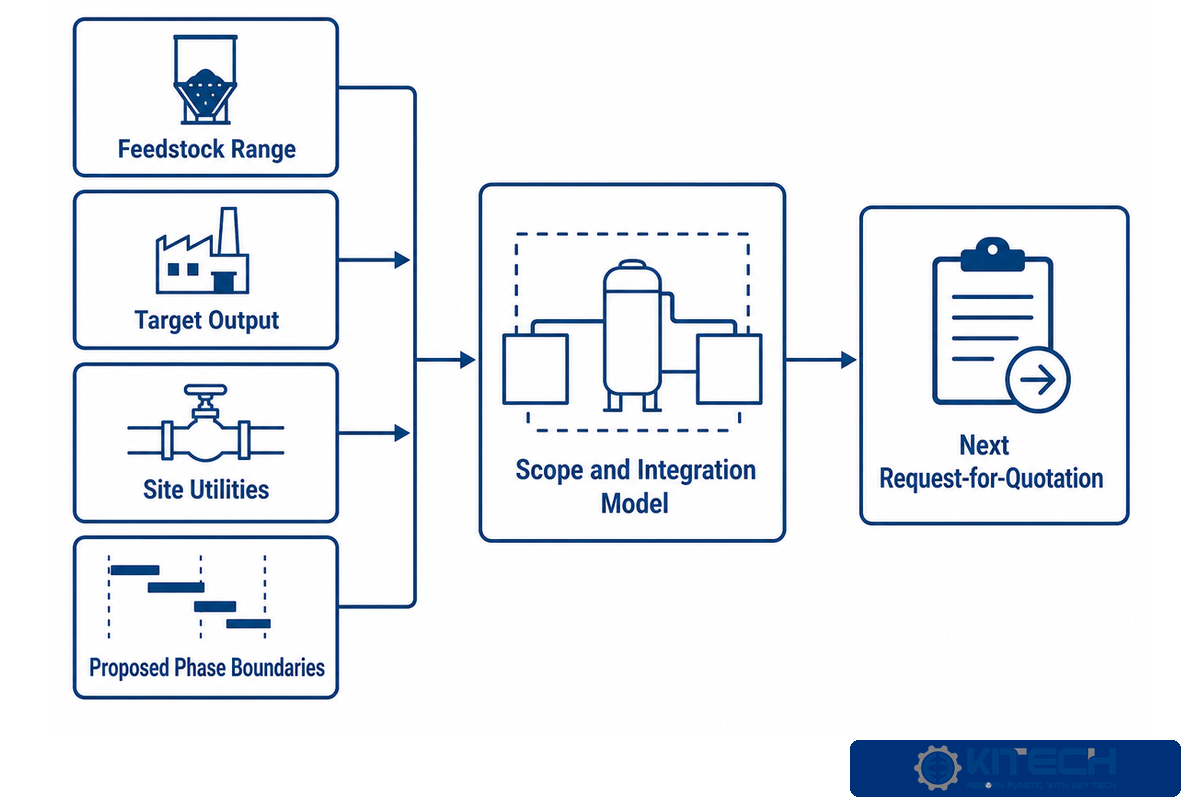
Bring your feedstock range, target output, site utilities and proposed phase boundaries. KITECH can discuss which scope and integration model should be included in the next request-for-quotation.
Frequently Asked Questions
Can a modular plastic recycling line be expanded later?
A modular plastic recycling line can be expanded later, but “space for another machine” isn’t an expansion plan. Reserve material-flow capacity, controls and data interfaces, structural space, safety boundaries and an acceptance method. Expansion still depends on demand and the next tie-in cost.
What is included in a turnkey plastic recycling line?
There is no universal list. Review a supplier’s company background separately from the contract inclusions. Contract language should specify whether turnkey includes process design, equipment, controls, utilities within a certain boundary, installation supervision, site works, commissioning, performance testing, training, documentation and defect closure. “Turnkey” can’t substitute for a responsibility matrix or exclusions schedule.
Which approach reduces integration risk?
One accountable integrator may mitigate coordination risk when scope and acceptance are clearly defined. It won’t control feedstock, market, financing, permitting or site-readiness risks. Modular procurement can preserve flexibility, but the owner must manage interfaces and change. The better choice depends on which risk the project can evidence and manage.
Can a modular line use equipment from multiple suppliers?
Yes. A modular line can use equipment from multiple suppliers, but the buyer must define material, mechanical, utility, controls, safety and performance boundaries. Name the line-level acceptance owner before award. Contract documents should also state which supplier owns cross-module troubleshooting, software changes, documentation updates and defect closure after the components operate as a line. A modular line can also come from one integrator, so supplier count and modularity aren’t the same decision.
What evidence should release the next investment phase?
Use evidence matched to the next irreversible commitment: representative-feed and output testing before freezing the process; utility, layout and approvals evidence before long-lead site commitment; interface and controls approval before balance-of-line integration; acceptance, staffing and training readiness before commissioning; and stable operating data plus market demand before expansion. State the document, approver and failure remedy for each gate. A dated programme is not release evidence; a supplier milestone should not trigger commitment while the next irreversible risk remains unresolved.
References & Sources
This guide uses plastic-recycling evidence with defined cross-industry analogies. It shouldn’t be taken as legal, financial, fire-code, permitting or investment advice. KITECH first-party pages are used for company and product-family context, not as standalone proof of project economics or performance.
- Systematic review of plastic recycling technologies and economics
- European Court of Auditors: Municipal waste management
- EFSA: Plastic recycling process applications
- European Commission: Packaging waste
- UK public procurement framework RM6184 construction-sector analogy
- UK volumetric modular construction research cross-industry contract-risk questions
- DOE-indexed modular chemical-process study variables only; no transferred numbers