Get in touch with Kitech Company


Updated July 2026.
Rebuilding and upgrading plastic pelletizing lines are the two paths available once an existing line’s output, energy use, or pellet quality starts to slip: rebuilding replaces the entire line, while upgrading replaces a single worn stage and leaves the rest running. Treating the two as interchangeable is the surest way to overspend or underinvest. The right call depends on which component actually failed, not on how old the line feels.
The guidance below applies whatever thermoplastic your production line runs — PE, polypropylene (PP), PVC, HDPE, polystyrene, or another polymer — because the underlying question is the same: is the pelletizing process still turning plastic waste into consistent, high-quality recycled plastic pellets at the rate your buyers expect, or has one part of that recycling operation started to lag behind the rest?
Quick Specs
Typical component upgrade lead time Weeks, not months (single-stage swap) Full-line rebuild delivery ~60 days from order confirmation (Kitech turnkey lines) Documented retrofit energy savings range 8%-40% depending on scope (see H2-4 sourcing) Rebuild cost vs. new line (cross-industry reference) ~50%-60% of new-line cost Regulatory driver to watch California SB 54 EPR regulations, effective May 1, 2026
Three Signals It’s Time to Decide: The 3-Signal Rebuild Trigger
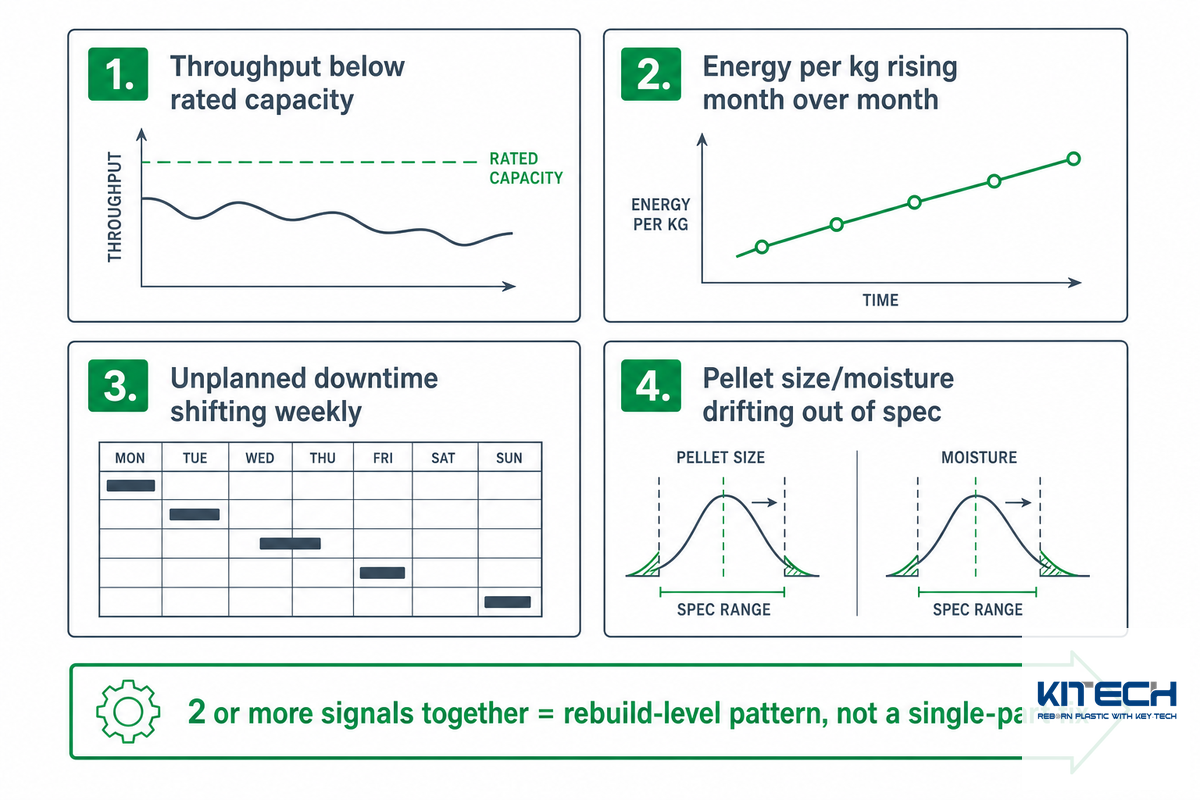
Pelletizing lines rarely fail all at once. They drift. Four measurable symptoms tell you the drift has become a decision, not a maintenance ticket: throughput falls below your line’s rated capacity even with good feedstock; energy draw per kilogram creeps upward month over month on the same material; unplanned downtime starts happening weekly instead of monthly; and pellet size or moisture consistency drifts outside your buyer’s spec sheet.
No single indicator points directly to “rebuild.” A single bad screen changer will trigger a throughput dip that a $2,000-3,000 can correct over a weekend. But when any two of these four (or more) conditions co-occur-falling output, energy increase, increasing stoppages and a wandering pellet quality-that suggests the various phases are aging in tandem rather than just one component giving out. Kitech’s own pelletizing-series machines fall in the 0.2 to 0.4 kWh/kg range for the KCP, 5G KCP Plus, KSP and TSK machines; if you’re seeing significantly more than that value for the machine’s stated capacity, that alone warrants closer inspection before even considering further investigation.
📐 Engineering Note
Focus on these four measures every month, not just annually. Losing 5% throughput one month and another 5% the next points to active wear; losing 8% once and staying flat since looks more like a bad batch of feedstock. NIST’s research on manufacturing machinery maintenance economics is a useful reminder of why this monthly discipline matters: reactive maintenance strategies carry real, measurable downtime costs, not just theoretical ones.
Here’s the symptom-stage mapping, which can help you know which place to begin with when calling up to get a quote.
| Symptom pattern | Likely equipment stage | Check first | Likely path |
|---|---|---|---|
| Throughput down, energy flat | Extruder screw/barrel | Output vs. rated spec, same feedstock | Reline or replace screw/barrel |
| Energy per kg rising, output flat | Drive motor or heating zones | kWh/kg vs. 0.2-0.4 baseline | Drive/motor upgrade |
| Screen changes more than once/shift | Melt filter | Filter-change log, last 30 days | Self-cleaning filter upgrade |
| Pellet size or shape inconsistent | Pelletizer head or die | Die wear, water/air temperature control | Die service or pelletizer head upgrade |
| Moisture reading out of spec | Drying/degassing stage | Vacuum degassing performance | Degassing system service or upgrade |
| Weekly downtime, multiple causes | Several stages aging together | Cross-check all four signals at once | Full-line rebuild evaluation |
| Controls predate current PLC generation | Automation/controls | HMI/PLC generation, safety compliance | Controls retrofit (either scope) |
| Growth plan exceeds rated capacity | Whole line undersized | 3-5 year production plan vs. rated throughput | Rebuild for capacity, not condition |
| Contamination or reject rate rising | Upstream washing/sorting, not pelletizing | Feedstock spec vs. contract terms | Fix feedstock input before crediting or blaming the pelletizing line |
Whole-Line Rebuild vs. Single-Stage Upgrade: The Component-Swap Threshold
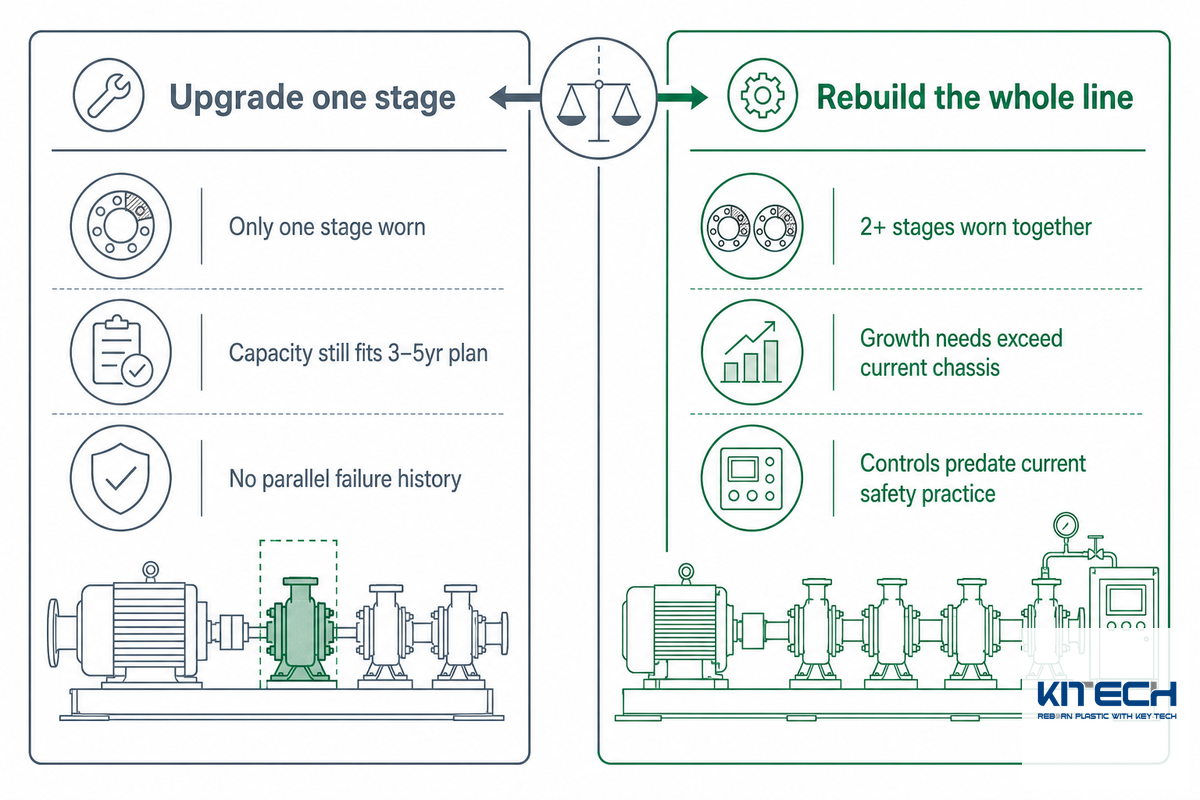
However, if your pelletizing line is comprised of a series of separate stage – ie, the compactor or force feeder, the extruder, the filtration stage, and the pelletizer head, it usually makes little sense to replace the three other parts when one stage fail. In fact, this modular construction principle is the reason behind the Kitech KCP, 5G KCP Plus, KSP and TSK models, where any combination of these individual units (compactor, extruder, filter and pelletizer head) can be chosen for a new machine and substituted with different components later on. This, more or less, is the practical background of the “Component-Swap Threshold” that follows.
✔ Upgrade one stage when
- At present, only one stage(either filter,screw/barrel or pelletizer head) shows wear signs listed below.
- Rated capacity matches your production plan for the next 3 to 5 years
- Rest of line history didn’t experience failures in parallel
⚠ Rebuild the whole line when
- At least 2 stages show evidence of wear in a 3-month period.
- Higher throughput, automation, or output-grade will be required to realize future growth strategies
- Controls, cutter, or guarding on the current line is older than the current best practices and would need retrofitting no matter what
That second rebuild condition is worth sitting with. Cross-industry data on capital equipment decisions shows that repairing and rebuilding is more economical than replacing in the majority of cases – but it also flagged the specific exception: when growth plans require higher speeds, more automation, or greater flexibility than the existing machine can deliver, the case for a new line get stronger, sometimes decisively. Industry guidance on heavy equipment repair-versus-replace decisions makes this same point outside plastics processing, and it holds here too: a line that’s merely worn is an upgrade candidate; a line that’s structurally undersized for where the business is going is a rebuild candidate, regardless of how well its current parts are holding up.
A note on safety scope: any retrofit that touches control, the cutter, or guarding should be treated as a chance to bring the line up to current machine-guarding and lockout/tagout practice, not just a like-for-like parts swap – this applies whether you upgrade one stage or rebuild the whole line.
RFQ checklist for an upgrade quote — copy these into your request:
| Parameter | Recommended range | Why it matters | How to verify |
|---|---|---|---|
| Current vs. target throughput (kg/h) | State both, plus 20-30% growth margin | Sets whether one stage or the whole line needs resizing | 30-day production log |
| Energy draw (kWh/kg) at rated output | Compare to 0.2-0.4 kWh/kg baseline | Flags whether the extruder or drive is the real bottleneck | Utility meter reading over one shift |
| Screen/filter change frequency | >1 change per shift = flag | Distinguishes a filtration problem from an extruder problem | Maintenance log, last 30 days |
| Controls/guarding age vs. current standard | Flag anything pre-dating current PLC/HMI generation | Affects safety scope and whether a partial upgrade still needs a controls retrofit | Nameplate/commissioning date |
| Screw/barrel wear inspection interval | Every 2,000-3,000 operating hours | Determines reline-vs-replace vs full extruder swap | Bore gauge / screw measurement records |
| Pellet moisture and size consistency | Within your buyer’s spec sheet | Separates a pelletizer/die issue from a drying issue | QC sample log, last 3 batches |
| Feedstock resin type and contamination level | State exact resin(s) and typical contamination % | A hardware upgrade cannot fix a feedstock-quality problem | Incoming-material spec or supplier data sheet |
| Current warranty/service status | Note if original equipment is still under warranty | Affects whether a component swap voids remaining coverage | Original purchase/service contract |
| Floor space and utility headroom | Confirm available power, water, compressed air | A bigger upgrade (e.g. underwater pelletizing) may need more of all three | Facility utility drawings |
Where Component Upgrades Actually Pay Off
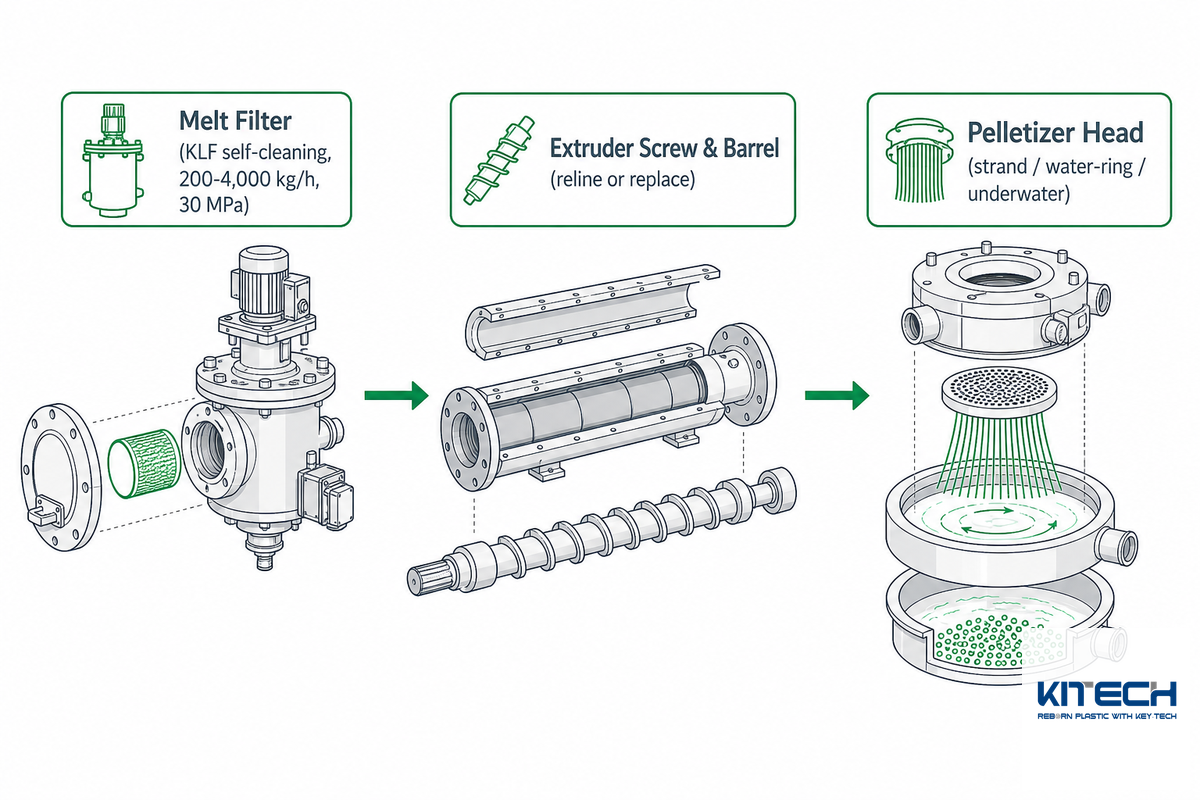
Three components carry most of the wear on a working pelletizing line, whichever raw material or types of plastic waste it processes: the melt filter, the extruder screw and barrel that turns solid feedstock into molten plastic, and the pelletizer head and die plate that cut it into finished pellets. Each has its own upgrade logic, and each already has a dedicated breakdown on this site – this section only covers what decides whether that component is your bottleneck.
Filtration. Manual or hydraulic screen changers that need changing more than once per shift on contaminated post-consumer feedstock are strong candidates for a continuous self-cleaning filter. Kitech’s KLF-series auto self-cleaning laser filter runs 200-4,000 kg/h at up to 30 MPa without stopping the line for a screen change.
The full decision matrix – including when a conventional screen changer is still the right call – is in our self-cleaning filter vs. screen changer comparison.
Extruder screw and barrel. Abrasive feedstock (glass-filled resins, mineral-loaded compounds, heavy metal contamination) wears screws and barrels faster than clean regrind. Screws or barrels that lose rated output on the same feedstock, or show visible flighting wear on inspection, can often be relined or replaced without touching the rest of the line – a repair option that costs less than a full replacement and far less than a rebuild.
Material and process selection details are covered in our pelletizing line types and selection guide.
Pelletizer head. Strand pelletizing, water ring pelletizing, and underwater pelletizing systems suit different resins and throughput bands, and switching between water-ring and strand is comparatively simple because they share similar extruder geometry and downstream conveying. Moving up to underwater systems is a bigger step – it typically means overhauling the water box, polymer diverter valves, and water-treatment skid, which starts to look like a partial rebuild rather than a component swap. See our full strand vs. water-ring vs. underwater pelletizer comparison for the material-fit decision matrix.
Energy and Throughput Gains a Retrofit Can Realistically Deliver
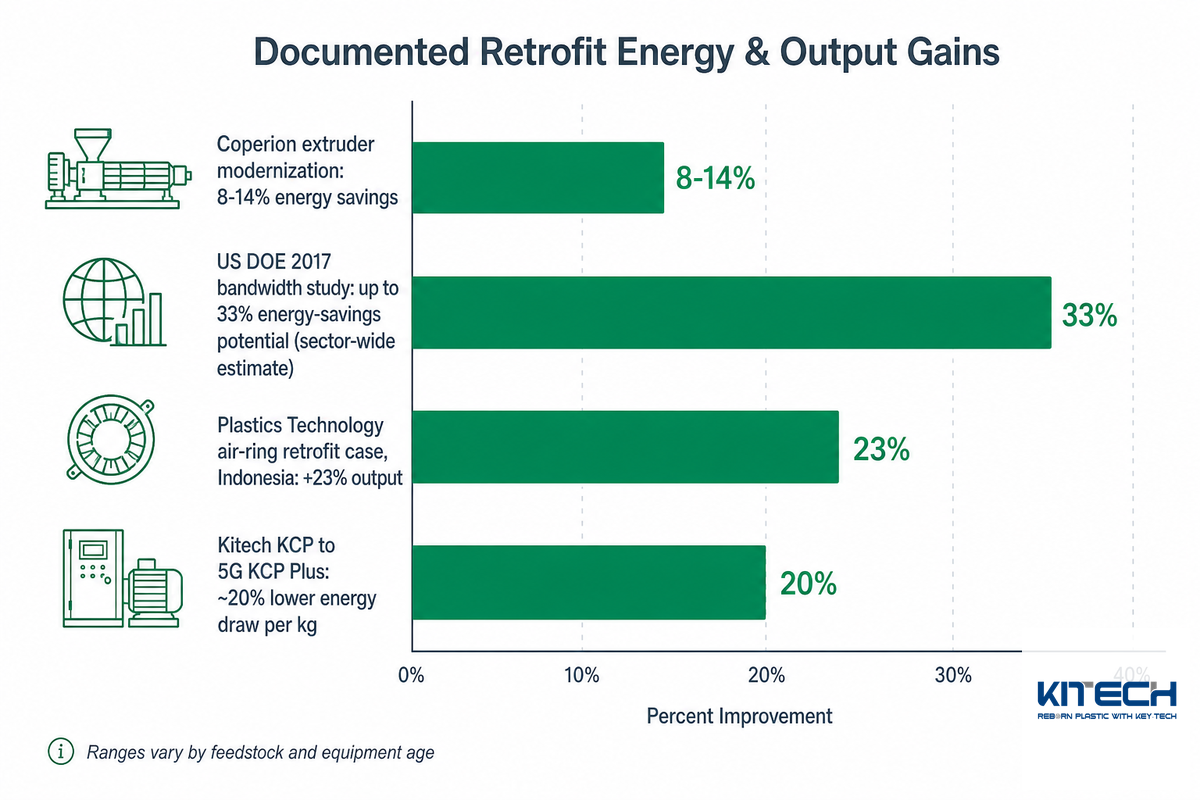
The published retrofit data varies quite a bit, and the range is the honest answer: extruder modernization projects that Coperion tracked averaged 8% to 14% energy savings, and a 2017 U.S. Dept. of Energy study of plastics and rubber put extrusion energy-savings potential at up to 33% — still the most commonly cited government figure for that equipment category, though the study is approaching a decade old. Neither figure is a promise for your particular line; the DOE study explicitly states its numbers are sector-wide estimates and not predictions for your facility, as actual results depend on your feedstock, the age of your existing equipment, and how much of the retrofit you implement.
Where the numbers get more concrete: Plastics Technology reported a named film processor in Indonesia realizing up to 23% output increase from an air-ring retrofit alone, with improved gauge uniformity as an additional benefit. On Kitech’s own lines, an upgrade from standard KCP to 5G KCP Plus represents a documented 50% throughput increase and an approximate 20% reduction in energy consumption per kilogram, due to the inclusion of a synchronous drive motor and smart heating zone control rather than a full rebuild.
One Caveat on all the above numbers: These represent hardware-side gains. Retrofits can’t overcome upstream feedstock quality issues — a screen changer running clean for 20 hours won’t achieve its rated throughput if the incoming flake is wet, mixed-resin, or heavily contaminated. Fix the input side before blaming (or crediting) the machine.
Rebuild Budget vs. Upgrade Budget: Cost and Payback
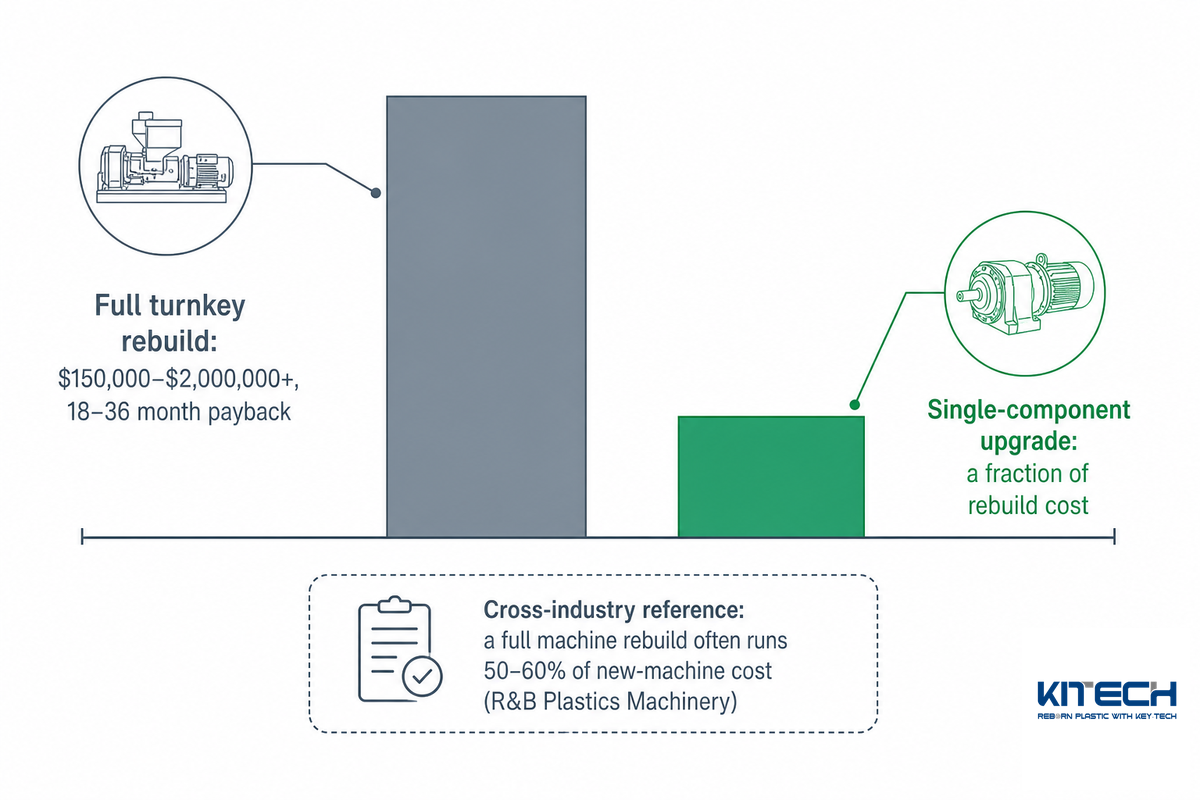
Full-service, turnkey pelletizing lines take $150,000 to over $2,000,000, depending on scale and automation level; a standalone pelletizing system can range from approximately $30,000 to $250,000, depending on 200 to 3,000 kg/hr capacities. These are Kitech’s published investment bands, with the payback range across these values typically running 18 to 36 months. Single component upgrades (e.g., a filter, a screw/barrel set, or a control system upgrade) are available for a fraction of those amounts, but actual component pricing depends on your machine configuration and supplier.
For an industry cross-reference on rebuilds in particular: R&B Plastics Machinery, which specializes in rebuilding blow-molding and extrusion equipment, quotes a fully rebuilt machine at roughly 50%-60% of the cost of buying new – a ratio from outside pelletizing specifically, but directionally useful when weighing a full-line rebuild against a new-line purchase.
5-year total cost of ownership: rebuild vs. upgrade
| Cost item | Option A: full-line rebuild | Option B: single-stage upgrade |
|---|---|---|
| Purchase price | $150,000-$2,000,000+ (turnkey line) | A fraction of a full line (component-dependent) |
| Installation & commissioning | ~60-day delivery, full-line commissioning | Typically weeks, single-stage swap-in |
| Energy (5-yr) | Resets to current baseline (0.2-0.4 kWh/kg range) | Improves only the upgraded stage’s contribution |
| Maintenance & spares (5-yr) | Lowest near-term, full warranty reset | Remaining original stages still age on their own schedule |
| Downtime risk (5-yr) | Higher during the changeover window, lower after | Lower changeover risk, but unaddressed stages remain a future risk |
Payback example: at Kitech’s published 18-36 month payback range for a full turnkey line, a plant replacing a line that has already lost 15-20% throughput to combined wear across multiple stages will typically recover the rebuild cost faster than a plant patching one stage at a time while the others continue to degrade — the reverse is true when only one stage is actually failing.
Installation Downtime and Spare-Parts Reality
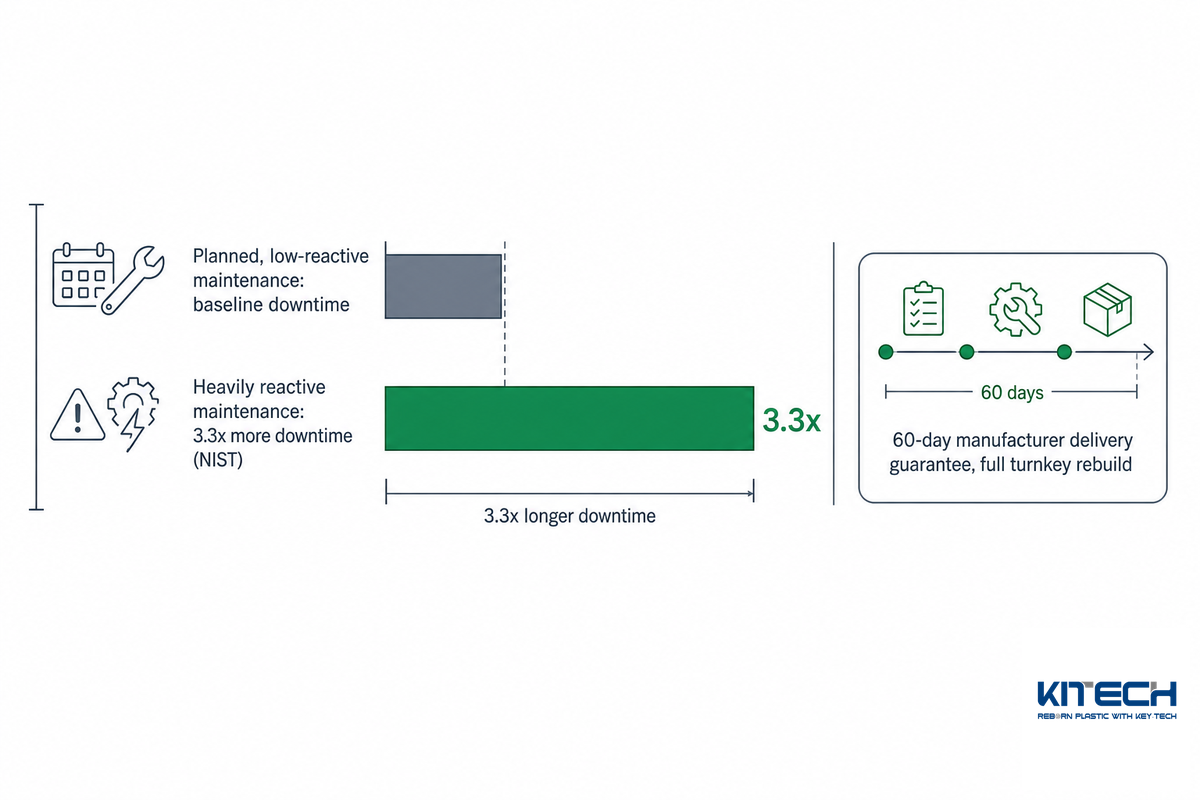
The cost of downtime isn’t distributed equally across maintenance strategies. NIST’s analysis of the economics of industrial machinery maintenance found that facilities practicing heavily reactive maintenance strategies — fixing issues only as they occur — incurred about 3.3 times the amount of downtime compared to facilities with planned, less-reactive strategies. That gap is significant for our purposes, as a line limping along with reactive maintenance practices makes it a worse candidate for “just upgrade one part and see” than a line with a documented maintenance program, as the timing of the next failure is less predictable on the reactive line.
Full turnkey rebuilds come with a 60-day manufacturer delivery guarantee from order confirmation, plus on-site installation and commissioning. Single-stage upgrades generally are faster to install because only one part of the line go down, but actual timing still relies on supplier lead time for that particular part. Both routes can take advantage of global spare-parts inventory and remote monitoring support-Kitech’s 5G-series lines even include AMS predictive-maintenance alerts so the next wear signal arrives before it causes an unplanned stop.
Why Now: Regulatory Pressure on the Rebuild-or-Upgrade Timeline
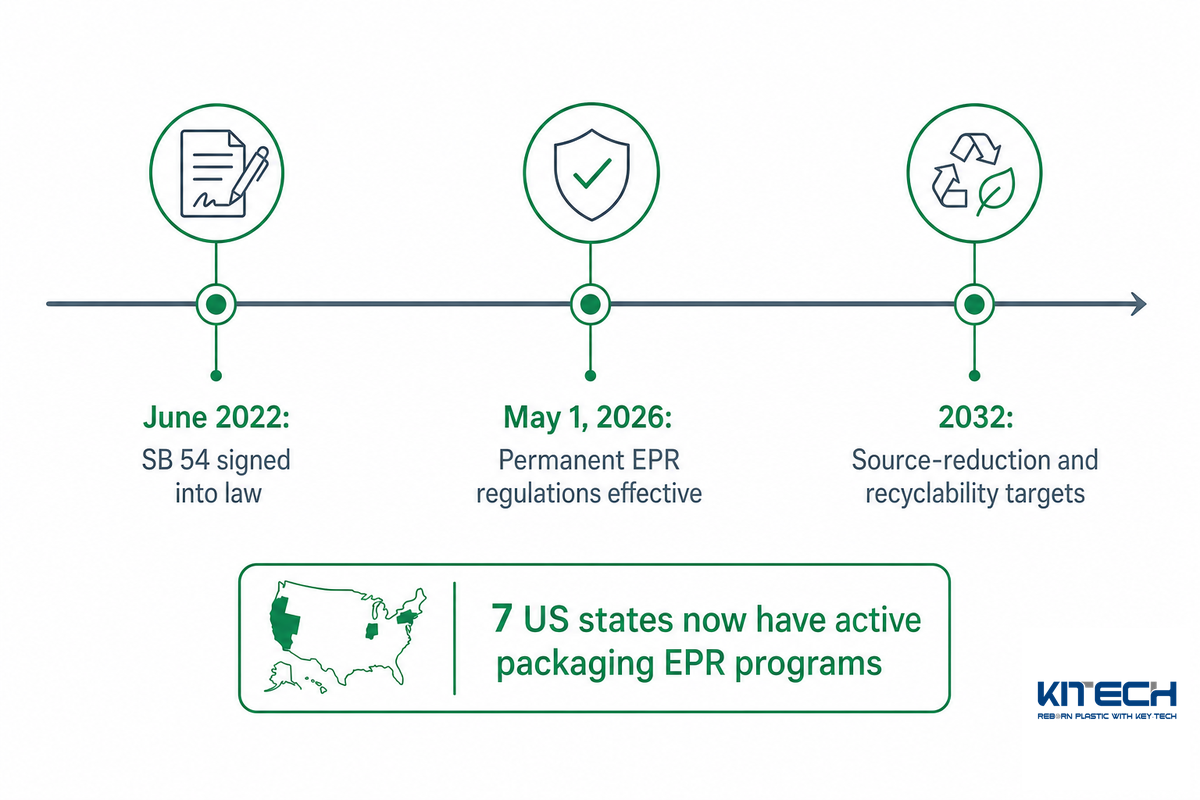
California’s SB 54 Plastic Pollution Prevention and Packaging Producer Responsibility Act – signed in 2022, with permanent extended producer responsibility (EPR) regulations approved and in effect May 1, 2026 – is worth watching, even if you don’t process packaging directly. Six other U.S. states have since enacted their own active EPR programs as of mid-2025.
SB 54 doesn’t require any specific pelletizing line to be upgraded; it regulates packaging producers, not equipment operators. However, it places a hard, dated obligation on brand owners to increase recycled content and recyclability in the products they sell in California.
That regulatory pressure flows downstream indirectly: as more brand owners commit to recycled-content goals, the processors supplying that recycled resin feel pressure to hold tighter output-quality and consistency specs than “good enough for a lower grade” pellet used to require. Lines that were adequate for a commodity-grade customer five years ago may not meet a brand owner’s ever-tightening specification list today – a solid, date-specific reason to revisit your rebuild-or-upgrade timeline now instead of waiting for a breakdown to make the decision.
None of this changes with the type of plastic waste you process. Whether your feedstock is PE film and plastic bags, foam plastic, PVC, or mixed post-consumer plastic material, the end goal of any pelletizing solutions upgrade is the same: processing recycled feedstock into recycled pellets with consistent pellet quality, controlled moisture content, and low enough operating costs to compete with virgin resin. Film recycling in particular rewards energy-efficient pelletizing and polymer pelletizing precision, since thin, contaminated plastic film punishes a tired line faster than clean rigid regrind does. Get the rebuild-or-upgrade call right, and your recycling operations keep turning waste plastic into new plastic products your buyers can actually use – not just pellets that technically came out the other end.
This holds across different types of plastic pelletizing systems and different types of plastics, including recycled PP and other recycled material: whether you call the machine a plastic pelletizer or describe the whole line as plastic recycling pelletizing equipment, the same rebuild-or-upgrade logic applies. Pelletizing technology has improved enough in recent years that recycling plastic waste into high-quality plastic pellets is now mostly a question of recycling efficiency, not raw feasibility.
Frequently Asked Questions
Q: What is a pelletizing line?
A pelletizing line is the equipment system that melts, filters, and re-forms plastic scrap into uniform pellets ready for injection molding, blow molding, or film extrusion.
Typically it combines a feeding stage, an extruder, a melt filter and a pelletizer head. Most lines process PE, PP, PET, or HDPE, though the core process stays the same regardless of resin. For a breakdown of the different types of pelletizers, as well as criteria for selecting one, please refer to our complete pelletizing line guide.
Q: How much does it cost to upgrade a plastic pelletizing line vs. rebuild it?
A single-component upgrade costs a fraction of a full rebuild; a complete turnkey rebuild runs $150,000 to over $2,000,000 depending on capacity, with an 18-36 month typical payback.
Component pricing will vary based on supplier and specific part, but as a cross-industry reference point, a full machine rebuild has been quoted at roughly 50%-60% of the cost of a new, equivalent machine. For capacity-tiered figures, please see our detailed pelletizing machine cost breakdown. Ask any supplier for a written quote broken down by stage so you can see exactly what you are paying for.
Q: Can I upgrade my pelletizing line without replacing the whole system?
Yes — on a modular line, the filter, extruder screw and barrel, and pelletizer head can typically be upgraded independently as long as only one stage is actually failing.
This is only applicable if the rest of your line has not experienced parallel wear and if the machine’s rated capacity continues to meet your production needs (refer to The Component-Swap Threshold above for the decision table). Most modular lines, including Kitech’s KCP and 5G KCP Plus series, are designed with this kind of staged, component-by-component upgrade path in mind from the start.
Q: How much energy can I save by upgrading vs. rebuilding?
Published retrofit data ranges from 8% to 33% depending on scope, though these are industry-wide figures and results are never guaranteed for a specific line, feedstock, or equipment age.
Upgrading a standard KCP model to 5G KCP Plus results in an estimated 20% reduction in energy usage, as stated by the manufacturer.
Q: How long does a pelletizing line rebuild or upgrade take?
A full turnkey rebuild carries roughly a 60-day manufacturer delivery guarantee; a single-stage upgrade is usually faster since the rest of the line stays running.
Actual time is subject to supplier lead time for the specific part and the scheduling of on-site installation work.
Q: Do I need to upgrade my whole line if only my pelletizer head is worn?
No — switching between water-ring and strand pelletizer heads is comparatively simple because they share similar extruder geometry and downstream conveying, so this is normally a component-level upgrade, not a rebuild trigger.
The exception to the rule is moving to an underwater pelletizer: it will almost certainly involve a full overhaul of the water box, polymer diverter valves, and water treatment skid, which begins to look more like a partial rebuild. Please refer to our strand vs. water-ring vs. underwater pelletizer comparison for more on the materials best-suited to each technology and the associated decision-making criteria, including the possibility of switching technologies at a later date.
Why We Write This
Kitech designs and manufactures turnkey new pelletizing lines as well as individual building blocks – KCP, 5G KCP Plus, KSP, and TSK series modules – that let buyers upgrade an existing line over time, in stages, across the wide range of polymers Kitech’s lines handle. This piece exists because the two choices, rebuild or upgrade, are too often presented as a single discussion, whereas an informed buyer can ask sharper questions when requesting an upgrade estimate for their recycling systems.
References & Sources
- SB 54: Plastic Pollution Prevention and Packaging Producer Responsibility ActCalRecycle, State of California
- Countdown to Compliance: Packaging EPR DeadlinesBaker Donelson
- Bandwidth Study on Energy Use and Potential Energy Savings, Plastics and RubberU.S. Department of Energy
- Economics of Manufacturing Machinery MaintenanceNational Institute of Standards and Technology
- Ways to Increase Energy Efficiency in ExtrusionCoperion
- Film Processor Boosts Line Performance with Air-Ring RetrofitPlastics Technology
- Is It Better to Repair, Rebuild or Replace Heavy Equipment?MacAllister Machinery
Related Articles
- Plastic Pelletizing Line: Types, Selection & Process Guidefull types/components/selection walkthrough
- Self-Cleaning Laser Filter vs. Screen Changersfiltration retrofit decision, including a TCO worksheet
- Strand vs. Water Ring vs. Underwater Pelletizerpelletizer head type comparison and switching guidance
- Plastic Pelletizing Machine Costcapacity-tiered pricing breakdown
- Plastic Recycling Plant Cost Guide 2026CAPEX/OPEX for a full plant, not just the pelletizing stage
Reviewed by the Kitech technical team.