Get in touch with Kitech Company

Plastic Shredder vs Granulator: What’s the Difference and When to Use Each


When it comes to recycling and waste management, equipment for plastic recycling must be chosen with care as it affects efficiency, quality of output, and cost of operation. The field makes extensive use of two machines, plastic shredders and granulators. At first glance, both machines look very similar, but they have different functions and are used for different purposes. It is important to differentiate between shredders and granulators if you want to maximize the efficiency of your recycling process and get the best results possible. The purpose of this article is to identify the key differences between the two machines, their respective features, and how to choose between them based on the requirements of the business. If you are enhancing material recovery or optimizing production, this guide shall help you out in carefully assessing your options.
Introduction to Plastic Shredders and Granulators
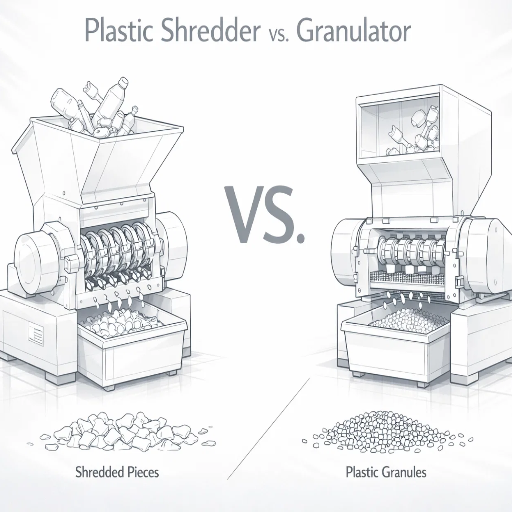
To understand a plastic shredder vs granulator, it is important to understand plastic shredding machines and plastic granulating machines. These machines function according to the kind of plastic in the process. A shredder can help cut plastic waste into larger pieces, hence shredding down material to a coarser level and pre-processing of material for further granulation process. Alternatively, a granulator reduces the plastic to very tiny pieces, usually granulate/homogeneous particles, which is very important for good quality recycled material. Accordingly, it is the output size and purpose that vary, where shredders are used before the material is further granulated, and granulators are used before final products are made. Their role is crucial in the recycling industry of today as they drive various processes of different types of materials to reach a certain goal.
Plastic Shredders
Plastic crushers, or shredders, are machines that cut down large plastic materials like pipes, crates, films, etc., into smaller pieces. They have rotating blades or shafts that force the material into rough shreds that can be easily transported or further processed. Shredders are typically used in many recycling stages as they make it possible to convert volumes of waste into sizes that then suit other operations, such as granulation.
Granulators
Granulators are sophisticated devices designed specifically to break plastic down into smaller, more manageable granules, which generally have a size of a few mm up to a few centimeters. Such devices make use of high-speed rotating blades and specially designed sieves or screens to maintain the consistency of the granulated material. In most instances, granulators are used where reprocessing of material is necessary, so that the material is appropriately conditioned according to the purpose of use, hence production feed is met as required by the subsequent manufacturing process.
Primary Functions and Applications
Large plastic items or waste materials, when shredded, turn into coarse pieces of a smaller size. As a preparation measure, this helps in easy handling of the materials and promotes further processing or ecologically efficient separation of plastics. Their use is common in industries engaged in recycling, as such bulky wastes are broken down, duly handled by packaging restraints and or handling e-wastes and sharable due to construction wastes.
Meanwhile, granulators convert this size-reduced material into fine powder or, in other words, very small particles in the size of granules. Most of their uses come from processing, incorporating dosing in formulations, improving the quality of raw material, and even limiting the manufacturing process itself, such as extrusion and injection. Granulators serve an especially important role in maintaining the shape and size of the particles, which are essentially the same, and can ensure proper reintegration into the manufacturing process or the chosen products. These two devices can improve recycling processes, reduce the waste of raw materials, and also support the environment and ensure green production.
Importance of Distinguishing Between the Two for Efficient Material Recycling
It is significant to employ plastic waste processing equipment to achieve higher efficiency in recycling and related processes. Reducing great masses and pieces of materials into manageable ones is the function of shredders, whose construction is often characterized by slow speed and high torque constructions. Distinguishingly, granulators take these shredded materials and further analyze them until smaller and more even masses are formed, thanks to their high-velocity rotating knife mechanism. In this way, effective preparation and fragmentation of materials depending on recycling applications, whether preparation of raw materials before feeding into the manufacturing processes or reprocessing, are great. Using the appropriate tool at the respective stage allows manufacturers to increase the production rate, save energy, and improve the quality of the materials utilized, thus going hand in hand with environmentally-friendly goals.
How Plastic Shredders Work
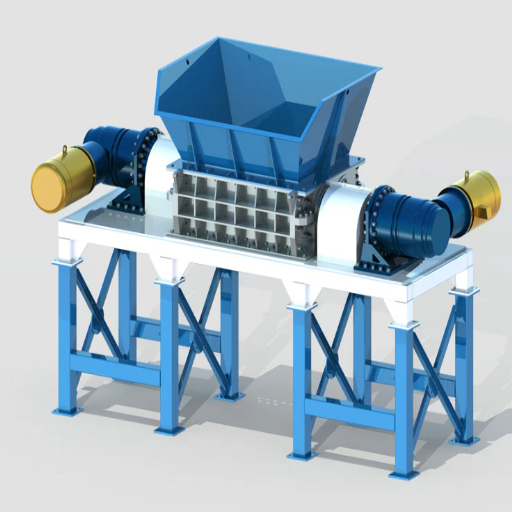
Plastic material shredders work on enthralling principles. Rotative blades referred to as ‘cutters’ work at different rpm and different degrees of hardness in cutting plastic for further breakage into small pieces. For shredding, the machines for plastics can be operated in one or more than one stage, depending on the final output size and the type of material. The items, for instance, the bottles, or containers, or industrial damage, all these will go to the machine hopper where the reduced material cutting system draws them in the form of fragments. More advanced machines have cutting speed, number of blades, and screen size adjustable to the needs of the user. Control features also include settings that provide the desired particle size, ensuring more efficiency in further processing for recycling or reprocessing purposes.
Detailed Explanation of the Shredding Process
Shredding consists of several key preparatory steps whereby hard materials are chopped into pieces, which can then be used to make something.
- At the very outset, the raw materials need to be placed in the shredder’s internal hopper.
- Then they are gravity-fed or force-fed into the main shearing compartment of the shredder.
- A series of revolving blades or knives cut or crush the entire workpiece present in this compartment. Such shredders exhibit dual-shaft, single-shaft, or quad-shaft options depending on the volume and type of material to be processed.
- In the process of cutting, a system of interchangeable filters or sieves will also be employed to control the size of the shredded pieces. For some processes where a specific size of cut particles is required, different screens with appropriate opening sizes are employed in order to accommodate recycling or any other re-utilization equipment.
- Sophisticated shredders incorporate protective measures into the systems — for example, an automatic rewind mechanism to prevent clogging or damage to the motor. Electronics use circuitry and sensors, which track the material flow and identify the occurrence of instability, to improve both functioning and to minimize the loss of time.
- Environmental and health concerns have emerged with shredding machines, and many models include measures for dust and noise reduction. In the end, it is such an advanced and designed process that is able to contemplate handling materials in such a way that is more manageable, and therefore more appealing in terms of sustainability and rematerialization.
Types of Plastic Shredders
① Single-Shaft Shredders
Single-shaft detail shredders have knives mounted on rotors, based against a fixed cutting counter blade. The shredder edges are sharp for the purpose of segmented cutting. The shredders are mostly used on the plastic unified particle size in the folders. One of the best cases for these machines is cutting plastic film, pipes, and other materials, without breaking the laws of production for a certain size.
② Dual-Shaft Shredders
Dual-shaft shredders have two parallel cutter-bearing shafts that rotate at low speed; this principle allows for dealing with bigger and bulkier material, e.g., tyres, barrels, and more cumbersome plastic components. Dual shaft machines are known to be tough, quiet, and have a self-feeding system to avoid clogging; hence can be used for shredding even at the industrial level.
③ Four-Shaft Shredders
Models with four shafts use primarily two sub-system pre-shredders, and further cutting is done at two supplementary shafts. They have more accuracy in cutting and can reduce the size of the process materials to very small dimensions. Four-shaft cutters include materials that are complex or fortified, such as mixed solid wastes and dirty plastic materials, which makes them multifaceted. They stand up under intense conditions for waste management, vastly improving operations.
Common Uses of Plastic Shredders in Waste Management and Recycling
Among the foremost interventions in the management of waste and promoting recycling processes is the breakdown, reuse, and disposal of materials in use; plastic shredders carry out such activities. Examples of such practice vary: for instance, the reduction of consumer plastics after their first use up to levels where they can be micro-cleaned and reused for further manufacturing processes allows for such practice. Furthermore, they are essential in ensuring the disposal of waste material in countries where models of fabricated materials are used in industries. Besides helping in these ways, they aid in activities such as the conversion of plastic shreds into molten pellets and granulates so that they can be used in new product premises, hence achieving the concept of a circular economy. Such equipment assists in minimizing the use of landfills and improving plastic waste recycling systems.
How Granulators Work
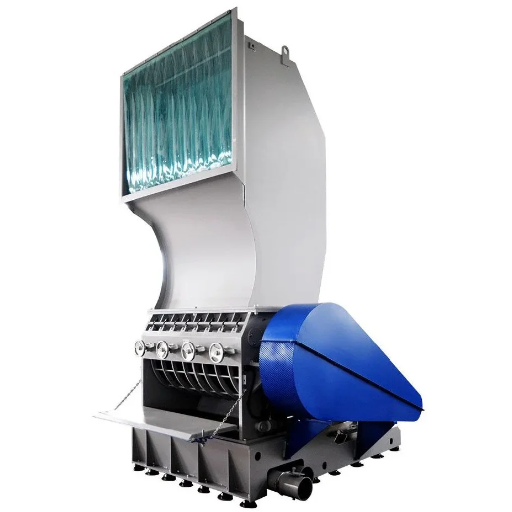
Instead of shredding, Granulators perform a similar function of size reduction of plastic waste through chipping and cutting action. It begins when the plastic materials are placed into the granulator’s coils, which act as a cutting chamber. Within it, there are rotating blades that cross the blades, which are positioned to release the material in pieces of equal size. Granule sizes are accommodated by a perforated shield under the cutting chamber that sieves out larger particles. Such removal of plastic waste piles up and prepares fresh plastic for other operations, such as melting, extrusion, or any other recycling and recovery processes.
Detailed Explanation of the Granulating Process
The process of granulation, or size reduction, encompasses several important phases that are geared toward reducing and preparing materials for secondary use.
- First, the refuse of polymer waste is grabbed and placed into the granulators’ supply hopper.
- After that, the material is fed into the chamber, where high-speed rotating blades installed opposite each other and incorporated with a static blade come into contact to shear the incoming material into bits. The manufacture of the blades uses hardened steel to minimize wear and tear. To achieve the aimed cut, the shape of the blades is designed with that in mind.
- This is achieved through a designated sieve, which is a perforated sieve placed beneath the cutting chamber. The screen has cut-out tiny holes through which the small granules pass, as it hinders more significant pieces from escaping, enabling additional shredding. The terminal granule size is controlled by the size of the openings in the screen, which ranges from approximately a millimeter to even longer, depending on the application.
- To achieve even granular materials, these granulator models have air evacuation systems, cooling, and other devices to prevent clogging in applications with high-friction materials. The presence of precision-engineered bearings and powerful motors allows for operation over a long period without using too much power and without putting much strain on the machine. These parts also need to be well-tuned and in good working condition to enhance their function in the granulation process, make sure that all the products are of the same size, and make the recycling stages up to the extrusion and compounding more effective.
Key Components of Granulators
- Rotor – this is the main cutting element with blades that rotate and cut the material by means of stationary bed knives. The rotor influences the cutting performance majorly by its design, such as the number of blades and the speed of rotation. Open rotors are generally used for soft plastics, while keeping closed versions for harder substances.
- Bed Knives – these feature stationary cutting edges that are placed close to the rotor and enhance slicing. These knives need to be very sharp, properly adjusted, and very tough to avoid quitting cutting operations effectively. The additional clearance allows for the fine-tuning of the bed knife, which results in better granulation as well as reducing wear of the rotor.
- Screens – Screens are perforated sheets that are placed below the cutting section and are responsible for controlling the upper limit of the output granule’s dimension. It is important to note that the screens used to process the material are specific in the design of the perforation, with different sizes of the hole for different desired granule sizes. The screens keep the size of the particle constant and avoid clogs or damage to the downstream equipment; hence, screens should be checked and replaced from time to time.
Common Materials Processed Using Granulators
There is a wide range of industries that do extensive use of granulators, for their ability to employ such machines to cut most any type of material. Commonly granulated materials include:
- Commonly used plastics such as Polyethylene (PE), Polypropylene (PP), Polystyrene (PS), and PVC
- Rubber items, including tires and other industrial components reduced for reuse
- Aluminum, copper wire, and other metals for easy separation and recycling
- Non-metallic materials such as wood, paper, and agricultural wastes for biofuel manufacturing or compost
Such versatility in granulators makes them very important to industries dealing with material recovery and size reduction.
Key Differences Between Plastic Shredders and Granulators
Plastic shredders and granulators are built differently and have different applications. Shredders merely reduce the volume of large waste plastic into smaller, uneven pieces or strips by shredding. They work at low speeds but with great torques, which makes them suitable for disposing of, for instance, plastic pipes, tanks, and containers that are obviously large in size. As for granulators, these are good for making small-sized particles or pellets or equally sizing smaller or prepared material. They are high-speed machines that contain cutting tools for accurate cutting. Although shredders work best for rough fragmentation, granulators are better at transforming solid waste into smaller fabrication sets ready for recycling and remanufacturing.
Comparison of Shredding vs. Granulating Processes
| Parameter | Shredding | Granulating |
|---|---|---|
| Output Size | Coarse pieces | Fine granules |
| Material Input | Large, bulky items | Pre-shredded / small |
| Speed | Low | High |
| Precision | Low | High |
| Blade Design | Rotating knives | Cutting mechanisms |
| Purpose | Initial reduction | Reusable particles |
| Operating Cost | Lower | Higher |
| Efficiency | General | Specialized |
| Typical Use | Bulk reduction | Material refining |
Differences in the Output Material Size and Shape
Both the functional uses and the construction of the shredders and granulators lead to the formation of different sizes and shapes of shredded elements. For instance, shredders produce large and rough shapes for use in reducing bulk materials and during the first stage of processing. Those shapes vary in size, but they are primarily different from each other. In contrast, granulators have the purpose of making thin, smooth-edged, and uniform pieces, all of which are necessary for the accurate processing of materials. The design of the granulators’ cutters enables deductions in the dimension target uniformity. The structure of the shredder and cutting blades differs by performance and capacity, as well as the capabilities of the cutting blades. For instance, the plastic shredder vs granulator is considered the distinction made for better work handling in the recycling system between the different levels of stages.
Performance, Capacity, and Energy Efficiency Considerations
The performance, capability, and energy productivity of a particular material processing machine are based upon many factors. Performance measures include throughput stability in the prioritization, where it is ensured that the machine processes a vast amount of material, and no deterioration of the output occurs. Capacity is dependent on the effective management of how much content the machine can intake and the scale of production it can be altered to in order to meet the production needs. In addition, energy efficiency has become an important aspect for modern granulators and refining equipment, which save energy with the help of features like variable frequency drives (VFDs) or redesign of motors to consume less energy and still be efficient. The incorporation of these features not only results in intervention cost reduction but also adheres to energy-saving strategies, which constitute the backbone of any well-functioning and effective system.
When to Use a Shredder vs. a Granulator

Shredders as well as granulators are both very useful machines used in material size reduction processes. Except that there is a distinction in the usage of the two based on the work environment and, most importantly, the nature of the material itself. Shredders serve more for the size reduction of extremely voluminous materials, e.g., whole pallets, large quantities of plastic in some cases, or scrap metal into more manageable parts. The shredders are so ingeniously constructed that they are more applicable in the initial phases of material destruction, especially for heavy volume and high-density materials.
Alternatively, the function of granulators is the reduction of already reduced materials into smaller-sized particles with an even distribution. They are designed for secondary operations such as preparing the injection molded scrap, film, or thin wall parts for substitution with clean regrind for the molding machine. Thus, a material type, the size to which the material is reduced, and the exact function of the shredders, i.e., either extreme initial breakdown of the material or finer step-by-step granulation, determines the choice of either plastic shredder vs granulator.
Guidelines for Selecting One Based on Material Type and Processing Goals
One of the focuses when selecting between a plastic shredder vs granulator is the material and the objective of the operation. This is very important in that shredders are typically used for operations that involve large volumes and heavy materials such as automotive parts, metals, or bulky waste because of their ability to handle massive load reductions. Moreover, any processes that do not necessitate the complete dismantling of the materials can utilize shredders as well. Conversely, granulators are more effective on light or thin materials, such as packaging films, plastic bottles, and injection molding waste. This is because, unlike the shredders, they produce the same size of particles, which are finer than those produced by precision recycling and reusage in manufacturing.
Granulators can achieve a more consistent reduction in size with less particle degradation, especially for items whose size must be kept to a bare minimum, which is why they are used. When looking for solutions that can include high-density or abrasive materials, and that can shred them down as a primary step at large volumes, shredders can be relied upon. In the end, it is an analysis of a few parameters, namely, the density of the source material, the finished size of the particles, and the process workflow to control such a process that distinguishes the plastic shredder from the granulator.
Cost-Efficiency Analysis for Various Scenarios
When carrying out an analysis of the costs and benefits associated with different measures, I look at it in terms of minimizing costs and ensuring there is a balance over time in the level of effort undertaken, deciding on investments as well as operational costs. One has to assess the critical factors determining this decision, including the choice of materials, the amount of processing, and the cost of it. For example, looking at this in terms of processing dense feed stock that require particular grain size, I would look, for instance, whether it is worth buying a more capital-intensive machine if this meant that the cost of using it in the medium term would be higher. More than anything else, I try to fit these constraints into each decision and yet maximize cost to provide service within the said period.
Case Studies: Proper Equipment Choices in Practice
Summary
Key Takeaways
- Shredders are ideal for initial, high-volume bulk reduction of large, dense plastic items.
- Granulators excel at producing uniform, fine-sized particles ready for manufacturing reuse.
- The two machines are complementary — shredders typically feed into granulators in a complete recycling workflow.
- Equipment selection should be based on material type, desired output size, volume, and cost.
- Modern machines with VFDs and energy-optimized motors offer significant long-term cost savings.
Reference Sources
Explores recycling techniques, including the use of granulators for finely ground scrap materials.
Discusses the differences between granulators and shredders, including feeding processes and operational considerations.
Frequently Asked Questions (FAQs)
How can we differentiate a granulator from a shredder?
The principal distinctions between granulators and shredders are the size reduction technique, the product sizes, and the capacities. Unlike the other machines that are used for primary and coarse size reduction, shredders are used to reduce the waste into large pieces that can be transported due to their lower speed and torque motion. These include the tires, drums, or even large furniture parts. Granulators work as fast-chopping machines that enable the formation of granules for extrusion or processing. In recycling, shredding is considered the initial process of reduction, while granulation is the final stage in reducing the material size with a specified quality of the end material.
Under what circumstances is it prudent for a recycling plant to rely on a plastic shredder vs granulator?
Many recycling processes often necessitate the use of two types of equipment, primarily because both shredders and granulators perform in stages; first, the equipment is subjected to the shredder for volume reduction, and second, the remaining large parts are sized with the help of granulators in a final processing stage. Shredders are used at the initial stage of recycling for fast and safe material reduction, followed by granulators, which give the preferred size material output that is suitable for extrusion, regrinding, or other processes associated with plastics. One may use a granulator instead of a shredder or both machines at once within a recycling process; the decision depends upon the nature of the scrap, the required rate of production, as well as the purpose, if it is met without compromising the quality of the end product.
What are the differences in the size reduction function of the shredder and the granulator in plastic shredder vs granulator to granulator?
Shredders are commonly used for primary size reduction purposes and thus work at very low speeds but produce high amounts of torque to process bulky materials and ensure maximum output for heavy scrap. Granulators are usually high-speed machines that cut materials down to granules, achieving uniformity in the reduction of size and hence the output. The output from these machines is comprised of large-sized and uneven shapes, but that is good for the purpose of transportation and preparation, unnecessary for per-processing whereas a granulator can shape or cut the size of this output to enable its use in plastic processing and extrusion as required.
Due to their nature, can shredders be applied as extrusion matrices and reprocess granules as needed?
Shredders do not produce uniform granules, as is essential for extrusion or precise plastic processing; instead, they cut and produce scraps of various sizes. During recycling processes where particulate uniformity and other qualities are important, shredders are mounted in series with granulators to produce uniform granules after shredding. It is commonplace to see shredders on recycling lines employed to size-reduce large volumes of scrap, but granulators are used to further reduce the scrap to the desired size for both recovery and reuse purposes.
In what way do throughput and torque affect the decision on plastic shredder vs granulator?
Shredders and granulators are high-capacity machines, although they work under different principles. Shredders employ a low-speed, high-torque principle for the primary size reduction of the lumpy, hard scrap, while granulators work on the principle of high speed, shear cutting motion intended for simple size reduction of the material in question. If you intend to cut down heavy scrap objects, such as large boxes or tires, use the shredder with a high torque. Granulating is used in the production of plastic materials for extrusion and recycling; thus, choose a grinder with the output capacity commensurate with the granule size to be achieved and the exit demand for the produced material.
In which shredder applications is the granulator not necessary?
Yes. Shredders may not necessarily require the use of a granulator when, for instance, they are being used for purposes such as on-site volume reduction, which is waste disposal, preparing landfill material, or shredding material into transportable pieces. For instance, when the purpose of breaking plastic waste or junk is to get doable chunks instead of producing granule-shaped particles for plastic processing, a shredder is enough. However, if the reasons are to recycle the material, re-process the material, or recycle the material to the whole extent, and the quality of an extruded feed is required, then a granulator on the back of the material would be added to the procedure.
Related Posts


Trending now