Get in touch with Kitech Company

Solid State Polycondensation (SSP) for rPET: How It Restores IV

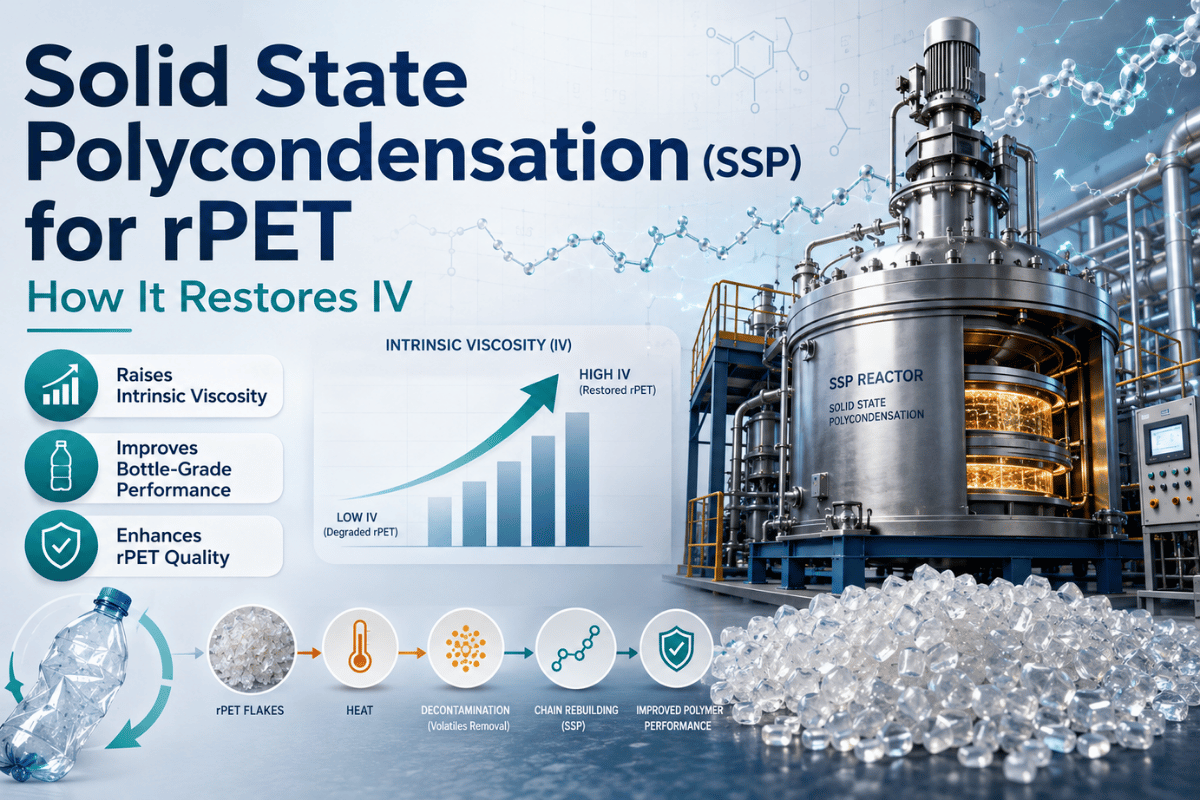
Solid state polycondensation is the final step that transforms recycled PET into a food-ready polymer For that to happen, though, the SSP process needs to be carefully controlled within exact engineering limits Learn the essentials of the process here – we cover intrinsic viscosity (IV) targets by end use, ways to comply with FDA and EFSA rules, and how to use the IV-First Selection Rule to decide whether to use a solid or liquid phase process. Whether you are in the process of selecting a new bottle-to-bottle recycling line or are assessing the need for new SSP capacity before upcoming EU policy targets take effect, this information is the technical and regulatory foundation.
SSP Process — Quick Specs
| Parameter | Value |
|---|---|
| Process type | Solid-phase polycondensation (below melting point) |
| Reaction temperature | 210–230°C (reaction stage) |
| Atmosphere | Nitrogen (N₂) or vacuum |
| Reaction time | 8–16 hours (continuous system) |
| IV increase range | 0.60–0.72 → 0.78–1.0+ dL/g |
| Acetaldehyde (food-grade target) | <1 ppm |
| Energy consumption | ~0.3–0.5 kWh/kg |
| Output | Food-grade rPET pellets (bottle / fiber / packaging) |
What Is Solid State Polycondensation (SSP) and Why Does rPET Need It?
Solid state polycondensation is a post-processing step performed on solid PET below its melting temperature — typically 180–230°C — where the thermoplastic material remains in semi-crystalline particle form rather than entering a melt phase. The process stabilizes and increases the molecular weight of PET by chain-length extension through polycondensation reactions in the solid phase.
During this phase, available carboxyl and hydroxyl end groups condense together to form ester bonds, increasing molecular weight (and hence intrinsic viscosity, IV). Volatiles and by-products — ethylene glycol (EG), water, and acetaldehyde — are extracted from the polymer matrix with either a vacuum or an inert gas (nitrogen). Removing these volatiles from the system drives the equilibrium forward, progressively extending chain length and restoring the molecular weight of PET to food-contact specification.
Recycled PET (rPET) needs this step because mechanical recycling degrades the polymer. Every time PET passes through a melt extruder — during bottle production, consumer use, collection, and reprocessing — thermal and hydrolytic chain scission shortens polymer chains and lowers intrinsic viscosity by approximately 0.05–0.15 dL/g per cycle. A post-consumer PET bottle typically arrives at a wash plant with an IV of 0.72–0.86 dL/g. After hot-wash and melt extrusion, that IV can fall to 0.60–0.72 dL/g — below the minimum 0.78 dL/g required for beverage bottle-grade applications. SSP restores, and can exceed, the original IV without re-melting the polymer, avoiding further thermal degradation.
Real-World Scenario
From garbage to food grade material A manager of a processing plant in Southeast Asia processes baled PET from municipal sources.
Post wash, flakes run in Quality Control’s instruments registered at 0.62 gL/g of IV, which does not meet food grade requirements (0.78 dL/g for bottles). Without an SSP line at 220 °Celcius under N2 flow for 12 hours, this post consumer plastic could only go to non-food grade applications such as fiber or strappings, at considerably less value. By the time the materials were extruded with an SSP line this material showed an IV value of 0.82, well in compliance of FDA grade materials with an approximated $180 to $220 per ton price premium, based on industry figures, 2025.
SSP is not required for every rPET application. Fibre-grade and strapping-grade PET products can accommodate lower intrinsic viscosity values. However, for direct food contact applications — beverage bottles, food trays, and food packaging — FDA and EFSA requirements make SSP a mandatory compliance step.
The 4-Stage SSP Process: From Flake to Food-Grade Pellet
Industrial SSP systems have four stages An industrial-scale solid state polymerization unit typically moves the rPET through four stages, with specialized process control for each. Understanding how each stage works and what could go wrong is key to properly selecting and operating an SSP unit.
- Pre-Crystalliser (160-180C) – Amorphous rPET chips or flakes are heated in a rotary drum or fluidised bed to kickstart crystallization. Skipping this stage causes amorphous PET particles to agglomerate at elevated processing temperatures — a production shutdown. The heating step raises crystallinity to 35–40%, preventing sticking before the material enters the dryer. Pre-crystallisation to ≥35% is required to prevent downstream agglomeration. Residence time: 30–60 minutes.
- Pre-Heater/Dryer (190-210C) – Crystallised chips are uniformly heated from 160C up to 190-210C whilst ensuring to lower moisture level to <30ppm. It typically involves purging with nitrogen or dried air to strip off the moisture. This heated stage also causes a mild increase in chain scission reversal with increasing temperatures and the mobility of functional end-groups. This is often the critical failure mechanism for SSP performance (see below Warning) because incomplete drying in this zone leads to the generation of carboxylic end groups, creating more reaction sites for this adverse chain scission mechanism to occur in the subsequent step.
- SSP Reactor (210-230C, 8-16 hours) – the process of polycondensation (building molecular weight) is carried out. Continuous reactors can be vertical gravity-driven, whereas batch reactors can be rotary drums. The process can operate under a nitrogen sweep (preferred for efficiency) or vacuum which remove the by-products of polycondensation (water, ethylene glycol vapor and acetaldehyde). These by-products are driven out, shifting the equilibrium towards the formation of polymer chains (ester bonds). For example, one could see an increase in IV of between0.02-0.04dL/gper hour (starting from some initial IV depending on temperature, gas phase, starting IV of materials). The Food Contact decontamination step also occurs during the SSP operation as volatile organic compounds migrate out of the polymer structure alongside the reaction by-products.
- Cooling Tower (<50C) – Once the molecular weight gain is achieved the product stream is cooled to ambient conditions (around<50°C) before either being stored, fed pneumatically ordirectly to a pelletizer.Cooling under an inert atmosphere avoids moisture pickupand colour formation (yellowing via oxidation).Direct, or hot feeding, to the pelletizer avoids ambient cooling, providing significant energy savings (20-30%) and is preferred for an integrated facility.
Engineering Note — Temperature Window Discipline
The 210-230C Operatingwindowis key. Below 180°C the polycondensation rate is too slow to achieve significant IV gain within the commercial cycle times available.Above240°C the particles start to soften, resulting in the chips sticking together and the bridging across the reactor, necessitating a manual shutdown.
Warning – The #1 SSP Failure Mode Is Not Energy: It Is Moisture
If rPET chips enter the SSP reactor with more than 100 ppm of moisture (aim for<30ppm), theywill hydrolyze,degrading thepolymer chain molecules more rapidlythan the rate at which polycondensation builds molecular weight. In this instance the resulting net change in IV is actually a decrease and not an increase (i.e. molecular weight degradation rather than buildup). More than 60% of industry SSP underperformance occurrences reported by field practitioners are attributed to this “moisture issue”. Strict moisture control prior to and into the SSP reactor is a non-negotiable parameter.
What Is the Difference Between Solid State Polymerization and Polycondensation?
While often used interchangeably in industry documents, polycondensation and solid state polymerisation represent two different levels of the same technology. Polycondensation describes the mechanism for building the polymer backbone: a step-growth reaction in which small molecules (such as water and ethylene glycol) are eliminated. Solid state polymerisation describes the overall process of making polymer in the solid phase – under the melting point of the material. In the case of recycling PET, all SSP process technologies use polycondensation as their principal mechanism. When an equipment supplier mentions an SSP system, they are referring to a polycondensation reactor operating in the solid phase. The distinction matters primarily in academic or regulatory citation contexts; operationally the two terms describe the same industrial process.
Intrinsic Viscosity (IV) Targets by Application: Setting Your Specification
Intrinsic Viscosity (IV): the main indicator of quality in rPET pellets coming off the SSP. IV is a direct measure of the average length of the polymer chains (i.e., molecular weight), and thus dictates how the rPET material can be used. Defining the optimal IV before specifying the residence time and temperature in your SSP is the single most critical decision when buying any bottle-to-bottle recycling line.
| Application | IV Target (dL/g) | Typical SSP Time | Regulatory Standard |
|---|---|---|---|
| Beverage bottle (food-grade) | 0.78–0.85 | 8–12h @ 215°C | FDA 21 CFR / EFSA |
| Food packaging (tray / sheet) | 0.75–0.80 | 6–10h @ 210°C | EFSA |
| Textile fibre | 0.90–1.0 | 12–16h @ 225°C | — |
| Industrial yarn | 0.96–1.05 | 14–18h @ 230°C | — |
| Tyre cord | >1.2 | LSP required | — |
But the process designer isn’t limited to time alone for tuning IV: temperature, gas-flow rate, particle-size distribution and existing IV are all factors. For instance, coarse rPET regrind requires 15–20% more residence time in the SSP reactor to achieve target IV compared with pelletised rPET of uniform geometry.
The IV-First Selection Rule
A Named Decision Framework for SSP vs. LSP Selection
- • If your targeted IV is 0.85 dL/g,SSP is the route of choice: 8-12h in process; low energy costs; and food grade from the get-go (your applications will be in food/beverage packaging including most containers and trays)
- • If your targeted IV is between 0.85 and 1.1 dL/g, you may choose a longer ssp cycle (e.g.,12-18 h at 225-230°C),or as an alternative a hybrid SSP-LSP approach (color and decontamination are still an important concern for applications such as textile fibers and high industrial yarns).
- • If your targeted IV is > 1.1 dL/g, there is only one viable technology:LSP(because SSP struggles to produce significantly higher levels of molecular weight within realistic business hours). Applications such as tire cord and highly technical fibers require high IV.
How SSP Produces Food-Grade rPET: FDA, EFSA, and Decontamination
Getting that recycled pet to comply with EU Food Safety Authority (EFSA) and United States Food and Drug Administration (FDA) standards for contact with food and beverages requires removing from the recycled material any “migrants”-substances from the previous life of the plastic that could be transferred to the food.The SSP process does this simultaneously by using heat to break down any residual polymer contaminants, and sweeping the degraded byproducts from the process via an inert gas stream (or vacuum).
At 210–230°C under continuous nitrogen sweep, volatile organic contaminants — including acetaldehyde content from prior processing, residual solvents, printing ink compounds, and incidental impurity migrants from post-consumer use — migrate out of the polymer matrix and are carried away with the purge gas. This decontamination mechanism improves the chemical purity of recycled polyethylene terephthalate to food-contact standards, and is the same driving force that removes polycondensation by-products, making decontamination an integral part of the SSP reaction rather than a separate step. EFSA’s 2025 safety assessments of SSP-based recycling technologies — including the EREMA VACUNITE system (which uses Polymetrix SSP V-LeaN technology), Starlinger iV+, and Boretech brtCOMBIPET — confirmed decontamination efficiencies of 95.7–99.6% for surrogate contaminants. These approvals establish SSP as the regulatory mainstream for bottle-to-bottle food-contact rPET.
Under 21 CFR Parts 174–179, rPET food contact approval follows the FDA’s Letter of No Objection (LNO) process. To obtain the LNO process approval, the applicant must submit an LNO-based filing which must contain, in addition to a detailed written description of the proposed recycling process: challenge test results on surrogate contamination demonstrating that adequate decontamination is achieved, as well as evidence of the material meeting appropriate migration limits in the final pellets.
For acetaldehyde specifically, food-grade rPET would ideally be at less than 1 ppm in the finished pellets, a goal which can be readily attained in a suitably configured SSP reactor because acetaldehyde is removed as a reaction byproduct through out the 8-16-h reaction cycle via vacuum or nitrogen stripping.
“SSP is post-recycling treatment for the enhancement of iv, molecular weight improvement, removal of contaminants and restoration of virgin like properties – enabling bottle to bottle recycling.”
How Does SSP Satisfy FDA and EFSA Food Contact Requirements?
Both the FDA and EFSA require what is called a Challenge Test — where the recycling process is deliberately challenged by the addition of surrogate contaminants in higher-than-expected concentrations to post-consumer material prior to recycling.
Surrogate contaminants span diverse chemical classes — polar, non-polar, volatile, and non-volatile. The technology will pass if the decontamination rate of the various surrogates in challenge tests are all above threshold levels determined by the agencies’ respective safety models.
Approved SSP technologies pass this challenge test for several reasons: the long residence time at high temperatures (8–16h at 210–230°C) ensures sufficient thermal driving force for migrant diffusion and desorption; the continuous “sink” effect provided by the nitrogen purge or vacuum conditions that removes migrating substances, thus creating a permanent concentration gradient that directs further migration of the contaminants to the surface and then off the solid; and the relatively large surface-to-volume ratio of solid chips compared to those of a melt. The easiest approach for recycling facilities trying to get approval from EFSA for their ssp product is to obtain an already-approved SSP platform than to reapply for their proprietary system. The whole process of approving a new recycling process can take from 2-3 years.
Common Pitfall
The presence of even trace amounts of contamination such as from mixed colored caps and glue in the post consumer input stream will not preclude food contact grade approval but may result in a reduced certified output from the process, since EFSA approve systems-not variable input streams-and a change in output in post-consumer stream necessitates an evaluation of claim for decontaminating effectiveness.
SSP vs. Liquid-Phase Polycondensation: When to Choose Each Technology
LSP (or melt-phase polymerisation as it is sometimes called) works at around 275-295C, i.e. above PET’s melting point. In this melt phase, IV can increase more quickly (in 2-4h compared to 8-16h in ssp, say) and to higher values, owing to a higher chain mobility compared to SSP. The major penalty for this is increased thermal degradation, leading to a rise in acetaldehyde production and requiring a more substantial energy demand.
The IV-First Selection Rule offers the best guide for selecting between the LSP and ssp technologies.
| Parameter | SSP | Liquid-Phase (LSP) |
|---|---|---|
| Reaction temperature | 210–230°C | 275–295°C |
| IV achievable | 0.75 → 0.85–1.0+ dL/g | 0.75 → 1.0–1.3+ dL/g |
| Reaction time | 8–16 hours | 2–4 hours |
| Energy consumption | ~0.3–0.5 kWh/kg | ~0.8–1.2 kWh/kg |
| Acetaldehyde control | Excellent (<1 ppm) | Good (<5 ppm) |
| Colour (yellowing) | Low | Moderate (higher temp) |
| Equipment CAPEX | Medium | High |
| Best for | Bottle / fibre / packaging (food-grade) | Tyre cord, industrial yarn (IV > 1.2) |
SSP Advantages
- Lower energy: ~0.3–0.5 vs. 0.8–1.2 kWh/kg
- Superior acetaldehyde control (food-grade default)
- Better colour retention (lower yellowing)
- Well-established FDA/EFSA approval pathway
- Continuous operation, scalable throughput
- Medium CAPEX — commercially accessible
SSP Limitations
- Slower: 8–16h vs. 2–4h for LSP
- Cannot reliably exceed ~1.1 dL/g IV
- Requires precise moisture control (<30 ppm)
- Larger reactor footprint than LSP equivalent
- 4-stage line adds process complexity vs. single melt step
For the vast majority of rPET recyclers targeting beverage bottles, food packaging, and textile fibre markets, SSP is the correct technology. LSP is not a competing alternative in these segments — it is the required technology for the narrow IV > 1.1 niche that SSP cannot reach. Note that chemical recycling (depolymerisation routes) is a separate technology pathway entirely, addressing contaminated or mixed plastic streams where mechanical recycling and SSP cannot achieve food-grade standards; for clean bottle-to-bottle PET streams, SSP remains the dominant and most cost-effective route.
Integrating SSP with Your Pelletising Line: Equipment Selection Guide
SSP never operates as a single unit — it is a stage within a broader PET recycling process line that includes sorting, washing, extrusion, pelletising, and quality testing. The SSP machinery interfaces with upstream washing equipment and downstream pelletising systems, making the integration design between the SSP reactor and pelletiser a key engineering decision affecting both capital cost and energy consumption across the pet recycling process.
Two integration architectures are common in industrial lines:
- Hot Conveying (Best For Continuous Lines): SSP chips at 180-200 C exit the reactor and are conveyed pneumatically or mechanically to the pelletiser extruder when still hot. This avoids having to reheat the chips from ambient conditions to extrusion temperatures, resulting in 20 to 30% energy savings on pelletiser power requirements. Throughput Matching is Required: SSP output (kg/h) per hour needs to be matched with the rate that the pelletiser can accept feeds.
- Cold conveying (Ideal for batch operations or blended product): SSP Chips cool to below 50°C, are siloed, and then separately fed to the pelletiser. This is desirable for operational flexibility where either SSP lines and pelletiser lines do not operate on the same schedule, or when a single pelletiser handles inputs from multiple SSP’s (different IV values, etc.) Silo filling under nitrogen advised to eliminate any re-uptake of moisture.
SSP System Procurement Checklist
- IV target – set your output IV value specification based on your application (see the IV table above).
- Throughput (kg/h) – typical industrial SSP: 150-2,000 kg/h; match to pelletiser capacity
- Atmosphere – nitrogen sweep (lower CapEx, high OpEx for N supply) or vacuum (high CapEx, low OpEx, most suitable for decontamination intensive process lines).
- Pre-crystalliser – needed for amorphous chip / flake material; may not be required if fed with crystallised pellets.
- Hot or cold conveying interface – interface architecture with the OEM of pelletizer
- Forme de matière première—pellets (réponse IV homogène) et gaines (aire spécifique variable, plus longue durée de rétention)
- Fresh produce certification – FDA LNO or EFSA Challenge Test according to food-contact grade.
Bottle-to-bottle recycling lines require a pelletising step downstream of SSP engineered for rPET’s specific melt behaviour — including IV sensitivity to residence time in the extruder, die-face pressure management, and underwater pelletising for tight size distribution. Kitech’s PET pelletising systems for rPET lines — including the TSK Series (100–1,000 kg/h) — are designed specifically for PET bottle-to-bottle recycling, with SSP-compatible input configurations and CE/UL certification. Energy consumption for the pelletising stage runs approximately 0.2–0.4 kWh/kg, bringing the combined SSP + pelletising line energy to 0.5–0.9 kWh/kg total.
Pro Tip
Always look at data for IV uniformity (coefficient of variation) from your SSP provider, not just average IV. For example, a line providing 0.82 dL/g avg IV with CV of 0.04 dL/g is significantly more valuable than one at 0.10 dL/g variation, as it offers a smaller window for operating parameter adjustment in pelletiser and more consistent bottle manufacturing in the downstream blow moulding step.
EU Regulations and the SSP Investment Case (2025–2030)
The business case for SSP has shifted from voluntary corporate sustainability efforts to a legal compliance requirement for beverage brands. The EU Single-Use Plastics Directive (SUPD), Directive (EU) 2019/904, requires bottles predominantly made of PET to contain a minimum level of recycled plastic content – starting with a 25% mandatory minimum from January 2025, increasing to a minimum 30% from January 2030. As of early 2024, the 25% target is now in effect, with non-compliant EU member states potentially facing enforcement actions. Brands with EU beverage sales will face increased scrutiny on their supply chains in states failing to meet their respective compliance quotas, placing material sourcing on their list of key priorities.
This creates significant, structural demand for food-grade rPET-as opposed to general rPET fiber and strap markets. Only recycling processes approved by European Food Safety Authority (EFSA) or FDA- cleared and producing food-contact acceptable rPET are permitted for food and beverage applications. SSP technology systems comprise a majority of those currently with regulatory approval, so the market opportunity created by the SUPD is directly gated to the availability of food-grade rPET recycling capacity.
$12.4B
rPET market size (2026)
$24.6B
rPET market forecast (2036, CAGR 7.1%)
55%
SSP/super-clean tech share of rPET processing demand
Source: Future Market Insights, rPET Packaging Market Report 2026-2036.
The 100% rPET bottle and container segment is growing faster than the broader rPET market: $3.5 billion in 2026, projected to reach $7.9 billion by 2036 at an 8.5% CAGR. For recyclers serving European beverage brands, food-grade rPET commands a structural price premium over commodity rPET that analysts expect to persist through at least 2030. The circular economy transition in packaging — where beverage bottles are designed for bottle-to-bottle recycling rather than downcycling — is the underlying sustainable demand trend. SSP is the bridge between mechanical recycling output and food-contact-grade polymer, reducing carbon emission intensity versus virgin PET production by an estimated 50–75%.
From an investment timeline perspective, a complete SSP plant, including pre-crystalliser, dryer, reactor, cooling tower and pelletising integration, requires anywhere between 12 and 18 months from purchase order to first operation. If targeting the 30% mandate in 2030, recyclers should be issuing requests for quotation (RFQ) and ranking their top suppliers of SSP equipment no later than late 2028.
FAQ — Solid State Polycondensation rPET
What is solid state polymerization?
Solid state polymerization is a chain-extension reaction carried out below PET’s melting point (180–230°C). The polymer stays solid throughout — as pellets or chips. Nitrogen or vacuum removes reaction by-products (water, ethylene glycol), driving chain growth without melting the material.
How long does SSP take for rPET?
A continuous SSP line typically runs a residence time of 8–16 hours in the reaction stage. The exact duration depends on the starting IV of the feedstock, the target IV, the reaction temperature (210–230°C), and the gas purge flow rate. A rPET feedstock starting at 0.62 dL/g targeting 0.82 dL/g at 215°C typically requires 10–12 hours. Higher IV targets (e.g., 0.96+ for industrial yarn) may extend to 16–18 hours at 230°C.
What intrinsic viscosity is needed for food-grade rPET?
Beverage bottle-grade requires ≥0.78 dL/g (FDA/EFSA); food trays accept 0.75–0.80 dL/g. IV alone doesn’t guarantee food-grade status — you also need a certified decontamination process (EFSA Challenge Test or FDA LNO) confirming acetaldehyde and volatile migrant clearance.
Is SSP better than liquid-phase polycondensation for bottle-grade rPET?
For bottle-grade rPET (IV target 0.78–0.85 dL/g), SSP is the preferred technology. It operates at lower temperature, uses less energy (~0.3–0.5 vs. ~0.8–1.2 kWh/kg), produces better acetaldehyde control (<1 ppm vs. <5 ppm), and has a more established FDA/EFSA approval track record. LSP is not inferior — it is the right tool for IV targets above 1.1 dL/g (tyre cord, high-tenacity yarn) where SSP cannot reach. The choice is governed by IV target, not by general technology preference.
Does SSP remove all contaminants from recycled PET?
Volatile organic contaminants, such as acetaldehyde, residual solvents, ink migrants and small molecule ‘post consumer chemicals’are eliminated to varying degrees (95.7–99.6%) on an EFSA-approved technology, but colorants, heavy metal based pigments (caps, labels) or non-volatile additives are NOT removed by the SSP process. SSP is not a contamination removal step — it is a decontamination step. Hot-wash, near-infrared optical sorting, and careful stream selection must be completed upstream. SSP cannot compensate for poor input quality.
Can rPET from SSP match virgin PET quality?
For intrinsic viscosity and mechanical properties, yes — SSP-processed rPET at 0.80–0.85 dL/g is functionally equivalent to virgin PET of the same IV. For colour (yellowness index), rPET typically runs slightly higher than virgin due to accumulated chromophores from prior thermal cycles — an important consideration for clear beverage bottle applications where visual clarity is a brand specification. Leading beverage brands currently accept blends of 25–50% SSP rPET in clear PET bottles without visible colour impact.
Are PET and PETE plastic the same material?
Yes — same material. PETE is the ASTM resin identification code (#1) printed on packaging; PET is the chemical name (polyethylene terephthalate). All SSP, food-contact, and recycling regulations use PET.
References and Further Reading
- EU Single-Use Plastics Directive (Directive 2019/904) — European Commission
- EFSA Safety Assessment — Starlinger iV+ rPET Technology (PMC, 2022)
- State-of-the-Art Industrial PET Mechanical Recycling — RSC Sustainability (2025)
- Recycled PET Packaging Market Report 2026–2036 — Future Market Insights
- Key 2025 Targets of the EU Single-Use Plastics Directive — Plastics Engineering
Transparency Note
This is an educational piece provided by Kitech, the producer of PET pelletiser and recycling equipment. Technical input – SSP parameters, regulatory standards, market figures and target IV – derived from the listed publicly available information. Kitech’s TSK Series pelletiser is cited within equipment integration section as a product from Kitech that will suit this application.
The IV-First Selection Rule framework was developed by the Kitech editorial staff.
Related: Kitech Equipment for rPET Lines
Browse Kitech’s TSK Series rPET pelletiser — designed for bottle-to-bottle production, SSP-compatible input, 100–1,000 kg/h throughput range.
Related Posts
Trending now