Get in touch with Kitech Company


Quick Specs
| Typical screen hole range (recycling) | 3–40 mm (4–20 mm most common) |
| Output particle size | ≈ screen hole diameter, skewed slightly finer |
| Hole formats | round, square, hex; cast iron or hardened steel |
| Screen-controlled machines | single-shaft shredders, granulators |
| Usually screenless | dual-shaft / rotary-shear shredders (cutter width sets strip size) |
| Core trade-off | smaller hole → finer and more uniform, but lower throughput, more fines, more heat and energy |
Updated June 2026 · Reviewed by the Kitech engineering team
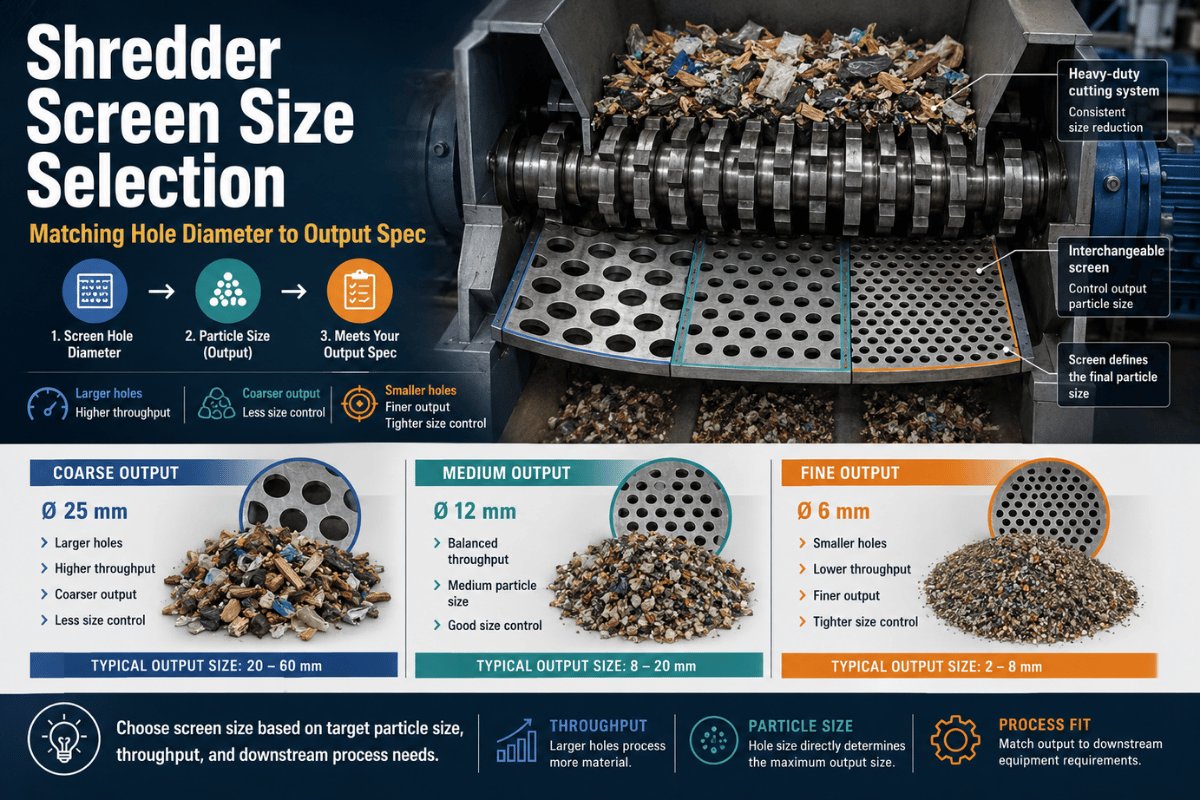
Shredder screen size selection is the single setting that decides what comes out of your machine: the perforated screen under the cutting chamber set the maximum particle size, so picking the hole diameter is really picking your output. Get it right and your regrind feeds cleanly into washing, pelletizing, or extrusion. Get it wrong and you either choke your throughput or hand the next machine particles it can’t use. This guide maps screen hole sizes to real output, walks through the trade-offs, and gives you a way to choose by material and by downstream process.
Shredder screen size sets the largest particle that can leave the cutting chamber: material recirculates until it’s small enough to pass through the holes, so output particle size lands close to the hole diameter and slightly finer. A 10 mm round screen produces mostly 8–10 mm regrind. Choose the hole size from your downstream feed spec first, then check throughput.
Key Takeaways
- A smaller screen is not automatically better, one field report found a 4 mm screen ran about 75% slower than a 12 mm screen on the same machine.
- Output particle size ≈ screen hole diameter; pick the hole from the downstream feed window (often 3–10 mm for pelletizing/extrusion).
- Not every shredder uses a screen: single-shaft units and granulators do; dual-shaft rotary-shear shredders set size by cutter width.
- Soft film and heat-sensitive resins punish small screens with heat and fines; hard, brittle plastics tolerate holes close to target.
- Worn or blinded screens silently drift output oversize, inspect before blaming the rotor.
What a Shredder Screen Is, and Why It Sets Your Particle Size
A shredder screen (also called a sizing screen or sizing chamber) is a perforated metal plate fitted beneath the cutting chamber. As the rotor knives cut against the fixed bed knives, material is forced down against the screen. Anything larger than the holes stays in the chamber and get cut again; anything small enough drops through and exits as regrind. That mechanism is why the screen, not the motor or blades, sets your maximum particle size and uniformity.
The principle is the same one taught in size-reduction engineering. In knife and hammer mills, material is struck “until it’s fine enough to pass through a screen and exit the device,” and low-speed rotors that meter material through holes tend to produce uniform particles with little heat, as the University of Michigan’s Visual Encyclopedia of Chemical Engineering describes for screened size-reduction equipment. The screen is the gate; the rotor just keep presenting material to it.
Screens differ in three ways that matter for selection:
- ✔Hole diameterthe number you select (e.g., 6 mm, 12 mm, 20 mm). This sets output size.
- ✔Hole shape and patternround holes give the best particle shape and screen strength; square holes can pass a bit more material per unit of open area but leave “tails” and less uniform particles. Staggered hole patterns wear more evenly than straight rows.
- ✔Open areathe percentage of the screen that’s holes. More open area raises throughput but lowers screen strength.
Picking the wrong hole size is a costly risk, because the screen, not the 15–200 kW motor, is the part that sets your output, and oversize material structurally can’t leave the chamber until it fits the hole. That’s why the screen, not raw power, is the lever you actually tune.
One quick clarification on terms. People say “mesh,” “screen,” and “perforation” almost interchangeably for shredders, but plastics shredders and granulators use thick perforated plates measured by hole diameter in millimeters, not woven wire mesh measured by mesh count. When a supplier quotes you an “8 mm screen,” they mean 8 mm holes.
Shredder Screen Size vs. Output Particle Size: The Real Relationship
If you fit an X-mm screen, what size particles do you actually get? Output particle size lands close to the hole diameter, with the distribution skewed slightly finer because material has to be smaller than the hole to escape. A 10 mm round screen produces regrind mostly in the 8–10 mm range. This is consistent across recycling practice and the patent literature, where shredder “perforations are formed in a perforation size so as to discharge” the intended particle, per US Patent Application 20070241216A1.
Because the relationship is close but not exact, treat the screen as your ceiling, not your average. If your downstream process has a hard maximum (say a pelletizer that jams above 10 mm), choose a screen at or just under that ceiling rather than hoping the average fall in range.
| Screen hole (round) | Typical output particle | Best suited for |
|---|---|---|
| 3 mm | 2–3 mm fine regrind | filament feedstock, high-value regrind |
| 4 mm | 3–4 mm | small extruders, fine PET flake |
| 5 mm | 4–5 mm | direct extrusion / pellet feed |
| 6 mm | 5–6 mm | general pelletizer feed |
| 8 mm | 6–9 mm | general recycling regrind (common HDPE default) |
| 10 mm | 8–10 mm | balanced throughput and size |
| 12 mm | 9–12 mm | high-throughput regrind before washing |
| 15 mm | 13–15 mm | coarse flake, pre-wash sizing |
| 20 mm | 17–20 mm | front-end of a two-stage line |
| 25–30 mm | 24–30 mm | bulk volume reduction |
| 40 mm | ≈40 mm chips/strips | pre-shred feeding a downstream granulator |
Output ranges are starting points for round-hole screens; verify with a sieve test on your material. Sources: recycling practice; US20070241216A1.
The Screen-Size Triangle: Particle Size, Throughput and Fines
The Screen-Size Triangle is a simple rule: every screen choice trades off three things, particle size, throughput, and fines/energy, and you can’t win all three at once. Shrink the holes for finer, more uniform regrind and you pay with lower throughput, more fines, and more heat.
How big is that penalty? Larger in practice than most buyers expect. One recycling operator reported that a 12 mm screen ran roughly four times faster, about 75% more output per hour, than the factory-supplied 4 mm screen on the same machine. Mechanically, smaller holes force material to be cut down further and recirculates longer in the chamber before it can escape, so each kilogram spends more time under the knives and draws more motor power per ton processed, raising energy consumption. A line rated for 800 kg/h with a coarse screen can drop well below that figure once you fit a fine one.
“Achieving a uniform particle size is a major advantage of the single-shaft shredder, but the higher-rpm rotor can generate heat and fines with some materials, and screens may reduce the throughput rate significantly.”
| Factor | Smaller holes (6–8 mm) | Larger holes (10–15 mm+) |
|---|---|---|
| Particle size | smaller, more uniform | larger, less uniform |
| Throughput | lower | higher |
| Fines generation | higher (over-grinding risk) | lower |
| Energy per ton | higher | lower |
| Heat buildup | higher | lower |
📐 Engineering Note
Fines are the hidden cost of going too small. Excess dust contaminates washing water, blocks dewatering screens, and creates melt inconsistencies and bubbles at the extruder. Finer grinding also costs more energy: analyses of solid-waste size reduction by the U.S. Environmental Protection Agency document how grate and screen size shift the particle-size distribution. If your buyer rejects regrind for “too much dust,” the screen, not the washer, is usually the first place to look.
Screen Size by Material: HDPE, PET, Film, PP, ABS and PVC
The plastic you process changes how a given screen behaves, because materials fracture, stretch, or heat up differently. Hard, brittle plastics fracture cleanly and tolerate a hole close to your target size. Soft, flexible films stretch and deform instead of snapping, so they need careful cutting and tend to wrap the rotor. Tough, impact-resistant resins absorb more energy and heat up faster. Across the shredder and granulator lines Kitech builds, the table below is where we usually start a feedstock conversation before fine-tuning by sieve test.
| Feedstock type | Material behaviour | Starting screen | Notes |
|---|---|---|---|
| Rigid HDPE (drums, crates) | tough, thick-walled | 8–12 mm | 8 mm is a common DIY/small-scale default |
| PET bottles | brittle, fractures clean | 6–12 mm | match flake size to wash line and float-sink |
| PE / PP film | soft, wraps rotor | special film screens | don’t just go smaller, heat and wrapping rise |
| PP (rigid) | moderate toughness | 8–12 mm | balances throughput and flake size |
| ABS | tough, impact-resistant | 8–10 mm | watch heat; common in automotive plastic shredding |
| PS / acrylic (brittle) | shatters, abrasive | 6–10 mm | can run close to target size |
| PVC | rigid, abrasive | 8–12 mm | manage heat to avoid degradation |
| PC | very tough | 8–12 mm | higher energy per ton |
| Foam (EPS/EPP) | light, bulky | 15–30 mm | volume reduction, not fine sizing |
| Mixed rigid scrap | variable | 12–20 mm pre-shred | two-stage: pre-shred then granulate |
Starting points from Kitech build experience; confirm with a sample run. Film and heat-sensitive resins favour screen geometry and rotor choice over simply shrinking holes.
Film is the row buyers misread most often. Plastic film also carries more surface contamination and has a low bulk density, so it bridges and wraps the rotor rather than feeding cleanly. Because film is soft, the instinct is to fit a tiny screen to “force” small particles. In practice that traps heat and makes the film wrap the rotor. The plastic shredder configurationrotor design, knife layout, and a film-appropriate screen, matters more than hole size alone.
Match Screen Size to Your Downstream Process
Here’s the question that reframes the whole decision: should the screen follow your plastic, or your next machine? In most recycling lines, the downstream process set a tighter window than the resin does, so size the screen from the downstream feed spec first, then sanity-check it against the material. A washer, a rigid plastic recycling line, and a pellet extruder each want a different particle window.
| Downstream process | Target particle | Suggested screen |
|---|---|---|
| Filament / fine extrusion | 3–6 mm | 4–6 mm |
| Pelletizing / repelletizing | 3–10 mm | 6–8 mm |
| Washing line (flake) | 8–14 mm | 10–12 mm |
| Feeding a second granulator | 20–40 mm | 20–40 mm pre-shred |
| Volume reduction / baling | 25 mm+ | 25–40 mm |
💡 Worked example: sizing from the downstream spec
Say your pellet extruder feeds best at 6 mm and jams above 10 mm. Start at the ceiling minus a margin: pick an 8 mm screen, which yields roughly 6–9 mm regrind, under the 10 mm jam point and around the 6 mm sweet spot. If a sieve test show too many fines, step up to 10 mm and accept a slightly coarser feed. If you see oversize stragglers above 10 mm, drop to 6 mm and accept the throughput hit. You’re tuning around the downstream ceiling, not guessing from the resin alone.
How many screen sizes should a recycler keep on hand?
If you run one resin into one downstream process, a single screen plus one spare is enough. If you switch feedstocks or sell regrind to different buyers, keep a small set, typically a fine (4–6 mm), a general (8–10 mm), and a coarse (12–20 mm) — so you can match each job instead of forcing one compromise screen to do everything. Screens are cheap relative to a day of mismatched output.
Shredder vs. Granulator vs. Single-Shaft: How Screening Differs
What are the three types of shredders?
In recycling you’ll meet single-shaft, dual-shaft (rotary shear), and four-shaft shredders, plus granulators as a separate size-reduction class. They don’t all control size with a screen, which is why “what screen do I need?” sometimes has the answer “you don’t.” Single-shaft shredders and granulators use a sizing screen and recirculate oversize material until it passes. Dual-shaft rotary-shear shredders set size by cutter width, often with no screen, they make strips, not calibrated granules.
| Machine | Uses a screen? | How size is set | Typical output |
|---|---|---|---|
| Single-shaft shredder | Yes | screen + recirculation (rotor ~80–110 rpm) | uniform, screen-controlled |
| Granulator | Yes | screen under high-speed rotor | uniform regrind |
| Dual-shaft (rotary shear) | Often no | cutter width and disc spacing | strips, variable length |
| Four-shaft shredder | Yes | cutters + sizing screen | more uniform than dual-shaft |
| Hammer mill | Yes | impact + screen | fine, for brittle material |
Getting this wrong is a common and expensive mistake: buyers order a dual-shaft shredder expecting calibrated 8 mm regrind, then hit the problem that it only make ragged strips because there’s no screen to control size. That happens because a rotary shear set size by cutter geometry, not by a screen, so the fix is a screened second stage, not a smaller setting.
Why does this distinction matter so much downstream? Because particle size shapes how recyclate behaves later: peer-reviewed work on recycled polypropylene composites (NC State BioResources) shows particle size shifts the final material’s characteristics, so a machine that can’t hold a size can’t hold a quality. In practice, if you need a calibrated particle size, you need a screened machine, a single-shaft shredder, granulator (including a low-speed granulator for heat-sensitive material), or four-shaft unit. If you only need volume reduction or you’re processing contaminated, non-shreddable-laced waste, a dual-shaft rotary shear is more forgiving but will hand you strips, not a tidy 8 mm regrind. Recycling lines often pair them: a dual-shaft pre-shredder followed by a screened granulator for final size control.
Screen Wear, Replacement and How It Shifts Output Size
Screens are wear parts, and a worn screen quietly changes your output. As holes erode, their effective diameter grows, so a nominal 8 mm screen can start passing 10–11 mm particles after heavy abrasive service. Blinding, partial clogging by soft or sticky material, does the opposite, restricting flow, cutting throughput, and raising heat. Both show up as “the machine isn’t running like it used to” long before anyone inspects the screen. Treat screen replacement as a scheduled wear item, not a failure, and favour a staggered perforation pattern, which wears more evenly than straight rows.
📐 Engineering Note
When output drifts oversize, check the screen before the rotor or knives. Pull it, measure a few holes against the nominal size, and look for tapered or bell-mouthed openings from abrasion. Abrasive feedstocks such as filled or glass-reinforced plastics wear screens and knives fastest; keep a measured spare on the shelf so a swap is minutes, not a day. Screen and blade wear travel together, which is why screen selection and shredder blade material selection are best planned as one decision.
6 Screen Size Selection Mistakes That Cost You Downstream
What are the biggest shredding mistakes?
Most screen-size mistakes share one root cause: choosing the hole in isolation instead of from the whole line. Over-grinding is the costly one, the University of Michigan size-reduction reference notes that metering material through a screen at low speed yields uniform particles with little heat, which is the opposite of forcing a too-small screen. These six come up again and again with recyclers, and field reports back them up.
The 6 mistakes
- Going too small “to be safe.” The most common error. A 4 mm screen can run about 75% slower than a 12 mm screen and bake heat and fines into heat-sensitive resin.
- Sizing from the resin, not the downstream spec. Your extruder or washer sets the real ceiling; start there.
- Forcing film through small holes. Film needs the right rotor and screen geometry, not just a tiny hole, otherwise it wraps and overheats.
- Ignoring fines. Over-grinding contaminates wash water and weakens pellets; dust is a screen problem first.
- Running a worn screen. Erosion drifts output oversize; blinding chokes throughput. Inspect and measure.
- Expecting one screen to do every job. A small screen set beats a single compromise.
Industry Outlook: Why Uniform Particle Size Matters More in 2026
Screen-size selection is quietly shifting from a throughput dial to a quality-control lever, and the driver is what happens after the shredder. As sensor-based, AI-assisted sorting and advanced (chemical) recycling scale up in 2026, downstream buyers increasingly specify consistent, on-spec particle size as a condition of sale, uniform feedstock sorts cleaner and reacts more predictably. TOMRA’s 2026 outlook describes sensor-based sorting increasingly enhanced by deep learning, and reviews of advanced plastic-recycling technologies point the same way: feedstock quality, including particle consistency, is moving upstream in importance.
Standards bodies reinforce the trend. The APR Design Guide continues to formalize design-for-recycling and regrind quality protocols, so “good enough” sizing is becoming “documented and consistent” sizing. For market scale, the plastic recycling machine market sits around USD 4 billion with mid-single-digit growth forecasts, useful as background, but it’s the quality pull, not the headline market number, that should shape how you pick a screen.
Picture a regional recycler in 2026 bidding to supply a chemical-recycling feedstock buyer. The buyer caps particle size at 12 mm and rejects any load where more than 10% of the regrind falls outside an 8–12 mm band. A line running a worn or oversized screen that drifts to 14 mm loses that contract, not on price, but on particle-size consistency. That’s the risk screen selection now carries: an inconsistent or out-of-spec output becomes a commercial failure, because the buyer’s process depends on a predictable feed. That balance has shifted. Buyers who once asked only about throughput now audit the particle-size distribution, so the screen you fit is part of your sales spec, not just your maintenance routine.
What we see as a manufacturer: customers who used to ask only “how many kg per hour?” now ask “how tight is the particle distribution?” If you’re planning a 2026 line, choose a machine that lets you change screens quickly and document the size you ship, that flexibility is becoming a commercial asset, not just an engineering convenience.
Frequently Asked Questions
What screen size should I use for a plastic shredder?
View Answer
Start from your downstream process, not the plastic. For pelletizing or extrusion, a 6–8 mm screen produces roughly 6–9 mm regrind that feeds most pellet lines. For washing-line flake, 10–12 mm balances size and throughput. For volume reduction or feeding a second granulator, 20–40 mm is enough. Then sanity-check against your material and run a sieve test before committing, because resin behaviour and rotor design shift the result.
How does screen size affect output particle size?
View Answer
The screen sets the maximum particle size. Material stays in the cutting chamber and is recut until it’s small enough to fall through the holes, so output lands close to the hole diameter and slightly finer. A 10 mm round screen yields mostly 8–10 mm particles. Treat the hole size as your ceiling rather than your average, especially when a downstream machine has a hard maximum it can’t exceed.
Does a smaller screen reduce throughput?
View Answer
Yes, and the penalty is larger than most people expect. Smaller holes keep material in the chamber longer, so each kilogram spends more time under the knives. One operator reported a 12 mm screen running about four times faster, roughly 75% more output per hour, than a 4 mm screen on the same machine. Smaller screens also raise fines, heat, and energy per ton, so only go small when the downstream process truly needs it.
What screen size is best for HDPE and PET bottles?
View Answer
Rigid HDPE commonly runs 8–12 mm, with 8 mm a frequent small-scale default. PET bottles, which fracture cleanly, suit 6–12 mm matched to your wash line and float-sink step. Let the downstream flake or pellet spec narrow the window, then confirm it with a quick sieve test.
What’s the difference between a shredder screen and a granulator screen?
View Answer
Both are perforated sizing plates with identical selection logic: the hole diameter sets particle size. A shredder screen sits under a slower single-shaft rotor; a granulator screen runs a faster rotor, giving finer, more uniform regrind for the same hole.
What causes excessive fines when shredding plastic?
View Answer
Fines come mostly from over-grinding: a screen smaller than the job keeps material under the knives too long, making dust and heat. Dull knives, the wrong knife gap, high rotor speed, and heat-sensitive resins add to it. Step up a screen size if fines spike.
Can I change the screen on my shredder?
View Answer
Yes. On most single-shaft shredders and granulators the screen is removable, so a few sizes on hand let you re-tune output by job. A swap takes minutes with a measured spare, re-check the first output with a sieve test afterward.
Get a screen size matched to your feedstock
Tell us your material and your downstream process and our engineers will recommend a screen size, and the shredder or granulator to match.
Explore Kitech plastic shredders →
Prefer to scope it yourself? Ask our engineers which screen fits your feedstock, or request a screen-size spec sheet.
Why We Wrote This Guide
Kitech designs and builds plastic shredders, granulators, and recycling lines, so we set screen sizes against real feedstocks, PET, HDPE, PE film, PP, ABS, every week. The starting-point ranges and the downstream-first method here come from that build experience; the throughput and physics points are cross-checked against published size-reduction engineering and trade sources rather than presented as lab-exact figures. Reviewed by the Kitech engineering team.
References & Sources
- Size Reduction, Visual Encyclopedia of Chemical Engineering EquipmentUniversity of Michigan
- Significance of Size Reduction in Solid Waste ManagementU.S. Environmental Protection Agency
- Effects of Content and Particle Size on a Recycled Polypropylene CompositeBioResources, NC State University
- APR Design Guide OverviewAssociation of Plastic Recyclers
- Shredder Selection BasicsRecycling Today
- Circular Economy Trends 2026TOMRA
- Shredding Machine and Shredding Method (US20070241216A1)Google Patents
Related Articles
- Shredder blade material guidepair blade choice with your screen selection
- Automotive plastic shredderscreen and feedstock tips for ABS and mixed auto plastics
- Rigid plastic recycling linewhere shredded regrind goes next
- Plastic washing systemhow flake size affects washing and dewatering
- Plastic recycling line selectormatch a full line to your material and capacity