Get in touch with Kitech Company


Updated June 2026 · Reviewed by the Kitech technical team
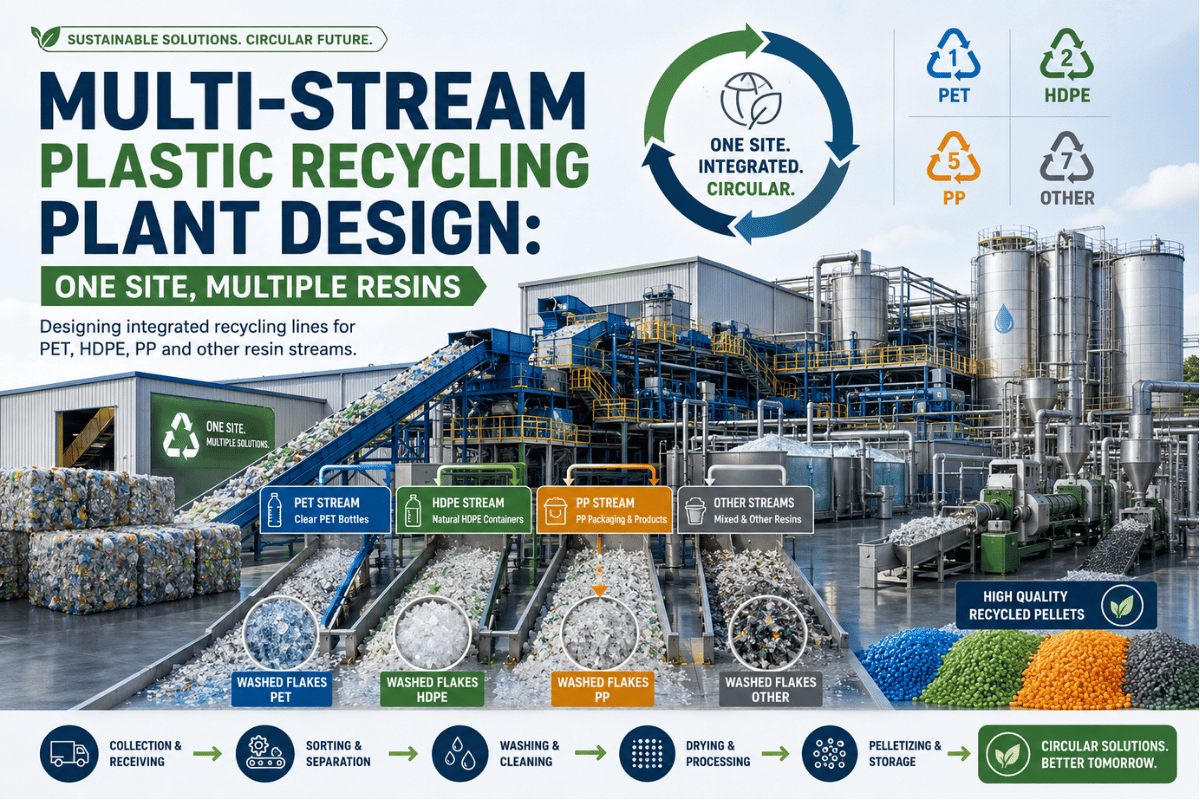
Good multi-stream plastic recycling plant design is less about buying machines and more about deciding which polymer streams share a line, where they split apart, and how you stop them contaminating each other. A plant that takes PET bottles, HDPE and PP rigids, and PE film off the same tipping floor has to separate those materials by density and polymer type before a single flake get washed. Get the sequence wrong and you ship low-grade regrind; get it right and you sell bottle-grade rPET.
In short: A multi-stream plastic recycling plant is a facility designed to process three or more distinct polymer streams, typically PET bottles, HDPE/PP rigids and PE film, on shared front-end handling and parallel downstream lines, rather than one line dedicated to a single resin. Its core design problem is separation: sorting mixed input by density and polymer type before washing, because each stream need a different wash temperature, melt point and pelletizing route.
Key takeaways
- Near-infrared (NIR) sorters are blind to carbon-black and dark plasticsthe pigment absorbs the beam, so black trays and full-wrap shrink sleeves get mis-sorted no matter what resin they’re. Design around this, don’t assume the sensor catches everything.
- “Multi-stream” is a feedstock decision, not an upgrade. Separated streams cut contamination; one universal line for every polymer doesn’t exist.
- Density does the first cut: PET sinks (~1.38 g/cm³), PE and PP float (<1.0 g/cm³). NIR and optical sorting clean up what float-sink can’t.
- Energy and labour concentrate in washing and extrusionthat’s where your operating cost lives, not in the shredder.
- EU PPWR (Regulation 2025/40) starts applying 12 August 2026, raising recycled-content and design-for-recyclability pressure on every stream you handle.
Quick Specs, Typical Multi-Stream Line
| Throughput band | ≤500 / 500–1,500 / 1,500–3,500+ kg/h (three tiers) |
| Polymer streams | PET, HDPE, PP, PE/LDPE film (PVC/PS minor) |
| Core stages | reception → pre-sort → size reduction → sorting → washing → drying → pelletizing → storage |
| PET wash temperature | ~80–85 °C, 1–2% NaOH (caustic) + detergent |
| Energy (granulation) | ~61.1 kWh/tonne input; full wash+dry lines run far higher |
| Output forms | washed flake or pellets (rPET, rHDPE, rPP) |
What Is a Multi-Stream Plastic Recycling Plant?
A multi-stream plant process three or more distinct polymer streams on shared or parallel lines, while a single-stream plant is dedicated to one resin. That’s the whole distinction, and it matters because the word “stream” gets used two different ways. Upstream, a material recovery facility (MRF) sorts commingled household recyclables into separate commodities. Inside a plastics plant, “multi-stream” means your line is built to run several of those commodities, bottles, rigids, film, rather than one. Multi-stream recycling earns its place when one site has to turn several incoming waste streams into separate, saleable products.
Here’s the part most equipment brochures skip: multi-stream isn’t automatically the better choice. It’s a feedstock-driven decision. When recyclables are collected commingled (single-stream collection), cross-contamination goes up and the value of the recovered material go down; separated or dual-stream collection typically yields cleaner, higher-value output, according to practitioner fact sheets from organisations like the Institute for Local Self-Reliance. So before you specify a single tonne of equipment, answer one question: how variable is your input?
| If your situation is… | Design choice | Why |
|---|---|---|
| One steady resin (e.g. only PET bottles, or only HDPE drums) | Single-stream line | Lower capex, simpler controls, highest purity per shift |
| Two resins, predictable split | Shared front end + 2 wash/pelletize lines | Reuses reception and size reduction; splits at washing |
| 3+ resins, variable bales, mixed rigids + film | Full multi-stream design | Needs density + NIR sorting before any washing |
In the field across 500+ installations in 80+ countries, the plants that struggle are almost never the ones that chose “too simple.” They’re the ones that bought a single line and then started accepting mixed bales, because the moment a second polymer enters, contamination shows up in the pellets. If your supply contract already mixes PET, HDPE, PP and film, design for multi-stream from day one, retrofitting sorting into a single-stream layout is far more expensive than planning for it.
For a fuller view of how these lines fit a site, see our overview of turnkey plastic recycling solutions and how rigid and film streams are configured.
The Polymer Streams a Multi-Stream Plant Must Handle
Each polymer stream behaves differently in water, under heat, and in the shredder, which is exactly why one universal line is a myth. Density is the most useful number in plant design, because float-sink separation is the cheapest, highest-throughput cut you can make. PET sinks; polyolefins float. Everything downstream follows from that split.
10-Stream Polymer Processing Matrix
| Polymer class | Density (g/cm³) | Float / sink | Shred + wash route | Typical end-market |
|---|---|---|---|---|
| PET bottle | 1.38–1.39 | Sinks | Granulate + hot caustic 80–85 °C | Bottle-to-bottle, fibre |
| PET tray / thermoform | 1.33–1.39 | Sinks | Granulate + hot wash | Sheet, strapping |
| HDPE rigid (bottles) | ~0.95 | Floats | Shred + warm friction wash | Pipe, non-food bottles |
| HDPE pigmented (caps, crates) | ~0.95 | Floats | Shred + friction wash | Crates, plastic lumber |
| PP rigid | 0.90–0.905 | Floats | Shred + warm friction wash | Automotive, crates |
| PP raffia / woven | ~0.905 | Floats | Shred + friction wash | Strapping, compounding |
| LDPE film | <0.93 | Floats | Friction wash + heavy dewater | Film, liners, bags |
| HDPE / LLDPE film | ~0.94 | Floats | Friction wash + dewater | Profiles, bags |
| PVC (contaminant in PET) | 1.30–1.45 | Sinks | Eject at NIR; separate line only | Dedicated PVC reprocessing |
| PS / EPS | 1.04 (PS) | Sinks (PS) | Dedicated line / densify EPS | Insulation, frames |
Density values per the Hudson River Park plastic density table and the APR PET sink-or-float test (PET flake measured at 1.37 g/cm³).
Density gives you the big split, but it doesn’t fully purify PET. Published research notes that PET density runs roughly 1.33–1.37 g/cm³ and overlaps some contaminants, so float-sink alone won’t deliver bottle-grade material, you need NIR or optical sorting afterward to remove the look-alikes. That single fact is why a credible multi-stream design always pairs a sink-float stage with sensor sorting rather than relying on one or the other.
📐 Engineering Note
Resin identity should be confirmed against the ASTM D7611 resin identification coding system, and recovery routes against the ISO 15270 guidelines for the recovery and recycling of plastics waste. Specify these in your acceptance criteria so incoming bales are graded on a documented basis, not on a visual guess.
Plant Layout and Material Flow
A multi-stream plant flows through eight stages, and the layout’s job is to keep clean material moving forward while contaminants drop out early. That sequence run reception → pre-sort → size reduction → sorting → washing → dewatering and drying → pelletizing → storage. Where you place the splits and buffers is the real art. Kitech engineers a custom configuration for each factory, and most plants combine a shared sorting front end with dedicated wash lines to improve the cleanliness of every output stream.
Reception→
Pre-sort→
Size reduction→
Sorting (density + NIR)→
Washing→
Dewater + dry→
Pelletizing→
Storage
Pre-sort→
Size reduction→
Sorting (density + NIR)→
Washing→
Dewater + dry→
Pelletizing→
Storage
Two layout rules save more money than any single machine choice. First, keep the drying section adjacent to the extruder. If washed flake travels far before it’s dried and pelletized, it re-absorbs moisture in transit, and wet feed degrades pellet quality. Second, film and rigid can’t share a wash line: PE film wraps around conveyors and feeders and holds water, so film lines need larger wash areas, longer drying, and forced feeding, while rigids need stronger crushing and shorter drying. Trying to run both through one wash circuit is the classic cause of conveyor jams and inconsistent output.
📐 Engineering Note
Keep incline conveyor belts at or below roughly 18–20° to prevent rollback of light film and flake, and size surge hoppers for about 15–30 minutes of buffer at rated throughput so a downstream stop doesn’t starve or flood the next stage. Guard and access design should follow ISO 14122 so the layout stays maintainable once it is running three shifts.
A practical example: a contractor commissioning a 1,000 kg/h mixed-rigids-plus-film plant placed the film dryer 30 metres from the film extruder to fit the building. Within a week, film pellets showed moisture streaks and the line was throttled back to 700 kg/h to compensate. Relocating the dryer beside the extruder restored rated output. That lesson is cheap to learn on paper and expensive to learn in steel, which is why layout comes before equipment selection, not after. For component-level choices once the layout is fixed, our guide to the industrial plastic shredder and the rigid plastic recycling line go deeper.
Sorting, Separation and Cross-Contamination Control
Mixed plastics are separated by running density float-sink, near-infrared (NIR) polymer identification, optical colour sorting and metal removal in sequence, no single technology does the whole job. This is the heart of multi-stream design, and it’s where most yield is won or lost. Think of it as a cascade of purity gates, each one removing a different class of contaminant before the material reach the wash line. Sensor-based sorting machinery, from established suppliers such as TOMRA and others, reads each flake and ejects off-spec polymers at the polymer gate.
5-Gate Stream-Separation Cascade
The Stream-Separation Cascade — five sequenced purity gates that each remove a different contaminant class:
- Coarse gatemanual or mechanical pre-sort pulls out oversize, non-target items and obvious trash before anything is shredded.
- Density gatefloat-sink splits sinkers (PET) from floaters (PE/PP) using water.
- Polymer gateNIR identifies resin type and ejects off-spec polymers.
- Colour gateoptical sorting removes off-colour fractions for high-value streams.
- Metal gateoverband magnets pull ferrous metal; eddy-current separators remove aluminium and other non-ferrous bits.
Now the finding that reshapes the whole cascade. NIR sorters can’t reliably identify carbon-black or dark plastics. The carbon-black pigment absorbs the infrared beam, so the sensor see nothing to classify, a black PP tray reads the same as empty belt. The Association of Plastic Recyclers’ own sorting guidance warns that dark colours containing carbon black attenuate reflected NIR energy and are at risk of being mis-sorted. Worse, a full-wrap shrink sleeve made of a different polymer can mask the container underneath and defeat sorting entirely.
“The carbon black in dark packaging absorbs near-infrared light, so the sorter simply can’t read the polymer. We design the cascade assuming a fraction of black and sleeved items will slip through, a manual quality check and a tolerance for that loss is part of an honest plant design, not an admission of failure.”
What do you do about it? Three things. Plan for residual loss rather than promising 100% capture; add manual quality control after NIR for high-value streams; and where the feedstock is yours to influence, push suppliers toward detectable (non-carbon-black) packaging. AI-assisted sensor sorting helps on the rest, peer-reviewed work reports that integrating AI with sensor sorting can lift separation accuracy and throughput by up to 95%, and emerging mid-wave infrared (MWIR) imaging is being developed specifically to crack the black-plastic blind spot. The underlying near-infrared sorting method is long established, see, for example, USPTO patent US 6,610,981 B2 for an early NIR plastic-sorting apparatus.
⚠️ Common Mistake
Under-sizing the pre-sort stage to save floor space. Every contaminant that survives the coarse gate multiplies downstream: it dulls shredder blades, pollutes the wash water, and ends up in your pellets. A generous manual or mechanical pre-sort is the cheapest contamination control in the plant.
In Kitech’s field experience commissioning sorting lines, the most expensive mistake is trusting a single NIR pass: because dark and sleeved items slip through, we design in a manual quality-control station and an eddy-current stage for non-ferrous metal, and we size the pre-sort for the dirtiest expected bale rather than the cleanest. That tolerance for a known loss, at roughly 5–10% of a contaminated stream, is what separates a plant that hit its purity target from one that chases it.
Vendor brochures often quote 98–99% purity. Treat those as supplier-stated and directional; anchor your own acceptance specs to documented test methods and the contamination ranges in independent recycler guidance instead. Honest purity targets, backed by a quality-check stage, age better than marketing numbers.
Size Reduction and Washing by Stream
Size reduction and washing are where each stream finally go its own way, and where the design must respect polymer chemistry. Most lines use a single-shaft shredder for the coarse cut (roughly 20–80 mm), followed by a granulator for the fine cut (around 4–12 mm) before washing and extrusion. Smaller flake washes more thoroughly but costs more energy and produces more fines, so the screen aperture you choose is a direct trade between cleanliness and yield.
What size shredder do I need for a given throughput?
As a rough starting point, match installed shredder motor power to target throughput and material: light film at 1,000 kg/h might need on the order of 75–110 kW, while dense mixed rigids at that throughput can demand more because they resist cutting. Honestly, exact sizing depends on bulk density, contamination and flake target, so request a trial with your actual feedstock rather than sizing from a chart. Our deep dive on shredder screen size selection works through the flake-size trade-off, and the shredder blade material guide covers wear on contaminated feed.
Washing is the stage that separates a credible PET line from a hobby operation. PET bottle streams need a hot caustic wash, European PET recycling lines typically run around 85 °C with caustic soda and detergent in multiple steps, and published protocols cite roughly 80 °C with 1–2% sodium hydroxide and a short residence time to dissolve glues and remove labels. That hot caustic step is what frees the adhesive so the label floats away and the flake come out clean enough for food-contact recycling.
| Stream | Wash approach | Design driver |
|---|---|---|
| PET bottle flake | Hot caustic ~80–85 °C, 1–2% NaOH, detergent, multi-step | Dissolve label adhesive; food-grade cleanliness |
| HDPE / PP rigid | Warm friction wash + rinse + float separation | Remove dirt and residue; separate floaters |
| PE / LDPE film | Friction wash + intensive dewatering before drying | Film holds water and wraps equipment |
Wash temperatures triangulated from the RecyClass PET adhesive protocol and APR PET design guidance.
For design, the takeaway is simple: if your input includes both PET and film, you’re building at least two wash circuits, not one. That’s the single biggest reason a true multi-stream plant costs more than the sum of its machines, and the reason the layout has to plan the split before the wash, not after.
Pelletizing and Output Quality
Pelletizing converts washed flake into a uniform, saleable pellet, and the choice of pelletizing method and the grade you target decide who buys your output. The common routes are strand pelletizing, water-ring, and underwater pelletizing; film and lightly contaminated streams usually need a degassing extruder to pull out volatiles and residual moisture before the melt is cut. Some buyers want clean washed flake and pelletize it themselves; others pay a premium for finished pellets. Clean rPET feeds bottle-to-bottle lines and polyester fibre, turning post-consumer scrap into a branded input.
| Output | Typical grade | Who buys it |
|---|---|---|
| rPET | Food-grade / fibre-grade flake or pellet | Bottle-to-bottle converters, fibre/strapping makers |
| rHDPE | Pipe / blow-moulding grade pellet | Pipe, crate, non-food bottle manufacturers |
| rPP | Injection / compounding grade pellet | Automotive, crates, compounders |
A recurring problem Kitech sees on the production floor is operators blaming the pelletizer for poor pellets when the real fault sits upstream: because a pelletizer running at 1,000 kg/h only preserves whatever flake quality the wash line delivered, contamination shows up as black specks and weak melt strength no matter how good the cutter is. For automotive rPP or food-grade rPET, the evidence is in the wash and the sort, not the pellet die.
The design implication is that output quality is set upstream, not at the pelletizer. A pelletizer can’t rescue poorly sorted, poorly washed flake, it just turns contaminated flake into contaminated pellets. If you want bottle-grade rPET, the money goes into sorting and the hot caustic wash; the pelletizer simply preserve what you already achieved. For the equipment itself, see our overview of the plastic pelletizer, and for material-specific routes, our notes on ABS recycling and PLA bioplastic recycling.
Sizing Throughput and Reading the Investment
Throughput is the master variable: it sets equipment size, automation level and operating cost in one decision. Most multi-stream plants fall into three capacity tiers, and which tier fits depends on your feedstock supply and offtake contracts, not on ambition. Oversizing a plant you can’t feed is as costly as undersizing one you can. Across Kitech’s installed base, the most expensive mistake at this stage is oversizing: a Tier 3 line starved of feedstock burns energy and labour for output it never reaches, because much of the connected power draw is fixed and doesn’t fall with throughput. We size to secured tonnes and signed offtake, not to the brochure maximum.
3-Tier Capacity Ladder
| Tier | Throughput | Design character |
|---|---|---|
| Tier 1 | ≤500 kg/h | Compact line, more manual sorting, single dominant stream |
| Tier 2 | 500–1,500 kg/h | Semi-automated, NIR added, 2+ parallel wash lines |
| Tier 3 | 1,500–3,500+ kg/h | Highly automated sorting, full multi-stream parallel lines |
Now the operating cost, which is where design decisions show up on the electricity bill. Energy data has to be read carefully because it depends on the process boundary. The EU’s Joint Research Centre estimated around 61.1 kWh per tonne of input waste for granulation-centric processing, and regranulation alone runs roughly 0.18–0.24 kWh/kg. But a full plant that washes, dries and extrudes is much higher: peer-reviewed life-cycle work reports on the order of 883–1,132 kWh per tonne depending on the drying load. That gap between the figures isn’t a contradiction, it’s the difference between one process step and the whole line.
Concretely, the design lesson is this: energy concentrates in washing and extrusion, so those are the stages to engineer for efficiency, not the shredder. Energy consumption and labor costs are the operational drivers that decide whether a full line pay back. Thermal drying in particular is an energy sink, which is one more reason to keep film, which carries the most water, on a dedicated, well-designed dewatering line. For the full cost model, including capex, labour and payback, see our plastic recycling plant cost guide for 2026, which covers capex, opex and payback in detail.
What’s Changing in Multi-Stream Plant Design for 2026
Regulation, not market size, is the biggest force reshaping plant design in 2026. The EU Packaging and Packaging Waste Regulation (PPWR, Regulation 2025/40) entered into force on 11 February 2025 and generally starts applying on 12 August 2026, with the stated aim that all packaging be recyclable in an economically viable way by 2030. For a plant operator that means rising recycled-content obligations and extended producer responsibility pressure, which in turn rewards flexible, multi-polymer lines that can adapt as packaging mixes shift. If you’re specifying a plant now, design in spare sorting passes and modular wash capacity so you can add a stream later without rebuilding.
On the technology side, AI-integrated sensor sorting is the practical advance: peer-reviewed reviews report accuracy and throughput gains of up to 95%, and MWIR imaging is being developed to finally read the black plastics that defeat conventional NIR. Design-for-recyclability, mono-material packaging, detectable inks, removable sleeves, is the clearest packaging trend, and the Association of Plastic Recyclers’ design criteria are moving toward a national framework. These shifts make the input stream cleaner and more sortable over time, which is exactly why over-fitting a plant to today’s contamination is a mistake.
As a manufacturer, Kitech is seeing buyers de-risk against this by specifying modular sorting passes they can populate later: because the cost of retrofitting a second NIR unit into a finished building is far higher than leaving the floor space and power for it now, the challenge is to design the headroom in from day one. For an EU project facing the 2026 deadline, that headroom is what turns a compliance risk into a planned, low-cost upgrade.
Market forecasts do exist, the recycled-plastics and NIR-sorter markets are both projected to grow at high-single-digit annual rates through the early 2030s, but treat those as directional background, not a basis for sizing. Load-bearing decisions here are regulatory timing and sorting capability, not a CAGR. If your 2026 project depends on EU offtake, anchor your design and compliance dates to PPWR’s 12 August 2026 application date and build in the headroom to meet tightening recycled-content rules.
Frequently Asked Questions
What is the difference between single-stream and multi-stream plastic recycling?
View Answer
Single-stream recycling collects or processes one resin (or commingled material) on a single line, while multi-stream design processes three or more distinct polymer streams — such as PET bottles, HDPE/PP rigids and PE film — on shared front-end handling with parallel downstream wash and pelletize lines. Multi-stream is not automatically better: commingled single-stream collection actually raises cross-contamination, whereas separated streams yield cleaner, higher-value output. The right choice depends on how variable your incoming feedstock is.
What equipment does a multi-stream plastic recycling plant need?
View Answer
A multi-stream plant needs equipment across eight stages: reception and pre-sort, size reduction (single-shaft shredder plus granulator), separation (density float-sink tanks, NIR and optical sorters, magnets and eddy-current separators), washing (hot caustic for PET, friction wash for film and rigids), dewatering and drying, pelletizing, and storage. Because PET and film need different wash temperatures and circuits, most multi-stream plants run at least two parallel wash-and-pelletize lines after a shared sorting front end.
Can one recycling line handle PET, HDPE, PP and film together?
View Answer
Not as a single universal line. Each polymer needs a different separation route, wash regime and melt temperature: PET sinks and needs an 80–85 °C caustic wash, while PE film floats and needs friction washing plus heavy dewatering. A true multi-stream plant shares the reception and sorting front end, then splits into parallel sub-lines for each material. A single line can only run one stream at a time with changeovers, and every changeover costs you a purge and lost production. That is why genuine multi-stream design means parallel processing after a shared sort — duplicating the wash and pelletize stages for each material family — rather than expecting one machine to do everything at once.
How much throughput should a multi-stream plant be designed for?
View Answer
Size to your secured feedstock and offtake, not to ambition. Multi-stream plants typically fall in three tiers: up to 500 kg/h, 500–1,500 kg/h, and 1,500–3,500+ kg/h, with automation rising by tier. An undersized plant strands demand; an oversized one runs hungry.
What certifications should plant equipment meet?
View Answer
For most markets, equipment should carry CE marking (EU), and UL or CSA where North American electrical compliance is required. Plant safety, access and guarding should follow ISO 14122, recovery routes should align with ISO 15270, and incoming material should be graded against the ASTM D7611 resin identification system. In the EU, plant operators should also track PPWR (Regulation 2025/40) obligations that begin applying in August 2026.
Who buys the recycled flake and pellets a plant produces?
View Answer
It depends on grade. Food-grade rPET goes to bottle-to-bottle converters and fibre makers; rHDPE goes to pipe, crate and non-food bottle manufacturers; and rPP goes to automotive parts, crates and compounders. Cleaner, better-sorted output reaches higher-value markets, which is why the buyer is effectively chosen at the sorting and washing stages, not at the pelletizer. Prices move with virgin-resin and oil markets, so treat any quoted figure as directional.
Planning a multi-stream line?
Send us your target streams and throughput and we’ll map a layout, from sorting cascade to parallel wash lines, against your feedstock. Request a plant layout consultation or download our equipment comparison.
How We Built This Guide
The layout rules, throughput tiers and Polymer-Stream Processing Matrix in this guide come from Kitech’s field experience commissioning shredding, washing and pelletizing lines across 80+ countries, cross-checked against published density data, APR and RecyClass wash protocols, EU JRC energy figures and the PPWR regulatory timeline. Where vendor purity claims couldn’t be independently verified, we labelled them directional. Well-designed waste and recycling plants make the manufacture of recycled resin more consistent and more environmentally friendly than landfill or incineration. Reviewed by the Kitech technical team.
References & Sources
- Sustainable Materials ManagementU.S. Environmental Protection Agency
- Separation of mixed plastics by densityPMC / U.S. National Library of Medicine
- Advanced technologies for plastic waste recycling (AI sensor sorting)PMC / U.S. National Library of Medicine
- NIR Sorting of Whole Rigid Packages (carbon-black limit)Association of Plastic Recyclers (APR)
- PET Packaging Sink-or-Float TestAssociation of Plastic Recyclers (APR)
- Recyclability Evaluation Protocol for Adhesives on PET Bottles (wash ~85 °C)RecyClass
- ISO 15270:2008, Guidelines for the recovery and recycling of plastics wasteInternational Organization for Standardization
- ASTM D7611/D7611M-21, Resin Identification Coding SystemASTM International
- Packaging and Packaging Waste Regulation (EU) 2025/40EUR-Lex, European Union
- Packaging waste (PPWR overview)European Commission
- Environmental performance of post-consumer plastic mechanical recycling (energy)MDPI Sustainability
- Method and apparatus for NIR sorting of recycled plastic (US 6,610,981 B2)USPTO via Google Patents