Get in touch with Kitech Company


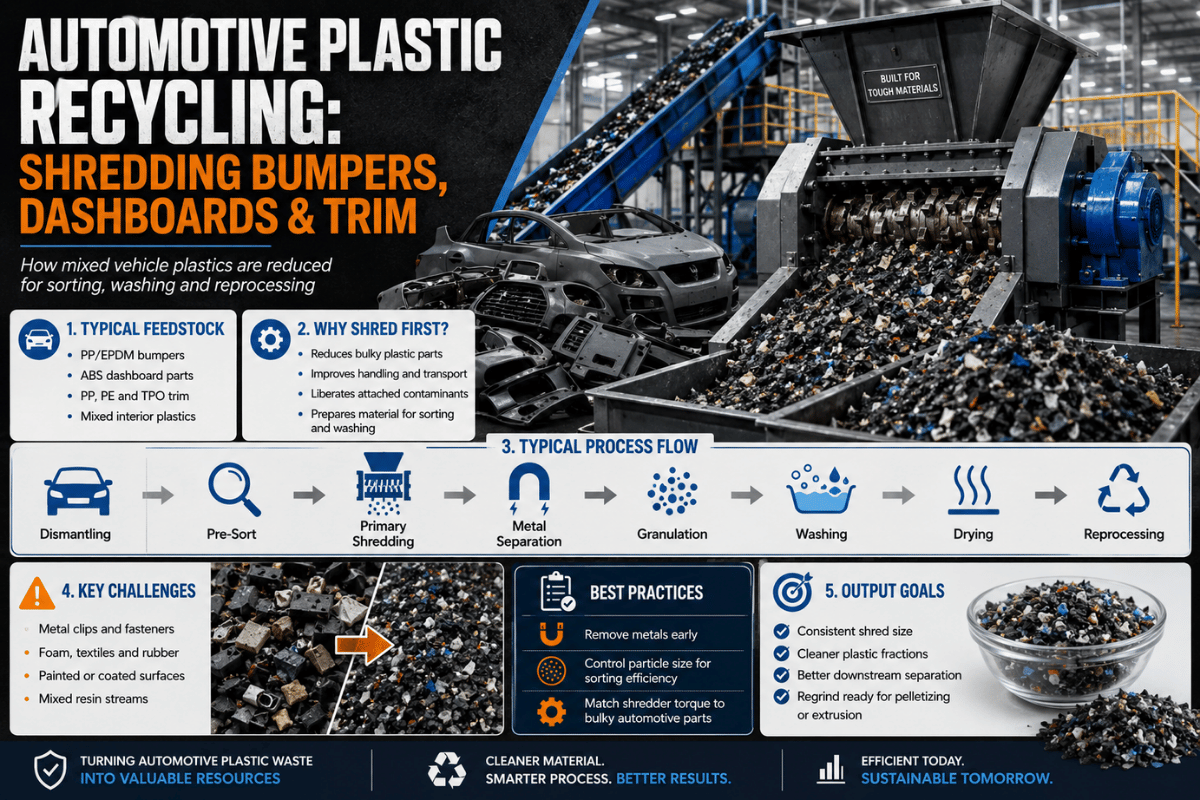
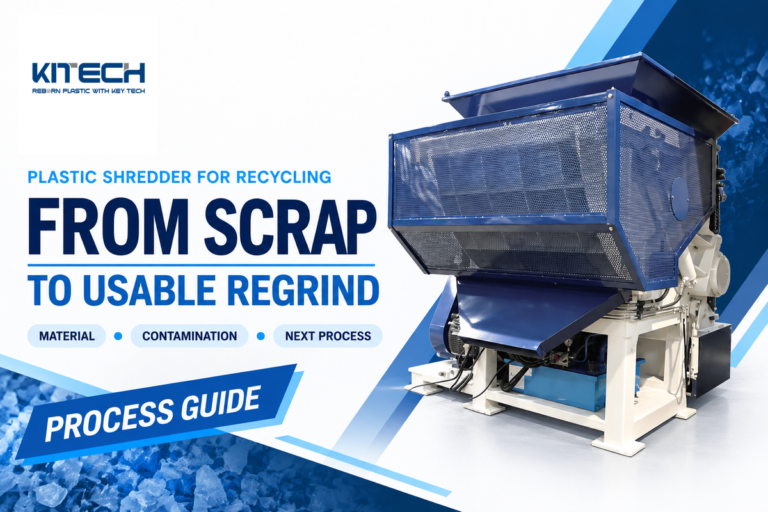
An automotive plastic shredder is the machine that converts bumpers, dashboards, fuel tanks, and interior trim into an actual recyclable feedstock. You get the machine wrong and every shift, you’ll be dealing with jams, wrap-arounds and blade wear. Get it right and a single line can eat everything your dismantling yard or molding plant can throw at it. This guide covers the different machine types, the car plastics that play nice and those that don’t, how to size for your throughput, the true cost of operation, and the position of the shredder in the complete line.
Quick Specs: Automotive Plastic Shredding at a Glance
- Weight (kg) per vehicle ~180-240, and increasing
- Popular plastic compounds PP, ABS, PE-HD, PA (nylon), PC/ABS, PVC, PMMA, PU
- Machine types: single-shaft, twin-shaft, four-shaft shredders; granulators; crushers
- Raw outputs typically range from coarse 25-100mm, screened down to ~10-50mm
- It’s generally two stages: shred, then granulate – that matters for car plastics
It helps to visualize how the industrial shredder will fit into the remainder of your recycling line before you buy. This guide is written from a plant-design point of view, drawing on the experience of building complete lines around Kitech automotive plastic shredders and the downstream washing and pelletizing equipment.
What an Automotive Plastic Shredder Does (and the Recycling-Rate Paradox)
An automotive plastic shredder cuts the various hard plastics and mixed parts found on cars down into smaller sizes, ready for cleaning, sorting, and subsequent re-processing. It’s the initial size-reduction step in recycling the different types of plastic found in a car, not the last.
There’s a catch here which is commonly overlooked. When car recycling statistics are read out it sounds impressive: according to a report from Argonne National Laboratory, car recycling recovered more than 95% end-of-life vehicles with approximately 75% of the recovered material by weight being metals. But that’s only true for items such as steel and aluminium that can be removed from a car with magnets or with eddy-current separators, or where a whole vehicle has been fragmented to be processed solely for metal. This “recycling rate” doesn’t accurately reflect the overall fate of materials such as plastics.
After a whole vehicle is processed through a heavy fragmentizer for metals the remaining material is known as automotive shredder residue (ASR) and this consists, according to Waste Management research in the ScienceDirect journal, of around 19-31 percent plastic, approximately 20 percent rubber, 10 to 42 percent of which are textiles and other fibers, and various plastics and oils. Approximately 20 to 25 percent of a car’s weight is ASR, a significant part of which is historically sent to landfill or processed for energy, meaning a “95 percent” vehicle could still see much of its plastic thrown away. This huge gap between high recovery of metals and very low plastic recovery is exactly why clean dismantling to feed your shredding operation matters.
💡 Key takeaway
Shredding an entire vehicle for its metals is a distinctly different task from shredding clean, dismantled parts for recycling. If you are aiming to produce plastic for recycling, then it is critical to remove the plastics and shred the individual items on a specialized automotive plastic shredder, rather than putting them into a whole-vehicle shredder, mixed with ASR.
Which Automotive Plastics You Can Shred (and How They Behave)
A car is not “plastic” — it is a dozen different polymers, each behaving differently under the cutters. Knowing which resin you are feeding tells you the blade type, the screen size and whether you even need a wash step. Most parts carry a resin code molded into them under the ISO 1043-1 marking standard (for example >PP< or >ABS<), which makes pre-sorting far easier than people expect.
| Resin | Typical car parts | Shredding behavior |
|---|---|---|
| PP (polypropylene) | Bumpers, battery trays, trim, fluid reservoirs | Tough but cuts cleanly; bulky bumpers feed best on twin-shaft |
| ABS / PC-ABS | Dashboards, consoles, interior trim, grilles | Rigid and brittle; shreds easily, watch for painted surfaces |
| PE-HD | Fuel tanks, fluid bottles, ducting | Thick-wall tanks need high torque; purge fuel residue first |
| PA (nylon, often glass-filled) | Under-hood covers, intake manifolds, connectors | Glass fiber is abrasive — accelerates blade wear |
| PMMA / PC | Headlights, tail lights, lenses | Brittle, shatters; keep metal reflectors out of the feed |
| PVC / PU | Wire insulation, seals, seat foam | Mixed density; foam compresses, often separated, not shredded |
What it means to you: the question is rarely “can the shredder cut it?” A low-rpm, high-torque machine cuts almost anything. Contamination is the real issue. Metal brackets, foam backing, paint, adhesives and glass fiber all change how the part behaves and what your output is worth. A dashboard with steel reinforcement will shred, but now you are buying a magnet downstream and accepting faster cutter wear.
“The most frequent error that buyers commit is designing the machine to accommodate the part on their list that’s easiest to machine or cast. Design around the hardest feed — the plastic with 30% filler, the steel-reinforced bumper — and you will have no problems with the simple parts.”
Shredder Types Compared: Single-Shaft, Twin-Shaft & Four-Shaft
Most automotive plastic shredders come in three configurations. Choosing which one to use is the biggest choice you’ll face, as it will determine your feed style, the consistency of your output, and how well the machine tolerates jams.
What is a single-shaft plastic shredder?
The single-shaft plastic shredder features a single rotor of rotating knives shearing material against a fixed bed knife – driven by a hydraulic ram that forces product into the knives. Material is held on a screen beneath the rotor until it’s small enough to pass – resulting in one pass of reasonably uniform product size. Single shaft equipment is good for solid, clean, rigid parts like purges, regrind or trim where particle size is of great concern. When processing light-gauge and film parts however, their limitations are evident – the rotor can skid across the material instead of processing it.
| Feature | Single-shaft | Twin-shaft | Four-shaft |
|---|---|---|---|
| Best feed | Clean rigid parts, regrind | Bulky, mixed, contaminated parts | Mixed parts needing fine, uniform output |
| Output control | Screen-controlled, uniform | Coarse 25–100 mm, no screen | Screened, uniform in one pass |
| Handles film / soft parts | Poor (rides over rotor) | Strong (grips and shears) | Strong |
| Jam / contaminant tolerance | Moderate | High (auto-reverse on stall) | Moderate |
| Relative cost | Lower | Mid | Higher |
For the majority of automotive operations that begin with intact disassembled pieces — bumper, dashboard, gas tank, car door — the safer piece of equipment to begin with is the twin-shaft shredder. Its twin contra-rotating rotors grab and cut massive and contorted or dirty products and will reverse automatically to clear obstructions. Plastic film produced from this operation can be easily handled by a twin-shaft based plastic film shredder.
Shredder vs. Granulator vs. Crusher: The Two-Stage Rule
What is the difference between a plastic shredder and a plastic granulator?
A plastic shredder uses slow, high-torque shafts to coarse-chop dense material into sizes of 25 to 100 mm. By contrast the plastic granulator machine uses an open, high-speed rotor cutting against a stationary bed knife for a fine, consistent flake of around 5 to 15 mm. There’s also a plastic crusher for brittler material between the two. Short version: shredders reduce; granulators sort to size.
And this leads to what may be the single biggest principle in the whole of car recycling – our two-stage rule: car plastic and the big lumps just *can’t* all go into one machine. Stuff the whole bumper into a hyper-active granulator and all you’ll end up with is an explosion of plastic dust, the smell of burning plastic and, probably, bent blades. Shred it coarse to begin with, then run the fragments through the granulate to produce perfectly sized, clean flakes for washing and pelletizing. In fact some of our machines combine the process of shredding and then screening with one integrated unit, and while that’s fine when you’re running the same material over and over it just won’t cut it with the mixed automotive fraction; you’ll want two machines for consistent output and less down-time.
The Two-Stage Rule — quick decision
- Whole or bulky parts (bumpers, tanks, panels): shred first on a twin-shaft.
- Need uniform flake for washing or pelletizing: granulate the shredded output.
- Single clean material at modest volume: a four-shaft with screen can do both in one pass.
How to Size an Automotive Plastic Shredder for Your Throughput
Sizing is driven from a single figure: the volume of waste you’ve got to treat per hour. Just as a prompt summary on the Reddit engineering thread pointed out, throughput is determined by motor strength, blade design, edge quality and how quickly the machine block up. There’s nothing to do with hopper capacity. A machine rated for 1 ton/hr on immaculate regrind might only manage half that on coarse, greasy automotive parts.
Work back from your year total . Car dismantlers and molders normally plan in vehicles, or tonnes, per year, before dividing by the hours you can realistically operate. The table below lists working planning ranges – use these, then trial your existing material.
| Target throughput | Typical motor band | Suited to |
|---|---|---|
| 100–300 kg/h | ~15–37 kW | Small dismantler, single-part streams |
| 300–800 kg/h | ~37–90 kW | Mid-size recycler, mixed automotive parts |
| 1–3 t/h | ~90–200 kW | High-volume line, bumpers and tanks at scale |
By reference: a specific automotive plastic shredder for, say, 200 litre-maximum sized bumpers and barrels has usually twin drive motors with 9-18 kW and slow shaft speed, eg 11-14 rpm. On the other end, the granulator of an even greater weight, eg for heavy car-part applications, is powered by 200 kW with capacity of many tons/h. This spread is big, not only compare brochure-peak values!
⚠️ Important
Size for your worst feed and your real operating hours, not the peak number off a spec sheet. A machine running at the ragged edge jams more, wears faster and costs more per tonne than a slightly larger one ambling along.
Blades, Screens & Wear Parts: The Real Cost of Ownership
Purchase price is your smallest cost. Over the life of the machine you’re likely to spend more on blades, screens and downtime than on the shredder itself. Machine feed is hard on cutters – glass-filled nylon is gritty, painted ABS contains fine particles of dirt and grit and the occasional small steel bracket in a piece of trim can damage the cutter.
Blades are made from tool steels like D2 or SKD-11 (hardened to produce a more wear resistant blade). These are sharpened on a preset schedule and replaced as needed depending on feedrate and amount of contamination. Many buyers, trying to “get the job for less,” will opt for cheap blades only to find they dulled quicker, jammed up often and required more motor torque ultimately costing more than better blades over the first few months by creating unexpected downtime. Our plastic shredder maintenance guide covers setting proper blade clearance, and how frequently you need to sharpen each specific tool at different wear-rate levels.
- Monitor motor load – a creeping current draw indicates a worn blade before output suffers.
- Keep another screen ready; it’s quicker to swap than retool.
- If pieces have the tendency of travelling with fasteners or reinforcement, magnetize the infeed to protect.
- Opt for machine with interchangeable cutters – changing blade in a couple of minutes rather than a few hours.
Building a Complete Automotive Plastic Recycling Line
A shredder is rarely operated individually. Instead, in a real plant setting, it’s only one component of a longer process line where worn-out vehicle components are processed and re-shaped into clean and re-usable plastic flake or pellet. Following is the layout order of a real rigid plastic recycling line:
Automotive plastic recycling line — process flow
- Pre-sort & dismantle – divided by resin code, obvious metal and foam.
- Shred – twin-shaft reduces bulky parts to coarse fragments.
- Metal separation – magnets and eddy-current units pull ferrous and non-ferrous bits.
- Granulate, reduce fragments to uniform flake.
- Washing and Sorting – With float-sink washing or friction washing techniques, dust, paint flakes and impurities with density-differentiation can be eliminated from the material.
- Clean flake processing – convert it into pellets ready for compounding equipment for.
Given that automotive plastics are blended and are frequently painted, the washing system for rigid plastics will ‘make or break’ their overall output quality. Bumper PP that runs clean and uniform through the line sells, while the same PP riddled with paint flecks doesn’t. A shredder is set up for this- consistent particle size will facilitate every subsequent operation.
What Affects the Price of an Automotive Plastic Shredder?
You won’t see a single honest price anywhere – a compact single-shaft machine and a high-output twin-shaft line are different orders of magnitude. Rather than a price point, what’s more useful to know are the cost drivers, so you can budget before you ask:
Cost levers, biggest first
- Throughput & motor size – usually the main driver; doubling capacity is not a small step.
- Number of shafts- twin shafts and four-shaft are more expensive than a single-shaft machine.
- Blade steel- the use of premium tool steels will add a few points to the price quote but will contribute to lower running costs.
- Automation- such as auto-reverse, load control systems, conveyors and automatic screen change machines will add costs but will also improve up time.
- Line integration- a standalone shredder is much less expensive than a completely installed, automated recycling line.
To get accurate numbers on CAPEX, OPEX and payback, our 2026 plastic recycling plant cost guide breaks down cost by line size, and you can compare specific machines on our industrial plastic shredder page.
Industry Outlook: ELV Rules Are Driving Recycled-Content Demand
Economics around recycling automotive plastics have begun to shift as regulatory forces push the agenda forward. A revised set of EU End-of-Life Vehicle rules is the clearest signal, as reported by Plastics News. The new ELV Regulation now states that a minimum 15% recycled plastic content must be integrated into new vehicles within six years of the law’s adoption. Previous iterations of the rules, highlighted by ICIS in another article, proposed an ambitious target of 25% by 2030, with a quarter of this derived from shredded end-of-life vehicles.
This immediately change who has interest in your shredding operation and products. Bumper PP recovered through shredding becomes less of a cost reduction strategy and a more valuable compliance input required for new vehicle manufacturing. Auto Recycling World notes that significant investment in post-shredder sorting and separation will be key to realizing the economic potential of recovered automotive plastics, making clean, consistent shredding an essential early step in an evolving supply chain.
What You Should Do If This Affects Your Business: When planning your capacity needs for 2026 and beyond, make sure your system is designed for producing clean single-resin output rather than solely for throughput. The most valuable recyclates sought by purchasers are those with high purity and traceable sources, all of which start at the shredder.
Frequently Asked Questions
Q: Can you shred a whole car bumper in one pass?
View Answer
A whole bumper? Absolutely. twin-shaft’s automotive plastic shredder handles entire bumper systems, gripping and shredding the material with its counter-rotating shafts to create coarse fragments. After this, you’ll need a granulator if you require uniform 10-15mm flake for washing and pelletizing.
Q: What output size does an automotive plastic shredder produce?
View Answer
Typical output from primary shredding processes is coarse – typically 25-100mm (about 1-4”). The single-shaft and four-shaft shredders can tighten this up to approximately 10-50mm by incorporating screening. However, to achieve a 5-15mm flake suitable for either washing or use in a pelletizing, a granulator will need to be included downstream from the primary shredder.
Q: Is a single-shaft or twin-shaft shredder better for car plastics?
View Answer
twin-shaft works better for bulk, mixed or contaminated pieces. single-shaft performs better when clean, rigid feeding and consistent screening are important.
Q: Do you need to remove paint or metal before shredding automotive plastic?
View Answer
Hardware must be detached or screened. Reinforcements and brackets will damage blades and contaminate shredding. Magnets and eddy-current separators after the shredder capture any loose components missed by dismantling efforts. While paint does not prevent shredding, it degrades value, emphasizing the need for washing downstream.
Q: How much plastic can be recycled from one vehicle?
View Answer
An average of 180 to 240 kg of plastic is found in modern cars, but a small portion of that volume is reclaimed today and much of it winds up in automotive shredder residue. Dismantling specific parts prior to shredding – instead of crushing entire cars and attempting to recover plastics from a homogenous mix – significantly improves the proportion of plastic you can recycle.
Q: What is automotive shredder residue (ASR)?
View Answer
The remnant mixed-up after processing fragmented, whole vehicles after the removal of metals from any whole vehicle-ASR, also known as fluff – contains on average 19-31% plastic combined with fibers and textiles and small traces of metal and oil, accounting for approximately 20-25% of the total weight of the vehicle. Traditionally, a large percentage of this residue would be directed to landfill or for energy recovery rather than to recycling. This has increased the emphasis on parts dismantling prior to direct plastic shredding – instead of shredding the vehicle whole and afterward extracting plastic from fluff material.
Planning an automotive plastic recycling line?
Tell us about your feed and target throughput and we can help you pair the optimal shredder, granulator, and wash-line configurations-or provide an initial parts test shred.
Explore Our Plastic Shredders →
See Full Recycling Solutions
Why Kitech Wrote This Guide
Given that we manufacture automotive plastic shredders, granulators, and washing lines, we provide a design-oriented perspective rather than attempting to sell a single solution. Our notes about machine behavior, such as favoring twin-shaft for bumpers, faster wear on blades for glass-filled nylon, and the two-stage shred-then-granulate process, describe how materials behave on a typical production line. The following lists external statistics on ASR and ELV regulations.
References & Sources
- The State of the Art of Resource Recovery from Shredder Residue – Argonne National Laboratory
- automotive shredder residue (ASR) Characterization – Waste Management (ScienceDirect)
- EU Publishes Final End-of-Life-Vehicle Regulation – Plastics News
- Transforming European Automotives for a Circular Future – ICIS
- Driving Plastics Full Circle: EU Roadmap for Car Recycling – Auto Recycling World
- Chemistry and Automobiles: Driving the Future – American Chemistry Council
- EN ISO 1043-1:2011 Plastics Symbols and Abbreviated Terms – ISO