Get in touch with Kitech Company


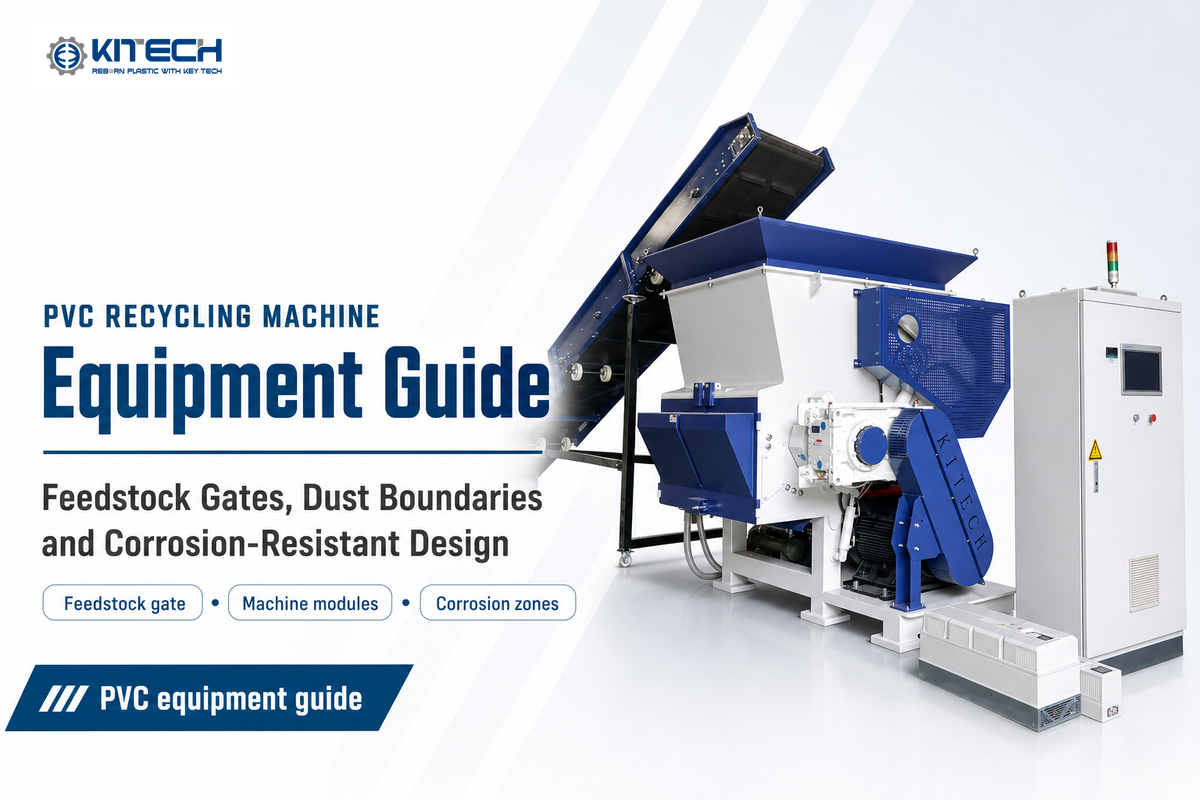
PVC Recycling Equipment Guide
A buyer-focused guide for rigid PVC scrap, machine duty basis, corrosion exposure zones, and RFQ data.
By DD
A PVC recycling machine is useful only after the buyer defines the PVC stream, target output, and acceptance basis. The right quote starts with feedstock form, piece size, contamination, moisture, fines, temperature exposure, and corrosion zones. Those facts set the test basis for comparing shredding, washing, milling, extrusion, or pelletizing equipment.
This guide is written for equipment buyers, not for legal or safety sign-off. It explains where PVC differs from PET, HDPE, and PP in a recycling line, then turns those differences into machine questions: which unit comes first, what should be measured, where corrosion may matter, and what the RFQ must not leave vague.
Kitech Recycling presents itself as a plastic recycling systems manufacturer covering shredding, washing, pelletizing, and filtration machinery. For full-line project routing, Kitech’s plastic recycling solutions page can sit beside the required equipment-page link used later in this article.
What Is a PVC Recycling Machine?
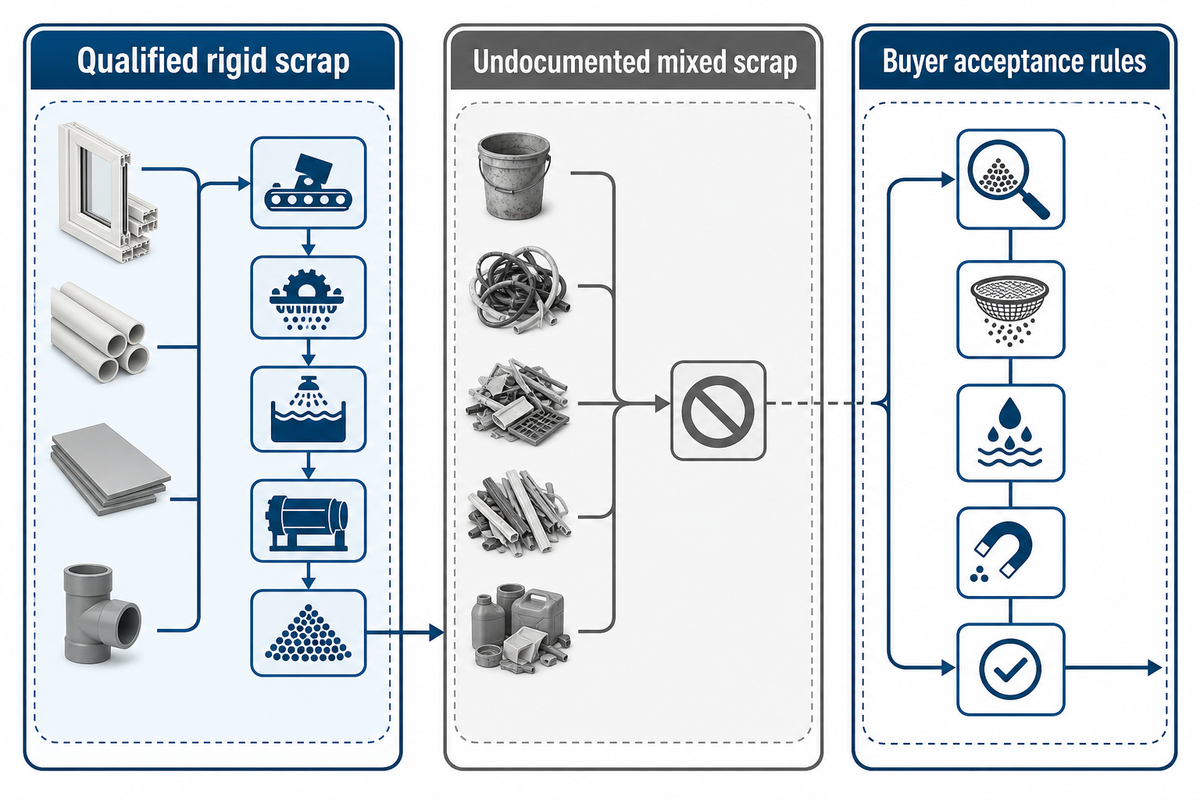
A PVC recycling machine is a standalone unit or complete line that prepares qualified PVC pipe, profile, sheet, board, or documented rigid scrap for reuse as flakes, powder, or pellets. It isn’t a universal route for undocumented mixed scrap, hazardous-additive-suspect material, or regulated end uses without buyer acceptance rules.
PVC needs that boundary because it isn’t just another rigid plastic. Research on PVC recycling describes route choices, additive concerns, and thermal behavior that can affect whether mechanical recycling is suitable for a given stream. That doesn’t mean every PVC part is too risky to process. It means the quote should be narrower than a generic plastic recycling machine quote.
The ordinary scope for this article is clean, documented rigid industrial or post-industrial PVC scrap. Flexible PVC, cable jacket, mixed cable scrap, dark or multilayer pieces, additive-rich material, and high-contamination feed can still be discussed. They belong in project-specific validation and buyer-acceptance language rather than in a guaranteed standard route.
Evidence basis: PVC recycling research on route choice, additives, and thermal limits supports this scoped definition; see this PVC recycling review.
Start With the PVC Feedstock Qualification Gate
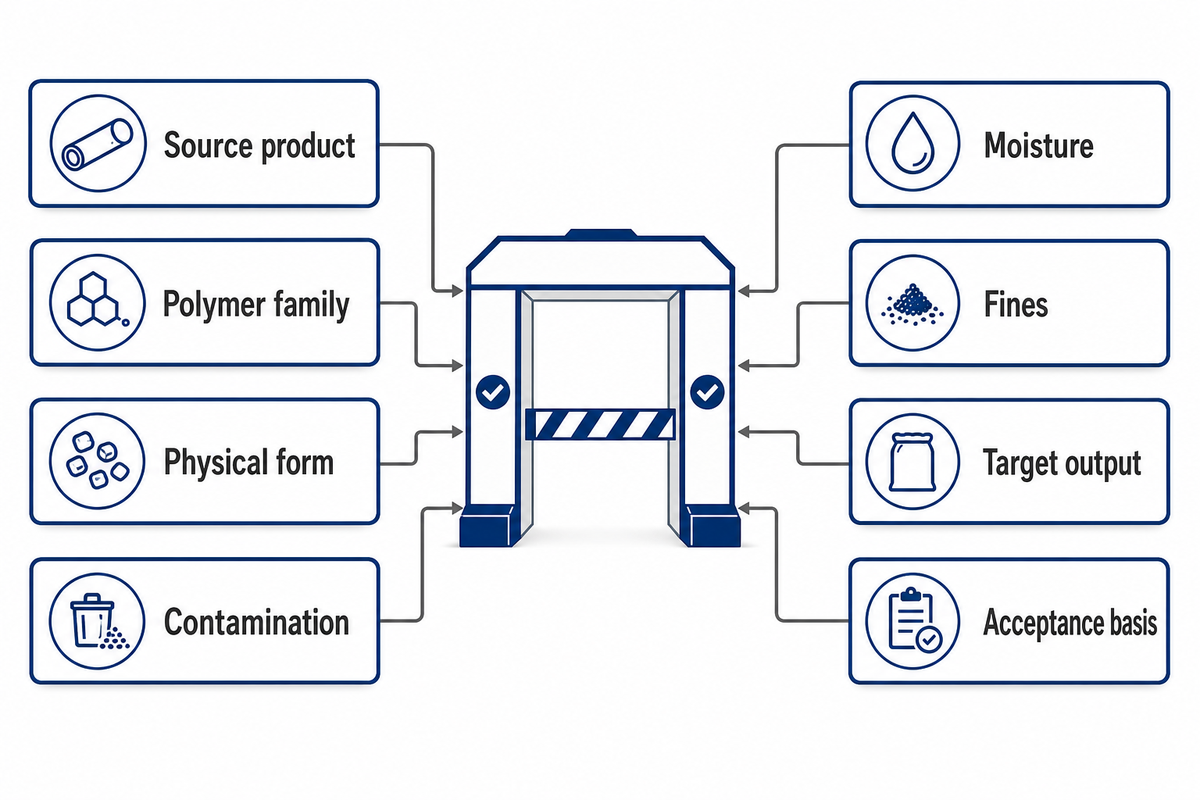
The PVC Feedstock Qualification Gate is the first buying step: define the source product, polymer family, physical form, contamination, moisture, fines, target output, and acceptance basis. Only then should the RFQ move into motor power or process order. This keeps the project tied to the actual scrap stream instead of a supplier’s generic line diagram.
If a recycling plant wants to recycle plastic from more than one type of plastic, the buyer shouldn’t blend those streams into one PVC quote. Waste plastic labels are often too broad for machine selection, and plastic waste from construction, cable, packaging, or factory trim can carry different additives, density, contamination, and downstream acceptance limits.
Start with the material family. PVC-U, PVC-P, and possible CPVC should be declared at RFQ level. Don’t use an outgoing recycled rigid PVC or CPVC classification standard as proof that incoming feedstock has already been qualified. Incoming identification, sorting, and property checks help define the feed; outgoing designations or certificates help define buyer acceptance for the produced flake, powder, or pellet.
Then mark the edge cases. Cable jacket, mixed cable scrap, black or dark fractions, multilayer pieces, flexible compound, additive-rich material, and high-contamination feeds should trigger project-specific validation questions. Ask how PVC will be identified, how false accept and false reject events are handled, and what reject stream is expected. Also ask whether the quote promises saleable output or only equipment capability.
Decision rule: if the buyer can’t state feedstock source, PVC family, contamination, moisture, fines, and target output, the project isn’t ready for a final equipment comparison. It’s ready for intake testing and a narrower RFQ.
Evidence basis: composition analysis and sorting evidence from NIST plastics research supports treating feed identification as a front-end gate.
PVC Recycling Machine Types by Process Step
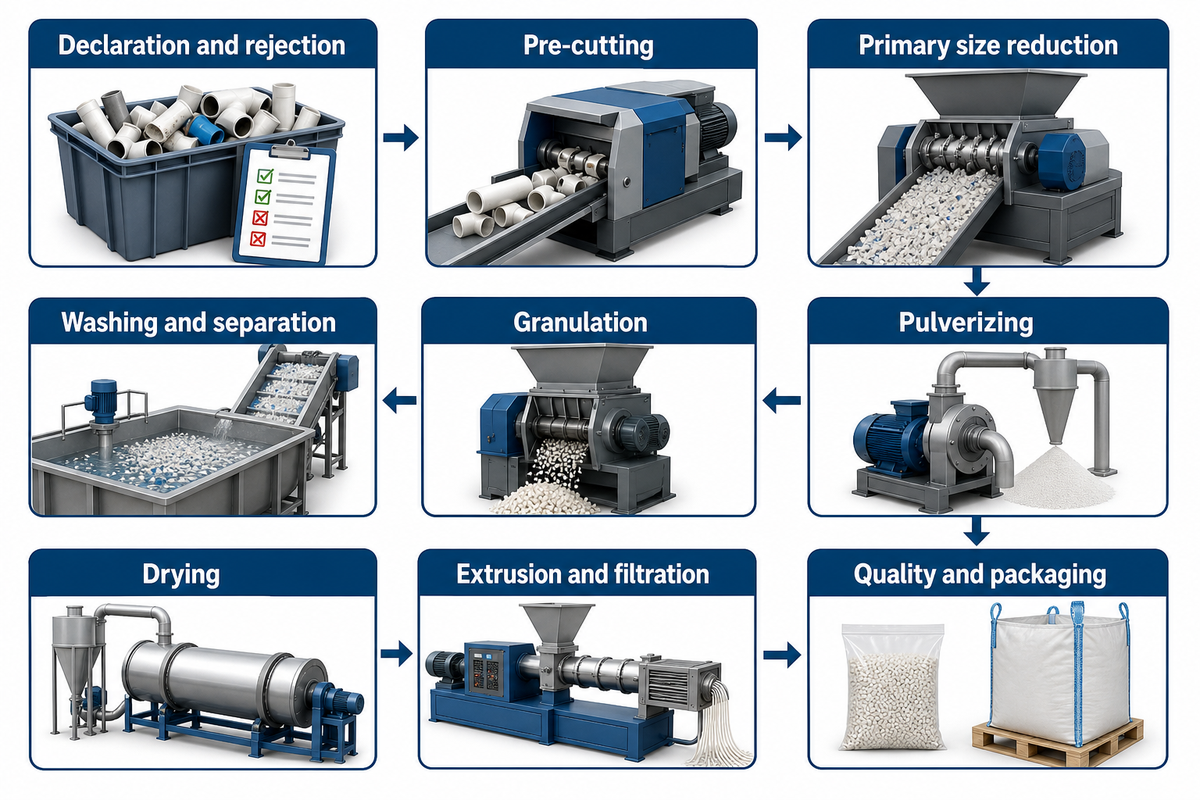
Machine selection should follow the feed and target output, not a fixed process flow. A line may begin with sorting, rejection, pre-cutting, or shredding before it moves into washing, separation, drying, milling, extrusion, filtration, pelletizing, or quality checks. The order changes with feedstock condition, output target, and supplier design.
For large pipe, profile, board, or sheet scrap, size reduction may begin with a saw, pre-cutter, single-shaft shredder, crusher, or granulator. Kitech’s plastic shredder page is the required internal reference for the first size-reduction discussion, but the rest of the line still depends on contamination and output needs.
RFQ rule: whether the buyer calls the project a PVC recycling plant, PVC shredder, or PVC granulator, the quote still has to tie each machine to feedstock, target output, and acceptance criteria.
| Process step | Typical equipment | Duty-basis input | RFQ question |
|---|---|---|---|
| Declaration and rejection | Manual, sensor, or lab-supported intake check | PVC family, source history, non-PVC fraction | What material is accepted or rejected before cutting? |
| Pre-cutting | Saw, guillotine, pre-cutter | Maximum piece length, wall thickness, bundle form | Can the feed enter the shredder without manual rework? |
| Primary size reduction | Single-shaft shredder or crusher | Feed opening, chamber size, torque envelope, screen target | What test feed and run time support throughput claims? |
| Washing and separation | Friction washer, sink-float, rinse tank | Labels, dirt, rubber, metals, moisture | What contamination remains after washing? |
| Granulation | Granulator or crusher with screens | Output size in mm, fines share, blade access | How is particle-size distribution measured? |
| Pulverizing | Pulverizer, mill, classifier | Powder target, cooling, dust path | What dust and heat interfaces are outside the machine quote? |
| Drying | Centrifugal dryer, thermal dryer, air system | Moisture target, air flow, residence time | What moisture value is accepted before extrusion? |
| Extrusion and filtration | Extruder, melt filter, die, pelletizer | Temperature range, screen change, purge practice | How are blocked-screen, vapor, and corrosion zones handled? |
| Quality and packaging | Sieve, sample station, bagging or silo | Flake, powder, or pellet acceptance basis | What certificate, retained sample, or buyer test closes the lot? |
Feedability also belongs in the table. Apparent density, bulk factor, and pourability can help describe powders, plastic flakes, irregular regrind, and fines-rich material, but they don’t guarantee hopper flow. If storage sensitivity or bridging is likely, the buyer should ask for the feed-tube, hopper, conveyor, agitation, and uniform-delivery assumptions.
Buyers comparing broad plastic recycling equipment should treat machine names as scope labels. A plastic washing line, washing line, crushing machine, plastic granulators, pelletizing machine, pelletizing system, and auxiliary machines can all appear in a plastic recycling line. Complete recycling lines may produce plastic pellets, powder, or cleaned flake, but the recycling machinery still has to match the feed and acceptance rule.
Evidence basis: process-route descriptions from CORDIS plastic recycling research support choosing modules by stream and target output.
Heat, Corrosion, Dust, and Safety Checks
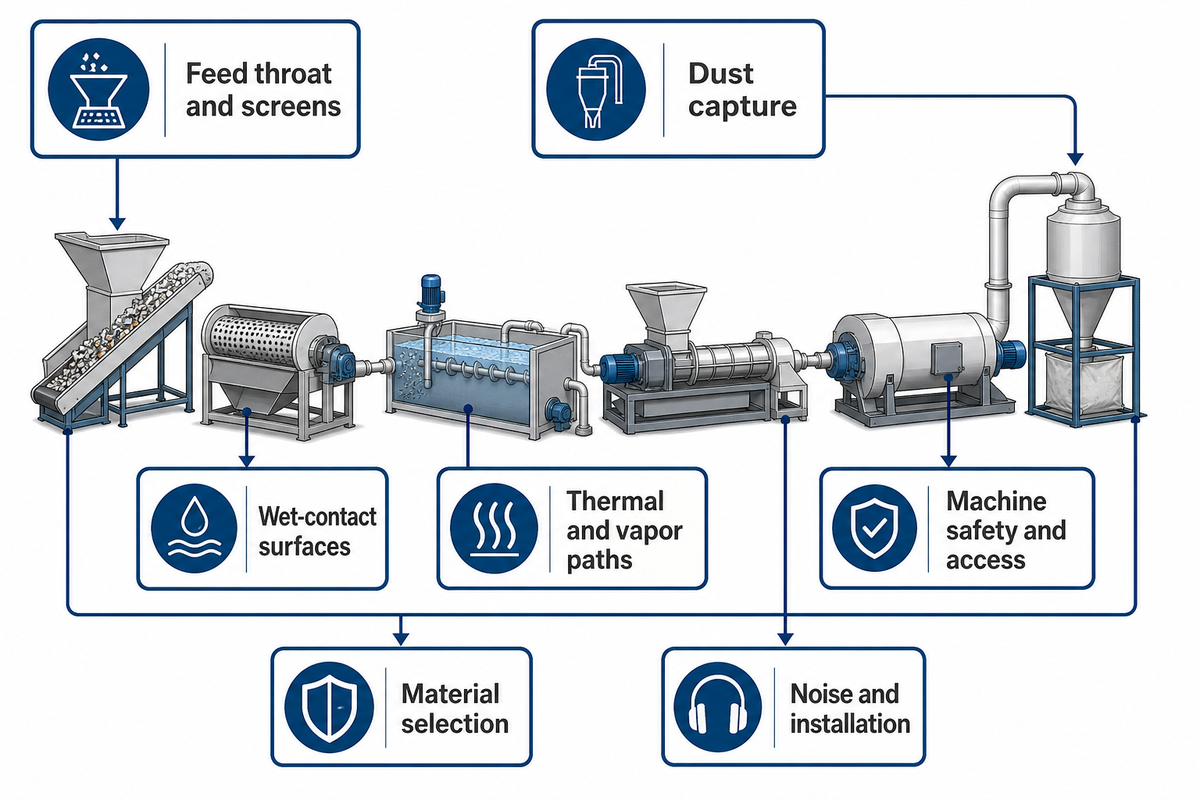
The 7-Zone Corrosion/Dust/Water/Safety Design Checklist keeps PVC-specific risk tied to equipment zones, not to a blanket line warning. Those feed and hopper assumptions from the previous section affect where heat, fines, condensate, wash water, vapor paths, access points, and maintenance tasks change the quote.
- Feed throat, cutter chamber, and screens: define wear surfaces, blade access, screen size, and the difference between cold cutting and heated processing.
- Dust capture and local exhaust: ask for collection interfaces, but state that collection, local exhaust, and filters aren’t combustible-dust protection.
- Wash tanks and wet-contact surfaces: define water contact, drainage, sludge removal, corrosion basis, and whether liquid carryover needs chemical characterization.
- Thermal and vapor paths: review dryers, extruders, melt filters, dies, blocked-screen states, purge practice, alarms, and exhaust routing.
- Material selection: ask for supplier-stated compatibility, coatings, lining basis, replaceable wear parts, and inspection access where wet, heated, or condensate service is expected.
- Machine safety and access: separate guards, access panels, emergency stops, interlocks where applicable, restart-prevention expectations, and retained-motion assumptions before hazard-zone access.
- Noise and installation: request comparable noise data, measurement conditions, enclosure options, electrical/control enclosure placement, and room-acoustics boundaries.
The corrosion decision should be process-specific. Ordinary ambient shredding shouldn’t be described as inherent HCl release. Heated PVC processing, condensate paths, wash-water chemistry, blocked-screen states, and maintenance exposure are different questions. Ask what the supplier has assumed, then decide whether a buyer-side engineer or site reviewer needs to set a stricter service envelope.
For dry fines, use the same restraint. OSHA combustible-dust guidance supports asking whether dust collectors, ducts, pulverizers, screens, or connected equipment need separate review for ignition control, electrical classification, deflagration propagation, venting, suppression, or specialist combustible-dust evaluation. That question isn’t answered by a dust hose alone.
Evidence basis: dust and plastics-fume boundaries draw on OSHA combustible-dust guidance and remain scoped to the relevant process zones.
PVC Feedstock-to-Process Route Matrix
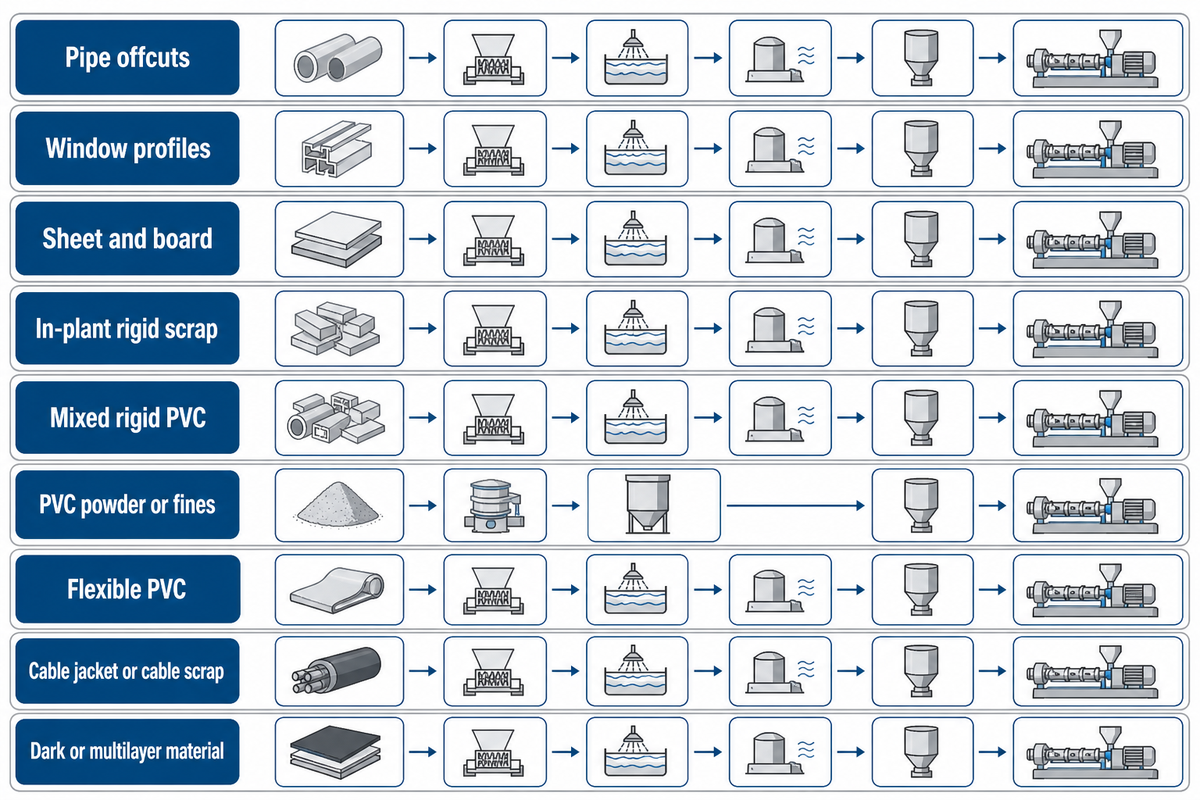
The PVC Feedstock-to-Process Route Matrix maps each feed type to the process modules and proof package that make sense. Mechanical recycling is the first route to evaluate only when recovery, processing impact, feasibility, economics, and buyer acceptance all support it.
| Feedstock route | Feeding issue | Watch point | Likely modules | Acceptance boundary |
|---|---|---|---|---|
| Pipe offcuts | Long lengths, wall thickness | PVC versus CPVC declaration | Pre-cut, shred, granulate, screen | Output size and buyer application |
| Window profiles | Gaskets, metal, dust | Stabilizer and contamination mix | Reject, shred, wash, dry, granulate | Reject handling and flake purity target |
| Sheet and board | Flat scrap, trim, stacked feed | Fillers, labels, lamination | Feed, cut, granulate, optional wash | Particle size and contamination limit |
| In-plant rigid scrap | Known recipe, changing geometry | Thermal history and stabilizer control | Shred, granulate, dry, refeed or pelletize | Internal quality test and retained sample |
| Mixed rigid PVC | Metals, rubber, wood, other plastics | Identification method and false reject | Sort, reject, wash, size reduction | Validation scope and buyer acceptance |
| PVC powder or fines | Flow, bridging, dust release | Hopper flow and dust responsibility | Mill, classifier, collection interface | Feedability test and site dust review |
| Flexible PVC | Soft, variable, additive-bearing | Plasticizer and end-use limits | RFQ-only validation route | No regulated-use promise |
| Cable jacket or cable scrap | Metal, rubber, polymer mix | Separation purity and saleable grade | RFQ-only separation validation | Do not treat as guaranteed standard route |
| Dark or multilayer material | Sensor and visual limits | Method-specific validation | Sort/reject plus method check | False accept and false reject rule |
This matrix keeps chemical recycling, dechlorination, additive-removal, and emissions review in the right place: as separate technical or specialist routes, not as promises attached to a standard mechanical line. Washing, shredding, granulating, pulverizing, and pelletizing can prepare material; they don’t by themselves validate legacy additives, food-contact use, children’s products, medical use, potable-water use, or other regulated applications.
Evidence basis: the route matrix follows mechanical-recycling feasibility boundaries described in peer-reviewed PVC recycling literature.
How to Specify a PVC Recycling Line for RFQ
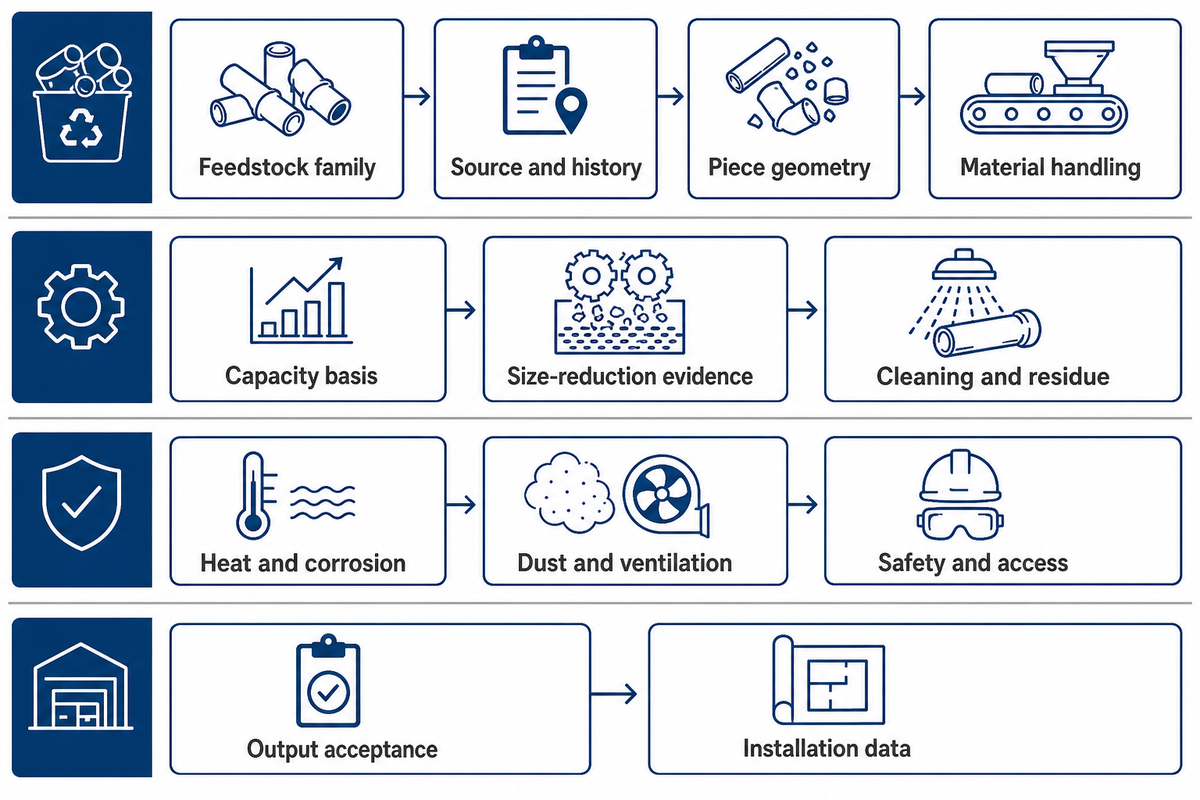
A quote-ready PVC recycling line RFQ should start with machine duty, then add PVC-specific limits only where they change design, testing, or acceptance. This order prevents chemistry caveats from burying the practical data a supplier needs to size the equipment.
The common types of plastic recycling machinery matter less than the measured duty basis. Buyers asking about machine price should compare operating cost, energy consumption, output specification, service access, and validation scope inside the same recycling process. A low first price can be weak when sorting, washing, drying, or pellet handling is left outside the quote.
Performance comparability needs special care. For size-reduction equipment, a useful test basis can state defined feed, feed condition, continuous run duration, net processing time, throughput basis, energy basis, sampling basis, and particle-size-distribution measurement. Whole-line yield, reject fraction, water use, labor, changeover, cleaning interval, wear tracking, output fractions, warranty duration, and uptime are different evidence types.
Safety wording should also be separated. Emergency stops aren’t energy isolation, and a normal stop isn’t a lockout process. Ask who’s responsible for servicing, cleaning, and unjamming tasks where unexpected energization, startup, or stored energy could injure. For access panels or guarded zones, ask whether interlocks, restart prevention, stopping time, or retained-motion assumptions are included. Then state whether those items sit inside the supplier’s scope or stay with the line integrator and site owner.
Finally, state the out-of-scope boundary plainly. Regulated end uses, additive-bearing residues, food-contact claims, children’s products, medical applications, potable-water use, or universal recyclate-grade claims require buyer-supplied acceptance rules and application review. A recycling machine quote can describe equipment and test basis; it can’t decide every downstream use of the recycled PVC.
Evidence basis: short supplier runs are separated from long-horizon reliability claims using NIST reliability acceptance-test guidance.
FAQ
Why is PVC harder to recycle than some other plastics?
PVC can be harder to recycle because formulation, chlorine content, stabilizers, plasticizers, contamination, and heat exposure can change what the recycled output is suitable for. Clean, documented rigid PVC is much easier to quote than mixed, flexible, cable, dark, multilayer, or legacy-additive-suspect scrap. The buyer should also separate material recovery from downstream eligibility because shredding, washing, and pelletizing don’t automatically remove legacy additives, prove a regulated application, or define what acceptance test closes the project.
What machine details and test basis should be in an RFQ before chemistry questions?
Start with maximum piece size, feed form, apparent density or bulk factor where relevant, throughput target, motor and torque envelope, feed opening, output size, layout, cleaning access, noise basis, test feed, run duration, net processing time, energy basis, and sampling method.
Does PVC recycling always require corrosion-resistant equipment?
No. Ordinary cold size reduction shouldn’t be treated as automatic HCl release or full-line corrosion service. Corrosion-resistant design questions belong where the actual service envelope includes wet contact, condensate, heated processing, vapor paths, blocked screens or dies, purge states, chemicals, or maintenance exposure. The useful RFQ request is a zone-by-zone material-compatibility basis, not one universal alloy promise. Ask the supplier to tie coatings, linings, seals, bearings, and inspection access to the exposed zone.
Is a shredder enough for PVC recycling?
A shredder may be enough only for a narrow size-reduction job where the buyer already controls feedstock and output acceptance. A full recycling line may also need sorting, rejection, washing, drying, granulating, pulverizing, extrusion, filtration, pelletizing, dust interfaces, quality checks, and packaging.
When should cable jacket stay RFQ-only instead of a standard route?
Cable jacket should remain RFQ-only if the stream has mixed polymers, rubber, metals, dark fractions, possibly restricted additives, WEEE-origin material, or uncertain separation targets. Specify the separation method, reject management, validation test, designated grade, and whether output saleability is promised. Keep the acceptance language relative to the quoted feed, intended output, and reject stream, and don’t suggest a separation method as a silver bullet for other cable or flexible PVC flows.
What should I send before asking for a PVC recycling machine quote?
Send photos, source description, PVC family if known, dimensions, contamination details, moisture, fines, metals, labels, desired output, throughput target, floor layout, utility limits, heat or corrosion concerns, cleaning and safety-access expectations, and the buyer test or certificate that will decide acceptance.
For a quote discussion, send the feedstock photos and the 12-point RFQ data above. Kitech can then discuss whether the project starts with shredding, washing, pulverizing, extrusion, pelletizing, or a narrower validation route.
Selected Source Links
- PVC recycling technical review – route choice and mechanical-recycling boundaries.
- PVC thermal decomposition and HCl context – heat-scoped corrosion language.
- NIST plastics composition and sorting page – identification and sorting validation boundary.
- AMPP corrosion materials selection guidance – service-envelope thinking.
- OSHA combustible dust SHIB – dust-collection versus combustible-dust responsibility boundary.
- ISO 13850 emergency stop function page and ISO 14119 interlocking devices page – safety function and guard-interlock scope boundaries.