Get in touch with Kitech Company


Updated June 2026 · Reviewed by the Kitech technical team.
Polymer recycling is the recovery and transformation of discarded plastic into usable material, and it can take the form of an endless circle (closed loop) or a one-way trip to fuel, and the path you follow – whether mechanical, chemical, or advanced – depends on where you start: your plastic feedstock, its family of resins, the degree of contamination, and current recycling laws (especially those set to kick in 2026).
We provide here a roadmap to the four major recycling categories and their attendant technologies, which plastics actually get recycled, and emerging regulatory frame works from the trenches of equipment manufacturers.
Simply stated: Polymer recycling generally falls into four types, often defined as primary, secondary (both mechanical), tertiary (chemical), and quaternary (energy recovery), by standards like ASTM D5033 or classifications used by industry groups such as the ISO 15270 family.
The most common method for processing the bulk of plastic waste, mechanical recycling, re-melts thermoplastics; chemical recycling involves deconstructing some plastics back to their basic elements. However, global recycling rates are dismally low, around 9% — and the recycling category of a material, rather than its resin code alone, determines whether you can achieve something approaching a circular economy.
Polymer Recycling at a Glance
| Category | Mechanism | Output |
|---|---|---|
| Primary | Mechanical (clean scrap) | Same-grade product (closed-loop) |
| Secondary | Mechanical (mixed/used) | Lower-grade product (downcycling) |
| Tertiary | Chemical / depolymerization | Monomers or feedstock |
| Quaternary | Energy recovery (combustion) | Heat / electricity |
The 4 Core Categories of Polymer Recycling (Method Family Tree)
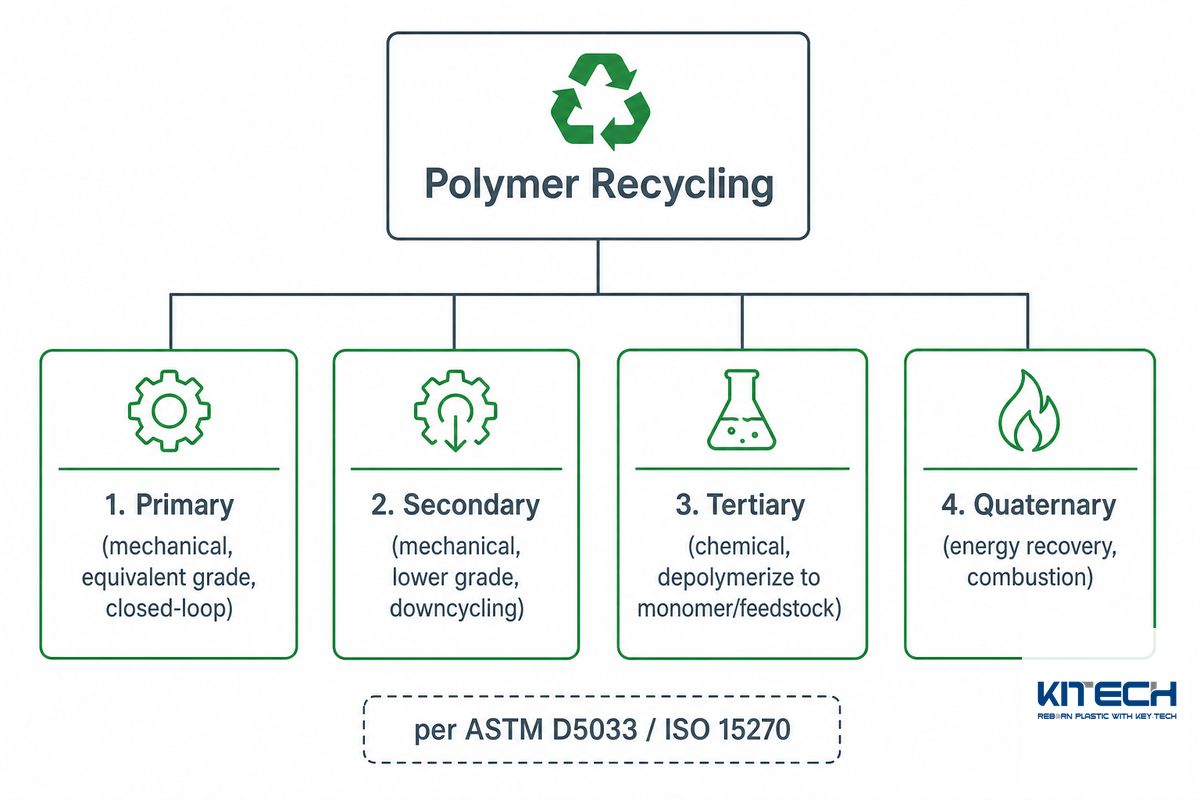
These four routes apply across the full span of polymer types — from commodity polymers and other thermoplastic polymers to cross-linked thermoset polymers and engineered polymer composites — and they govern whether a polymer blend or a single polymer can re-enter production and recycling rather than disposal. The recycling of plastic is rarely one tidy recycling solution; in practice it spans recycling and upcycling across renewable and sustainable supply chains. A frequent and costly mistake is counting quaternary energy recovery as recycling on a sustainability report: it overstates circularity, fails an audit, and invites greenwashing scrutiny.
You’ll encounter four distinct groups of recycling technologies: primary, secondary, tertiary, and quaternary. While standards can differ in classification, the most consistent taxonomy comes from a peer-reviewed standards mapping and ASTM D5033: Primary recycling occurs when the same resin is mechanically reworked into products with similar properties to the original material, completing a closed-loop system. Secondary recycling occurs when used, possibly mixed, plastics are mechanically reworked into products with lower performance requirements (also known as downcycling).
Tertiary recycling consists of chemically breaking the plastic down into monomers (for potential monomer synthesis) or converting it into feedstock for the chemical industry. Finally, quaternary recycling converts energy through the controlled combustion of plastic waste.
What often confounds readers-including industry veterans-is the different ways the two major recycling standards define these categories. The ASTM D5033 standard categorizes routes numerically from 1 to 4. Conversely, the ISO 15270 family defines categories by action type (mechanical, chemical, energy recovery) while combining what ASTM distinguishes as ‘primary’ and ‘secondary’ under a single heading “mechanical recycling,” differentiating them only by output quality.
The transition within ISO standards-its 2008 single-point guide is being replaced by a series (Parts 3, 4, and a new 2025 Part 5 for organics/biological)-has introduced a fifth category to be formally considered: industrial composting for certifiable “compostable” plastics. Home composting, however, is outside the purview of plastic recycling per se.
💡 Key takeaway
The widely adopted waste hierarchy ranks the four types as follows, favoring high-value use of resources: • Primary (closed-loop mechanical): the best.
• Secondary (downcycled mechanical) • Tertiary (chemical) • Quaternary (energy recovery): the least preferable alternative to landfill, and a useful check on vendors mislabeling incineration as “recycling.”
Which Polymers Can Actually Be Recycled? (Resin Recyclability Decoder)
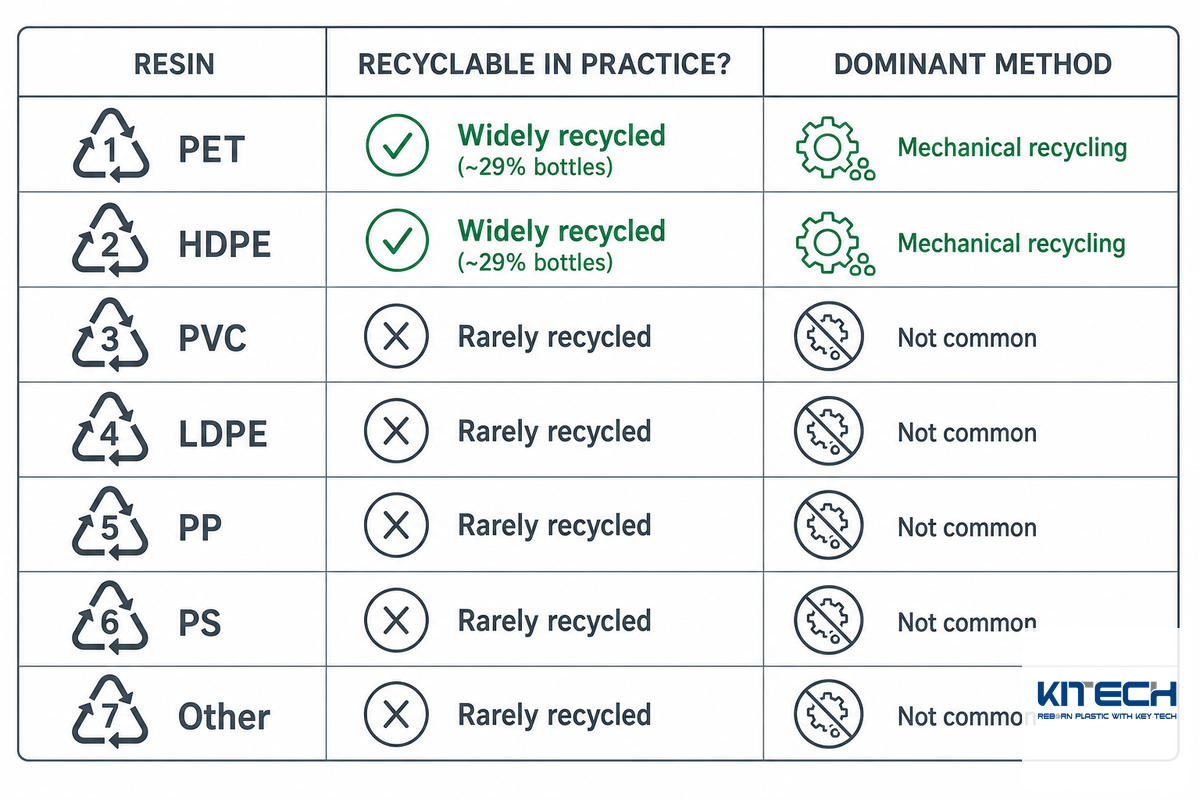
A resin’s chemical structure and thermal stability decide its fate. In practice, only PET (#1) and HDPE (#2) are recycled at meaningful rates — about 29% of bottles in the U.S. — while PVC, polystyrene, and most #7 polymer materials are challenging to recycle and leave a buyer with few recycling options, because some polymers tolerate repeated reprocessing and most others simply do not.
The Resin Identification Code — the chasing arrows with a number inside — tells you what the material is, not whether it’s recyclable. Only the first two resin codes-#1 Polyethylene Terephthalate (PET) and #2 High-Density Polyethylene (HDPE)- are reliably recovered in any significant quantity in most streams.
In the U.S., recycling rates for PET beverage bottles stand at 29.1%, while for natural HDPE beverage bottles it is 29.3% (U.S. EPA 2018 data)-far exceeding the overall U.S. rate of 8.7% for plastics waste. All lower resin codes are largely contaminants within a sorted bale destined for recycling equipment.
The “Resin Recyclability Decoder” table shows you the commonality of recycling by each plastic code, and what sort of processing each typically undergoes.
| Resin class (code) | Real-world recyclability | Dominant method & output |
|---|---|---|
| PET (1) | Widely recycled (~29% bottles) | Mechanical → rPET flake/fiber; chemical → monomer |
| HDPE (2) | Widely recycled (~29% bottles) | Mechanical → pipe, lumber, bottles |
| PVC (3) | Rarely curbside — stream contaminant | Limited mechanical; trace PVC ruins rPET |
| LDPE/LLDPE (4) | Store drop-off film only | Mechanical → film, liners |
| PP (5) | Increasingly accepted (>60% US households, 2025) | Mechanical → crates, automotive |
| PS (6) | Rarely recycled | Limited; depolymerization → styrene emerging |
| PLA (7, bioplastic) | Not curbside; contaminates PET | Industrial composting (organic route), not mechanical recycling |
| PC (7, polycarbonate) | Niche; chemically recyclable | Methanolysis → BPA (95–96%) |
| ABS (7, engineering) | Limited (e-waste, sortation-dependent) | Mechanical regrind; density separation |
| Multilayer / composite (7) | ~5% recyclable conventionally | Chemical (feedstock) only; immiscible bonded layers |
Rates: U.S. EPA Plastics Material-Specific Data (2018).
“Thermoset Plastic Recycling 101.” The deeper divide is chemical, not numerical: thermoplastics (PET, PE, PP, PS) have linear chains that re-melt, so they can be mechanically recycled; thermosets (polyurethane foam, epoxy, flame-retardant and fiber-reinforced composites) are locked into a covalently cross-linked 3D network and cannot be re-melted at all. That’s why a guide claiming “thermosets are non-recyclable” is half right and half outdated-they can’t be melt-recycled, but chemical routes exist (polyurethane foam glycolysis recovers polyol, the most mature thermoset route), and reprocessable vitrimers are an active research frontier. To go deeper on the resin families, see our breakdown of the types of recyclable plastic and resin codes and why thermosetting plastic behaves differently from thermoplastics.
Can thermoset plastics be recycled?
Not by melting. Thermosets such as polyurethane foam and epoxy are permanently cross-linked, so they can’t be re-melted and reshaped the way a PET bottle can. They’re recycled by chemical routes instead-polyurethane foam glycolysis recovers usable polyol, and that’s currently the only industrially mature thermoset chemical-recycling path.
Otherwise thermosets are ground into filler or sent to energy recovery.
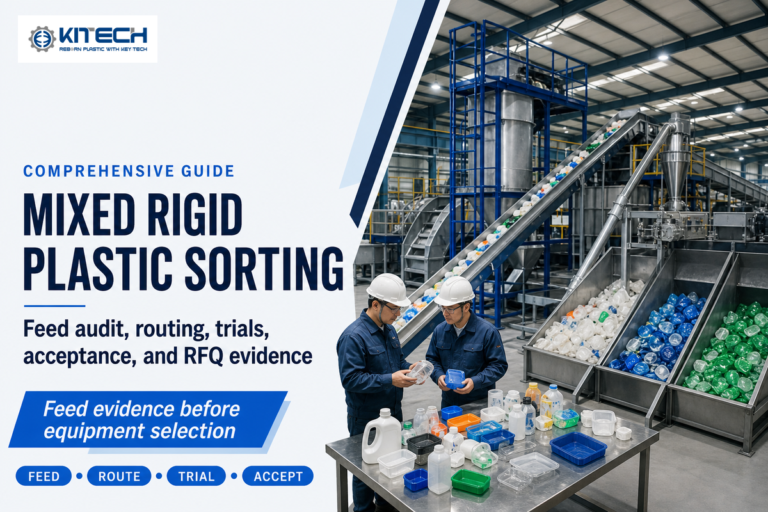
Picture a reclaimer receiving a mixed curbside bale. The PET bottles and natural HDPE jugs have buyers; the PVC blister packs, the metallized snack film, and a stray polystyrene tray don’t.
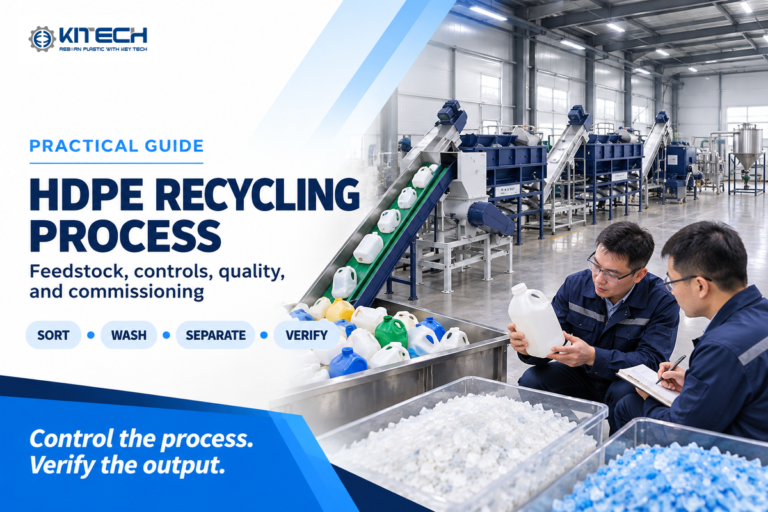
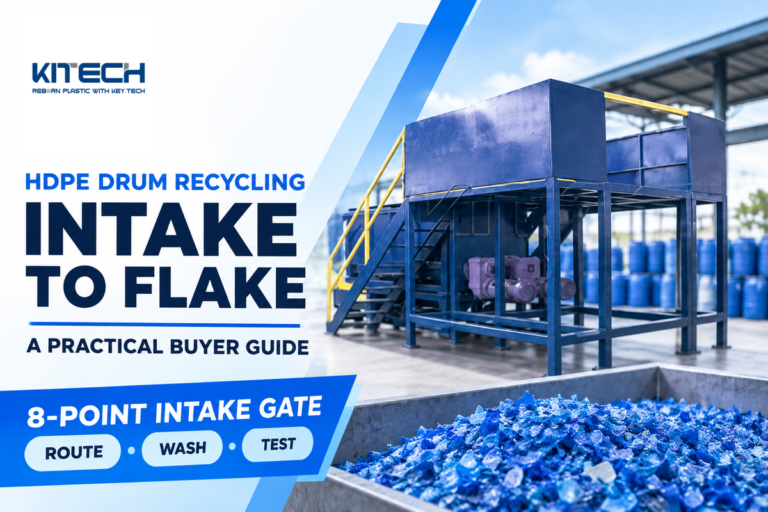
Worse, the operator can’t simply melt them together-PE, PP, PS, PA, and PET are largely immiscible and won’t co-melt into a usable resin. So the first real recycling decision happens at the sort, not the extruder, and it’s driven by what each resin’s end market will actually pay for. Buyers exploring resin-specific lines often start with HDPE recycling, ABS recycling, or recycled LDPE.
Mechanical Recycling: How It Works (and Where It Hits a Wall)
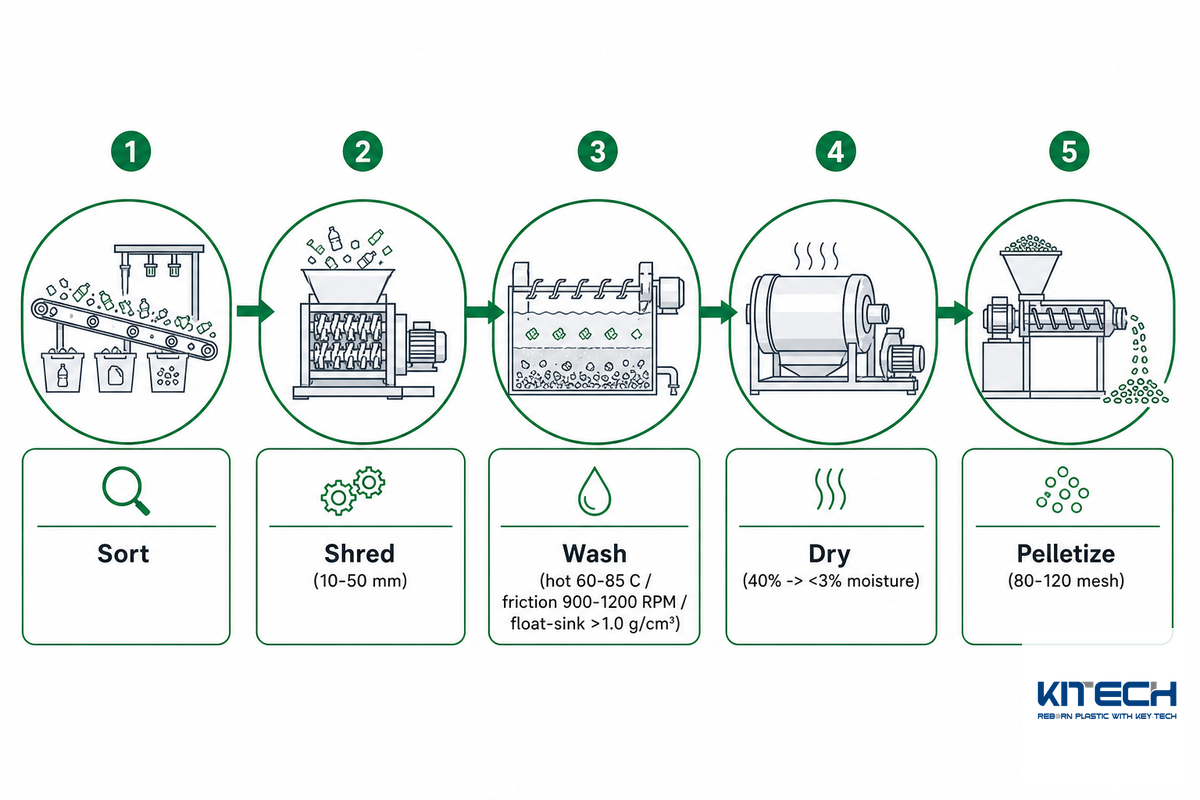
Mechanical recycling of plastic is the dominant form of material recycling, but every pass drives polymer degradation — chain scission shortens polymer chains and erodes the thermal and mechanical properties batch after batch. A single lot of clear PET bottle flake shows the path in practice: its first mechanical loop can still yield food-grade rPET, but by the third or fourth remelt the falling intrinsic viscosity pushes it down into fiber and strapping, then into non-food uses — the same plastic three rungs down the value ladder within a few years.
Mechanical recycling is the workhorse that handle the overwhelming majority of recycled plastic worldwide. It re-melts and reforms thermoplastics without breaking their chemical structure-at least in theory. In practice the polymer changes a little every pass, and that’s the wall every operator eventually meet.
What are the stages of mechanical plastic recycling?
A mechanical recycling line runs four purpose-built stages: size reduction, washing and contaminant removal, drying and moisture control, then pelletizing. On Kitech lines the chain runs as follows, with each stage sized to the feedstock’s particle size, contamination level, and moisture content, and the equipment matched to a throughput of 300 to 3,000 kg/h so no single step becomes the bottleneck.
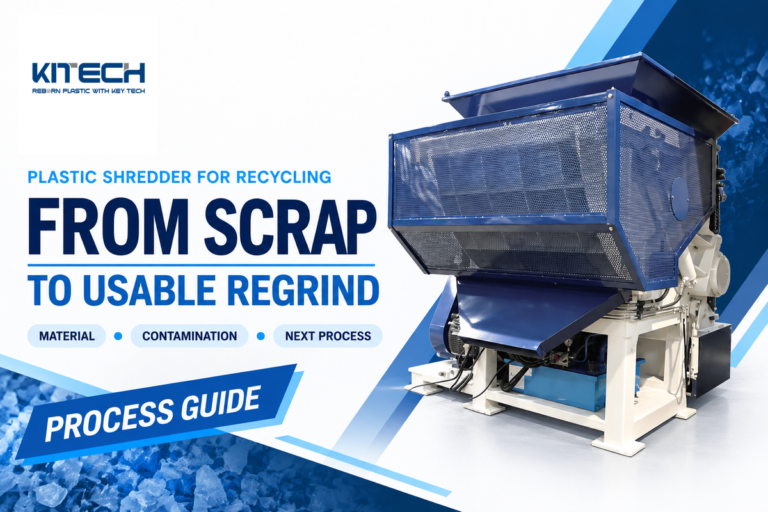
- Shredding (size reduction): single- or two-shaft crushers cut waste to uniform 10-50 mm granules; motor power runs 15 kW for light film up to 200 kW for heavy HDPE drums and rigid ABS.
- Washing: hot caustic washes at 60-85 °C dissolve adhesives and organic residue; friction washers spin at 900-1,200 RPM to abrade surface dirt; float-sink tanks separate by density (PET sinks above 1.0 g/cm³, PP/PE caps float).
- Drying: centrifugal dryers and screw-press dewatering pull moisture from ~40% down to below 3%-miss this and the extruder produces bubbles and weak pellets.
- Pelletizing: single- or two-stage extruders with 80-120 mesh melt filters remove fine contaminants and form clean pellets ready for the next molder.
Two of these stages decide output quality, see our deep dive on float-sink separation in plastic recycling and how drying and moisture control protect pellet quality.
📐 Engineering Note: why mechanical recycling downcycles
Each remelt cycle scissions polymer chains and reduces molecular weight. Bottle-grade PET going through four melt extrusion passes under controlled circumstances lost up to ~19% of intrinsic viscosity (from a nominal ~0.80 to ~0.65 dL/g), ~29% of elongation at break, while crystallinity increased from 23% to 29.5% — the stuff gets brittle/stiff.
That’s “downcycling” as the process go, which leaves a number of demanding applications in other material uses. it’s why the plastic recyclate has to be diluted with virgin polymer or a barrier is put around it.
There are two field factors that mean more to plastics recycling than the chemical textbooks ever could; firstly, mechanical recycling isn’t, strictly speaking, entirely a physical process-chain-scission of polypropylene, branched chains in polyamide, transesterification of PET/polycarbonate during melt processing makes it a “material” recycle for others; secondly, feedstock composition is the real capacity limitation: as low a level as fractions of percent of PVC in a PET load means a HCl emission will degrade the product; therefore, the material sort and composition management will be equipment issues on the load handling side, not afterthought process elements; the melt is recovered for the balance to be made up by chain extenders or by diluting with virgin resin.
Chemical Recycling: Breaking Polymers Back to Building Blocks
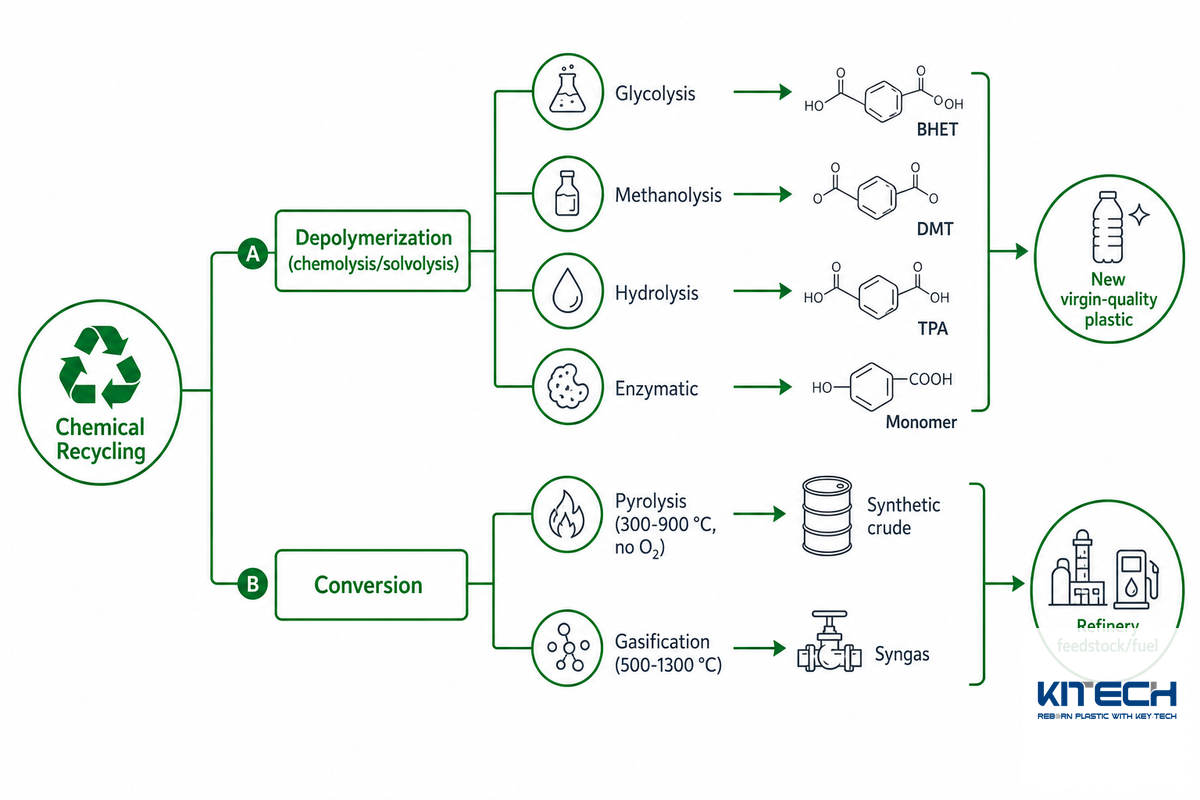
Going beyond mechanical recycling, feedstock recycling — including the recycling of polyolefins and the recycling of polystyrene — uses heat, catalytic systems, and chemical agents to break polymer networks down to new polymer building blocks, while compatibilization of polymer blends keeps mixed mechanical streams usable.
Chemical processes rearrange a polymer’s molecules.
Broadly speaking there are two streams here, which the industry doesn’t helpfully markets under one term: one is the chemistry that deconstructs polymers back to monomers (depolymerization, aka chemolysis, or solvolysis) to be re-inserted into plastics manufacturing, while another class is a physical-chemical breakdown process called conversion that takes sorted plastics waste and generates refinery (pyrolysis, gasification) Feedstock: to go back into the chemical plant. (Another niche process called dissolution isn’t covered).
For a process overview, the U.S. GAO describes the operating envelopes: pyrolysis runs at 300-900 °C without oxygen to make synthetic crude; gasification runs at 500-1,300 °C in low oxygen to make syngas; and depolymerization uses heat, chemicals, catalysts, or enzymes, some near 40-70 °C. Conversion is the most established and furthest along in scaling; depolymerization sits in early pilots and purification is least mature.
According to peer-reviewed reviews, representative PET depolymerization yields are: glycolysis (160-300 °C) recovers about 70-90% BHET monomer, methanolysis gives up to ~98% dimethyl terephthalate (DMT), and hydrolysis provides about 78-96% terephthalic acid (TPA) — exact figures vary with conditions and catalyst. The best enzyme systems work as low as 40-70 °C at similar yields. Polycarbonate methanolysis recovers ~95-96% BPA.
Nylon-6 yields caprolactam up to about 85-90% on total weight.
⚠️ The bond that decides everything
In addition, clean monomer recovery is currently only applicable to some condensation polymers such as PET, polycarbonate, nylon, and PLA because they are designed to contain an ester or amide group that is readily broken (cleavable). Olefin-based products such as the world’s top volume plastics – polypropylene (PP) and polyethylene (PE) – were never designed to contain such a differentially cleavable bond. As such, there is no way to break them down into their respective monomers selectively, so polyolefin recycling to monomer is off the table and the recycling of polymers like PE and PP stays mechanical or fuel-bound.
They can only be cracked nonselectively into various hydrocarbons via cracking. Therefore, chemical recycling, as is, will not work for “all plastics”.
Pyrolysis itself is a fuel process as much as a plastic process: a 2025 review found it converts 60-80% of plastic into liquid fuel (up to 85% in fast pyrolysis at 450-600 °C), with pyrolysis oil selling at $600-900/tonne. That basic distinction – feedstock versus fuel – is where the next section live.
And for an example of a downstream process related to depolymerization, we recommend a look at solid-state polycondensation for rPET.
Advanced Recycling & Depolymerization: The Infinite Loop vs the 2026 Reality
“Advanced recycling,” the process marketed as the circular economy panacea which will create infinite recycling. The patents are indeed there – Carbios with an enzymatic PET process delivering over 90% depolymerization in under 10 hours at 72 °C; Loop Industries patents glycolysis / methanolysis / hydrolysis routes to monomer. The reality in 2026 is however far more nuanced than the hype: most polymer recycling companies pursuing advanced polymer recycling have yet to prove the polymer recycling process out at commercial scale.
According to one industry estimate cited by Yale Environment 360, of 2 million tons of advanced recycling capacity to come online, less than 500,000 tons will actually be new plastic, the remainder used as fuel. The track record is poorer still, with as of January 2025 only eight chemical-recycling plants active in the U.S.; an Indiana facility in the Brightmark pipeline has declared bankruptcy and hasn’t yet reached capacity, and the Department of Energy withdrew a $375 million contract in May 2025 for an Eastman facility, stating that such projects “aren’t economically feasible.” The proposed capacity (more than 6 million tons/year of plastic through 169 projects) remains enormously optimistic about reality.
“There’s a real lack of transparency about how much plastic they’re recycling.”
Veena Singla, Senior Scientist, Natural Resources Defense Council
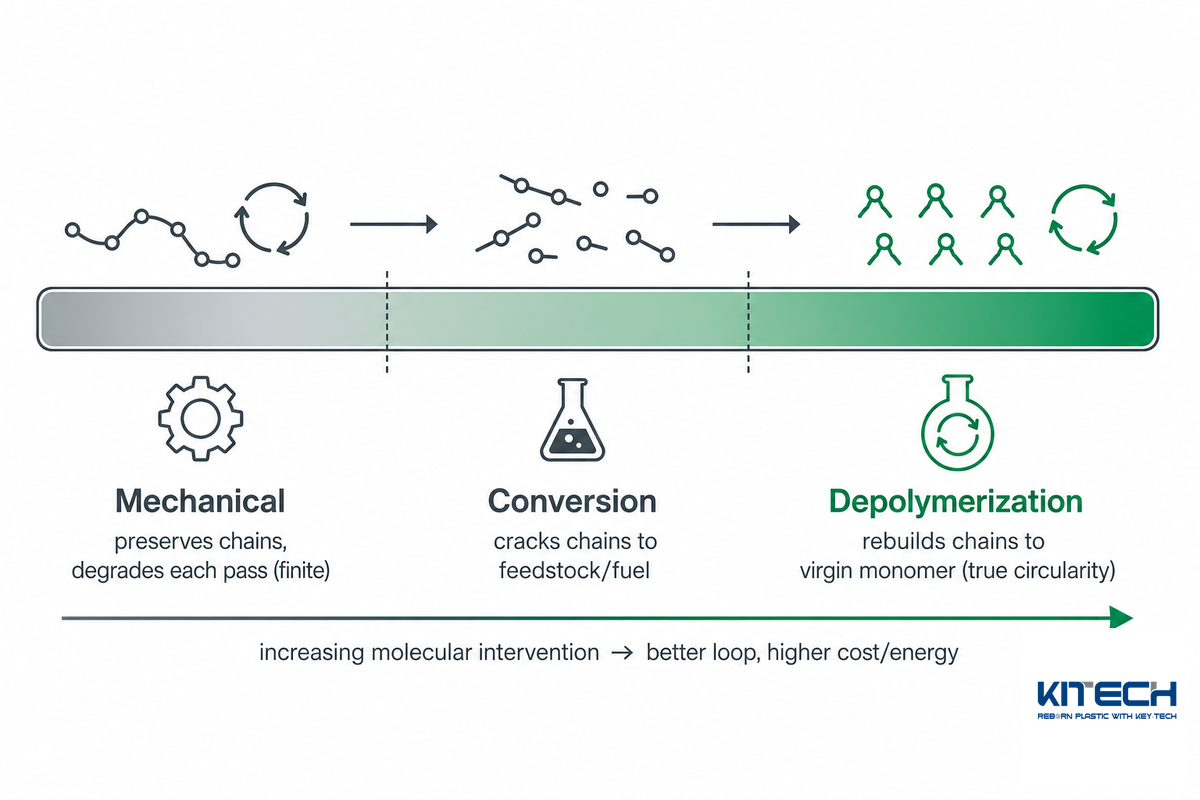
Chain-Integrity Spectrum: how deep each method cuts the polymer
Here’s a handy mental model I’ve found — the “Chain-Integrity Spectrum,” reflecting how much impact a process has on the polymer chain: Mechanical recycling preserves chains but degrades them with every pass (finite reuse). Conversion cracks chains into mixed feedstock or fuel (loss of polymer identity). Depolymerization rebuilds chains by recovering virgin-quality monomer (true circularity, assuming it can run).
The further right on this chain of methods you get, the better the ideal loop — and the higher the cost, energy, and immaturity, all relative to a naive understanding. The honest truth for a purchasing team in 2026, if they decide this isn’t hype — economics not chemistry is the bottle-neck, because virigin plastic is still cheaper and the demand is still too narrow.
Mechanical vs Chemical vs Advanced: A Feedstock-to-Route Decision Tree
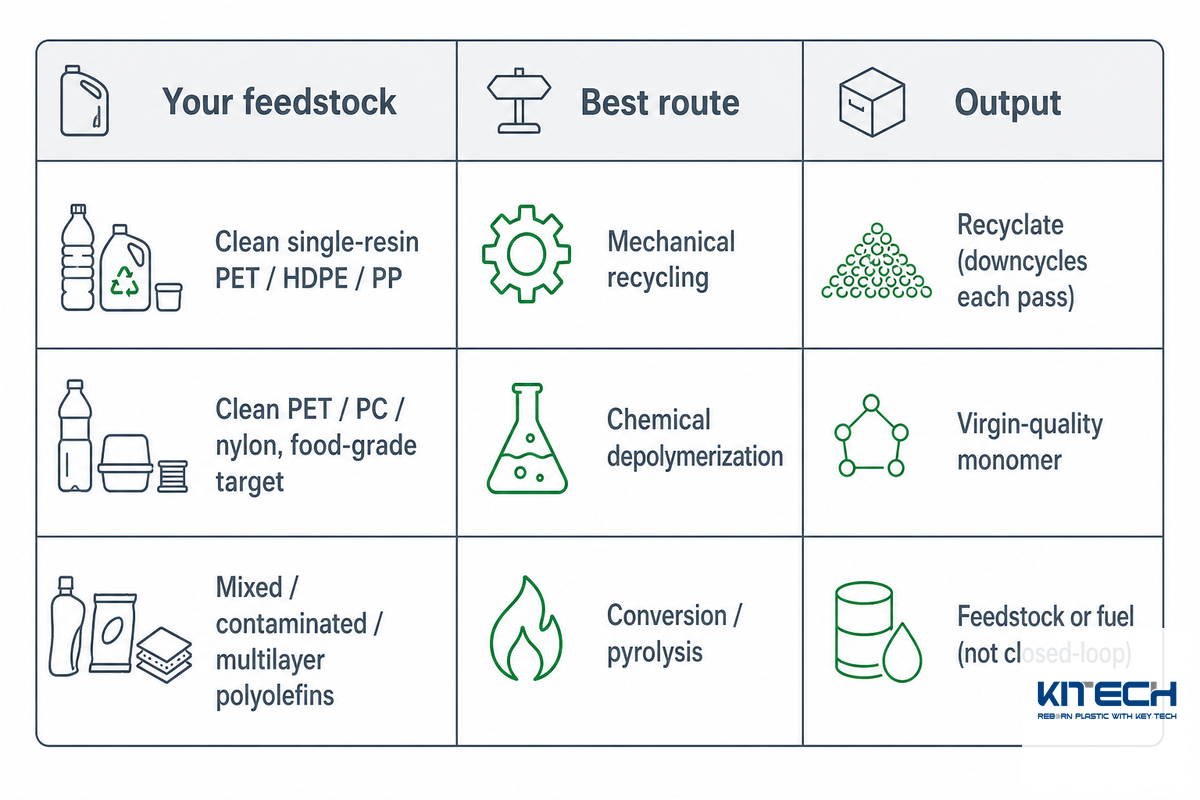
“What’s going into this are three input variables that feed a route decision tree… how clean and what single resin is your material?… what’s the polymer family?… what must that end use polymer qualify for?” – This all leads to a purchasing call rather than just the science.
- Clean, single-resin PET/HDPE/PP, non-critical end use mechanical recycling. lowest cost, lowest mature, lowest energy. Can downcycle, blend with virgin.
- Clean PET/PC/nylon, food contact or virgin quality target depolymerization (chemical) where a plant exists. Restores monomer; pay capex, energy, and availability at a limited scale.
- Converting mixed, contaminated or multi-layer polyolefins into feedstock or fuel – not circular, more diversion than “recycling.”
✔ Mechanical recycling
- Mature, lowest cost, lowest energy
- Handles clean PET/HDPE/PP at scale
- ⚠ Downcycles each pass; contamination-sensitive
⚠ Chemical / advanced recycling
- Recovers virgin-quality monomer (depolymerization)
- Handles some mixed/contaminated streams
- … High capex/energy; low capacity; Polyolefins fuel only
Take a film recycler with a clean, single-resin LDPE stream headed for non-critical trash-can liners: the decision tree points straight to mechanical recycling, because the feedstock is clean, the resin is a polyolefin that cannot be depolymerized to monomer anyway, and the buyer does not need virgin-grade output. A food-grade rPET target on the same site would force the opposite branch toward depolymerization. Against a U.S. plastics recycling rate of just 8.7% (U.S. EPA), picking the wrong route is not a rounding error — it decides whether material returns to use or quietly exits the loop. Realities glossed over: Mechanical only shifts the problem (recyclate also gets sent to end of life), only substitutes virgin 1:1 at best and therefore dictates low maximum recycled content per line. Effectively, no current mechanical option to process multilayer food packaging, so chem comes back to availability & cost.
Closed-Loop vs Open-Loop: Why Recyclable Does Not Mean Recycled
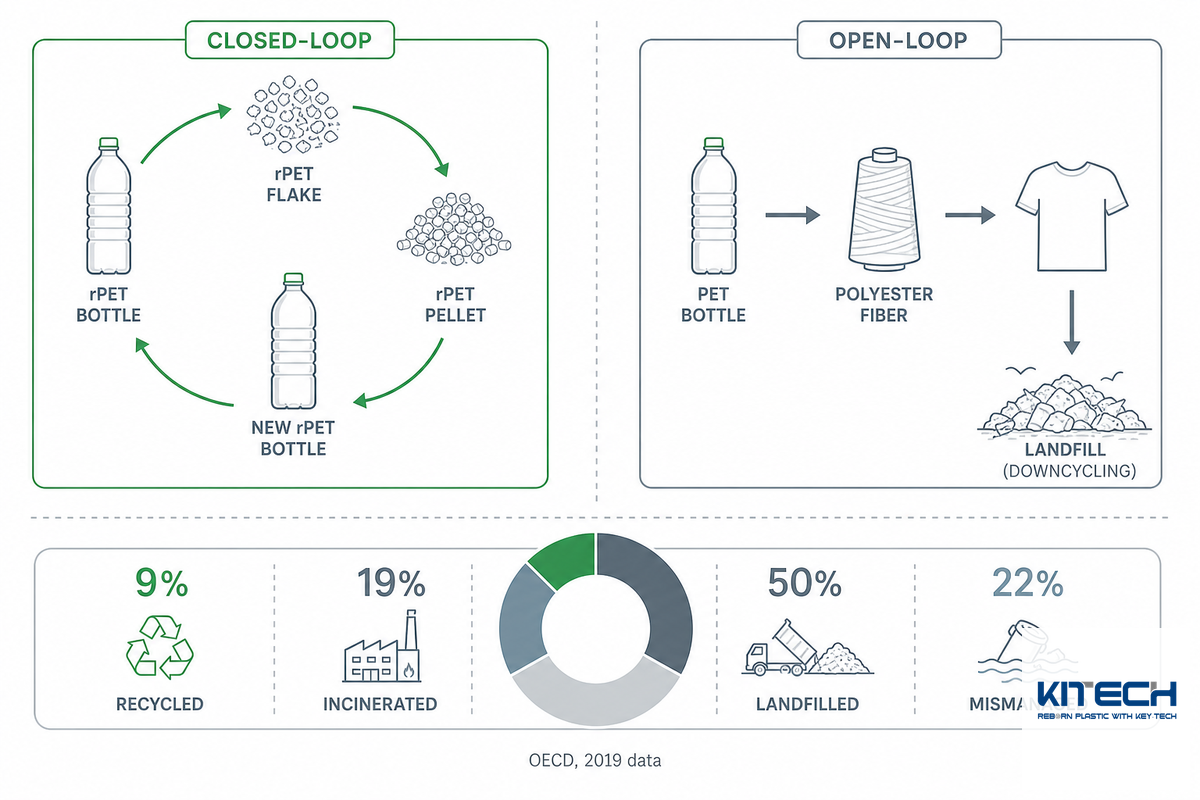
The recycling rate measures how much waste plastic and polymer waste actually return to use rather than disappearing into waste recycling at the margins. The recycling of plastic waste, the recycling of waste, and the recycling of mixed bales of mixed plastic all hinge on sorting and recycling economics and the genuine use of waste plastics.
Closed-loop recycling converts the product back into itself (a PET bottle can become another PET bottle). Open-loop recycling downcycles a product back into a lower grade product, the fate of much of the world’s plastic.
For those who don’t live their lives within the jargon, “recyclable” versus “recycled” has a gap – a vast gap. For example, in the OECD Global Plastics Outlook (2019 data, 2022 pub), it estimates the world recycles only ~9% of plastic waste, despite 15% of plastic waste being collected for sorting, as ~40% of collection becomes lost to residues. Incineration (19%), landfill (50%), and mismanaged plastic (22%) take up the slack.
Despite the concept of the circular economy, for most polymers, the first step is the only one they ever take.
Think about that stand-up, resealable plastic pouch labeled “recyclable” designed to keep food fresh through layers of PET, PE and maybe some aluminium.
At a Materials Recovery Facility (MRF), near-infrared equipment recognises only the outer ~2 microns and therefore assigns the pouch to just one of those resin types. In the ensuing process at downstream facilities – these immiscible plastic types can’t be successfully processed together. We estimate that 17-20% of plastic packaging falls into the ‘multilayer’ category, but only around 5% is considered recyclable with current methods.
Therefore, the “recyclable” pouch ends up in the trash not thanks to the landfill but despite the marketing… what matters is the method used, not the claim on the bag, and where recyclate quality is the goal, see our guide to recycled pellet quality grades.
Industry Outlook 2026: What Is Actually Driving Polymer Recycling
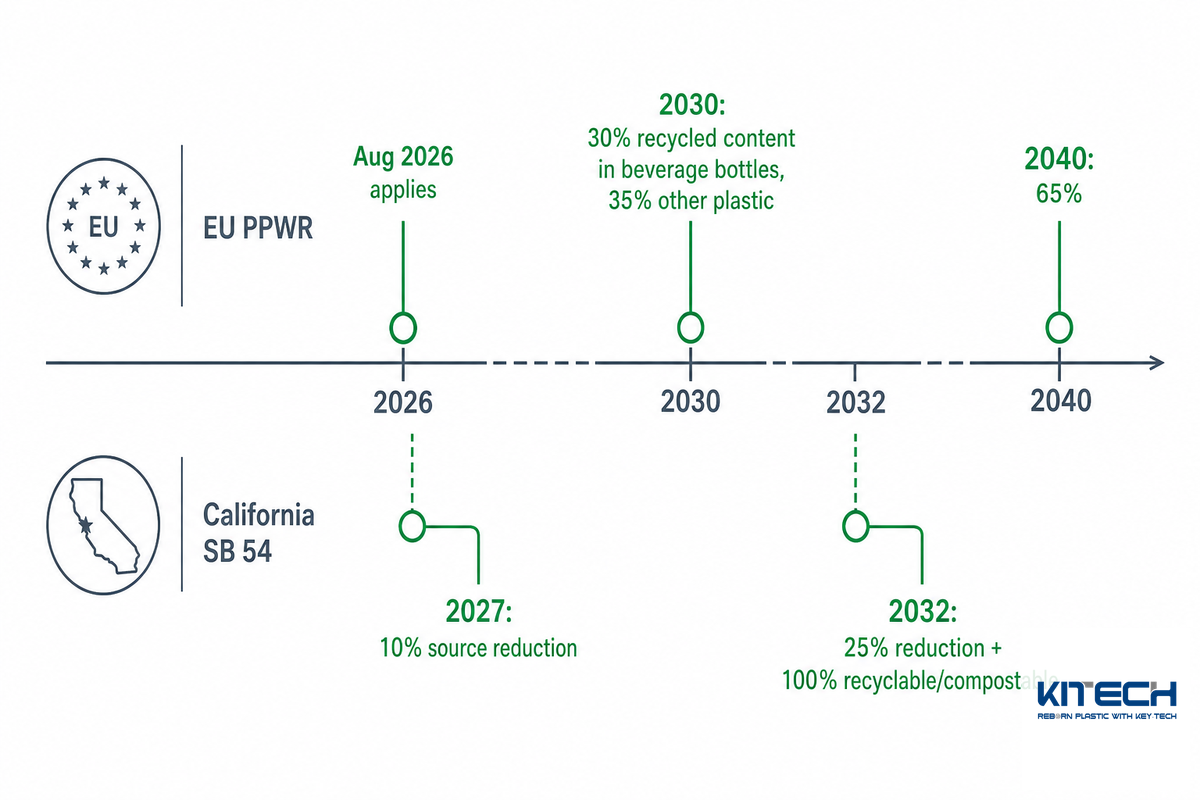
These rules push a developing circular economy aligned with the UN sustainable development goals, rewarding sustainable polymer output and sustainable materials over virgin polymers — a shift built on recycling and reuse and on disciplined handling of waste materials across recycling industries.
Regulation – not a new reactor design – will be the force driving polymer recycling in 2026.
The interest search volumes for umbrella method keywords have levelled out as the sector move from concept to implementation – the regulation driven clock, however, will get the money flowing. In the EU, the Packaging and Packaging Waste Regulation (PPWR, Regulation 2025/40) applies from 12 August 2026, and its binding minimum recycled-content quotas land in 2030: 30% recycled content in single-use plastic beverage bottles by 2030 (rising to 65% by 2040), and 35% for other plastic packaging. For the U.S., CA’s SB 54 requires 100% of covered packaging be recyclable or compostable and 25% source reduction by 2032, requiring reporting of producer registration by 1 June 2026.
So 2026 isn’t a recycled content “demand shock”- the regulations kick in in 2030. What’s happening today is the procurement clock running early, brand owners are locking in recycled-resin supply, and most crucially recycling capacity, right now to be compliant in 2030. And the law isn’t just about percentage points; PPWR blocks food-contaminating PFAS, food contact safety, and recyclability grades (Grade A ≥ 95%, Grade B ≥ 80%, Grade C ≥ 70% by weight), a process where the recycled product must also make grade on other safety/design elements beyond a simple number.
This is also the reason why mass-balance accounting is currently the gating question for buyers. Under the industry’s “free” allocation method, a feedstock that is 90% virgin and 10% recycled can be sold and labeled as 100% recycled, so a product marked “30% recycled” may physically contain none. The FTC Green Guides permit only a rolling-average method, and ISO 22095 permits only proportional allocation, therefore, the credible buyer demands physical chain-of-custody, not a credit.
“The cup bearing this label could physically contain 0 percent recycled content and may not be readily recyclable itself.”
Renee Sharp, Director of Plastics & Petrochemical Advocacy, Natural Resources Defense Council
The mistake buyers make is treating a 2030 mandate as a 2030 problem: by then, contracted recycled-resin supply is scarce and priced at a premium, so the teams that wait end up paying the most. What this means for a 2026 buyer – processing clear PET or HDPE – the road to your 2030 obligation is the safest one via mechanical recycle with an audited physical plastic recycled content number. For those pursuing virgin quality or food- grade content – engage a depolymerization source now, but critically, load on physical capacity and audit the mass-balance assertion, and watch that multilayer, non-uniform polyolefin – that’s still tough nut.
From Method to Machine: Matching Equipment to Your Stream
Each and every recycling method boils down to machines, where it’s the feedstock-additives, colors, heritage chemicals, contaminants – which will make the stream viable even if family and flow seem right. A mechanical line is like an endless chain – a shredder wash station – a dryer – a pelletizer, scaled to your waste stream. The most common procurement mistake is sizing a line for headline throughput while ignoring feedstock quality: feed a PET wash line a stream carrying even a few percent PVC and the HCl released during drying will discolor the output until that contamination is sorted out upstream. Match the line to the dirtiest feedstock it will actually see, not the cleanest. Picture a reclaimer running 1,000 kg/h of post-consumer HDPE jugs: the shredder, friction washer, dryer, and pelletizer have to be sized as one chain, because oversizing the shredder while undersizing the dryer leaves wet flake that foams in the extruder — the bottleneck simply moves rather than disappears. Kitech makes that – a dedicated, waste-stream-specific line – in through put from 300 – 3,000kg/hr and certified – “CE/UL/CSA listed”.
Buyers comparing polymer recycling cost across routes can lean on design-for-recycling guidance from the plastic recycling association (the APR) and the wider literature on the recycling of polymers when scoping a line. A chemical-recycling pathway is another category of cap-ex altogether; feedstock pre-treatment and a reactor, which most buyers turn to only once their mechanical solution can’t meet their virgin-quality or food-grade target.
| Route | Core equipment | Best-fit feedstock |
|---|---|---|
| Mechanical | Shredder, washing system, dryer, pelletizer | Clean single-resin PET/HDPE/PP/film |
| Chemical / advanced | Feedstock prep + depolymerization or pyrolysis reactor | Mixed, contaminated, or food-grade-target streams |
Confused by which recycling line best matches your stream and throughput?
Explore Plastic Recycling Solutions →
Alternatively, the machines: the shredders, washing line and pelletizer could be individually supplied.
Frequently Asked Questions
What are the four types of polymer recycling?
View Answer
Polymer recycling is grouped into four categories under ASTM D5033 and the ISO 15270 family: primary (mechanical reprocessing of clean scrap into an equivalent-grade product, i.e. closed-loop), secondary (mechanical reprocessing of mixed or used waste into a lower-grade product, i.e. downcycling), tertiary (chemical recycling that depolymerizes the plastic into monomers or converts it to feedstock), and quaternary (energy recovery through controlled combustion). ISO is also adding a fifth, organic/biological route for certified compostable plastics.
Can all plastics be recycled?
View Answer
No. A resin code is only a material identifier, not a recyclability guarantee. In practice only PET (#1) and HDPE (#2) are meaningfully recycled (~29% of bottles in the U.S.), while PVC, LDPE, PS, and most #7 plastics are rarely accepted and often act as contamination. Thermosets such as polyurethane foam and epoxy cannot be melt-recycled at all, and multilayer pouches are roughly 5% recyclable by conventional methods.
Is chemical recycling better than mechanical recycling?
View Answer
It depends on the feedstock and target. Mechanical recycling is cheaper, more mature, and lower-energy, and it handles clean PET/HDPE/PP well — but it downcycles each pass. Chemical recycling (depolymerization) can recover virgin-quality monomer and handle some contaminated streams, but it carries high capital and energy costs, limited operating capacity, and cannot selectively depolymerize polyolefins. For most operators in 2026, mechanical remains the default and chemical is reserved for food-grade or virgin-quality targets.
What is depolymerization?
View Answer
Depolymerization is a chemical recycling route that breaks a polymer back into its monomers — the original building blocks — using heat, chemicals, or enzymes. For PET, glycolysis recovers 70–90% BHET monomer that can be re-polymerized into virgin-quality plastic.
Why is only a small share of plastic actually recycled?
View Answer
The OECD estimates only about 9% of plastic waste is recycled globally. The losses are structural: just 15% is collected for recycling, and 40% of that is discarded as residues from contamination and missorting. Weak end-market demand, the cost gap versus cheap virgin plastic, and the loss of overseas offtake after China’s 2018 import ban push most collected plastic to landfill or incineration instead of back into product.
What is the difference between closed-loop and open-loop recycling?
View Answer
Closed-loop recycling returns a product to the same product (bottle-to-bottle rPET), preserving value. Open-loop recycling downcycles the material into a lower-grade use — for example, bottles into fiber or lumber — after which it usually exits the loop entirely.
Does recycled polymer have the same quality as virgin material?
View Answer
Mechanically recycled polymer is generally lower quality than virgin: chain scission lowers molecular weight and mechanical properties each cycle, so recyclate is usually blended with virgin resin or sandwiched between virgin layers to meet spec. Only chemical depolymerization back to monomer can restore virgin-equivalent quality — and that route is not yet widely available at commercial scale.
What equipment is needed to recycle polymers?
View Answer
A mechanical recycling line needs a shredder, a washing system, a dryer, and a pelletizer, sized to the waste stream and throughput. Chemical recycling instead requires feedstock pre-treatment and a depolymerization or pyrolysis reactor — a different and more capital-intensive class of plant.
Our Perspective
We build shredders, washing systems, and pelletizers for plastic reclaimers in more than 80 countries, so the process parameters in this guide, wash temperatures, friction speeds, float-sink density cuts, moisture and mesh targets, are the numbers our lines actually run, not generic estimates. Where the topic leave our bench (global recycling rates, depolymerization chemistry, PPWR text), we cite government, academic, and standards sources directly. Reviewed by the Kitech technical team.
References & Sources
- Global Plastics OutlookOECD
- Plastics: Material-Specific DataU.S. Environmental Protection Agency
- Science & Tech Spotlight: Advanced Plastic RecyclingU.S. Government Accountability Office
- Plastics recycling: challenges and opportunitiesHopewell et al., Phil. Trans. R. Soc. B (NIH PMC)
- Depolymerization within a Circular Plastics SystemACS Chemical Reviews (NIH PMC)
- Can ‘Advanced’ Recycling Cut the Waste?Yale Environment 360
- Packaging and Packaging Waste Regulation (PPWR)European Commission
- Strategy for Plastics InnovationU.S. Department of Energy
- Potential and Limitations of Recyclable ThermosetsPolymer Reviews
- The Plastics Industry’s Latest Deception: Mass BalanceNatural Resources Defense Council
Related Articles
- Types of Recyclable Plastic: Resin Codes 1–7the resin map behind the Decoder
- Multi-Stream Plastic Recycling Plant Designwhen one line can’t serve every resin
- Plastic Recycling Plant Cost Guide 2026CAPEX, OPEX, and ROI by capacity
- Recycled Pellet Quality Gradeswhat separates food-grade from filler
- HDPE Recyclingthe #2 resin’s mechanical recycling path