Get in touch with Kitech Company


The names HDPE, LDPE, LLDPE, and polypropylene indicate the materials of the bags. T-shirt bags, gusseted bags, and resealable bags indicate designs, and a single bag can belong to several categories at the same time. To choose a bag or take a recycling route, one needs to keep the categories separated.
Different types of plastic bags used for food and shipping can look similar while having different closures, coatings or layers. For packaging buyers and recycling operators, those details affect the specification and the receiving stream.
Types of plastic bags differ by resin, construction and use. HDPE, LDPE and LLDPE are polyethylene families; PP is polypropylene. Codes 2, 4 and 5 identify resins. Collection rules determine where a particular bag belongs.
Key points
- A resin number identifies the material; collection and recycling follow the receiving program’s rules.
- Bag film, a slider and a removable liner can contain different materials.
- Film impact results need matching test conditions; thickness alone isn’t a load rating.
- Industrial washing produces cleaned material; pelletizing is a separate downstream operation.
What Are the Main Types of Plastic Bags?
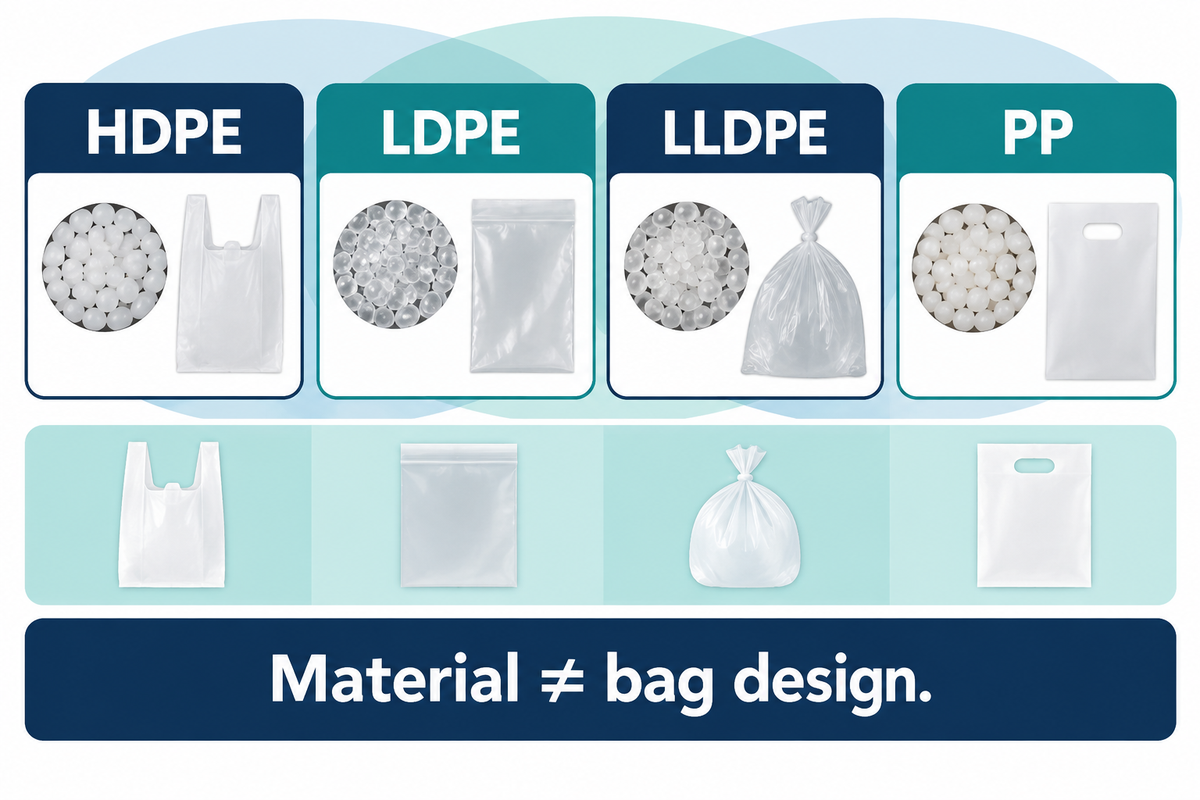
HDPE, LDPE, LLDPE and PP are good starting points for the common plastic bag materials. Polyethylene bags cover many everyday film applications. Polypropylene is seen in film and fabric constructions. A plastic material name identifies the plastic family; the bag shape and its intended contents describe different parts of the specification.
The National Institutes of Health resin guide lists grocery and retail bags among HDPE applications, and produce bags and bread bags among LDPE applications.
| Material | Construction or example | What the name leaves out |
|---|---|---|
| HDPE | Film grocery bags and retail bags | Gauge, blend, handles and seals |
| LDPE | Flexible bread, produce and liner film | Other PE grades in the blend |
| LLDPE | Blown film and blended packaging film | Grade and finished-film properties |
| PP | Clear film, woven sacks or nonwoven fabric | Orientation, liner and lamination |
One has to read a purchase description such as “poly bag” as an incomplete specification. The broader seven plastic resin categories also include materials used in rigid plastic containers and composite packaging.
HDPE, LDPE and LLDPE: How Polyethylene Bags Differ
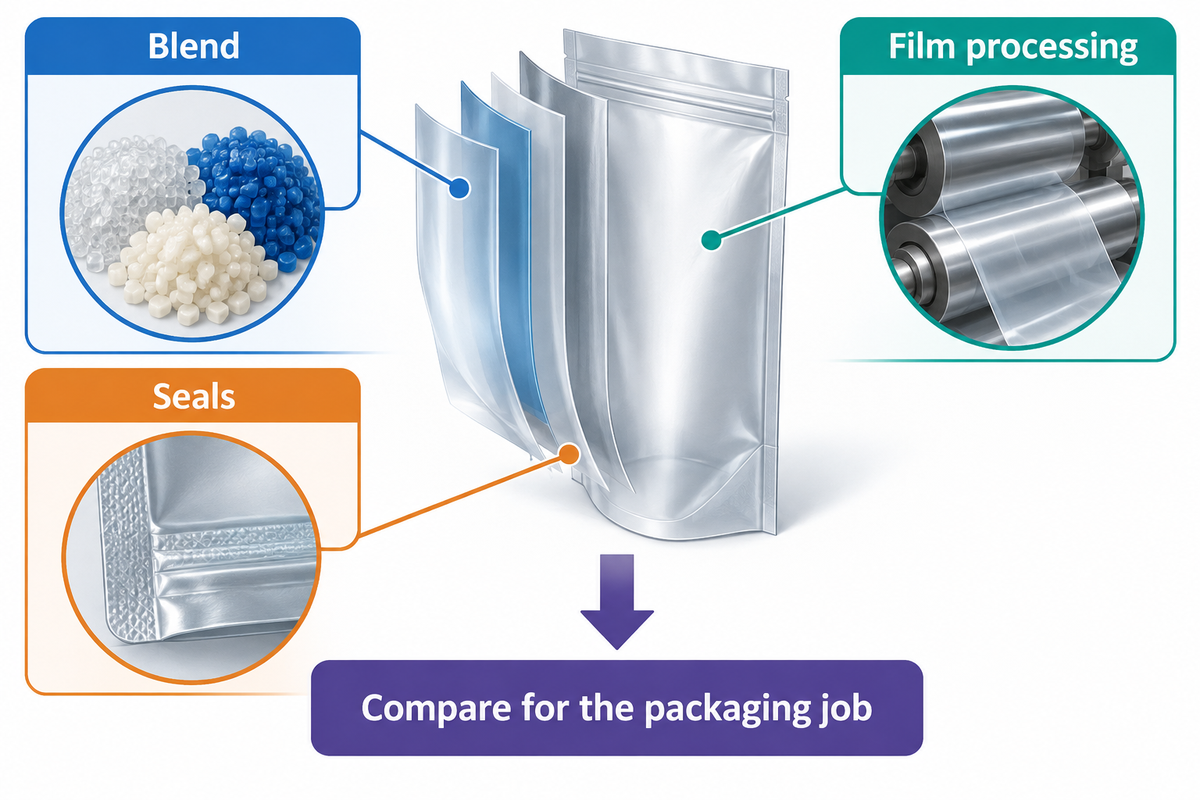
HDPE film typically has a higher stiffness, and LDPE film has more flexibility. LLDPE film grades are used where toughness matters. Finished-bag performance also comes from blends, film processing, and seals. Compare film specifications to choose the polyethylene family suited to the packaging job.
HDPE plastic bags are often made from thin plastic film with the familiar crisp feel of a grocery carrier. LDPE film is common in softer packaging and liners. LLDPE films are used in industrial and food packaging, including stretch films, Shell states. Heavy-duty garbage bags may use blended PE film; the product description and load test matter more than a family label.
For a grade-specific example, Shell’s 18F1B blown-film resin data gives nominal density of 0.918 g/cm³ under ASTM D792 and melt index of 1.0 g/10 min under ASTM D1238 at 190°C/2.16 kg. Melt index describes resin flow under that test. The test temperature is not a recommended use temperature for the finished bag.
Consider a hardware packer changing a conventional plastic bag after sharp corners puncture the film. The thickness of the film (gauge) can be increased, but changing only gauge leaves the resin blend and seal design unresolved. A useful comparison keeps the packed hardware and handling sequence the same, then checks punctures, tears and seal openings separately. The buyer can compare candidate HDPE and LLDPE films against that job instead of selecting a supposed universal winner. Record the film specification alongside the result so the next delivery can be matched to the approved sample.
PP Bag Types: Clear Film, Woven Sacks and Nonwoven Totes
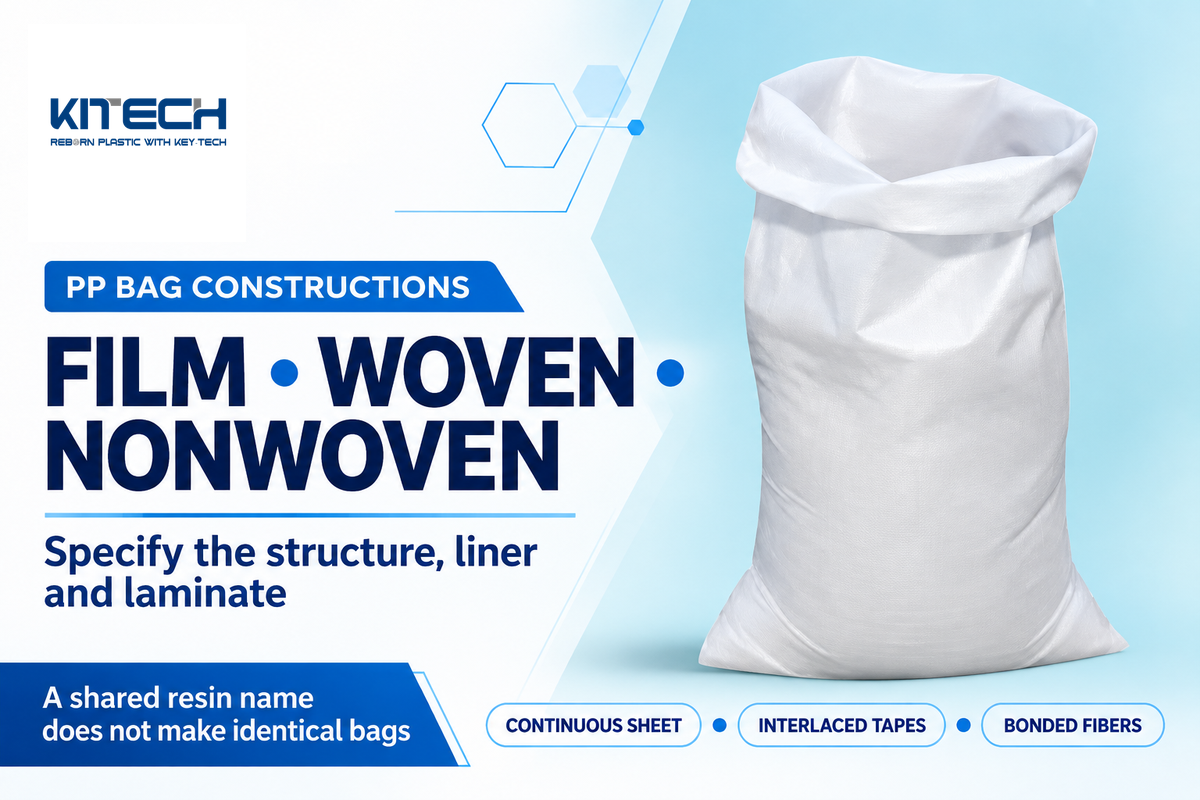
PP bags can be made as continuous film, woven tapes or non-woven fibers bonded together. Different plastic structures can be of polypropylene, but have different handling characteristics. A clear plastic display sleeve, a woven industrial sack and a fabric-like reusable bag should therefore be specified and collected as distinct products.
Film bags offer a continuous plastic sheet. Woven sacks have inter-laced tapes; non-woven totes have bonded fibers. Printed retail packaging can combine constructions. PP woven bags laminated to biaxially oriented polypropylene film can be found in Palmetto’s BOPP bag description.
Bag production can add liners and coatings. Plastic bags made from woven fabric need those components recorded separately. For a woven sack to hold powder, the liner should be recorded separately from the outer fabric. A removable PE liner and a PP shell create a different sorting task from an inseparable laminate. KITECH’s PP woven bag recycling line addresses this industrial feedstock family.
Shopping Bags, Food Bags and Shipping Bags: Names by Design
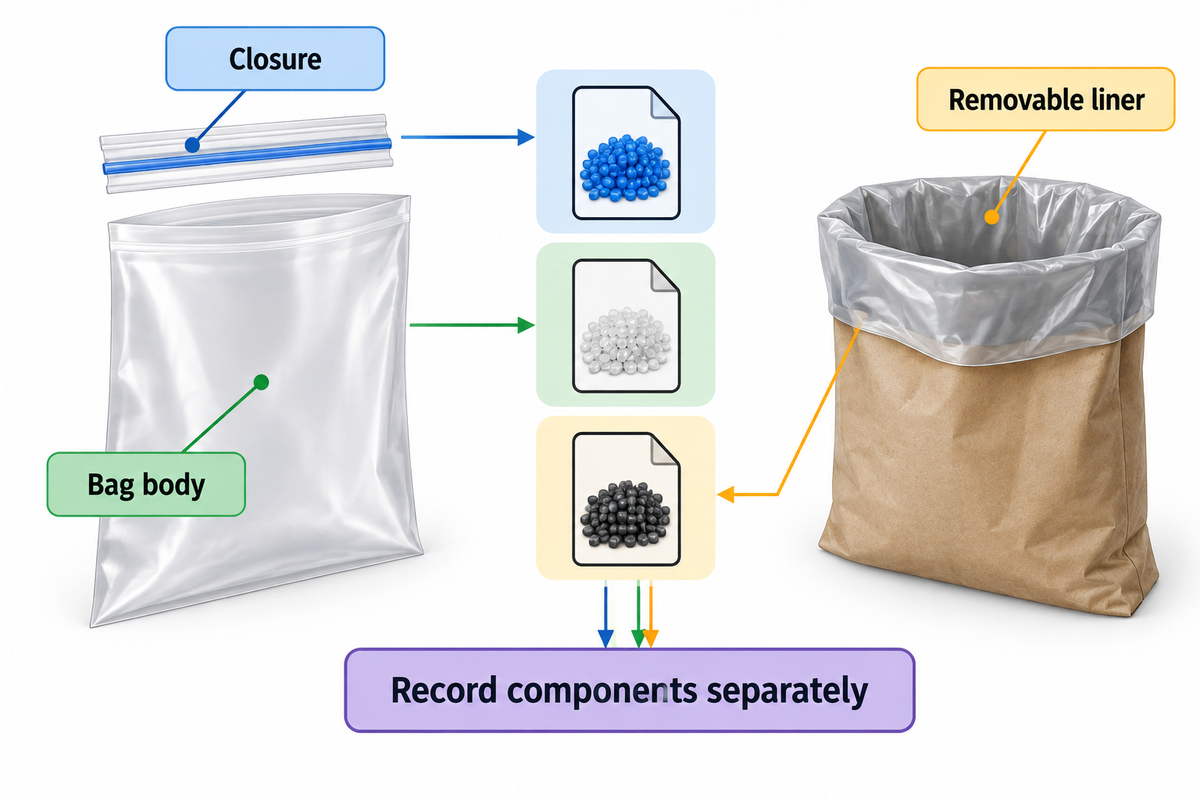
Plastic packaging names, such as flat bag, shopping bag and gusseted bag, describe use or geometry rather than a fixed plastic resin. Handles change how a bag is carried; gussets create space when it opens. The opening of a gusseted bag may increase the space inside. Closures and liners add components that should appear separately on a material specification or waste-stream description.
T-shirt bags have integral handles. Other handle bags use cutouts or attached handles, while a flat bag has a simpler envelope shape. Gusseted bags are designed to expand at the sides or the base. Plastic shopping bags, including retail shopping bags, may have a similar shape to shipping bags, without using the same film formulation, adhesive or printing system.
What kind of plastic is in Ziploc bags?
SC Johnson lists LDPE and LLDPE for its Ziploc Sandwich Bags. The brand’s Slider Storage Quart/Medium disclosure also lists polypropylene, which it describes as a possible slider material. A product’s full ingredient list gives a more useful answer than assuming every bag and closure in the brand uses identical plastic.
One Bag, Several Materials
| Bag type or component | Material information | Buying or sorting action |
|---|---|---|
| Sandwich-bag film | Named Ziploc product lists LDPE and LLDPE | Keep the product-specific disclosure |
| Slider storage bag | Named product lists PE families plus PP | Record the closure separately |
| Woven sack body | PP tapes in the stated product family | Identify any liner or bonded film |
| BOPP-laminated woven bag | Palmetto describes BOPP film over PP fabric | Include coating and ink in the specification |
| Removable liner | Use the liner’s own declared composition | Separate it where the receiving route requires |
| Grocery carrier film | HDPE is a common NIH-listed example | Keep film format distinct from rigid HDPE |
| Bread bag | LDPE is a common NIH-listed example | Follow package-specific collection instructions |
| Laminated laundry pouch | RecyClass assessed a particular PE design and PP closure | Carry the full component specification into assessment |
| Compostable collection bag | Read the declared composting conditions | Use a facility accepting the labeled product |
Sources: Ingredients for SC Johnson’s Sandwich Bags and Slider Storage Bags, and product description for Palmetto. Suppliers own the product formulations; the worksheet is to aid in purchasing and sorting.
What Recycling Codes 2, 4 and 5 Tell You
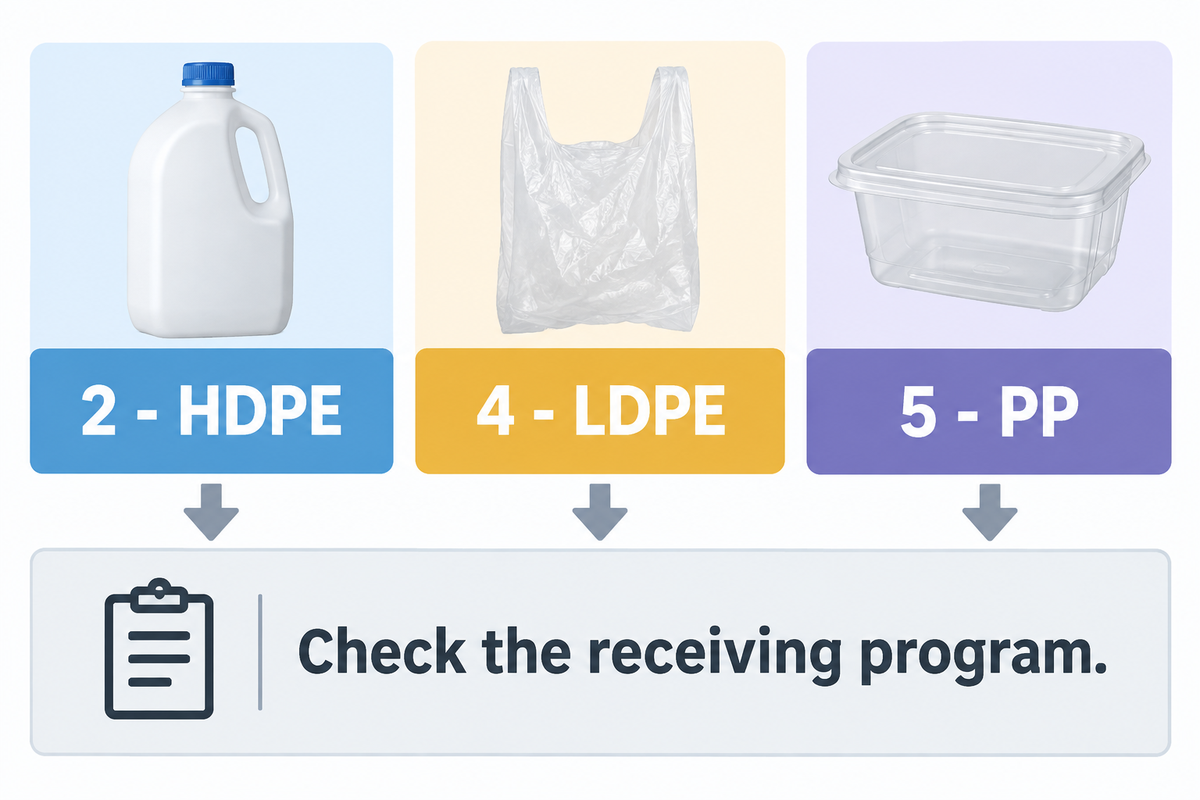
Resin codes 2, 4, and 5 respectively represent HDPE, LDPE, and PP. The number is a resin category, not permission to place the item in a recycling bin. A bag still needs a receiving program that accepts its format and composition, even if a bottle of the same number is collected locally.
Under ASTM D7611/D7611M-26, a resin identification mark indicates a resin type; a separate closure or bonded layers can contain other resins. Separate closures or layers may contain different resins. To find where to recycle it, check whether a reclamation system accepts that package.
“Resin Identification Codes are not ‘recycle codes.’”
How do I know if my plastic is polyethylene or polypropylene?
Read a product’s resin marking or specification first. NIST states that spectroscopy can determine the type of plastics, but commercial instruments can’t always differentiate HDPE from LDPE. For an unmarked bag, supplier documentation or material analysis gives stronger identification than feel, sound or transparency.
Additives and fillers in plastic products are described in NIST’s sorting explanation. A film can be crisp, but that doesn’t necessarily indicate composition. Keep unknown bags out of a defined PE or PP batch; a water float won’t tell you for sure if the bags are PE or PP.
Choose Plastic Bag Materials for the Packaging Job
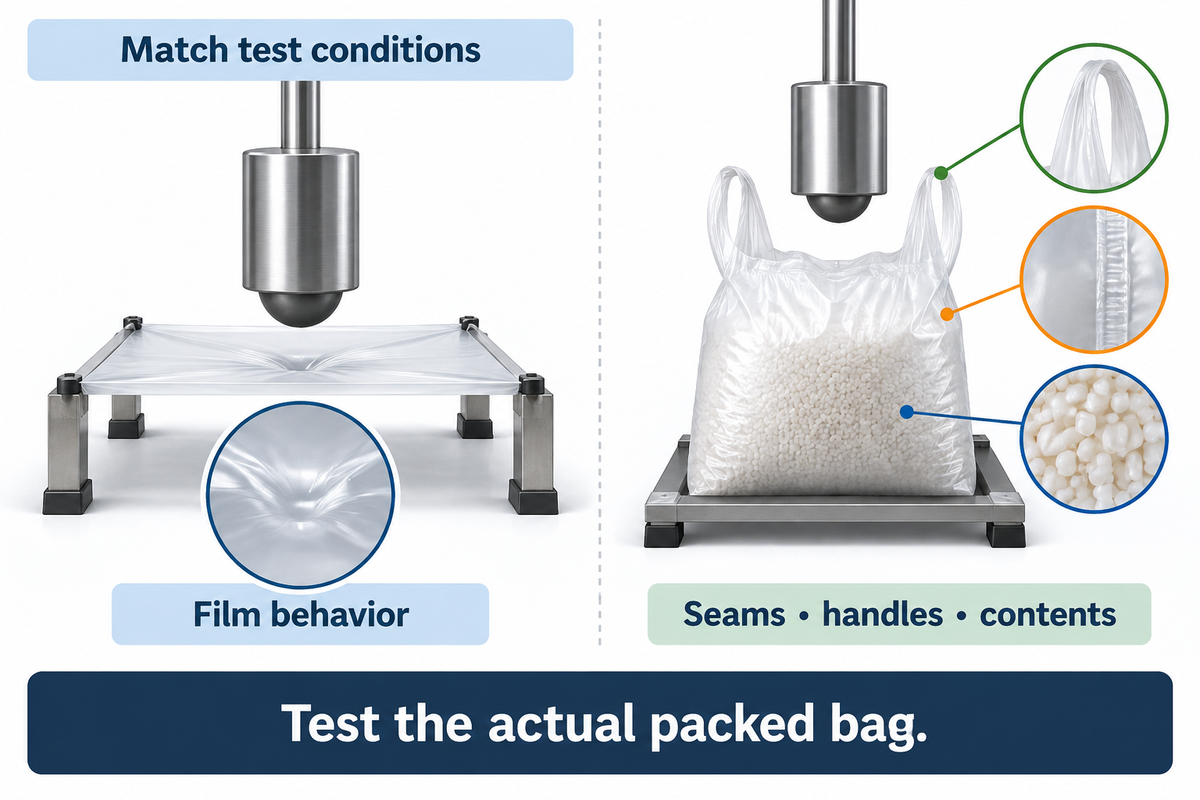
Choose a plastic bag by the packed product, handling demands and closure requirements, then compare candidate materials against the same acceptance test. A bag for display, a puncture-prone industrial load and plastic bags for food have different requirements. Match test methods and sample conditions prior to assessing a supplier’s performance data.
ASTM D1709-24 points out that the impact resistance of a film cannot be directly correlated with film thickness. Its comparison provisions include a ±25% thickness range around the nominal or average test specimens, along with matching method conditions. A dart-impact result tests film behavior; a packed-bag evaluation also needs the actual seams, handles and contents.
State the intended storage conditions for freezer bags and compare films. For procurement, specify resin or blend, single-wall film gauge and tolerance, dimensions, gussets, closure materials and packed handling test. Quality staff needs the approved sample and test conditions. Food packaging also needs suitability for the intended food contact and use conditions; “food-grade plastic” is not established by a resin code.
Which Plastic Bags Are Recyclable?
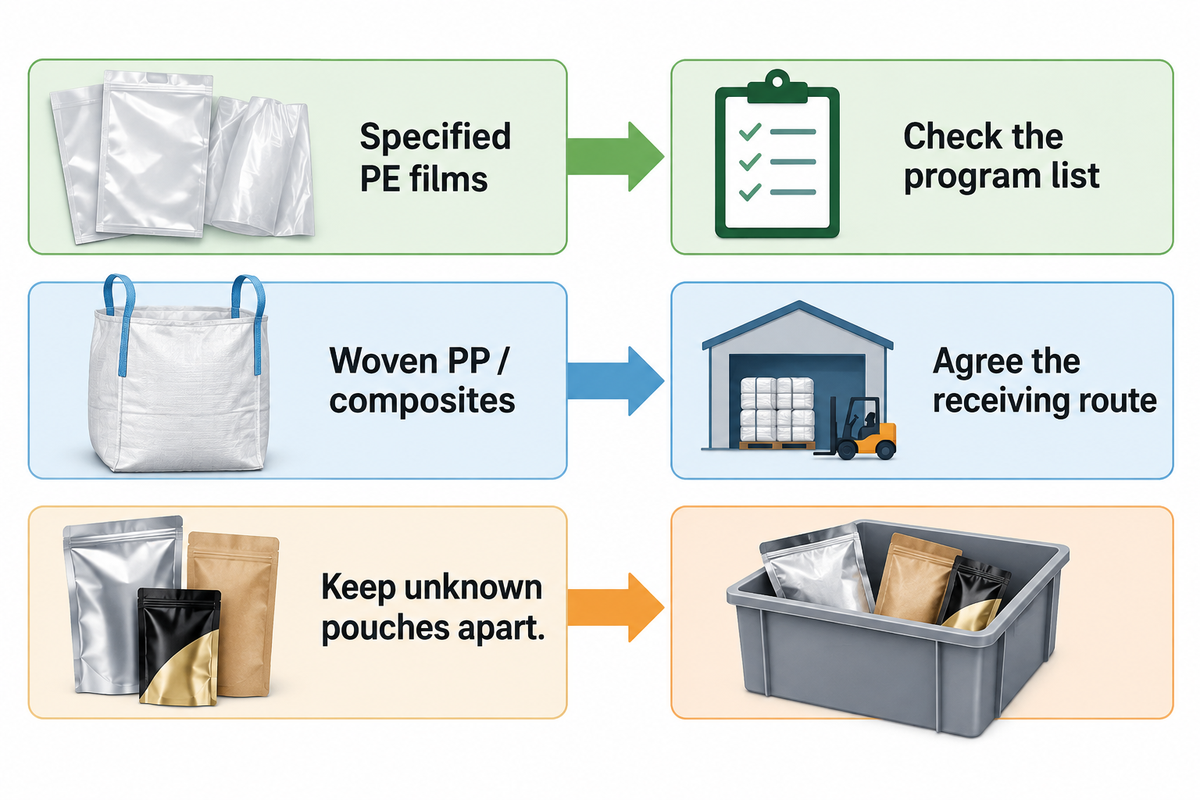
Specified PE bags and films are accepted by many US store programs, whereas woven PP and composite packaging need their own receiving arrangements. To recycle plastic bags, match the package instructions against the named collector’s currently accepted-item list before consolidating materials.
RecycleSpot’s regional film guidance includes grocery carriers, bread bags, mailing envelopes and other named films. It excludes snack wrappers, cellophane, coffee bags and prepared-food pouches.
Why doesn’t my local recycling accept plastic bags?
Bags of film can tangle in sorting systems. Many local systems aren’t equipped to handle the packaging format. The US Environmental Protection Agency recommends checking the local collection policy. How2Recycle likewise directs eligible US film packages toward a separate store drop-off route rather than most curbside programs.
| Identified stream | Candidate route | Acceptance information to carry forward |
|---|---|---|
| Eligible household PE film | An accepting film collection program | Exact item list and preparation instructions |
| Separated commercial PE film | Commercial film recycler | Polymer mix, coatings, contamination and shipment form |
| PP woven sacks | A receiver handling woven PP | Liner composition, residual contents and bonded layers |
| Multilayer package | Route matched to the complete design | Polymer composition and design-compatibility assessment |
| Compostable bag | A composting facility accepting that product | Product label and facility acceptance |
| Unknown mixed bags | Characterization and sorting first | Material identity before entering a specified stream |
| PE film with a separate slider | The film receiver’s component instructions | Bag-body and closure composition, recorded separately |
| Bag with a removable liner | Separate agreed streams where required | Liner and outer-bag composition |
| Soiled commercial film | A recycler accepting that feedstock condition | Residual contents and the washing-stage requirement |
The EPA advises checking local collection policy, RecycleSpot lists accepted film items, and How2Recycle directs eligible US films to store drop-off. For commercial material, agree the feedstock description with the receiver.
A warehouse receives pallet wraps, printed shipping envelopes, and woven ingredient sacks on the same dock. Combining the different materials into one bale simplifies waste management, but erases the distinctions a buyer needs. A better starting arrangement keeps known PE film apart from woven sacks and unknown pouches. Staff record adhesive labels, product residue and any liner. The recycler can then quote against an identified stream, while the warehouse avoids describing a mixed bale as clean polyethylene simply because most of its contents look like film.
Multilayer Bags and Compostable Bags: Check the Actual Materials
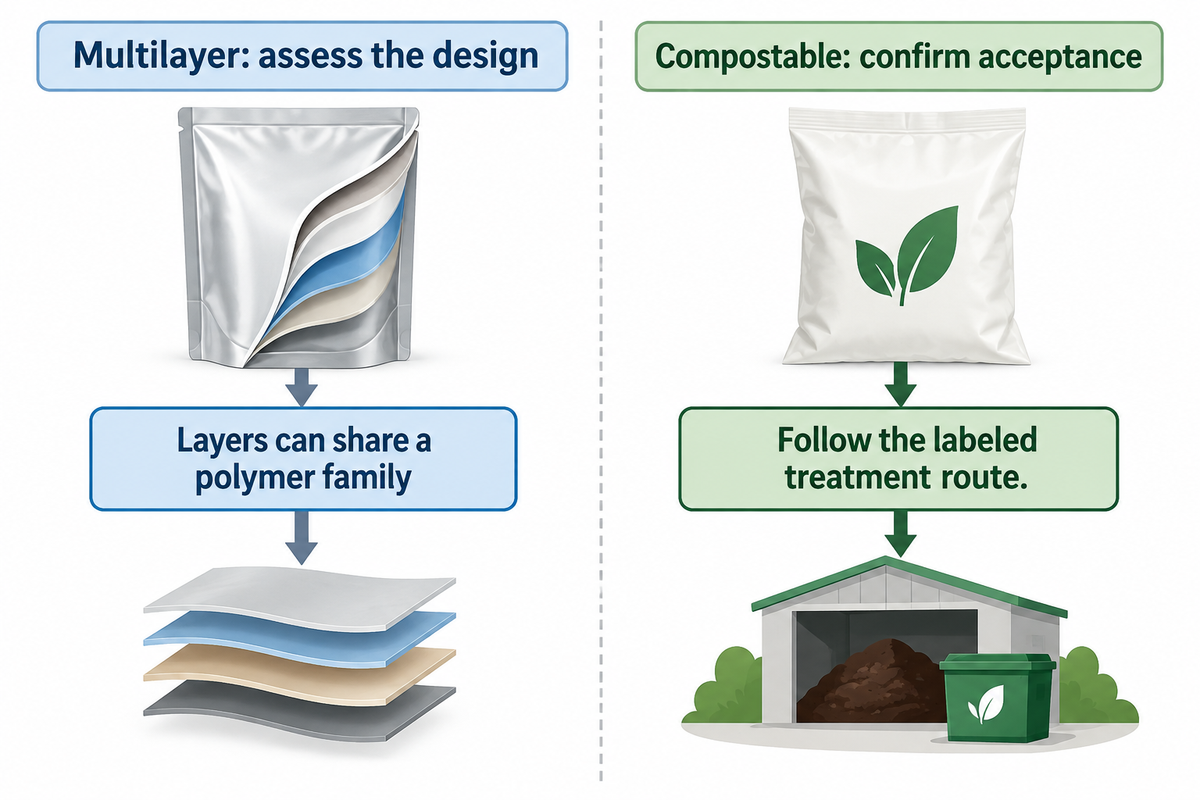
Multilayer bags need assessment of their complete design; several layers can still use a compatible polymer family. Compostable bags follow a different treatment question: whether an appropriate composting facility accepts the product. Neither the number of layers nor a plant-based marketing description is enough to select a disposal route.
A useful historical example is RecyClass’s June 2021 laundry-pouch assessment. The original multilayer pack had a PP closure representing 4% of its weight. Replacing the PP closure with a PE zipper results in an improved assessment. The original design was reported to be compatible with a specified European colored PE film stream under specific conditions. The example is evaluating the design that was tested rather than all laminated pouches.
Biodegradable plastic and biobased plastic describe different things: breakdown behavior and feedstock origin. As per the EPA, compostable plastics can disrupt conventional plastic recycling. Biodegradable bags should not be added to a PE film bale as though they were polyethylene.
For a compostable product, use the labeled treatment route and an accepting facility. Conditions for home composting and industrial composting differ. TÜV AUSTRIA’s EN 13432 comparison describes laboratory biodegradation testing for industrially compostable packaging: conversion of ≥90% of the tested material’s carbon to CO2 within 6 months at 58°C with a 2°C tolerance, plus disintegration and compost-safety checks. Reusable shopping bags require material specific treatments at end-of-use. Reusability alone doesn’t determine plastic bag disposal.
From Plastic Bag Waste to a PE or PP Recycling Line
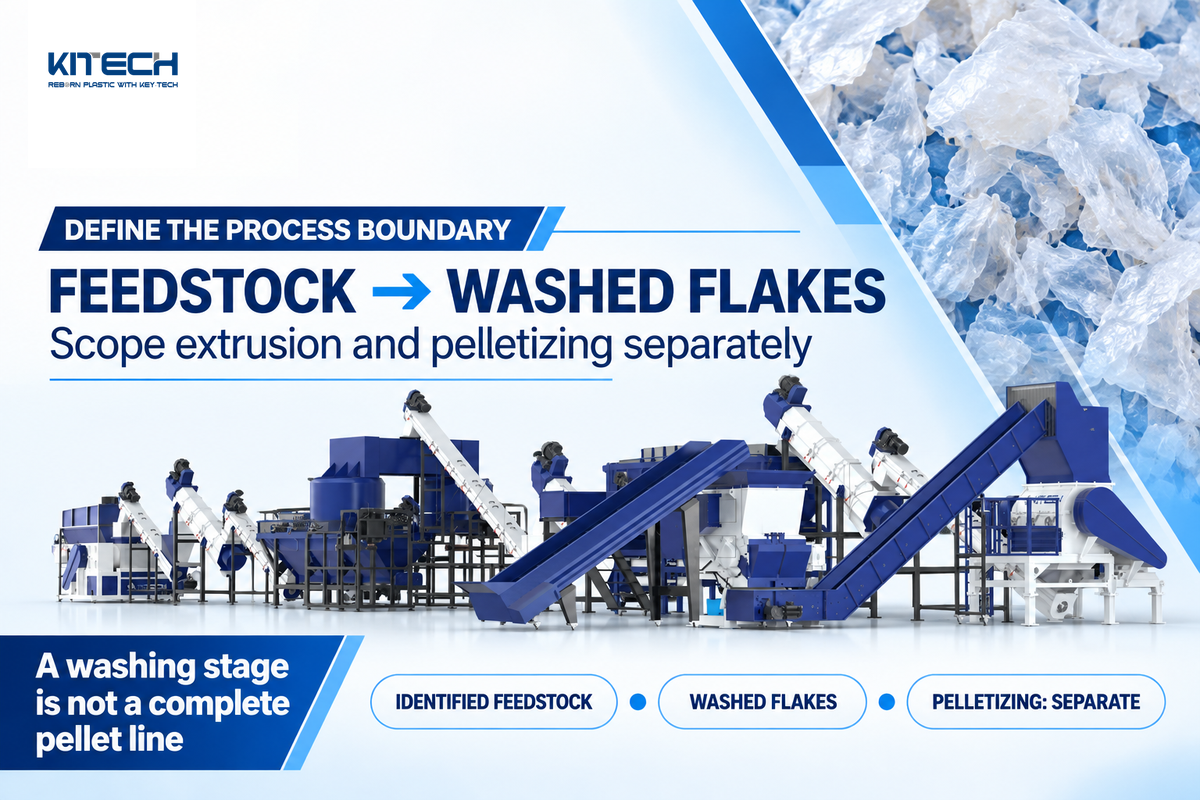
Industrial plastic bag recycling begins with an identified feedstock and a target output. KITECH supplies washing and recycling equipment for PE film and PP woven-bag streams. Extrusion and pelletization turn the feedstock into pellets.
KITECH’s PE Film Washing Line can process LDPE film, LLDPE stretch film, and HDPE bags, among others. For a process example, see the plastic film recycling process guide. The feedstock specification should state the polymer mix, construction, remaining contents, and required output.
PE and PP can’t always be separated by water flotation. HDPE and PP are low-density polymers and fell into the same group in water in a published sinking-flotation experiment. The authors examined other media to separate the polymers. Actual waste bags contain inks, fillers and other bonded layers. Thus, the experiment is a material separation study and not a process performance study.
Suppose a recycler wants to turn used carrier bags into pellets. The inquiry should distinguish incoming film from washed and dried flakes, then state whether the project includes extrusion and pelletizing. A quoted washing stage and quoted complete pellet line address different needs. If the intended market is food-contact packaging, add that requirement at the start: FDA evaluates recycled-plastic food-contact uses by the process, source controls and intended conditions. Simple pellet formation and ordinary cleaning do not answer the question of whether the destination is food contact. The raw material specification should likewise be agreed upon for a non-food contact market.
The FDA recycled-plastics guidance explains those process and use considerations. For a line discussion with KITECH, send representative bag samples and separate descriptions of the film, closures and liners, together with the required final material.
What Is Changing in Flexible Packaging Recycling?
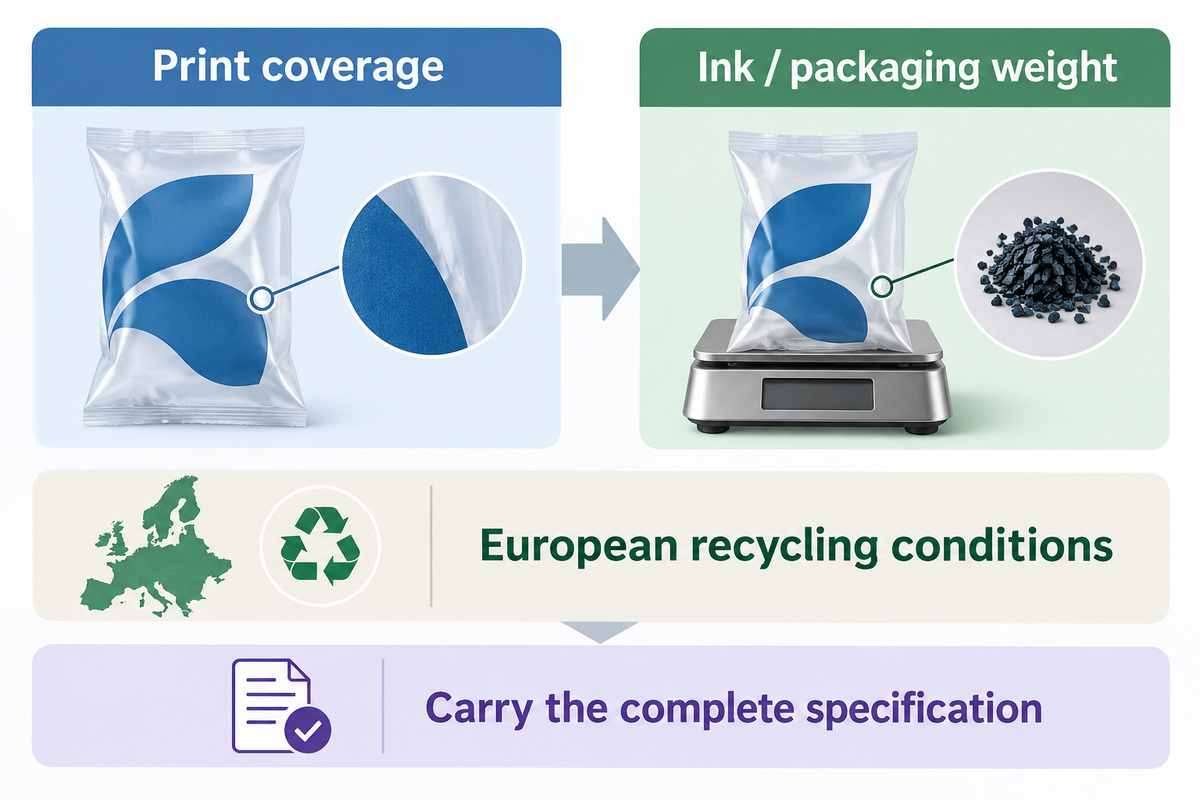
Flexible plastic design is evaluated beyond the main resin. RecyClass’s post-2025 testing guidance outlines a major change in how it assesses transparent film, with greater emphasis on ink weight relative to package weight. Packaging buyers should carry ink, coating and closure information into design reviews alongside the base-film specification.
According to RecyClass, more than 20 testing campaigns have provided the basis for their latest updates. For transparent films, its recommendations move away from print coverage alone toward the proportion of ink by packaging weight. An identical-looking printed area can therefore leave an important design question unanswered: how much ink is actually present?
For a packaging redesign, procurement can obtain the film and printing specifications together. Quality staff can then compare the complete design with the relevant assessment route, while recycling operators describe the material that their receiving process accepts. The guidance applies to European recycling conditions.
Resin coding is a separate case. ASTM’s current public listing, D7611/D7611M-26, updated in July 2026, covers resin identification. Replacing an old artwork file with a new number does not resolve closures, coatings or the receiving system.
For the use of plastic bags in a new packaging program, keep a component record from the first sample through production changes. A change to the slider, liner or print formulation deserves another compatibility check even if the main resin is unchanged. Claims such as “eco-friendly plastic” are less useful for this decision than the material record and the named route for the finished package. That approach also keeps recycling instructions attached to the actual design rather than a generic bag category.
Frequently Asked Questions
What are type 5 plastics?
Type 5 plastics are polypropylene, commonly abbreviated PP.
The number identifies a resin category within the identification system. PP appears in many plastic products, including film and woven sacks, but the number doesn’t tell you whether the finished item is a film, a rigid container or a laminate. Use the receiving program’s item instructions alongside the material marking.
What kind of plastic bags can be recycled at the grocery store?
Participating stores accept the bags and films on their collection program’s list, often including eligible PE grocery and bread bags.
Read that location’s current instructions before returning packaging. A store collection point isn’t an all-plastics bin: snack pouches, compostable products and woven sacks need separate consideration. Preparation instructions also apply, including a clean-and-dry requirement where the label or program specifies it.
What type of plastic bags are made from LDPE?
LDPE is used in produce, newspaper, bread and frozen-food bags, as well as liners.
The NIH guide lists those common applications. Some bags made for similar uses combine different polyethylene grades, as SC Johnson’s product disclosures illustrate. The closure can have a separately specified material. For a specific purchase or feedstock batch, keep the manufacturer’s material description.
How many types of plastic bags are there?
HDPE, LDPE, LLDPE and PP are the main starting material categories.
The main material categories are HDPE, LDPE, LLDPE and PP, but construction and use create overlapping categories with no fixed total.
Can I recycle plastic shipping packaging?
Yes, when the receiving program accepts that specific shipping material and you follow its preparation instructions.
Separate the outer mailer from any different-material padding or liner. An eligible PE film envelope can have a different route from a bonded composite envelope. Check the package label against the actual receiver’s list before combining it with plastic wraps.
What are the downsides of polypropylene plastic?
PP can complicate a PE recycling stream when it appears as a separate component.
Film, woven fabric and laminated PP bags need separate specifications for storage and packaging.
Does the Plastic Film Packaging Need to Be Clean?
Yes, for household film programs that require clean, dry packaging.
How2Recycle’s label explorer gives that instruction for the applicable package and its US component example. Empty the contents and separate components as instructed. Commercial industrial recycling may accept a different contamination level under a feedstock agreement; that doesn’t change the preparation rules of a household return program. Keep the two collection arrangements separate.
Planning a Bag Recycling Stream?
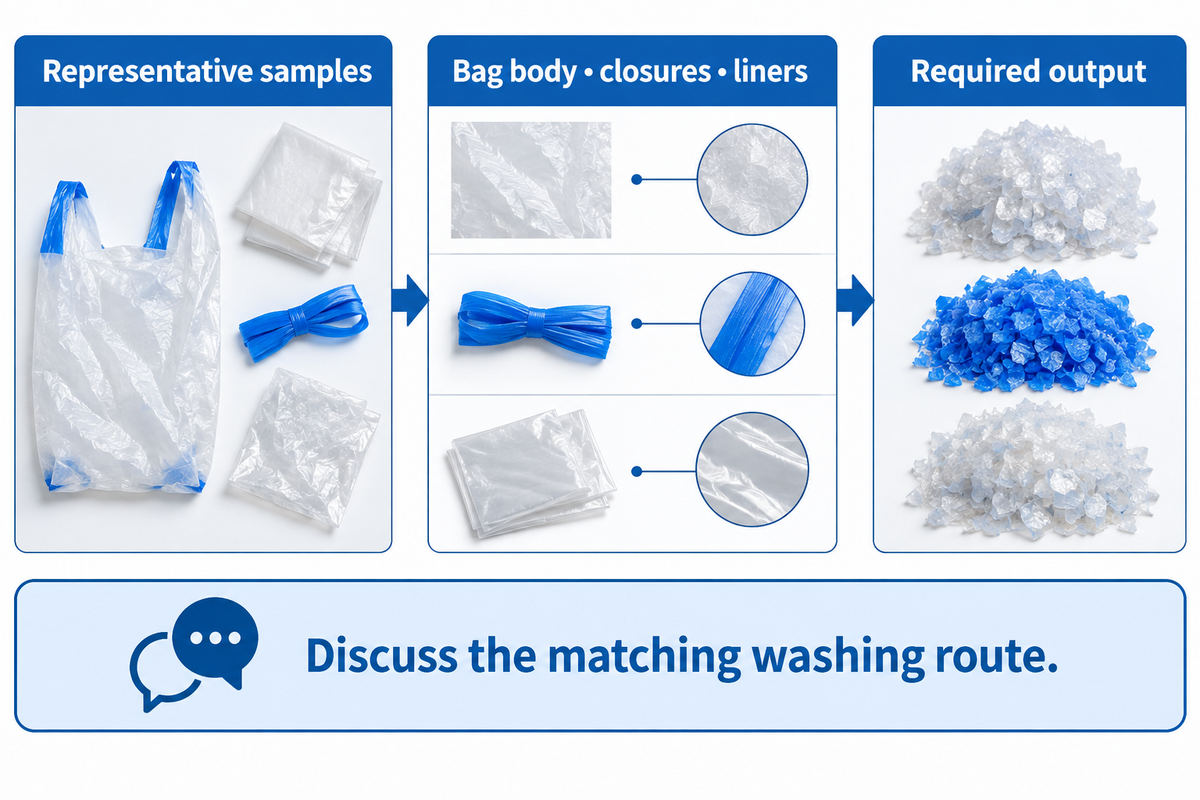
Identify the bag body, closures and liners before selecting equipment. Send KITECH the material description, representative samples and required output to discuss a washing route for your PE film feedstock or the appropriate woven-bag process.
Material examples use public manufacturer disclosures and institutional guidance. Component and Route tables are mainly sorting and purchasing aids.
References & Sources
- Plastic Resin Codes National Institutes of Health.
- D7611/D7611M: Coding Plastic Manufactured Articles for Resin Identification ASTM International, public scope.
- How Do Recycling Facilities Sort Different Kinds of Plastic? National Institute of Standards and Technology.
- D1709-24: Impact Resistance of Plastic Film by the Free-Falling Dart Method ASTM International, public scope and significance.
- Plastic Bags and Film RecycleSpot.
- Frequently Asked Questions about Plastic Recycling and Composting US Environmental Protection Agency.
- Store Drop-off and Label Explorer How2Recycle.
- Single Unit Dose Laundry Pouch Pack by Procter & Gamble Approved by RecyClass RecyClass, June 2021 historical assessment.
- Separation of Virgin Plastic Polymers and Post-consumer Mixed Plastic Waste by Sinking-flotation Technique Meneses Quelal, Velázquez-Martí and Ferrer Gisbert; published abstract.
- Recycled Plastics in Food Packaging US Food and Drug Administration.
- RecyClass Updates Packaging Recyclability Recommendations Following Extensive Testing in 2025 RecyClass.