Get in touch with Kitech Company

Circular Polymers: Closed-Loop Recycling Technologies, Resin Specifications, and Brand Commitments

Circular polymers are reprocessed post-industrial plastic and post-consumer resins using super-clean mechanical extrusion, physical solvent dissolution, or chemical depolymerization. The molecular weight and melt rheology of Circular polymers are adjusted to meet the specifications of virgin polymer. Unlike conventional open-loop regrind that cascades into non-structural lumber, building materials, or drainage pipes after a single use cycle, recycled polymers support regional circular economies by closing the loop and returning to food contact bottles and blown packaging films, automotive manifolds, and textile filaments. According to data compiled by Mordor Intelligence, global production reached 20.09 million metric tons in 2025, with polyethylene terephthalate (PET) accounting for 41.62% of the total volume and packaging applications absorbing 60.78% of the total output.
Managers and engineers in packaging procurement and operation of plastic recycling plants face the environmental challenge of qualifying circular polymers by polymer type. They must consider intrinsic viscosity (IV) and Melt flow index (MFI). They must verify continued filtration of the melt and determine the presence of PVC parts-per-million (ppm) in the closed-loop stream while lowering environmental impact and meeting sustainability goals. Additionally, they must differentiate between different classes of circular polymers and circular economy initiatives (e.g. Ascend’s Circular Polymers), as their use in polymer science is broad.
Executive Engineering Takeaways
- Entity Disambiguation: In industrial resin trading, circular polymers denotes closed-loop post-consumer recycled (PCR) and chemical-recycled resins, whereas Circular Polymers by Ascend is Lincoln, California post-consumer carpet recycler acquired by Ascend Performance Materials in 2022, which diverted 85 million pounds of carpet waste from landfills, as reported by PR Newswire.
- Energy and Yield Balance: According to Mordor Intelligence and MDPI Sustainability, mechanical recycling retains 64.35% market share in 2025 because high-efficiency extrusion and advanced sorting consume 883 to 1,131.7 kWh per metric ton at 80% to 96% mass yield, whereas solvent dissolution requires 1,200 to 2,500 kWh/t (at >95% solvent recovery reported by Umbrex) and thermal pyrolysis consumes 3,000 to 6,000+ kWh/t equivalent with 60% to 75% pyrolysis oil yield.
- Critical CoA Cutoffs: According to Energycle, bottle-to-bottle rPET requires IV of 0.74 to 0.84 dL/g (0.80 ± 0.02 dL/g benchmark), pre-extrusion moisture below 50 ppm, continuous melt filtration at 40 to 80 μm, and PVC contamination below 5 to 10 ppm (since 100 ppm PVC triggers hydrochloric acid chain scission at 260–285°C).
- Regulatory Deadlines (2026–2030): As documented in PPWR Connect under European Union Regulation (EU) 2025/40 (PPWR, applying from August 12, 2026), packaging converters must meet 2030 post-consumer recycled minimums of 30% for contact-sensitive PET and single-use beverage bottles, 10% for contact-sensitive non-PET plastics, and 35% for other plastic packaging, rising to 50%, 25%, and 65% by 2040.
What Are Circular Polymers? Closed-Loop Polymer Recycling vs. Downcycling (And the Ascend Brand Disambiguation)
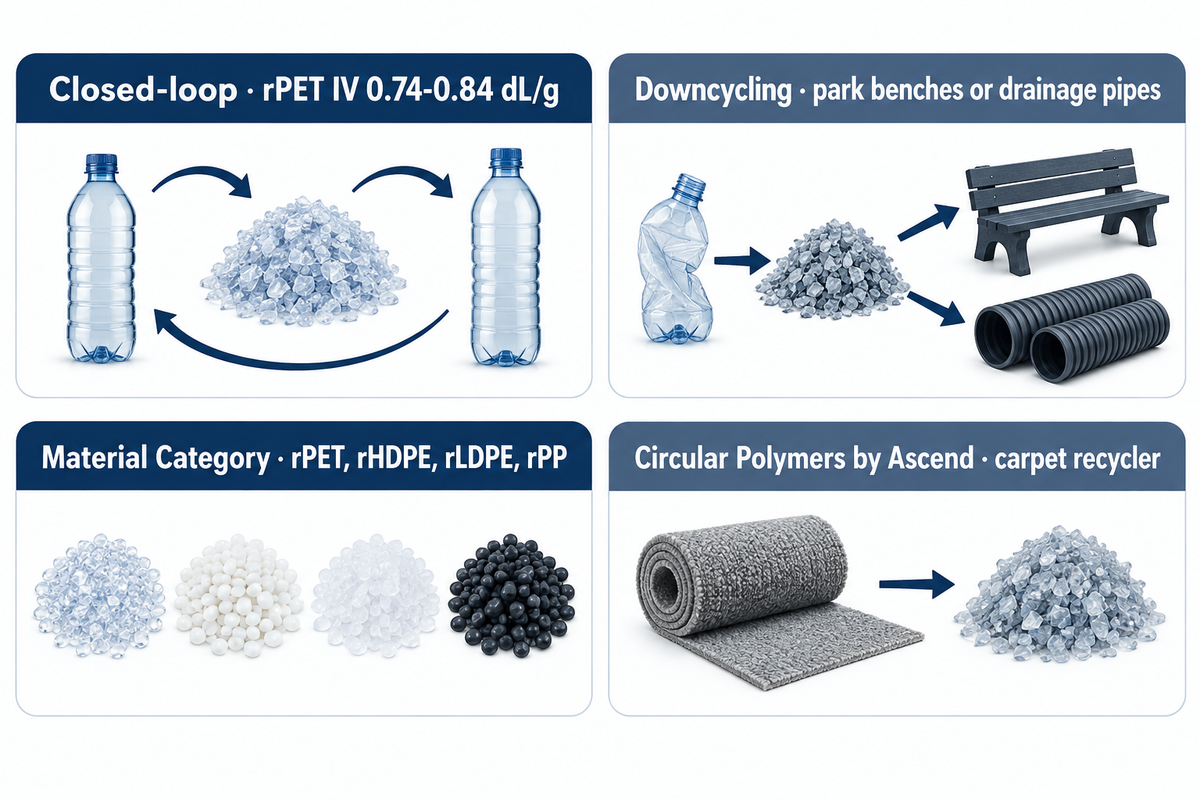
In polymer engineering and resin trading, circular polymers represents secondary raw materials and engineered materials, which replace virgin materials on a one-for-one functional basis across the value chain, without compromising tensile strength, optical clarity, or regulatory food contact compliance. Reaching virgin-like performance requires inhibiting chain scission of thermo-oxidative and hydrolytic and thermal degradation across the collection, washing, decontamination and compounding processes.
Within the European transition framework published by Plastics Europe and Plastics Recyclers Europe (PRE), European installed recycling input capacity stands at 13.5 million metric tons (led by 26% polyolefin films, 24% PET, 14% polypropylene rigids, 13% high-density polyethylene rigids, 8% PVC, and 2% PS/EPS according to PRE), serving as the industrial foundation toward a 65% circular plastics target by 2050 as regional capacity expands at a steady compound annual growth rate. Across North America, data from the Association of Plastic Recyclers (APR) shows 5.1 billion pounds of post-consumer plastic waste recovered annually, though capturing high-purity streams requires pairing optical sorting with mixed rigid plastic sorting and pre-processing equipment at each sorting and recycling facility before flakes ever reach an extruder.
Because search engines blend corporate brand pages with material science documentation, procurement teams should immediately distinguish between the two meanings of the phrase:
- Material Category (Circular Polymers): The global class of mechanically super-cleaned, solvent purified (such as PureCycle Technology polypropylene dissolution) or chemically depolymerized resins (rPET, rHDPE, rLDPE, rPP, and recycled polyamide) certified to re-enter closed-loop manufacturing.
- Corporate Entity (Circular Polymers by Ascend):
Circular Polymers by Ascend was founded in 2018 in Lincoln, California, and in November 2022, the company was majority-acquired by Ascend Performance Materials (PR Newswire). Circular Polymers specializes in reclamation of nylon and polypropylene carpets through their brand, Cerene. Through its Cerene brand and a $700,000 grant awarded from the Carpet America Recovery Effort (CARE Case Study) for mechanical separation of commercial broadloom and polyurethane-backed carpet tiles, which represent 30% of the discarded carpet in California reported by CARE, the Lincoln facility mechanically separates carpet into polyamide 6 (PA6), polyamide 66 (PA66), polypropylene (PP), PET, and calcium carbonate, adding 600,000 pounds per month of capacity (+27% output growth) and redirecting more than 85 million pounds of post-consumer carpet from landfill disposal.
How Does Closed-Loop Polymer Recycling Differ from Conventional Downcycling?
Closed-loop polymer recycling preserves or restores molecular chain length (maintaining rPET Intrinsic Viscosity at 0.74 to 0.84 dL/g with under 5 to 10 ppm PVC and under 1% flake moisture according to Energycle and Kitech) so that recovered pellets re-enter the original bottle, film, or injection molding specification. In conventional downcycling, mixed or degraded waste plastic is melted without prior contaminant removal, and the regrind is cascaded to make park benches or drainage pipes.
There are three important physical mechanisms that define the demarcation line between closed-loop recovery and downcycling in industry: solid-state or reactive chain extension, surface or bulk decontamination and narrow residence-time extrusion. If post-consumer polyolefins or polyesters aren’t specifically designed for direct reuse and are ground and melted without hot caustic washing or vacuum degassing, residual label adhesives, printing inks, and moisture cleave polymer backbones, leaving an irreversible effect on the melt flow rate and forcing the converter to blend the recyclate into low-margin thick-wall profiles.
Mechanical Extrusion-Pelletizing vs. Solvent Dissolution vs. Chemical Pyrolysis (Energy, Yield & Resin Quality)
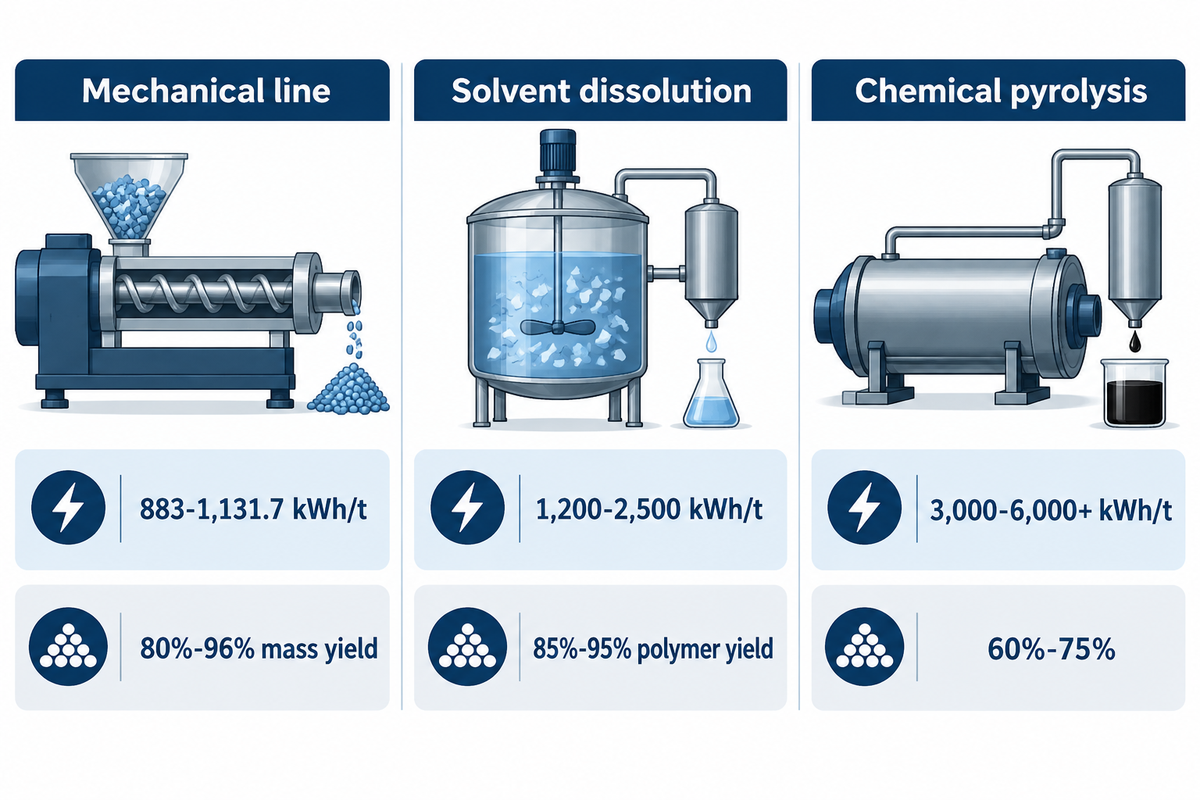
When balancing specific energy consumption (kWh per metric ton), mass yield, capital intensity, and decontamination depth, three industrial technologies provide the avenues for the production of circular polymers. Mechanical washing and extrusion-pelletizing, particularly, remain the economic backbone for sorted mono-material streams. Physical solvent dissolution and advanced recycling technologies (including feedstock recycling via chemical depolymerization, pyrolysis, or syngas gasification) target multi-layer, pigmented, or cross-contaminated flexible or rigid packaging waste.
Solvent Dissolution 1,200–2,500 kWh/t at 85–95% yield vs. Pyrolysis 3,000–6,000+ kWh/t at 30–50% yield) with NIST AMS 100-64 minimum selling prices ($0.38–$0.63/lb) and EPA/PMC9004285 PET bale utility inventories (251.7 kWh/t, 4.7 kg NaOH/t), alongside data from US Department of Energy OSTI 1854363 and the European Commission Joint Research Centre (JRC 132067).
| Process Parameter | Mechanical Washing & Extrusion-Pelletizing | Physical Solvent Dissolution & Purification | Chemical Recycling (Pyrolysis & Depolymerization) |
|---|---|---|---|
| Primary Mechanism | Optical sorting, wet crushing, 80–90°C caustic hot washing, friction scrubbing, thermal drying, continuous melt filtration, vacuum-degassed pelletizing (reported by Kitech). | Selective dissolution of target polymer in heated solvent (such as xylene, cyclohexanol, or NMP per US5278282A), filtration of insoluble pigments/inks, anti-solvent or flash precipitation. | Solvolysis/methanolysis/glycolysis for condensation polymers (PET, PA6); thermal or catalytic pyrolysis (400–600°C) + steam cracking for polyolefins (PE, PP) reported by Umbrex. |
| Specific Energy Demand | 300–800 kWh/t (extrusion subsystem); 883–1,131.7 kWh/t (integrated sorting, washing, drying & pelletizing line reported by MDPI). | 1,200–2,500 kWh/t equivalent (driven by solvent evaporation, stripping, and >95% solvent recovery loops reported by Umbrex). | 3,000–6,000+ kWh/t equivalent (pyrolysis reactor heat + hydrotreating + steam cracking + repolymerization reported by OSTI). |
| Polymer-to-Polymer Mass Yield | 80%–96% mass yield from pre-sorted bales; 251.7 kWh/t and 4.7 kg NaOH/t utility baseline on 78% PET bales modeled in PMC9004285. | 85%–95% polymer yield (reaching 99.2% PP recovery in xylene at 110°C for 80 min as documented in US5278282A). | 85%–90%+ monomer yield for PET depolymerization; 60%–75% pyrolysis liquid oil yield (30%–50% final polyolefin yield after steam cracker) according to Umbrex. |
| Feedstock Tolerance & Limits | Mono-material PE/PP film, rigid HDPE/PP, and PET bottles; requires <5–100 ppm PVC and <1%–3% pre-extrusion moisture according to Kitech. | Multi-layer packaging films, pigmented rigids, and odor-contaminated polyolefins; struggles with cross-linked thermosets per JRC 132067. | Mixed polyolefin pots/tubs/trays and complex packaging; sensitive to halogens (PVC <50–100 ppm), PET oxygenates, and heavy metals according to Energycle. |
| Commercial Economics & Share | 64.35% global market share in 2025 (Mordor); NIST AMS 100-64 MSP of $0.38/lb (PP) to $0.63/lb (HDPE); $450–$1,350/t flake market range reported by Energycle. | Emerging commercial scale; economics fail if solvent loss exceeds 3%–5% per cycle or residual solvent violates food-contact limits reported by Umbrex. | Over $10B global funding ($1B VC) in past decade (Baker Institute); requires ISCC PLUS mass-balance premium (+8%–16%) or €1,440–€1,850/t mandate pricing. |
| Operating Temperature Window | 80–90°C caustic hot washing; 130–285°C melt extrusion and pelletizing barrel zone (reported by Kitech). | 110°C dissolution in xylene for 80 min (US5278282A) without cleaving the covalent polymer backbone. | 400–600°C+ endothermic thermal or catalytic cracking reactor zone (Umbrex). |
| Decontamination & Odor Removal | Strips 98%–99%+ surface adhesives/oils; twin-stage vacuum degassing and 40–150 μm laser filtration remove volatiles and solid gels (reported by Kitech). | Removes matrix-bound pigments, titanium dioxide, and organoleptic compounds via sub-micron solution filtration (JRC 132067). | Resets polymer to monomer or hydrocarbon naphtha; requires hydrotreating to strip sulfur, nitrogen, and chlorine (Umbrex). |
| Chain-of-Custody Accounting | Physical segregation or controlled blending with traceable PCR batch CoA under EU 2022/1616 (PPWR Connect). | Physical segregation or controlled blending when dedicated single-polymer dissolution lines are operated (PPWR Connect). | ISCC PLUS or REDcert² mass-balance credit allocation (fuel-use-exempt or free attribution per PPWR Connect). |
| Typical Line Capacity Range | 100–3,000 kg/h modular washing and granulation lines for in-house and commercial plants (reported by Kitech). | Regional solvent purification plants requiring closed-loop condenser recovery (Umbrex). | Refinery-integrated pyrolysis and steam-cracker units co-processing pyrolysis oil (OSTI). |
A recent Monte Carlo life-cycle assessment (LCA) published in MDPI Sustainability (2026) evaluating mechanical recycling of PET, HDPE, LDPE, and PP demonstrates why advanced mechanical preprocessing remains the lowest-carbon pathway for low-carbon resin production and reduced greenhouse gas emissions while maintaining consistent product quality alongside complementary bio-based polymers. Under the baseline mechanical configuration, plant electricity intensity averaged 1,131.7 kWh per metric ton (with 515.3 m³ of natural gas and 67.7 GJ cumulative energy demand per ton). When operators integrated Sensor-Based Sorting (SBS) with High-Efficiency Extrusion (HEE), electricity demand fell to 883 kWh per metric ton, outperforming baseline lines in over 95% of 10,000 Monte Carlo iterations according to MDPI. Similarly, unit-process inventory modeling in PMC9004285 for post-consumer PET bales (78% PET, 7.2% PE, 3.3% PP) records wash-line utilities of 251.7 kWh electricity and 4.7 kg (0.0047 metric tons) of sodium hydroxide (NaOH) per metric ton of feed, supporting NIST AMS 100-64 / DOE minimum selling prices of $0.38/lb for PP, $0.46/lb for LDPE, $0.54/lb for PET, and $0.63/lb for HDPE. For converters scaling film recovery, mastering the complete plastic film recycling process from waste film to pellet is essential to stay within that 883 kWh/t energy envelope.
Why Does Pyrolysis Consume 3,000–6,000 kWh/t While Mechanical Pelletizing Uses 300–800 kWh/t?
Mechanical extrusion-pelletizing only heats thermoplastics above their 130°C to 285°C melting range while preserving covalent polymer chains, requiring 300 to 800 kWh/t at the extruder (883 to 1,131.7 kWh/t plant-wide per MDPI). Thermal pyrolysis must supply endothermic bond-scission energy at 400°C to 600°C+, hydrotreat pyrolysis oil, and re-crack hydrocarbons, losing 25% to 70% mass according to Umbrex.
Despite attracting more than $10 billion in global investment ($1 billion in venture capital) over the past decade (Rice University Baker Institute), chemical pyrolysis polymer yields aren’t always high or stable. In industrial practice, halogens, flame retardants, fillers, and pigments in mixed plastic waste poison reactor catalysts and form char, meaning advanced recycling still depends heavily on upstream mechanical sorting, de-labeling, and hot washing to prepare a low-halogen feedstock.
Qualifying Circular Polymers: IV, MFI, Moisture ppm, PVC Thresholds, and Continuous Melt Filtration Specs
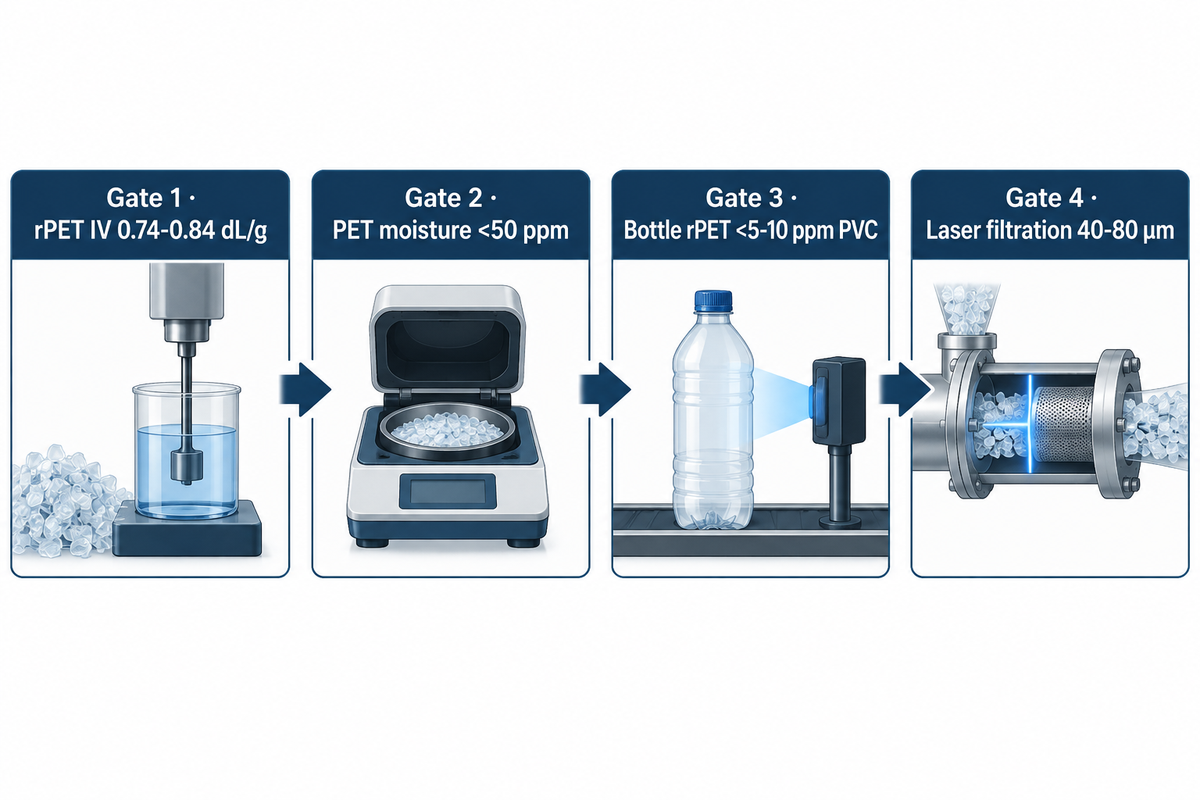
While rapid innovations in recycling allows for the flexibility to potentially create a supply that isn’t fully qualified, in the case of circular polymers, variability and uncertainty due to distributions in Molecular Weight and Moisture content, coupled with trace polymer cross contamination negatively impacts die swell and parison sag, as well as stress crack resistance.
To prevent off-spec production runs, plant engineers enforce The 4-Gate PCR CoA Qualification Checklist (IV, MFI, Moisture & PVC ppm) across every incoming resin lot, mapping converter CoA tolerances (rPET IV 0.74–0.84 dL/g, rHDPE MFI 0.3–1.0 g/10 min, <50/500 ppm melt moisture, 40–150 µm laser filtration) and European rPET/rHDPE spot spreads (+€340 to +€687.50/t) directly to upstream washing-line configuration:
| Qualification Gate | Target Resin & Application | Standard Test Method | Contract CoA Tolerance | Shop-Floor Failure Mode If Violated |
|---|---|---|---|---|
| Gate 1: Intrinsic Viscosity (IV) & Melt Flow Index (MFI) | Food-grade rPET bottles/sheet; blow-molding & injection rHDPE/rPP | ASTM D4603 / ISO 1628 (PET IV); ASTM D1238 / ISO 1133 (MFI at 190°C or 230°C / 2.16 kg) | rPET IV: 0.74–0.84 dL/g (0.80 ± 0.02 dL/g benchmark per Honest Ocean); rHDPE blow molding: 0.3–1.0 g/10 min; injection rPP/rHDPE: 4–30 g/10 min | IV below 0.72 dL/g causes bottle burst under carbonation; uncontrolled MFI swings cause parison drawdown instability or short shots. |
| Gate 2: Pre-Melt Moisture Ceiling | Hygroscopic PET flakes vs. non-hygroscopic PE/PP washed film | Karl Fischer titration / inline loss-on-drying analyzer | <50 ppm (0.005%) at PET extruder throat (<1% washed flake input reported by Kitech); <500 ppm at PE/PP throat (<3% squeezed film input) | Residual water above 50 ppm in PET at 260–285°C triggers rapid hydrolytic chain cleavage; moisture above 3% in PE film causes steam voids and foaming according to Kitech. |
| Gate 3: Trace PVC & Polyolefin Cutoff | Post-consumer rPET flakes for preform, sheet, and filament extrusion | APR PET-A-01 / 500 g lab oven bake at 200°C for 45–60 min; XRF chlorine scan | <5–10 ppm PVC for bottle-to-bottle (0.001% max); <30–50 ppm for sheet/filament; <100–150 ppm for staple fiber reported by Energycle | PVC dehydrochlorinates at 180–220°C, releasing HCl gas that turns rPET yellow/brown, creates black specks, and drops IV below 0.65 dL/g (Energycle). |
| Gate 4: Continuous Melt Filtration Rating | Thin-gauge blown PE film, bottle-grade rPET, and rigid blow molding | Continuous rotary laser disk or piston backflush screen changer ΔP monitoring | 40–80 μm (200–325 mesh) for thin film & bottle rPET; 100–150 μm (100–150 mesh) for rigid blow molding reported by Kitech | Coarse screens (>150 μm) pass paper fibers, cross-linked gels, and unmelted PET/PA specks that rupture 15–25 μm blown film bubbles. |
A frequent operational misconception in the recycling industry is assuming that a standard water sink-float separation tank (specific gravity 1.00 g/cm³) will separate PVC from PET. While water cleanly floats polyolefin caps and labels (PP at 0.90 to 0.92 g/cm³ and HDPE at 0.94 to 0.96 g/cm³), amorphous and semi-crystalline post-consumer PET has a density of 1.33 to 1.40 g/cm³, which directly overlaps rigid unplasticized PVC at 1.35 to 1.52 g/cm³. As detailed in technical failure studies by Energycle and the Association of Plastic Recyclers (APR PET-A-01), both polymers sink together to the bottom discharge auger. When trace PVC fragments enter a PET extruder operating at 260°C to 285°C, PVC undergoes dehydrochlorination starting at 180°C to 200°C (peaking above 220°C), liberating hydrochloric acid (HCl) gas. Under 120 to 180 bar barrel pressure, HCl acts as an acid catalyst that severs ester bonds, forms conjugated polyene chromophores, and separates profitable bottle-grade rPET ($1,100 to $1,350 per metric ton reported by Energycle) from discounted staple-fiber regrind ($450 to $650 per metric ton reported by Energycle).
Where moderate hydrolytic degradation is seen in incoming post-consumer PET, molecular weight is restored either through Solid-State Polycondensation (SSP) under a vacuum or reactive extrusion with multifunctional chain extenders. Peer-reviewed rheology trials in Polymers (PMC10519981) confirm that dosing 0.25 to 1.25 wt% pyromellitic dianhydride (PMDA) during twin-screw extrusion couples hydroxyl and carboxyl end-groups, systematically lowering the melt flow index and rebuilding melt strength for foaming and sheet extrusion.
What Continuous Melt Filtration Micron Rating and Wash-Line Specs Prevent Gel and Black-Speck Defects?
Eliminating gels and carbonized black specks requires pairing upstream 80°C to 90°C caustic sodium hydroxide (1% to 2% NaOH) hot washing and high-speed friction scrubbing, which strip 98% to 99%+ of acrylic adhesives, oils, and paper fibers according to Kitech, with continuous 40 to 80 μm laser disk melt filtration for thin packaging films and bottle rPET, or 100 to 150 μm filtration for rigid rHDPE.
In plant commissioning, relying on melt filtration alone without upstream hot washing is a costly mistake: if adhesive residues and cellulose fibers aren’t saponified and rinsed in an industrial PE film washing line (500–3,000 kg/h) or a hot-wash PET bottle washing line achieving <100 ppm PVC, fine 50 μm screens blind within minutes, spiking head pressure above 250 bar and scorching the melt.
ISCC PLUS Mass-Balance Accounting, 2026–2030 EU PPWR Mandates, and Recycled vs. Virgin Pellet Pricing
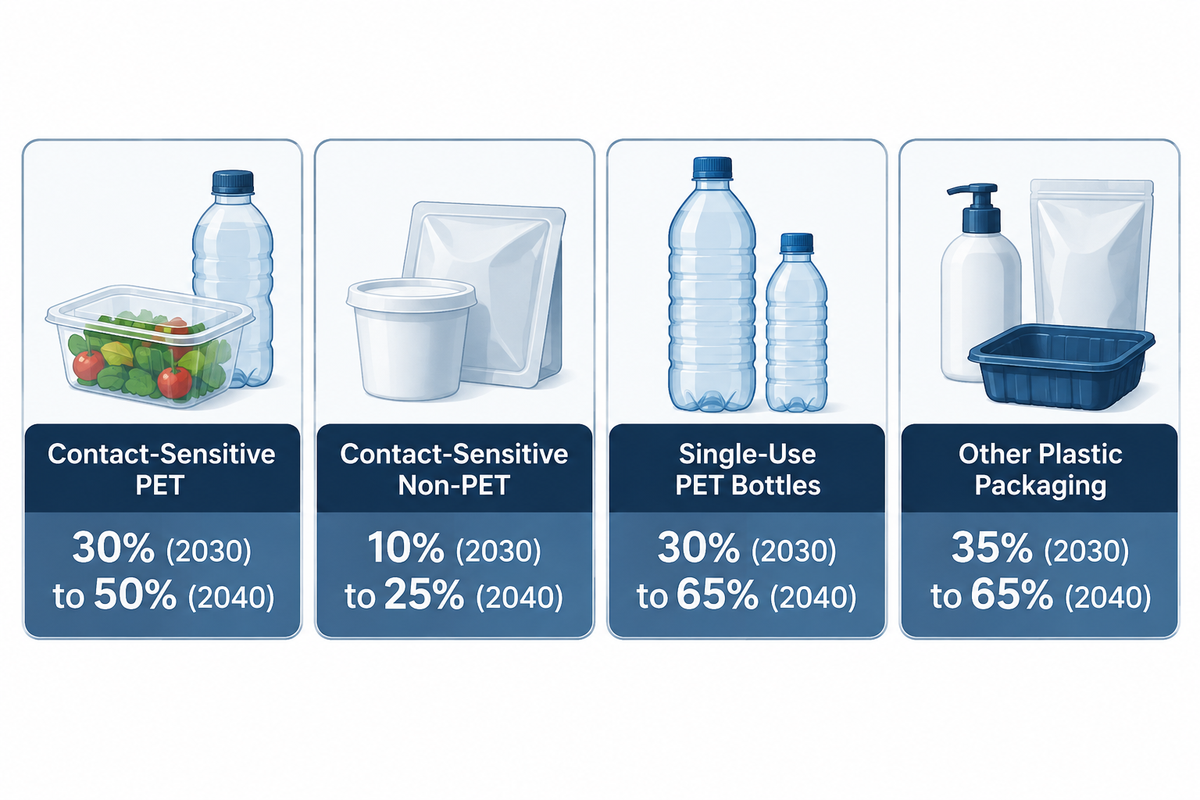
Procurement of circular polymers has shifted from voluntary corporate sustainability pledges to binding legal compliance under European Union Regulation (EU) 2025/40, the Packaging and Packaging Waste Regulation (PPWR), which enters into general application on August 12, 2026. Understanding how to calculate recycled content according to Article 7, as well as the chain of custody models, will influence whether a converter’s supply contract passes an audit.
As analyzed by PPWR Connect and the European Commission PPWR Guidance C(2026)3702 Article 7 sets a minimum content of post-consumer recycled (PCR) per packaging unit and averaged per manufacturing plant per year (excluding any plastic component representing less than 5% of the total weight of the packaging unit). It should be noted that PIR is explicitly excluded from Article 7.
Meanwhile, polyolefins produced by chemical recyclers through the pyrolysis process are sold under ISCC PLUS or REDcert² mass balance schemes where circular credits are attributed either by free attribution or under a fuel-use exemption, even when the physical pellets contain zero segregated recycled molecules, and whether mass balance credits satisfy PPWR Article 7 depends on the methodology the European Commission adopts by December 31, 2026.
To address this situation, sourcing teams use the PPWR 2030/2040 Mass-Balance vs. Physical-Segregation Sourcing Decision Tree:
| EU PPWR Article 7 Packaging Category | 2030 Min. PCR Target | 2040 Min. PCR Target | Primary Chain-of-Custody Model | 2025–2026 Pellet Pricing & Audit Exposure |
|---|---|---|---|---|
| Contact-Sensitive Packaging Made Primarily from PET (food trays, punnets, dairy/cosmetic containers) | 30% (PPWR) | 50% (PPWR) | Physical Segregation or Controlled Blending (EFSA-authorized under Regulation (EU) 2022/1616 & 2025/351). | €1,440–€1,850/t DDP NW Europe vs. €970–€1,200/t virgin PET (+€340 to +€687.50/t spread; $250/t secondary premium reported by Mordor Intelligence). |
| Contact-Sensitive Packaging from Plastics Other Than PET (food-grade PE films, PP tubs, HDPE closures) | 10% (PPWR) | 25% (PPWR) | ISCC PLUS / REDcert² Mass Balance (chemical pyrolysis) or closed-loop deposit mechanical HDPE/PP. | +8%–16% ISCC PLUS certification uplift; exposed to Dec 31, 2026 Commission implementing act on mass-balance attribution rules (PPWR Connect). |
| Single-Use Plastic Beverage Bottles (PET) (builds on SUPD 25% mandate in 2025) | 30% (PPWR) | 65% (PPWR) | Physical Segregation (super-clean caustic wash + SSP bottle-to-bottle loop). | $1,100–$1,350/t bottle-grade rPET vs. $450–$650/t off-spec fiber flake reported by Energycle; high color/ink load risks Annex II recyclability grade floor. |
| All Other Non-Contact Plastic Packaging (industrial stretch hood, shrink film, non-food detergent bottles, pallets) | 35% (PPWR) | 65% (PPWR) | Physical Segregation or Controlled Blending via high-efficiency mechanical film & rigid washing lines. | Lowest compliance cost: in-house mechanical recycling via PFW/KCP lines delivers $0.38–$0.63/lb pellet cost (NIST) and 11–24 month ROI payback (reported by Kitech). |
Converters must also coordinate Article 7 recycled-content targets with Article 6 Annex II recyclability performance grades: loading dark pigments, unwashed adhesives, or carbon-black masterbatch into a package to meet a 35% PCR quota can drag the unit below the Annex II Grade-C recyclability floor, which is banned from January 1, 2030 (PPWR Connect).
Global Circular Polymer Brand Commitments and Producer Portfolios (SABIC, Borealis, LyondellBasell, Eastman)
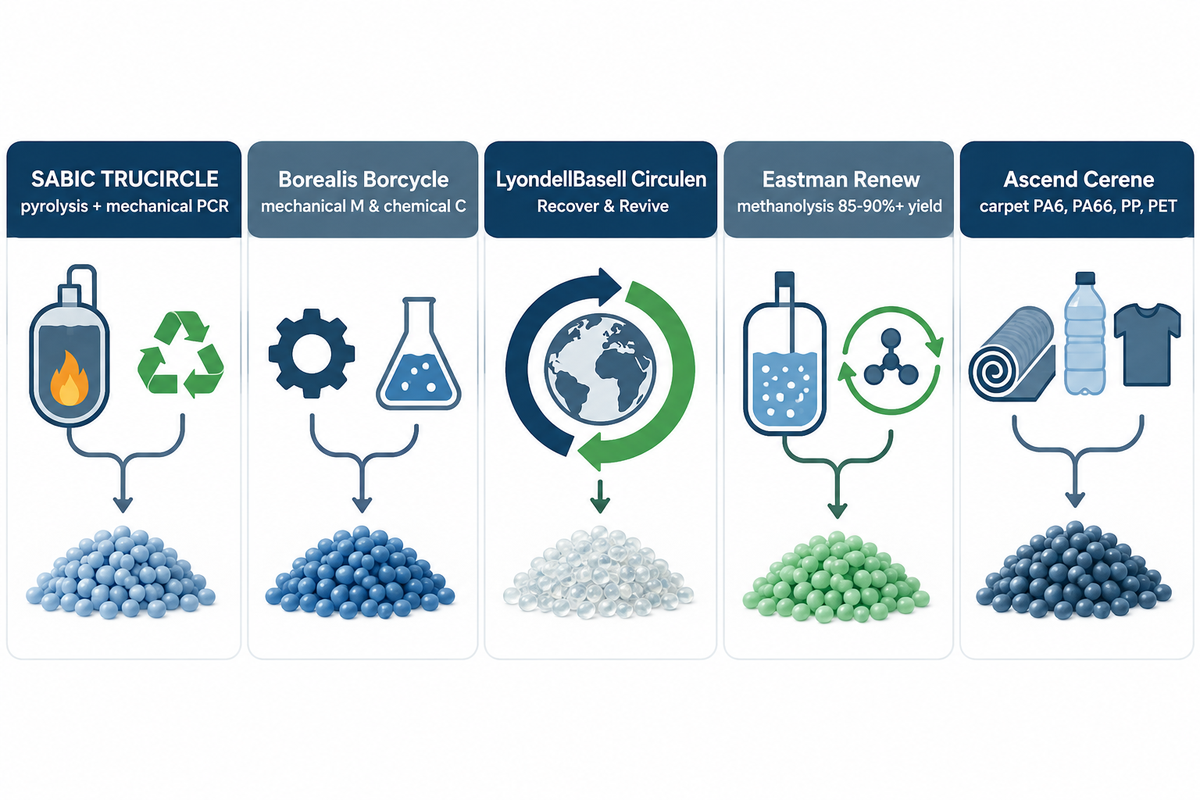
Major petrochemical producers and specialty compounders have restructured their product lines into dedicated circular polymer portfolios, pairing mechanically decontaminated PCR grades with ISCC PLUS mass-balance certified resins. Nonetheless, commercial deliveries across Europe, North America, Asia-Pacific and the Middle East and Africa are limited due to a major global shortage of sorted, low-contamination post-consumer plastic waste, and increasing demand for recycled materials.
Market segmentation data from Mordor Intelligence shows PET leading the pack at 41.62% in 2025; however, recycled Nylon-6 (polyamide) is the quickest engineer resin in terms of growth at 8.37% CAGR by 2031, primarily driven by automotive under-the-hood components and electrical connectors, in addition to carpet recovery. The National Association for PET Container Resources (NAPCOR) in North America reports a 30.2% US PET bottle recycling rate; thereby, explaining why global CPG companies find it hard to secure food grade feedstock. The following shows how the flagship producer portfolios stack against each other:
| Producer & Flagship Portfolio | Core Recycling Pathway | Target Polymer Families | Certification & Key Industrial Applications |
|---|---|---|---|
| SABIC — TRUCIRCLE™ | Pyrolysis tacoil steam cracking + mechanical PCR compounding | Certified circular PE, PP, polycarbonate (PC), and PBT blends | ISCC PLUS mass balance; food-contact flexible packaging, medical devices, and automotive interior trim. |
| Borealis — Borcycle™ M & Borcycle™ C | Advanced mechanical recycling (Borcycle M) & chemical pyrolysis (Borcycle C) | Polyolefins (rHDPE, rLDPE, rLLDPE, rPP compounds) | ISCC PLUS & EuCertPlast; stretch film, household detergent bottles, and automotive bumper fascias. |
| LyondellBasell — CirculenRecover & CirculenRevive | Mechanical super-cleaning (Recover) & catalytic MoReTec pyrolysis (Revive) | HDPE, LDPE, and polypropylene homopolymers & copolymers | ISCC PLUS mass balance; rigid logistics crates, cosmetic caps, and multi-layer barrier food films. |
| Eastman — Renew (Molecular Recycling) | Polyester Renewal Technology (methanolysis depolymerization to DMT & EG monomers) | Tritan™ Renew copolyester, Cristal™ Renew, and specialty polyesters | ISCC PLUS mass balance (85–90%+ monomer yield per Umbrex); hydration bottles, luxury cosmetics, and eyewear. |
| Ascend Performance Materials — Cerene™ & ReDefyne™ | Mechanical post-consumer carpet separation (Lincoln, CA) & polyamide compounding | PA6, PA66, PP, and PET recovered from post-consumer carpet | Reduces carbon footprint in automotive air-intake manifolds, radiator end tanks, and consumer power tools (PR Newswire). |
In parallel with corporate R&D on depolymerization and pyrolysis, intellectual property filings show rapid progress in selective solvent dissolution and ionic-liquid valorization. Foundational selective dissolution data in US Patent US5278282A (Rensselaer Polytechnic Institute) demonstrated 99.2% polypropylene recovery in xylene at 110°C (80 minutes), 99.7% EVOH barrier recovery in NMP at 83°C (120 minutes), and sequential single-solvent temperature splits of multilayer waste, such as cyclohexanol separating LDPE at 100°C, PP at 125°C, and HDPE at 161°C, or xylene separating LDPE at 60°C, LLDPE at 85°C, and HDPE at 105°C. More recent patent families (WO2022128487A1 and WO2024030678A1) extend solvent purification and deep eutectic solvent depolymerization to mixed packaging waste. Even so, as technical panels at the annual Plastics Recycling Conference repeatedly note, stagnant municipal recycling rates mean that demand for recycled polyolefins far outstrips pyrolysis capacity, making internal recycling efforts and HDPE recycling process control for cleaner flakes the most practical commercial path to meeting 2030 quotas.
How to Qualify Turnkey Washing and Pelletizing Line Manufacturers for Food-Grade and Film-Grade Circular Pellets
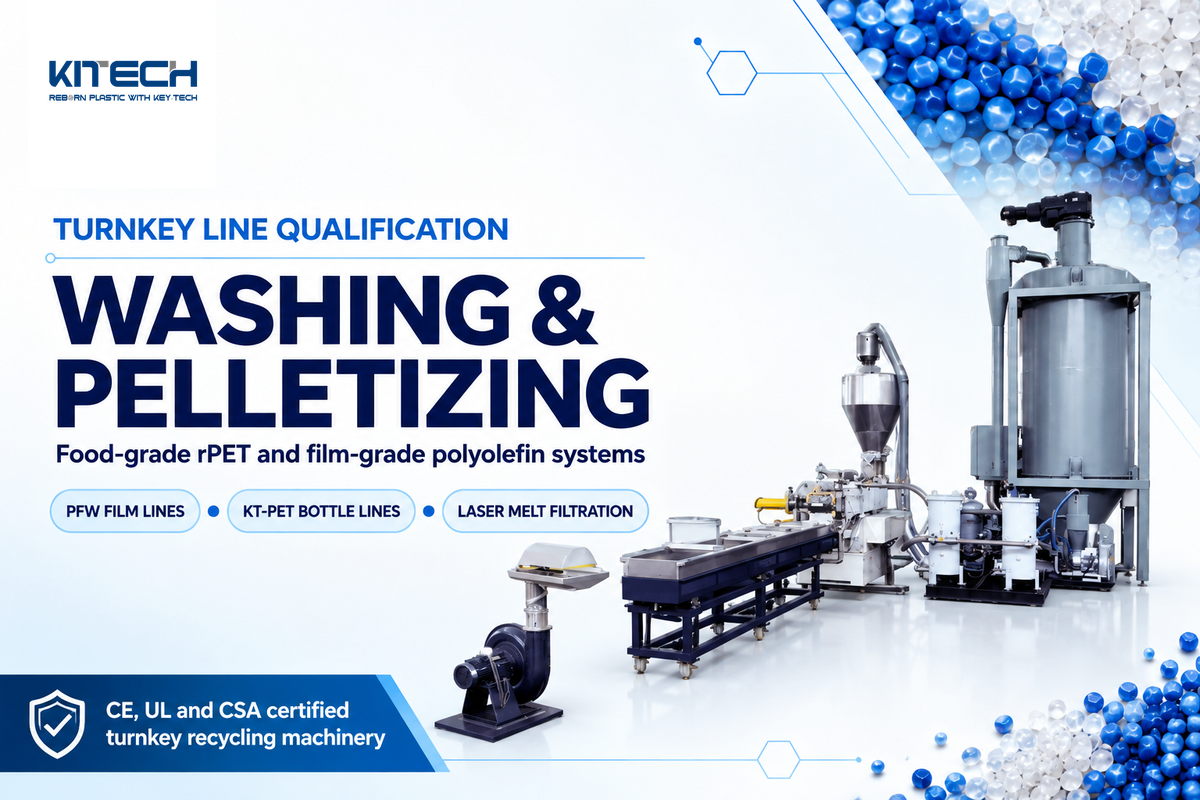
Because food-grade and film-grade PCR pellets sell for a $250 to €687.50/MT premium over virgin resin (Mordor Intelligence), more mid-to-large packaging converters and recyclers are justifying the purchase of washing and pelletizing systems to process end-of-life plastics into high-purity recycled materials. To achieve closed-loop pellet specifications, the amount of operational challenges and opportunities during washing, caustic temperature, and melt filtration must be optimized according to feedstock contamination.
A frequent mistake in procurement is the purchase of an entry-level cold-wash line ($80,000 to $150,000 for 500 to 800 kg/h as reported by Kitech) for adhesive-free thermoforming sheets, bottle-to-bottle rPET, and thin-gauge blown film. Cold water can’t saponify cross-linked acrylics or hot-melt label adhesives. Therefore, sustainable solutions for circular-grade flakes requires an industrial hot-wash configuration ($300,000 to $800,000+ for 3,000 to 5,000 kg/h as reported by Kitech) that includes mechanical bottle de-labeling, 80°C to 90°C caustic NaOH wash, high-speed friction washers, and closed-loop water filtration.
When evaluating CE, UL, and CSA certified plastic recycling systems engineered by Kitech across 80+ countries, engineering teams audit both mechanical build tolerances and utility efficiency. Operating from a 20,000 m² CNC and robotic-welding manufacturing campus under ISO 9001 quality management, Jiangsu Kitech Machinery Co., Ltd. dynamically balances every crusher, friction washer, and dryer rotor to within a 3 to 5 gram tolerance, extending bearing life by 40% while eliminating high-speed structural vibration, and backs turnkey lines with a 60-day delivery guarantee and 24/7 cloud Siemens PLC remote diagnostics as documented in Kitech engineering specifications.
Published first-party equipment specifications from Kitech PE film washing lines and Kitech PET bottle washing lines cover Kitech PFW-500 to PFW-3000 (500–3,000 kg/h, 80–450 kW, 2–12 m³/h water, <3% flake moisture) and KT-PET-500 to KT-PET-5000 (500–5,000 kg/h, 80–780 kW, 3–5 g rotor dynamic balance, <1% moisture, <100 ppm PVC) across 9 standard model tiers:
| Model Series & Target Category | Rated Capacity | Total Motor Power | Water & Thermal Process Specs | Final Flake Purity & Moisture |
|---|---|---|---|---|
| Kitech PFW-500 (Agricultural & Packaging PE Film Tier) | 500 kg/h | 80–120 kW | 2–3 m³/h water usage (60%–70% closed-loop water recycling savings reported by Kitech); 85°C hot wash; 300 m² footprint | 98%–99%+ dirt/oil removal; <3% residual film moisture via centrifugal + screw-press squeezing (reported by Kitech) |
| Kitech PFW-1000 (Post-Consumer Stretch & Shrink Film Tier) | 1,000 kg/h | 150–200 kW | 4–6 m³/h water usage (60%–70% closed-loop water savings reported by Kitech); 85°C caustic wash; 500 m² footprint | 98%–99%+ dirt/oil removal; <3% residual film moisture ready for blown-film pelletizing (reported by Kitech) |
| Kitech PFW-1500 (Commercial Logistics LLDPE Film Tier) | 1,500 kg/h | 220–280 kW | 6–8 m³/h water usage (60%–70% recycled water reported by Kitech); SUS304 contact parts; 800 m² footprint | <3% moisture ready for direct KCP two-stage vacuum-degassed laser-filtered extrusion (reported by Kitech) |
| Kitech PFW-2000 (Industrial Heavy-Duty PE/PP Film Tier) | 2,000 kg/h | 280–350 kW | 8–10 m³/h water usage (60%–70% recycled water reported by Kitech); 85°C hot wash; 1,100 m² footprint | <3% moisture; 11–24 month ROI payback reported by Kitech |
| Kitech PFW-3000 (High-Output Municipal & Agricultural Film Tier) | 3,000 kg/h | 380–450 kW | 10–12 m³/h water usage (60%–70% recycled water reported by Kitech); twin-shaft pre-shredding; 1,500 m² footprint | 98%–99%+ decontamination; <3% moisture for high-output circular polyolefin compounding (reported by Kitech) |
| Kitech KT-PET-500 (Regional Post-Consumer PET Bottle Tier) | 500 kg/h | 80–130 kW | 30 m line length; wet crushing (12–18 mm flake size); 80–90°C NaOH hot wash; 80%–90% water recovery (reported by Kitech) | <1% final flake moisture; <100 ppm PVC; >98% flake purity reported by Kitech |
| Kitech KT-PET-1000 (Thermoforming & Bottle-Grade rPET Tier) | 1,000 kg/h | 150–220 kW | 38 m line length; whole-bottle de-labeler (>98% removal); 80–90°C caustic wash; 80%–90% water recovery (reported by Kitech) | <1% final flake moisture; <5–10 ppm PVC with NIR/XRT sorting; >98% flake purity (reported by Kitech) |
| Kitech KT-PET-2000 (Food-Contact Preform & Sheet rPET Tier) | 2,000 kg/h | 280–380 kW | 48 m line length; dual sink-float tanks + 80–90°C NaOH wash; 80%–90% water recovery (reported by Kitech) | <1% final flake moisture; <5–10 ppm PVC; IV retention 0.74–0.84 dL/g (reported by Kitech) |
| Kitech KT-PET-3000 / KT-PET-5000 (Mega-Scale Bottle-to-Bottle Tier) | 3,000–5,000 kg/h | 450–780 kW | 55–65 m line length; multi-stage hot caustic wash; 80%–90% water recovery; 3–5 g rotor dynamic balance (reported by Kitech) | Food-grade rPET flake output ready for SSP reactor and bottle-to-bottle preform molding (reported by Kitech) |
How Do Turnkey Washing-to-Pelletizing Lines Integrate Hot Caustic Washing with Laser Melt Filtration?
High-speed friction scrubbers for washing and mechanical drying systems are integrated within washing-to-pelletizing lines. Turnkey washing-to-pelletizing lines integrate 80°C to 90°C caustic hot washing, high-speed friction scrubbing, and mechanical screw-press or centrifugal drying (reducing flake moisture below 1% for PET or 3% for PE film reported by Kitech) directly upstream of cutter-compactor extruders equipped with double-zone vacuum degassing and 40 to 150 μm laser melt filtration.
By integrating surface washing and pelletizing, certain volatile gases present in the flakes are reduced, and as a result, screen changer pressure increases are prevented. This allows extruders to produce uniform, deodorized, circular pellets in a continuous process.
Frequently Asked Questions About Circular Polymers
1. What is the difference between circular polymers and Circular Polymers by Ascend?
Circular polymers as a material class refer to closed-loop recycled plastics (mechanically super-cleaned, solvent-purified, or chemically depolymerized resins) that replace virgin polymers in equivalent-spec applications. Circular Polymers by Ascend is a specific recycling company founded in 2018 in Lincoln, California, and acquired by Ascend Performance Materials in 2022 that converts post-consumer carpet into PA6, PA66, PP, and PET (PR Newswire).
2. Can mechanically recycled rHDPE and rPP be used in food-contact packaging?
Yes, but only under strict closed-loop collection and decontamination rules. According to PPWR Connect, mechanically recycled rPET accounts for over 95% of EFSA and US FDA food-contact approvals due to PET’s low diffusivity and 80–90°C caustic wash + SSP decontamination, whereas mechanically recycled rHDPE and rPP qualify for food contact only when sourced from closed-loop deposit schemes and processed under Regulation (EU) 2022/1616 and Regulation (EU) 2025/351.
3. How does ISCC PLUS mass-balance accounting work for circular polymers?
ISCC+ mass-balance accounting supports circular feedstock inputs (i.e. bio-circular naphtha or pyrolysis oil) to a steam cracker and allocates recycled credits to polymer grades. Under free attribution, the physical pellets shipped to a converter may not contain recycled molecules and EU PPWR Article 7 recognition hinges on the December 31, 2026, Commission implementing act (PPWR Connect).
4. What is the typical ROI payback period for an in-house plastic washing and pelletizing line?
According to Kitech, industrial recycling plants operating a Kitech PFW-series PE film washing line (500 to 3,000 kg/h) or KT-PET bottle washing line (500 to 5,000 kg/h) achieve full capital payback in 11 to 24 months, driven by 60% to 70% closed-loop water savings and the $450 to $1,350/t value spread between baled waste and clean flakes.
5. Why is hot caustic soda (NaOH) washing required before Solid-State Polycondensation (SSP)?
As documented in Kitech and Energycle, caustic hot washing (1% to 2% NaOH at 80–90°C) and high-speed friction washing remove external surface contaminants—saponifying acrylic label adhesives, residual beverages, and oils while keeping PVC below 5 to 10 ppm. Solid-State Polycondensation (SSP) then heats crystallized rPET at 200–220°C under vacuum to diffuse out volatiles and lift Intrinsic Viscosity to 0.80 ± 0.02 dL/g.
References & Sources
- Plastics Europe (2024). The Plastics Transition Roadmap: Enablers to Achieve 65% Circular Plastics by 2050. https://plasticseurope.org/wp-content/uploads/2024/09/2310838_RoadmapCopyChange_110924.pdf
- Mordor Intelligence (2026). Circular Polymers Market Size, Share & 2026–2031 Industry Analysis. https://www.mordorintelligence.com/industry-reports/circular-polymers-market
- PR Newswire / Ascend Performance Materials (2022). Ascend Buys Majority Stake in Recycler Circular Polymers. https://www.prnewswire.com/news-releases/ascend-buys-majority-stake-in-recycler-circular-polymers-301671767.html
- Carpet America Recovery Effort (CARE). CARE Grantee Case Study: Circular Polymers (Lincoln, CA). https://carpetrecovery.org/care-grantee-case-study-circular-polymers/
- MDPI Sustainability (2026). Environmental and Energy Assessment of Advanced Mechanical Plastic Recycling (SBS + HEE). Available at: https://www.mdpi.com/2071-1050/18/8/3862.
- Umbrex Chemicals & Advanced Materials Practice. Circular Polymers & Chemical Recycling Industry Primer. Available at: https://umbrex.com/resources/industry-primers/chemicals-advanced-materials-industry-primers/circular-polymers-chemical-recycling-industry-primer/.
- Rice University, Baker Institute for Public Policy (2024). Controversy in Context: Evidence-Based Insights on Chemical Recycling. https://www.bakerinstitute.org/research/controversy-context-evidence-based-insights-chemical-recycling
- US National Institute of Standards and Technology (NIST AMS 100-64 / SP 1500-206). Current State of US Infrastructure and Recycling Technologies for Polymer Waste & Circular Economy Workshop. https://www.osti.gov/servlets/purl/1854363
- US Department of Energy OSTI (1854363) & NIH PubMed Central (PMC9004285 / PMC10519981). Material and Energy Balances for Post-Consumer PET & Reactive Chain Extension. Available at: https://pmc.ncbi.nlm.nih.gov/articles/PMC9004285/.
- Energycle Technical Library. PVC in PET Bottle Recycling: Understanding the Challenges and Solutions. Available at: https://www.energycle.com/pvc-in-pet-bottle-recycling-understanding-the-challenges-and-solutions/.
- PPWR Connect & European Commission C(2026)3702 (2026). EU Packaging and Packaging Waste Regulation (EU) 2025/40 Article 7 Recycled Content & Mass Balance Chain of Custody. https://ppwrconnect.com/blog/ppwr-recycled-content-mass-balance-chain-of-custody
- US Patent US5278282A & WIPO WO2022128487A1 / WO2024030678A1. Selective Dissolution Process for the Separation and Recycling of Commingled Plastic Waste. Available at: https://patents.google.com/patent/US5278282A/en.
- Jiangsu Kitech Machinery Co., Ltd. PFW-Series PE Film Washing Line & KT-PET Bottle Washing Line Technical Specifications. Available at: https://kitech-recycling.com/plastic-recycling-solutions/pe-film-washing-line/.
Related Posts
Trending now