Get in touch with Kitech Company


Plastic Washing Line for Recycling: How It Works, Types, and How to Choose
Quick Specs: Plastic Washing Line
| Parameter | Value |
| Throughput Range | ³00–5,000 kg/hr |
| Material Types | PET, PE, PP, HDPE, ABS, PS |
| Output Quality | Moisture ≤1% (PET food-grade), ≤3% (rigid), ≤5% (film) |
| Water Consumption | 3–8 m³/ton (with closed-loop recirculation) |
| Power Consumption | 50–80 kWh/ton |
| Investment Range | $50,000–$500,000+ |
The global plastic recycling market is growing at its fastest rate ever. Stringent legislation, rising virgin resin prices and the booming demand for recycled content has driven operators around the world to invest in greener processing infrastructure. At the core of every recycling operation is a plastic washing line – the washing system that transforms contaminated post-consumer and post-industrial plastic waste into free-flowing flakes suitable for pelletizing. Not investing in a washing system means purchasing an extruder that spews out contaminated end-product rejected by buyers.
The forecast value of the OECD‘s global plastic market will be $1.2tn by 2040, with increasing shifts towards recycled content. This guide will explain the workings of a plastic washing line, the most common types available for differing material streams, the main components, selection of an appropriate system, cost comparisons and best practice operation – all the key knowledge for an operator or investor.
What Is a Plastic Washing Line?
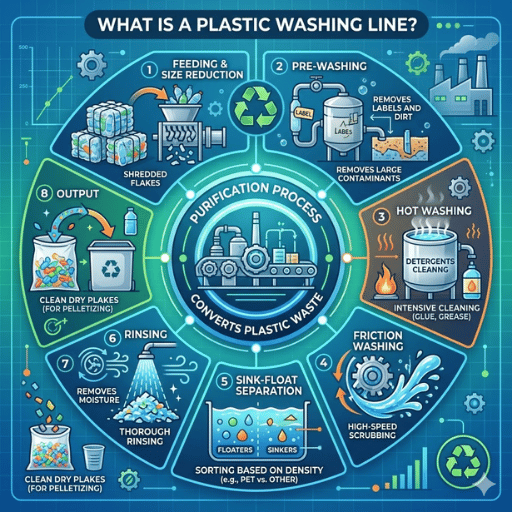
A plastic washing line is a collection of integrated equipment to clean contaminated plastic waste, i.e. a defined material stream of collected post-consumer and post-industrial waste, to produce relatively impurity-free flakes or chips that can then be pelletized and reformulated into new products. A typical process flow would be pre-washing, friction-washing, hot washing, density separation and drying.
The term “plastic recycling washing line” covers a range of equipment configurations designed to process differing material streams. A PET bottle washing line would have quite a different configuration from a PE film washing line, as would the complexities and end-point specifications of the two systems.
The marketplace for this equipment is well and rapidly expanding with the PET washing line segment alone predicted to increase from $1.2bn to $2.1bn by 2033 due to increasing demand for food-grade rPET and EU and North American bottle-to-bottle reclaim targets.
Plastics Recyclers Europe has stated that extracting increased yield from HDPE and polypropylene recycling with a correctly engineered washing system can be as high as 30% compared to manual sorting without a washing system, while the European Environment Agency confirms that plastic recycling is responsible for a reduction in CO emissions in Europe of circa 250 million tons per annum – a level heavily dependent on clean output from the washing stage.
“The washing stage is the most overlooked bottleneck in the recycling process chain. Without it the most efficient pelletizer produces a contaminated material which no-one will buy.”
— Industry recycling engineer
Whether investing in a newly built recycling plant or retrofitting an existing in-situ washing operation, grasping the concepts listed below will be the foundation for selecting the most appropriate configuration.
Key Take-away: your washing line is not a peripheral item and standing alongside the pelletizer, it is a integral process stage upon which your saleable output ultimately depends.
How Does a Plastic Washing Line Work?
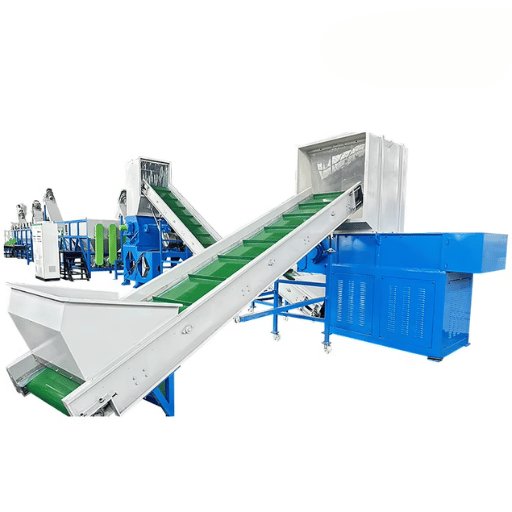
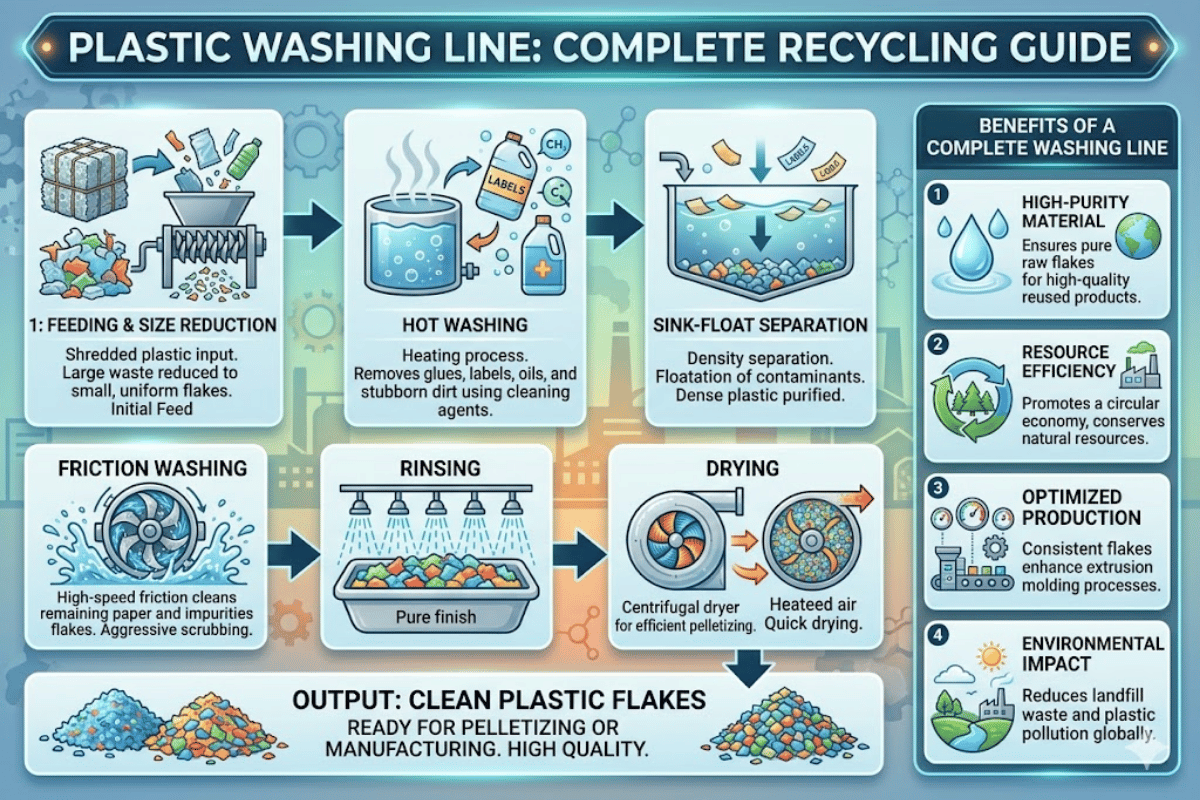
A typical plastic washing line utilizes a staged sequence of contamination removal stages. Each of these removes specific contaminants with the subsequent stages built upon the removal efficiency of those before it. Starting with the most obvious four stages below, the average system design incorporates the following:
-
- Bale Breaking / Feeding – Compressed deposits of plastic waste are opened and fed onto conveyor belts at controlled rates. Even, steady feeding prevents jamming while ensuring a uniform flow through each subsequent processing step.
- Size Reduction (Shredding/Crushing) -An industrial grade Granulator or Shredder reduces the material into 10 50 mm flakes. Pinpoint-sized lumps maximize surface area for additional washing stages.
- Pre-Washing – A rotating Trommel or Drum removes loose dirt, sand, stones and small metal objects using spray jet nozzles and molecular tumbling.
-
- Friction washing -High RPM blades (800 1,200 rpm) creates a powerful mechanical character that scours Away surface dirt, labels, sticker glue residue.
- Hot Wash – For food-grade PET streams and heavily soiled post-industrial scrap, the flakes are immersed in water heated to 85 95 C and 1-2% solution of NaOH for 15 30 minutes to chemically strip sticky residues and proteins that cannot be removed by standard cold washing.
- Density separation ( sink-float tank) – A water bin causes plastic flakes to separate out from film or PP caps and labels that tend to float, enabling effective separation without any optical sorting process.
- Rinsing and Dewatering – Any remaining dirt or filming from the clean flakes is rinsed away with water, then the flakes are dried out with a centrifugal dewatering system.
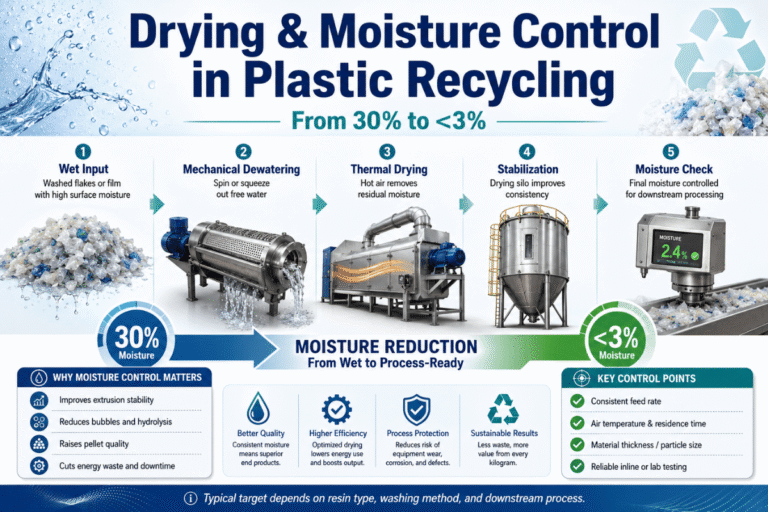
- Drying – The cleanstream is dehydrated with an initial centrifugal dewatering system followed by a giant multi-speed air loop at about 120 160 C to ensure final moisture levels are below specification limits (1% for PET, 5% for film).
How Does Friction Washing Remove Contaminants from Plastic?
Friction washer works in tandem using just the abrasion principle rather than dissolved chemical principle. A rotating shaft with steel paddles (800 1,200 rpm) sits inside a screen-drum and collides with the plastic flake, the paddles and the wall in a constant wash of spray water. This causes a triple-action and vigorous cleaning that removes paper labels, oil residues and thin adhesives, as required, without the use of any heat sources or chemicals. The perforated screen allows water and spent particles away while it retains the clean flakes. For post-industrial, relatively free of dirt or oil contamination, friction washing alone may get the job done.
📐 Engineering Note
Speed of the blades at the friction washer is around 800 1,200 RPM. Hot wash tanks for food-grade PET operate at 85 95 C with 1-2% NaOH and are internally FDA NOL and EFSA approved for use with all contact recycled PET.
💡 The 3-Stage Contamination Rule
Match your washing intensity to feedstock contamination level:
- Stage 1 ( Light contamination Cold friction wash): Industrial clean scrap, factory offcuts, manufacturing rejects
- Stage 2 ( Moderate contamination Cold + Hot wash): Post-consumer bottles and other household plastics
- Stage 3 ( Heavy contamination Pre-wash + Hot + Chemical): Ocean-recovered waste, heavily soiled woven plastic bags, agricultural film
Key Point: There exists only one washing logic – crush the material, wash it in multiple steps, separate by density, dry off and ship out. A basic washing system has few stages/processes and a formula, while a food-grade system contains them all at appropriate intensities.
Types of Plastic Washing Lines by Material
Different plastic washing lines are configured differently. The type of material you wish to process impacts washing setup, processing speed and investment. They are four basic types of washing lines as follows:
| Type | Material | Throughput | Key Process | Output Quality | Investment |
|---|---|---|---|---|---|
| PET Bottle | Post-consumer PET bottles | 500–5,000 kg/hr | Hot wash + label removal + sink-float | Moisture ≤1%, FDA/EFSA eligible | $150K–$500K+ |
| PE/PP Film | Agricultural film, bags | 300–2,000 kg/hr | Friction wash + squeeze drying | Moisture ≤5% | $80K–$250K |
| Rigid HDPE/PP | Barrels, crates, containers | 500–3,000 kg/hr | Friction wash + hot wash + density separation | Moisture ≤3% | $100K–$300K |
| PP Woven Bag | Cement bags, fertilizer bags | 300–1,500 kg/hr | Heavy pre-wash + friction wash | Moisture ≤5% | $60K–$200K |
PET Bottle Washing Line
The most critical configuration is the PET bottle washing line. PET bottle recycling for food grade uses requires almost no contamination. Hot washing at 85-95C with caustic soda is necessary to dissolve glues and sterilize the flakes.
Label removal (dry or wet) systems removes paper and plastic sleeve labels before they are introduced to the wash water. A sinkfloat tank separates PE/PP caps and rings from PET flakes by density difference. The output—clean, dry PET flakes (moisture below 1%)—can be sold as food grade rPET or directly fed to a plastic pelletizer into bottle to bottle recycling.
PE/PP Film Washing Line
For film washing the difference in density between PE and PP is not so important because the films are very light and tend to tull more, also the burden of soil and sand is very high (especially for agri film). A PE film washing line uses the first pre-washing step to loosen the soil followed by a friction washing step where the residue of the soil is removed. The main difference with film washing is in the drying process, the film retain a lot more moisture than flakes therefore it needs a pressures drier, which works as a mechanical press, before a thermal dry.
Rigid Plastic (HDPE/PP) Washing Line
Whether it be rigid HDPE and polypropylene drums, containers, crates, other packaging, or automotive parts, there are usually residues of oil contamination, traces of chemicals, along with relatively heavy paper labels. All of these can be treated efficiently in a HDPE/PP (associated polymers) rigid washing line which utilises friction washing combined with hot washing and density separation. Optical sorting equipment can be added upstream to remove PVC (and other non-PP/HDPE target polymers) which would otherwise compromise the finished quality of the recycled material.
PP Woven Bag Washing Line
Woven polypropylene cement, fertilizer and grain bags have some of the highest loads of contamination of any woven polypropylene bags – powder residue in the weave, soil ground into the seams, and glue from printed labels. A polypropylene woven bag washing system would use a pre-washing step with large volumes of water and a high water to bag ratio, followed by several steps of friction washing.
What Is the Difference Between a PET Bottle Washing Line and a Film Washing Line?
There are three basic differences that distinguish a PET handling system from a film line. Firstly, PET lines need hot (85095C) washing with NaOH in order to produce a food grade product, whereas film lines usually rely on cold friction washing as film is conventionally not recycled into food contact products. Secondly, PET lines employ sink-float tanks to separate caps and labels by density, there is no such requirement in a single-polymer film feed stream.
Thirdly, film lines are hugely dependant on squeeze-drying mechanisms to extract dissolved water between the thin film layers whereas PET flakes readily throw off the water in a standard centrifuge. These differences make dedicated lines a very cost effective option if using both film and PET feed streams.
✔ Real-World Example
A mid-size recycler in Ho Chi Minh City produces 40 tons/day of post-consumer PET bottles. Since installing a hot wash line running at 90 C with 1.5% NaOH instead of just a cold wash line, their flake purity has increased from 92% to 99.3%, which means they can begin to sell their rPET to food-grade customers at roughly double the price of fiber-grade flakes. The upgrade cost $85,000 and repaid itself in 14 months.
Main Point to Note: Similarly, selecting the right kind of washing line according to your main feedstock contributed to a lower cost of operation as well as quality output than universal washing lines.
Unsure of your configuration for your material?
Find out with our free plastic Recycling Line Selector.
Key Components and Equipment
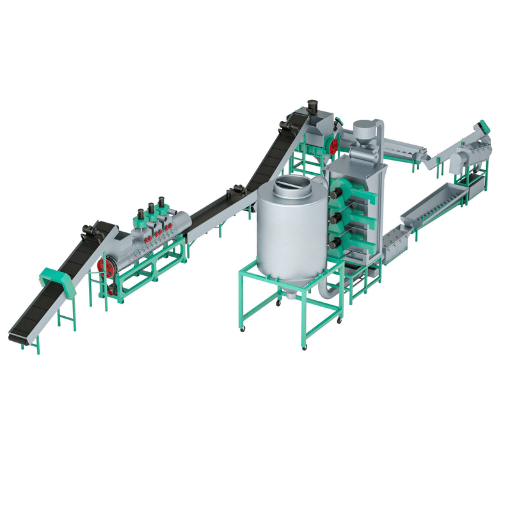
All plastic washing line is made using modular units that can be set up for various materials and through-put. Some of the main machines used in these lines include:
- Shredder / Granulator – Converts baled or loose plastic into consistent 10-50 mm flakes. Single shaft shredders are used for large rigid items, whereas granulators provide a more uniform and fine output for film and bottles.
- Pre-Wash Drum (Trommel) – Rotating screen with holes that constantly rolls the material over it and knocks off the soil, sand and stones through the jets beneath before the mainwash stages.
- Friction Washer – The contamination remvoing champ! Heated, high speed paddles ( 800-1,200 RPM) agitate screens to scrub flakes and then ouse the water to wash away loosened contaminants.
- Hot Wash Tank – A heated vessel at 85-95 o C with chemical dosing (NaOH, Detergent) and agitation to dissolve adhesives, oils and other organic residue. A necessary process for food grade PET to be produced.
- Sink-float separation tank—separates polymers based on water density. PET sinks, all others (PE, PP, PVC) float. Eliminate need for chemicals and energy intensive sorting processes.
- Centrifugal Dryer—high speed spins wet flakes and forcibly removes surface moisture through centrifugal action. First stage drying for all material types.
- Dewatering / Squeeze Press: – utilise a mechanical means of pressing water from film and fiber material that require moisture to be removed from between layers of material. This is essential for PE/PP film lines.
- Thermal Dryer — Hot air (120–160°C) reduces residual moisture to target levels. Final drying stage before storage or pelletizing.
- Optional: Laser/Optical Sorter — Near-infrared (NIR) optical sorting removes non-target polymers and colored contaminants. Adds $30,000–$80,000 but dramatically improves output purity for mixed-stream feedstock.
📐 Engineering Note
Friction washer blades are typically manufactured from hardened tool steel (HRC 55–60) or stainless steel for corrosive environments. Screen hole sizes range from 2–8 mm depending on target flake size. Smaller holes produce cleaner output but reduce throughput by 10–15%. Replace screens when hole wear exceeds 20% of original diameter.
⚠️ Common Mistake
Skipping the pre-wash stage to save cost may seem logical, but field experience shows it increases downstream contamination by up to 40%, forcing additional washing cycles and reducing overall throughput. The pre-wash drum costs 5–8% of total system investment but prevents 30–40% of downstream contamination issues.
💡 Key Takeaway: A washing line is only as strong as its weakest component. Each machine handles a specific contamination type — remove one stage and the entire output quality drops.
How to Choose the Right Plastic Washing Line
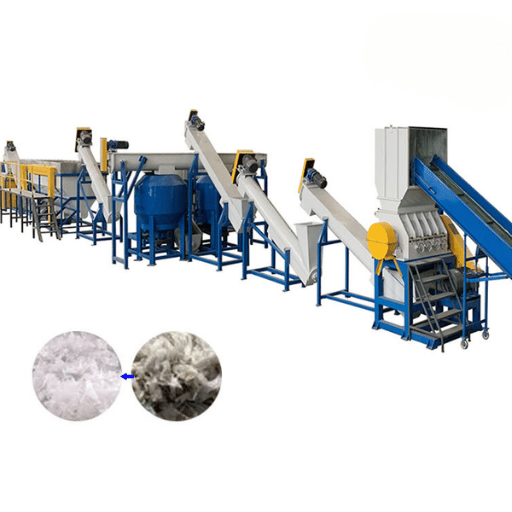
Choosing a washing line configuration that is right for you hinges on five factors (and getting any one of them wrong is an expensive mistake that produces substandard output). Follow our 5-Factor Selection Framework:
Factor 1: Material type. PET, PE/PP film, Rigid HDPE and woven bags all differentiate process stations. PET requires hot wash and sink-float separation; film requires squeeze-drying. Running film material through a PET washing line is energy intensive and results in poor output.
Factor 2: Contamination level. The contamination present in feedstock should inform washing demand according to the 3-Stage Contamination Rule introduced above. Light contamination (post-industrial) can be handled using a cold, friction-only process. Heavy contamination (field- or ocean-recovered) requires pre-wash, hot wash and chemical treatment.
Factor 3: Target capacity. Washing system speed varies enormously by intended throughput. Small systems run at 300 Kg/hr; factory processing lines clock in at 5000 Kg/hr. Size of the washing line influences footprint, power draw, water use, and capital outlay.
Factor 4: Budget. Basic cold-wash, postindustrial systems start at $50,000- $80,000 for 300 kg/hr. Mid-range hot washes with density separation and disc dryers run $120,000-$250,000 for 1,000 kg/hr. Automated, on-line washing lines with optical sorters and water treatment hit $300,000tainb+ and require an outsized budget. Power usage across those examples of 50-80 kWh/ton is fairly consistent.
Factor 5: End product quality. Fiber-grade flakes (intended for textil, paper straw etc.) can tolerate more residual contamination and moisture. Food grade rPET will require a hot wash, EFSA and FDA compliance, and a moisture content less than 1%. For use in a car engine or refrigerator, in-between quality is appropriate. The specificity of the final fiber grade determines the number of processes and amount of capital required.
| If Your Material Is… | And Contamination Is… | Recommended Config | Budget Range |
|---|---|---|---|
| Post-consumer PET bottles | Medium-Heavy | Hot wash + friction wash + sink-float + optical sort | $150K–$500K+ |
| PE/PP agricultural film | Heavy | Pre-wash + friction wash + squeeze dryer | $80K–$250K |
| HDPE bottles/containers | Medium | Friction wash + hot wash + density separation | $100K–$300K |
| PP woven bags | Heavy | Heavy pre-wash + friction wash + hot wash | $60K–$200K |
How Much Does a Plastic Washing Line Cost?
Cost structure now broken into tiers. Entry level cold-wash, post-industrial configurations (300 kg/hr, friction washing only, no hot wash) start at $50,000- $80,000 – adequate if your source material is entirely clean scrap. Mid-range configurations (1,000 kg/hr hot-wash and density separation) run $120,000-$250,000, for most post-consumer scale operations. Large automated lines (2,000+ kg/hr, automated, on line with optical sorting and waste water treatment) reaches $300,000-Tandukeg+. Factors that influence cost include hot-wash option, automation and quality level, and whether separate waste water treatment is incorporated.
⚠️ Common Mistake
Commercial washing line configuration selected for needs one and two levels higher than current feedstock availability results in 25-35% unavoidable over spend on a scale that will remain under-utilized for years. Size a system to current access volume and plan modular expansion to increase capacity.
✔ Real-World Example
A Kenya-based recycler considered a $200,000 1,000 kg/hr based HDPE washing line unable to process more than 400 kg/hr on local feedstock and down sized to a Taseke 500 kg/hr system. As a consequence of planning for today’s input rather than tomorrow’s anticipated access the entrepreneur was able to invest in a water treatment system and working capital and achieve profitability in 11 months rather than 24.
If starting a new recycling facility, the full 7.5 step investment decision making process in our guide to opening your own plastic recycling plant is a good place to begin.
Key takeaway: Size the washing line to your confirmed input volume today. Modular capacity expansion later is a smarter, cheaper, option than underutilized equipment today.
Utilising your system capabilities? Use our Capacity Calculator to evaluate your system’s processing efficiency:
Installation, Commissioning, and Maintenance
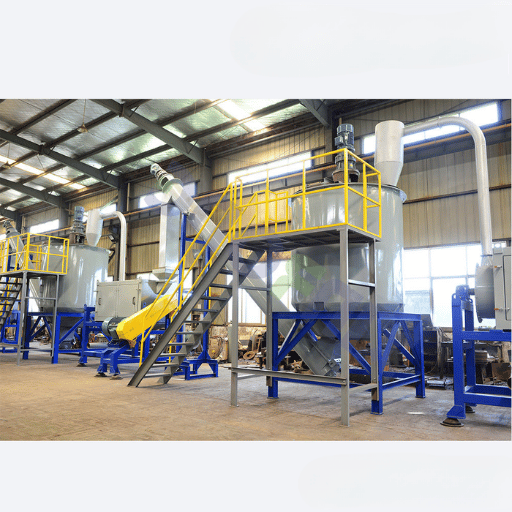
Installation of a plastic washing line isn’t simply a matter of unloading equipment and snaking pipework. Correct initial site work-up, commissioning and operational maintenance can mean the difference between a system operating at its rated capacity or an costly bottleneck.
Installation Timeline (4–8 Weeks)
- 2.1 Activation・Preparation of the foundation for the 1st and 2nd weeks. Electrical system connection・Water supply & drainage system connection
- Week 2-4: Arranged the equipment, built mechanical assembly, aligned conveyor, connect pipes and valves.
- Week 4-5: Electrical wiring, PLC programming, control panel assembly and sensors calibration
- Week 5-6 – Commissioning of the water system and leak test, premix and detail dosing calibration.
- Week 6-8: Several test runs with real feedstock, throughput, optimization and operator training
Preventive Maintenance Schedule
| Component | Inspection | Replacement |
|---|---|---|
| Friction washer blades | Weekly visual check | Every 2,000–3,000 operating hours |
| Screens / perforated plates | Monthly wear measurement | When hole wear exceeds 20% |
| Bearings (all stages) | Quarterly vibration analysis | Per manufacturer spec or on failure |
| Conveyor belts | Monthly tension and alignment | Every 8,000–12,000 hours |
| Water treatment filters | Weekly pressure differential | When flow rate drops 25%+ |
⚠️ Important
Water treatment is the cost most often ignored in washing line projects. If a closed water recycling loop is not implemented, then the operating costs and government emission fees can surpass the leasing fees of the equipment. Budget another $20,000-$80,000 for water treatment.
⚠️ Cautionary Example
A film recycler in Izmir operated his friction washer blades 4,500hours beyond their suggested service interval. When the blades failed it resulted in a shaft bearing failure that shut down the production line for 12days. The cost: $8,200 in parts, $15,000 in lost production, and three rejected pellet cargoes.
The blade set would have cost$1,200..
💡 Pro Tip
Every dollar spent on preventive maintenance will save $3-$5 in emergency repairs, lost production, and scrap. Maintain an extra set of blades on-site at all times, a $1,200 inventory item will keep $20,000+ dollars in Downtime.
Frequently Asked Questions

Q: What is the typical throughput of a plastic washing line?
View Answer
Throughput depends on material type and system configuration. PET bottle lines range from 500 to 5,000 kg/hr. PE/PP film lines handle 300 to 2,000 kg/hr. Rigid HDPE/PP systems process 500 to 3,000 kg/hr, and PP woven bag lines manage 300 to 1,500 kg/hr. Actual throughput also depends on feedstock contamination level and moisture content.
Q: How much water does a washing line consume per ton?
View Answer
A washing line with closed-loop water recirculation consumes 3–8 m³ per ton of plastic processed. Without recirculation, consumption can reach 15–25 m³/ton. Investing in a water treatment and recirculation system reduces both water costs and regulatory exposure.
Q: Can one washing line process multiple plastic types?
View Answer
Technically yes — some operators switch between material types by adjusting water temperature, blade speed, and screen sizes. However, dedicated lines consistently outperform multi-material configurations. Switching between PET bottles and PE film, for example, requires different drying equipment and wash temperatures. Most experienced recyclers run dedicated lines for each primary material and accept the higher capital cost in exchange for better output quality and fewer changeover delays.
Q: What is the difference between cold wash and hot wash?
View Answer
Cold washing uses ambient-temperature water with mechanical agitation to remove surface dirt, loose labels, and light contaminants. Hot washing heats water to 85–95°C and adds 1–2% NaOH (caustic soda) to dissolve adhesives, oils, food residues, and organic contamination that cold water cannot break down. Hot washing is required for food-grade PET recycling and for any feedstock with adhesive or chemical contamination. It adds $30,000–$60,000 to system cost plus ongoing energy and chemical expenses.
Q: How long does full installation take?
View Answer
A complete installation typically takes 4–8 weeks from equipment arrival to first production run. This includes foundation work, mechanical assembly, electrical wiring, water system commissioning, and operator training with test feedstock.
Q: Does a plastic washing line require water treatment equipment?
View Answer
Yes. Wash water picks up contaminants including microplastics, detergent residues, oils, and suspended solids. Most jurisdictions require wastewater treatment before discharge. A closed-loop recirculation system is strongly recommended — it reduces freshwater consumption by 70–85% and eliminates most discharge compliance issues. Budget $20,000–$80,000 for water treatment depending on system capacity and local regulations.
Find the Right Plastic Washing Line for Your Operation
Specify the type of material, maximum capacity, and budget you desire-our engineers will supply you with a configuration for the system within 24hours.
About This Guide
Kitech produces plastic washing systems in six different material-optimized variations; from PET bottle to agricultural film. This primer relies on publicly available industry information from the OECD, EEA and ISO standards along with technical information confirmed by over 500 machines at 80+ plants worldwide. Failing to confirm any data source independently, we have qualified rather than quoted specific data.
References & Sources
- Global Plastics Outlook — Organisation for Economic Co-operation and Development (OECD)
- Plastics Recycling Key to Reducing Carbon Footprint (2023) — European Environment Agency (EEA)
- Plastics Recyclers Europe Annual Report (2023) — Plastics Recyclers Europe (PRE)
- ISO 15270:2008 — Plastics: Guidelines for Recovery and Recycling — International Organization for Standardization
- Plastic’s Hidden Price Tag — Duke University Nicholas Institute
- Challenges of Plastic Recycling Wastewater — Water Online
Related Articles
- PE Film Washing Line Buyer Guide — Capacity, cost, and configuration comparison
- HDPE Recycling Line: Complete Guide — From collection to pelletizing
- Plastic Recycling Machine: Types, Selection & Cost — Equipment overview for new recyclers
- How a PE Film Washing Line Works — Process flow and technical details
- Energy Efficiency in Plastic Recycling Lines — Reducing kWh/ton and operating costs
Reviewed by the Kitech engineering team. Technical parameters validated across 500+ installations worldwide.