Get in touch with Kitech Company

Float-Sink Separation in Plastic Recycling: How Density Sorting Cleans PET & PE

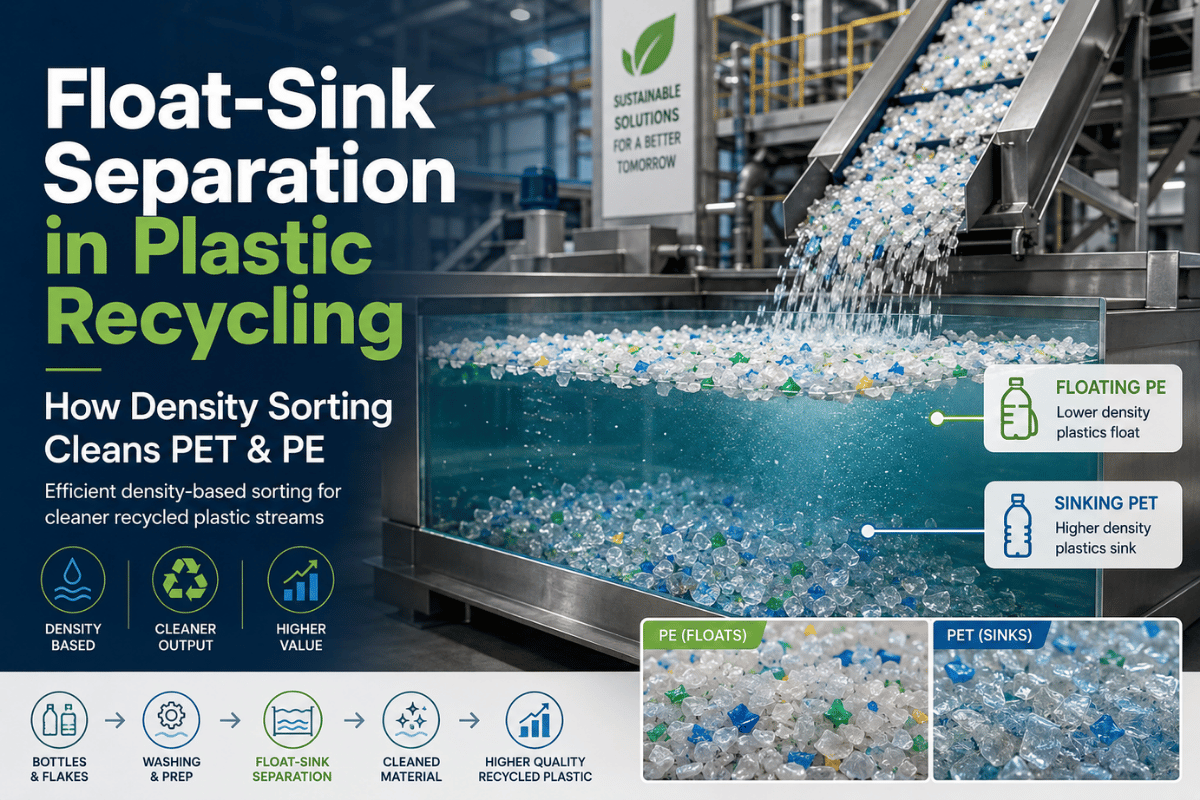
In any plastic recycling washing line, only one metric determines the market value of your output flakes: whether or not the target polymer floats in the liquid phase. Float-sink separation-or sink-float separation, also sometimes known as density-based sorting-is the most widely implemented mechanical separation step in the world today within the context of plastic recycling.
Quick Specs — Float-Sink Separation
| Separation principle | Specific gravity differential in liquid medium |
| Float fraction | PE (0.91–0.97 g/cm³), PP (0.89–0.91 g/cm³) |
| Sink fraction | PET (1.33–1.45), PVC (1.38–1.65), PS (1.04–1.06) |
| Standard medium | Water (1.00 g/cm³ at 23°C per ASTM D792) |
| Dense-media option | CaCl₂ / NaCl brine (1.05–1.35 g/cm³) |
| Industrial throughput range | 250–10,000+ kg/h |
| Typical residence time | 2–5 minutes (30 min for multi-stage PP/PET trials) |
| Fiber-grade PET target | PVC < 40 mg/kg |
| Density standard | ISO 1183 / ASTM D792 |
The Science Behind Float-Sink Separation — Archimedes’ Principle Applied to Polymer Sorting
What Is Float-Sink Separation in Plastic Recycling?
The Float-Sink Process Float-sink separation is the foundational wet method for plastic separation based on density — shredded plastic flakes are placed into a water-filled tank where polymers sort according to their specific gravity. It is the most widely deployed wet density separation technique for separation of plastics in post-consumer solid waste streams — raising the recycling rate of post-consumer packaging by enabling material to be diverted from being landfilled or sent to incineration. Materials with specific gravities less than 1.0 g/cm³ -chiefly PP and PE-will float to the surface while those materials with specific gravities above 1.0 g/cm³ -commonly PET, PVC, PS, and ABS in standard applications-will sink to the bottom where they may be removed using screw conveyors or other physical separation mechanisms such as paddle wheels.
As per Archimedes’ principle, each body submerged in a liquid experiences a buoyant force which is equal to the weight of the liquid displaced. Thus, when an object’s density is less than the medium density, the buoyant force is great enough to overcome gravity and carry the object upward whereas when an object’s density is greater than that of the medium, it will sink. Since water at 23°C has an average density of roughly 0.9975 g/cm³, (based on ASTM D792 standard), it naturally serves as the dividing line between polyolefin (floaters) and other, denser plastic types in most of industrial applications.
The physics of plastic densities can be precisely understood by means of density-measurement procedures such as the immersion method, known as ISO 1183 (Hungarian standards), or the displacement method ASTM D792, which uses water to make measurements. Each of the two standards define plastic density based on measurement at 23°C, which matches that of actual operating temperature in the float sink tanks that ensure the stability of separation.
ISO 1183 reference on the Radwag’s website states that, directly from the Archimedes law, calculation of plastic density after weighing a sample both in the air and dipped into distilled water gives difference caused by buoyant forces.
One weakness has to be highlighted before you consider the implications for the process: the technique separates plastics by density only, not colour, molecular weight, grade or additive content. It mainly affects items at density borders. In a study from the Delft University of Technology (Hu, Fraunholz & Rem, 2010), it was observed that 2 mm of air at the edges of a 200 mm PET flake represents a 10 kg/m error on average density – sufficient to transfer 2-5% of the PET input to the float fraction.
So a Pre-Wetting of the surface is essential for a working plant.
Polyolefin fractions – PP, LDPE, HDPE The Polyolefin densities are 0.89 g/cm – 0.97 g/cm, they always sink float very reliably in normal water. The sink-float method to recover polyolefins from post consumer packaging has also been proven in a research paper (Bauer et al., Montanuniversitaet Leoben, 2018): the used sample waste streams contained always more than 90 wt% polyolefins in the recovered lightweight fraction. If density alone can’t remove all materials because densities match (like PP & LDPE or with border-lines like PS density at 1.04-1.06 g/cm), then another liquid medium or secondary step must follow as shown further below.
Polymer Density Reference Table — Which Plastics Float, Which Sink (and When You Need Brine)
Use the table to compare ISO 1183 density with ASTM D792 density of twelve primary polymers by their behavior in pure water and 1.10 g/cm CaCl solution. The density differences between polymer groups determine whether plain water, brine, or a secondary stage is required. Sorting plastics based on density starts with knowing the exact specific gravity of every polymer in your input stream — this table serves as a working guide for judging new feedstocks or designing your sorting media. Kitech’s plastic material comparison tool provides an interactive calculator to compare separation feasibility for your specific input stream.
| Polymer | Density (g/cm³) ISO 1183 / ASTM D792 |
Behavior in Water | Behavior in Brine (1.10 g/cm³) | Notes |
|---|---|---|---|---|
| PP (homopolymer) | 0.90–0.91 | Floats | Floats | Copolymer 0.89–0.91 |
| LDPE | 0.91–0.94 | Floats | Floats | Film grades overlap with PP at 0.91 |
| HDPE | 0.94–0.97 | Floats | Floats | Pipe grade at upper bound (0.96–0.97) |
| PS (crystal) | 1.04–1.05 | ⚠ Borderline sink | Floats | Air bubbles can cause PS to float without pre-wetting |
| ABS (standard) | 1.04–1.06 | ⚠ Borderline sink | Floats | FR grades reach 1.18–1.22; needs brine for WEEE |
| HIPS | 1.03–1.06 | ⚠ Borderline sink | Floats | Common in WEEE housings |
| PA6 (Nylon 6) | 1.12–1.14 | Sinks | Sinks | GF-reinforced grades up to 1.23 |
| PA66 (Nylon 66) | 1.13–1.15 | Sinks | Sinks | FR-modified grades up to 1.19 |
| PMMA (Acrylic) | 1.17–1.20 | Sinks | Sinks | Impact-modified grades may drop to 1.10 |
| PC (Polycarbonate) | 1.19–1.22 | Sinks | Sinks | 30% GF grade: 1.40–1.43 |
| PET (bottle-grade) | 1.33–1.45 | Sinks | Sinks | Post-consumer recycled PET may drop to 1.33–1.37 |
| PVC (rigid, PVC-U) | 1.38–1.41 | Sinks | Sinks | Plasticized PVC: 1.30–1.70 (variable by plasticizer %) |
– water to plastic >0.05 g/cm³; pure water not good for separations, unless pre-wetted. Source: ISO 1183; ASTM D792; Radwag metrology PDF, PMC8724085 (Meneses Quelal et al. 2022).
Engineering Note — The Brine Decision Rule
But as for most polymers, with density differences of less than 0.05g/cm between your polymer of interest, using simple water for industrial-level sorting of plastics does not perform well. Some Polymers in this narrow density gap: ABS (1.04 – 1.06) PS (1.04 – 1.05) HIPS (1.03 – 1.06) The use of a CaCl solution with density around 1.05 – 1.10g/cm raises the threshold, allowing these polymers to float over denser impurities (PET 1.33 and PVC 1.38). That’s how it commonly works on our WEEE (Waste Electronic and Electrical Equipment) sorting lines with ABS and PS contained within e-waste casings.
Also note that common NaCl brine is not soluble enough to reach the densities needed for some plastics to float (e.g. PVC, PA6). In order to reach high densities of separation for materials like PVC you will require a CaCl or similar solution or an even denser media such as silicones.
Sink-Float Tank and Sink Tank Configuration — Design, Sizing, and Throughput Parameters
What Is the Right Residence Time for Industrial Float-Sink Separation?
Standard industrial sink float tanks typically operate with 2-5 minutes Residence Time (RT) for Post-Consumer Rigid Plastics (i.e. PET, HDPE and PP closures), when the density difference to water is high (>0.1g/cm) and a wash process removes contamination from the flakes. For smaller density difference plastics (i.e.
PS, ABS, or blended plastic streams), residence time typically increases to 10–30 min. A 2025 TU Wien study (Lipp et al.) operated a flotation tank in plain water at 25°C to separate PP from PET label contamination at a 30-minute residence time, achieving a density cut above 1,000 kg/m³. A 3-minute residence time is the standard design target for most PET or HDPE cleaning lines — long enough for reliable separation, short enough to keep tank volume and capital cost reasonable.
Things that make it take longer: particle size under 10mm, too much contaminent attached (labels, food debris), lack of pre-wet, too slow water motion, below 15C, cool water (causes higher surface tension). There is an automatic throughput calculator on our website for you to properly calculate you needs for our separatory tank.
Engineering Note — Tank Volume Estimate
A conservative tank sizing formula:
V = (Q_mass ÷ ρ_bulk_wet) × t × 2.0
Where: Q_mass = throughput (kg/h); ρ_bulk_wet ≈ 0.30 kg/L (wet plastic flakes); t = residence time (hours); 2.0 = safety factor for headspace and water volume.
Example — 1,000 kg/h, 3 min residence time: V = (1,000 ÷ 0.30) × (3÷60) × 2.0 = 333 L × 0.05 × 2.0 = 33 L effective volume → tank gross size 0.35–0.5 m³ including water headspace (30–40% additional). A 2,000 kg/h line doubles to 0.70–1.0 m³ minimum.
The tank geometry is of the same importance as volume of the separation tank. The separation process within the tank depends on laminar — not turbulent — flow pattern, which keeps the float and sink fractions from re-mixing. Residence times are calculated to match this flow pattern for each feedstock type — the velocity field inside the tank must remain laminar across the full cross-section, including the zones where solid particles from contaminated label debris accumulate. Even with large density differences, turbulence reduces separation efficiency to near zero.
A well-designed sink float tank separates the incoming material stream at the water surface — lighter plastics rise, while heavy material (PET, PVC, glass flakes, sand) sinks to the bottom of the tank. Water enters from below and the floated fraction is extracted via weir or paddle-skimmer without disturbing the settled sink fraction below. Separate extraction of sink material is realized through bottom-valves driven by a screw or conveyor, resulting in the so-called “sink tank function” — sink material collected independently from the float separation. A separate sink tank-body with separate extraction screw serves to allow sink-material out without interfering with float-skimming.
Vendor Evaluation Checklist — Sink-Float Separation Tank Machinery
- Minimum tank body will be AISI 304, can be updated to AISI 316 for any service involving brine (NaCl or CaCl)
- Double-station bottom discharge valves with adjustable inverter-controlled paddle speed — single fixed-speed drives do not permit residence-time adjustment without tank evacuation
- Variable-speed screw or paddle drive on the exit conveyor so that residence time can be tuned on-the-fly as feed material changes, without emptying the tank
- Closed-loop water recirculation with makeup water flow rate of 2–3 m³/h per 1,000 kg/h plastic throughput — continuous replenishment maintains stable separation conditions
- Weir-type or paddle skimmer at the float-fraction outlet for continuous removal of the polyolefin fraction without batch interruption
- PLC-readable tank-level sensors and optional density monitoring sensor to auto-alarm for excursions from set-point densities.
- Easily accessible clean-out hatches and removable bottom-ports for solid particles, fines, and sludge discharge — reputable machinery manufacturers typically rate access interval at quarterly minimum servicing.
The one thing most manufacturers skip that has real impact is this: you MUST pre-wet the input to float-sink processing.
Studies by TU Delft have shown that the virgin-surface of plastic and especially the crevices and surfaces of structured geometries of film (folded, rolled or foam) all entrap small pockets of air that affect the material’s effective density so much that density itself will cause systematic mis-sorting. Either flow the material through water prior to filling the float-sink tank at a rate of 1 m/s, or use a pre-soaking stage with a friction washer. Skipping pre-wetting saves minutes but costs percentage points of recovery and purity.
Float-Sink Separation by Plastic Stream — PET Bottles, HDPE Containers, PP/PE Film, and WEEE
The separation effect will vary according to your plastic types and your input composition. This is a summary for common polymers with real-world data from Kitech commission logs and publications:
PET Plastic Bottle Recycling — Density Separation Performance
PET (specific gravity range of 1.33 – 1.45 g/cm³): Clear sinking in plain water, leaving behind PP and PE caps and labels. The huge range in specific gravities makes PET bottles the “reference application” for float-sink. PVC the material you’re usually concerned with is a major contaminant because its density often co-sinks with PET. (The PET bottle recycling guide has the whole procedure).
Case — Russia, Kitech RPW1000 PET Washing Line
Sample input: Post-consumer (PCR) mix-colored PET bottles with a high percentage of PCR PP or PE caps/lables. Post float-sink and hot-wash: Material has less than 40 mg/kg PVC and <1% moisture and can be taken up by any fibre spinner in a direct to fibre spinning mill application without needing further melt filtering for melt-spinning fiber.
HDPE Container Recycling
HDPE (specific gravity range of 0.94 – 0.97 g/cm³): Clearly floats in plain water, separating from all other materials. Paper labels, glass pieces, any remaining PVC (sinks in plain water) and any trace amounts of the lighter PP or PE that coexist in PCR streams.
Float sink alone usually produces at minimum 97%+ HDPE with only the co-floating trace amounts of PP or PE. That means the final fraction is blow mold and pipe grade regranulation ready.
Case — Saudi Arabia, Kitech RPW2000 HDPE Washing Line
Sample input: PCR HDPE food-contact containers like oil and detergent bottles. Post float-sink only output produced on the first commission with the equipment 97%+ HDPE in a dry, balanced composition. Customer sell these bales directly to blow molding compounders, to whom they’re a valuable premium product due to consistency of color even within PCR materials, commanding prices well above the market value of commodity scrap bales.
Output was being loaded for delivery within 22 days. Line capacity 1,600 kg/h.
PP/PE Film Recycling
Mixed Polypropylene (PP) and Polyethylene (PE) films: this is the absolute hardest case to float-sink. In plain water, PE or PP both float — the density overlap between them is so narrow that standard tanks cannot distinguish the two. The overlapping densities in the range from 0.89 – 0.95 g/cm³ means a tank using pure water simply can’t differentiate between PP and PE.
In fact, papers from TU Wien and the University of Córdoba demonstrate that with an excellent separation accuracy of 10 kg/m, the recovered PP fraction of a mixed PP/LDPE stream is only about 87%, with the remainder found in the incorrect density fraction because it’s within the density band. [72] Sorting PP from PE in a float sink tank requires chemical additives – e.g. use of an alcohol/water mixture – and a more complex wastewater treatment and chemical management system to create an elevated density of 0.93 – 0.96 g/cm³. Due to added complexity, mixed plastic films are normally routed to NIR optical sorters.
WEEE Plastic Recycling — Waste Management Challenges and Brine Solutions
Can Sink-Float Tanks Process WEEE Plastics?
Sort of, but with huge issues. Plastics found in WEEE housings (ABS, HIPS, PC, PP, PE) tend to fall into density bands extremely close to one another (1.03 – 1.22 g/cm³). To effectively separate them, a water-only float-sink separation won’t work. A brine solution set between 1.05-1.10 g/cm³ however, can effectively separate floating ABS and PS plastics from the heavier plastics (e.g. PVC > 1.38 g/cm³, PA > 1.12 g/cm³) and dense contaminants that sink – achieving a useful primary sort. The problem is that plastics in WEEE housings often incorporate flame retardants and similar additives, which alter the perceived densities of these individual flakes unpredictably. A 2024 study reported in the journal Materials (Fiorente et al., Politecnico di Bari) could only recover 55.85% of PP from a mixed WEEE plastic stream into plain water (as compared with over 99% recovered for virgin PP, largely because the additives cause density to shift) while a combination of brine separation (using different concentrations, including up to 90% w/v cane molasses to offer an environmentally friendlier substitute for heavy inorganic salts) successfully separated most of the fractions.
Application Summary Matrix
| Plastic Stream | Density (g/cm³) | Separation in Water | Media Required | Typical Output |
|---|---|---|---|---|
| PET bottles | 1.33–1.45 | Sinks cleanly | Plain water | Fiber / food-grade rPET |
| HDPE containers | 0.94–0.97 | Floats cleanly | Plain water | Blow molding, pipe |
| PP/PE film mix | 0.89–0.95 | Both float — no separation | Ethanol 23–31% or NIR | Mixed polyolefin pellets |
| PVC (contaminant) | 1.38–1.65 | Sinks cleanly | Plain water | Removed to sink fraction |
| ABS/PS (WEEE) | 1.02–1.08 | Borderline — unreliable | CaCl₂ brine 1.05–1.10 | E-waste polymer fractions |
| PP (from PET line) | 0.89–0.91 | Floats — separated from PET | Plain water | PP caps fraction |
For a complete view of which recycling line configuration matches your feedstock, see Kitech’s plastic recycling solutions for each stream type. The sink float tank separates plastics based on density at every stage of the process — so correctly sizing and positioning this unit is where most recycling plant profitability decisions are made.
Float-Sink Separation vs NIR Optical Sorting vs Air Density Separation — When to Use Each
The 3 main plastic sorting technologies used in post-consumer recycling lines are NIR-based sensor-based sorting, air density separation, and float-sink separation. Each is a distinct separation technique suited to specific operating ranges — and the choice between them depends heavily on the density differences in your feedstock, the moisture state of the material, and the purity target you need to hit.
| Factor | Float-Sink (Density) | NIR Optical Sorting | Air Density Separation |
|---|---|---|---|
| Separation basis | Specific gravity | Polymer type (IR spectrum) | Mass-to-aerodynamic drag |
| Purity (mixed streams) | 60–75% (mixed); >90% (single polymer) | >95% for targeted fractions | 50–80% (size/shape dependent) |
| Energy use | ~24 kWh/ton (static bath) | ~$150–300/ton OPEX | Low (blower + classifier) |
| Works on wet flakes? | Yes — wet process | Needs dry flakes | Needs dry, freeflowing flakes |
| Black plastics | Works (density-based, color-blind) | Fails — carbon black blocks NIR | Works |
| Same-density polymers | Cannot separate (e.g. PP vs LDPE) | Can separate by polymer type | Cannot separate |
| Capital cost (medium scale) | Typically lower | $2–5M (medium-scale system) | Low–medium |
[Sources: MDPI journal, Processes 2026. DOI: 10.3390/pr14071144; PatSnap/EuREKA engineering report; Microplastics.today Comparative Table (2024-2025)]
Technology Decision Framework — Choosing Your Sort Method
| If your stream is… | Use… | Because… |
|---|---|---|
| Post-consumer PET bottles mixed with PP/PE caps | Float-sink (primary) | Large density gap handles bulk polymer separation; PP/PE caps float cleanly |
| Mixed polyolefin film (PE + PP, both <1.0 g/cm³) | NIR or feedstock pre-sort | Float-sink cannot separate PP from PE — both float |
| WEEE (ABS/PS/PC mixed with PE/PP) | Multi-stage float-sink + brine | Density separation proven at industrial scale for WEEE; brine adjusts cut-point |
| Black pigmented plastics (carbon black) | Float-sink or air density | NIR sensors blind to carbon black — density separation unaffected by color |
| Color or grade separation within one polymer type | NIR optical sorting | Float-sink cannot differentiate color or molecular weight within same polymer |
Common misunderstanding: NIR sorting isn’t an alternative to float-sink. It requires dry flakes, so is used as a pre or post sort within a dry recycling line – it is unable to process wet plastics in a wash-line process. Float-sink separation is integrated within the washing stage, accepting wet flakes as they move through the washing process line at full flow. The two techniques address different stages and complement each other on higher grade wash lines.
How Float-Sink Separation Fits into a Complete Plastic Washing Line
Float-sink isn’t employed in isolation — it’s the defining density-separation stage in mechanical recycling, and one of the most consequential steps in recycling systems for post-consumer plastic waste. Its performance is highly dependent on both the upstream stages that prepare the material and the downstream quality targets that the output must meet. Here is the typical sequence for rigid plastics washing lines with float-sink at Stage 5:
- Stage 1: FEEDING & PRE-SORTING – Magnetic drums (to remove metals), feed on belt conveyor, manual visual quality check.
- Stage 2: SIZE REDUCTION – shredding or crushing material to small, uniform flakes of approximately 15-30 mm, so each fragment behaves predictably in the separation tank.
- Stage 3: PRE-WASHING – A first rinse using cool water to dislodge loosely adhered surface contamination, which is then channeled off, thereby pre-treating material and reducing the burden on the following friction cleaning step.
- Stage 4: FRICTION WASHING – A mechanical agitation process in high-speed rotor scrubbers to remove surface-attached elements such as adhesive residues, paper labels, and various coatings. During this stage, air trapped on the surface of flakes is driven out, ready for entry into the separation tank. Friction washing doubles as a pre-wetting stage in addition to clearing surface contamination.
- STAGE 5: FLOAT-SINK SEPARATION – Material is fed into a tank filled with a dense solution where based on differing densities of shredded plastics;polyolefins float upwards and are carried off by an overflow conveyor, while dense contaminants, PET, and heavy plastics such as PVC, settle at the bottom of the tank and exit via a bottom screw conveyor.
- Stage 6 (optional): HOT WASHING – Materials are heated to between 80 to 95°C for the purpose of removing difficult adhesives and food soil, often integrated in to many lines ahead of, or incorporated in to the float sink stage if any adhesives may be present on the flakes.
- Dewatering: centrifugal dryer for filamentary flakes; squeeze press + thermal dryer for film fractions.
- Quality control, storage, and pelletizing: to the storage silo or directly to the downstream pelletizing line.
Insider Perspective — The Hot-Wash Cost Trap
Kitech commissioning engineers have seen this pattern before: operators cut steam by skipping hot washing, then sell their flakes with lower-than-advertised flake value. Hot washing leaves behind glues and other film residue that float through the float-sink tank; here the separation process does not remove the unified surface films from the flakes. Carryover then causes intrinsic viscosity (IV) degradation in the downstream extrusion, and it causes odor complaints from the market. The downstream value of the net flake loss is far greater than the steam saved. If food-grade or fiber-grade output is your goal: skipping hot-wash step is not an option.
The architecture of Kitech’s washing line — whether RPW series (PET / HDPE rigid), LDW series (PE / PP film), or WES series (WEEE – waste electrical and electronic equipment) — positions the float-sink separation tank as your key quality gate. Recycling plants in the plastics recycling industry use this stage to define the commercial grade of their output before downstream pelletizing. This position makes it effective to detect and separate feedstock contamination right at the final sizing and friction washing: to give you the cleanest stream possible before hot washing (in rigid series configurations) or to define whether one or two separation stages are required. Kitech’s plastic washing system configurator maps your architecture to follow this flow. For an explanation of the basic mechanical-conversion alternative for plastics, in contrast with the chemical alternative, see mechanical plastic recycling vs chemical alternatives.
Flake Purity After Float-Sink — Output Quality Standards and What Grade You Can Achieve
PVC concentration in your flake represents perhaps the most market-sensitive attribute in PET plastic scrap (expressed in mg/kg). For rigid plastics — PET and HDPE in particular — the separation process must consistently hit these purity thresholds to unlock the most valuable end markets. Fiber-grade applications require PVC levels below dedicated limits; bottle-to-bottle food-contact applications face the tightest constraints of all. Here is the supply/ demand chart for 2022, updated with critical EC and EFSA guidance for 2025 and beyond.
| Plastic / Grade | PVC Limit (mg/kg) | Moisture Target | Standard Reference |
|---|---|---|---|
| PET — Fiber spinning | < 40 mg/kg | < 1% | Industry practice; Kitech RPW1000 data |
| PET — Food-grade (bottle-to-bottle) | ≤ 20 mg/kg | < 1% | EFSA Journal 2025, 23(12):e9766 |
| PET — General packaging | < 100 mg/kg | < 1.35% | Industry practice |
| HDPE — Blow molding (non-food) | < 200 ppm mixed polymer | < 3% | Industry practice |
| HDPE — Pipe extrusion | < 100 ppm | < 3% | ISO 1133 melt flow requirements |
Engineering Note — Achieving Sub-40 mg/kg PVC
A single float-sink stage serves as the primary purification step — it can yield PVC < 40 mg/kg in finished PET when initial PVC contamination is already low and pre-washing is adequate. Bauer et al. (2018, Montanuniversitaet Leoben) demonstrated that a single float-sink stage for mixed scarp stream resulted in only 50-65 wt% polyolefins in light fractions – which leads to medium-density polyolefin clusters that invariably demand another stage for achieving optimal high-purity targets. Dual float-sink stages achieve the reduction of PVC by 40-60% versus a single float-sink stage. For sub-40-mg/kg PVC, conditions should include residence time of 4 minutes, dual-bottom discharge valves on station stations, and continuous-surface- skimming of the floated PE/PP. Sinked PS PET caps (density 1.04-1.06 g/cm3) account for second-most frequent PVC spec inconsistencies, sinks with PET, yet tests as PVC:.
Insider Perspective — Flake Pricing Logic
For Kitech’s process engineers, who’ve been designing top-tier washing lines for two decades, material pricing on flake sale depends on two factors: how wet the material is, and how much PVC it contains. 1.5% moisture flake will command a material premium to the equivalent material that’s 4% moisture on sale because less moisture equates to higher throughput in the extruder, and less rejected material at purchase. Realized value premium per tonne often is manifold times the value of an additional drying step. Feeding into that commercial logic, a separation tank reduces how much subsequent downstream equipment has to “correct” the density distribution.
To calculate the impact of separation performance on your line’s profitability, review our washing line ROI calculator tool.
The Future of Density-Based Sorting — EU Regulations, Advanced Media, and What’s Coming Next
Separation technologies – and the overall investment argument for float-sink in particular — is shifting due to three concurrent trends over the next three to five years: stringent regulatory timelines, replacement of brine with bio-based dense media, and the advent of AI-driven quality monitoring.
1. EU Packaging & Packaging Waste Regulation (PPWR 2025/40)
The PPWR 2025/40 — a key delivery mechanism of the EU Circular Economy Action Plan — mandates a dramatic increase in post-consumer recycled content. Article 7 (Regulation 2025/40, in force 11 February 2025, applicable from 12 August 2026) sets mandatory targets: 30% recycled content in single-use plastic beverage bottles by 2030, rising to 65% by 2040; 30% in other PET food-contact packaging by 2030, rising to 50% by 2040. From 2028, variable EPR fees modulated by recyclability grade will create direct financial pressure to produce higher-purity rPET. Demand for fiber-grade and food-grade rPET will increase substantially as these targets approach — and density-based separation infrastructure is the foundational prerequisite for processing plastic waste at the volumes and purity specifications required. Washing lines handling rigid plastics must be engineered for the separation process to hit sub-40 mg/kg PVC at full throughput. Recycling plants that rely on incineration or landfill as a fallback will face direct financial penalties via variable EPR fees from 2028. For CE-certified recycling equipment considerations relevant to EU-market compliance, see that linked guide.
2. Bio-Based and Green Dense Media
Wastewater issues and limitations on density with traditional saline (NaCl or CaCl) systems are addressed by two developments. At the Material Science forum in September 2024, researchers from Politecnico di Bari demonstrated what’s known as multi-stage float-sink separation for plastics contained within WEEE with various types of “green” dense media derived from bio-resources instead of mineral salts. They tested cane molasses as a bio-based dense medium at staged concentrations — 10%, 45%, 60%, and 90% w/v. Within stages, they recovered 100% PS or 100% PVC, and generated substantially less contaminated wastewater than traditional brine-based processes, all in the context of effective WEEE separation. Commercialisation is still in its infancy, but moving to closed-loop brine solutions utilizing lower-cost bio-media is the clear way forward for ABS, PC, and PS separation in WEEE streams.
3. AI-Enhanced Sorting and Monitoring
Optical sorters powered by artificial intelligence (AI) are proliferating on the dry end of recycling lines – AMP Robotics’ Cortex reaches 60 picks/min at 99% accuracy; its GAINnext solution delivers >95% purity on food grade PET/PP/HDPE by incorporating AI-driven grade classification on its existing NIR (near-infrared) detection. In the wet line, emerging interest centers around the use of AI on tanks to allow computer vision and density sensors to detect abnormalities in the separation process and automatically alter the rate of the paddle or water flow to make up for deviations. pilot plants are running on two European lines, and commercialization is planned for 2027.
The examination of different mechanical processing technologies (dry and wet), concluded that separators for wet float-sink separation are appropriate to PO recovery from the waste fractions, as they can handle products post-consumer plastic (post-consumer-plastic)”.
— Bauer M., Lehner M., Schwabl D. et al. (2018). Sink–float density separation of post-consumer plastics for feedstock recycling. Journal of Material Cycles and Waste Management, 20, 1781–1791. DOI: 10.1007/s10163-018-0748-z
To guide equipment selection for the PPWR timescale and European market, view the Kitech washing line configurations page and associate your capacity and energy and purity targets to particular line models.
Frequently Asked Questions — Float-Sink Separation in Plastic Recycling
About This Analysis
Prepared by Kitech’s engineering department with 25 years of plastic washing equipment design, 500+ washing systems commissioned in 80+ countries. The purity statistics for the PET fiber-grade and HDPE output values come from Kitech commissioning reports of systems deployed in Russia, Saudi Arabia and Mexico, no estimations or simulations are presented. Peer-reviewed materials referenced with DOI links.
The polymer density data in the polymer density table is referenced with ISO 1183 / ASTM D792 measurement reports.
Ready to Specify a Float-Sink Separation System?
Kitech engineers take a look at feedstock, product purity goals, and target throughput to provide optimal tank configurations. UL, CSA & CE certified. Throughput: 250-10,000 kg/hr
References & Sources
- Bauer, M., Lehner, M., Schwabl, D., Knaus, C. E., and Gepp, C. E.: Sink-float density separation of post-consumer plastics for feedstock recycling.Journal of Material Cycles and Waste Management, 20, 1781-1791, https://doi.org/10.1007/s10163-018-0748-z, 2018.
- Fiorente A., Petrella A., Todaro F., Notarnicola M. (2024). Recovery of Plastics from WEEE by Green Sink-Float Treatment. Materials, 17(12), 3041.PMC11205700
- Meneses Quelal M.V.,Manzo J. et al.2021. Sinking-Flotation Technique for Separation of Mixed Plastic Waste. Enviromental Science and Pollution Researc.PMC8724085
- EFSA CEP Panel (2025). Safety assessment of the process brtCOMBIPET (RECYC338). EFSA Journal, 23(12), e9766. DOI: 10.2903/j.efsa.2025.9766
- European Commission (2025). Regulation (EU) 2025/40 on Packaging and Packaging Waste (PPWR). Official Journal of the European Union. ec.europa.eu
- Hu B. Fraunholz, N. Rem P.C. (2010). Wetting technologies for improving the accuracy of sink-float separations. The Open Waste Management Journal, 3, 71–80.Bentham Open
- ISO 1183: Plastics – Procedures for the determination of the density of non-cellular plastics. International Organization for Standardization. iso.org
Related Articles
PET Recycling: Complete Process GuideFull end-to-end PET bottle washing & pelletizing
Mechanical vs Chemical Plastic RecyclingWhich process fits which material stream
Strand vs Water Ring vs Underwater PelletizerChoosing the right cutting technology
Kitech Plastic Washing SystemsSoft, rigid & WEEE lines — 250 to 10,000 kg/h
Mechanical vs Chemical Plastic RecyclingWhich process fits which material stream
Strand vs Water Ring vs Underwater PelletizerChoosing the right cutting technology
Kitech Plastic Washing SystemsSoft, rigid & WEEE lines — 250 to 10,000 kg/h