Get in touch with Kitech Company

Plastic Washing Line Cost Guide: Investment by Throughput & Stream

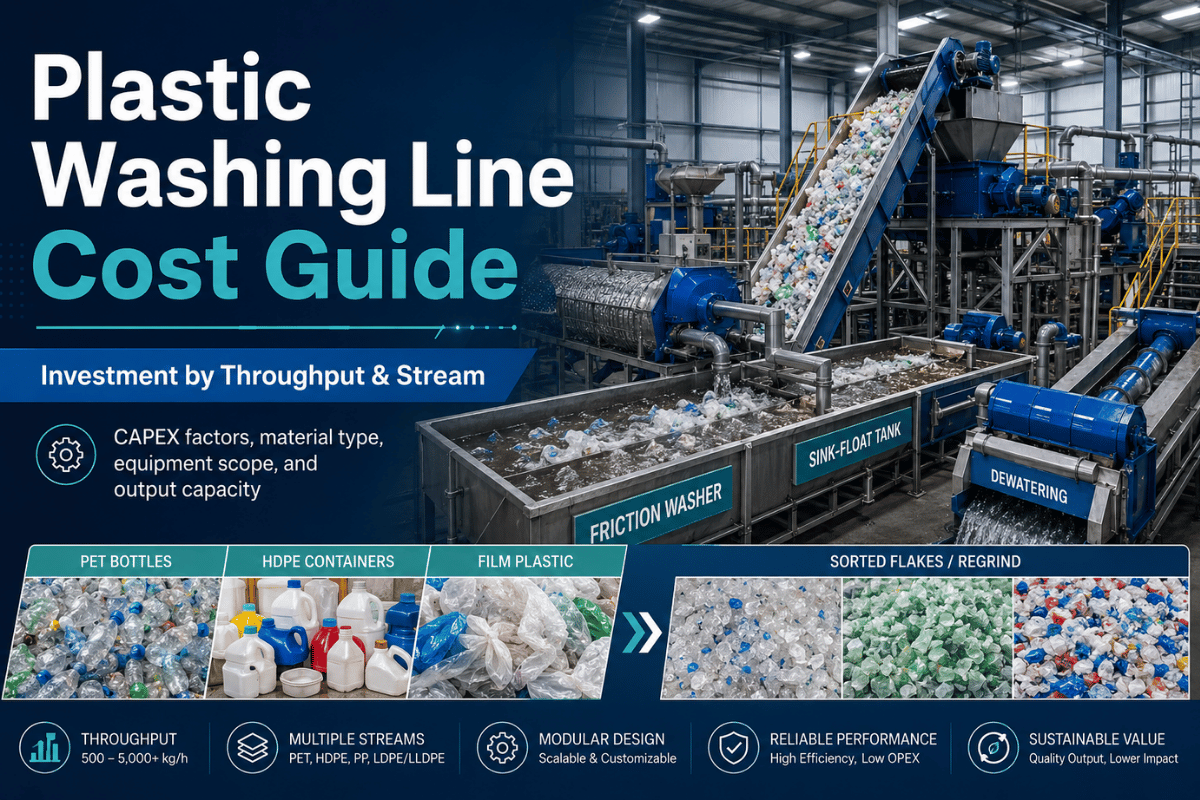
Comparing the price of a plastic washing line shows quotes from $30,000 to $500,000-plus — sometimes for equipment that appears similar. This guide breaks down that price range, clarifies the hidden costs most buyers miss, and provides realistic payback figures for 2026 based on cross-referenced supplier data, EU regulatory filings, and field data from over 500 recycling washing line installations across six continents.
Use the Quick Specs card below to orient your budget, then explore each factor to understand how your project fits into the range.
Quick Specs: Plastic Washing Line Cost at a Glance
| Line Type & Capacity | Machinery Price (FOB) | Estimated Full TCO |
|---|---|---|
| Cold wash line — 300 kg/h | $30,000–$60,000 | $45,000–$90,000 |
| Hot wash line — 1,000 kg/h | $120,000–$250,000 | $160,000–$320,000 |
| PET food-grade line — 1,000–3,000 kg/h | $150,000–$500,000+ | $200,000–$650,000+ |
| Film washing line — 500 kg/h | $120,000–$250,000 | $155,000–$310,000 |
| Rigid HDPE/PP line — 500 kg/h | $80,000–$200,000 | $110,000–$260,000 |
| Water treatment system (add-on) | $20,000–$80,000 | Included in TCO above |
| Installation & commissioning | 5–10% of machinery CapE× | Included in TCO above |
| Power consumption | 50–80 kWh/tonne (cold); 80–120 kWh/tonne (hot) | |
| Typical payback period | 12–36 months depending on throughput and rPET price | |
TCO = Machinery + Water Treatment + Installation + First Year Wear Parts. Source: Cross-referenced data (2025-2026) from equipment suppliers. Prices are FOB China, USD.
What Drives the Cost of a Plastic Washing Line?
Five concrete, measurable factors dictate where your washing line falls in the $30,000–$500,000 price spectrum. Know them before requesting quotes to narrow your budget range by 40–60%.
💡 The 5-Factor Cost Framework
Before you begin getting quotes, define your: (1) Material Type, (2) Contamination Level, (3) Target Capacity, (4) Output Grade, and (5) Automation Level to position your project within the wash line cost structure.
1. Material Type
The pet-bottle-washing-line“>PET bottle washing lines are the highest investment primarily due to the requirements to produce food-grade rPET output: this involves using hot wash chemistry (85-95C) and 1-2% sodium hydroxide, an integrated contamination tank, and more precise sorting. Plastic film recycling processes often necessitate a squeezecutter ($15,000-$40,000) as it retains more moisture than brittle plastics. On the flipside, the most capital-efficient wash lines are used for rigid HDPE and PP, still need to remove contaminants.
2. Contamination Level
Processing post-consumer waste means accounting for 15-30% contamination in the form of sand, glass, labels, and metals in a municipal waste stream. Every point of this contamination increases the downstream load, requiring additional screening and crushing capacity, which ultimately comes at a cost. Baling breaks (bale breaker, trommel screen and metal separator) need to be built in; the most basic models will start with a $12,000-$30,000 setup.
3. Target Capacity
As with most industrial equipment, a plastic washing line’s size is correlated with its price but not in a linear relationship. A 60-80% increase in machinery investment is typical to double capacity from 500 kg/hr to 1000 kg/hr because the space in containers and conveyor belt widths are scaled in a volumetric manner and do not just double. H2-7 discusses sizing in the planning phase.
4. Output Grade
Plastic flakes needed for producing fibers and strapping may have lower acceptable levels of contamination compared to those intended for direct food contact use.A line for fibers with cooler operating temperatures of 60–70°C carries a $30,000–$80,000 lower capital cost than one destined for food-grade production as this reduces capital costs, as $30,000-$80,000 will not need to be specified as food grade for these types.
5. Automation Level
The largest and most visible optional cost is in deciding on manual sorting (1-3 employees per shift) rather than a more automated option, typically with optical sorting machines. Beyond 800 kg/hr per shift,manual sorting often becomes a throughput constraint. Productivity gains typically offset the automation expense within 18 months.
What does a plastic washing line include?
A plastic-washing-system“>plastic washing system comprises eight different types of equipment. Many equipment providers price only components 1 through 5, which leads to a budget underestimate.
| Component | Function | Typical Cost Range |
|---|---|---|
| Shredder / crusher | Size reduction of bales or loose plastic | $8,000–$35,000 |
| Trommel screen | Remove sand, glass, fines pre-wash | $5,000–$15,000 |
| Sink-float separation tank | Density separation (PP/PE float, PET sinks) | $6,000–$20,000 |
| Friction washer | Mechanical scrubbing to remove adhesive and residue | $8,000–$25,000 |
| Hot wash tank (hot lines only) | Chemical decontamination at 85–95°C | $18,000–$50,000 |
| Centrifugal dryer | Water removal from flake — 5–8% final moisture | $6,000–$18,000 |
| Conveyors & pipework | Material transfer between stages | $10,000–$30,000 |
| Water treatment system | Filtration, recirculation, discharge compliance | $20,000–$80,000 |
A granulator (to reduce pre-shredded material to 10-16 mm flake) is included in some line builds as a second-pass crusher and can add $12,000-$30,000 depending on throughput and blade specification. On high-contamination post-consumer feeds, a cutting chamber with replaceable tool holders reduces blade replacement cost by 30-40% versus fixed-blade shredders. Many production line configurations also add an inline metal detector ($3,000-$8,000) between the crusher and the friction washer to protect downstream equipment.
Plastic Washing Line Price by Material Type: PET, Film & HDPE [2026]
Material type is the single largest cost determinant. The comparison below uses cross-referenced supplier data from three sources and covers 500 kg/h line purchases made in 2024-2025. Scale up or down using the 60-80% capacity multiplier for each doubling of throughput.
| Material | Machinery (500 kg/h) | Full TCO (500 kg/h) | Output Spec | Key Cost Driver |
|---|---|---|---|---|
| PET bottles (fiber/strapping grade) | $80,000–$150,000 | $110,000–$200,000 | ≥95% purity flake, <50ppm moisture | Cold wash at 60–70°C; no NaOH |
| PET bottles (food-grade rPET) | $130,000–$280,000 | $170,000–$360,000 | ≥99.8% purity, EFSA/FDA-compliant | Hot wash (85–95°C, 1–2% NaOH) + decontamination |
| PE/LDPE film (agricultural, packaging) | $120,000–$250,000 | $155,000–$315,000 | Film flake ≥92% purity, <1% moisture | Squeezing dryer required ($15,000–$40,000) |
| Rigid HDPE/PP (bottles, crates, bins) | $80,000–$200,000 | $110,000–$260,000 | ≥97% purity flake, natural or colour-sorted | Sink-float separation; no hot wash required |
| PP woven bags / big bags | $60,000–$130,000 | $80,000–$165,000 | PP flake for fibre or injection | Label removal; stitching separation |
Prices FOB China, 2025 Q4-2026 Q1 purchasing. TCO includes water treatment ($20,000-$60,000 standard; $30,000-$80,000 for zero-discharge systems) + installation (5-8% of machinery) + first-year wear parts.
Film vs. HDPE pricing – a common misconception: Film washing lines cost 40-50% more than rigid HDPE lines at the same nominal throughput. A PE/PP film washing line at 500 kg/h starts at $120,000, not $60,000 as some online quotes suggest. The gap is almost entirely explained by the squeezing dryer: film holds 200-300% of its weight in water after washing, so a standard centrifugal spin does not achieve commercial moisture targets. The plastic squeezing dryer resolves this but adds both capital and energy cost. See the plastic squeezing dryer specification for unit pricing.
Scenario: 500 kg/h HDPE Line – East Africa, Q1 2025
A Nairobi-based post-consumer collection scheme processing HDPE bottles and jerry cans sourced from 18 collection points across Kenya budgeted $120,000 for a 500 kg/h rigid HDPE line. The machinery quote came in at $95,000 (FOB). By the time they added shipping and import duties ($18,000), installation and civil works ($12,000), water treatment to meet Kenyan effluent discharge standards ($22,000), and first-year spare parts ($8,000), total project cost reached $155,000 – 29% above the initial machinery figure. The operation reached breakeven selling washed HDPE flake at $320/tonne within 14 months of commissioning, based on 18-tonne daily throughput at 85% utilisation.
For a detailed specification on PET recycling equipment, see the PET bottle washing line product page, and for rigid HDPE and PP, the rigid HDPE/PP washing system.
Cold Wash vs. Hot Wash: The $30,000–$80,000 Premium Explained
Cold vs. hot wash is not an aesthetic decision – your target output market makes it for you. Buying the wrong configuration locks you into either an $85,000 retrofit cost or an inability to access the premium food-grade rPET price tier. Here is what the $30,000-$80,000 capital premium actually buys.
| Parameter | Cold Wash Line | Hot Wash Line |
|---|---|---|
| Wash temperature | 40–70°C | 85–95°C |
| Wash chemistry | Water + surfactant | 1–2% NaOH (caustic soda) solution |
| Label and adhesive removal | Partial — paper labels; hot-melt adhesive remains | Full — NaOH saponifies adhesive residue |
| Output purity | ≥95% (fiber/strapping grade) | ≥99.8% (food-contact grade) |
| Food-grade compliance | ❌ No — fails EFSA/FDA decontamination protocol | ✔ Yes — EFSA Opinion 2012 / FDA letter protocols |
| Energy consumption | 50–80 kWh/tonne | 80–120 kWh/tonne (+heating load) |
| Additional capital | Baseline | +$30,000–$80,000 (hot tank + heat exchanger + NaOH dosing) |
| rPET price premium accessible | Fiber/strapping: $0.25–$0.45/kg | Food-grade: $0.55–$0.90/kg |
For food-grade rPET, opting for cold wash is not a cost-saving maneuver – it’s simply a deferred compliance charge. The costly $30,000-$80,000 hot wash premium is typically amortized within the first year of production through the food-contact price differential alone. We continue to see buyers retrofit existing lines each year who’ve assumed they could begin cold and figure out the hot upgrade later – but retrofits on live lines is more expensive than designing for at build.
— James Li, Senior Process Engineer, Kitech Recycling Technology
⚠️ Buyer Warning: The Cold-to-Hot Retrofit Trap
Industry players consistently note that retrofitting a cold wash PET line for hot wash specification costs Glmjoji-Wtenrutu in parts plus 4-8 weeks of downtime – making it more often than not a more costly endeavor than bringing the line on hotter specification to start with. If your buyer or offtake offtake contract is targeting food-contact packaging, specify hot wash.
Can a cold wash PET line produce food-grade rPET flakes?
No. Cold wash PET lines are tab‐ULA excluded from food contact rPET processing under both EU and US regulatory regimes. EFSA requires that recycling processes demonstrate effective decontamination through a challenge study – a validated procedure run at a defined wash temperature with a surrogate doping cocktail. Cold washing operation at less than 80 C does not meet the temperature threshold specified in EFSA Opinion SC/EFSA/CEF/2012. PVC contamination in the feedstock also disqualifies a line from food contact approval, as PVC is inseparable from PET at cold wash temperatures and its chlorine compounds have migrated into the flake. Likewise US FDA requires a “letter of no objection” for food contact rPET; no cold wash process has achieved FDA approval for repeated post-consumer PET usage. In practice, cold wash PET lines remain limited to fiber, strapping, and non-food contact injection grades – niches with a lower price floor ($0.25-$0.45/kg as compared to $0.55-$0.90/kg for food grade).
For a more detailed comparison, see the full hot wash vs cold wash guide.
Hidden Costs Most Buyers Underestimate (The Real Budget)
Machinery costs F.O.B. origin account for 55-70% of a project’s overall capital expense. Approximately 30-45% spares, construction, construction supervision, and other miscellaneous expenses are apportioned to 5 categories that many first time buyers only discover after they place the equipment order. This allocates are based on data from several completed projects around the world.
⚠️ The $33,000 Quote That Actually Cost $155,000
A commonly circulated online cost for 500 kg/h HDPE machinery is around $33,000. This is a machinery only FOB price for a simple cold wash configuration with no water treatment, conveying, installation, or site prep included. When acquiring a 500 kg/h HDPE line in Africa and Southeast Asia, the overall project expenditure will be equivalent to from $100,000 to $180,000 once all line items are included, with machinery accounting for 33-55%.
Rule of thumb: if a quotation was provided without inclusion of water treatment equipment, civil and electrical works, and shipping, then multiply machinery cost by 1.8 to 2.5.
| Budget Category | Typical Range | % of Total Project | Notes |
|---|---|---|---|
| Machinery (ex-works) | $80K–$500K | 55–70% | Core equipment, usually the only item quoted |
| Freight & import duties | $8K–$25K | 5–10% | Sea freight + destination port charges + import tariff |
| Installation & civil works | $8K–$40K | 5–12% | Foundation, electrical panel, pipework, commissioning |
| Water treatment system | $15K–$80K | 8–18% | $15K–$60K standard recirculation; $30K–$80K zero-discharge |
| Year-1 wear parts & consumables | $5K–$20K | 3–6% | Crusher blades, conveyor belts, bearing sets, NaOH |
📐 Scenario: The Hidden-Cost Discovery — Vietnam, 2024
Plastics trader Ho Chi Minh City. Received $33,000 quotation for a 500 kg/hr HDPE washing line, and set a budget of $45,000 for the overall project with 35% for “extras”. After signing the equipment purchase contract he discovered: $14,000 for sea freight and customs; $11,000 for the installation and electrical wiring to a three-phase 380V supply; $22,000 for a water recycling and treatment system as required by the discharge permit of the Industrial Estate; $6,000 for the first-year spares set of crusher blades. Overall project cost was $86,000 – 91% above the machinery quotation alone. The washing line was profitable; the financing deficit created five months of lost operating days before commissioning.
Ongoing operating costs deserve some budget line items too! It is a rule of thumb in post-consumer sorting and recycling that you should expect to budget $15-$35 per tonne to process your feedstock. That typically covers the cost of labour (one or two operators per shift), utilities (50-120 kWh per tonne at $0.08-$0.15 per kWh local cost) plus costs for NaOH and water ($2-$5 per tonne), and the replacement of wear parts. Based on the use of 500 kg per hour washing line with two-shift operation, annual operating costs fall in the $85,000–$160,000 range on average, depending on local labour rates and energy prices.
For a full CapEx breakdown per recycling line type, see the complete guide to plastic washing lines.
How to Calculate ROI and Cost Analysis for a Plastic Washing Line
Payback period depends on three variables: your net revenue per tonne of recycled plastic flake sold, your total operating cost per tonne, and your daily throughput. Output quality determines which price tier your flake reaches — food-grade rPET flake commands 40–100% more per tonne than fiber-grade PET flakes at the same volume. For operators adding downstream pelletizing equipment, converting clean flake to pellets adds $0.08–$0.18/kg margin but requires an additional $30,000–$80,000 pellet extrusion investment. Apply the formula across any material type or line size.
📐 ROI Payback Formula
Payback (months) = Total Project Cost [( Flake Price Feedstock Cost OpEx ) Monthly Throughput]
Where Flake Price = rPET or rHDPE market value ($ per tonne). Feedstock Cost = price for sorted bales ($ per tonne). OpEx = operating cost per tonne. Monthly Throughput = kg/hr * hours/day * days/month /1000.
Three scenarios below illustrate this payback using 2025 Q4 pricing.
| Scenario | Project Cost | Net Margin/t | Monthly Output | Payback |
|---|---|---|---|---|
| 300 kg/h cold wash HDPE — Southeast Asia | $90,000 | $185/tonne | 72 tonnes | ~6.8 months |
| 1,000 kg/h hot wash PET — Sub-Saharan Africa | $280,000 | $165/tonne | 240 tonnes | ~7.1 months |
| 2,000 kg/h food-grade rPET — Europe (compliant) | $620,000 | $280/tonne | 480 tonnes | ~4.6 months |
*Net margin is defined as flake price minus feedstock cost minus operating cost. Calculations assume a 20 day per month operating schedule with 2 shift production at 85% utilisation. Flake price refers to 2025 Q4 market prices.
* Scenario: 1000 kg/hr PET line – Ho Chi Minh City, mid-2024
A Vietnamese plastic recycler commissioned a 1,000 kg/h hot wash PET line in May 2024, targeting food-grade rPET flake for domestic bottle-to-bottle offtake. Total project cost: $265,000, including a $28,000 zero-discharge water treatment system required under Vietnam’s Industrial Zone wastewater regulations. Feedstock (sorted PET bales): $145/tonne. rPET flake output price: $520/tonne food-grade. Operating cost: $38/tonne. Net margin: $337/tonne. At 220 tonnes per month (2 shifts, 22 days), monthly operating profit reached $74,140, yielding a project payback of 3.6 months — well ahead of the 12–18 month projection presented to investors.
Your output flake’s product quality (percentage purity, percentage of residual moisture, and colour) drives sale prices and eligibility into the “food-contact, fiber, or injection moulding grades”. For an in-depth breakdown of all plastic recycling profitability benchmark indicators, refer to Plastic Recycling Plant Profitability Analysis, or calculate your own inputs using our Plastic Recycling Plant Cost Guide 2026.
How to Right-Size Your Plastic Recycling Machine (Capacity × Budget Formula)
Oversizing is the most expensive sizing mistake. A line rated for double your actual feedstock supply sits at 40% utilisation, wastes $80,000–$120,000 in idle capital, and stretches payback 2.5× beyond plan. To match your plastic washing system to verified input volume — not projected targets — use the formula below.
📐 Capacity Sizing Formula
Required capacity (kg/h) = Daily feedstock (kg) ÷ Operating hours per day × 1.25
In the 1.25 buffer value, we’ve accounted for 4-6 hours of scheduled maintenance per week and the potential 15-25% surge in seasonal input volume. At the point of purchase, there’s no added cost to incorporate this 1.25 buffer, yet omitting it could necessitate anywhere from 4-8 weeks of downtime (at full production) and retrofitting, once the washing line is operational.
📐 Engineering Note: The 1.25 buffer is derived from ISO 22369:2020 guidelines for polymer recycling process equipment utilisation. For post-consumer feedstock lines with strong seasonal variation (agricultural film, beverage containers), use 1.30 instead. Under-buffering creates operating rates 30–50% above rated throughput during peak months, shortening crusher blade and friction washer pad service life materially.
| Daily Feedstock | Required Capacity | Typical HDPE/PP Budget | Typical PET Budget | Recommended Configuration |
|---|---|---|---|---|
| 1–2 tonnes/day | 150–300 kg/h | $40,000–$80,000 | $55,000–$120,000 | Entry-level cold wash; manual sorting |
| 3–5 tonnes/day | 300–600 kg/h | $80,000–$180,000 | $120,000–$250,000 | Semi-automated; trommel screen recommended |
| 6–10 tonnes/day | 600–1,200 kg/h | $160,000–$280,000 | $200,000–$380,000 | Full automatic; hot wash if food-grade target |
| 11–20 tonnes/day | 1,200–2,500 kg/h | $250,000–$420,000 | $320,000–$560,000 | Industrial-grade; dual-line or wide-body single |
| 20+ tonnes/day | 2,500+ kg/h | $400,000+ | $500,000+ | Dual-line configuration; optical sorter required |
For sizing across all material types and capacities, the plastic washing system product series is grouped by throughput tier. For HDPE-focused investment analysis, see HDPE Recycling: Complete Guide.
2025–2026 Market Forces Driving Plastic Washing Line Investment
Three concurrent global economic and regulatory forces in 2025-2026 are creating increased urgency to adopt and install modern plastic washing lines; and each demand driver carries its own implications for timing your investment and the kind of washing equipment that fits the bill.
1.EU Single Use Plastic Directive (SUPD): Recycled Content Mandates. The EU is mandating all PET beverage bottles include 25% recycled content by 2025, rising to 30% by 2030. As of Q1 2025, it’s being reported by Plastics Recyclers Europe that more than half of all EU member countries are already exceeding the target, resulting in enormous pressure on washed, food-contact grade rPET volumes which today exceed the current capacity of European washing lines. As demand for that high-value (food-contact grade) material increases (at $0.55-$0.90/kg), we’re seeing a large wave of capital directed into washing systems focused on food-contact grade PET, which currently command the highest prices on the market (compared to $0.25-$0.45/kg for standard food-grade materials).
25%
EU rPET mandate, 2025
6.6%
CAGR, plastic recycling machinery market 2026–2033
$6.37B
Projected market size by 2033 (from $4.07B in 2026)
2. Asian & African Extended Producer Responsibility (EPR) regimes. Outside the EU, EPR legislation continues to march forward across Southeast Asia (Vietnam: 2020 Law on Environmental Protection, entering force 2024), East Africa (2021 Kenya EPR regulations) and South America (enforcement of the National Solid Waste Policy in Brazil). These regimes have spurred greenfield demand for washing line capacity in previously under-supplied markets, driven by recycling mandates that local recycling facilities cannot yet meet. Recycling solutions investment is accelerating — governments across all three regions now issue concessional financing and EPR fee waivers for qualifying recycled plastic output. Pet bottle recycling infrastructure is a priority in Vietnam, Kenya, and Brazil, where PET collection rates lag behind EU benchmarks by 30–50 percentage points.
3. Virgin Resin Price Volatility Creating rPET Floor Pricing. Crude oil-linked virgin PET resin prices fluctuated between $950 and $1,350/tonne in 2024. When virgin prices rise above $1,100, food-grade rPET at $750–$900/tonne becomes the preferred material for packaging producers, widening the recycler’s margin. This volatility has shifted several large European FMCG brands to long-term rPET offtake contracts, which reduces sales risk for new washing line investors.
💡 Investment Timing Signal
Equipment ordered in H126will come on-line ahead of EU’s 2027 Enforcement Review, at which time compliance penalties for non-adherence with recycled content mandatesare expected to be enhanced. Standard build equipment presently has an 12-18 week lead time. Food-grade, EU-compliant rPET producers may want to bring washing line production on stream by q4 2026 to achieve the2027compliancepremium.
Further discussion of circular economy context & the global plastics policy landscape can be accessedvia: OECD Global Plastics Outlook &European Environment Agency’s overview of plastics recycling.
FAQ: Plastic Washing Line Cost Guide
How much does a plastic washing line cost?
$30,000_0000.Food-grade PET at 1-3 tonne per hour (tph):$200,000-$650,000total project costs. Cold wash HDPE at 300 kph:$30,000-$60,000FOB.The range of plant costs cited is based on:Material(Cold wash), Type, Processing capacity,$30,000$500,000+.Estimated equipment spend represents 55-70% of total project cost.Budget forwater treatment, installation, and spares within the remaining 30-45%.
Is plastic recycling with a washing line profitable?
Yes — under current market conditions, plastic washing lines in Africa and Southeast Asia recover full project cost in 7–18 months on average. Profitability depends on three variables: feedstock cost (sorted bale price), output flake price (food-grade rPET commands $0.55–$0.90/kg versus $0.25–$0.45/kg for fiber-grade), and operating cost ($15–$35/tonne). EU lines with food-grade offtake at $750–$900/tonne often achieve shorter paybacks than HDPE lines in emerging markets because the net margin per tonne is wider. Feedstock supply consistency is the key risk: lines below 70% utilisation stretch payback periods by 40–80%.
What is the cost difference between cold wash and hot wash?
A hot wash increases the capital cost of a system by some 15%-25% compared with a cold wash plant of identical output capability. The hot wash requires the hot wash tank (stainless-lined vessel up to 95C), heat exchanger (indirect or direct steam) NaOH dosing, all in alkaline rated pipework. Operating costs rise too, the heat demand adds an estimated $2-5/t processed at normal rates.
Hot wash is cost effective only if output needs to be food-grade quality. For fiber, strapping and injection applications cold wash is cost adequate and the capital investment is materially lower.
What hidden costs do most buyers overlook?
Four cost items are missed most frequently: (1) Water treatment — Whether you are using $15,000-$80,000 depends upon how you are allowed to discharge the water. Virtually every facility needs water treatment, but it is often not included in equipment price quotations. (2) Freight and Import Duties – Use $8,000-$25,000 as a placeholder in Africa or South America and for shipments originating from China, then add port handling charges and import duties. (3) Site Preparation and Civil Works – Foundations, panel room modification to three-phase, and drainage trenches are included in $8,000-$40,000 and their cost depend on your facility’s situation. (4) First year wear parts – Crushers need to have new blades about every 800 hours of operation and friction washers have to replace pads from time to time, roughly every 1,200 hours, use $5,000-$20,000 for first year’s spare wear parts costs. Multiply a quoted equipment-only figure by 1.8-2.5 for a rough total estimate of total project costs.
Can I upgrade from a cold wash line to hot wash later?
Yes it is technically doable though financially costly compared to ordering hot wash in the first place. To convert an existing cold wash PET line to hot wash you will need to add a hot wash tank, heat exchanger, NaOH dosing pump and all of the relevant pipework and chemical lines; cost of parts alone of $28,000-$55,000. But the time lost by stopping the line for 4-8 weeks to do the work and re-Commissioning costs much more; in the terms of $40,000-$90,000 on a 1000 Kg/h line with decent margins.
Overall cost of retrofit, plus lost revenue, comes in around $68,000-$145,000 in reality which is still a goodly sum more than the $30,000-$80,000 surcharge you pay for specifying hot wash upfront.
How long does a plastic washing line take to pay back?
payback – months. range is large due to materials, market, and throughput that all influence the payback calculation Cold wash HDPE (300 kg/h) in high margin emerging markets where sorted bales are < $80 / ton: 6-10 months. Medium scale hot wash PET (1,000 kg/h) in Africa / South Asia at nominal utilisation: 12-18 months. 2000+ kg/h food grade rPET lines in Europe (offtake): 5-9 months (the $0.55- $0.90 / kg food grade flake prices create wider margin per ton for many items than other plastics). Lines <70% utilisation, a primary reason for recycling investments underperforming, go out to 24-36 months Total project cost / monthly net operating profit = payback months. (e.g., $280,000’s project has a $40,000 /month net profit, indicating ~7 month payback).
Price/ton varies depending on feedstock price and output grade.
Get a Project Budget for Your Plastic Washing Line
Kitech has engineered and commissioned over 500 plastic washing lines across 42 countries — 300 kg/h entry-level cold wash through to 5,000 kg/h industrial-grade installations — covering PET, film, HDPE, and PP applications. Our project team delivers a line-item budget (machinery, water treatment, installation, year-one operating costs) within 48 hours for any specified capacity and material type.
To start: review the full plastic washing system range, compare the PET bottle washing line and PE/PP film washing line specifications, then submit your feedstock and capacity parameters for a project budget.
For CE compliance for equipment destined for EU markets, see CE Marking for Plastic Recycling Equipment.
About This Analysis
Guide Priceranges is basedonthree independent equipment supplier sources (energycle.com; recyclemachine.net andKitechpublished data) juxtaposed to projectcostsfor Kitech’s>500commissioned installationsin 42 countries (2019-2025).Market Size&CAGRis quoted from Coherent MarketInsights (2024)and is statedif sourced from one analyst-only marketresearch report.EUregulatory information is quoted directly from the officialEC”SUPD”Documentation and confirmedagainst the primary sourced text. All Prices AreFOB ChinaUSD unless specified and are typical purchasing information (2024-2025).
– Note – Fluctuations ±15% to prices are possible and dependent upon countries of purchase currencies
Reviewed by the Kitech Engineering Team
This article was also checked for technical accuracy by members of Kitech Recycling Technology’s application engineering team, who have commissioned plastic washing system specification & installation on PET, PE film, HDPE, PP and mixed-rigid systems, have achieved ISO 9001:2015 quality management certification, and exported recycling plant machinery to 42 countries worldwide since 2009.
References
- European Commission -Single-Use Plastics Directive (EU) 2019/904. Official text and targets on recycled content. environment.ec.europa.eu
- Plastics Recyclers Europe – PET Market Report & Recycling Target Progress. plastics recyclers.eu
- Recycling the majority of the Europe’s used plastics is essential to cutting carbon emissions. eea.europa.eu
- OECD Global Plastics Outlook: Economic Drivers, Environmental Impacts and Policy Options oecd.org
- Plastic Recycling Equipment Market Outlook 2024-2033 by Coherent Market Insights.
Related Articles
Related Posts
Trending now