Get in touch with Kitech Company

How to Plan a PET Recycling Plant: From Site to Production


Among the challenges faced by the planners when coming up with a cost estimate for a pet recycling plant are the aspects of installation costs and the cost of space to lay out the plant. The presentation of the world in terms of ease in creating a recycling plant is quite a difficult task; it becomes more prioritised due to the extent of complications. This manual covers several key aspects for the fans of building a Plant, how to build a helpless pipe around ideas focusing only on business norms, geography, and many others, eliminating the pressure box and reaching the self point of manufacture all alone. This is applicable, as you could be an executive officer, endorsing the eco-friendly changes before making those sustainable decisions, which would result in excellent activities such as recycling and waste diversion. After reading this passage, the components that make up a recycling unit will become crystal clear to you, and you will feel like these components are already ready to use.
Introduction to PET Recycling Plants

PET bottles, containers made of PET, food trays, and manage to make them new again. By doing so, this pet recycling plant aims to link plastic reduction, resource consumption, and pollution. The procedure of recycling has majorly this, collection of used media, their sorting for further sections, which are washing, shredding, smelting, or molding PET in the form of granules, fiber-form for some other purpose. Their effective operations within the set quality management limits seen in the domain of PET recycling facilities, therefore offers immense opportunity for sustainable development and circular economic growth.
Overview of PET as a Recyclable Material
PET, or more completely, Polyethylene Terephthalate, is a kind of thermoplastic admired for its robustness, low-weight feature, and reusability. Used primarily in beverage bottles and food packaging, in textiles, for instance, PET is largely recyclable. The molecular structure, for example, is the prime reason why by-products of PET after disposal can easily be reformed. PET can be made into polyester fibres, sheets for thermoforming, and even new PET containers, which is helpful in striving for a sustainable future. The most impactful aspect of enhancing the pet recycling plant is the decrease in the energy required in the process of producing raw rather than processed PET, which means fewer gases are emitted into the atmosphere, and in addition, fewer raw resources, such as petroleum, are consumed.
PET recycling processes differ by country. However, they may all include a collection method (curb-side or deposit return) followed by sorting to remove other materials from PET. Cleaned bottles are then cut into flakes or pellets, which are used as feedstock in the manufacturing of new products. Although the people need to discard properly for recycling to be effective, there have to be suitable waste management facilities and appropriate anti-pollution activities in place. Ultimately, PET promises an answer to plastic waste within industries that heavily use plastic packaging materials, thanks to its high recyclability, and this makes PET an essential element in the fight against the global menace of plastic waste.
Importance of PET Recycling in Reducing Environmental Impact
PET is one of the most used types of plastic in the food and beverages industry, so much so that its recycling process helps reduce environmental pollution, such as the resources needed to construct a new PET facility due to heightened fossil fuel activities. This helps to lower the greenhouse gas emissions in the manufacturing and transportation of unprocessed material. Also, pet recycling reduces the volume of plastics that are disposed of for waste management purposes and sent to landfills, possibly for a hundred years, since they are toxic to the air, water, and soil. Thus, turning the PET into new devices for use would minimise the use of these plant materials and cease the use of plant resources, bearing in mind that these components are non-renewable. What is more, recycling promotes proper disposal of waste, which is a plastic pollution strategy that assists ecosystems in preventing harmful waste accumulation. All these reasons, amongst many others, illustrate the importance of PET recycling; it is an essential solution to the problem of environmental destruction on a global scale.
Key Benefits of Setting Up a PET Recycling Plant
🌿 Protecting the Environment
An adequate alternative would be installing a pet recycling plant in order to lower the amount of plastic that ends up in municipal dumps, the ocean, and other environments. Recycling PET materials reduces the amount of hazardous waste by turning the waste plastic into something useful. This process of reducing resources directly translates into the manufacture of new products with diminishing pollution, thus creating a more sustainable environment.
📈 Business Growth
Economical resources exploitation and efficient utilization are the values that will be propagated by the PET recycling plants. In addition to their primary function, these plants also provide low-cost secondary raw materials, which help lower the costs of production as compared to using virgin raw materials. Benefactors such as governments as well as enterprises often engage in such activities through the provision of subsidies and grants, thereby making this alternative method economically acceptable.
♻️ Efficient Use of Resources
One way to make use of unwanted plastic bottles is through PET recycling. Sustainable development is observed when processes turn wastes into products like new bottles, old containers, and fillers. This reduces dependence on scarce raw materials such as petroleum, thereby prolonging resource consumption sufficing existence as a neat economy.
⚖️ Regulatory Compliance
Global efforts to prevent plastic pollution have heightened such that setting up a pet recycling plant helps businesses meet the required environmental standards, preventing any form of environmental tax. Efforts in recycling are self-sustaining as they conform to all environmental conventions, and the business organization’s operations performance indicators allow for waste generation.
🔬 Growth & New Technologies
Recent advances in recycling technologies offer a solution for scaling a pet recycling plant and utilizing progressive strategies that optimize productivity, hence, enhancing plant size and capacity. Besides, chemical recycling, for instance, delivers an added value as it enables the regeneration of most of the inputs, thus giving a wider perspective on the use of different industries. This allows for consistent expansion and changes in market requirements.
Market Research and Feasibility Analysis
Right from the beginning, it is necessary that extensive research is conducted into the market to ascertain if it is possible to set up a pet recycling plant. How to do this? Look into industries like packaging, textiles, and construction to determine how versatile the use of recycled PET (resin PET) has become. Understand the key players of the value chain, including waste collection companies and those who purchase rPET, in order to seek alliances and/or learn from one’s competitors as well. Speaking about the prices on virgin PET and rPET, their dynamics should be examined and understood in order to calculate economic profit and enable production.
Investigate the resources in the region of interest, considering the availability of post-consumer waste polyethylene and other materials, as well as logistical issues of organizing a constant supply of raw materials. Additionally, understand the existing legal framework in order to comply with strict environmental regulations, and also explore the possible benefits or funding for such waste management activities. Analysis of SWOT will also contribute to the identification of the plan’s strengths, weaknesses, opportunities, and risks in order to consider how effectively the financial outlay could work.
Evaluating Demand for Recycled PET Products
In order to understand the scope of penetration of using recycled PET (rPET) material in finished products, it is necessary to first consider the market and the consumers’ needs. There is a noticeable trend today of transitioning from the use of any materials to sustainable materials, with governments enforcing the requirements and businesses incorporating all that into the businesses sustainability agenda. For instance, packaging, textiles, and certain consumer goods industries opt for rPET because of its functionality and lower ecological effects compared to virgin PET.
Then, analyze national and international developments in the progression of rPET markets. Various assessments indicate that beverage bottles/jars and food containers, among others, have a high rPET consumption rate, taking into account their growing use by corporate-level companies, as well as consumer preference and recycling laws, which push towards increased use of recycled content.
Finally, consider rival companies and the infiltration into the supply network. The current facilities are not in a position to satisfy the demand for high-grade PET as their demand is higher than the current production levels. As a solution to this, there is a need for establishing proper structures in which the sourcing and processing of the post-consumer delivered PET is done in a less complicated manner. The potential for improved efficiency in the supply chain, moreover, creating competitiveness in this expanding business can be achieved by partnering with recyclers and engaging in breakthrough technologies.
Assessing Competition in the Recycling Industry
To ascertain competition in the recycling sector, begin by profiling major players and their respective market shares. Market leaders, who control a large portion of the business, usually have a network for collecting recyclable materials and a high capacity for processing, which poses an entry challenge. Opportunities and challenges can be identified if one analyzes industry trends, and in particular, what products competitors have and how they sell those products; otherwise, technological changes can be explored.
Further, evaluate top players and how they are addressing recycling challenges and targets set by the government. Many of these companies are conforming to the design principles of the circular economy, and depending on technological advancements such as robotic segregation systems or chemical plant-based recycling and innovations in a home pet recycling plant, more growth opportunities can be found.
Also, more importantly, geographical and regional considerations should be taken into account. The recycling market depends a lot on different aspects, including local legislation structures, local pick-up and drop-off structures, and incentives, as well as participation rates. Being in a position to pinpoint weak spots in the sector or industry is a big opportunity for growth, while also considering how other players adapt to changes in this context is an aspect of conducting a competitor analysis.
Economic Feasibility and Financial Projections
The benefits and drawbacks of recycling on an economic basis ought to be measured to make an informed decision. Recycling processes incur costs such as transportation, wages, machinery, and upkeep of buildings. Also, the ability to spread fixed costs is an important economic consideration—there are high fixed costs with small recyclers, whereas these costs go down with an increasing size of the recycling plant, as it is able to take the pet recycling plant scale.
On the revenue side, the changes in the prices of plastics, metals, papers, etc, affect the revenues of recycled materials. One of the mechanisms of getting out of this problem is to have an elastic design where more than one material is processed or entering into fixed contracts with customers to supply the products for a certain period. Other efforts, such as charging processing fees or seeking ways to sell or utilize the energy that is generated through advanced recycling systems, will help to cope with problems.
Forecasting methodologies in finance have to take into account the market demand as well as the economic conditions and development rate of the region. Sensitivity analysis might be useful for determining the sensitivity of profitability to changes in different parameters (such as material recovery rates and operational efficiency). It is particularly important to compute return on investment in various case scenarios to provide a more reliable forecast in the light of ever-changing markets and policy-focused incentives. Therefore, these financial insights need to be associated with the operational goals as they work together to build an effective recycling plan.
Selecting the Location for the Recycling Plant
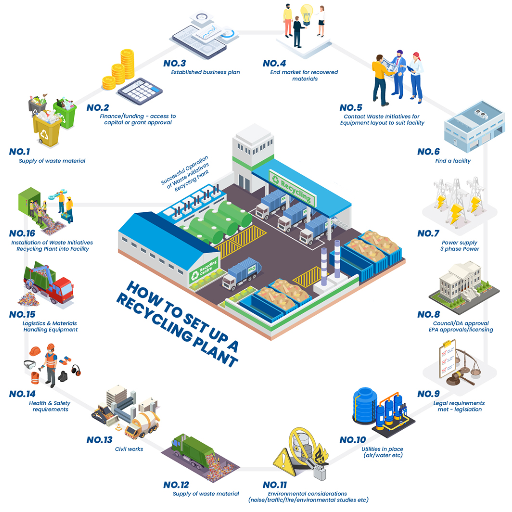
Many factors determine how efficient and durable a recycling plant may be, but the location of the plant is crucial. For instance, waste sources must be close to the plant to avoid high transportation expenses and also to remain within the energy-efficient bracket. Location will also be a factor, as it will determine the distance of the labor pool, as well as professionals, who will help in enhancing the performance of the recycling plant. There is also the need to examine whether or not basic infrastructure, like energy, water, and transportation systems are present in the area, as it will affect the operation of the pet recycling plant in the area. Moreover, it is critical to observe land use regulations before commencing construction, consider any existing environmental laws, and consider how the taxes affect circumvention. Finally, the space that has been chosen must be expandable and should be able to accommodate any foreseen growth in the business operations in the future. The best site will always combine all aspects of logistical and environmental considerations into one inseparable goal.
Proximity to Sources of PET Waste and Target Markets
Construction of facilities near the sources of huge volumes of PET substantially reduces logistics costs and contributes to the efficient work of its supply chain. It is therefore important to identify and locate the primary industries, businesses, or even municipalities responsible for the given wastes so that such wastage can be addressed. On the other hand, having the operation close to customers also reduces the cost of delivery and shortens the time usually needed to access the market. Convenient location of the facilities with respect to city centers or geographical locations where recycling is common maximizes the availability of the consumables and the repeatable business, as well as improving the bottom lines in organic growth. In conclusion, the construction of a pet recycling plant is advisable near highly built-up areas or in areas with a high index of recycling behavior.
Zoning, Environmental Regulations, and Infrastructure Requirements
The choice of a location for the planting of a recycling plant must be evaluated critically, as it is heavily governed by zoning guidelines that only allow certain activities to operate in certain areas. In most cases, such facilities are placed in industrial or commercial lands in order to avoid ill effects on residential neighborhoods and ensure that other land uses near them are not contrary to the facility. Legal environmental provisions, such as amendments by the Environmental Protection Agency (EPA) or regional bodies, require compliance with emissions, waste discharges, and conservation of the environment for the purpose of reducing environmental damage. Also, organisations must seek air emission licenses, water pollution measures, and permits or licenses for waste procedures made within their establishments.
Infrastructure concerns turn out to be very crucial as well. That is to say, the site must be able to use stable electricity, water, sewage, and other services, and ideally, must be accessible as a transportation hub. The opportunities of road, rail, or port are made suitable for the movement of raw materials coming into the plants and shipping/recycling of the final products. Not only that, the building hosting the facility must provide for all the waste handling machinery, storage, and must be expanded to cope with changes in the market. All these elements guarantee respect for regulations, effectiveness, and viability.
Designing the Plant Layout and Workflow

Given its nature, plant layout and process structure suggest that there must be considerations for efficiency and safety while at the same time observing flexibility. The objective of layout designing is logistical to eliminate bottlenecks and the existing distances of material handling. Even the type of equipment and its positioning have to conform to the sequencing of actions for the sake of operational efficacy and safety. Additionally, a smooth movement of people and also equipment has to be considered with appropriate consideration given to the layout of functional processes such as the waste reception, treatment, and also storage to avoid cross–functional contamination of wastes. In addition and among other factors, such a pattern should factor in the possibilities of growth by making some of the areas factual, in so lowing volume growth through the increase of activity in certain spaces and given this there should be another burden of introducing techniques on how to tools to undertake the operations and the more enhance efficiency and accuracy of the operations in place. A proper plan enables smooth running, compliance, and allows for the sustenance of practices.
Optimising Plant Layout for Operational Efficiency
In the most favorable scenario, optimization of the pet recycling plant design would be directed towards strategic minimization of material handling distance, improvement of workflow, and provision of safety measures within the facility. It would also address the consideration of the arrangement of the sorting, washing, and extrusion equipment in a structured order to minimize while operating under overload conditions. Provision of enough space for maintenance and expansion should provide flows for equipment and people as well. Better performance of the ingress and egress, as to the automatic (automation) and minimum manning cost systems, also rationalizes the transport system. Organizing the storage areas and waste management plan correctly renders the activities efficient in accordance with health and safety legislation and environmental commitments. The integration of all these approaches results in a process facility that is balanced between productivity, cost, and sustainable recovery.
Workflow Stages: From Waste Collection to Production of Recycled Materials
- 1
Waste Collection and Transportation
Waste is first collected from homes and other areas, such as business enterprises and firms. Waste collection methods are applied, which include using less fuel for collection, such as involving GPS trackers in lorries or other collection vehicles, to every collection point in residential, industrial, or commercial urban settings. The waste is then taken to the established recycling centers, where it is sorted and pre-processed. - 2
Sorting and Pre-Processing
Once inside the facility, waste is adequately arranged so that recycling components can be easily gathered from the trash. This includes employing both human labor and machines like optical sorters, magnetic separators, and eddy current machines that facilitate the separation of plastic, metal, paper, and glass materials. Pre-treatment of materials can involve shredding, washing, or otherwise handling them in preparation for further treatment. - 3
Material Processing and Refinement
Each category of recyclable waste is subjected to particular processing methods to convert it into the necessary raw materials in the manufacturing process. For example, metallic waste is smelted, plastics are converted into granules again, and paper is disintegrated and decontaminated. This step aims to obtain high-value recycled secondary raw materials that conform to the requisite industry standards. - 4
Recycling of Materials into New Products
In the end, such advanced materials will be put to the production of something else or a packaging. For instance, collected and treated plastic can be used to make other bottles or clothes, or metals that have been processed can be used in construction or the automobile industry again. This is the stage that completes the recycling of materials, supporting the cyclic requirements of the economy and decreasing the demand for primary raw materials.
Therefore, along with the above-described staged technology, such recycling methods provide maximum recovery of materials without breaching any guidelines of various industries and government authorities, except for the pet recycling plant.
Securing Technology and Equipment

Investing in the right technology and equipment is significant to the performance and profitability of a recycling operation. Depending on the type of material, throughput, and quality requirements, one needs to source appropriate machinery for the facility. Investment should be mainly aimed at the provision of reliable sorting technology, such as optical sorters, eddy current separators, and efficient balers. Proper planning and installation of automation equipment and real-time management systems can significantly enhance efficiency and reduce wasted time due to stoppages. It is imperative to collaborate with well-known equipment suppliers for the pet recycling plant, as well as oversee the training of the personnel who work on the facilities.
Overview of PET Recycling Technologies
The major purpose of Polyethylene Terephthalate or simply PET recycling plants is to extract reusable polyethylene terephthalate from customer or commercial products that have already been used. PET recycling technologies are usually defined into two branches: Mechanical and Chemical recycling.
Types of Machinery Required
A more detailed account of the effective mechanism of processing PET would be to make use of appropriate equipment that caters to every single step of the process involved.
- ⚙️
Shredders — Serve to cut the PET into small, uniform flakes for downstream processing. - 🚿
Washing Machines (Friction & Hot Washing) — Allow for the removal of contamination, including labels, glues, and other debris. - 🔩
Pelletizing Machines — Help make pellets out of clean and dry PET flakes, ensuring high-quality output. - 🔍
Optical Sorters — Automated separation of PET from other materials by type and colour. - 🧲
Eddy Current Separators & Magnetic Separators — Separate metals and other non-PET contaminants from the stream.
Evaluating Costs and Suppliers for Recycling Equipment
When aiming at relevant costs and research of suppliers of recycling equipment they are many crucial issues that require being stipulated to achieve value addition and efficiency in operations. Firstly, compare the cost of purchasing the equipment from different suppliers without forgetting costs such as installation, maintenance, or energy consumption. Give preference to suppliers who offer warranties for the products and flexible buying options such as leasing or purchase in installments, because it may reduce the lump sum payment at the purchase point.
Beware of the reputation of the supplier by researching their reviews, certifications, and past clients. Most good suppliers are most likely to provide technical help and training so that the equipment is easily fitted into existing systems. Another thing to look at is how much better their machinery can be scaled up or down and how long it will serve before breaking down, as in the pet recycling plant, making sure to purchase only the equipment that is needed for the operations.
If you are comparing the products or services offered, look for value-added functionalities like automatic controls or Internet of Things features that boost efficiency. Some suppliers know the local rules and the constraints posed by the environmental regulations very well and can work out compliant products, reducing the risks of breaching operational and legal norms. In the end, the selection of the most beneficial supplier requires consideration of price, performance, and durability.
✅ Supplier Evaluation Checklist
- ✓ Compare purchase cost, including installation, maintenance, and energy consumption
- ✓ Verify warranty coverage and flexible payment options (leasing/installments)
- ✓ Research supplier reviews, certifications, and reference clients
- ✓ Confirm technical support and operator training availability
- ✓ Assess scalability and machinery lifespan
- ✓ Look for IoT and automation capabilities for efficiency gains
- ✓ Confirm supplier knowledge of local environmental regulations for compliance
In Summary
Setting up a PET recycling plant is a multi-faceted undertaking that demands careful attention to feasibility, location, layout, technology, and supplier partnerships. Done right, it represents both a compelling business opportunity and a tangible contribution to a cleaner, more circular economy.
Reference Sources
Key Insights: This research investigates the release of microplastics from PET recycling plants and their impact on freshwater ecosystems. It highlights the biostability and migration potential of microplastics.
Key Insights: This pilot study explores microplastic pollution from plastic recycling facilities and evaluates the effectiveness of filtration systems in mitigating this issue.
“An Overview on PET Waste Recycling for Application in Packaging”
Key Insights: This review discusses the most viable methods for recycling PET waste, focusing on its application in packaging. It emphasizes advancements in chemical recycling techniques.
Frequently Asked Questions (FAQs)
What role does separation play in the pet recycling plant?
The separation process in a PET recycling plant describes the method employed in sorting the incoming materials so that PET plastic bottles and flakes are not mixed with other plastics and other contaminants, such as metals and glass. It normally involves several systems, including but not limited to manual sorting, optical sorters that work with conveyors, magnets for metallic materials that are ferrous and those that are not ferrous, among others. Effective separation means that you get cleaner recycled plastic and that, in the end, you don’t need to go through extensive decontamination or washing procedures.
When during the process of PET Bottle Recycling is the grinding done, and for what process, or reasoning, is the trash ground?
The process of grinding, which involves breaking PET bottles and filled plastic bales in order to convert them into particles with the help of grinders or shredders, is another important process. The grinding process serves to decrease the size in order to help remove labels and remnants for washing purposes, and also screen and separate by density. This is so because it is easy to wash and purify PET flakes and eventually convert them back to pellets, which are used by manufacturers in post-consumer and industrial use.
What system is in place for metal removal to protect quality?
Recycling plants utilize methods such as magnets, eddy current separators, and manual pick stations in order to eliminate any metals contained within the plastic material. Preventing metal contaminants is necessary to protect domestic grinders and melters, enhance the employed quality control measures, and avoid the contamination of recovered plastic pellets. Proper elimination of tin cans protects the environment by limiting released emissions and decreasing the frequency of repair works, as well as increasing the market value of the manufactured product of recycled PET.
Is the green pet recycling plant sustainable in terms of energy consumption and other factors?
The recycling and recovery of polymers to produce recyclates, such as the PET recycling plant, are considered economically sustainable, although they consume energy, labor, and time and manpower in collecting, sorting, cleaning, moving, treating, and arranging the waste plastic, further making it environmentally sound.
In what ways do screening and scanning assist in reaching effective quality control?
Polymers of abnormal large or small sizes are removed after grinding through the screens. Optical sorting, on the other hand, processes various processes, including the analysis of colors and types of plastics, which air jets and cameras are used for. The impurities, such as PVC and other plastics that are not pet are minimized, thus ensuring constant quality control. Apart from manual checking, these two features work together and give precise flakes that go to the melting and pelleting sections.
How and why is it necessary for the different manufacturers to check the quality of recycled PET pellets?
Manufacturers examining the recycled PET pellets aim to determine the usefulness of these pellets for food packaging, bottles, or fiber, and for this purpose, they assess the melt flow, color, contaminant content, and mechanical properties of the pellets. Such perfect quality control is achieved in the pet recycling plant through procedures that include sampling, testing, and the maintenance of records concerning the origin, movement, and destination of the recycled stock, so that the plastic foils are least likely to be fragmented and become safety hazards or performance issues when recycled for the replacement of virgin foam. This in turn enhances the value of the high retained PET content of the recycled films, while facilitating the enhanced embryos and other goals, for sothat Helps the disposable economy produce less plastic waste.


Trending now