Get in touch with Kitech Company


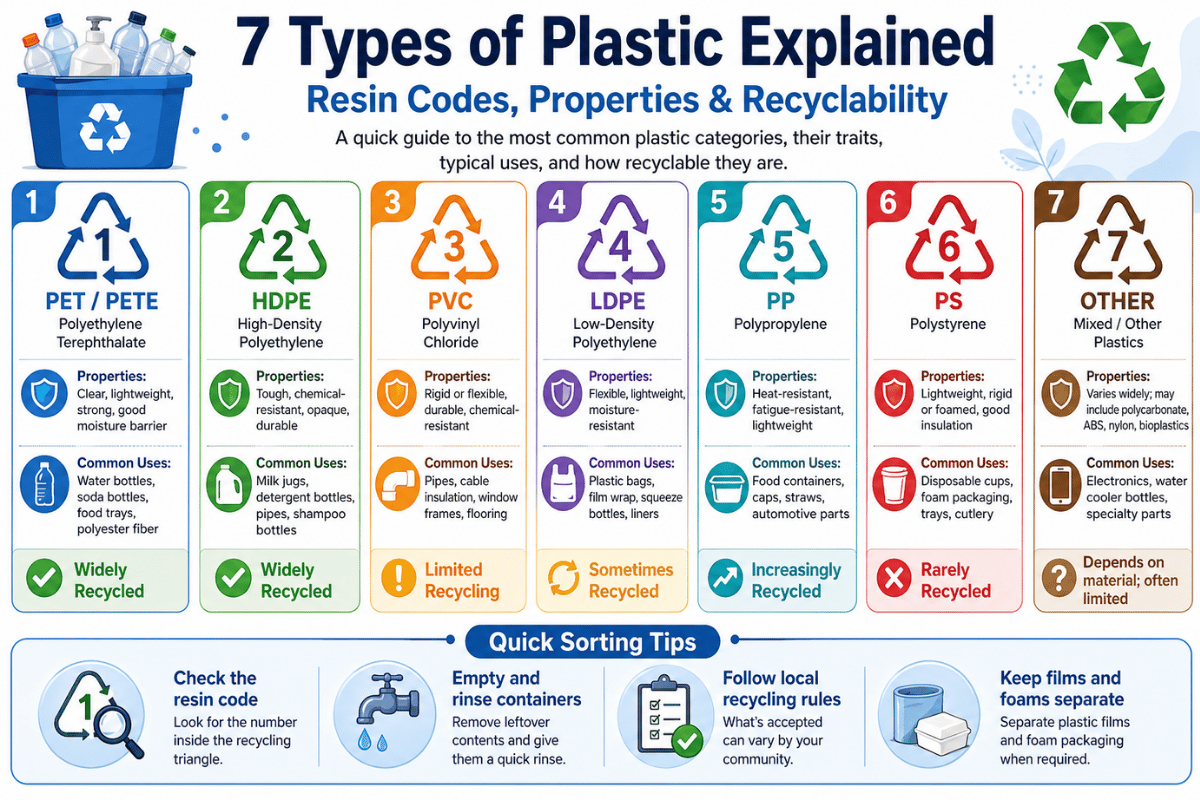
Plastic types are grouped by resin identification code: PET, HDPE, PVC, LDPE, PP, PS, and Other. Each synthetic plastic starts as a plastic polymer family, but the code does not guarantee recycling in any given system. Product form, contamination, color, additives, labels, and available recycling equipment all influence the answer.
Quick Specs
| Main resin codes | 1 PET, 2 HDPE, 3 PVC, 4 LDPE, 5 PP, 6 PS, 7 Other |
| Best-known recycling streams | PET bottles, HDPE containers, PP containers, LDPE/LLDPE film where collection exists |
| Industrial sorting rule | Use the resin code as the first screen; confirm by density, product form, contamination, and melt behavior |
| Kitech equipment bridge | PET washing, PE/PP film washing, rigid plastic recycling, shredding, washing, and pelletizing lines |
U.S. EPA describes plastic products as containers and packaging, nondurable goods, and durable goods. Then they mention that there are seven polymer types of plastic products with resin identification codes. That’s the right place to start, but it is only the initial indication for recycling guidance.
Quick Answer: What Are the 7 Types of Plastic?

Seven resin codes span PET, HDPE, PVC, LDPE, PP, PS, and Other. Each code points to a different use, polymer chain type, heat-transition behavior, density trend, and recycling limit. Bottles, film, pipe, trays, caps, and mixed parcels may all carry resin marking, yet they often need different recovery pathways.
| Code | Resin | Common products | Recycling note |
|---|---|---|---|
| 1 | PET or PETE | Beverage bottles, trays, polyester fiber | Strong bottle stream when sorted and washed |
| 2 | HDPE | Milk jugs, drums, crates, caps | Common rigid plastic recycling stream |
| 3 | PVC | Pipe, profiles, cable insulation, flooring | Keep separate from PET and polyolefin streams |
| 4 | LDPE | Film, bags, shrink wrap, squeeze bottles | Best handled through film-specific collection and washing |
| 5 | PP | Food containers, woven bags, caps, automotive parts | Recyclable in suitable PP streams |
| 6 | PS | Foam packaging, trays, cups, insulation | Collection is more limited, especially for foam |
| 7 | Other | PC, ABS, PMMA, multilayer, bio-based plastics | Requires material-specific review |
Code 1: PET or Polyethylene Terephthalate

PET, or polyethylene terephthalate, is the plastic that most consumers associate with clear beverage bottles. Recycling facilities want PET because it can be sorted, granulated, washed, separated from caps and labels, then sold into established flake or pellet markets.
For one specific industrial PET stream, the resin code is not enough. A recycling line must be able to pull off caps and labels, remove dirt and glue, separate from other plastics, and clean the flake for the end market. Kitech describes PET bottle washing lines with hot washing, float-sink separation, and processing ranges from 500 to 3,000 kg/h as a first party equipment example.
Engineering NotePET bottle recycling is often a washing and separation challenge, not a pelletizing challenge. Screw caps and labels are usually PP or PE, not PET. Density separation is effective. A PET line skipping sorting and washing may send contaminated flake into the extruder, which results in lower pellet quality, higher filter changes, and more downtime.
Code 2: HDPE or High-Density Polyethylene
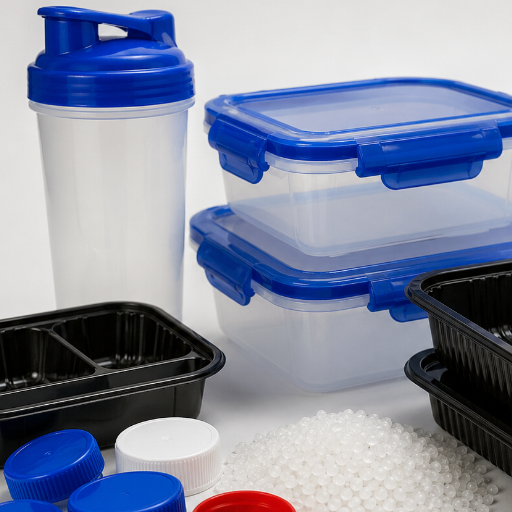
HDPE stands for high-density polyethylene. HDPE appears in large bottles, detergent bottles, drums, crates, pipe and rigid plastic parts. Relative to LDPE film, HDPE is more rigid and is usually shipped in rigid form, not film rolls.
From the recycler’s side, the biggest question is not “Is it HDPE?” but rather “What form is it in?” HDPE bottles, coarse-walled drums, injection molded crates, or cut-offs from pipe require varying amounts of size reduction. Heavy rigid plastic should be processed with a shredder before washing, while clean production scrap will often accelerate into the granulation and pelletizing line.
Kitech converts rigid plastic waste streams such as HDPE, ABS, PS and PC into existing rigid plastic recycling streams with shredding, washing and pelletizing. For mixed rigid feed streams, review the rigid plastic recycling line and plastic shredder category before completing the rest of your system sizing.
Code 3: PVC or Polyvinyl Chloride

PVC, or polyvinyl chloride, can be rigid or flexible. Unlike PET, or polyethylene terephthalate, or the polyolefins, PVC does not have just one easy stream with a single set of properties. Pipe, profiles, construction and many other general use material provide rigid PVC. Flexible PVC may be a key component of insulation, flooring, hoses or various medical tubing. Many formulation choices create that spread, so if you do not want to complicate your operations have a simple rule about PVC contamination.
Plastics Europe calls PVC one of the world’s most widely used and recorded plastic. Rigid (unplasticized) and flexible (plasticized) forms should be kept apart at recycling plants: keep PVC out of PET, PE and PP streams unless the line is designed for PVC. Often PVC contamination does not show up as much as you’d think it should given the proportion in the bale, but quality and processing issues remain.
Advantages
- Rigid PVC appears in pipe, profiles and general construction materials.
- Flexible PVC can be used in cable insulation, flooring, hose and tubing.
- Long service life makes it useful in durable goods.
Limitations
- It is best to keep flexible PVC out of PET and polyolefin collections.
- Flexible formulations can include additives that affect processing.
- In a given region markets for each form of plastic may vary; acceptance rules will also vary.
Code 4-6: LDPE, Polypropylene (PP), and Polystyrene (PS)

LDPE, PP and PS are often grouped because they are very common plastics, yet they do not behave the same. LDPE is generally flexible and common in film and bags. PP, or polypropylene, is more common in caps and food containers. It also appears in woven sacks and industrial components. PS, or polystyrene, creates collection and densification hurdles in both solid and foamed form.
| Material | Typical stream | Plant question | Kitech path |
|---|---|---|---|
| LDPE / LLDPE | Film, stretch wrap, bags | How dirty and wet is the film? | PE film washing line |
| PP | Caps, containers, woven bags, FIBC | Is it rigid, woven, or film-like? | PP woven bag recycling line |
| PS | Trays, foam, insulation, packaging | Is the stream dense enough to move and sell? | Rigid plastic review |
Can different types of plastic be recycled together?
There are cases in which mixed plastics may be collected, but that does not mean a plant should process the plastics mixed into the same recycled pellet. It depends on separating by resin, density, melt flow and other contamination signals before melting. Mixed collection can make logistical sense, but mixed extrusion is a quality risk unless the buyer accepts the final specification.
Code 7: Polycarbonate, Engineering Plastic, and Biodegradable Plastics

Code 7 refers to Other. This category may encompass polycarbonate, acrylonitrile butadiene styrene (ABS), polymethyl methacrylate (PMMA), multi-layer plastics, bio-plastics, compostable or other engineering plastics that do not fit codes 1-6. It is the reason the 7th resin code should never be treated as a single recycling stream.
Beyond the common commodity resin codes, Plastics Europe identifies several other plastic families: engineering plastics, thermosets, fluoropolymers, polyurethanes, and bio-degradable plastics. For the recycler, code 7 should prompt testing and supplier review rather than a casual yes/no decision.
If the incoming material is thick and rigid, solid ABS or PC may still need a shredder-fed line with sorting and washing before any pellet step. Final equipment choice depends on whether the recycler is making separated regrind, cleaned flake, or pellets. Kitech’s plastic material recycling comparison tool can help.
How Plastic Material and Plastic Pollution Fit Waste Management

Plastic packaging turns resin Codes into a waste management problem because the same package can include caps, labels, adhesives, barrier layers and food contact rules. A clear PET bottle, a natural HDPE plastic container, an LDPE plastic film bag and a PVC plastic blister pack all enter the plastic industry with different sorting limits. Food containers and plastic bottles may look simple to consumers, but recyclers still check color, odor, residue and whether the stream can be sold as recycled plastic.
That is why the circular economy discussion cannot stop at resin identification labels. Commodity plastics such as PET, PE and PP can move through established markets when the stream is clean and sorted. Polypropylene plastics, plastic containers, plastic packaging and biodegradable plastics all need separate market checks before an operator commits to washing, densifying or pelletizing equipment.
The Resin Recovery Matrix: Which Types of Plastic Are Recyclable?
Use the Resin Recovery Matrix to check resin Codes without over-trusting them. Resin identification Codes can provide clues to the polymer family but a true recycling assessment depends on the full product: resin, cap, label, closure, application, proximity to the source, food residue, dirt, water access and recycling facility options.
| Resin | Often recyclable when… | Risk condition | Equipment implication |
|---|---|---|---|
| PET bottle | Bottle-grade stream is sorted, de-labeled, and washed | PVC, glue, labels, caps, heavy dirt | Bottle washing, float-sink, hot wash |
| HDPE bottle/drum | Color and product form are sorted | Chemical residue, mixed caps, labels | Shredding, washing, pelletizing |
| PVC rigid | Dedicated PVC handling exists | Mixed into PET or PE/PP streams | Separate stream review |
| LDPE film | Film is collected separately and washed | Soil, labels, high moisture, multilayer film | Film washing, squeezing, pelletizing |
| PP rigid | PP-rich containers or caps are sorted | Mixed PE/PP/PS without sorting | Rigid washing and pelletizing |
| PP woven | Bags or FIBC material are separated | Sand, dust, rope, label contamination | Woven bag washing line |
| PS solid | A buyer accepts clean PS regrind or pellet | Low value or mixed food residue | Densification or rigid processing review |
| PS foam | Densification and market access exist | Bulky, light, dirty material | Densifier before transport or pelletizing |
| Code 7 | The exact polymer is known and marketable | Multilayer or unknown resin blend | Lab check and custom route |
ASTM D7611 frames resin identification as a method to identify the resin used in a manufactured article. That key part is identify: it is not a promise that every article with that code can be recycled. APR’s Design Guide treats recyclability as a system and package-design question rather than a resin-code-only question.
How to Match Plastic Type to Recycling Equipment
For an industrial recycler, the critical question is what equipment turns this feedstock into a saleable output. Clean PET bottles, dirty LDPE film, and mixed rigid HDPE/PP crates are all plastic waste, but they require different process routes.
Material-to-Line Decision Path
- If the stream is mostly PET bottles, begin with bottle washing, de-labeling, cap separation, and hot wash design.
- If the stream is PE/PP film, check moisture, dirt, print, and whether squeezing or densification is needed before pelletizing.
- If it is a rigid HDPE, PP, ABS, PC or mixed rigid plastic stream, sizing and washing precede pellet decisions.
- For PVC or Code 7 material, check the exact resin and market before purchasing a standard line.
Kitech designs material-specific lines for PET bottles, PE/PP film, PP woven bags, rigid plastics, agricultural film, drip tape & pelletizing. Use the plastic recycling line selector if you know what material you want but not the system flow, or browse the plastic recycling solutions if you are comparing full lines.
Standalone upgrades matter, too. Maybe the recycler does not require a complete line if the bottleneck is only size reduction, friction washing, melt filtration, or pelletizing. Kitech separates the plastic washing system, plastic pelletizers, and auxiliary equipment for line upgrades.
What Is Changing in Plastic Recycling?
EPA references OECD figures showing the U.S. consumed 18% of global plastic products in 2019, and that global plastic use and waste could nearly triple by 2060 without interventions. Those are some of the reasons why lot-specific sorting, improved package design, and higher grade recycling equipment are important.
What recyclers seem to be indicating is “not more plastic.” Control of material source and input is becoming more exacting: cleaner PET flake, closer scrutiny of contamination in film, increased requirements of recycled plastic pellets by buyers, fewer tolerances for unknown mixed streams. Plants designed for a specified, well-defined resin and output specification stand a greater chance than those built as “Mixed Plastic” plants with unknown input stream(s).
About This Analysis
This reference paper pairs public resin-code and plastic pollution sources with Kitech’s recycling equipment data for specific kinds of plastics. Kitech’s engineers work with PET, PE, PP, rigid plastics, film, woven bags and agricultural film streams, so this article focuses on how resin identification affects actual recycling-line decisions.
Need to Match a Plastic Waste Stream to Equipment?
Send Kitech your resin type, form, contamination, output, and capacity. Its engineering group can trace the stream to shredding, washing, drying, and pelletizing stages.
FAQ
Q: What are the 7 different types of plastic?
View Answer
The seven main plastic categories are PET, HDPE, PVC, LDPE, PP, PS, and Other, marked by resin codes 1-7. These markings identify the type of plastic resin, but recyclability still depends on product form, contamination, and the recycling systems available to process it.
Q: Which type of plastic is most commonly recycled?
View Answer
PET bottles and HDPE containers are the most prevalent plastic waste streams due to the maturity of collection, sorting, washing and end markets. PP and LDPE recycling still feasible where collection and processing system in place.
Q: Can all 7 types of plastic be recycled?
View Answer
Not in one universal system. Some products in all seven categories may have a recovery path, but many do not have routine collection or a buyer. Shape, additives, contamination, resin code, and local or industrial equipment decide the real answer.
Q: What are the two main types of plastic?
View Answer
Broadly, plastics are divided into two types of thermoplastics and thermosets. Thermoplastics soften when heated and harden when cooled. Almost all thermoplastics are suitable for mechanical recycling. In contrast, thermosets need special handling as they are permanently cured.
Q: Is resin a type of plastic?
View Answer
A resin is the polymer material used to produce a plastic product. In recycling, the resin identification code indicates the polymer family, such as PET, HDPE, PVC, LDPE, PP, PS, or Other.
Q: What plastic types are food safe?
View Answer
Food safety depends on the actual grade, the additives used, the manufacturing procedures, and approval for the target food-contact use. PET, HDPE, PP, and some other plastics are widely used in food packaging, but the resin code alone does not guarantee food-contact approval.
Related Articles
References & Sources
- About Plastic Products and Plastic Pollution (U.S. EPA)
- ASTM D7611/D7611M Standard Practice for Resin Identification – ASTM International
- APR Design Guide Overview – Association of Plastic Recyclers
- A Large Family of Plastics – Plastics Europe
- Plastics Recycling Machines and Material-Specific Lines – Kitech