Get in touch with Kitech Company

HDPE Drum Recycling: The 2026 Guide to Safe Intake, Washing, and Line Acceptance

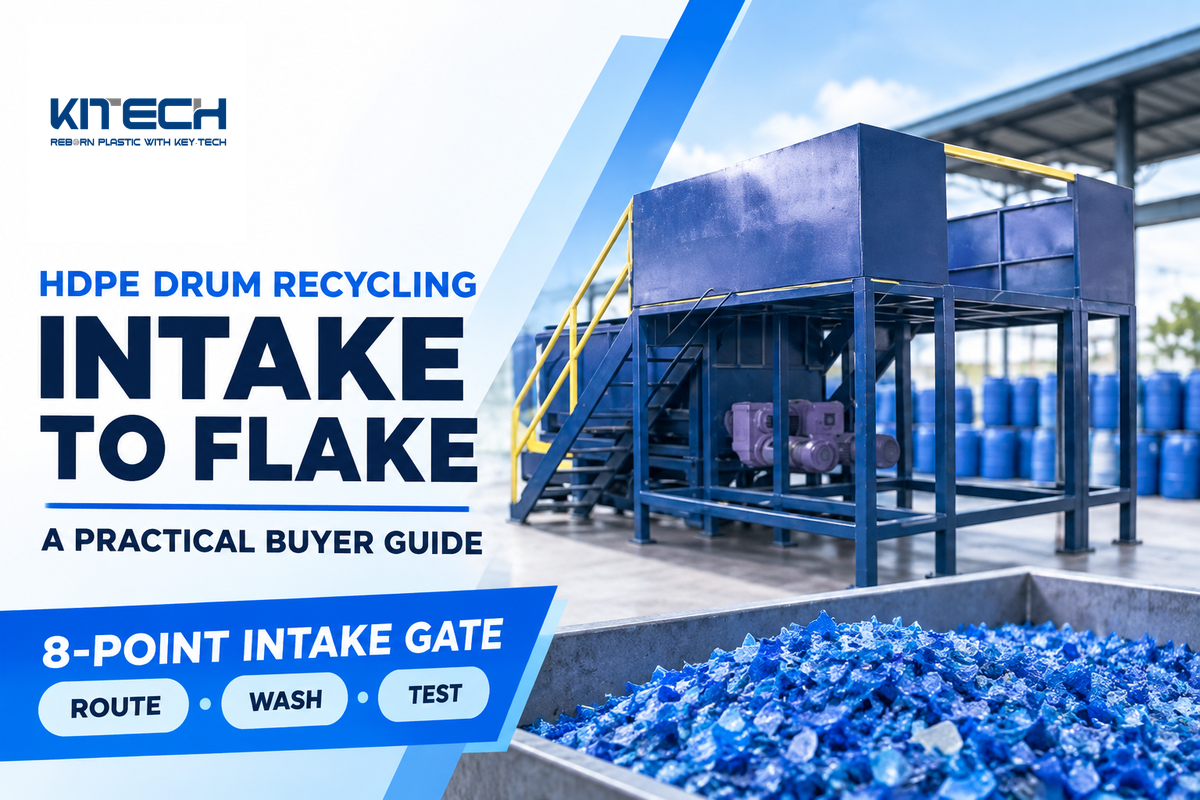
HDPE drum recycling begins before a drum reaches the shredder. The presence of a resin code on a body polymer tells nothing of what the drum contained, if any residue remains in the drum wall, which fittings will cross-contaminate the flake, or if a recycler is even authorized to accept it.
For a recycler or equipment buyer in the recycling industry, that distinction matters when evaluating a line for recycling plastic made from high-density polyethylene for specific industrial applications. A line may be mechanically capable of reducing a drum yet still receive the wrong feed. It may also produce visually clean flake that a downstream buyer rejects because it does not meet the agreed specification.
This guide provides the decision path for a drum and outlines the requirements to accept dry flake as a practical guide to plastic drum processing. It covers feed qualification, process controls, and evidence for factory acceptance. For an explanation of a commercial project and machine configuration, see Kitech’s HDPE drum washing system.
Well-managed plastic drum recycling programs can reduce waste sent to landfill, conserve natural resources and supply recycled HDPE that can be recycled into new products, while a plastic drum recycling system remains distinct from a production line for new plastic drums. Those benefits depend on controlling hazardous materials and matching the recycling process to the actual drum stream; they are not automatic results of collection.
Route the Drum Before You Size the Recycling Line
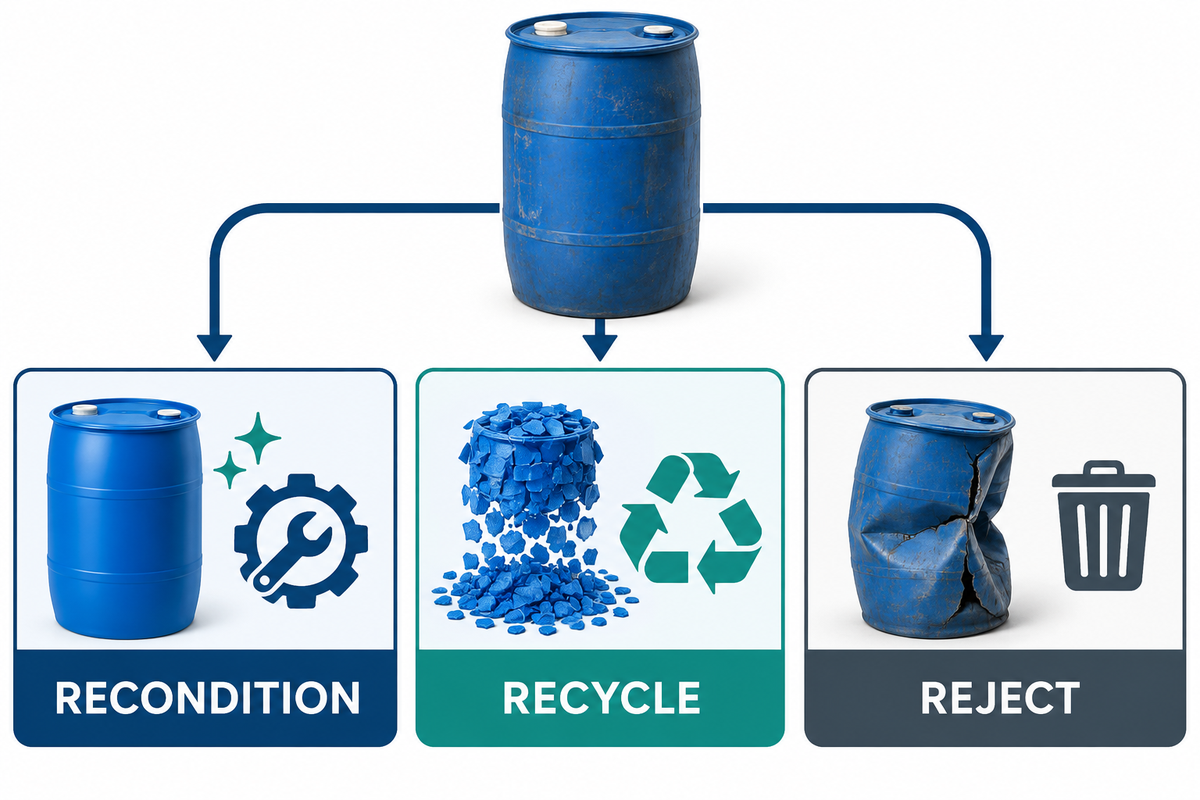
In reality, a used drum has at least three options: It may be reconditioned for reuse; it may undergo mechanical recycling for polymer feedstock; or it may undergo controlled rejection and waste management; reconditioned drums belong to the reuse route, market comparisons of new and reconditioned packaging are separate, and recyclers crush used drums after feed qualification. The route chosen should be based on the worst case scenario for the contents, empty condition, and cleanability of the drum, and not based on the HDPE mark.
Reuse and mechanical recycling require different acceptance decisions. A candidate for reuse must retain the required package integrity and complete the applicable reconditioning process. A candidate for mechanical recycling must meet the recycler’s written feed specification; any damage must remain within that facility’s safety standards and processing limits.
In the United States, the legal boundary for containers that held hazardous waste deserves separate consideration. The U.S. EPA’s used-drum guidance states that affected generators must meet the RCRA empty-container provision before sending containers to reconditioners, and notes that facilities still receive drums that are not legally empty. Legal emptiness is not proof that a specific recycling line can safely or effectively process the drum.
| Decision category | Minimum evidence | Typical stop condition |
|---|---|---|
| Reuse: contents | Known previous contents and compatible next service | Unknown history or incompatible next fill |
| Reuse: condition | Sound body, closures and required inspection | Cracks, distortion, degradation or failed leak test |
| Reuse: process | Complete qualified reconditioning sequence | Partial cleaning presented as full reconditioning |
| Recycle: polymer | HDPE body verified | Mixed, unidentified or excluded construction |
| Recycle: residue | Residue class fits the plant’s written limit | Persistent, unknown or excluded chemical |
| Recycle: attachments | Closures, liners, labels and metal can be removed or tolerated | Foreign material exceeds separation capability |
| Hold: evidence | Contents and cleaning documents are being verified | Conflict cannot be resolved |
| Reject: safety | Authorized handling and disposition route | Leakage, pressure or unsafe condition |
| Reject: acceptance | Receiving facility has confirmed authorization | No authorized receiving route |
The goal is to be conservative. The Plastic Drum Institute’s work has shown that some previous lading has remained after reconditioning, and has studied the use of flake washing and repelletizing. This work does not prove that all previous residue remains. It has shown the need to make the claims of empty, washed, and chemically suitable for the next use, separately.
Use the 8-Point Drum Intake Gate Before Shredding
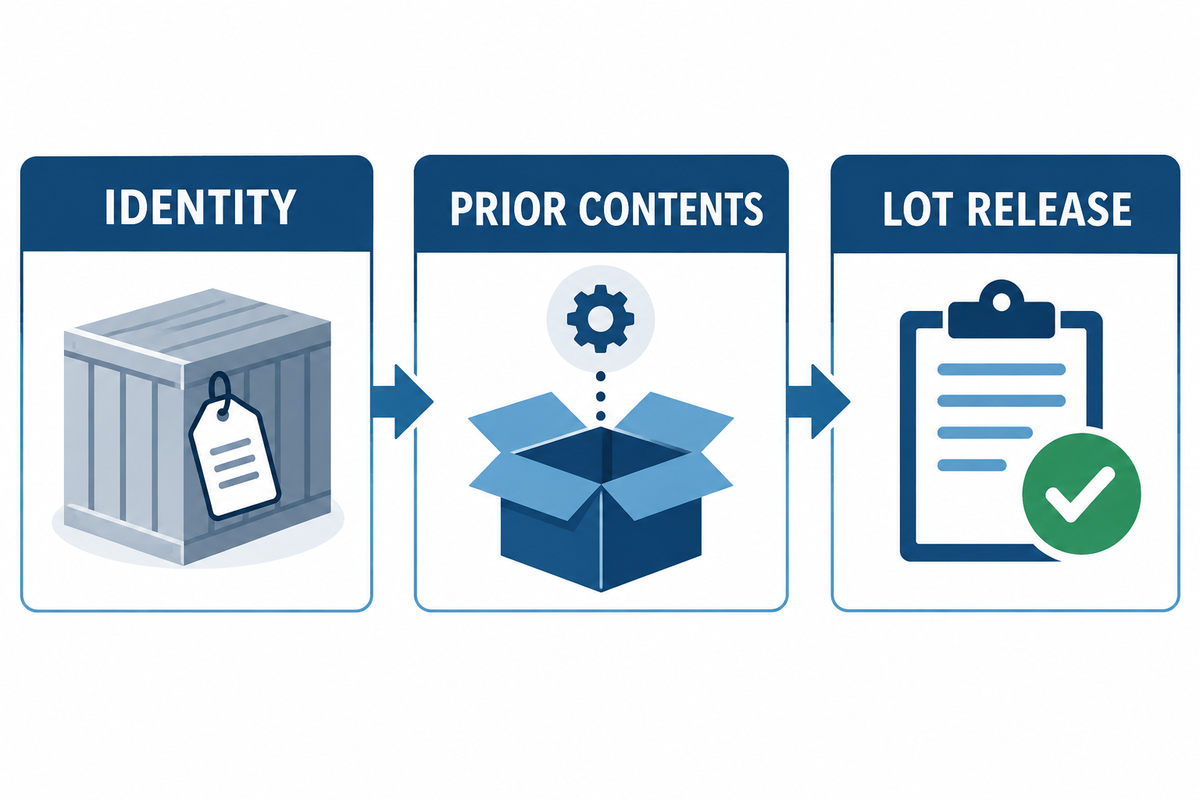
The 8-Point Drum Intake Gate turns an informal visual check into a documented lot-release decision. Use four outcomes for each point: accept, hold for evidence, rework, or reject. Do not release a lot for size reduction while a safety-critical or quality hold remains unresolved.
- Previous contents: confirm the availability of supplier’s declarations, safety data, cleaning records and original labels. In the absence of the documentation, a hold is requested.
- Empty condition: check for free liquid, sludge, powder, pressure, strong odor and external contamination. Apply the applicable empty-container definition and the site-specific definition.
- Body resin: confirm the drum body is HDPE. Treat resin mark as an identity clue, not an acceptance criterion.
- Closures and liners: identify bungs, caps, gaskets, taps, dip tubes, barrier layers and removable liners. Describe the materials that a line can separate.
- Metal: remove rings, handles and bands. Confirm the site’s strategy for the line’s magnets and metal detectors.
- Labels and adhesive: grade label burden, face material and adhesive type against the line’s removal capability.
- Color: when the downstream specification requires consistency, separate natural, white, blue, black and mixed colors.
- Contamination limits: define observable or measured limits for dirt, product film, odor, moisture and excluded substances.
Sampling should represent the lot, while Kitech’s broader HDPE recycling guide explains the surrounding material-recovery routes outside this drum-specific intake gate. Examining the cleanest drum at the front of the load doesn’t prove much about the sample in the middle. You should record the sample basis, the person who released it, photographs or test results, the final disposition, and any disposal costs assigned to rejected material. The gate is useful only if the next shift can reproduce the decision.
Match the Wash Recipe to the Residue Family
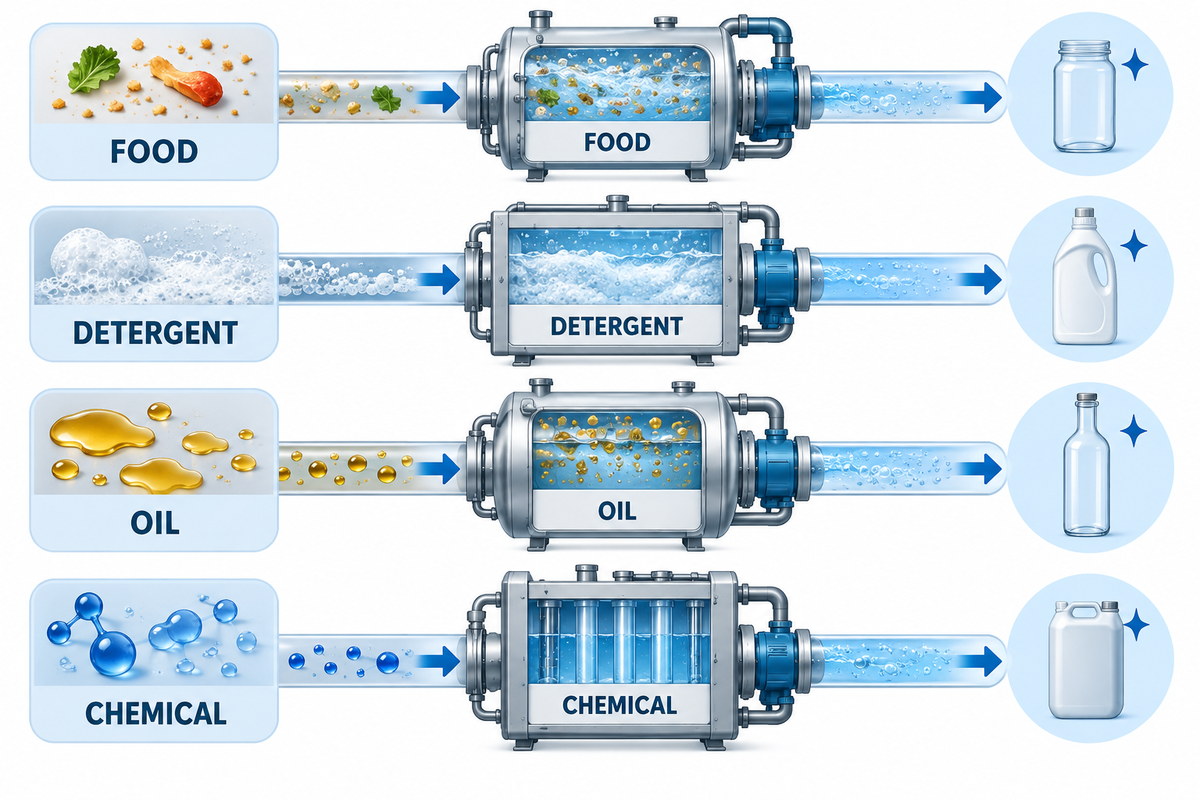
There are many variables in a wash recipe; Kitech’s plastic washing line guide covers the general washing stages, while this section stays focused on drum residue families. These include mechanical action, temperature, chemistry, dwell time, water quality, rinsing, and solids management. Changing the previous contents can affect the whole load on that recipe; EPA’s used-drum guidance documents why residue history and empty-container status require separate checks. A food residue, surfactant, mineral oil, and industrial coating, for example, should not share one untested setpoint, simply because their containers are HDPE.
How should food and water-soluble residues be handled?
Unlike new drums, drums with previously accepted food contact material (FCM) are drained, pre-cleaned, and verified to have achieved a defined endpoint rinse and a final flake condition. Previous food use does not qualify recycled FCM or other recycled materials for food contact, for manufacture into new containers, or as substitutes for new materials without the required evidence. That requires a defined and controlled input stream, an applicable route in the regulation, and evidence to support the intended use.
What changes when the residue is detergent or surfactant?
Foam can obscure liquid levels and disrupt stable operation. During a feed trial, track foam, suspended solids, chemistry concentration and rinse carryover. If antifoam is used, record its type and dose so its effect on washing and water treatment can be evaluated during the trial.
Why do oils and coatings need a separate trial?
Heat and/or friction may assist in the removal of the foreign material, but can also affect energy usage, wash-liquor loading, odor, and the demand on the wastewater treatment plant. Identify the family of residue and inspect the flakes after they have been rinsed and dried. A clear wash tank is not an output specification.
What happens to unknown or high-hazard residues?
Keep them outside the ordinary feed stream until an authorized specialist determines the material and its disposition route. Do not use a more aggressive wash recipe as a substitute for contents history, facility authorization or safe waste handling.
| Residue family | Trial variables | Release evidence | Reason to hold |
|---|---|---|---|
| Food or water-soluble | Pre-rinse, friction, temperature, rinse volume | Defined rinse endpoint, odor and flake checks | Unknown allergen or intended food-contact claim without evidence |
| Detergent or surfactant | Foam control, water turnover, rinse stages | Stable wash circuit and low carryover | Uncontrolled foam or wastewater upset |
| Oil or coating | Heat, chemistry, dwell, friction | Residual-film, odor and downstream quality results | Persistent contamination or excessive treatment load |
| Unknown or excluded chemical | None on the ordinary line | Authorized identification and disposition record | Missing or conflicting contents evidence |
Build the Line Around Control Points, Not a Machine List
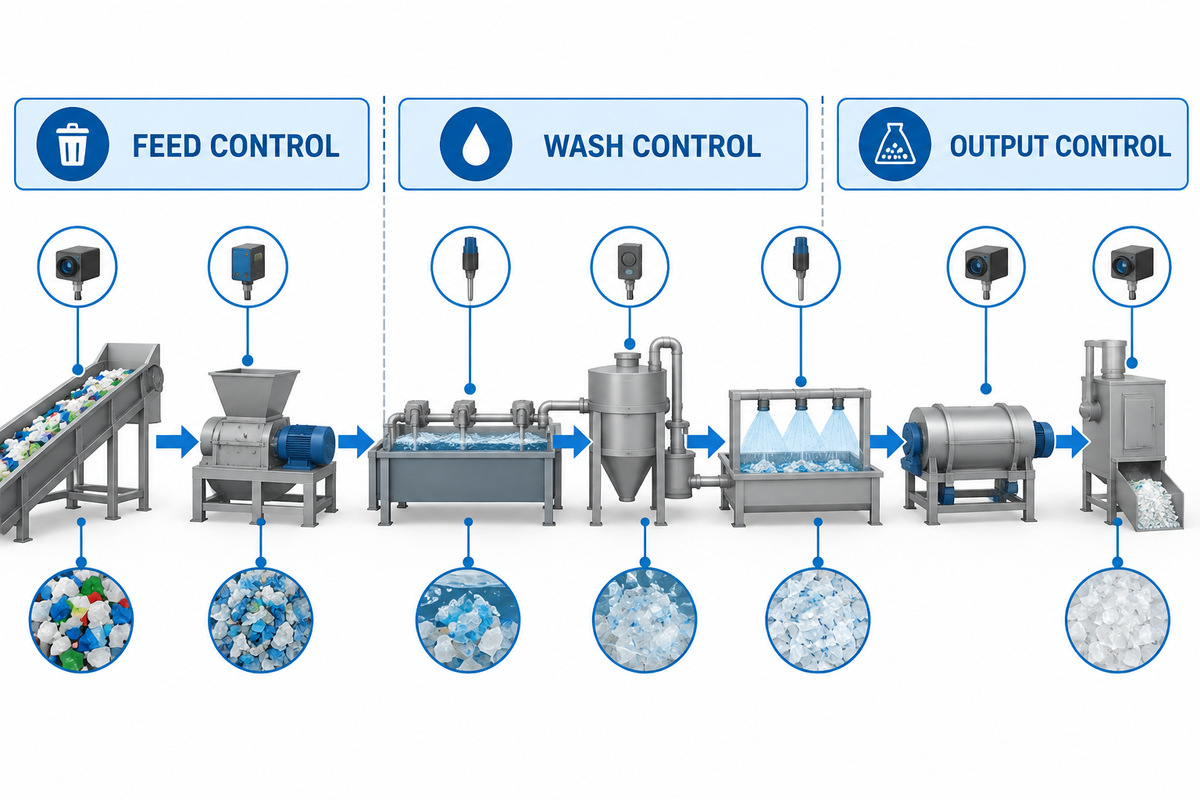
A conventional rigid-plastic line may include drums, size reduction, metal protection, washing, density separation, rinsing, dewatering, drying and final separation; Kitech’s rigid-plastic recycling line overview shows the wider system context. The correct question is not whether all suppliers list those machines. The correct question is what each machine must remove, what is measured, and what happens when the result is out of control; this control-point approach also keeps the line response aligned with EPA’s documented used-drum hazards.
| Stage | Main job | Control point | Failure response |
|---|---|---|---|
| Preparation | Open safely, drain, remove large attachments | Contents evidence and visible/free residue | Hold or divert the drum |
| Shredding or granulation | Create a controlled particle-size range | Feed rate, motor load, knife condition, metal protection | Stop, clear and inspect; do not push metal downstream |
| Friction or hot wash | Loosen product film, dirt, labels and adhesive | Temperature, chemistry, dwell, solids and foam | Quarantine output and restore the validated window |
| Density separation and rinse | Remove separable foreign materials and wash carryover | Water condition, overflow, material split and rinse endpoint | Correct the circuit and retest the lot |
| Dewatering and drying | Meet downstream moisture requirements | Moisture at an agreed sampling point | Adjust feed or drying conditions; segregate wet output |
| Final quality control | Release sellable flake | Purity, metal, fines, color, odor and moisture | Rework, downgrade, or reject under a written rule |
This also eliminates the possibility of a misleading capacity comparison. An input feed rate is not the same as the accepted dry-flake output. A heavily contaminated drum mix can increase reject mass, washing demand and increase downtime, even though the shredder appears to be working.
Define Output Quality by Its Next Use
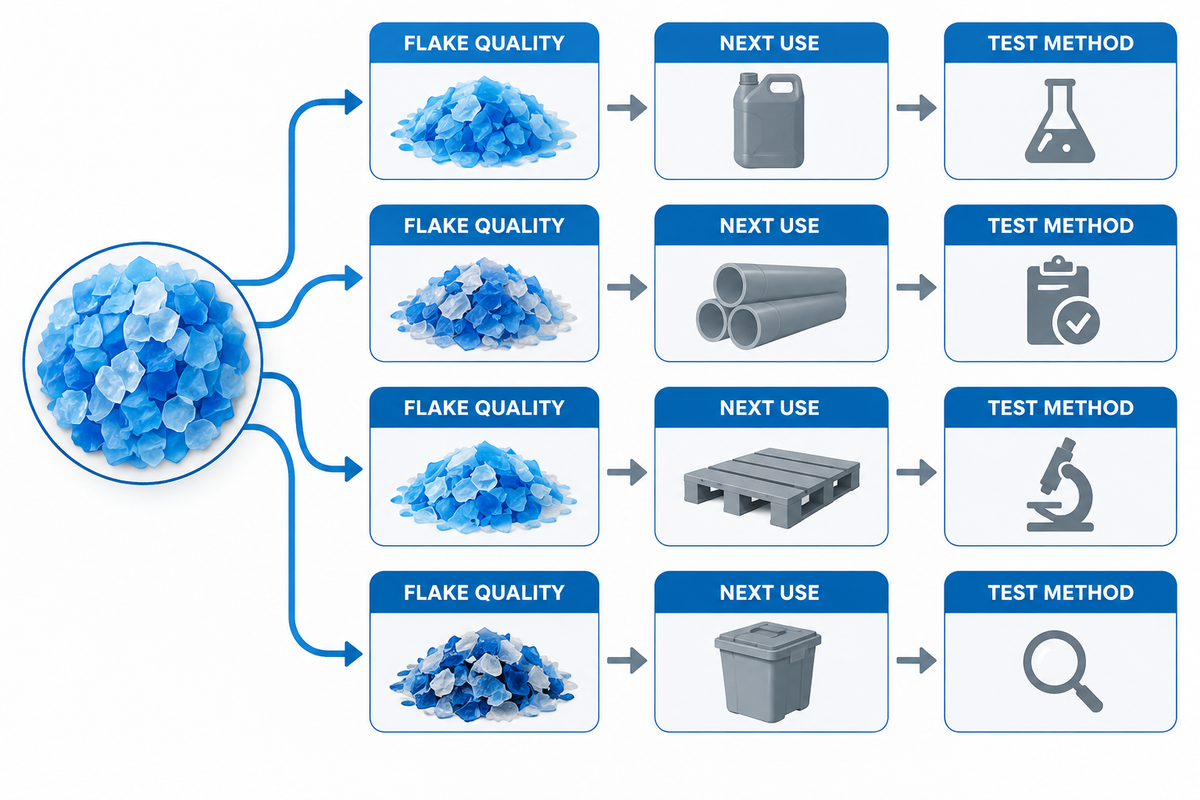
The specification for “Clean HDPE flake” is incomplete; Kitech’s plastic washing system overview provides the equipment-family context, but the release limits still belong to the downstream buyer. A pipe compounder, non-food bottle producer, profile extruder, and mixed color product molder may set different limits and test methods. Start with the next user’s process and work backwards to the recycling line; for food-contact applications, FDA asks for source control, process information, and evidence of contaminant removal rather than a generic clean-flake claim.
- Polymer purity: specified method and limit for maximum content of non-HDPE and incompatible polymers.
- Metal: detection sensitivity, sample size, and disposition of a failed sample.
- Moisture: test location, conditioning, method and limit agreed with the buyer.
- Fines and particle size: sieve method and acceptable distribution.
- Define the color class or blend, not “mostly blue.”
- Odor and residual contamination: Agreed test or qualified acceptance method.
RecyClass protocols illustrate the importance of method: they define preparation, washing, drying and conditioning for a particular recyclability evaluation. Use that discipline, but do not present a protocol’s laboratory conditions as every converter’s commercial flake limits.
Calculate Yield and Waste Loads From One Trial Batch
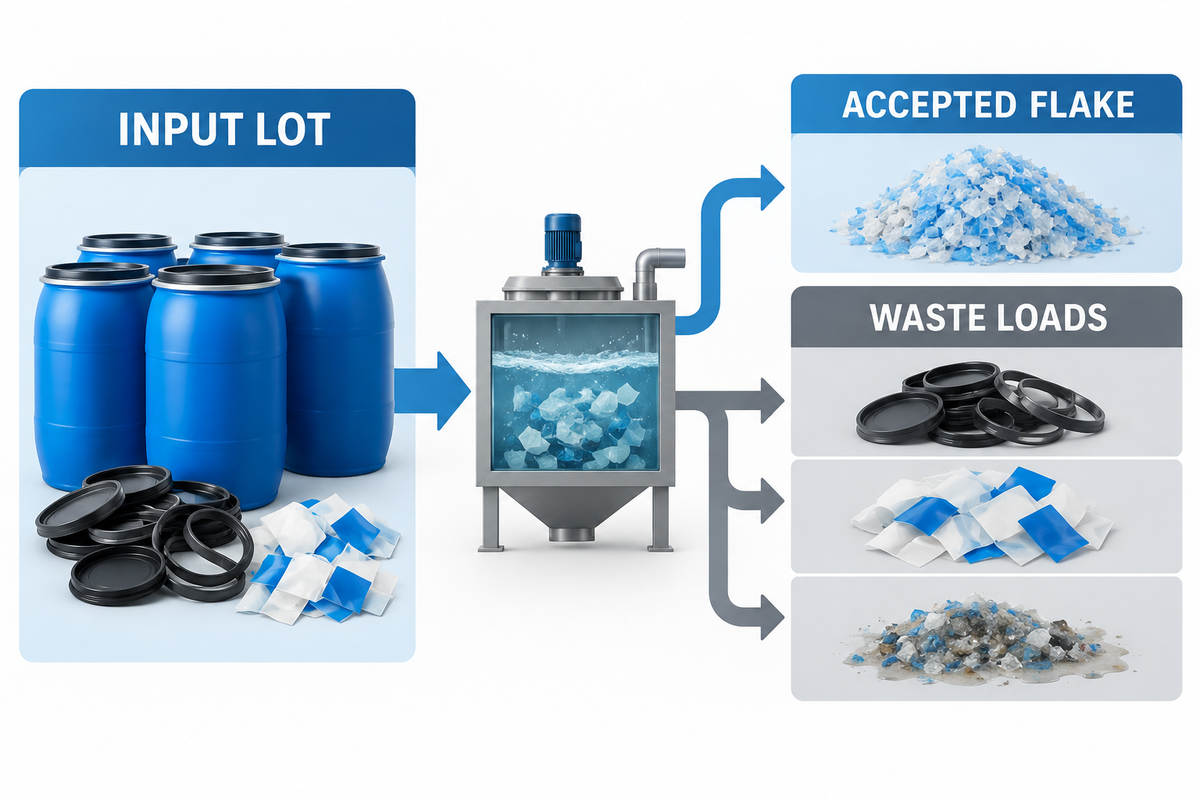
A mass balance exposes hidden assumptions. Consider an illustrative 1,000 kg as-received batch. Assume the trial records 70 kg of closures, metal, and labels; 80 kg of drained residue and captured solids; 25 kg of fines; 800 kg of dry accepted flake; 15 kg dry-solids equivalent in measured sludge; and 10 kg unexplained loss, while treating the lot and sampling basis as material because EPA’s representative-sampling guidance distinguishes homogeneous streams from heterogeneous or unclassified waste.
| Stream | Mass | Share of incoming batch |
|---|---|---|
| Dry accepted HDPE flake | 800 kg | 80.0% |
| Attachments removed | 70 kg | 7.0% |
| Residue and captured solids | 80 kg | 8.0% |
| Fines | 25 kg | 2.5% |
| Measured sludge solids | 15 kg | 1.5% |
| Unexplained loss | 10 kg | 1.0% |
Under those assumptions, dry accepted-flake yield is 800 ÷ 1,000 = 80%. Accounted mass is 990 kg, leaving a 1% gap. The numbers are fictitious and are not to be taken as a Kitech performance claim. Their purpose is to show the denominator: do not insert wet sludge mass into a dry-solids balance or compare an input-rate claim with a dry-output rate.
Specify the Acceptance Test Before You Request a Quote
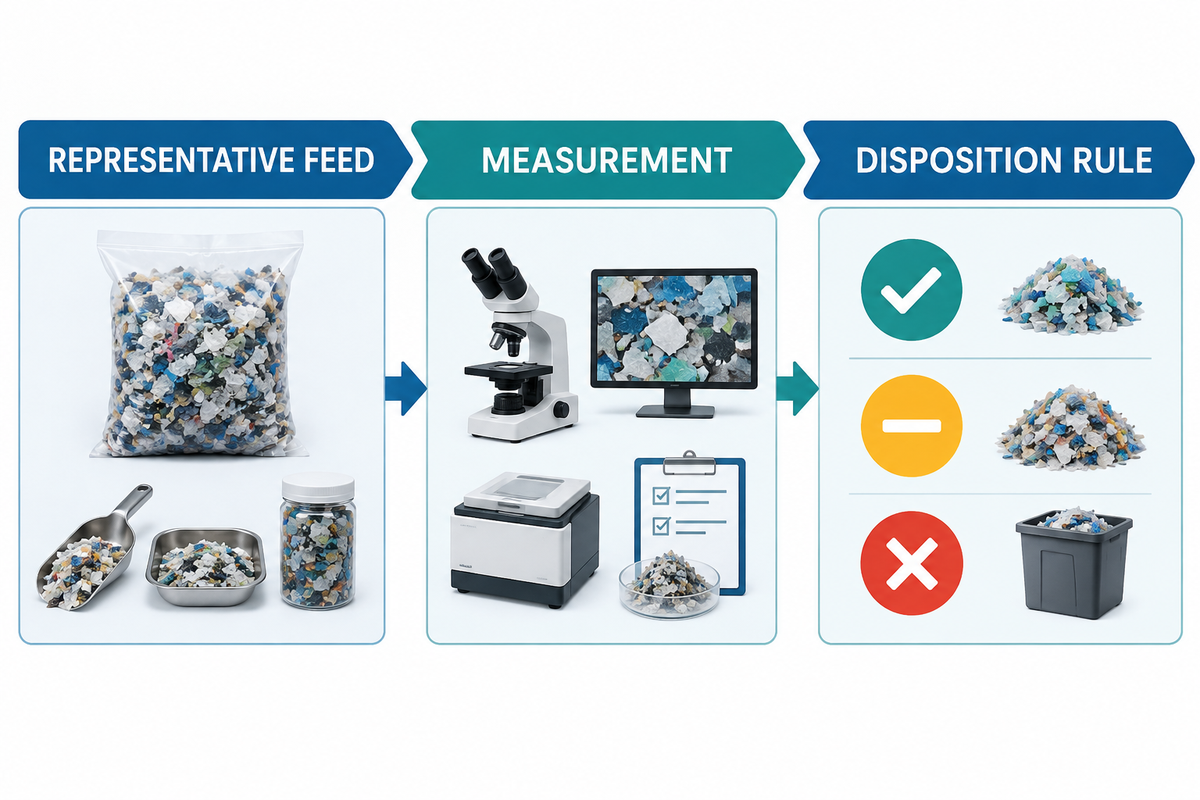
A defensible request for quotation (RFQ) defines the test in enough detail to prevent suppliers from pricing different interpretations. The feed description should also state how the sample represents the proposed supply, consistent with EPA guidance on representative sampling. The Feed-to-Flake Acceptance Limit Map connects each promise to an input, measurement, owner and disposition rule.
What belongs in the RFQ and factory acceptance plan?
- Representative feed pictures and analysis of composition, color mix, bulk density, and moisture. Exclusion of previous content (if any).
- Fixed test batch mass and stable process window after startup.
- Definition of throughput: Throughput is defined as input rate, gross washed output, or accepted dry-flake rate.
- Output specification, sampling points, sampling methods and laboratory responsibility.
- Categories of mass balance: attachments, residue, fines, sludge, rework, and loss in-process.
- Boundaries: water, heat, air, chemicals, effluent, and sludge.
- Rules for blocked equipment, feed interruption, retesting, off-spec product, and downtime.
- Controls, safety interfaces, spare and wear parts, training, and commissioning.
Report throughput, purity, yield, downtime and wastewater. A higher input rate with a lower accepted-flake yield is not equivalent to a lower input rate that meets the buyer’s specification. A short demonstration with hand-selected drums is not equivalent to a sustained run using the declared feed mix.
The final comparison will separate three types of evidence: supplier declarations, observations made during the trial, and measured results. This should illustrate differences in the process where appropriate, rather than assume a single configuration fits all drums.
Frequently Asked Questions
Can HDPE chemical drums always be recycled?
No. Just because the HDPE body is technically recyclable does not mean the actual route is the same. When deciding whether to recycle your drums, the actual route for recycling drums, including baled drums, depends on the previously documented contents, if the container meets the rules for an empty container, residual contamination, the condition of the drums, the recycler’s permits and acceptance policy, and the downstream flake specification. Unknown, non-empty, leaking or excluded drums should be held for a documented disposition rather than recycled.
A recycler should also distinguish transport compliance from process acceptance. A container may satisfy one rule yet still contain an odor, liner, pigment or absorbed residue outside a buyer’s material specification. Before shipping a mixed lot, obtain the receiving facility’s written limits.
Do plastic drums need to be washed before shredding?
The safe process order depends on the contents and the design of the facility and the approved operating procedure. Generally, drums need to be emptied and qualified prior to size reduction, but some plants add whole-container draining and prewashing. Some plants further add shredding, which is followed by washing. The important rule is that uncontrolled residue should not be introduced to an ordinary cutting device merely because a washing device exists downstream.
What contaminants must be removed from HDPE drums?
Common removal targets in mechanical recycling include free product, dirt, non-HDPE closures and liners, metal rings and inserts, incompatible labels or sleeves, adhesive, fines and off-spec colors. The applicable targets depend on the line’s separation capability and the flake buyer’s limits. Each target needs a defined inspection or sampling method; “looks clean” is not a release specification.
What is the difference between drum reconditioning and recycling?
Reconditioning involves cleaning, restoring, inspecting and testing the drum to enable it to be reused. Mechanical recycling of an accepted drum involves washing and separating the material to produce secondary HDPE feedstock.
How do buyers verify an HDPE drum washing line’s capacity?
Operate drums in a stable operating window agreed to by both parties. Record composition and rate of input material, stoppages, accepted dry flake output, reject and side streams, purity, moisture, waste loadings of wastewater and utility consumption. State whether the throughput figure is input or accepted. Repeat or extend the run if starting inventory, hand selected feed, and/or varying denominators do not allow a closed mass balance.
References & Sources
- U.S. EPA — Used Drum Management and Reconditioning
- eCFR — 40 CFR 261.7, Residues of Hazardous Waste in Empty Containers
- (Reusable Industrial Packaging Association – Codes of Operating Practice)
- Plastic Drum Institute — Resin Reconditioning Study
- RecyClass — HDPE Container Recyclability Evaluation Protocol
- Association of Plastic Recyclers — NIR Sorting Guidance
- U.S. FDA — Recycled Plastics in Food Packaging
- U.S. EPA — Representative Sampling Guidance