Get in touch with Kitech Company

Shredding Plastic Machines Explained: Industrial vs Maker Workshop Sizes

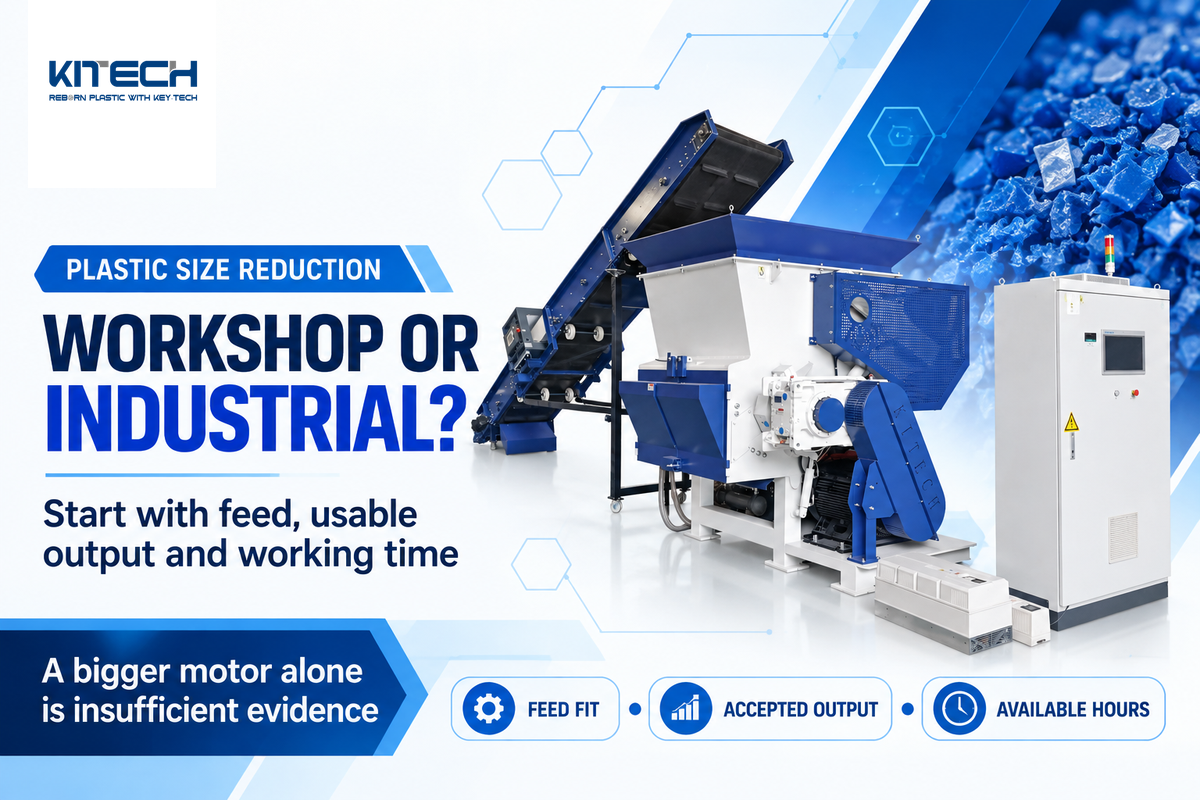
A shredding plastic machine fits best in a maker workshop when it can handle the work available with the correct batch time and output. For larger equipment demands, sustained demand, or integrated material handling, look towards industrial machines. Usually the starting point is with the feed material and the number of usable kilograms per working day. Then compare machines.
A smaller unit isn’t always hand-cranked, and an industrial shredder isn’t simply a workshop machine with a bigger motor. The examples below span manual, desktop-electric, semi-industrial and industrial equipment. Published rates describe particular configurations; a representative material trial connects them to your workload.
What Does a Plastic Shredder Machine Actually Produce?
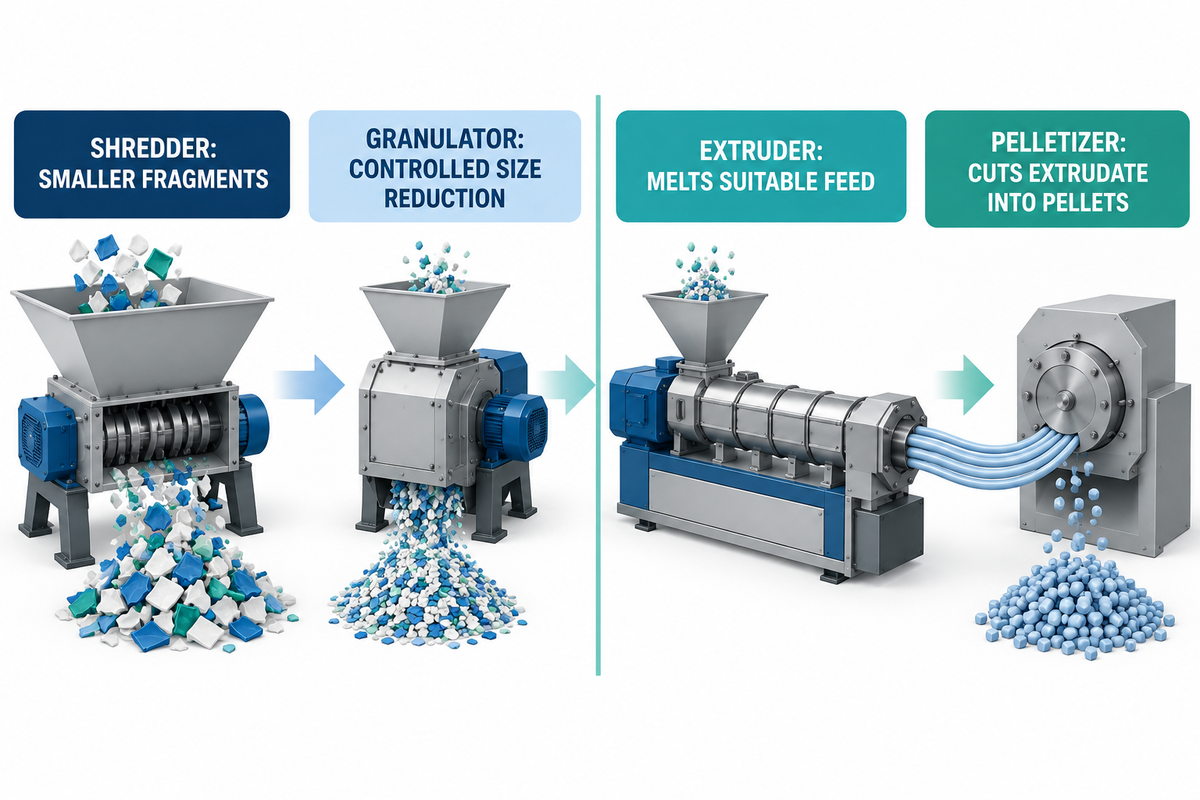
A plastic shredder mechanically cuts plastic waste into smaller pieces for easier material handling, or for further processing. A granulator performs a more controlled size reduction, and often uses a screen to retain larger pieces. Melt-based pellet production adds a separate process: an extruder melts the feed material, and a pelletizing machine cuts the extrudate into pellets.
In equipment catalogs, there are machines with names like plastic crusher, plastic grinder and grinder granulator. For equipment offered as a plastic shredder grinder, determine whether you need primary fragments or controlled plastic flakes. Identifying the cutting mechanism and desired output is better than considering the equipment interchangeable. The shredder and granulator comparison provides an example of the different duties. Our plastic pelletizing line is a separate downstream option for suitable material.
What do you do with shredded plastic?
Route identified shredded plastic to a receiving process that accepts its polymer, cleanliness and particle-size distribution. Based on your end use, further processing such as drying, extrusion or molding may be required. An injection molding workshop has a different feed requirement from an industrial recycling line preparing extrusion feed. Name that process requirement before selecting a shredder.
For instance, in Precious Plastic’s machine descriptions, shredding is separated from sheet pressing, extrusion and injection. Cutting is one operation within plastic recycling; it does not perform all the others. Only shred suitable feed.
When Is a Small Plastic Shredder Enough for a Workshop?
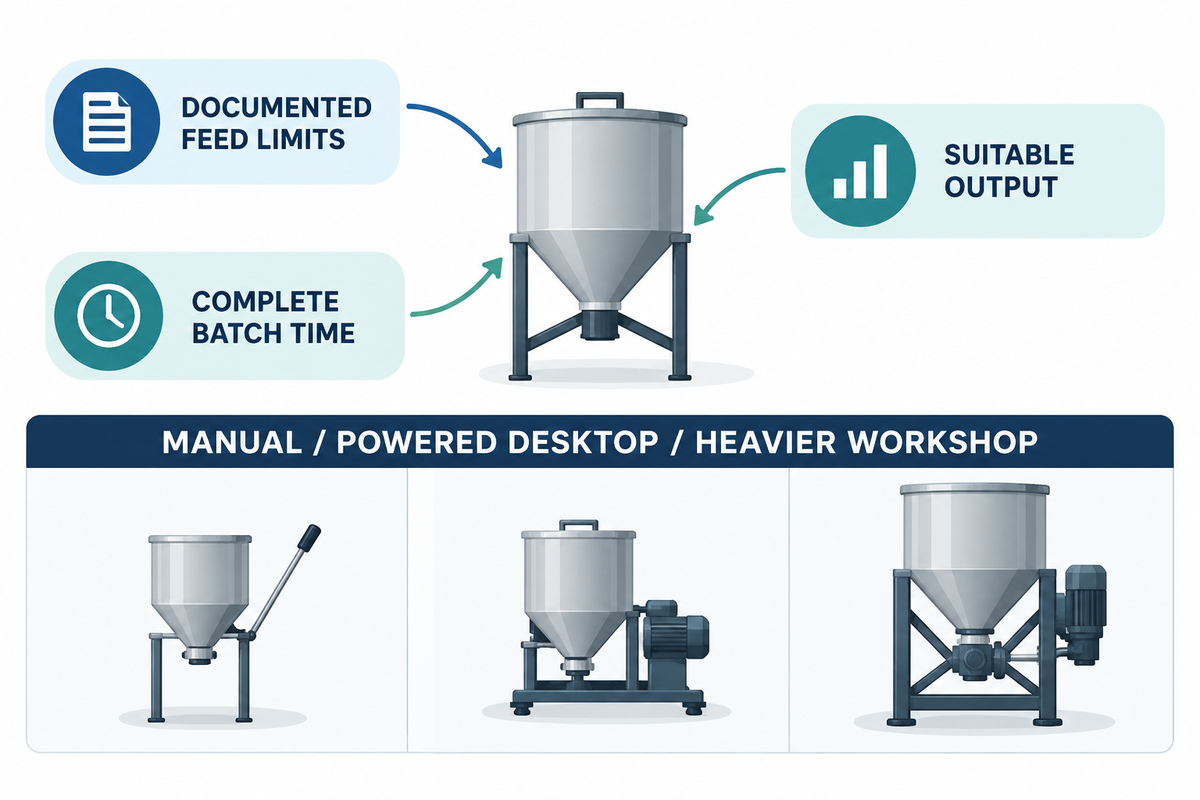
A small plastic shredder is sufficient when a few representative pieces fit the documented feed limits of the shredder, and the resulting material is suitable for the following process, and the whole batch fits your available time. Compact equipment covers several scales: a manually driven cutting box, a powered desktop unit and a heavier workshop machine can have substantially different installation needs.
For specific examples, Sustainable Design Studio lists its Mini V2 at approximately 5 kg/h, depending on material and drive method. It can be driven by a hand tool, a drill or motor. The Desktop Shredder V2 is electric: the seller lists a 1.5 kW motor and up to 20 kg/h with the standard 8mm mesh. These are separate machines and conditional seller ratings.
How do you prepare plastic before shredding?
Intended feed must be separated from foreign objects and whole part dimensions compared to the limit of the manufacturer. Keep unknown mixtures outside the trial. Prepare plastic for recycling as identified streams, and shred only the material included in the agreed application. The application should describe resin, form, thickness and contamination. Preparation should be done according to the instructions for use of the machine; it shouldn’t involve reaching into a hopper or modifying the machine.
For a printing workshop, recycling 3D print waste also involves material quality and downstream processing. Shredding PLA prints doesn’t make usable printer filament.
What Changes with an Industrial Plastic Shredder?
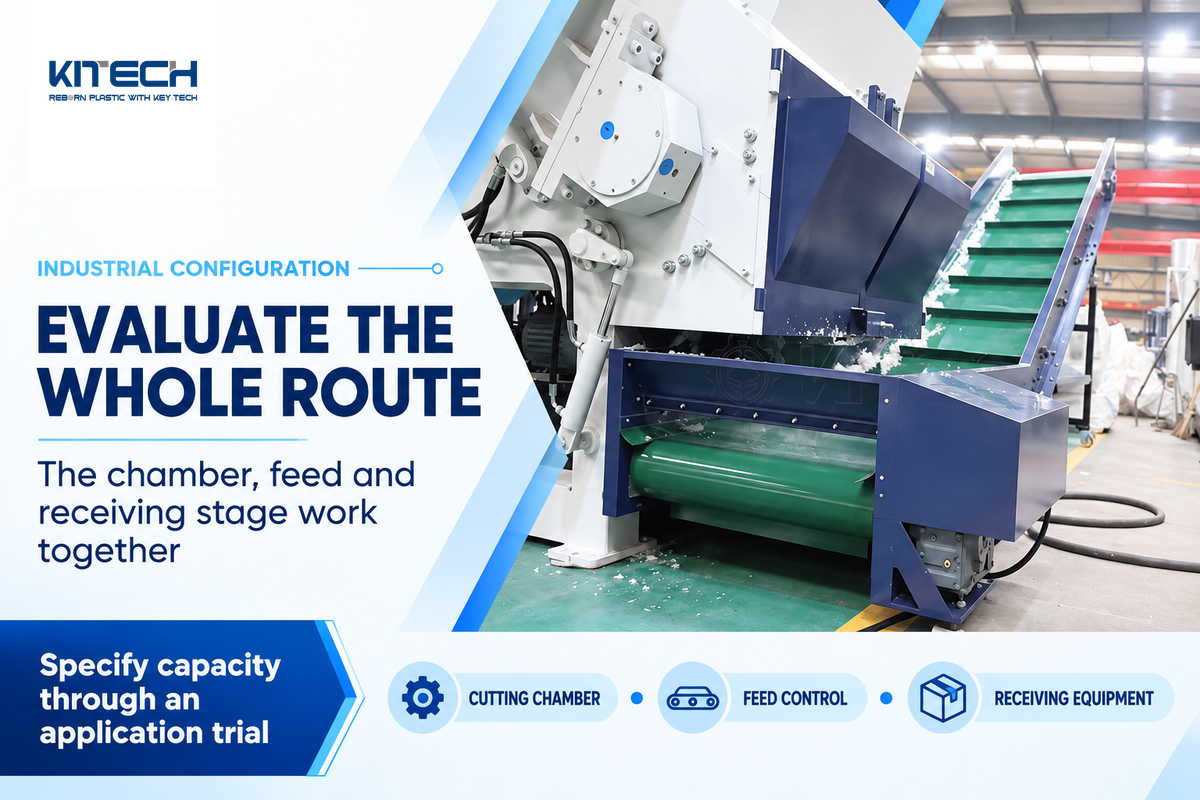
An industrial plastic shredder adds cutting capacity and material-handling options for a defined application, rather than a universal daily output. Consider the chamber, rotor, shaft arrangement, feed control and receiving equipment together. A single-shaft shredder with a hydraulic ram employs a different feeding system from a compact, manually loaded machine.
The following are supplier-published examples, checked on 27 October 2026 . They illustrate scale as opposed to fixed capacity classes or independently verified rankings.
| Example | Drive or motor | Size measurement | Published output and condition |
|---|---|---|---|
| Mini V2, table-mount configuration | Hand tool, drill or motor options | 38 × 37 × 16 cm, H × L × W; 12 kg | Approximately 5 kg/h; material and drive dependent |
| Desktop Shredder V2 | 1.5 kW; 220V, 50 Hz | 77 × 35 × 64 cm, H × D × W; 85 kg | Up to 20 kg/h with standard 8mm mesh; optional 5mm mesh |
| Precious Plastic Shredder Pro | 2.2–4 kW; 400 V | 1205 × 550 × 1512 mm overall; 340 kg | Up to 50 kg/h, depending on desired flake size |
| Kitech AGS850 single-shaft shredder | 37–55 kW | 840 × 1570 mm cutting chamber; not overall dimensions | Rate to be specified through an application trial |
| Kitech AGF500/700 granulator, separate equipment family | 37–55 kW | Granulator configuration; not an AGS chamber measurement | 0.3–0.5 t/h listed for this granulator range; not an AGS rating |
Sources: Mini V2, Desktop V2, Shredder Pro and Kitech’s AGS/AGF specification. Overall dimensions need installation and servicing allowances; chamber dimensions describe the cutting space.
Double-shaft shredders and other industrial shredders also warrant application-specific evaluation. In her granulator sizing article, Paige O’Meara of Wittmann USA relates machine technology to the material being handled, the desired regrind and the throughput required.
What are the different types of plastic recycling machines?
The process steps include sorting, shredder, granulator, washing, drying, extrusion, and molding. Decide on the stages based on the incoming waste and the desired final product. Clean production offcuts and contaminated packaging waste require different treatment routes and adding each machine to a line won’t always be beneficial.
Match the Hopper and Cutting System to Plastic Waste
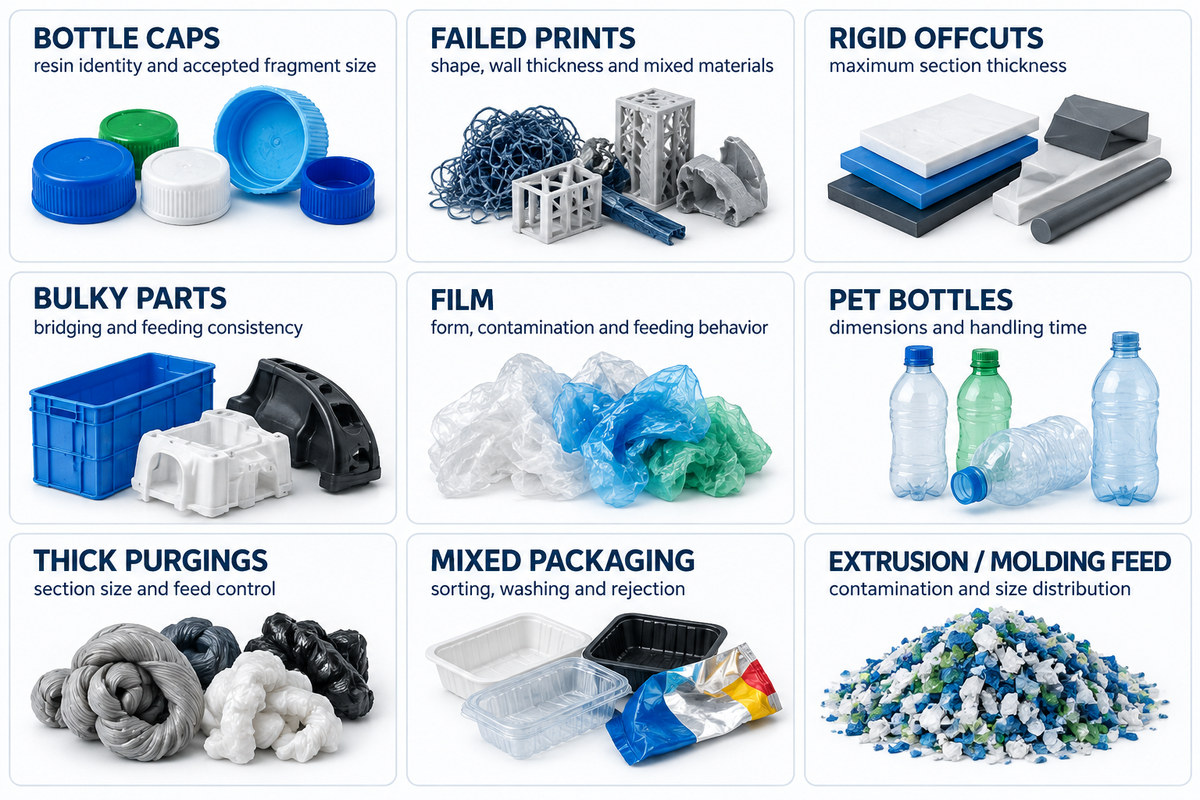
For each item, evaluate the largest representative piece, its thickness, and its form with respect to the feeding and cutting system. Then, assess the output with respect to the next process. Polymer names such as HDPE, LDPE, PP, PET and PVC describe only part of the application. Handling film, hollow containers, thick, solid scrap and other products presents different challenges.
Use this feed-to-output map to document a trial. Cumberland’s sponsored technical explanation links granulator selection to size, shape, thickness and density.
| Feed or application | Trial observation | Decision affected |
|---|---|---|
| Sorted bottle caps | Resin identity and accepted fragment size | Receiving mold or further granulation |
| Failed 3D prints | Largest shape, wall thickness and mixed materials | Feed fit and separation effort |
| Rigid production offcuts | Maximum section thickness and repeatability | Cutting configuration |
| Bulky items or hollow parts | Bridging and feeding consistency | Chamber and loading arrangement |
| Plastic film | Film form, contamination and feeding behavior | Film-specific handling or plastic film shredder trial |
| Loose PET bottles | Whole-container dimensions and handling time | Feed system; a plastic bottle crusher has a specific duty |
| Thick purgings | Section size and behavior under the proposed feed control | Application approval and loading system |
| Known mixed packaging streams | Sorting, washing and rejection requirements | Preparation and waste management route |
| Feed for extrusion or injection molding | Contamination and acceptable size distribution | Screen, further processing and receiving equipment |
For unknown electrical/electronic or flame-retarded scrap, obtain specialist waste classification before assuming a recycling route. For instance, the guidance from the Environment Agency (England) restricts the use of recycling for identified waste containing persistent organic pollutants. This is a specific material and jurisdiction boundary.
Select the screen to reduce plastic to the size distribution the next process accepts. Note the effect of screen choice on sizing duty; see shredder screen selection. Also, compare steel blades or alloy steel blades through their documented application, wear and service requirements. For a granulator with alloy steel cutters, include the actual blade specification and service requirements in the quotation. Our blade material guide addresses this in greater detail.
Hypothetical plant scenario. A molding business plans to reprocess identified production scrap. Small offcuts feed easily, but occasional hollow parts occupy most of the operator’s time. The trial log therefore separates those forms instead of reporting one average for a convenient bag of small pieces. Staff also record whether the granulator receives material consistently and whether its output meets the molding process requirement. A larger primary shredder is considered if its feeding arrangement addresses the challenging parts. If the receiving stage is the constraint, then moving the material further down the line, with primary reduction only, doesn’t reduce the waiting time.
Calculate Plastic Shredder Capacity from Your Working Time
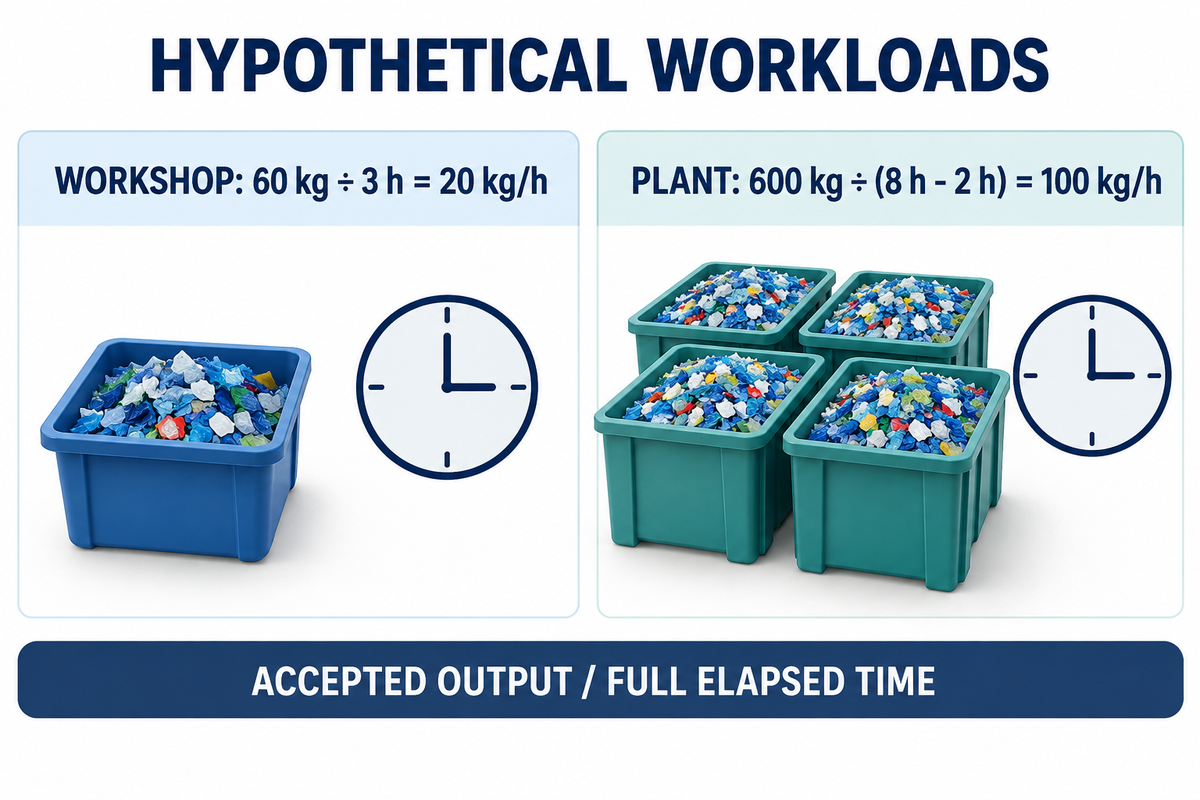
For a production plan, the target accepted kilograms are divided by the actual processing hours available. For a machine trial, the accepted output is divided by the full elapsed trial time, with preparation and stoppages specifically timed. These time bases should remain visible: a short cutting-only rate answers a different question from delivery across a complete work session.
Assume the following workloads. A workshop needs 60 kg of accepted output per day and allocates 3 hours to processing. A plant needs 600 kg and has an 8-hour schedule with 2 hours unavailable.
| Assumed case | Calculation | Required average |
|---|---|---|
| Workshop | 60 kg ÷ 3 h | 20 kg/h accepted output |
| Plant | 600 kg ÷ (8 h − 2 h) | 100 kg/h accepted output |
At a constant 5 kg/h, 60 kg would take 12 processing hours. Likewise, an advertised 20 kg/h rate matches the workshop’s numerical target only if the trial’s material, accepted yield and time basis match.
If the available figure is scrap mass in input, measure accepted yield and determine the usable output target. Rejected material, oversize fragments, and material waiting for another pass should be included in the scrap mass record. Results can be altered due to usage of fine screens and different feed. Test the system in the desired configuration.
Motor power in kW is an equipment specification. Energy intensity is calculated by dividing the measured kWh by accepted kilograms for the same test period. Do not calculate operating cost by assuming that the nameplate motor draws full rated power throughout every scheduled hour.
Can businesses benefit from shredding plastic?
Usable output can be less costly and more beneficial if there’s a clear destination for the output and the complete operation costs less than the chosen alternative. Service, wear, paid handling time and electricity costs for handling the process, along with receiving and inspection costs, should be compared to outsourcing the size reduction or acquiring recycled plastic.
Does Buying a Bigger Shredder Save Money?
A larger machine saves money when it removes a costly constraint often enough to cover its additional ownership and operating costs. Analyze cost per accepted kilogram for the same material and accounting period. Consider shredder blades, service access, collection equipment and paid operator time. Consider current landfill or disposal costs, if applicable, in the alternative case. Industrial shredder cost factors provide a more detailed purchasing breakdown.
Power, Space and Guarding Before Installation
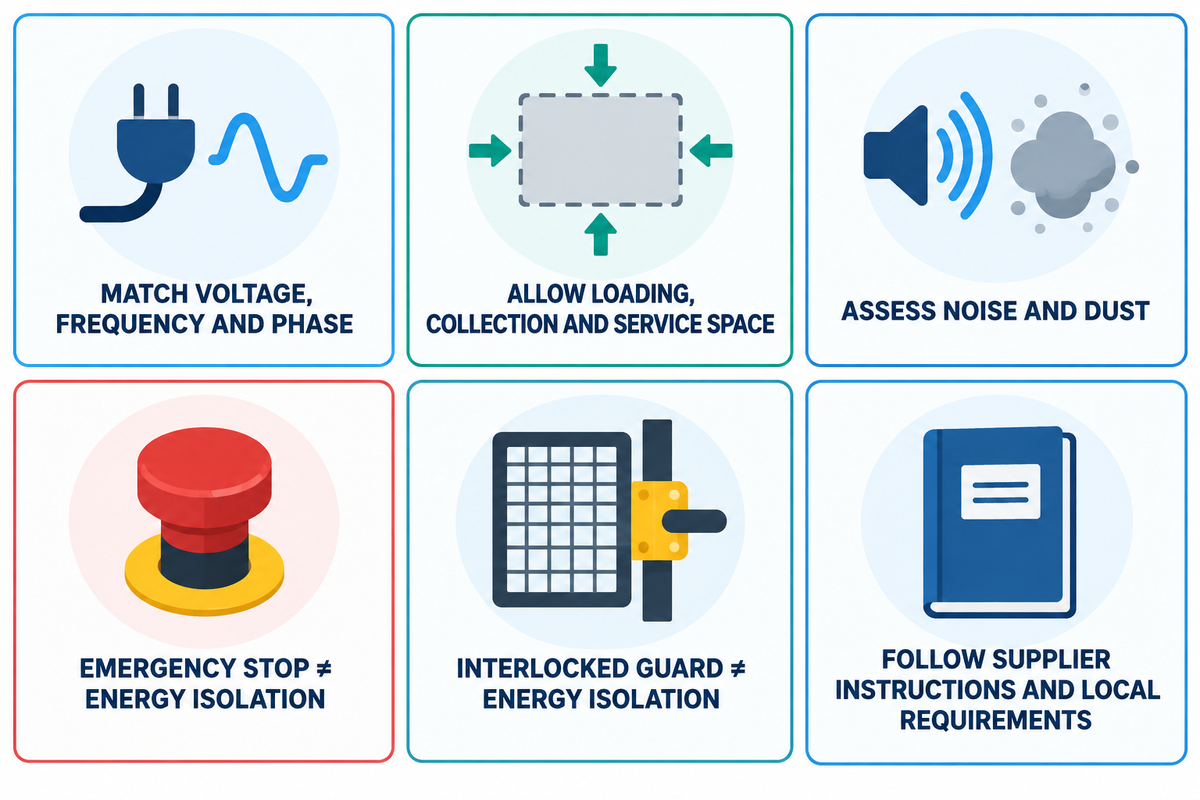
Consider an electrical supply and complete layout and controls that are appropriate for the intended use of the new installation. Allow for loading and discharging, and for the machine itself, service and cleaning. Assess the noise and dust from the intended operation, particularly if an occasional batch operation becomes a daily routine.
The desktop example specifies 220V, 50 Hz; the Pro example specifies 400 V. Match voltage, frequency and phase with the desired configuration through the supplier and a qualified installer. Optional caster wheels or a small cabinet do not change these requirements.
UK HSE plastics-industry guidance identifies shredders and granulators as noise sources and considers combined exposure over the course of a workday. Determine the noise exposure of the actual tasks. Other controls that may need to be considered are enclosure, housekeeping and dust collection, suited to the material and the method of installation.
What equipment do you need to shred plastic?
Plan a suitable shredder, approved loading and collection arrangements, and any preparation or downstream equipment required by the application. Include the electrical installation and appropriate noise and dust controls. The right machine for recycling is part of that complete route; a workshop trying to reduce waste needs a use for the output as well as a cutting unit.
What safety features should a plastic shredder have?
Use equipment that has suitable guarding, controls and means for safe energy isolation, suited to the intended material and the operating condition. The configuration is determined by the supplier’s instructions and a site specific evaluation. An isolating device serves a different purpose from an emergency stop and an interlocked guard. An anti-jam feature isn’t permission to access moving cutters.
As stated in US OSHA 1910.147, control-circuit devices are distinct from energy-isolating devices. HSE waste-machinery guidance addresses suitability, guarding and isolation as well. Ensure the relevant procedures are followed and the correct local requirements are observed when servicing and/or cleaning; see our service and maintenance planning guide.
Use a Material Trial to Decide When to Upgrade
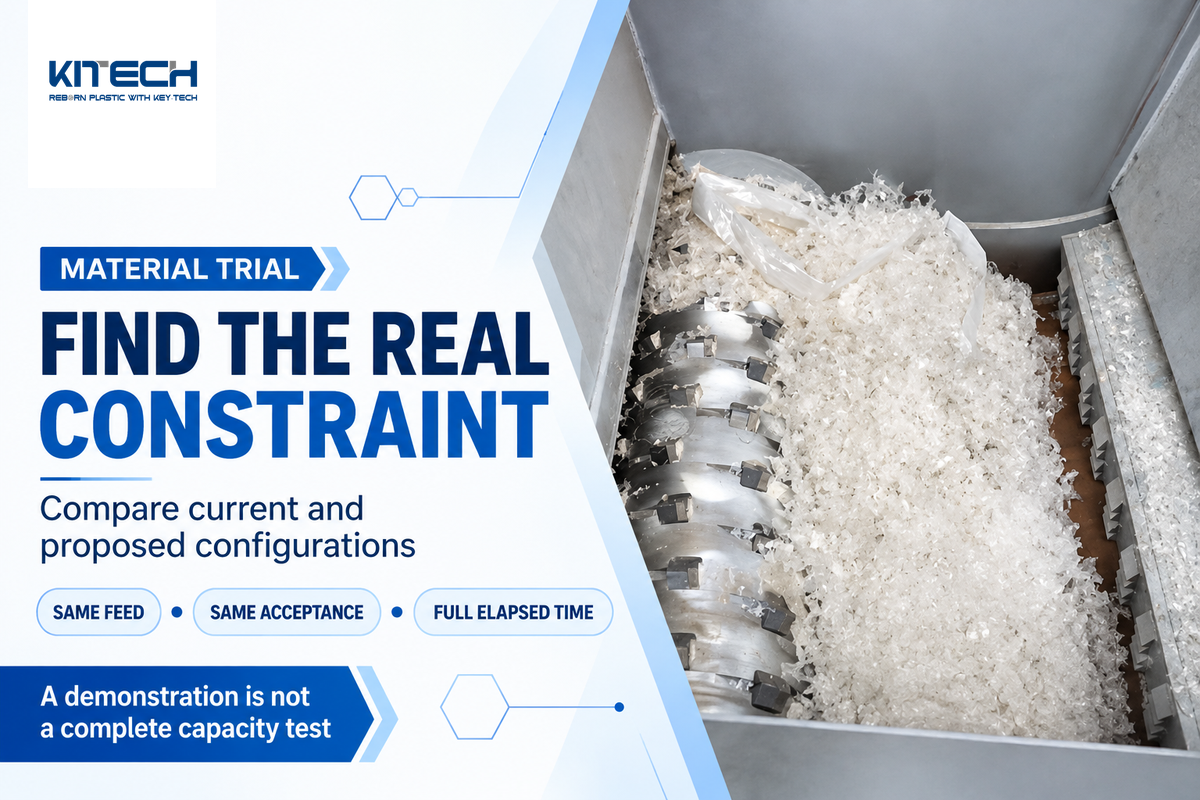
Upgrade if a representative trial shows the compact arrangement can’t produce the required output within the time allowed, or if the incoming parts exceed the limits defined in the application. Find the restriction first. Then evaluate whether the proposed industrial configuration meets the same requirements for output, material and time.
“The clearest lesson so far is that deploying the equipment isn’t enough to ensure success.”
His program lesson is useful here: the quality of the material and the collection affects the entire route. Therefore, to ensure relevance and validity of a demonstration, the material being fed should be used rather than a surrogate simply because it cuts easily.
Batch-to-Shift Readiness Test
Use the following record for both the current workshop set-up and the proposed machine. Mark each item with the observed result or the information required.
| Record | Workshop setup | Proposed industrial setup |
|---|---|---|
| Feed identity and contamination | Current accepted stream | Same representative stream |
| Largest part and thickness | Documented feed fit | Proposed feed fit |
| Preparation and sorting | Paid time recorded | Paid time recorded |
| Input mass | Weighed test batch | Weighed test batch |
| Accepted output mass | Receiving-process specification | Same acceptance specification |
| Full elapsed trial time | Include interruptions | Include interruptions |
| Screen and repeated passes | Actual configuration | Proposed configuration |
| Installation and exposure | Power, space, noise and dust | Power, space, noise and dust |
| Ownership and support costs | Labor, energy, wear and service | Comparable scope and period |
Hypothetical purchasing scenario. A buyer is given a demonstration whereby clean shredded plastic is shown dropping into a bin. Before accepting the result as a capacity test, the buyer requests the input description, screen configuration, batch mass, accepted output and the elapsed start-to-finish time. The quotation identifies the feeding system and downstream equipment, if any. Preparation that happened off camera or repeated passes, if any, are captured and compared to the record. The outcome is a documented application proposal rather than a purchase based on the fastest portion of a video. The same record captures retention of the status quo (e.g. no machine purchase), extended hours, or outsourcing.
For a Kitech proposal, provide the material description, largest part dimensions, targeted output, daily requirement, available hours and site supply. Compare our industrial plastic shredder options with the sample data. The Equipment Acceptance Testing Guide outlines how to turn a demonstration into a purchase record.
What to Plan for in 2027
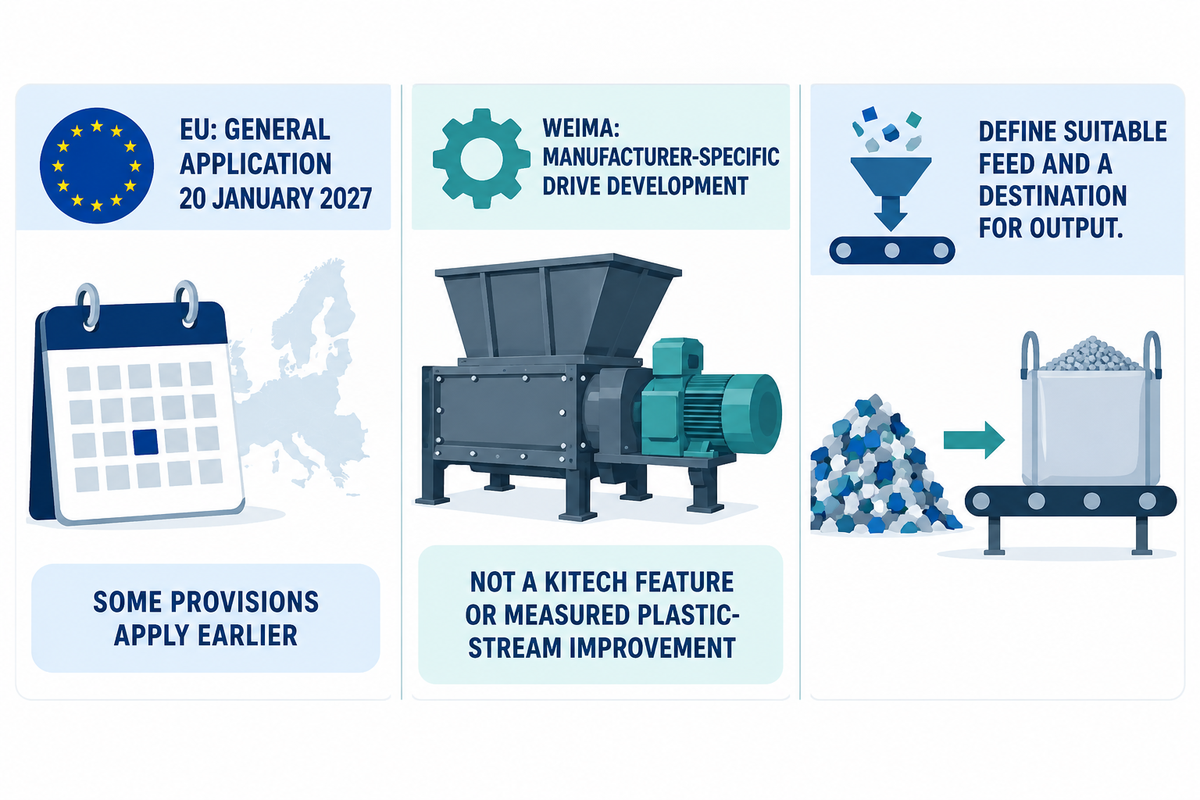
For a purchase extending into 2027, plan delivery-market documentation, actual feed collection system and acceptance trial before deciding on additional drive power. The European Union has an application date for the machinery regulation, and manufacturers continue developing drive systems.
The official European Union machinery summary gives 20 January 2027 as the general application date of Regulation (EU) 2023/1230 and notes that some provisions apply earlier. For equipment destined for the European Union, the purchase brief should identify the intended placing-on-market arrangements, applicable requirements and documentation for that configuration. It may be treated as a procurement-planning input, rather than as a declaration that all machines sold outside the EU have the same requirements.
On the technology side, WEIMA’s IFAT 2026 announcement describes a new high-torque drive for one of its waste shredders. That is a manufacturer-specific development, not a Kitech feature or a measured improvement for your plastic stream. When assessing advanced features, associate each to a trial observation, for example irregular feed, an overloaded receiving stage, excessive handling, or inconsistent product output.
The same discipline applies to a flywheel, a hydraulic feed system or a control described as suitable for nonstop running. The drive, duty and control arrangement selected must be suited for the application for which it’s being used. A feature list becomes helpful when a quotation shows which operating problem it addresses and the acceptance test record supports that condition.
Collection planning deserves equal attention. If the workshop expects more packaging waste, specify how known materials will be separated and fed to the machine. If the plant wants to launch another plastic product, show its actual rejects in the sample. A repeatable supply of suitable feed and a defined destination for output give the next investment a usable workload; a bigger machine by itself doesn’t create that material loop.
Frequently Asked Questions
What is shredding of plastics?
Plastic shredding mechanically cuts plastic waste into smaller fragments so it can be handled or processed further. The result depends on the machine, cutters, screen and incoming material. Shredding is a size reduction step: it doesn’t by itself wash mixed waste, identify polymers or melt material into finished recycling pellets.
Can a paper shredder shred plastic bags?
Usually not: plastic can damage a paper shredder by clogging its cutting blades, so use one for plastic bags only if its manufacturer explicitly approves that plastic and its form. A paper shredder specification isn’t approval for processing bags, film or rigid scrap. For a workshop project, ask the equipment supplier about compatible feed, guarding and permitted operation instead of modifying an office machine or testing unknown materials in it.
Does a shredder make plastic pellets?
No; a shredder mechanically cuts material into fragments. In a melt-based recycling line, an extruder melts and processes suitable plastic, and pelletizing equipment cuts the extrudate into pellets. The extrusion and pellet-cutting stages have different functions from mechanical shredding. Select the required output and process route before comparing equipment with overlapping catalogue names.
Can plastic be shredded?
Many plastic articles can be size reduced with suitable equipment, but the polymer name describes only part of the job: film, hollow containers and thick, solid scrap present different handling challenges. Check part dimensions, thickness, additives, contamination and required output against the supplier’s application limits, then test representative suitable material before committing.
Are small plastic shredders worth it?
A small shredder can be worthwhile when it fits your actual scrap, its accepted output has a use and batch work fits the time you can allocate. Include preparation, feeding, collection, repeated passes and cleaning in that comparison. Low purchase cost doesn’t compensate for excessive handling hours: at a constant 5 kg/h, 60 kg would take 12 processing hours. Compare the cost per usable kilogram with outsourcing or buying suitable recycled feedstock. Use a material trial to resolve uncertainty before paying for equipment, rather than relying on a demonstration.
Can I make filament directly from shredded prints?
Shredding produces fragments, not finished filament. Suitable feed needs the appropriate downstream preparation, extrusion and diameter control for a filament-making process. Define those receiving requirements before treating print waste as usable feedstock for your printer.
How do I know it is time to move to an industrial machine?
Consider industrial equipment when representative trials show that your required accepted output can’t fit the workshop’s available time, or your feed needs handling and cutting capacity beyond the compact machine’s documented limits. First confirm where the delay occurs: sorting, preparation, feeding, cutting or the next process. A larger shredder only helps if it addresses that constraint. Match the proposed installation, support arrangements and total operating cost to the workload before upgrading; motor power is an equipment specification, not a measure of accepted output.
References & Sources
- HSE: machinery in waste management and recycling, and plastics-industry noise guidance.
- OSHA: hazardous energy control, 29 CFR 1910.147.
- Environment Agency: managing waste containing persistent organic pollutants, England.
- EUR-Lex: machinery safety requirements and application dates.
- Paige O’Meara, Wittmann USA: Sizing Your Granulator To Optimize Scrap Reuse, Plastics Technology, 2025.
- Recycling Today: Arizona commercial-film collection program, 2026.
Trending now