Get in touch with Kitech Company


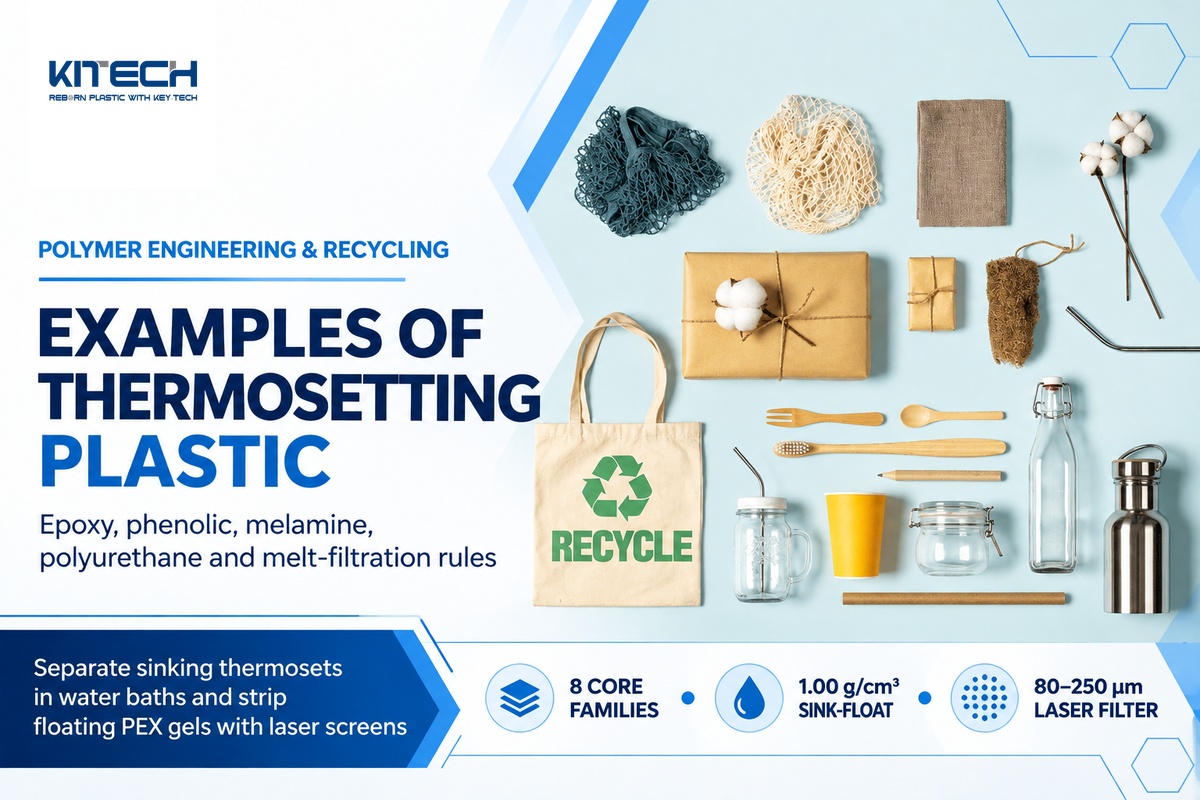
The core industrial examples of thermosetting plastic include epoxy resin (EP), phenol-formaldehyde (Bakelite, PF), melamine-formaldehyde (MF), urea-formaldehyde (UF), unsaturated polyester (UPR), cross-linked polyurethane (PUR), vulcanized silicone (VMQ), and sulfur-cured rubber; cross-linked polyethylene (PEX/XLPE) is evaluated separately as a cross-linked polyolefin contaminant. Because an irreversible chemical reaction locks their molecular chains into a permanent three-dimensional covalent network, cured thermosetting materials typically char or thermally decompose around 200 to 400 °C (varying by resin formulation, curing agent, and filler loading) instead of melting. For thermoplastic recycling plants, profitable operation requires sinking heavy thermoset fragments (specific gravity >1.00 g/cm³, spanning 1.15 g/cm³ to 2.00 g/cm³) in water baths and stripping floating PEX gels (0.93 g/cm³ to 0.95 g/cm³) with 80 to 250 µm continuous self-cleaning laser melt filters.
Quick Engineering Reference: The Sink-Float vs. Laser-Screen Contamination Split Framework
- Across 54.1 Mt of European polymer demand, other thermosetting resins represent a 5.9% conversion share, alongside polyurethane networks (Plastics Europe), while global thermosetting market revenue reaches USD 90.31 billion in 2026 (Fortune Business Insights).
- Under The Sink-Float Density Split Matrix (1.00 g/cm³ Water Bath vs. Extruder Screen Cut), polymer specific gravity separates unfilled and glass-filled epoxy (1.15–1.40 g/cm³ neat; 1.70–2.00 g/cm³ composite), phenolic (1.25–1.50 g/cm³), MF/UF amino resins (1.45–1.60 g/cm³), and polyesters sinking at >1.00 g/cm³ in a 1.00 g/cm³ water bath from cross-linked polyethylene (PEX/XLPE, 0.93–0.95 g/cm³) and rigid polyurethane foam (0.03–0.60 g/cm³) floating with HDPE and PP flakes.
- According to The 260 °C Soldering-Iron & Solvent Swell Shop-Floor Identification Protocol, suspect bale fragments may be screened by receiving inspectors using a 260 °C heat probe, a 180 °C hot air elasticity test, and a surface wipe with acetone, prior to shredding.
- According to the 80-250 µm Continuous Laser Filter Mesh Selection Rule for Cross-Linked Gel Removal, Kitech KLF Series laser filters, which use 80 to 250 µm hardened steel discs (rated at 30 MPa), remove under-melted PEX and elastomer gels in a 10-second scraping cycle, without blackouts of the screen packs.
What Makes a Polymer a Thermoset? Covalent Cross-Linking vs. Thermoplastic Melting
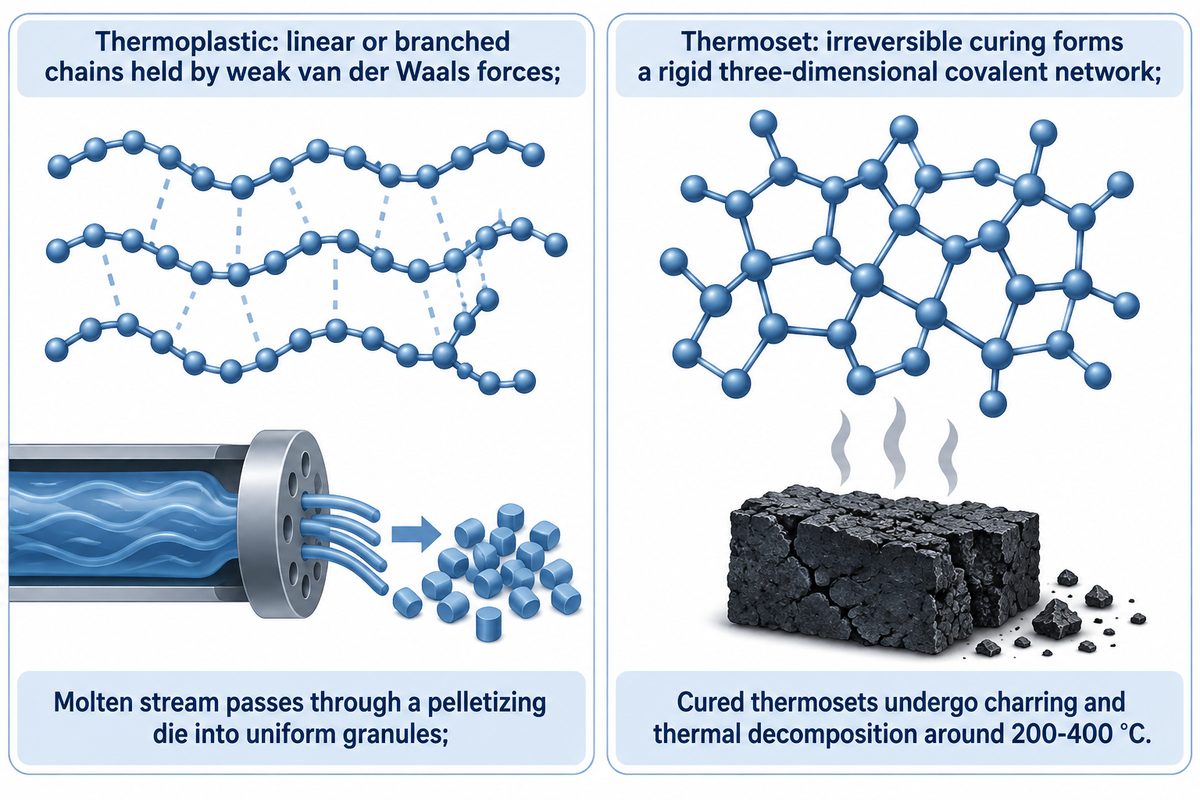
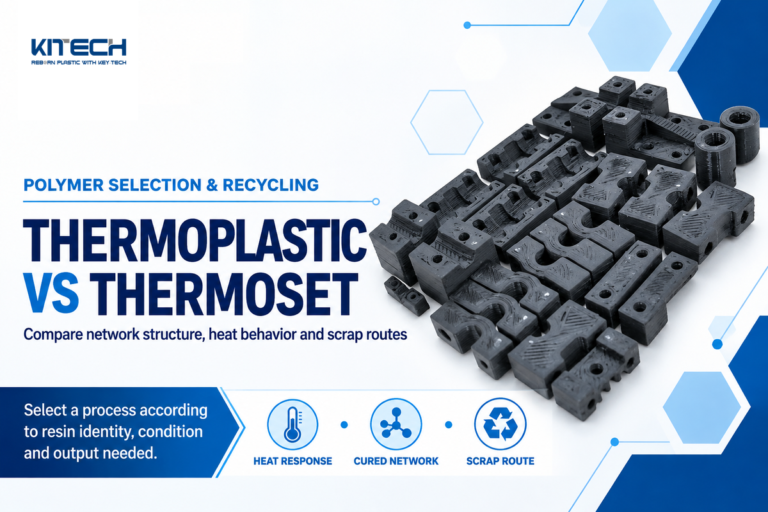
A thermosetting polymer is a plastic material in which monomers or prepolymer chains, under the influence of an irreversible curing process, led by heat, catalysts, or irradiation, form a rigid three-dimensional, covalent network. Unlike a thermoplastic polymer, which softens on heating and hardens on cooling, cured thermosets undergo charring and thermal decomposition around 200-400 °C (varies with resin chemistry, curing agent, and filler system) without going through a molten state.
Analysis of structural differences between thermoplastics and thermosets starts at the level of molecular architecture. In most thermoplastic material, such as polyethylene, polypropylene, and amorphous polystyrene, molecular chains remain linear or branched throughout their common types of thermoplastic. Weak secondary van der Waals forces allow adjacent chains to come together. When heat is applied at a specific temperature above the glass transition temperature inside an extruder barrel, thermal energy breaks the intermolecular attractions, and the chains, being in a lower energy state, collapse to a tightly packed amorphous condition. The molten stream can pass through a pelletizing die; semi-crystalline polymers crystallize on cooling, while amorphous polymers solidify without crystallizing as the material solidifies into uniform granules.
Thermosetting materials, on the other hand, begin as low-viscosity liquid precursors or B-stage molding powders. During the manufacturing process, chemical reactions chain down the length of the molecule and fuse reactive groups across all planes (like epoxide rings with polyamines; or phenols with formaldehyde methylene bridges). Once this network formed during curing reaches gelation (Syracuse University Libraries Plastics Collection), the entire molded component effectively becomes a single interconnected macromolecule locked by primary chemical bonds.
Cured thermoset is decomposed by heat. Reheating a cured thermoset breaks or degrades network bonds before the material can flow as a melt, producing decomposition gases and char instead of a recyclable melt; attempts to reheat and reshape a cured thermoset plastic therefore fail. For a more in-depth molecular comparison of linear versus cross-linked architecture and other key properties of plastics, see our engineering guide on thermoplastic vs. thermosetting plastic.
8 Core Examples of Thermosetting Plastic: Industrial Properties & Density Matrix
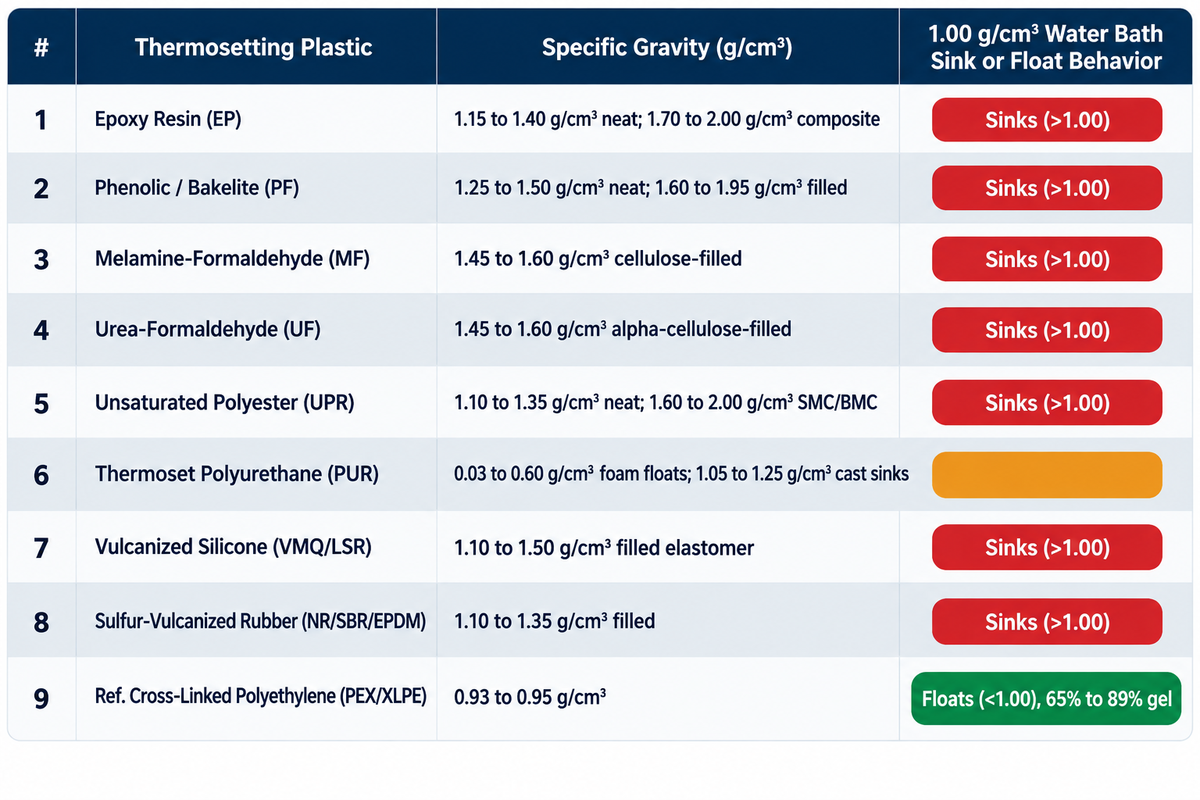
The thermosetting plastics consist of high-density electrical resins (epoxy, phenolic Bakelites, melamines, and urea-formaldehyde) and structural or elastomeric networks (unsaturated polyester, cross-linked polyurethane, vulcanized silicone, and sulfur-cured rubber). Their specific gravities cover the range from 0.03 g/cm³ (rigid, low-density insulation foams) to 2.00 g/cm³ (densified or glass-reinforced composites). Their specific gravity spans 0.03 g/cm³ in rigid insulation foams to 2.00 g/cm³ in glass-filled composites, while thermal decomposition typically begins around 200 to 400 °C depending on formulation and filler content.
Identify each type of plastic in mixed post-industrial scrap by general properties and physical properties such as specific gravity and thermal degradation onset rather than textbook chemical names. Under The Sink-Float vs. Laser-Screen Contamination Split Framework and The Sink-Float Density Split Matrix (1.00 g/cm³ Water Bath vs. Extruder Screen Cut), plant engineers separate incoming plastic properties and each thermoset material into two buckets: heavy thermosets (>1.00 g/cm³) that sink in standard wash-line float tanks, and buoyant cross-linked materials (0.03 g/cm³ to 0.95 g/cm³) that float over the weir alongside polyolefin regrind. Note that specific gravity and thermal decomposition onset ranges for epoxy, phenolic, amino, polyester, polyurethane, silicone, rubber, and PEX vary with mineral or glass fiber filler loading and curing agent chemistry.
| # | Thermoset Family & Code | Unfilled vs. Filled Specific Gravity (g/cm³) | 1.00 g/cm³ Water Bath | Thermal Behavior & Decomposition Condition | Typical Cure / Molding Method | Primary Industrial Scrap Sources |
|---|---|---|---|---|---|---|
| 1 | Epoxy Resin (EP) | 1.15 g/cm³ to 1.40 g/cm³ (unfilled neat); 1.70 g/cm³ to 2.00 g/cm³ (glass/carbon composite) | Sinks (>1.00) | Chars without melting (~200–400 °C range; formulation-dependent) | Amine/anhydride cure, resin transfer molding, pultrusion | FR-4 printed circuit boards, wind turbine blades, structural adhesives |
| 2 | Phenolic / Bakelite (PF) | 1.25 g/cm³ to 1.50 g/cm³ (unfilled neat); 1.60 g/cm³ to 1.95 g/cm³ (mineral/glass-filled) | Sinks (>1.00) | Chars without melting (pyrolysis requires 300 to 850 °C) | High-pressure compression & transfer molding | Switchgear blocks, brake pads, cookware handles, foundry cores |
| 3 | Melamine-Formaldehyde (MF) | 1.45 g/cm³ to 1.60 g/cm³ (cellulose-filled molding); 1.10 g/cm³ to 1.50 g/cm³ (base resin) | Sinks (>1.00) | Continuous service 120 to 150 °C; chars without melting above ~200–300 °C | Compression molding of cellulose-filled amino powder | Formica countertop laminates, commercial dinnerware, arc chutes |
| 4 | Urea-Formaldehyde (UF) | 1.45 g/cm³ to 1.60 g/cm³ (alpha-cellulose-filled molding grade) | Sinks (>1.00) | Chars without melting (~200–400 °C general thermoset range) | Acid-catalyzed condensation & hot platen pressing | Particleboard/MDF wood binders, wall outlet plates, appliance knobs |
| 5 | Unsaturated Polyester (UPR) | 1.10 g/cm³ to 1.35 g/cm³ (unfilled neat); 1.60 g/cm³ to 2.00 g/cm³ (SMC/BMC fiberglass) | Sinks (>1.00) | Chars without melting (~200–400 °C range; varies by glass/mineral load) | Styrene free-radical cross-link, SMC/BMC compression | Fiberglass boat hulls, automotive body panels, utility enclosures |
| 6 | Thermoset Polyurethane (PUR) | 0.03 g/cm³ to 0.60 g/cm³ (rigid/flexible foam); 1.05 g/cm³ to 1.25 g/cm³ (cast/RIM solid) | Foam Floats / Cast Sinks | Chars without melting (~200–400 °C range; formulation-dependent) | Polyol-isocyanate reaction injection molding & slab foaming | Refrigerator insulation panels, cushioned seating, mining sieve screens |
| 7 | Vulcanized Silicone (VMQ/LSR) | 1.10 g/cm³ to 1.50 g/cm³ (filled silicone elastomer) | Sinks (>1.00) | High-heat siloxane network; thermally degrades without melting | Platinum-catalyzed LSR injection molding, peroxide cure | High-voltage gaskets, turbo hoses, medical tubing, baking molds |
| 8 | Sulfur-Vulcanized Rubber (NR/SBR/EPDM) | 1.10 g/cm³ to 1.35 g/cm³ (carbon-black/mineral-filled elastomer) | Sinks (>1.00) | Deforms elastically under pressure; chars above ~200–300 °C | Sulfur vulcanization & compression/transfer molding | EPDM weatherstripping seals, tires, conveyor belts, appliance hoses |
| Ref | Cross-Linked Polyethylene (PEX/XLPE) (Cross-linked polyolefin) | 0.93 g/cm³ to 0.95 g/cm³ (unfilled cross-linked HDPE) | Floats (<1.00) | Forms elastic unmeltable gel (65% to 89% gel content per ASTM D2765) | Peroxide (PEX-a), silane-moisture (PEX-b), or e-beam (PEX-c) | Radiant heating plumbing pipe, medium/high-voltage XLPE cable jackets |
Persistence Market Research anticipates an increase in the Global thermosetting resin market from USD 90.7 billion in 2026 to USD 134.6 billion by 2033 at a CAGR of 5.8% (Persistence Market Research). Because base thermoset densities are in the range of 1.10 g/cm³ to 1.60 g/cm³ before high-density glass loading (TLD Vietnam), gravity water baths sink rigid electrical and composite thermosets while allowing buoyant PEX and closed-cell polyurethane foam to float with polyolefins.
High-Rigidity Structural & Electrical Thermosets: Epoxy, Phenolic (Bakelite), and Amino Resins
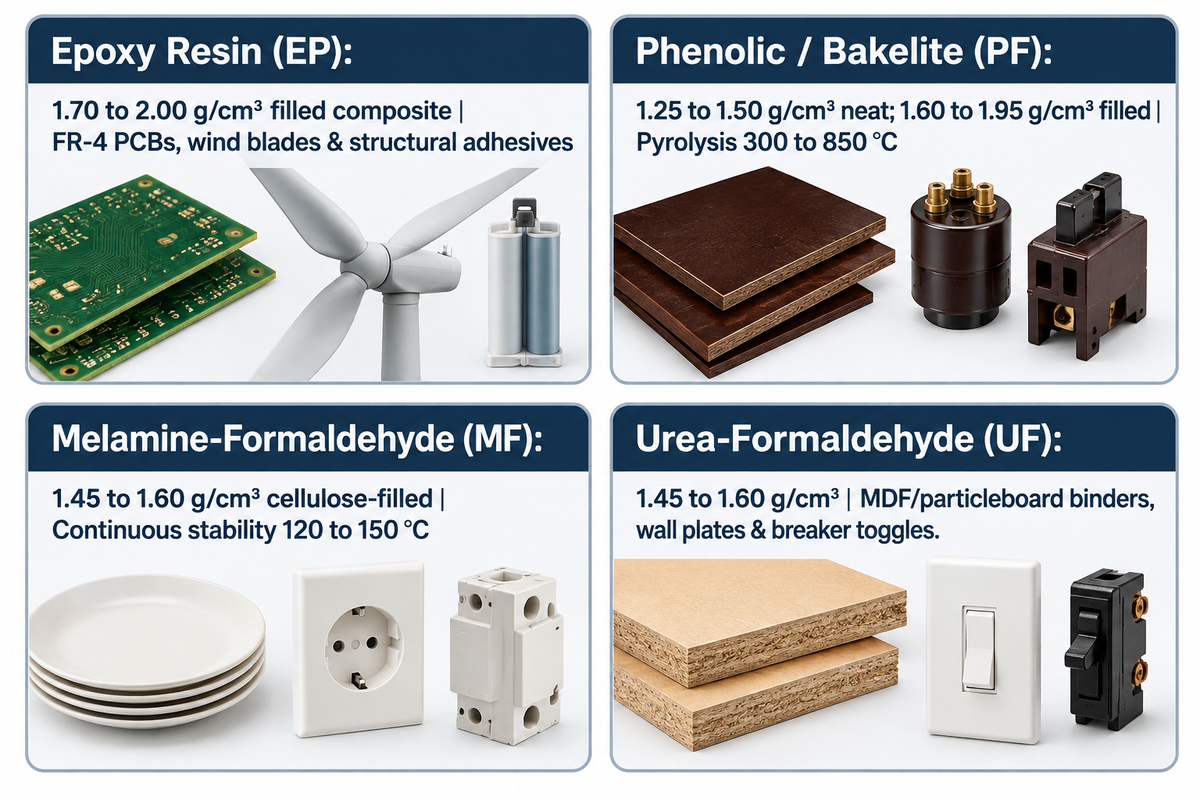
High-rigidity structural and electrical thermosets (epoxy, phenolic (Bakelite), melamine-formaldehyde, and urea-formaldehyde) are predominantly used in rigid electrical, structural and molded components, but their usage in these applications is limited by the state of the cure. Because their specific gravity spans 1.10 g/cm³ to 2.00 g/cm³, fragments of these four resins sink rapidly during wet density separation.
1. Epoxy Resins (EP): Circuit Boards, Wind Blades & Structural Adhesives
Epoxy resin, produced by condensing epichlorohydrin with bisphenol A and curing with polyamines or anhydrides, is the workhorse of structural thermosetting composites across heavy industrial applications. Cured epoxy exhibits low cure shrinkage, high chemical resistance and good mechanical adhesion to carbon and glass fibers. These materials exhibit a filled specific gravity of 1.70 g/cm³ to 2.00 g/cm³. Vacuum-infused and pultruded epoxy spar caps in the aerospace and wind turbine industries have demonstrated excellent fatigue performance. Small amounts of two part epoxy structural adhesive or high temperature adhesive tape backing, when introduced in a thermoplastic scrap bale, would also be expected to remain intact during the washing process and would arrive at the extruder feed throat as an abrasive, unmeltable grit.
2. Phenol-Formaldehyde (PF / Bakelite): High-Heat Switchgear & Friction Bindings
Introduced in 1907, phenol-formaldehyde Bakelite was one of the earliest fully synthetic thermosetting polymers and remains widely specified where high temperature resistance, low thermal conductivity, and good electrical insulation properties are required. Cured PF resin lacks fluidity and moldability. Thermal pyrolysis can be used to recover PF resin, but this requires reactor temperatures of 300 to 850 °C (PMC phenolic resin recycling review). Unfilled phenolic resin has a specific gravity of 1.25 g/cm³ to 1.50 g/cm³, while mineral- and glass-filled phenolic molding compounds (1.60 g/cm³ to 1.95 g/cm³) maintain stable electrical properties, high resistance to chemicals and oils, and dimensional rigidity as the primary plastics used for precision small parts in electrical switchgear housings, automotive disc brake pads, commutator brush holders, and phenolic kettle and skillet handles.
3. Amino Plastics: Melamine-Formaldehyde (MF) and Urea-Formaldehyde (UF)
Melamine-formaldehyde and urea-formaldehyde are high-density amino thermosetting molding compounds (U.S. EPA Thermosetting Molding Compounds guidance). Melamine resin reacts melamine crystals with formaldehyde to produce scratch-resistant surfaces used in Formica high-pressure decorative laminates and commercial cafeteria dinnerware; cellulose-filled melamine molding grades reach a specific gravity of 1.45 g/cm³ to 1.60 g/cm³ (with base melamine thermoset materials spanning 1.10 g/cm³ to 1.50 g/cm³) and provide continuous thermal stability around 120 to 150 °C (PatSnap Eureka melamine material data). Urea-formaldehyde (UF, 1.45 g/cm³ to 1.60 g/cm³) cures at lower temperatures with acid catalysts; the majority of global UF production binds medium-density fiberboard (MDF) and particleboard, while alpha-cellulose-filled UF molding powders form electrical wall plates and circuit breaker toggles that resist arc tracking.
What Are 10 Common Uses of Thermosetting Plastics in Daily Life and Industry?
Ten common everyday and industrial applications made from thermoset polymers include: (1) melamine-formaldehyde commercial cafeteria plates and bowls, (2) phenolic Bakelite pots, skillets, and electric kettle handles, (3) Formica decorative kitchen countertop laminates, (4) FR-4 epoxy printed circuit boards inside computers and smartphones, (5) two-part epoxy structural and household adhesives, (6) unsaturated polyester fiberglass boat hulls and utility enclosures, (7) cross-linked polyurethane For further comparison of these with commodity thermoplastics, see our article on common examples of plastic in industrial recycling.
Composite & Elastomeric Thermosets: Unsaturated Polyester, Polyurethane, Silicone, and Vulcanized Rubber
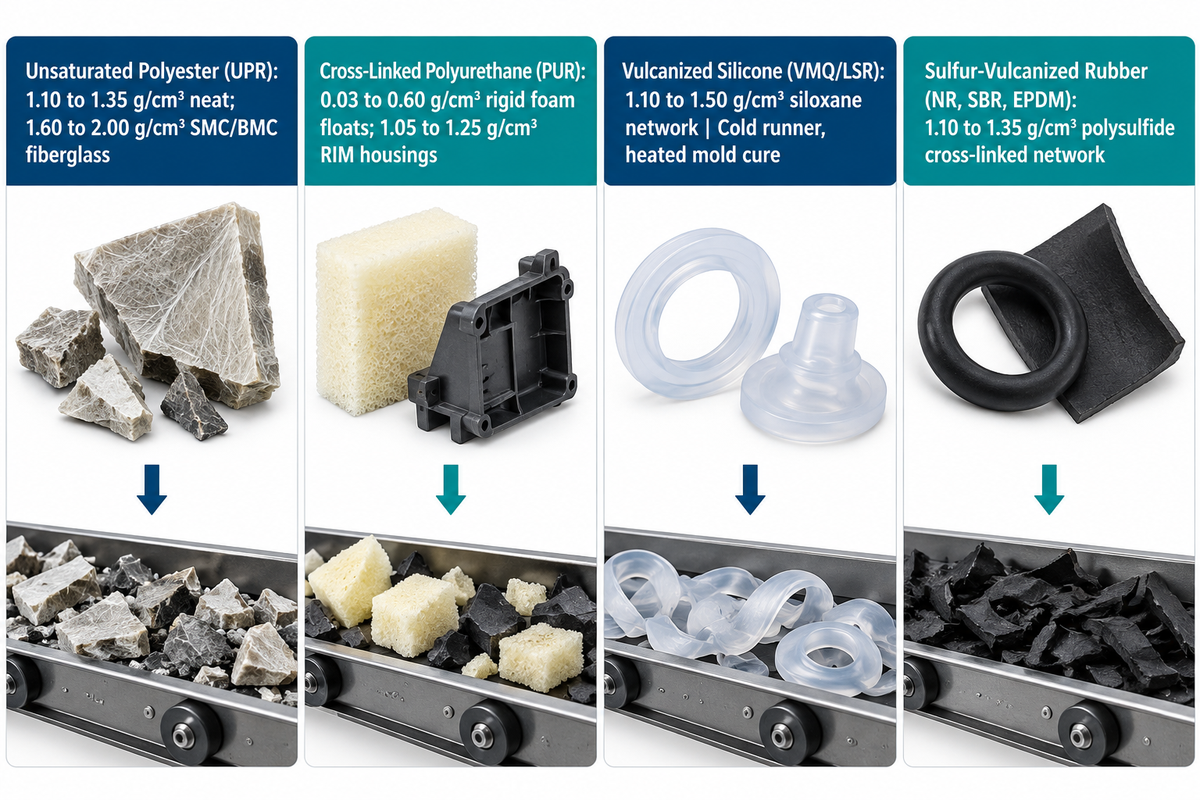
Composite and elastomeric thermosets including unsaturated polyester resin (UPR), cross-linked polyurethane (PUR), vulcanized silicone (VMQ), and sulfur-cured rubber, range from glass-reinforced structural panels to sealants. Fragments of rigid UPR resemble abrasive grit in a recycling line. Elastomers PU, silicone, and rubber, on the other hand, deform and plug the screen packs.
4. Unsaturated Polyester Resins (UPR): SMC/BMC Automotive & Marine Composites
Unsaturated polyester resin holds a dominant position in construction, marine, and transportation markets, with the specialty thermosetting plastics segment touching USD 15.8 billion in 2025, growing at 4.1% CAGR, forecast for 2032 (Stratview Research). Presented as a viscous liquid of polyester oligomers in reactive styrene monomer, neat UPR cures to an unfilled specific gravity of 1.10 g/cm³ to 1.35 g/cm³, through free radical initiation. When compounded with chopped glass fibers and mineral fillers into Sheet Molding Compound (SMC) or Bulk Molding Compound (BMC), cured polyester resin reaches a filled specific gravity of 1.60 g/cm³ to 2.00 g/cm³. These thermosetting composites remain dimensionally rigid across normal industrial service temperatures and char without melting when overheated, making them standard for heavy truck hoods, electrical utility pedestals, and chemical storage tanks.
5. Cross-Linked Polyurethanes (PUR): Reaction Injection Molding & Insulation Foams
While linear thermoplastic polyurethane (TPU) is extrudable for cable jackets and footwear, the majority of the global polyurethane production is irreversibly cross-linked thermoset networks formed by the reaction of polyfunctional isocyanates (MDI or TDI) with polyols. In reaction injection molding (RIM), two low-viscosity liquid streams are mixed and cure rapidly inside closed molds at low pressures to produce molded elastomers and industrial housings (specific gravity 1.05 g/cm³ to 1.25 g/cm³). When blowing agents are introduced during curing, polyurethane expands into closed-cell rigid insulation panels (0.03 g/cm³ to 0.60 g/cm³) for building construction and cold-chain appliances, or open-cell flexible cushioning foam. Low density PUR (polyurethane) rigid foam floats in water wash tanks for appliance shredding, so air classification is used prior to pelletizing thermoplastic ABS/PS in appliance shredding plants.
6. Vulcanized Silicone (VMQ / LSR) and High-Performance Polyimides
Unlike organic polymers based on a carbon-carbon backbone, silicone elastomers have an inorganic alternating backbone of silicon and oxygen (Si-O-Si, or siloxane). In processing liquid silicone rubber (LSR), two platinum-catalyzed liquid components are pumped into a cold runner and are vulcanized in a heated mold cavity, a special process called thermoset injection molding. This is the reverse of thermoplastic physics, where the barrel is hot and the mold is cold. Cured silicone (specific gravity 1.10 g/cm³ to 1.50 g/cm³) serves across extreme temperature ranges without melting, acting as an electrical insulator for high-voltage transmission sheds and automotive turbocharger boots. Where aerospace and semiconductor fixtures demand rigid strength at elevated temperatures, thermosetting polyimide resins alongside high-heat engineering polymers like PPO, PBT, and fluoropolymers such as polytetrafluoroethylene (PTFE) are selected.
7. Sulfur-Vulcanized Rubber (NR, SBR, EPDM)
Natural polyisoprene rubbers and synthetic elastomers like styrene-butadiene rubber (SBR) and ethylene-propylene-diene monomer (EPDM) behave as soft gums until elemental sulfur and organic accelerators are added to them. Sulfur vulcanization leads to the formation of polysulfide cross-links between the carbon-carbon unsaturated chains and transforms the gum to an elastic network (specific gravity 1.10 g/cm³ to 1.35 g/cm³) that recovers after high tensile elongation. EPDM is the most common elastomer in weather stripping. In post-consumer automotive and construction plastics, co-extruded EPDM weather strips and rubber gaskets which are adhered to polypropylene profiles are a significant contaminant that sink in water if free, or go into the extruder if mechanically adhered to polyolefin flakes.
Common Classification Pitfalls: Why Cross-Linked Polyethylene (PEX/XLPE) Behaves Like a Thermoset vs. PVC
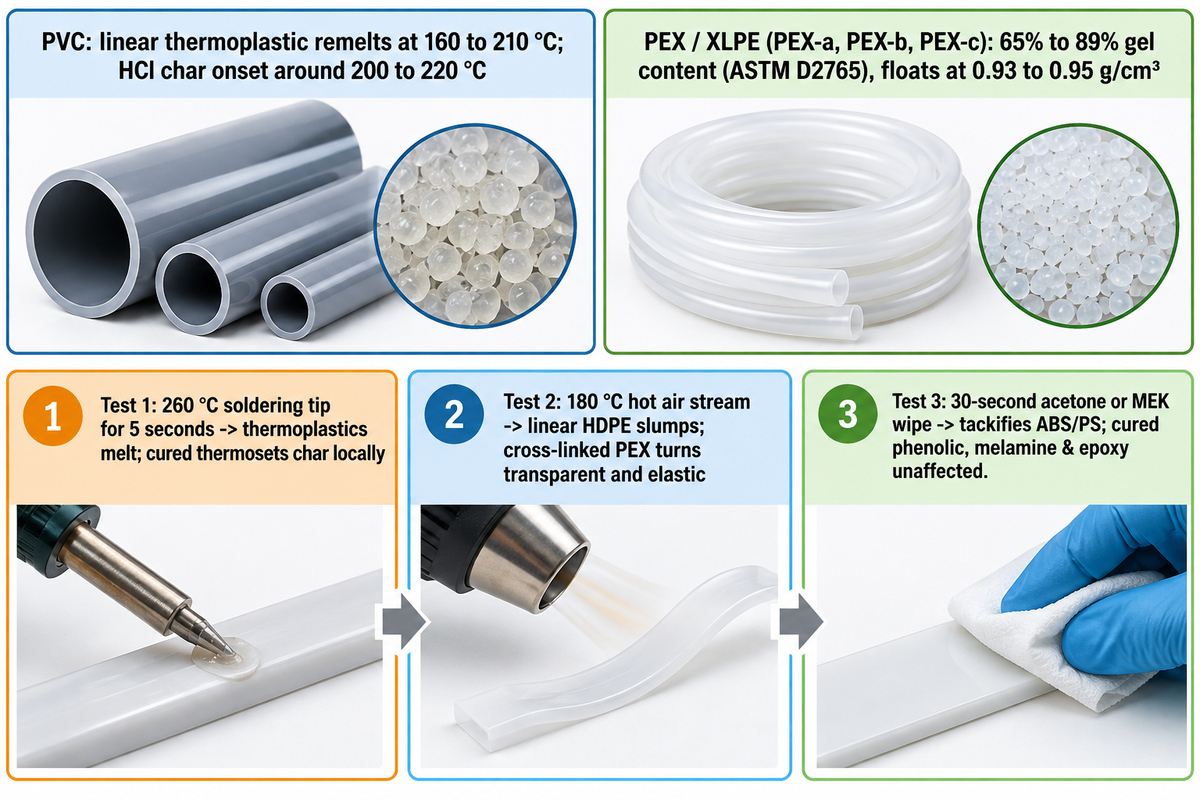
Polyvinyl chloride (PVC) is a linear amorphous thermoplastic, not a thermoset, because its molecular chains remain uncross-linked and remelt between 160 °C and 210 °C. However, polyethylene (XLPE and PEX) starts off as HDPE thermoplastic and undergoes covalent cross linking (65%-89% insoluble gel, ASTM D2765-16(2024)), and behaves like a thermoset inside recycling extruders.
Why Polyvinyl Chloride (PVC) Is an Uncross-Linked Thermoplastic
Even though operators can confuse rigid PVC pipe with a thermoset when it chars in a high-temperature polyolefin extruder, it’s still a thermoplastic material. PVC is made of linear chains with polar carbon-chlorine dipoles. These polar interchain interactions can be viewed similarly to a cross-link in amorphous thermosets. When compounded with thermal stabilizers, PVC sheet and resin can be repeatedly softened for thermoforming, profile extrusion, or injection moulded fittings at 160 to 210 °C. The confusion arises because PVC’s thermal degradation onset (around 200 to 220 °C, where autocatalytic dehydrochlorination strips HCl gas and leaves conjugated polyene char) overlaps the normal barrel temperatures of PET (260 to 280 °C) and high-molecular-weight HDPE (210 to 240 °C). Consequently, PVC, a recyclable thermoplastic, is confined to closed-loop window-profile and pipe extrusion lines, and is considered a char-forming contaminant in other extrusion processes.
Why Cross-Linked Polyethylene (PEX / XLPE) Acts as a “Trojan Horse” in HDPE Recycling
Whereas PVC is a misclassified thermoplastic, cross-linked polyethylene (PEX for plumbing pipe; XLPE for medium- and high-voltage cable insulation) is a commodity thermoplastic intentionally converted into a covalent network. Manufacturers cross-link polyethylene commercially by peroxide (PEX-a), silane-moisture (PEX-b), or electron-beam irradiation (PEX-c) methods, achieving 65% to 89% gel content across commercial grades under ASTM D2765-16(2024):
- Peroxide cross-linking (PEX-a/Engel method) uses organic peroxides to produce free radicals above the crystal melting point during extrusion, and locks adjacent polyethylene chains together.
- Silane-grafted moisture curing (PEX-b) grafts vinyltrimethoxysilane onto the polyethylene backbone and cures with moisture into Si, O, Si bridges, and its resulting cross-link gel level is measured by ASTM D2765.
- High-energy beta or gamma rays, in the case of electron-beam cross-linking (PEX-c) strip Hydrogen atoms from solid extruded pipe, making carbon-carbon cross-links without using chemical peroxides.
For ASTM D2765 gel content testing, a specimen is taken from the cross-linked sample in boiling decalin or xylene solvent to measure the insoluble cross-linked fraction and its swell ratio. PEX and HDPE have similar densities (0.93 g/cm³ to 0.95 g/cm³) and both float in water-based separation; basic near-infrared (NIR) sorting generally identifies both as polyethylene and does not reveal whether the material is cross-linked.
The 260 °C Soldering-Iron & Solvent Swell Shop-Floor Identification Protocol
Before feeding suspect post-industrial pipe, cable stripping, or electrical housing bales into a shredder, receiving inspectors can combine material documentation and visual sorting with The 260 °C Soldering-Iron & Solvent Swell Shop-Floor Identification Protocol :
- Pressing a digital temperature-controlled soldering tip set to 260 °C against a clean edge of the sample for 5 seconds causes true thermoplastics (HDPE, PP, PA, ABS) to form a viscous melt puddle, whereas cured epoxies, phenolics, and amino plastics stay hard and char locally. Cured epoxies, phenolics, and amino plastics remain hard and char locally.
- Heating a thin shaving of suspect polyethylene pipe in a 180 °C hot air stream causes linear HDPE to slump into a liquid droplet, while cross-linked PEX turns transparent and retains its solid strip with rubber like elasticity.
- Unpainted electronic housings can be tackified with ABS and PS thermoplastics by wiping with acetone or MEK for 30 seconds, while cured phenolic, melamine, and epoxy surfaces aren’t affected.
Why Examples of Thermosetting Plastic Resist Recycling (And 4 Viable Recovery Pathways)
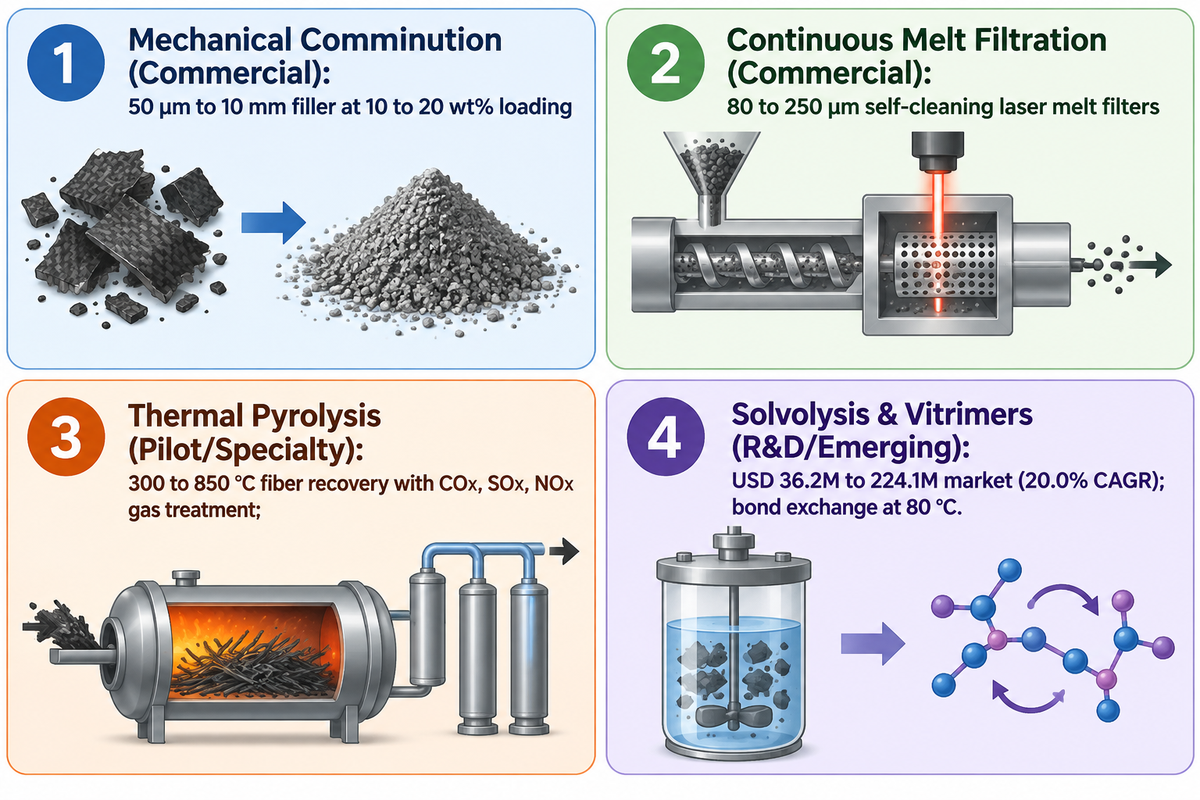
Industrial recovery of examples of thermosetting plastic relies on four distinct engineering pathways: mechanical grinding into reinforcing filler (10 to 20 wt% loading) and continuous laser melt filtration (80 to 250 µm) at commercial scale, alongside thermal pyrolysis (300 to 850 °C) and catalytic chemical solvolysis or vitrimerization as emerging recovery technologies.
The following four pathways treat both pure thermoset composite off-cuts and thermoplastic bales contaminated with cross-linked polymers (rePurpose Global recyclability analysis; polymer cross-linking mechanics). Mechanical comminution into filler and continuous laser melt filtration are at industrial scale, while thermal pyrolysis and catalytic chemical solvolysis or vitrimer resins are primarily research, patent, or pilot-based pathways:
- Mechanical comminution into reinforcing filler (50 µm to 10 mm) pulverizes cured SMC/BMC polyester, phenolic, and rigid polyurethane scrap into graded powders or short fiber bundles. Re-incorporating ground thermoset recyclate at 10 to 20 wt% filler loading into new composites or construction binders reuses cured waste before excessive flexural strength loss occurs (AIMS Press 2026 thermoset recycling review), while cryogenic pulverization and melt filtration enable mechanical reuse of cross-linked high-density polyethylene (MDPI Processes xHDPE study).
- Continuous melt filtration during thermoplastic extrusion allows commercial polyolefin and styrenic recyclers to treat residual thermosets and PEX as solid or gel contaminants inside HDPE, PP, PET, or ABS regrind, pairing wet gravity separation with 80 to 250 µm continuous self-cleaning laser melt filters to strip unmelted specks out of the molten polymer stream.
- Thermal pyrolysis in an inert or oxygen-restricted environment is the main method used to recover carbon and glass fibers from phenolic and epoxy matrices, respectively. Most phenolic pyrolysis processes require a high temperature (300 to 850 °C) and emit gases such as COx, SOx, and NOx which require treatment (PMC 11085933 phenolic recycling review).
- Chemical solvolysis, base-mediated deconstruction, and vitrimer resins introduce cleavable or exchangeable bonds into cross-linked matrices. Cleavable silyl-ether thermoset chemistry (MIT News) has expanded into 2025–2026 patent disclosures, including US20260002012A1, US20260132266A1, WO2025235324A1, and WIPO publication WO2026112105A1 (2026112105). Meanwhile, the global vitrimer resins market is projected to grow from USD 36.2 million in 2026 to USD 224.1 million by 2036 at a 20.0% CAGR (Future Market Insights). At CAMX 2026, CompositesWorld documented commercial vitrimer epoxy pultrusion resins designed for dynamic covalent bond exchange at temperatures as low as 80 °C (176 °F).
Managing Thermoset & Cross-Linked Contamination in Thermoplastic Pelletizing Lines
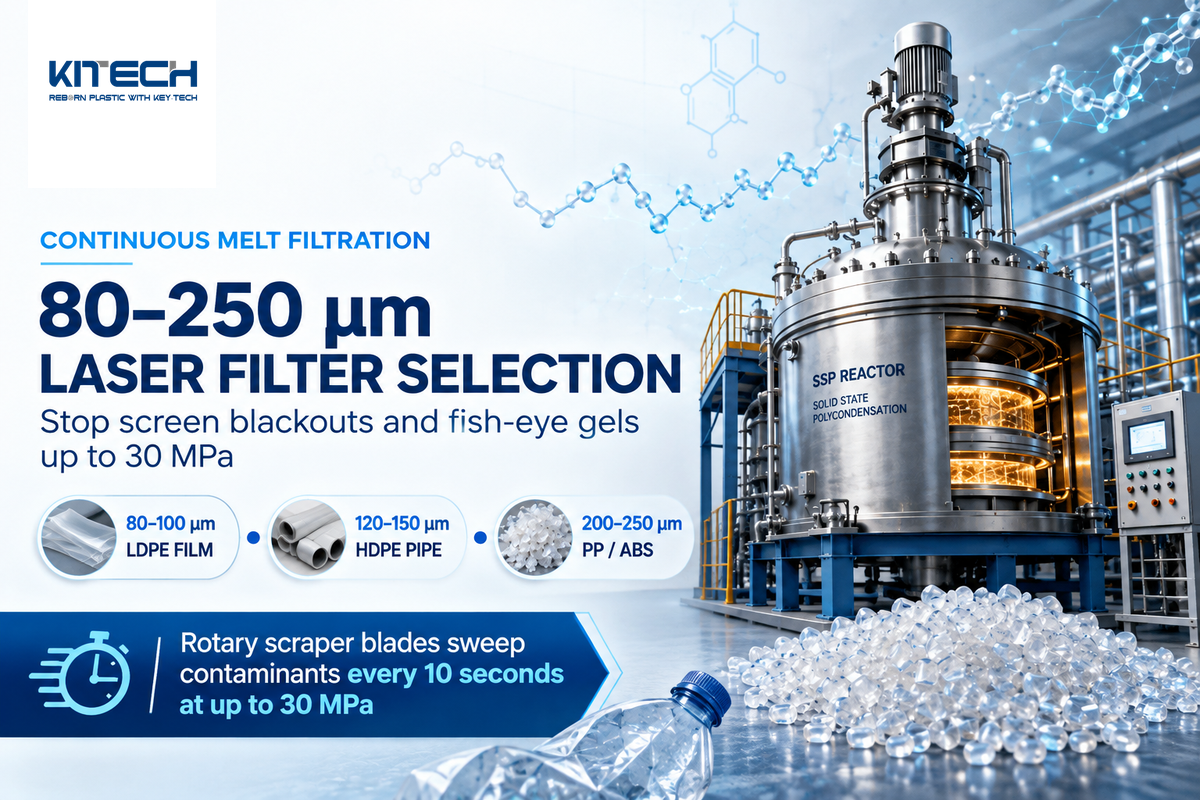
Unmelted thermoset fragments and cross-linked PEX gels entering a thermoplastic pelletizing extruder result in rapid increases in melt pressure up to the 30 MPa limit of the system (compared with 15 to 25 MPa baseline head pressure on standard manual or hydraulic screen changers), blind woven wire-mesh screen packs, and deformable gels that squeeze through coarse screens, causing surface fish-eyes.
Cross-linked contamination happens often in post-consumer recycling alongside target thermoplastics, such as silane-cured PEX-b pipe found in demolished HDPE conduit bales, or FR-4 epoxy board dust and phenolic switch toggles found in WEEE electronic plastics. Inside the extruder barrel, two failure modes occur. (Elant Machine pellet defect analysis; Plastics Technology extrusion diagnostics):
- Rigid Abrasives and carbon specks happen when UPR, cured epoxy, phenolic, or melamine particles bypass density separation and get processed as unmeltable solids. These solids pack against woven wire screens and char urea-formaldehyde or polyurethane specks to black carbon trails.
- Deformable gel extrusion and die-swell defects happen when cross-linked polyethylene (PEX/XLPE) or elastomer particles soften into rubbery gels at 200 to 240 °C; under 15 to 25 MPa of baseline screen-changer pressure, deformable gels elongate through woven wire apertures and snap back inside the die, creating thin “fish-eye” weak spots in blown film and pipe. Deformable gels elongate through woven wire apertures and snap back to their original shape, creating thin “fish-eye” defects in blown film and pipe, when cross-linked polyethylene (PEX/XLPE) or elastomer particles soften into rubbery gels at 200 to 240 °C under 15 to 25 MPa of baseline screen-changer pressure.
The Continuous Laser Filter Mesh Selection Rule (80–250 µm) for Cross-Linked Gel Removal
Replacing woven wire mesh packs with continuously self-cleaning rotary scraper filters prevents ‘fish eye’ defects. Continuous self-cleaning laser filters use a hardened steel disc perforated with tapered, laser-drilled micro-bores (80 to 250 µm) and rotating scraper blades that sweep contaminants into a discharge auger every 10 seconds. (Plastics Technology melt filtration guide, Recycling Today filtration engineering).
Under The Continuous Laser Filter Mesh Selection Rule (80–250 µm) for Cross-Linked Gel Removal, optimum laser filter screen aperture (80 to 250 µm) and scraper cycle intervals depend on the specific polymer melt viscosity, gel contamination load, and downstream film or pipe wall-thickness specification:
- Fine 80 to 100 µm laser discs are applied to post-consumer LDPE/LLDPE blown film regrind and drip-irrigation tape to capture fine cross-linked packaging adhesive and sealant gels before thin-gauge film blowing.
- Medium 120 to 150 µm laser discs are used on post-consumer HDPE milk bottles, detergent containers, and construction pipe regrind containing residual cross-linked PEX/XLPE or EPDM rubber specks, balancing gel capture against melt pressure differential.
- Coarse 200 to 250 µm laser discs are used for high-throughput (1,000 to 4,000 kg/h) rigid PP/ABS automotive and WEEE housing flakes, to remove rigid phenolic and epoxy PCB dust, as well as wood fibers, paper and aluminum flecks, prior to pelletizing.
Equipment Selection Guide: Shredding, Density Sorting & Continuous Melt-Filtration Pelletizing
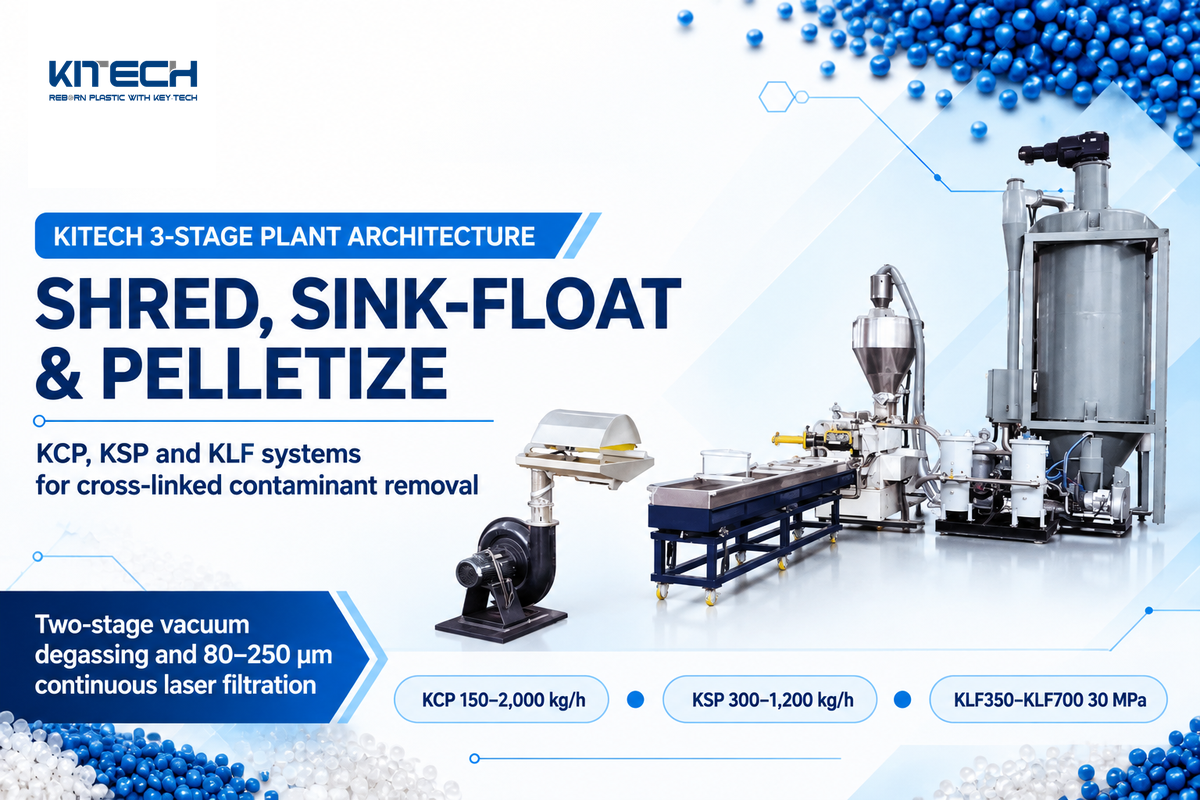
Processing thermoplastic scrap contaminated with thermoset composites or PEX requires a synchronized three-stage plant architecture: pre-shred material screening and high-torque single-shaft shredding, gravity sink-float water separation tanks, and two-stage vacuum-degassed pelletizing extruders equipped with KLF continuous self-cleaning laser melt filters rated up to 30 MPa.
Kitech Machinery engineers complete plant integration for recycling lines that isolate thermosetting plastics across three sequential plant checkpoints—pre-shred size reduction, wet gravity separation, and continuous laser-filtered extrusion.
Stage 1: Pre-Shred Screening & High-Torque Single-Shaft Size Reduction
When glass-filled epoxy (FR-4), mineral-filled phenolic, or SMC polyester panels enter a high-speed granulator, fiberglass and silica fillers rapidly wear standard blades and generate excessive fines. Operators should identify and segregate bales with mixed materials, using a combination of documentation, visual sorting, and either thermal or analytical screening, prior to size reduction in a low speed, high torque plastic shredder for recycling, outfitted with wear-resistant alloy rotor knives (and a tungsten carbide wear package, when specifically requested by the customer to reduce high-abrasion composite materials). The goal of size reduction is to liberate assemblies with minimum dust creation.
Stage 2: Sink-Float Gravity Water Separation
Following wet granulation and friction washing, shredded flakes enter a calming sink-float separation tank filled with water (1.00 g/cm³). Here, gravity executes the primary density cut: polyolefin flakes (PP at 0.90 g/cm³ to 0.92 g/cm³, LDPE/HDPE at 0.92 g/cm³ to 0.96 g/cm³) float across the surface paddles, while dense thermosetting resins, epoxy (1.15 g/cm³ to 2.00 g/cm³), phenolic Bakelite (1.25 g/cm³ to 1.95 g/cm³), melamine and urea-formaldehyde (1.45 g/cm³ to 1.60 g/cm³), unsaturated polyester SMC (1.10 g/cm³ to 2.00 g/cm³), vulcanized silicone (1.10 g/cm³ to 1.50 g/cm³), and sulfur-vulcanized rubber (1.10 g/cm³ to 1.35 g/cm³), sink to the bottom screw conveyor for discharge.
Stage 3: Kitech Two-Stage Pelletizing Lines with KLF Continuous Laser Filtration
To eliminate the buoyant contaminants that float through water washing, specifically cross-linked polyethylene (PEX/XLPE at 0.93 g/cm³ to 0.95 g/cm³), closed-cell polyurethane foam specs (0.03 g/cm³ to 0.60 g/cm³), and paper fibers, whereas dense silicone elastomers (1.10 g/cm³ to 1.50 g/cm³) sink in water unless mechanically trapped on light flakes, the dried flakes feed into a Kitech industrial plastic pelletizer matched to your feedstock geometry:
- The KCP Series (KCP80, KCP180) cutter-compactor pelletizing systems process 150 to 1,300 kg/h (screw diameter 80 to 180 mm, L/D 36 to 42, specific energy 0.30 to 0.40 kWh/kg), while the 5G KCP120–200 PLUS Series delivers 600 to 2,000 kg/h using an extended 50:1 L/D extruder, synchronous motor drive (0.32 kWh/kg, saving 8% to 12% energy vs. standard induction motors), Siemens PLC automation, and an integrated KLF continuous self-cleaning laser filter.
- The KSP Series (KSP100, KSP200) single-screw rigid flake pelletizing system processes 300 to 1,200 kg/h of rigid PE, PP, PS, ABS, PET, and PA regrind (screw diameter 100 to 200 mm, L/D 25 to 35, specific energy 0.20 to 0.30 kWh/kg), combining force double vacuum degassing with infrared barrel heaters and continuous thermal insulation that save 30% on heating energy.
- The KLF Series self-cleaning continuous laser filters spanning KLF350 (200 to 800 kg/h), KLF500 (800 to 2,000 kg/h), and KLF700 (2,000 to 4,000 kg/h), operate at pressures up to 30 MPa, using a laser-drilled hardened steel screen (80 to 250 µm) with two-way scraping on a 10-second cycle to pull out unmelted rubber, PEX gels, wood, paper, glass, and metal particles without line stops.
Struggling with PEX Gels or Thermoset Specs in Your Recycled Pellets?
Ship a 25 kg sample of your contaminated HDPE, PP, or ABS regrind to Kitech Machinery’s testing center. Our process engineers will run a documented trial through our sink-float separation line and KCP / KSP pelletizing system equipped with a KLF continuous self-cleaning laser melt filter, and will return certified pellet melt-flow and filtration efficiency data.
Request a Custom Filtration & Pelletizing Trial Explore KCP & KSP Plastic Pelletizers
Frequently Asked Questions About Thermosetting Plastics
Below are engineering solutions for the four most common questions plant managers, material buyers, and quality engineers ask when finding instances of thermosetting plastic and preventing cross-linked contamination in mechanical recycling lines.
1. What is thermosetting plastic and how does it differ from thermoplastic?
Thermosetting plastics are irreversibly hardened and crosslinked by heat, chemical hardeners, or irradiation into a permanent three-dimensional covalent network and cannot be remelted or reshaped, whereas thermoplastics soften and flow repeatedly when heated. When cured thermosets like epoxy, phenolic, or melamine resins are heated above approximately 200 to 400 °C (depending on resin formulation and filler content), they decompose into solid char and pyrolysis gases instead of a liquid melt.
2. Why are thermosetting plastics not recyclable through standard melt extrusion?
Thermosetting plastics aren’t recyclable by standard melt extrusion because of permanent covalent cross-links that lock adjacent molecular chains, preventing the formation of a molten liquid phase inside an extruder barrel. Consequently, heated epoxy, phenolic, or amino resin fragments remain cross-linked rigid solids and cannot slide past one another to pass through a pelletizing die like linear thermoplastics; they blind melt filter screens or thermally char. Therefore, during recycling, the heated epoxy, phenolic, or amino resin fragments, remain cross-linked rigid solids that bind melt filter screens or thermally char.
3. Is PVC a thermosetting plastic or a thermoplastic?
Polyvinyl chloride (PVC) is an amorphous, linear thermoplastic, not a thermosetting plastic, because its polymer chains remain un-cross-linked after extrusion or molding. Properly stabilized rigid and flexible PVC can be thermally softened and reprocessed repeatedly between 160 °C and 210 °C, though in polyolefin or PET pelletizing lines operating above 210 to 260 °C it degrades via dehydrochlorination into corrosive hydrochloric acid gas and carbon char.
4. How do recycling plants remove thermoset and PEX contaminants from HDPE or PP regrind?
Industrial recycling plants remove thermoset and cross-linked polyethylene (PEX/XLPE) contaminants from HDPE or PP regrind by using gravity sink-float separation in conjunction with continuous laser melt filtration. First, water baths (1.00 g/cm³) sink dense thermosets like epoxy, phenolic, melamine, and polyester SMC (1.10 to 2.00 g/cm³); second, continuous self-cleaning laser filters (80 to 250 µm) with rotating scraper blades strip floating PEX gels (0.93 to 0.95 g/cm³) during extrusion.
References & Sources
- Syracuse University Libraries Plastics Collection: Thermosetting & Amino Materials Classification
- National Center for Biotechnology Information (PMC) An Overview of Recycling Phenolic Resin (PMC11085933)
- U.S. Environmental Protection Agency (EPA NEPIS) Effluent Development Document: Thermosetting Molding Compounds
- Plastics Europe The Circular Economy for Plastics: A European Analysis (2024 Report)
- ASTM International / iTeh Standards ASTM D2765-16(2024): Determination of Gel Content and Swell Ratio of Crosslinked Ethylene Plastics
- AIMS Press (2026) Recycling Technologies for Thermosetting Plastics and Their Composites: Advances Through Vitrimerization
- MDPI Processes (2025) Mechanical Recycling of Crosslinked High-Density Polyethylene (xHDPE)
- Plastics Technology Finding the Right Melt Filtration System for Post-Consumer Recycling
- Recycling Today Finessing Filtration: Continuous Self-Cleaning Laser Melt Filters
- MIT News Chemists Make Tough Thermoset Plastics Recyclable via Cleavable Silyl Ethers
- CompositesWorld (2026) Vitrimer Chemistry Brings Reversibility to Thermoset Resins (CAMX 2026)
- United States Patent Application (2026) US20260002012A1: Methods of Chemical Deconstruction and Upcycling of Polymeric Material
- United States Patent Application (2026) US20260132266A1: Base-Mediated Deconstruction of Epoxy Resins
- WIPO Patent Application (2025) WO2025235324A1: Methods and Systems for the Solvolysis of Epoxy Thermosets
- Fortune Business Insights Thermosetting Plastics Market Size, Share & Global Growth [2026–2034]
- Future Market Insights Vitrimer Resins Market Global Analysis of Key Trends [2026–2036]