Get in touch with Kitech Company


Updated June 2026 · Reviewed by the Kitech technical team
Is plastic recycling profitable? Plastic recycling is the business of collecting plastic waste and reprocessing it into resaleable flake or pellets, and it is profitable only under specific conditions. You can make money on high-value resins (PET and HDPE, the resins numbered 1 and 2) at high volume, when contamination stays low. Processing mixed, dirty, low-value bales usually loses money. The difference come down to an equation, not luck or the specific machine you buy. The U.S. National Institute of Standards and Technology (NIST) puts the baseline plainly: producing material from recycled waste “tends to be less profitable than using primary material.” This guide explains the math so you can see which side of the line your operation lands on.
Quick Specs: Plastic Recycling Profitability Snapshot
| Typical gross margin (well-run plant) | 25–35% |
| Typical net margin | 10–20% (15–35% reported after full ramp-up) |
| Typical equipment payback | 18–36 months |
| Most reliably profitable resins | HDPE (#2), PP (#5), clean PET (#1) |
| Pellet vs washed-flake price premium | ~20–40% |
| #1 margin killer | Contamination — ~40% of collected plastic is lost before it sells |
| Profit ceiling set by | Virgin (oil-linked) resin price |
Is Plastic Recycling Profitable? The Short Answer
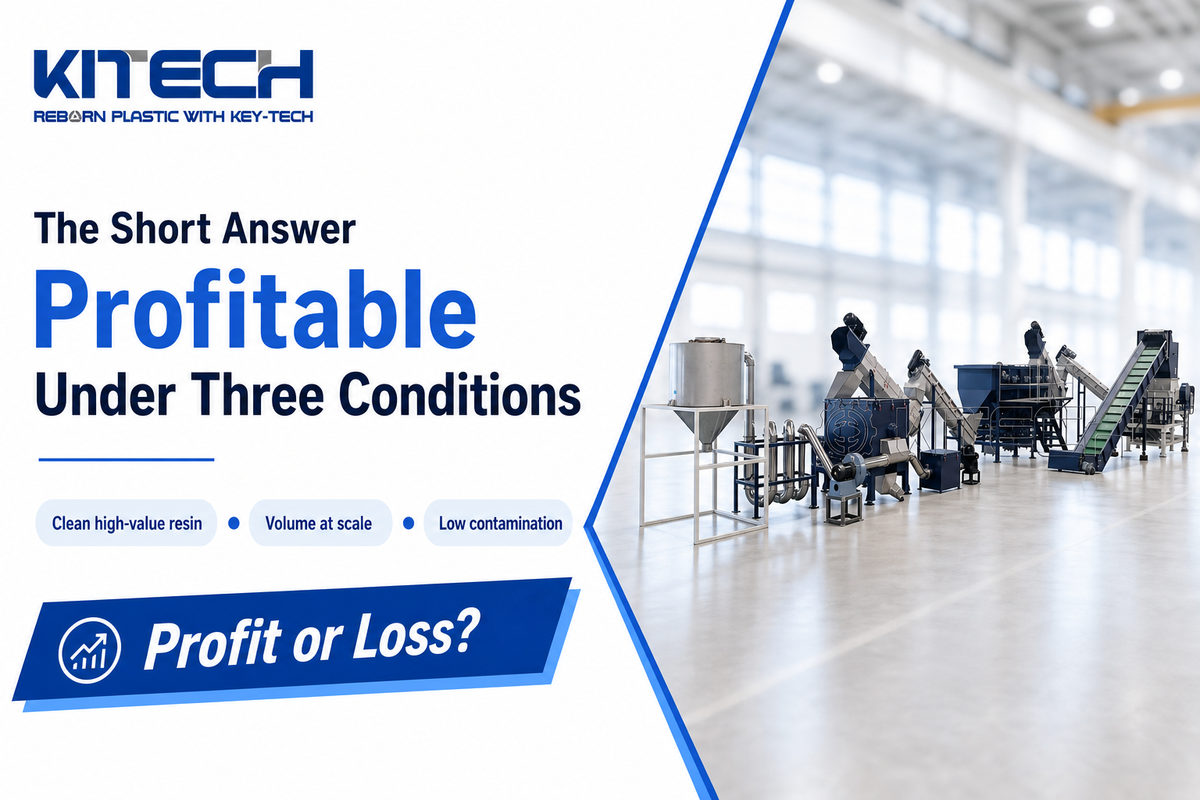
Plastic recycling becomes profitable when three factors line up: a steady supply of clean, high-value resin; enough throughput to spread fixed costs; and a recycled price that stays above your operating cost. When any of those slip, a mix of resins in your feed, heavy contamination, or a dive in virgin resin prices, even efficient equipment can run at a loss.
That distinction get lost online, where advice splits into two camps. Ask equipment makers and the answer is “Of course you’ll make money” — they sell machinery. The other camp, activists, rightly laments system-wide collection inefficiency and low capture rates. Neither answers the operator’s real question: how many dollars and cents per unit make my particular plant work?
It also helps to separate two very different endeavors. A household turning in bottles for a state deposit is doing tiny arbitrage on a fixed redemption value. The operator of a washing-and-pelletizing line is buying by the ton, converting that material, and selling a commodity into an industrial market. This guide is about the second one, the business, not the bottle drive.
Can you actually make money recycling plastic?
Yes, at industrial scale and with the right resin focus. Plastic recycling has thinner per-pound margins than electronic waste or tires, but feedstock volumes are larger and steadier. According to the World Bank’s IFC analysis of recycled-plastic markets, recyclers capture up to 80% of the supply chain’s profit margin at reprocessing, not collection. Established plants often report 15–35% net margins once throughput and supply stabilize.
The 5 Variables That Decide Profit or Loss
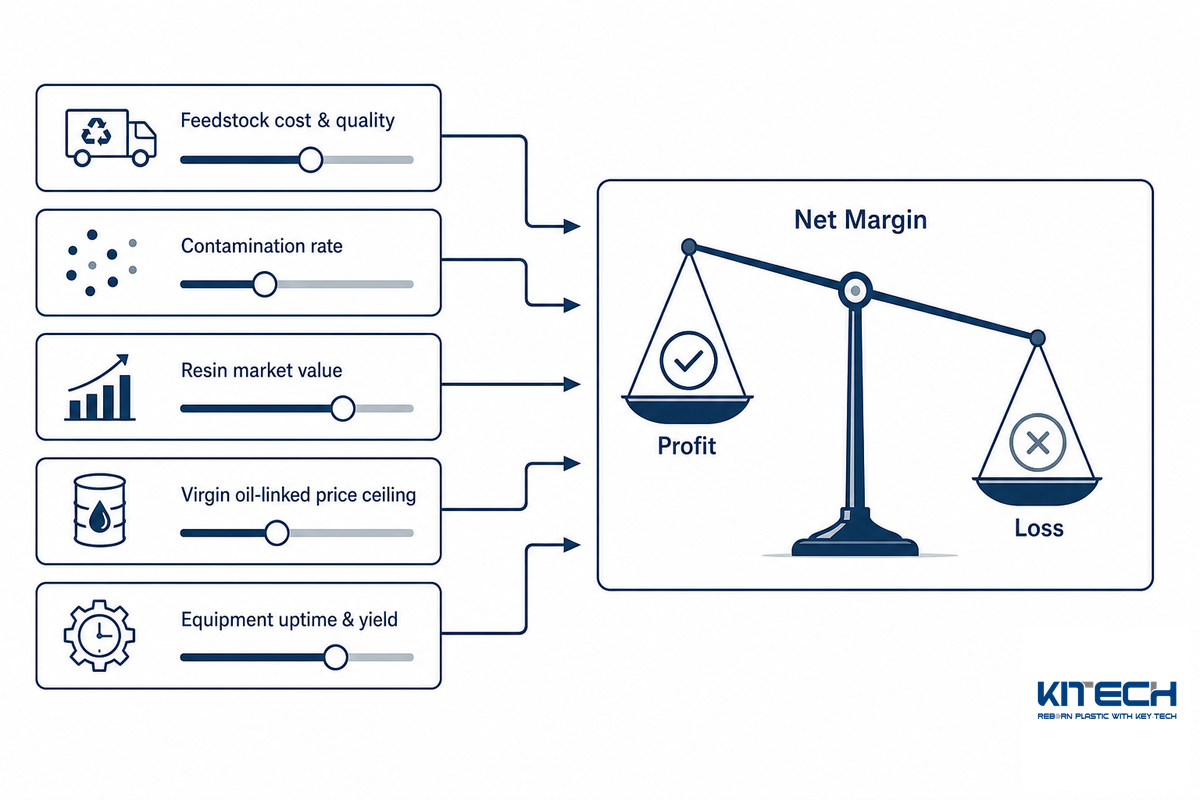
Profitability in recycling isn’t a single number but a dynamic equation that blends five factors. We call it the Recycling Profit Equation: change any one of these and you can flip a line from red to black. Use it as a diagnostic before you buy anything.
The Recycling Profit Equation — 5 Levers
- Feedstock cost & quality. The single biggest line item, raw material runs 50–60% of operating cost. Cheap, clean, single-resin feed is the whole game.
- Contamination rate. Nearly 40% of plastic collected for recycling ends up in landfill because it was missorted or contaminated. Every point of contamination is yield you paid for but can’t sell.
- Resin market value. What your output pellet actually sells for, and it moves constantly. Recycled HDPE bale prices shot up more than 80% in a year while recycled PET softened.
- Virgin (oil-linked) price. Your ceiling. When virgin resin is cheap, buyers have no reason to pay a premium for recycled, and margins compress up and down the chain.
- Equipment uptime & yield. Capital is paid back faster the more your line runs at high yield and the less it stop for jams and changeovers. In-line metal separation protects downstream machines and cuts labor, an automated process keep things steady, and a modular, scalable layout lets you add capacity as feedstock grows.
Note what’s conspicuously absent: the price of your machine. The biggest mistake first-time operators make is fixating on machinery cost. A cheap line fed dirty mixed plastic will be less profitable than a properly specified line on clean, single-resin feed. As BloombergNEF reported, more than half of the mechanical recyclers it surveyed named feedstock shortage, not equipment cost, as their single biggest challenge. The machine is necessary; it’s rarely the deciding variable.
Contamination also reaches beyond yield into market access. Under the Basel Convention’s plastic-waste controls, only clean, near-contamination-free, separately sorted PE, PP, and PET qualifies for streamlined cross-border movement, so a poorly managed waste stream can quietly cut you off from export buyers, not just lower your yield. Disciplined waste management at intake is therefore both an operational and a commercial decision.
⚠️ Important
A line quoted as “low cost” is not a bargain if it cannot handle your contamination level. Under-specifying the washing stage to save capital is the most common way operators turn a profitable resin into a loss-making one.
The ROI Breakdown: Cost Stack vs Revenue Stack
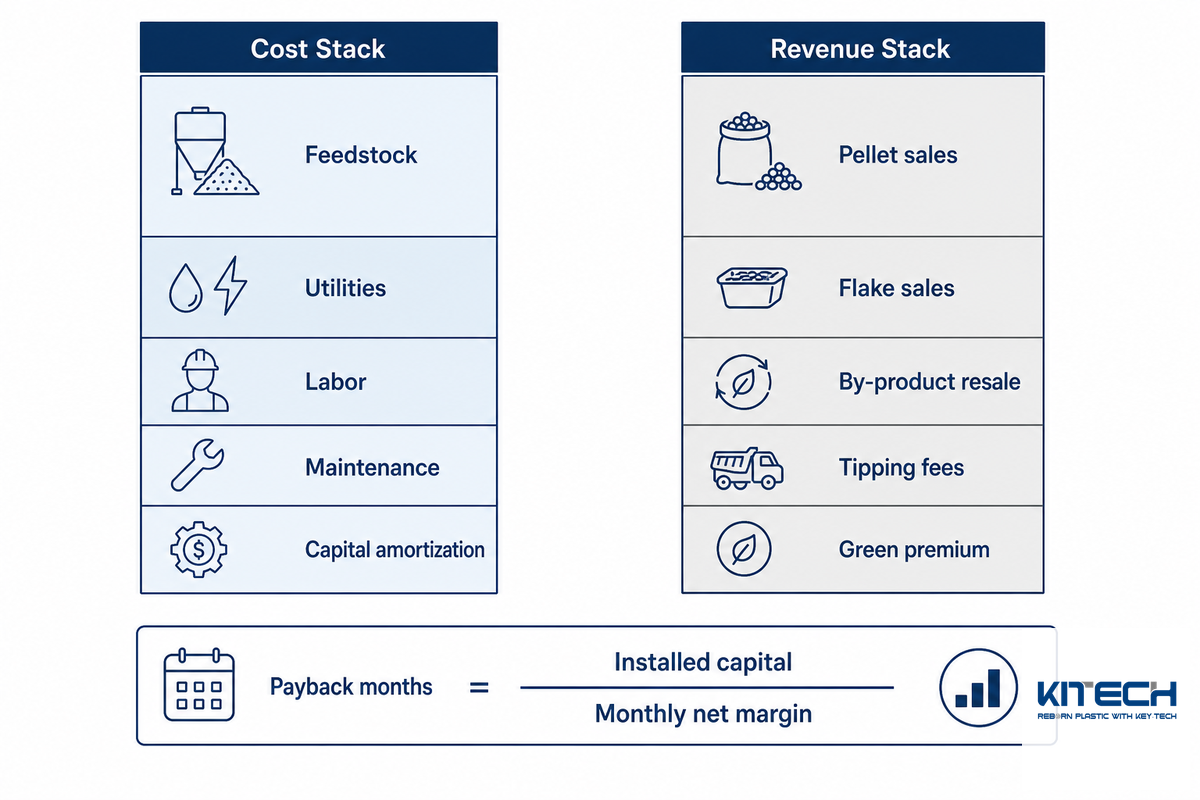
To pin down plastic recycling business profit for your case, you build two stacks, what leaves your account each month and what comes in, then divide the capital by the gap. Here’s the structure, with the cost side anchored to the operating-cost split reported for a typical waste-plastic plant.
| Cost Stack (monthly outflow) | Share of opex | Revenue Stack (monthly inflow) |
|---|---|---|
| Feedstock (bales/scrap) | 50–60% | Pellet sales = price/ton × tons × yield × uptime |
| Utilities (power, water) | 20–25% | Flake sales (lower-value, pre-pelletizing) |
| Labor | 10–15% | By-product / off-spec resale |
| Maintenance & consumables | 5–10% | Tipping/gate fees (where applicable) |
| Capital amortization | varies | Recycled-content / green premium |
Operating-cost distribution: industry project-report benchmarks for a waste-plastic plant, 2026. Treat as ranges; your split shifts with feedstock contracts and power tariffs.
Peer-reviewed plant models put real numbers on that cost stack. A techno-economic study of a 20,000-tonne-per-year mechanical recycling plant found per-tonne processing costs of roughly €287–€383 depending on resin, with product yields of 0.60–0.87 tonnes of saleable output per tonne of feedstockmeaning 13–40% of what you buy never reaches the sale. A U.S. Department of Energy techno-economic analysis of a 120,000 t/y sorting facility reported operating cost near $45 per tonne and an NPV swing from about $3.6M to $60M depending on waste composition and market prices. The width of that NPV range is the point: the same facility is a strong business or a marginal one depending on inputs you partly control (contamination, resin focus) and partly don’t (virgin price).
📐 Engineering Note — Work your own payback
Payback is straightforward once you’ve the two stacks:
Payback (months) = Total installed capital ÷ Monthly net margin
Illustrative example (your numbers will differ): a mid-size line installed for ~$1,000,000 (equipment plus civil and electrical works) that nets ~$55,000/month once stable pays back in about $1,000,000 ÷ $55,000 ≈ 18 months. If contamination rises or pellet price falls so the net margin halves to ~$27,500, the same line stretches to ~36 months, still inside the 18–36 month band, but with far less cushion. These inputs are illustrative, not a quote: ground them in your own per-tonne economics. Peer-reviewed plant studies put mechanical processing cost near €287–€383 per tonne; subtract that (plus feedstock) from your local pellet price to get the net margin that drives the equation. Run it before you sign anything.
Which Plastics Are Actually Profitable to Recycle?
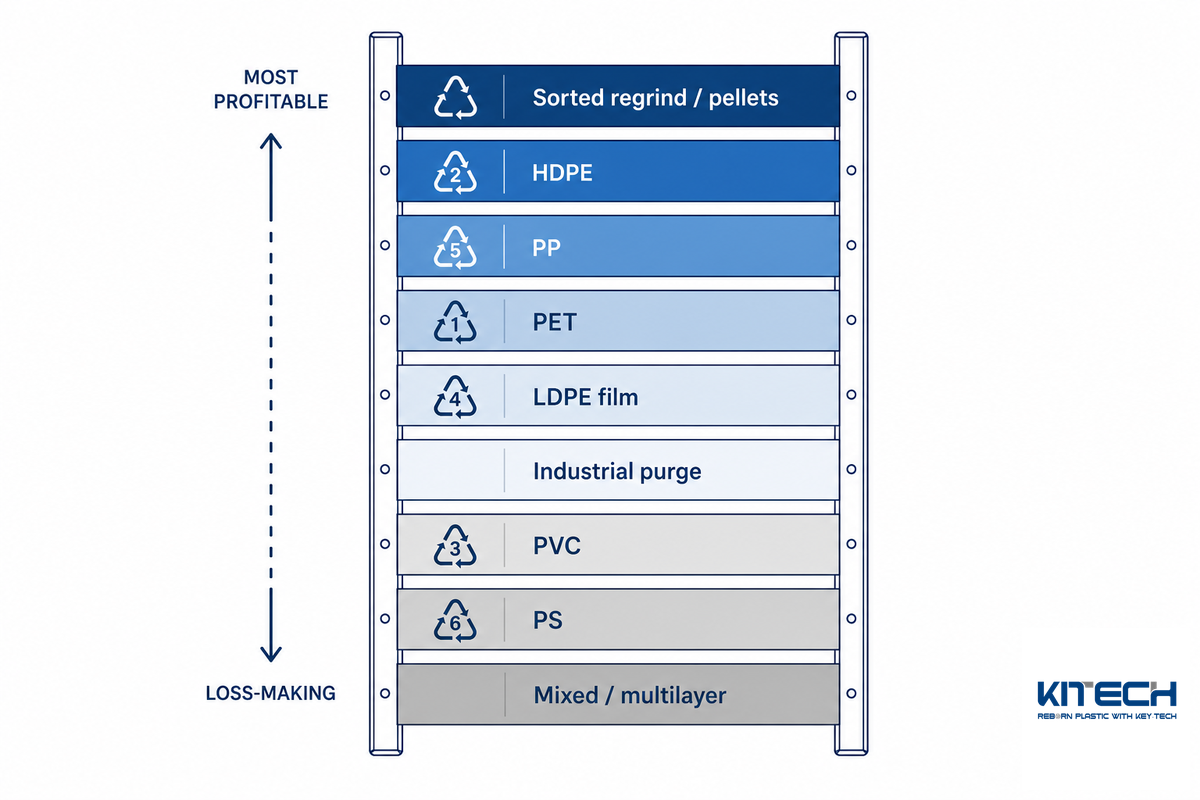
The most profitable plastics to recycle are HDPE (#2) and PP (#5), followed by clean PET (#1) and clean industrial regrind; mixed, contaminated, and multilayer streams usually lose money. That ranking is not fixed — it tracks resin price, contamination sensitivity, and end-market demand, which is exactly why 2025–2026 reshuffled the order.
One assumption dominates the conversation — “PET is the most profitable plastic to recycle” — and it’s no longer reliably true, as 2025–2026 has proven. Each resin maps to a different set of plastic products: PET to drink containers and trays, HDPE to bottles and crates, PP to caps and automotive parts. Each recyclable material is valued differently by the plastics industry because end markets and contamination behavior differ. If you are asking which recycling business is most profitable, this is where it gets concrete. The table below is our Resin Profitability Ladder — a ranking of the most profitable plastics to recycle by how dependably each stream turns recovered material into a profitable business, with the 2026 market reality layered on top.
| Resin (code) | Reliability of margin | Contamination sensitivity | End market | 2026 verdict |
|---|---|---|---|---|
| HDPE (#2) | High | Low–medium | Pipe, crates, bottles | Strong — bale prices up ~80% YTD 2026 |
| PP (#5) | High | Medium | Automotive, totes | Strong — durable industrial demand |
| PET (#1) | Medium (volatile) | High | Bottles, textiles | Squeezed — virgin oversupply, US plant closures |
| LDPE film (#4) | Medium | High | Bags, liners | Viable only if clean & high-volume |
| Industrial purge / lumps | High (if clean) | Low | Re-compounding | Underrated — clean single-source scrap |
| Sorted regrind / pellets | Highest | Low | Direct to molders | Best — ready-to-use commands top price |
| PVC (#3) | Low | Very high | Niche | Avoid unless dedicated stream |
| PS (#6) | Low | High | Limited | Marginal — thin end markets |
| Mixed / multilayer | Negative | Extreme | None (mechanical) | Loss-maker — often costs more than output |
Most striking is the PET reversal. Through 2025–2026, several U.S. PET recycling plants closed even as headlines touted “rising recycled demand,” because a flood of cheap virgin PET, from record production and imports, undercut recycled prices below processing cost. Over the same window, recycled HDPE natural bale prices climbed more than 80% since the start of 2026, while HDPE and PP bales rose as PET dropped further. The lesson for an operator: profitability is resin-specific and time-variable. Anchor your business case to a resin with a durable end market and watch the virgin-price spread, not last year’s “most profitable plastic” listicle.
“These are the price of the recycled polymer compared with virgin polymer, and the cost of recycling compared with alternative forms of acceptable disposal.”
Jefferson Hopewell et al., “Plastics recycling: challenges and opportunities,” Philosophical Transactions of the Royal Society B (on the two factors that decide recycling viability)
What It Costs to Start: Capital by Scale
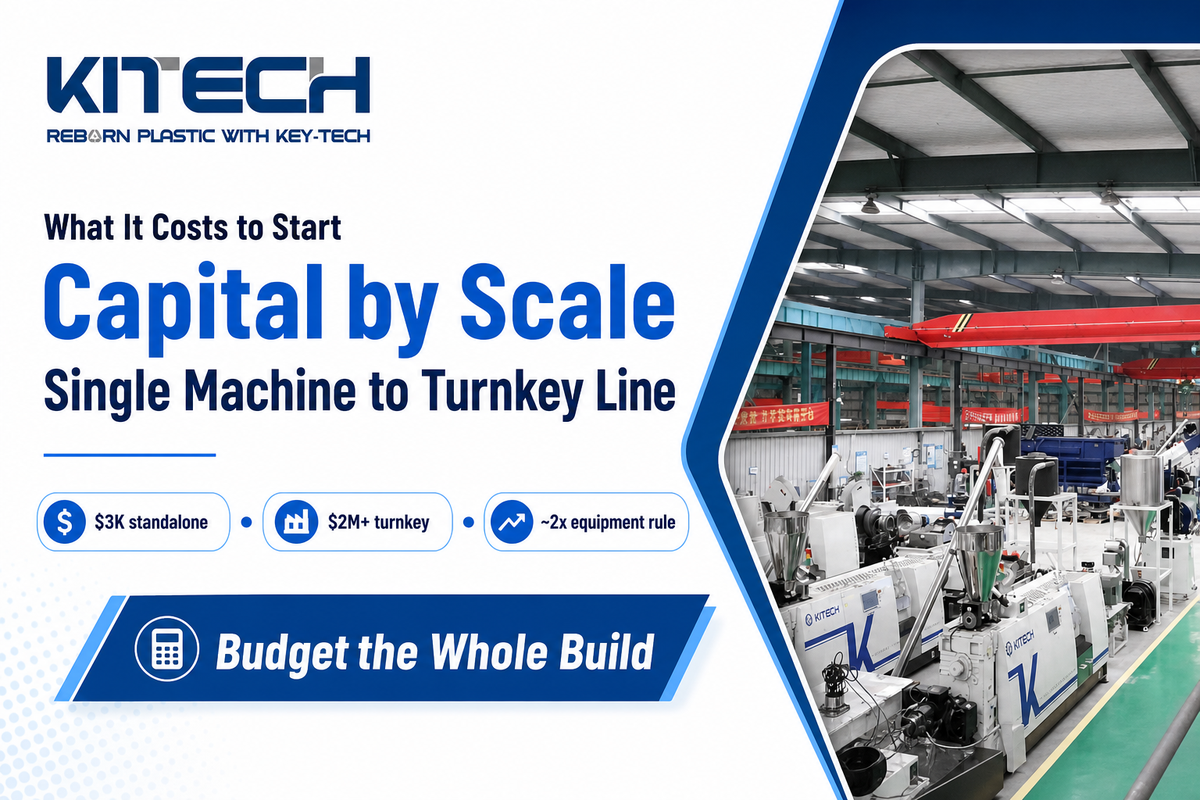
A standalone recycling machine starts near $3,000 and a full turnkey line runs past $2,000,000, but the figure that actually sets your budget is the rule of thumb that total project cost lands at roughly twice the equipment price once civil works, power, and water treatment are added in.
Plastic recycling plant cost scales with how much of the chain you build. You might buy a single machine to add a step to existing recycling facilities, or commission a full turnkey line. Treat the figures below as indicative, not precise: an EU Joint Research Centre review found that published capital and operating data for plastic recycling is scarce and highly variable across technologies, so any single quoted band should be treated as a starting point for your own quotation, not a fixed price. Indicative equipment ranges from a recycling-machinery manufacturer’s published pricing:
- ✔ Standalone shredder: ~$3,000–$100,000 (light film grinder to heavy twin-shaft)
- ✔ Granulator: ~$5,000–$50,000
- ✔ Film washing line: ~$80,000–$250,000
- ✔ PET bottle washing line: ~$180,000–$600,000
- ✔ Full turnkey line: ~$150,000–$2,000,000+
What catches operators off guard is everything around the equipment. A realistic rule of thumb from the manufacturing side, consistent with the wide capital ranges the EU JRC review documents: budget roughly twice the equipment list price once you add civil works (foundations, drainage), electrical infrastructure, water management, conveyors and auxiliary handling, commissioning, and operator training. For a deeper teardown of equipment economics, see our plastic pelletizing machine cost guide and the plastic recycling machine cost & investment guide. Operators financing the build should review recycling equipment financing options before locking a configuration. If you’re starting a plastic recycling business from scratch, sequence the spend to your feedstock contracts, buy the capacity you can keep fed with a single plastic material, then scale, rather than over-building for volume you haven’t yet secured.
Where the Money Comes From: Flakes vs Pellets vs Finished Goods
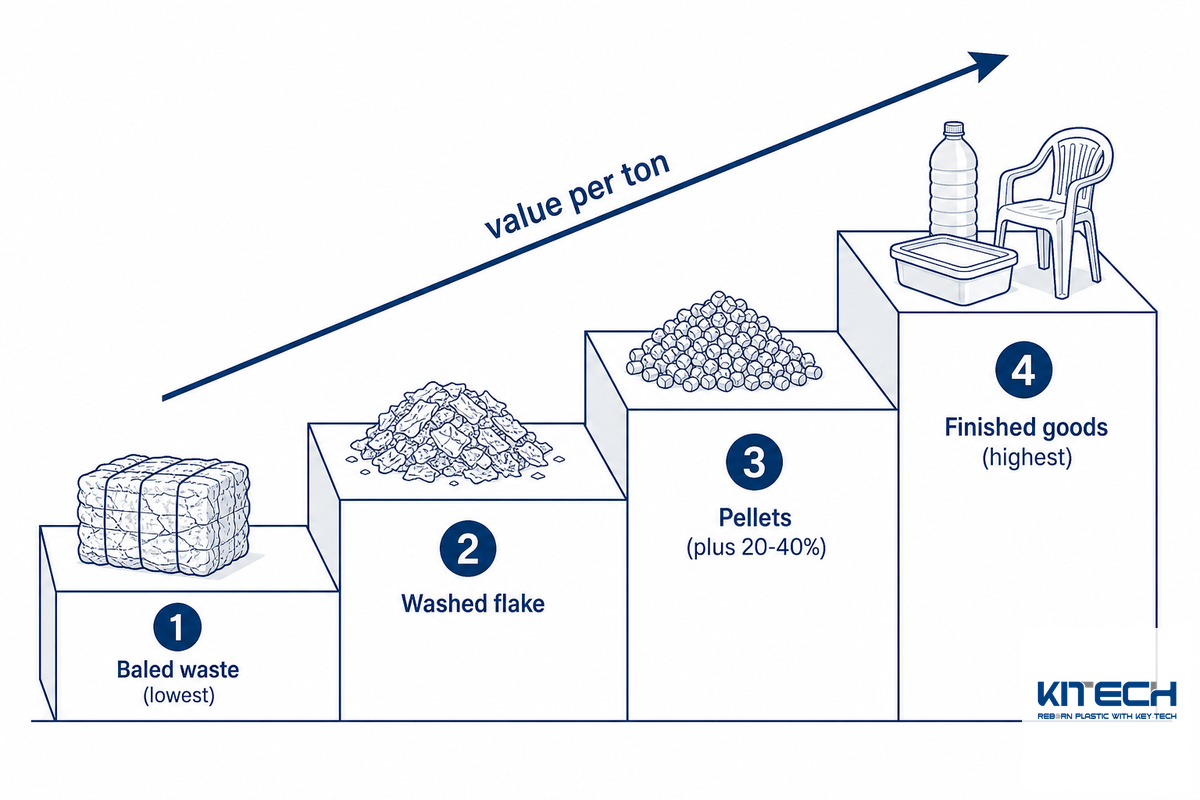
Most recycling revenue comes from one move: turning washed flake into pellets, which sell at a 20–40% premium because molders can feed them directly. Recycled plastic gains value at each processing step, and where you stop on that ladder largely sets your margin. This is the Value Uplift Ladder — the same ton of material is worth progressively more as you move it up:
| Processing rung | What it is | Relative value |
|---|---|---|
| Baled waste | Collected, sorted, compressed | Lowest |
| Washed flake | Shredded, washed, dried | + moderate |
| Pellets | Extruded, filtered, uniform | + 20–40% over flake |
| Finished goods | Molded products | Highest (different business) |
That jump from flake to pellet is where most operators capture margin: uniform, ready-to-use recycled plastic pellets sell at a 20–40% premium over washed flake because molders can feed them directly, our HDPE pellets buying guide breaks down how grade sets the price. Integrating a pelletizing stage rather than selling flake changes the ROI picture, and it’s why the World Bank’s recycler analysis found reprocessors, not collectors, keep the lion’s share of supply-chain margin. Feedstock quality feeds straight into this: recyclers in some markets pay roughly $84 more per metric ton for clear bottles than for colored, because clear material yields higher-value output. For PET specifically, our PET flake price guide tracks the flake-to-pellet spread.
One caveat keep the premium honest: it only applies to pellets that actually qualify for the buyer’s application. Molders making new products from recycled raw material demand consistent melt flow, color, and additive control, and food-contact work adds another approval layer. Off-spec pellets sell at a discount or not at all, so the value-uplift step pay off only when your process holds tight, repeatable specifications. Recyclers who win the closed-loop contracts are the ones whose output a customer can drop into an existing mold without re-qualifying it.
Micro-Business vs Industrial Plant: Which Scale Makes Money?
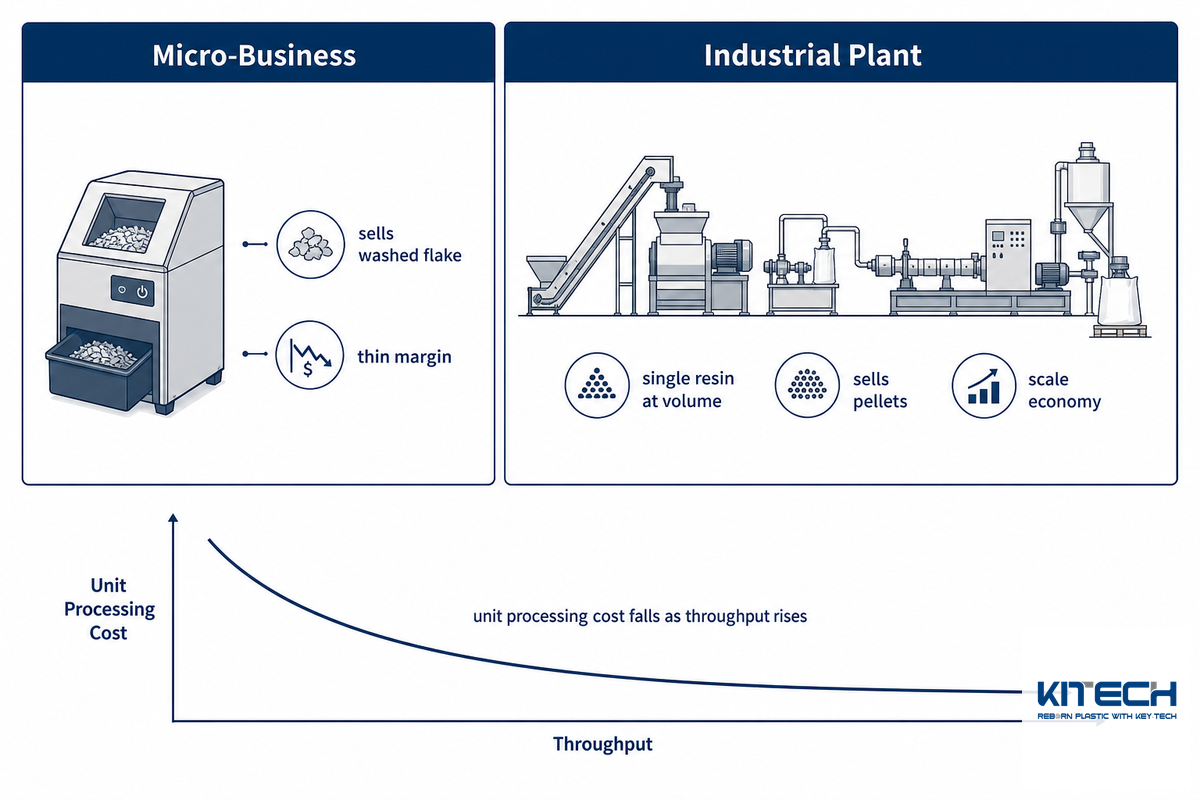
Scale decides the model. A micro-operation selling commodity flake rarely clears its fixed costs, while an industrial plant running a single resin at volume can hold a 20%-plus EBITDA margin. Small scale tends to work only when you convert recycled material into a differentiated finished product rather than competing on raw flake.
Scale changes the entire profitability model, not just the size of the numbers. At the micro end, a small operation that buys a desktop machine to crush bottles into recyclable materials can sell the output for roughly $1 per kilo, which one operator candidly described as making about $15 an hour before expenses, viable as a side venture or a finished-goods craft business, rarely as a standalone plant. At the large-scale end, the unit economics invert: a recycler running tens of millions of pounds a year of a single resin can hold a ~20%+ EBITDA margin because fixed costs spread across volume and contracts stabilize feedstock. The peer-reviewed sorting study above shows the mechanism, unit processing cost fell from about €110 to €70 per tonne as one facility scaled from 25,000 to 100,000 tonnes a year. Below a threshold throughput, recycling a given resin simply isn’t economically feasible no matter how good the machine.
For example, consider two operators who started the same year and faced the same risk of failure. One bought a low-cost shredder, sold washed flake, and stalled, flake buyers squeezed the price and the line never cleared its loan. The second spent more upfront to add washing and pelletizing, locked a single-resin feedstock contract, and sold pellets directly to molders; that operator crossed break-even in the second year. What separated them wasn’t effort or even capital, it was choosing the rung of the value ladder where margin actually exists, and matching feedstock to equipment. Small scale can work, but usually only when the output is a differentiated finished product, not a commodity flake competing against industrial plants. Operators targeting a single high-value stream often start with one focused line, a PET bottle recycling business, for instance, before widening their resin mix.
Pyrolysis & Chemical Recycling: More Profitable or More Hype?
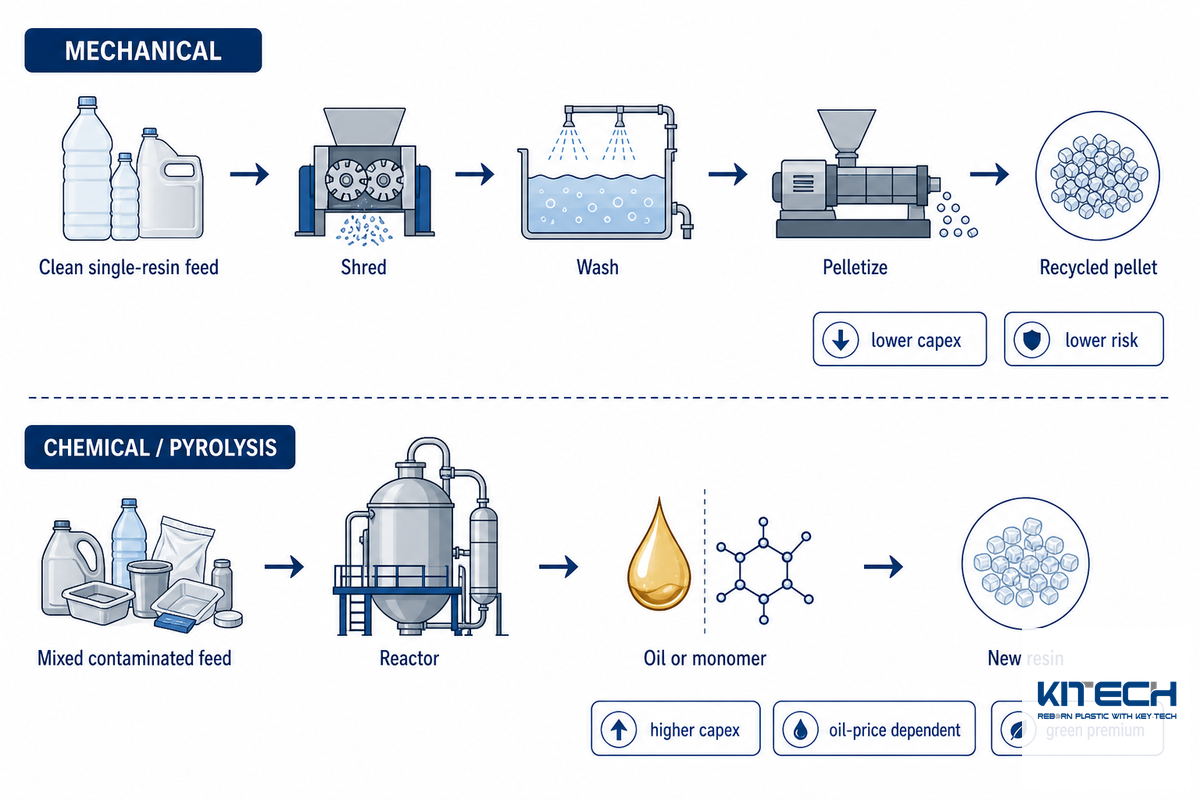
Chemical recycling, including pyrolysis and depolymerization processes that break plastic back into oil-like or monomer feedstock, attracts the most investment and the boldest profit claims. About 80% of new recycling-capacity announcements tracked in late 2024 were chemical-recycling projects, and high-quality chemically recycled resin can earn a “green premium” of 30–70% over virgin. So is it the more profitable future? The peer-reviewed evidence says: not always. Weigh the pros and cons that actually move the economics:
✔ Advantages
- Handles mixed, contaminated, multilayer plastics mechanical recycling rejects
- Output can re-enter food-grade and virgin-equivalent applications
- Commands the higher 30–70% green premium
⚠ Limitations
- Far higher capital cost per ton of capacity
- Poor economy of scale with current technology
- Higher energy use and emissions; output economics swing with oil price
A 2024 capital-investment study in ChemSusChem found chemical recycling plants “suffer from poor economy of scale,” and an EU Joint Research Centre assessment concluded chemical recycling was “not always superior to energy recovery, especially for pyrolysis.” Translation for an operator: mechanical recycling of a clean, high-value resin remains the lower-risk path to profit today. Chemical recycling is a real opportunity where you’ve hard-to-recycle feedstock and deep capital, but it isn’t a shortcut to better margins, and its economics depend heavily on the same oil price that sets the virgin ceiling.
The 2026 Outlook: Why the Profit Math Is Shifting
By far the biggest near-term change to recycling profitability is regulatory, not technological. Through 2026, recycled-content mandates and Extended Producer Responsibility (EPR) laws are putting a policy floor under recycled-resin demand. California’s CalRecycle finalized its EPR regulations on May 1, 2026; multiple U.S. states now require minimum recycled content, for example, 20% post-consumer recycled content in rigid plastic packaging by 2030, and the EU will require recycled content in food packaging and bottles by 2040. As of 2025, five states had enacted recycled-content laws, a wave that began gathering force around 2021.
These incentives are reshaping the broader recycling industry. Rising demand for recycled plastics, paired with public investment in recycling infrastructure and collection programs, is pulling more solid waste out of landfills (per EPA materials data) and into waste plastic recycling streams, and reducing plastic pollution in the process. For brand buyers, recycled content is shifting from a sustainable-solutions talking point into a hard procurement requirement, while reuse and refill models add a parallel pull on the same material. The operators who plan around this demand, rather than chasing this month’s spot price, are the ones building durable margins.
This matters to the profit equation because mandated demand props up the price spread between recycled and virgin resin, the exact variable that, left to the market, has been squeezing PET recyclers. It’s worth being honest about the starting point: the OECD reports that secondary (recycled) plastics still make up only about 6% of total plastics feedstock, so the market remains small and policy-sensitive rather than self-sustaining — a recycler that bets on demand without a mandate behind it risks the same fate as the U.S. PET plants that closed in 2025–2026. That’s precisely why environmental regulations belong inside the profit model, not in a footnote, recycled-resin economics frequently depend on recycled-content targets, EPR fees, and landfill taxes to stabilize demand. Public recycling programs and collection infrastructure determine whether clean feedstock even reaches your gate.
An operator planning a line in 2026 should map which mandates govern their target end markets and time capacity to the compliance deadlines that will pull recycled material. The market-size headlines (a recycled-plastics market measured in the tens of billions of dollars, growing high-single-digit percentages a year) are real but secondary; the actionable driver is policy creating buyers who must purchase recycled content regardless of the virgin price. Position your operation as part of a sustainable, closed-loop supply chain that keeps plastic out of the landfill, and you align with both the regulation and the demand it create, turning the importance of recycling from a marketing line into a contracted revenue stream.
Frequently Asked Questions
Can you make money recycling plastic?
View Answer
Yes, but it depends on scale and resin. At industrial scale, well-run plants report 10–20% net margins (15–35% after full ramp-up), and reprocessors capture up to 80% of the supply chain’s profit. At hobby scale, recycled plastic sells for around $1/kg, so a manual operation earns closer to $15/hour before expenses. The money is real, but it lives in clean single-resin feedstock processed at volume — not in casually collecting mixed plastic.
Which type of plastic recycling is most profitable?
View Answer
HDPE (#2) and PP (#5), plus clean industrial regrind, are today’s most consistent earners, because both move as clean single-resin streams into strong, established end-use markets. PET (#1) historically topped the list but faces real 2025–2026 pressure from cheap virgin oversupply and plant closures. Mixed and multilayer plastics will usually lose money in mechanical recycling.
What is the payback period for a plastic recycling plant?
View Answer
Typically 18–36 months for a well-run line, computed as total installed capital divided by monthly net margin. For illustration, a line netting ~$55,000/month against ~$1,000,000 installed cost pays out in about 18 months; if a spike in contamination or a dip in price cuts the margin by half, payback stretches toward 36 months. The main swing drivers are feedstock cost, equipment uptime, and the recycled-to-virgin price spread — not the line’s sticker price.
How much does it cost to start a plastic recycling business?
View Answer
A standalone machine can run ~$3,000–$100,000; a full turnkey setup runs ~$150,000 to $2,000,000+. Budget roughly twice the equipment list price once civil works, utilities, and electrical are included.
How many plastic bottles do you need to make $100?
View Answer
At a typical 5–10¢ deposit, $100 means roughly 1,000–2,000 redeemed bottles — that is consumer behavior, not a business model. Operators generate revenue by transforming tons of feedstock into pellets, where value is set per ton rather than per bottle.
Is small-scale plastic recycling worth it?
View Answer
It can be — just not usually by selling commodity flake to large industrial reclaimers. Small operators win when they process recycled material into more valuable finished products like tiles, furniture, or custom moldings, moving up the value chain. Small-scale flake sales rarely cover the cost of operating.
Related Articles
- How to Start a Plastic Recycling Business, equipment chain and first steps
- Plastic Pelletizing Machine Cost, the capex behind the highest-margin rung
- PET Flake Price Guide, tracking the flake-to-pellet spread
- Recycling Equipment Financing, leasing, loans & grants for operators
- Rigid Plastic Recycling Line, HDPE/PP processing systems
Want the ROI math run for your specific resin, volume, and feedstock?
References & Sources
- The U.S. Plastics Recycling Economy (AMS.100-64)National Institute of Standards and Technology (NIST)
- The Run on Recycled Plastic (2025)International Finance Corporation (World Bank Group)
- Plastics recycling: challenges and opportunities (Hopewell et al., 2009)Philosophical Transactions of the Royal Society B
- Total Capital Investment of Plastic Recycling Plants (De Tommaso, 2024)ChemSusChem
- Facts and Figures about Materials, Waste and RecyclingU.S. Environmental Protection Agency (EPA)
- Recycled-content requirements & PET recycling market reportsAssociation of Plastic Recyclers (APR)
How We Built This ROI Analysis
Kitech engineers and manufactures plastic shredders, washing lines, and pelletizers for reclaimers in more than 80 countries, so the cost and throughput figures here are anchored to real equipment economics rather than estimates. The margin, payback, and resin-price data are drawn from government, peer-reviewed, and industry sources current to mid-2026; where the market is volatile, as PET is right now, we say so rather than quoting a single tidy number. Reviewed by the Kitech technical team.