Póngase en contacto con Kitech Company


Actualizado en junio de 2026.
El filamento reciclado es un filamento imprimible rehecho a partir de chatarra limpia e impresiones fallidas en lugar de bolitas vírgenes. Si quieres reciclar filamento de impresora 3D, la respuesta honesta es sí -ñ pero sólo es posible si tienes acceso al equipo correcto, al correcto plástico, y generar muy poca chatarra. PLA, PETG, ABS y TPU tienen el potencial de convertirse nuevamente en un nuevo filamento, pero prácticamente nada puede ir en su contenedor en la acera. Esta guía lo guía a través de las tres opciones reales: extrusión por correo, una opción de envío por correo y una línea industrial y la ingeniería que mantiene algunos carretes en buen estado mientras que otros obstruyen las boquillas.
Respuesta corta: Reciclar el filamento de la impresora 3D consiste en triturar chatarra limpia de una sola resina en escamas de 2 a 5 mm, secarlas bien en un secador giratorio (lo ideal es un secador de polímero exclusivo) y luego alimentar esa escama a un filamento extrusora está diseñado para producir una hebra consistente de 1,75 mm ±0,05 mm de diámetro. Funciona bastante bien para PLA y PETG, es mucho más desafiante con ABS, nailon y PC, y en términos de dólares generalmente no se vuelve rentable hasta que se producen 50 kg/mes de chatarra de filamento purificada, aunque los beneficios son casi en su totalidad en reducción de residuos.
Especificaciones rápidas: reciclaje de filamentos de un vistazo
| Tipos reciclables en el hogar | PLA, PETG, ABS, TPU «clasificados estrictamente, nunca mezclados |
| Aceptación en la acera | Ninguno en la práctica (código de resina #7 “Otro”) |
| Pérdida de propiedad | del orden de tracción de 10% por refundición temprana; utilizable ~5-6 ciclos (mezcla virgen después del 3o) |
| Diámetro objetivo | 1,75 mm ±0,05 mm, redondez ≥95% |
| Equipo de escritorio | Trituradora + extrusora de filamentos, ~$700 (DIY) a ~$10.000 (prosumidor) |
| Paso no negociable | Secado (PLA, PETG, nailon y PC son higroscópicos) |
💡 Conclusiones clave
- Una nota importante antes de comenzar es que el material de filamento reciclado puede no sea tan fuerte como virgen. Puede ser tan bueno en los primeros ~3 pases y luego está sujeto a una degradación acelerada.
- Stabilitate diametrului « no en última instancia, Strength 'Refuerzo tiene el mayor potencial de fallar, y es la diferencia entre un 0,05 mm comercial y un 4,6% DIY lo que causa tantos problemas de obstrucción en el extremo caliente.
- Nunca procese PLA, PETG y ABS en el mismo lote, sus ventanas de fusión están demasiado separadas, por lo que la resina de baja temperatura se quema mientras que la de alta temperatura apenas se derrite.
- Una operación de reciclaje doméstico generalmente sólo “paga por sí misma” más de 50 kg/mes de chatarra, pero reduce aproximadamente a la mitad la energía incorporada y evita la mayor parte de los residuos.
Por qué no puedes simplemente tirar impresiones 3D en la papelera de reciclaje
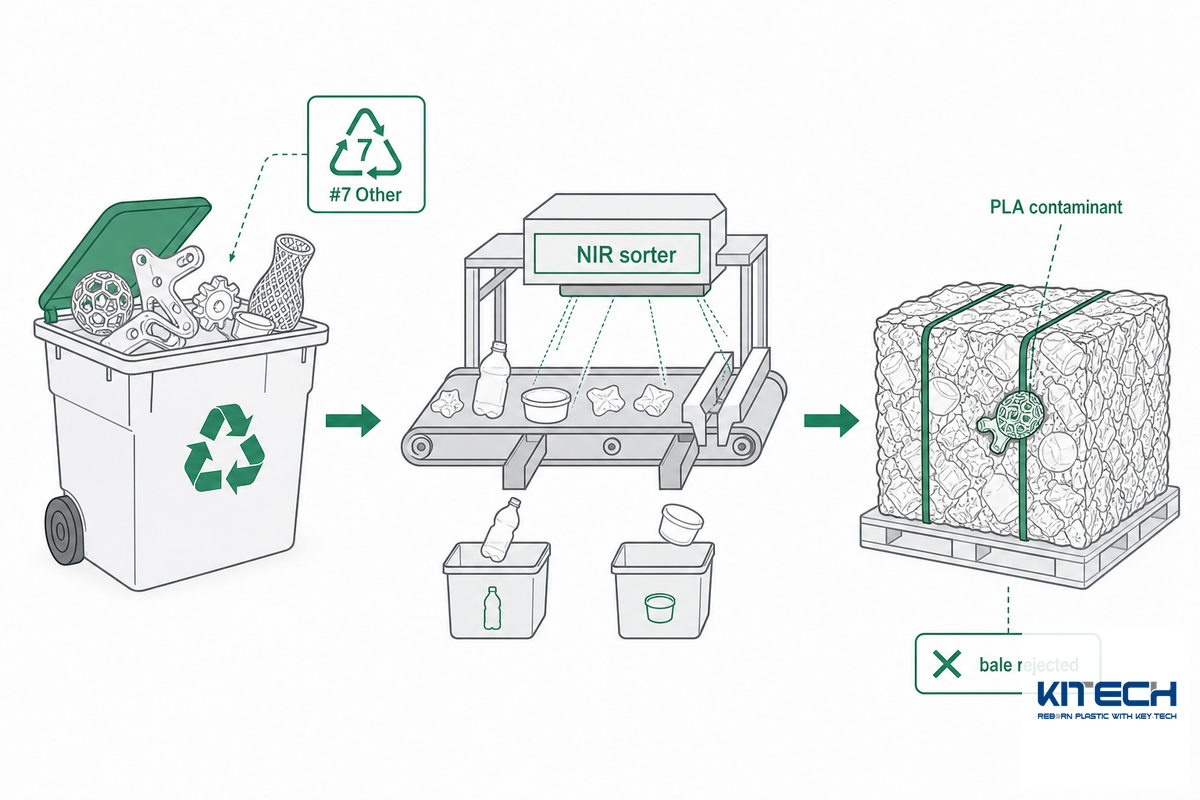
En la mayoría de los casos, los recicladores locales lo harán no acepta tu impresiones fallidas, soportes o conjuntos de purga. Prácticamente todos los termoplásticos de deposición fundida (PLA, PETG, ABS, policarbonato, nailon) se incluyen en el código de identificación de resina “Otro” #7, tal como lo define ASTM D7611.
Ahí es donde las cosas empiezan a salir mal al interpretar el número « ASTM D7611 define el número como una forma de distinguir los plásticos entre sí, no como una forma de señalar cómo se pueden o se deben reciclar. Ese código señala sólo el tipo de polímero, no si existe un sistema de reciclaje. Los EE.UU. esquemas de la EPA que muchos plásticos no se pueden reciclar a través de sistemas locales, generalmente porque no existe un proceso; la mayoría de las instalaciones rechazan los plásticos etiquetados con 7: el sitio Recycle Ann Arbor afirma que “los contenedores de plástico etiquetados con #7 de cualquier forma no son reciclables”
También existen varios problemas físicos con los plásticos #7. El primero y más obvio es simplemente que las impresiones 3D no tienen forma de botella o caja de almacenamiento (ya que son complejas, de forma irregular y multicolores). Los clasificadores de infrarrojo cercano que clasifican un flujo de reciclaje están calibrados para botellas y tinas, no carcasas de ABS y relleno cuadrado de 1/2. En segundo lugar, un PLA bioplástico perdido como simplemente actúa como contaminante en un arroyo; una parte del PLA perdida simplemente disminuirá el valor de una bala entera de plásticos templados. En pocas palabras: la mayor parte del reciclaje de residuos de material de impresora 3D es un esfuerzo exclusivo; no es una característica automática del contenedor azul; el resto de esta guía cubre el proceso esperado para hacerlo bien. La mayoría de las opciones de reciclaje locales y los centros de reciclaje municipales simplemente no tienen un proceso de reciclaje para estas resinas, por lo que para reducir los residuos hay que clasificarlos por tipo de plástico y encaminarlos a través de uno de los canales dedicados a continuación. En la práctica, una sola impresión PLA perdida puede contaminar una bala entera, el problema oculto que hace que la acera sea la ruta equivocada para los desechos de impresión 3D y convierte un lanzamiento descuidado en un costo real para toda la carga. Si quieres comenzar con los códigos y clasificadores, aquí tienes una imprimación. los diferentes tipos de plásticos y sus códigos de reciclaje.
¿qué filamentos de impresora 3D se pueden reciclar realmente?
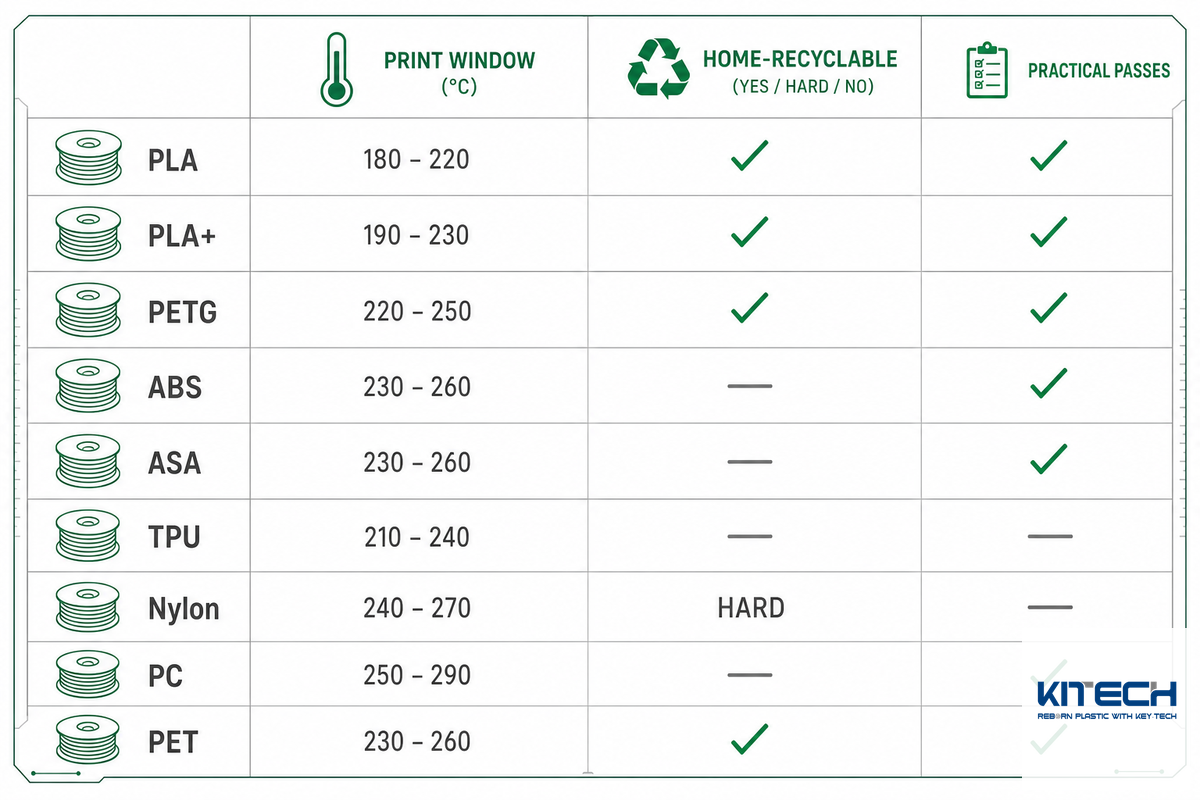
Los cuatro filamentos principales principales: PLA, PETG, ABS y TPU; todos se pueden reciclar nuevamente al filamento -ñan siempre que estén estrictamente clasificados por tipo. Realmente no se pueden coprocesar ya que tienen puntos de fusión muy diferentes. PLA está en alrededor de 215 °C, PETG en 250 °C, ASA/ABS están en 260 °C. PLA es el más indulgente, el nailon y el PC son complicados. Ninguno de ellos será aceptado en su colección habitual en la acera.
Los tipos de filamentos que realmente puede recuperar dependen del tipo de material y su ventana de fusión: PLA y PETG son los materiales de impresión más fáciles de reciclar, mientras que PETG y ABS exigen un secado y ventilación más estrictos.
Simplemente lea la resina en la herramienta a continuación y vea si el reciclaje de bricolaje parece prometedor, a qué temperaturas secarlo y cuál es la mejor ruta a través de la máquina para usted.
El cuadro de mando de recuperación de filamentos de 9 materiales
| Material | Ventana de impresión | ¿reciclable en casa? | Secar antes de extruir | Pases prácticos | Mejor ruta |
|---|---|---|---|---|---|
| PLA | 190-220 °C | Sí (más fácil) | 45-55 °C, 4-6 h | ~5-6 | extrusión o servicio de bricolaje |
| PLA+ | 200-225 °C | Sí | 50-55 °C | ~4-5 | extrusión de bricolaje |
| PETG | 230-250 °C | Sí (crítico seco) | 65 °C, 4-6 h | ~5 | bricolaje (duro seco) o servicio |
| ABS | 230-260 °C | Más duro (humos) | 70-80 °C, 2-4 h | ~3-4 | Servicio/industrial; ventilar |
| ASA | 240-260 °C | Más duro | 70-80 °C | ~3-4 | Servicio / industrial |
| TPU | 210-230 °C | Duro (no se triturará) | 70 °C | bajo | Servicio |
| Nailon (PA) | 240-270 °C | Muy duro | 70-90 °C, 6-12 h | bajo | Servicio / industrial |
| PC | 260-300 °C | Muy duro | 90-120 °C | baja medicina | Industrial (puede combinar virgen) |
| PET (botellas) | 250-270 °C | Especialista (cinta) | 65 °C+ | n/a (cinta) | Poliformador o industrial |
Ventanas impresas/secas compiladas a partir de datos del fabricante de la extrusora y hojas de datos de materiales (3devo, Felfil, pruebas de ventanas fundidas de cocina CNC); Las calificaciones de reciclabilidad se cotejan con estudios de reprocesamiento revisados por pares.
¿qué filamento de impresión 3D es reciclable?
La facilidad es un orden ascendente: PLA primero, luego PETG, luego ABS/ASA. PLA cuida al máximo tu hogareño trituradora y extrusora; El PETG se recicla limpiamente pero es más higroscópico y se endurece fácilmente si el material no está lo suficientemente seco; El ABS es bastante fácil de reciclar, además de escupir humos nocivos y deformarse significativamente, lo que lo hace más adecuado para un proceso interno ventilado o en una línea industrial.
Los mayores desafíos vienen con el TPU (ya que es muy fibroso y resiste el corte limpio) y el policarbonato o el nailon, ya que son extremadamente sensibles a la humedad, lo que significa que los resultados domésticos repetibles probablemente serán difíciles de alcanzar. Recuerde la regla de la comunidad: nunca mezcle diferentes plásticos o diga que el PETG se vuelve pegajoso mientras el PET es sólido y la masa fundida se vuelve inútil. Consulte nuestra guía para Reciclaje de PET y policondensación en estado sólido por qué la química del PET hace que se comporte de esa manera.
El flujo de trabajo de reciclaje de filamentos domésticos: ordenar → triturar → secar → extruir
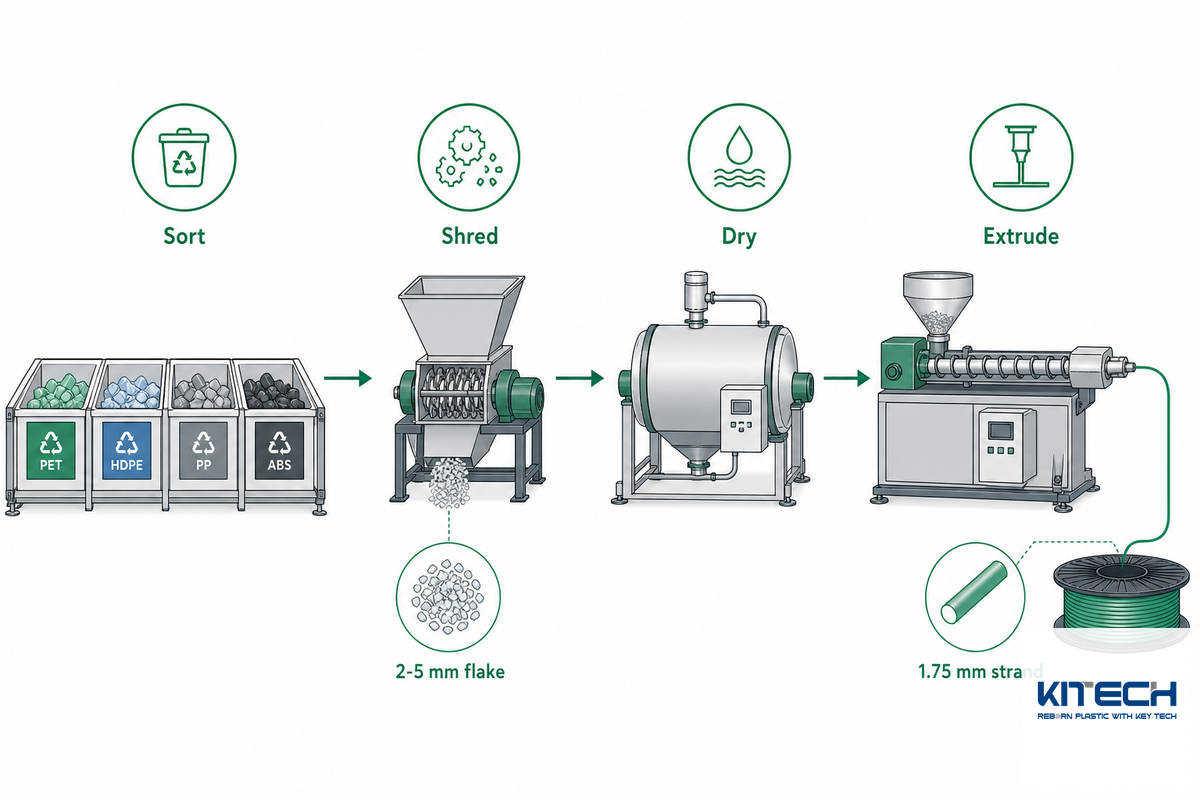
Para reciclar el filamento de la impresora 3D en casa, deberá seguir los mismos pasos para: clasificar el material estrictamente por tipo y color, triturar las impresiones hasta obtener escamas de 2-5 mm, secar completamente el material para eliminar el exceso de humedad y alimentar. esta escama a través de una extrusora de filamentos ajustada a la temperatura de fusión de la resina, donde se extrae hasta un diámetro de 1,75 mm ±0,05 mm. La mayoría de los fallos ocurren dentro de este proceso (a menudo el más común de los cuales es escatimar o incluso faltar al paso de secado).
1. Ordenar. Primero, separe por tipo de polímero. En segundo lugar, clasifique por color. Pequeños rastros de pigmentos más oscuros pueden dominar fácilmente el color de un lote completo, haciéndolo incluso limpio apagado-los cortes o filamentos de purga aparecen de color marrón turbio. Contaminar un lote de escamas de PLA incluso con una sola pieza de PETG provocará huecos de aire en el filamento final. Los cortes de impresión limpios y las purgas gastadas son materia prima mucho menos problemática que las piezas pintadas. Ordenar bien es la forma de eliminar los contaminantes antes de que destruyan un lote, y es el paso que le permite reciclar las impresiones fallidas en lugar de agruparlas.
2. Triturar. Utilice una trituradora de plástico para convertir las impresiones en piezas que su reciclador pueda manipular más fácilmente. Concéntrese en piezas consistentes de 2 a 5 mm. Si las escamas varían mucho en tamaño, el plástico reciclado no fluirá suavemente a través de su extrusora ; esto a menudo se debe a una inconsistencia en el tamaño y contribuye a las fluctuaciones en el diámetro del filamento y la extrusión de sobretensiones. Regrind tiene la mitad de la densidad aparente de los gránulos y, a menudo, tiene un tamaño inconsistente.
3. Seco. Es importante que cada tipo de polímero se seque completamente para obtener mejores resultados. PET, PLA, nailon y PC absorben la humedad ambiental del aire, que se convierte en vapor cuando se calienta dentro del cilindro de la extrusora, provocando burbujas, cambios de diámetro y, en casos extremos, daños reales a las cadenas moleculares. PLA debe secarse alrededor de 50 °C, PETG alrededor de 65 °C, ABS y ASA alrededor de 75 °C y nailon hasta 90 °C. ¡Lo que buscas es un nivel de contenido de humedad que garantice una extrusión sin problemas, como ocurre con los polímeros reciclados convencionales! Consulte nuestra guía en secado y control de humedad en el reciclaje de plástico para los niveles de contenido de agua necesarios para producir plástico reciclado de alta calidad.
4. Extruir. Introduzca la escama en una extrusora de filamentos de un solo tornillo, que la derrita hacia abajo y la empuje a través de la boquilla y la matriz. Esa masa fundida continua se tira, a mano o mediante un sistema automático, hasta alcanzar el diámetro correcto de 1,75 mm a medida que se enrolla en el carrete. Trabajará principalmente para lograr un diámetro de filamento constante en este paso del proceso.
📐 Nota de ingeniería « La disciplina de ±0,05 mm de diámetro
El filamento comercial tiene una capacidad de 1,75 mm ±0,05 mm con una redondez de alrededor de 95%. Por el contrario, un robot de reciclaje de código abierto de grado de investigación medía aproximadamente ±0,08 mm (±4,6%), lo que provoca una subextrusión y obstrucción en extremos calientes apretados. Usted controla el diámetro con cuatro variables: (1) secado (la humedad provoca oscilación); (2) tamaño de rectificado (sobretensiones de escamas mixtas); (3) estabilidad de la temperatura de fusión; y (4) velocidad de tracción/enrollado adaptada al flujo. Mantenga esos cuatro, y el control del proceso de extrusión y extrusión seca del que dependen las líneas de pellets industriales rinde dividendos.
Un ejemplo de comunidad de creadores contará la historia. Un fabricante que volvió a extruir una mezcla uniforme (50/50) de PLA residual recrudado y una fuente virgen de PLA limpia todavía imprimió piezas subextruidas y sobreextruidas porque el diámetro oscilaba entre 1,65 y 1,85 mm, aproximadamente un tramo de 0,1 mm, el doble. La solución no era un material más resistente: se secaba más fuerte y se tiraba más lentamente y de forma controlada.
⚠¦ Seguridad: ventilar el proceso
Más allá del plástico -gnel proceso de trituración/secado/extrusión puede crear partículas ultrafinas (UFP) y, cuando se utilizan determinadas resinas, otros volátiles. El Investigación de la EPA de EE. UU. sobre impresión 3D identifica la extrusora de filamentos como una fuente de partículas ultrafinas, incluso a velocidades iguales a las propias impresoras 3D. Los CDC NIOSH (Instituto Nacional para la Seguridad y Salud Ocupacional) trata la impresión 3D de bricolaje en espacios de creación, aulas y pequeñas empresas como una cuestión relacionada con la exposición en el lugar de trabajo, no solo con la calidad de la impresión. Cuando ejecute equipos para su proceso de reciclaje, asegúrese de hacerlo en ambientes bien ventilados o bajo gases de escape localizados, prestando especial atención cuando utilice ABS y ASA donde estén calientes y genere estireno.
Equipos de reciclaje de filamentos: comparación de recicladores de escritorio
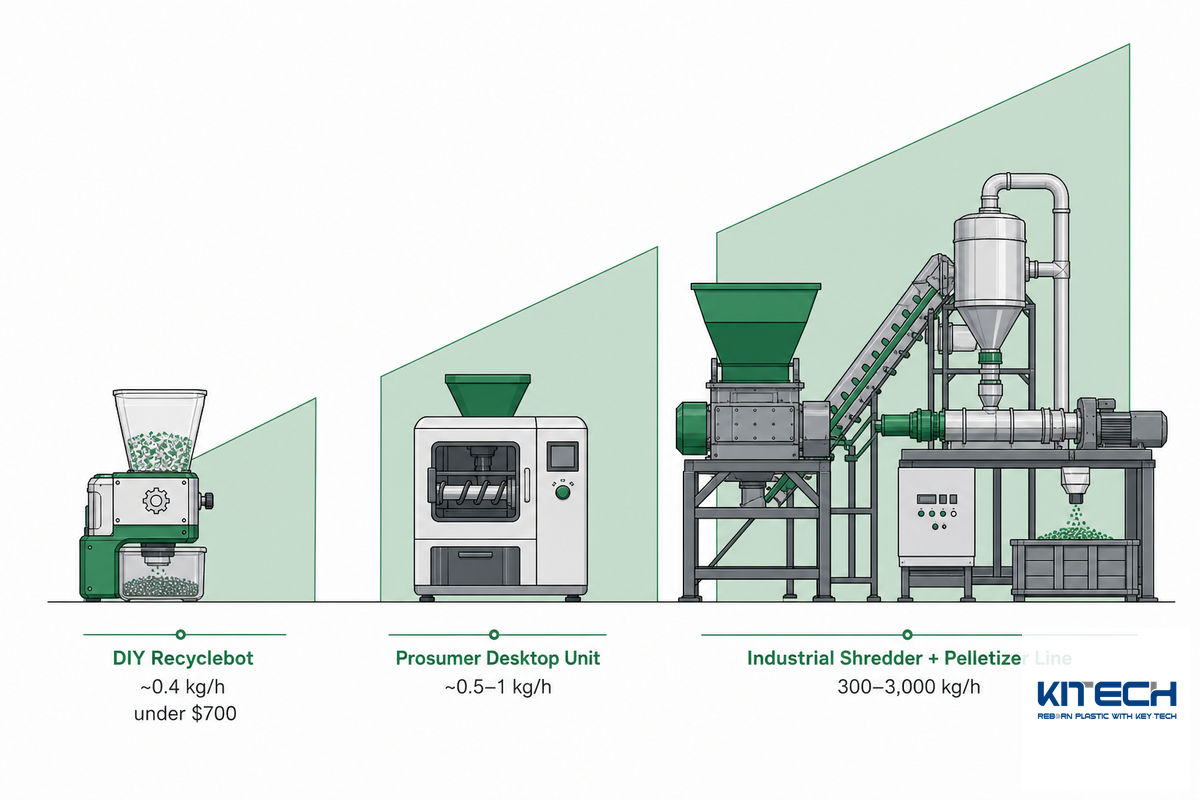
Para uso doméstico, una máquina de reciclaje de filamentos suele ser dos equipos «una trituradora y una extrusora de filamentos «, aunque existen algunas unidades combinadas todo en uno y un fabricante decidido puede construir un reciclador de filamentos de bricolaje a partir de planos de código abierto. De cualquier manera, la configuración de la extrusora central es la misma: una trituradora alimenta el filamento residual limpio a un sistema de extrusión de filamentos que lo funde y lo vuelve a dibujar para calibrarlo. La impresión 3D Guía de campo del reciclador de filamentos de escritorio a continuación se comparan productos populares en el mercado, antes de explorar opciones industriales más grandes, considerará si se toma en serio la impresión 3D o establece una gran granja. Los precios a continuación están actualizados a partir del verano de 2026 y cambian según el modelo y el país.
| Sistema | Tipo | Rendimiento | Banda de precios | Mejor para |
|---|---|---|---|---|
| Reciclobot de bricolaje (código abierto) | Extrusora (+ trituradora separada) | ~0,4 kg/h | <$700 compilación | Fabricantes / investigación |
| ExtrudeX | Kit de bricolaje (+ trituradora) | bajo | ~$300 | Bricolaje económico (60% virgen + 40% residuos) |
| Felfil Evo | Extrusora (+ trituradora Felfil) | ~0,5 kg/h | ~800€-1.500 | Prosumidor económico |
| Creality Filament Maker M1 + Trituradora R1 | Extrusora + trituradora/secadora | ~1 kg/h | Consumidor | Fabricantes de escritorios |
| Filabot EX2 | Extrusora (+ amoladora Filabot) | ~0,5-1 kg/h | $2.995-3.750 | Prosumidor/laboratorio |
| Fabricante de filamentos 3devo | Extrusora + sensor de diámetro | ~0,7 kg/h | ~$4-8k | Laboratorio/educación |
| ProtoCycler V3 (ReDeTec) | Molinillo todo en uno + extrusora | ~0,5 kg/h | $9,999 | Prosumidor todo en uno |
| Filabot EX6 (industrial-lite) | Línea extrusora | más alto | ~$12.000-24.000 | Pequeña producción |
| Trituradora industrial + peletizador línea | Línea completa (triturar + lavar + peletizar) | 300-3.000 kg/h | Cápice industrial | Imprimir granjas/recuperadores |
(Datos tomados de las especificaciones del catálogo del fabricante, es decir, Filabot, ReDeTec, 3devo, Creality. Literatura de código abierto sobre robots de reciclaje, así como versiones anteriores. Confirme los precios del minorista actual antes de comprar)
¿se puede fundir y reutilizar el filamento de la impresora 3D?
Sí, esto es exactamente para lo que sirve una extrusora de filamentos. Triture adecuadamente el plástico usado, séquelo, luego derrita y vuelva a extruirlo en una hebra continua enrollada en un carrete. La consistencia es el único inconveniente: una extrusora de bajo costo generalmente carece de control del diámetro en línea, por lo que el ancho de la hebra se desplaza.
Esa deriva hace que una impresora se extruya demasiado o demasiado, o impone límites estrictos sobre los cuales la impresora puede hacer funcionar el material reciclado. Para obtener mejores resultados, granule o peletice el material reciclado antes de extruirlo; La alimentación con trituración irregular produce una hebra quebradiza e inconsistente.
Qué hace el reciclaje con la calidad de los filamentos (y cómo limitarla)
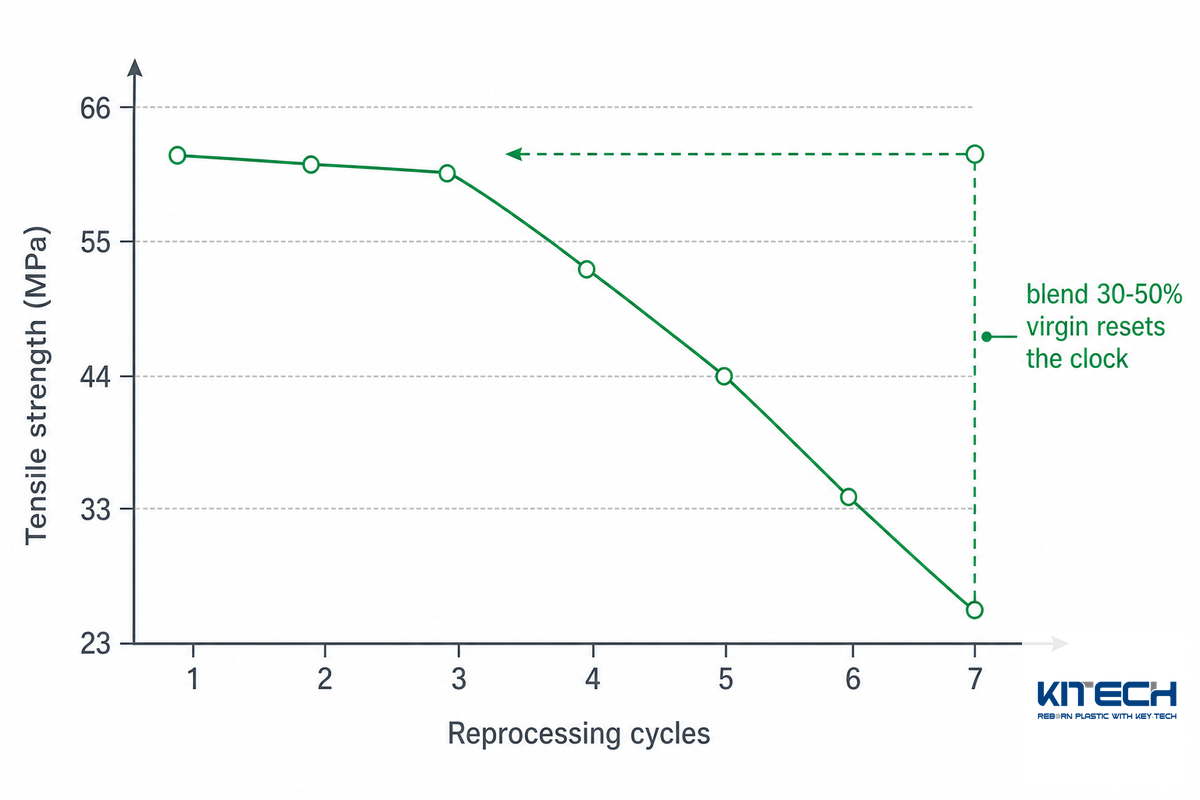
Aquí está la mayor inexactitud encontrada en la mayoría de las guías prácticas: el proceso de reciclaje no reduce la resistencia en línea recta. El filamento reciclado no pierde resistencia en proporción directa al número de pasadas, y la curva difiere según los tipos de filamentos, ya que PLA, PETG y PC se degradan cada uno según su propio horario en lugar de todos a la vez.
En las primeras 1 a 3 pasadas, el PLA y el PET reciclados a menudo coinciden o mejoran con los materiales vírgenes originales debido a un aumento en la cristalinidad logrado mediante el reprocesamiento adecuadamente controlado de los plásticos. Un estudio de la Universidad de Texas en Austin reveló que las propiedades mecánicas del PLA “no se vieron afectadas en gran medida incluso después de someterse a cuatro” pasadas de reciclaje. Datos técnicos de Michigan policarbonato reciclado medido a 64,9 MPa, justo en línea con virgen. En otras palabras, los desechos de PLA bien secos pueden regresar como filamento que rivaliza con el filamento virgen, casi tan bueno como el filamento nuevo durante las primeras pasadas.
En algún lugar más allá del tercer ciclo, el deterioro se activa y comienza a acumular interés. En una prueba, la tensión de tracción del PLA se degradó de aproximadamente 66 MPa a aproximadamente 23 MPa a través de siete ciclos de refundición, mientras que la transición vítrea se mantuvo prácticamente plana (el PLA se sitúa cerca de 60-61 °C y apenas cambia con el reprocesamiento). Esos primeros ciclos aún pueden ser notablemente benignos: algunos experimentos muestran que la fuerza del PLA se mantiene bien desde el principio, razón por la cual la guía revisada por pares generalmente limita la reutilización práctica en alrededor de tres a cinco ciclos. La palanca que ‘restablece el reloj’ está en forma de mezcla: agregar polímero virgen 30% a 50% devuelve un rendimiento cercano al nivel base.
Sin embargo, tenga en cuenta que los números de laboratorio reflejan materia prima impecable. La exposición a los rayos UV, el historial térmico, la carga de tinte y la contaminación son reales impresiones fallidas significa que el material de “campo” probablemente degenera más rápidamente de lo que indican los estudios. Realice un seguimiento de cuántas veces se vuelve a fundir cada lote e inspeccione en lugar de simplemente asumir que cada pieza impresa se puede procesar como restos limpios recién salidos de la cama.
“Reciclar plástico residual en filamento con un robot de reciclaje de código abierto reduce la energía incorporada de ese filamento en aproximadamente 90% y el costo del material a unos pocos centavos por kilogramo. La barrera nunca fue la química, estaba dando a la gente las herramientas”
Un consejo inesperado de un estudio reciente sobre PET reciclado: apagar completamente el ventilador de enfriamiento de la pieza y eliminar el túnel de viento para el plástico durante la solidificación puede aumentar de manera mensurable la resistencia a la tracción probada de la pieza al permitir períodos más largos de cristalización. A menudo se descubre que los materiales reciclados pueden funcionar mejor con menos enfriamiento del que podría haber conectado para obtener filamento nuevo. Consulte nuestra tabla en grados de calidad de pellets reciclados para las clasificaciones industriales utilizadas en reprocesamiento.
✔ ¿Qué aguanta
- PLA/PET durante los primeros ~3 ciclos (puede coincidir con virgen)
- Resistencia a la tracción de PC reciclada (~65 MPa)
- La virgen mezclada 30-50% se recupera cerca del inicio
⚠ Ce degrada
- Resistencia a la tracción después de ~3 ciclos (hasta grandes pérdidas en el ciclo 7)
- Consistencia del diámetro (la verdadera causa de la obstrucción)
- Adhesión de capas sobre chatarra muy reimpresa
¿sin equipo? Programas de reciclaje por correo y devolución
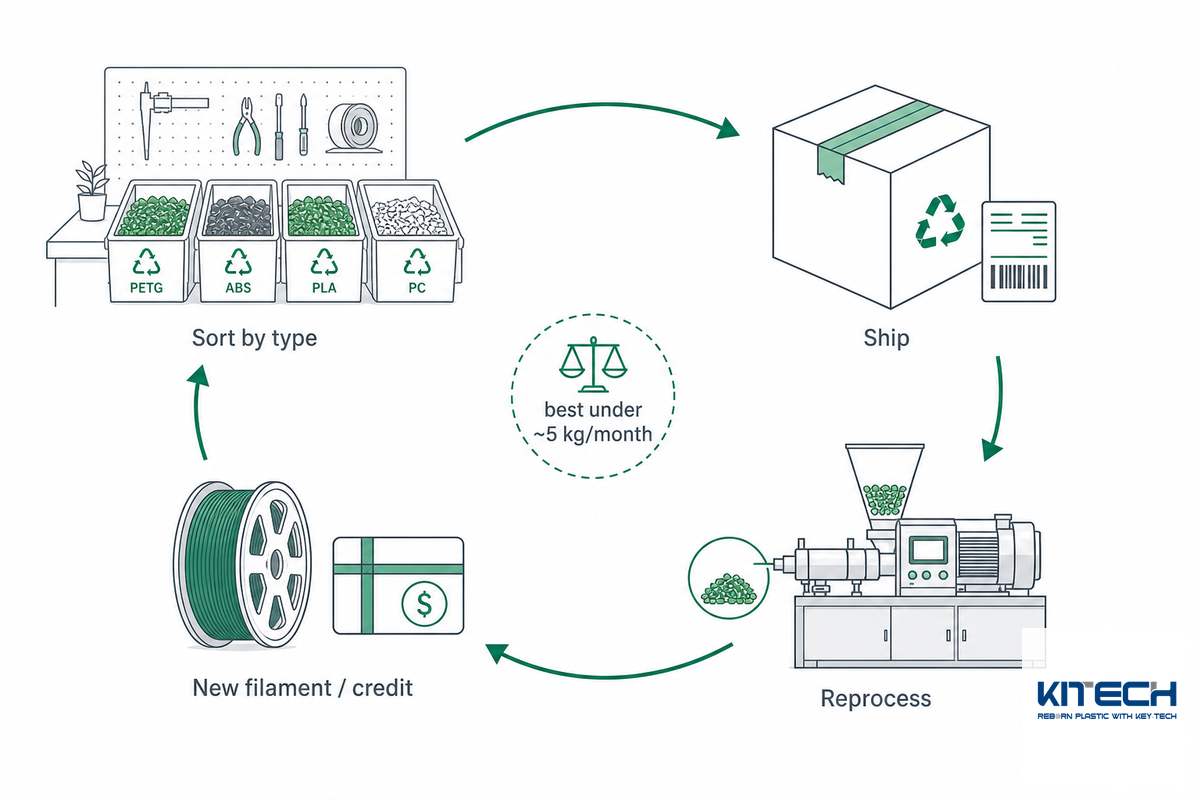
Si invertir en el equipo usted mismo no es una opción, varios servicios de reciclaje de filamentos y programas de reciclaje especializados le quitarán los restos de plástico de las manos. Estos métodos de reciclaje por correo le permiten enviar sus desechos y hacer que otra persona los reprocese. Impresora ofrece lo que llama un modelo de clasificación y envío que otorga puntos canjeables por nuevos filamentos basados en materiales limpios y bien segregados. TerraCiclo vende “Cajas de Residuos Cero” ($195-$352, según tamaño) que se pueden llenar con filamentos y carretes (entre otras cosas). FormaFutura también ofrece un servicio de devolución de filamentos PLA y PETG, y Filabot está probando actualmente una opción de envío por correo para impresiones fallidas (específicamente de PLA). Las universidades también ejecutan sus propios bucles «El programa REMake de la Universidad de Auburn recoge los residuos de impresión del campus « y resúmenes como Guía de servicios de All3DP realice un seguimiento de nueve o más opciones de envío y entrega por correo, a veces con un reciclador cerca de usted.
Si genera menos de unos pocos kilogramos de plástico defectuoso al mes, un servicio de envío por correo podría ser la mejor opción. El momento es la compensación oculta: debido a que una caja puede tardar 60 días o más en llenarse al volumen de hobby, en la práctica los puntos o el crédito de la tienda recuperan solo un pequeño % del valor de la resina, por lo que el envío por correo es en realidad una forma de evitar el desperdicio, no para ahorrar dinero. Los expertos indican un “umbral útil” para servicios tales como menos de aproximadamente 5 kg por mes, momento en el cual el tiempo de espera (de 6 a 12 meses hasta que llene una caja) está relativamente equilibrado con el tiempo típico de entrega de 6 a 8 semanas. En cuanto a los carretes vacíos, si están hechos de cartón, probablemente se puedan colocar en sus contenedores habituales; Si están hechos de plástico, pueden enviarse a través de una caja Zero Waste. Y lo más importante: evite colocar el PLA o cualquier impresión de plástico #7 con sus materiales reciclables habituales en la acera solo para ser seguros; la EPA enumera específicamente los plásticos compostables y de base biológica como contaminantes. El PLA solo se biodegrada en instalaciones de compostaje industrial, no en un contenedor de patio trasero o en un arroyo en la acera, razón por la cual contamina una carga de reciclaje.
¿reciclar filamentos realmente ahorra dinero? Las matemáticas de equilibrio
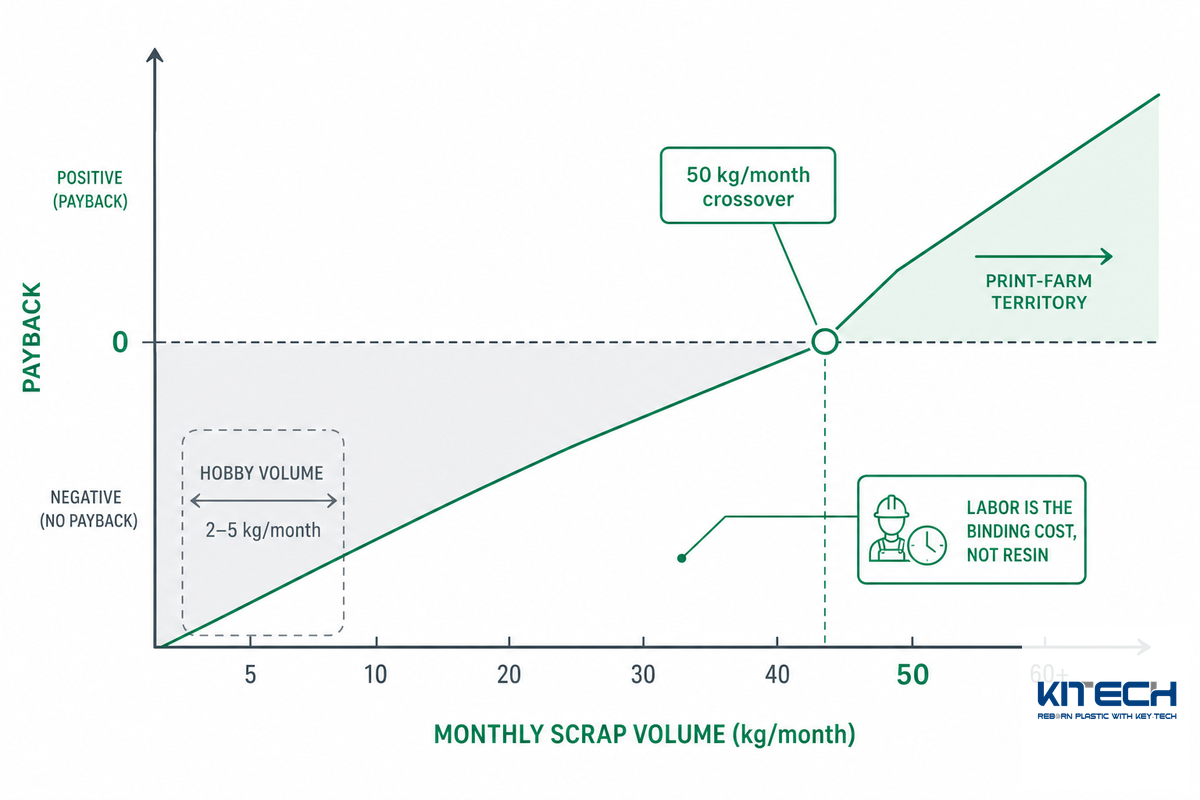
Ahorrar dinero reciclando su propio filamento es algo que normalmente sólo tiene sentido económico una vez que alcanza un cierto volumen umbral. Mientras que el material en sí es casi gratuito (original Estudios de Recyclebot costos de procesamiento sugeridos de alrededor de 2,5 centavos/kg frente a $20-$50+/kg para filamentos comerciales), el costo total se contabiliza por la máquina, la energía y el tiempo. La mayor parte del valor de reciclar los residuos de filamentos propios es mantener el plástico fuera del vertedero, ya que la resina en sí es casi gratuita.
Repasemos los números con un ejemplo del mundo real. Si produce 3 kg de filamento de chatarra al mes y asume que el coste del filamento es $25/kg -estabiliza esto da como resultado $75/mes de ahorro bruto. En un robot de reciclaje de bricolaje $700 (ignorando la mano de obra, tratando la construcción como un pasatiempo), la recuperación es de aproximadamente $700/$75 = 9-10 meses. Pero en una unidad de prosumidor $3000, la recuperación es de más de tres años. Agregue un rendimiento razonable (un modelo de retorno de la inversión considera 90-100% como “fan fiction” y establece el uso en 60-85% -an junto con 2,5 horas adicionales de mano de obra por kilogramo, y el caso financiero simplemente no resiste a los fabricantes ocasionales. En el banco, el costoso error que cometen la mayoría de los fabricantes es tratar su propio tiempo como gratis; las 2,5 horas de trabajo por kilogramo eclipsan los 2,5 centavos/kg de resina, por lo que el costo de encuadernación es mano de obra, no material.
⚠¦ La ventana de equilibrio
Para el aficionado promedio (2-5 kg/mes), ningún reciclador alcanzará el punto de equilibrio basándose en dinero en efectivo puro, pero si desea evitar poner plástico en los vertederos y disminuir la energía incorporada en aproximadamente 90%, podría valer la pena. Un punto realista de equilibrio de efectivo comienza en algunos lugares alrededor de 50 kg/mes, que normalmente es territorio de granjas de impresión. Por debajo de ese número, simplemente opte por reciclar los plásticos para sentirse bien, no rico.
¿Cuánto vale 1 gramo de filamento?
Debido a que la mayoría de los filamentos cuestan entre $20 y $50 por kilogramo, un gramo vale entre $0,02 y $0,05. A un costo por gramo tan bajo, resulta difícil justificar el precio de un robot de reciclaje doméstico basándose únicamente en el rendimiento, aunque son bastantes gramos antes de la recuperación.
Fabricación de filamentos a partir de botellas de PET y otros residuos de plástico
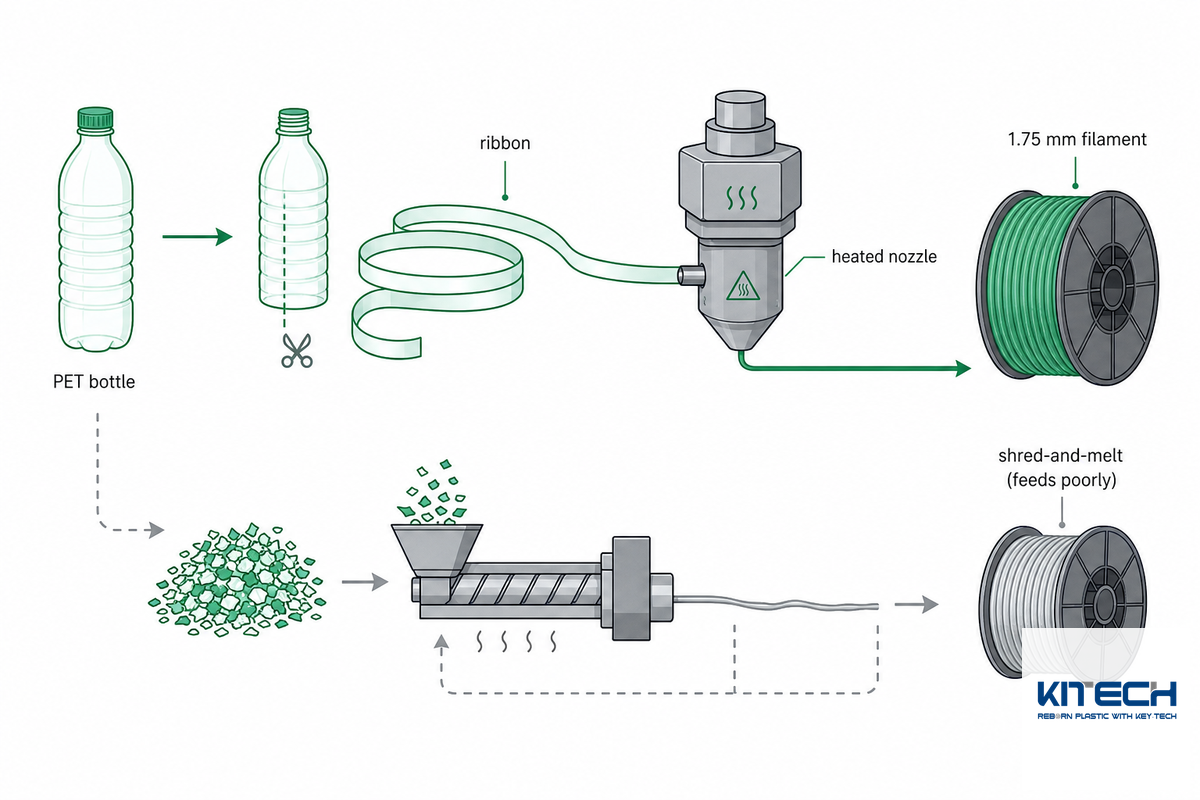
Además de la chatarra que produjiste en casa, podrías considerar convertir las botellas de comida y bebida en algo útil. Convertir el plástico residual en filamento de impresora 3D a partir de botellas es la rampa de acceso más accesible, y el diseño de código abierto es lo suficientemente barato como para crear prototipos en un fin de semana. En un tema completamente diferente, hay un diseño, el Polyformer (reconocido por el Premio James Dyson), que convierte una botella de comida PET en filamento reciclado. En lugar de reciclarlos en estado fundido, el diseño corta una botella limpia en una cinta continua y la tira a través de una boquilla calentada, luego la saca en un filamento de 1,75 mm. Su belleza está en su simplicidad -un proyecto de bricolaje que es simple, barato e incluso imprimible. La necesidad es real: donde no hay reciclaje de PET en la acera, las botellas son simplemente desechos y el poliformador de código abierto se construyó por primera vez para convertir botellas desechadas en filamento de 1,75 mm en Ruanda, donde los carretes comerciales son costosos y difíciles de conseguir.
Para que no tengas expectativas demasiado altas, hay dos razones a considerar. En primer lugar, el PET es difícil de reciclar localmente porque sus escamas de botella delgadas y de baja densidad se alimentan mal a través de extrusoras estándar de un solo tornillo. El verdadero problema que evita el enfoque de cinta. También tiende a absorber agua (higroscópica), y los materiales en cinta o en escamas deben estar completamente secos y no deben tener la posibilidad de calentarse demasiado, ya que podrían ser la causa de lo que se conoce como degradación hidrolítica (las cadenas de materiales se acortan y su peso molecular se reduce significativamente). En segundo lugar, los materiales de PET no son muy fluidos y el filamento de PETG no funciona bien en las extrusoras de tornillo estándar debido a su estructura delgada. Para la mayoría de los propósitos, comprar material de proveedores de PETG con contenido reciclado resultaría en un proceso más exitoso y confiable. El Polyformer se puede utilizar como un proceso más simplista/de menor costo o, para el usuario que requiere un poco más de recursos, como herramienta educativa. En la práctica, una pequeña empresa o un espacio de creación generalmente compra PETG con contenido reciclado en lugar de procesar botellas, porque la aplicación rara vez justifica los problemas de consistencia de 1,75 mm y el riesgo de degradación hidrolítica.
Cuándo volverse industrial: el crossover de 50 kg/mes
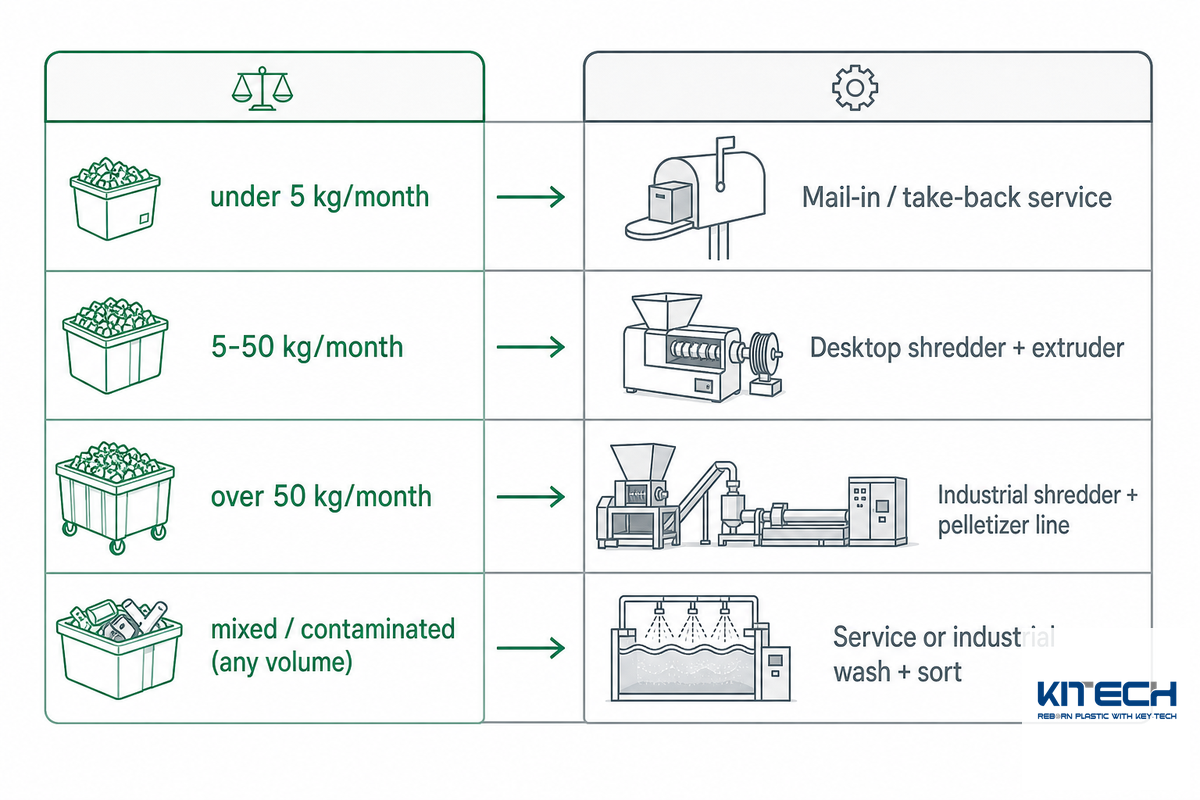
Si su volumen puede seguir el ritmo, un aficionado puede sacar mucho provecho de una extrusora de escritorio típica (aproximadamente 0,4 a 1 kg de material por hora), pero esa velocidad rápidamente se convierte en un cuello de botella para los espacios de fabricación y granja de impresión, lo que produce números mucho mayores, del orden de decenas de kilogramos de residuos de impresión 3D al mes.
Una vez que alcanza aproximadamente 50 kg por mes, ingresa a una escala completamente diferente, donde el reciclaje industrial vale la pena: invertir en granuladores/trituradoras industriales, peletizadores y producir gránulos estándar listos para el proceso de fusión que se utilizan en el equipo de compuesto o granulado fundido. El “crossover de 50 kg al mes “es un término utilizado para describir el punto en el que la economía manufacturera se desplaza hacia la escala industrial (de hecho, hasta 12 toneladas por año de chatarra de impresión 3D procedente de la producción de BMW ya se recicla nuevamente en filamento).
Utilice el Triaje de reciclaje o envío para situarte:
| Chatarra mensual | Ruta recomendada | Por qué |
|---|---|---|
| < 5 kg | Servicio de envío/devolución de correo | Capex nunca devuelve el dinero; El tiempo de acumulación es aceptable |
| 5-50 kg | Trituradora de escritorio + extrusora (secadora + sensor de diámetro) | El volumen justifica una unidad prosumidora; diámetro de control |
| > 50 kg | Línea trituradora industrial + peletizadora | El rendimiento del escritorio se convierte en el cuello de botella; Los pellets alimentan a los compuestos |
| Mezclado/contaminado (cualquier volumen) | Servicio o lavado industrial + línea de clasificación | Las unidades domésticas no se pueden limpiar ni separar de manera confiable |
Si su báscula avanza lentamente hacia el crossover de 50 kg al mes, se vuelve muy importante una solución de reciclaje dedicada a nivel industrial que se encarga del lavado, la filtración por fusión y el secado. Kitech es el pionero en ese mundo; Hemos desarrollado equipos a esta escala, nuestro selector de línea de reciclaje de plástico y guía de costos de trituradoras industriales son buenos próximos pasos, junto con nuestra línea completa de soluciones de reciclaje de plástico.
Las perspectivas: el filamento reciclado se generaliza
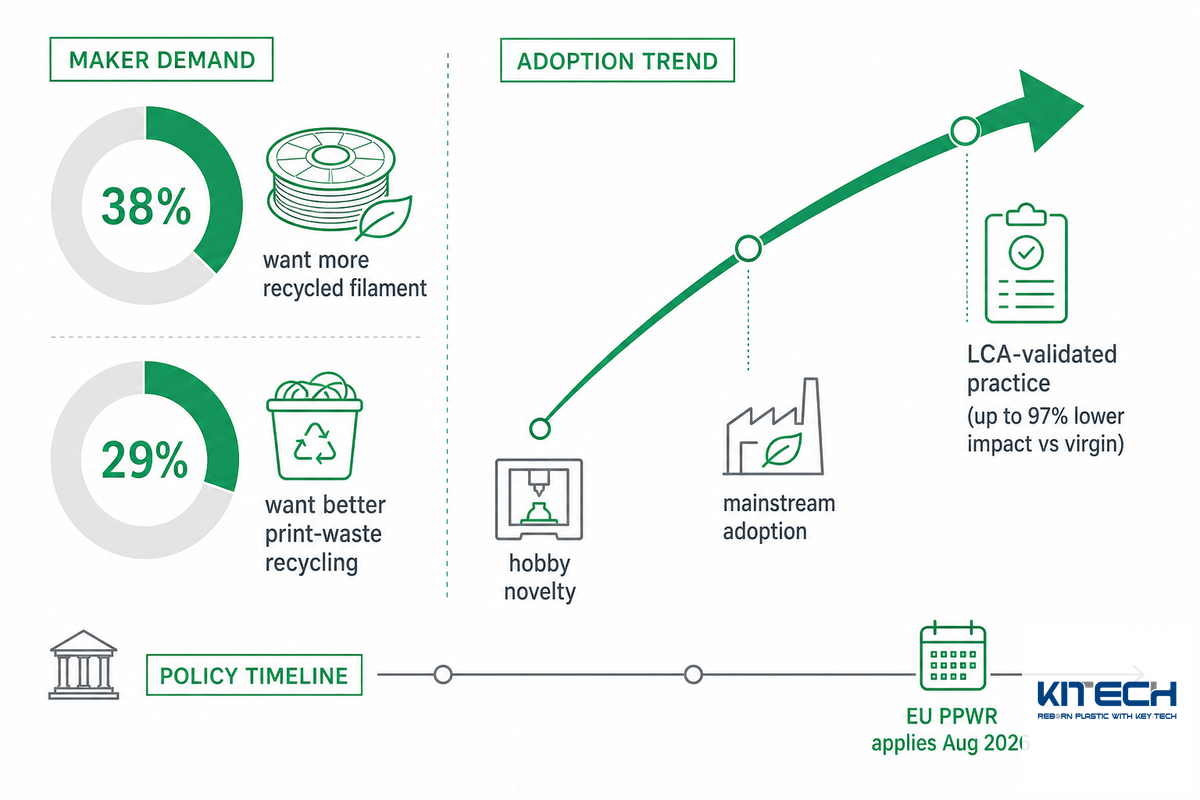
Lo que importa ahora no es un gráfico de mercado; es que la demanda y las políticas están convergiendo en materia de materia prima reciclada. En una encuesta de la industria, los cambios que más se querían para la impresión 3D fueron más filamentos reciclados (38%) y un mejor reciclaje de los residuos de impresión (29%). Y el reciclaje distribuido ha pasado de ser una novedad de pasatiempos a una práctica validada por el ciclo de vida: una práctica revisada por pares evaluación del ciclo de vida mostró un impacto ambiental 97% menor que el stock virgen.
La regulación nos está llevando en la misma dirección. La de la UE Regulación de Envases y Residuos de Envases es aplicable desde 2025 y se implementará en agosto de 2026, introduciendo un contenido mínimo obligatorio de reciclado. Y los estados de EE. UU. están aprobando una oleada de legislación de responsabilidad extendida del productor para aumentar aún más los costos del plástico virgen.
La selección de filamentos por parte del comprador irá desde “¿se puede reciclar?” a “¿compro esto para mi computadora de escritorio, servicio o aplicación industrial?” (Para escala, el tamaño del mercado de filamentos reciclables es de aproximadamente $1.4B en 2025 y se proyecta hacia $3.7B para 2033; cifras aproximadas, pero la dirección es clara). Si está desarrollando capacidad para 2026, tiene sentido determinar cuál de los escenarios anteriores es suyo con Triage y diseñar impresiones para generar menos desperdicio por adelantado. Cualquiera que sea su escala, un viaje de reciclaje que convierta impresiones fallidas en piezas hechas de materiales reciclados es la forma en que la impresión de escritorio puede contribuir a un modelo de fabricación más sostenible y con menores residuos. Convertir esa presión política en un suministro real depende de un equipo de pasatiempo de capa industrial que no puede alcanzar: líneas de producción de fabricantes como Kitech, construidas alrededor de trituración de precisión y control de procesos de grado ISO 9001.
Preguntas frecuentes
P: ¿Qué filamento de impresora 3D es reciclable?
Ver respuesta
PLA, PETG, ABS y TPU se pueden volver a filtrar en filamento nuevo, pero solo si se mantienen estrictamente para escribir debido a las diferentes ventanas fundidas. PLA es el más fácil; Por lo demás, el PETG no produce problemas, pero debe secarse con fuerza; El ABS funciona en gran medida excepto en cuestiones de desgasificación y deformación; El nailon, el policarbonato y el TPU son demasiado difíciles y requieren una línea industrial o de servicio. Ninguno de ellos está disponible en reciclaje en la acera para la categoría amplia #7 “Otro”.
P: ¿Vale la pena reciclar PLA?
Ver respuesta
Depende de la escala. El PLA es el filamento más reciclable en el hogar, pero un reciclador de escritorio rara vez paga menos de 50 kg/mes, y los aficionados suelen generar 2-5 kg/mes. Por debajo de eso, recicle PLA para obtener el beneficio ambiental (alrededor de 90% menos energía incorporada que virgen) en lugar de ahorrar, o utilice un servicio de correo. Por encima de ~50 kg/mes, los números comienzan a acumularse.
P: ¿Se puede fundir y reutilizar el filamento de la impresora 3D?
Ver respuesta
Sí. Triture 1 chatarra de material para obtener escamas de 2 a 5 mm de tamaño uniforme, séquela muy bien y luego aliméntela a una extrusora de filamentos a la temperatura de fusión de la resina, enrollando la hebra. Necesitarás un buen control del diámetro, idealmente 1,75 mm + 0,05 mm, y es posible que necesites alimentar algunos gránulos vírgenes después de algunos ciclos a medida que la cadena del material se acorta en algún factor en cada refundición.
P: ¿Cuánto vale 1 gramo de filamento?
Ver respuesta
Entre 2 y 5 °C por gramo, dado el precio minorista típico de entre $25 y $50/kg «por qué el reciclaje necesita un rendimiento enorme antes de que la máquina comience a ganarse la vida.
P: ¿Puede el filamento reciclado ser tan fuerte como nuevo?
Ver respuesta
Normalmente sí, los primeros ciclos «puedes controlar el reprocesamiento para acercar mucho el PLA/PET/a la fuerza virgen y la fuerza reciclada del PC viene aproximadamente igual (aproximadamente 65 MPa). En ~ciclo 3, la fuerza disminuye, comenzarás a ver más pérdida de uniformidad del diámetro. Al mezclar material virgen 30-50%, recuperamos la mayoría de las pérdidas.
P: ¿Qué hago con los carretes de filamento vacíos?
Ver respuesta
Los carretes de cartón suelen ser reciclables en la acera; Los carretes de plástico pueden ir en una caja Zero Waste por correo o en un programa de recarga que reutiliza el núcleo.
¿escalar más allá del escritorio?
Si su granja o tienda de impresión genera más chatarra de la que una unidad de escritorio puede manejar, Kitech diseña trituradoras industriales, tendederos y peletizadores construidos para 300-3000 kg/h. Cuéntanos tu volumen y material, y nuestros técnicos especificarán la línea adecuada a tus necesidades.
Por qué escribimos esto
Kitech construye trituradoras, sistemas de lavado y peletizadores que convierten los desechos plásticos en materia prima utilizable, por lo que abordamos el reciclaje de filamentos de la misma manera que abordamos una línea industrial: como un proceso de extrusión, triturado y seco donde el secado y el control del diámetro deciden el resultado. No vendemos recicladores de escritorio, lo que nos permite ser honestos de que para la mayoría de los aficionados la recompensa es la reducción de residuos, no el efectivo, y que la economía sólo cambia una vez que se cruza con los volúmenes de las granjas de impresión. Revisado por el equipo técnico de Kitech.
Referencias y fuentes
- ASTM D7611/D7611M-21 Práctica estándar para codificar artículos plásticos para la identificación de resinasASTM Internacional
- ¿cómo reciclo? Reciclables comunesAgencia de Protección Ambiental de EE. UU
- Preguntas frecuentes sobre reciclaje y compostaje de plástico (ASTM D6400)Agencia de Protección Ambiental de EE. UU
- RepRapable Recyclebot: extrusora de código abierto para convertir plástico en filamentoHardwareX (Pearce et al., Michigan Tech)
- Propiedades mecánicas de la impresión por extrusión de material de partículas de policarbonato recicladoUniversidad Tecnológica de Michigan
- Evaluación comparativa de las propiedades de tracción del ácido poliláctico (PLA)Universidad de Texas en Austin
- Evaluación del ciclo de vida de la producción de filamentos en el reciclaje distribuido de plástico mediante fabricación aditivaSistemas de residuos más limpios
- Poliformador: Botellas de plástico a filamentoPremio James Dyson 2022
- Reglamento de Envases y Residuos de Envases (a partir de 2026)EUR-Lex, Unión Europea
- Investigación de Impresión 3D (emisiones de partículas ultrafinas)Agencia de Protección Ambiental de EE. UU
- Enfoques para la impresión 3D segura (controles de exposición)NIOSH/CDC